You've found the right supplier in China — now who's going to get those goods to your warehouse in Khartoum? Search for a freight forwarder from China to Sudan and you'll find no shortage of options, but they start to look the same fast. What separates a forwarder who genuinely knows this route from one who just added Sudan to their country list? It comes down to the details: the IM Form your bank must issue before cargo leaves China, the SSMO Certificate of Conformity that needs arranging before your container sails, and the Red Sea disruptions that have rewritten transit times and freight rates across this corridor.
In this guide, we share what DTFU Logistics has learned on this lane. For a complete overview of our Sudan services with real-time rate estimates and booking, visit our dedicated Shipping From China to Sudan page. You'll walk away knowing what services to expect, what Sudan's import compliance actually demands, what 2026 freight rates and transit times look like, and how to tell an experienced Sudan forwarder from a generalist.
Why Work with a China-Based Freight Forwarder
One of the most common questions we hear from first-time Sudan importers is: "Can't I just use a local shipping agent in Port Sudan to handle everything?" The short answer is no — and understanding why will save you significant money and frustration.
A freight forwarder based in China does things that no remote agent or destination-side broker can replicate. The most obvious is physical proximity to your suppliers. When your goods are ready at a factory in Foshan, a forwarder with operations in South China can dispatch a truck within hours — not days — to collect the cargo. They can inspect pallets, verify quantities against your purchase order, and flag packaging issues before the goods ever leave the factory gate. If you're buying from multiple suppliers — ceramic tiles from one factory, bathroom fittings from another, and lighting fixtures from a third — a China-based forwarder consolidates everything at their warehouse, repalletizes to maximize container utilization, and loads a single FCL (Full Container Load) or LCL (Less than Container Load) shipment. Without this consolidation step, you'd either pay for three separate partial shipments or watch your suppliers struggle to coordinate among themselves in a language and logistics culture they may not fully control.
China export customs is the second irreplaceable function. Every shipment leaving China requires a customs declaration with correct HS Code classification, a Commercial Invoice, a Packing List, and in some cases product-specific export licenses or inspection certificates. A forwarder physically present in China handles this daily — they know the electronic filing system, they have relationships with customs officers at major ports, and they catch classification errors before they become clearance rejections. A Sudanese agent working remotely cannot file Chinese export declarations.
There's also the communication layer that many importers overlook. Your forwarder in China speaks Mandarin and Cantonese. They can call your supplier directly to confirm pallet dimensions, clarify whether a shipment is ready on the promised date, or negotiate last-minute documentation corrections — all without the delay and distortion of email chains crossing eight time zones. When your supplier says "the goods are ready" but actually means "they'll be ready next Tuesday," a forwarder on the ground gets the real answer faster than you can from Khartoum.
The third piece is pre-shipment services. A China-based forwarder can arrange third-party quality inspection before your goods leave the country. They can apply shipping marks, barcodes, and retail-ready labels at their consolidation warehouse. They can re-pack fragile items for ocean transit standards — which are far more punishing than most domestic Chinese packaging is designed for. They can photograph the loaded container before the doors close so you have proof of condition at origin. These are services that exist only at the point of departure.
None of this means you don't need a Sudanese partner on the destination side. You absolutely do — someone who knows Sudan Customs Authority procedures, who can process the IM Form through your local bank, and who can arrange trucking from Port Sudan to Khartoum. The ideal setup is a two-partner model: a China-based forwarder handling everything from factory to the vessel, and a Sudan-based customs broker handling import clearance and last-mile delivery. A good China forwarder will coordinate with your Sudanese broker so the handoff is seamless — rather than leaving you to play middleman between two providers who don't communicate with each other.
Services a Freight Forwarder Should Provide for Sudan Shipments
When you're evaluating potential freight forwarders for the China-Sudan route, knowing what a complete service offering looks like gives you a baseline for comparison. Here is what a capable forwarder should be able to arrange — and the cost and transit benchmarks you can use to assess whether their quotes are realistic.
Sea Freight to Port Sudan: FCL and LCL
Sea freight from China to Sudan is the workhorse of this trade lane. For a detailed breakdown of current ocean freight rates, container options, and port-specific sailing schedules, see our Sea Shipping cost from China to Sudan guide. Port Sudan, on the Red Sea coast, handles over 90% of the country's maritime imports. There is no rail connection to Khartoum, so every container that arrives at Port Sudan continues its journey by truck — a detail your forwarder should factor into both the timeline and the cost estimate.
FCL (Full Container Load) is the right choice when your shipment volume exceeds approximately 15 cubic meters. At that threshold, the per-unit cost of booking your own container starts to beat the per-CBM rate of sharing one. A capable forwarder will help you choose between a 20-foot GP (General Purpose, roughly 28 CBM capacity, ideal for heavy dense cargo like tiles and machinery), a 40-foot GP (roughly 56 CBM, the standard choice for most mid-to-large volume shipments), and a 40-foot High Cube (roughly 68 CBM, best for bulky but lightweight goods like furniture or insulation materials). For a focused comparison of container sizes and their all-in costs on this lane, check our 20ft and 40ft Shipping from China to Sudan breakdown.
LCL (Less than Container Load) is the practical choice for smaller shipments — typically under 15 CBM. Your cargo shares container space with other importers' goods, and you pay only for the cubic meters you use. The trade-off is time: LCL adds roughly 5–10 extra days on each end for consolidation at a CFS (Container Freight Station) in China and deconsolidation at Port Sudan. The per-CBM rate is higher than FCL's per-CBM equivalent, but for small volumes the total out-of-pocket cost is lower.
Real-World Example: A Khartoum-based building materials trader sources ceramic floor tiles, bathroom fixtures, and aluminum window frames from three different suppliers in Foshan. Total volume per order: roughly 42 CBM. Their forwarder collects from all three factories, consolidates at a Guangzhou warehouse, and loads everything into a single 40-foot High Cube container. By consolidating into FCL rather than shipping three separate LCL shipments, they save approximately $2,400 per order cycle and eliminate the deconsolidation delays that used to add two weeks to their timeline. For a deeper look at logistics strategies for construction-sector imports, see our comprehensive Shipping Building Materials from China guide.
The table below shows realistic 2026 reference rates for FCL and LCL shipments from major Chinese ports to Port Sudan. These figures include the War Risk Surcharge (WRS) that carriers are currently applying to Red Sea destinations. Rates fluctuate weekly — use these as a benchmarking tool, not a locked-in quote.
| Container Type | Shanghai | Ningbo | Shenzhen | Guangzhou | Qingdao |
|---|---|---|---|---|---|
| 20ft GP | $4,100–$4,800 | $4,200–$4,900 | $3,900–$4,600 | $4,000–$4,700 | $4,300–$5,000 |
| 40ft GP/HQ | $5,800–$6,800 | $5,900–$6,900 | $5,500–$6,500 | $5,600–$6,600 | $6,000–$7,200 |
| LCL (per CBM) | $140–$220 | $145–$225 | $130–$210 | $135–$215 | $150–$230 |
Current sea freight transit times reflect the reality that most carriers are routing around the Cape of Good Hope rather than transiting the Suez Canal. The table below compares today's actual timelines with the pre-disruption norm so you can plan inventory accordingly.
| Route | Current Transit (Cape Route) | Normal Transit (Suez Canal) |
|---|---|---|
| Shanghai → Port Sudan | 30–40 days | 22–28 days |
| Ningbo → Port Sudan | 32–42 days | 23–30 days |
| Shenzhen → Port Sudan | 28–38 days | 20–26 days |
| Guangzhou → Port Sudan | 28–38 days | 20–26 days |
| Qingdao → Port Sudan | 34–44 days | 26–32 days |
A capable forwarder will explain to you what drives these numbers up or down. Bunker Adjustment Factor (BAF), Peak Season Surcharge (PSS), and the War Risk Surcharge (WRS) are the three largest variables affecting your ocean freight bill. WRS alone currently adds $800–$1,500 per container on Red Sea destinations. Your forwarder should itemize these in your quote rather than burying them in an all-inclusive number.
Air Freight to Khartoum and Port Sudan
Air freight from China to Sudan is the answer when time is money — high-value electronics, medical equipment, urgent spare parts, or seasonal goods with a hard deadline. For a focused look at air cargo rates, airline options, and transit strategies on this route, see our dedicated Air Shipping from China to Sudan guide. There are no direct cargo flights from China to Sudan, so all air freight transits through a Middle Eastern or North African hub — typically Dubai (DXB), Cairo (CAI), or Istanbul (IST). Your forwarder should be able to tell you which transit hub your cargo will pass through and factor hub dwell time into the total transit estimate.
The primary air cargo gateway for Sudan is Khartoum International Airport (KRT). However, KRT has experienced intermittent operational restrictions in recent periods. A forwarder who actively handles Sudan air freight will know the current status and have Port Sudan International Airport (PZU) as a backup routing option.
Air freight is priced on chargeable weight — the higher of your actual gross weight and your volumetric weight (calculated as length × width × height in centimeters, divided by 6,000). A shipment of lightweight, bulky boxes can cost far more than its kilogram weight suggests once volumetric pricing kicks in. A good forwarder will flag this before you commit to air freight and suggest packaging adjustments to optimize chargeable weight.
The table below shows reference air freight rates by weight tier and departure airport for 2026. Per-kilogram pricing drops significantly as your shipment size increases.
| Weight Tier | Shanghai PVG | Guangzhou CAN | Shenzhen SZX | Beijing PEK | Hong Kong HKG |
|---|---|---|---|---|---|
| 45–100 kg | $8.00–$10.50 | $7.50–$10.00 | $7.50–$9.50 | $8.50–$11.00 | $7.00–$9.50 |
| 100–300 kg | $7.00–$9.00 | $6.50–$8.50 | $6.50–$8.00 | $7.50–$9.50 | $6.00–$8.00 |
| 300–500 kg | $6.00–$7.50 | $5.50–$7.00 | $5.50–$6.50 | $6.50–$8.00 | $5.00–$6.50 |
| 500+ kg | $5.00–$6.50 | $4.50–$6.00 | $4.50–$5.50 | $5.50–$7.00 | $4.00–$5.50 |
Air freight transit time from China to Sudan typically ranges from 4 to 8 days airport-to-airport, including the transit hub connection. Door-to-door, factoring in pickup at origin, export clearance, and last-mile delivery in Sudan, ranges from 7 to 14 days.
Express Courier: DHL, UPS, and FedEx
For samples, documents, and small parcels under 200 kg, international express couriers offer the fastest door-to-door option — typically 3 to 7 days. Rates range from $12 to $25 per kilogram depending on the service tier and dimensional weight. One important caveat: express shipments to Sudan are still subject to the same import documentation requirements as commercial freight. The IM Form and SSMO Certificate of Conformity don't disappear just because the goods traveled by courier. If your forwarder tells you otherwise, treat it as a signal that they may not fully understand Sudan's import regime.
Cargo Insurance and Shipment Tracking
Given the current Red Sea security environment and the overland transit from Port Sudan to Khartoum, cargo insurance on this route is not an optional extra — it's a core component of a responsible shipping plan. A forwarder who is serious about the Sudan lane will proactively discuss insurance options with you, including All Risks coverage, War Risk coverage, and combined policies. They should be able to explain coverage limits, exclusions, and the claims process in plain English. For a detailed breakdown of insurance costs and coverage types for shipments originating in China, see our Shipping container insurance cost for shipments from China guide.
Shipment tracking is the second pillar of operational transparency. Your forwarder should provide access to an online platform — not just periodic WhatsApp updates — where you can see your shipment's real-time location, container status, estimated arrival, and any holds or exceptions. If you have to ask "where is my container," the tracking system isn't doing its job.
Quick Reference: Choosing Your Shipping Method
| Method | Cost Level | Transit (Door-to-Door) | Best For | Watch Out For |
|---|---|---|---|---|
| Sea FCL | $$ | 35–50 days | Shipments >15 CBM; heavy/dense cargo; regular importers | Port Sudan congestion can add 5–10 days |
| Sea LCL | $$–$$$ | 40–55 days | Shipments <15 CBM; trial orders; mixed supplier cargo | Consolidation/deconsolidation adds time at both ends |
| Air Freight | $$$$ | 7–14 days | High-value goods; urgent shipments; <500 kg | Volumetric weight can surprise you |
| Express Courier | $$$$$ | 3–7 days | Samples; documents; parcels <200 kg | Still requires IM Form and SSMO CoC |
China Departure Ports and Sudan Entry Points
Your choice of departure port in China should follow a simple principle: ship from the port closest to your suppliers. Every extra kilometer your goods travel by truck inside China adds cost, time, and handling risk before the ocean journey even begins. A forwarder with multi-port capability gives you the flexibility to choose the optimal origin rather than forcing your cargo through a single gateway.
Shenzhen (Yantian and Shekou terminals) and Guangzhou (Nansha) serve the Pearl River Delta — China's manufacturing heartland for consumer electronics, building materials, furniture, and textiles. Foshan, the world's largest ceramic tile production center, sits squarely in Guangzhou's catchment area. If your suppliers are in Guangdong province, these ports offer both the shortest inland trucking distances and the most competitive ocean freight rates to Port Sudan.
Shanghai and Ningbo serve the Yangtze River Delta — home to China's machinery, automotive parts, and high-end textile industries. Shanghai is the world's busiest container port by volume, which means the highest sailing frequency and the greatest carrier choice. If schedule reliability is your top priority, Shanghai offers the most options.
Qingdao and Tianjin serve northern China's industrial bases — steel, heavy machinery, chemicals, and agricultural equipment. While the ocean transit to Port Sudan is 4–6 days longer from these northern ports compared to Shenzhen, shipping from a northern port can still be the cheaper total option once you factor in the avoided cost of trucking a 20-ton machine from Shandong down to Shanghai. For guidance on handling oversized industrial cargo, refer to our Shipping Heavy Machinery from China guide.
On the Sudan side, the destination path is more constrained. Port Sudan is the country's dominant maritime gateway, handling the vast majority of containerized imports. It has container handling facilities, but congestion is a recurring reality — during peak periods, vessels may wait at anchorage, and container dwell times at the terminal can stretch beyond the standard free storage period. A forwarder with Sudan route experience will know Port Sudan's current free time policy (typically 7–14 days), the demurrage and detention rates that kick in after free time expires, and strategies for minimizing storage charges.
Suakin Port, south of Port Sudan, has limited container handling capability but can serve as an alternative entry point for specific project cargo or breakbulk shipments. It is not a practical option for standard containerized freight.
For air freight, Khartoum International Airport (KRT) is the primary gateway, with Port Sudan International Airport (PZU) as a secondary option. Your forwarder should advise which is operational and appropriate for your shipment at the time of booking.
The inland leg from Port Sudan to Khartoum deserves as much attention as the ocean segment. The distance is roughly 800 to 1,000 kilometers by road, depending on the exact origin and destination. Truck transit time ranges from 5 to 10 days, influenced by road conditions, security checkpoints, and seasonal weather. The cost of this inland trucking typically runs between $800 and $1,300 per 20-foot container and between $1,200 and $1,800 per 40-foot container. A forwarder who knows the Sudan route will include this estimate in your total door-to-door quote up front — not mention it as a surprise add-on after your cargo has already arrived at Port Sudan. Importers serving the wider Red Sea and East Africa region may also be interested in our Shipping From China To Egypt and Shipping From China To Saudi Arabia routes, which share similar Red Sea transit patterns and benefit from the same carrier relationships.
Sudan Import Requirements: What Your Freight Forwarder Should Help You Navigate
This section covers the three Sudan-specific compliance documents that every commercial importer must contend with — and that an experienced China-Sudan freight forwarder should proactively help you manage. If a forwarder you're evaluating does not mention these documents during your initial conversation, it may indicate limited experience on this specific route.
The IM Form: Sudan's Import Gatekeeper
The IM Form (Import Declaration Form) is the document that unlocks Sudan's import process. Issued by a Sudanese commercial bank, it serves as both an import declaration and a foreign exchange allocation mechanism. Without an approved IM Form, your cargo cannot clear customs at Port Sudan — regardless of how complete the rest of your documentation is.
This is also the document that causes the most confusion for importers new to Sudan. The IM Form must be obtained by the importer of record — meaning you, the Sudanese entity importing the goods — through your local bank. A freight forwarder, whether based in China or anywhere else, cannot obtain an IM Form on your behalf. The bank reviews your pro forma invoice, checks foreign exchange availability at the official rate, and issues the form. This process can take anywhere from several days to several weeks, depending on the foreign exchange situation at the time.
What a capable forwarder can and should do is: alert you early that an IM Form is required for your shipment, help you understand what the bank will need from your supplier's documentation, and build the IM Form approval timeline into the overall shipment schedule so you're not left with a container arriving at Port Sudan before the paperwork is ready. A forwarder who never mentions the IM Form until you bring it up is a forwarder who may not have much hands-on Sudan experience.
SSMO Certificate of Conformity: Pre-Shipment Compliance
The Sudanese Standards and Metrology Organization (SSMO) requires a Certificate of Conformity (CoC) for most commercially imported goods. This is a pre-shipment certification — meaning the inspection and approval must happen before the goods leave China. Once your container is on the water, it's too late to obtain a CoC retroactively, and goods arriving without one face rejection or costly re-export.
The process works as follows: an SSMO-authorized inspection agency — typically SGS, Bureau Veritas, or Intertek — conducts a physical inspection of your goods in China, verifies that the products meet applicable Sudanese standards, and issues the Certificate of Conformity. The inspection can take place at your supplier's factory or at your forwarder's consolidation warehouse. Processing typically takes 5 to 10 working days, and the cost varies based on cargo value and product category.
A competent freight forwarder on the China side coordinates this process for you. They contact the inspection agency, schedule the inspection at the right location, ensure your supplier has the necessary product documentation ready, and track the CoC issuance so it's in hand before the vessel sails. This is one of the highest-value services a China-based forwarder provides on the Sudan route — because if it's not done right at origin, there is no practical fix at destination.
Import License
Sudan's Ministry of Trade and Supply requires importers to hold a valid import license. The license is tied to your registered business entity in Sudan and may carry category-specific conditions depending on the types of goods you import. Like the IM Form, this is a document that you as the importer must hold — a foreign forwarder cannot obtain or hold an import license on your behalf.
The import license requirement is also one of the structural reasons why true DDP (Delivered Duty Paid) shipping to Sudan is difficult to execute, a topic explored in detail in the next section. Your forwarder should at minimum be aware of the license requirement and able to confirm that your planned shipment falls within the scope of your license category.
Customs Clearance and Import Duties
Sudan's customs process follows the standard international sequence — arrival at port, document submission and verification, potential physical inspection, duty assessment, payment, and release — but with Sudan-specific layers that affect both timeline and cost.
The Sudan Customs Authority assesses two main charges on imported goods. The first is customs duty, which ranges from 5% to 40% of the CIF value (Cost + Insurance + Freight) depending on the product's HS Code classification. Building materials typically fall in the 15–25% range, electronics and consumer goods in the 20–35% range, and industrial machinery and equipment in the 5–15% range. The second is Value Added Tax (VAT) at a flat rate of 17%, calculated on the sum of the CIF value plus the customs duty. Additional charges may include port handling fees, inspection fees, and customs broker fees.
A forwarder who adds real value here will help you anticipate these costs before you ship. They should be able to review your product's HS Code, estimate the applicable duty rate, and calculate the expected total landed cost — rather than giving you a vague "duties range from 5 to 40 percent" answer.
To illustrate how these calculations work in practice, here are two worked examples:
Example 1 — Building Materials by Sea: A Khartoum importer ships one 40-foot High Cube container of ceramic tiles from Guangzhou to Port Sudan. The CIF value (cost of goods + insurance + ocean freight) is $15,000. The applicable customs duty rate for ceramic tiles is 20%.
Customs Duty = 20% × $15,000 = $3,000 VAT = 17% × ($15,000 + $3,000) = 17% × $18,000 = $3,060 Estimated port and broker fees = $500 Total Landed Cost = $15,000 + $3,000 + $3,060 + $500 = $21,560
Example 2 — Electronics by Air: A Sudanese phone accessories distributor air-freights 200 kg of mobile phone cases and screen protectors from Shenzhen to Khartoum. The CIF value is $8,000. The applicable customs duty rate for consumer electronics accessories is 25%.
Customs Duty = 25% × $8,000 = $2,000 VAT = 17% × ($8,000 + $2,000) = 17% × $10,000 = $1,700 Estimated airport handling and broker fees = $300 Total Landed Cost = $8,000 + $2,000 + $1,700 + $300 = $12,000
These examples make the point clearly: duty and VAT can add 30–45% to your CIF cost, depending on the product category. A forwarder who helps you model these numbers before you commit to a purchase order is doing more than just selling you freight — they're helping you price your imports profitably.
Documents at a Glance
| Document | Who Obtains It | Forwarder's Role |
|---|---|---|
| Commercial Invoice | Supplier or importer | Reviews format for Sudan customs compliance |
| Packing List | Supplier or importer | Reviews for accuracy and completeness |
| Bill of Lading (Sea) / Airway Bill (Air) | Freight forwarder | Issues and manages |
| Certificate of Origin | Freight forwarder | Arranges through CCPIT or local trade authority |
| IM Form | Importer (via Sudanese bank) | Advises on timeline, helps prepare supporting docs |
| SSMO Certificate of Conformity | Authorized inspection agency (SGS/BV/Intertek) | Coordinates inspection scheduling and follow-through |
| Import License | Importer (via Sudan Ministry of Trade) | Advises on category requirements |
Understanding DDP and DAP for Sudan Shipments
Trade terms are frequently the most misunderstood part of a new importer's conversation with a freight forwarder. The question "Can you do DDP to Sudan?" seems straightforward — but the honest answer is more nuanced than a simple yes or no, and how a forwarder answers it tells you a lot about their experience on this route.
Quick Incoterms Refresher
| Term | What the Forwarder Covers | What You Cover |
|---|---|---|
| EXW (Ex Works) | Nothing — picks up from supplier only | Everything: China trucking, export customs, ocean/air freight, Sudan import clearance, all duties, inland delivery |
| FOB (Free on Board) | China export customs and delivery to the vessel | Ocean/air freight booking, insurance, Sudan import clearance, all duties, inland delivery |
| CIF (Cost, Insurance, Freight) | China export, ocean/air freight to Port Sudan/KRT, basic insurance | Sudan import clearance, all duties and taxes, inland delivery |
| DAP (Delivered at Place) | Everything from factory pickup through to final delivery in Sudan | Sudan import customs clearance, all duties and taxes |
| DDP (Delivered Duty Paid) | Everything — factory to doorstep, including customs clearance and duties paid | Nothing except receiving the goods |
The Reality of DDP in Sudan
On paper, DDP — where the freight forwarder handles absolutely everything including paying Sudan import duties on your behalf — sounds ideal. You pay one price, and your goods show up at your door. In practice, Sudan's regulatory environment makes true DDP extremely difficult to execute for three structural reasons.
First, the IM Form must be issued by a Sudanese bank to a Sudanese-registered importer. A foreign freight forwarder cannot walk into a Sudanese bank and open an IM Form in their own name. The import transaction is legally tied to you, the licensed importer.
Second, the import license is tied to your Sudanese business entity. A foreign forwarder cannot hold a Sudanese import license, and they cannot legally act as the importer of record for customs declaration purposes.
Third, customs duties and VAT must be paid in Sudanese Pounds (SDG) through banking channels linked to your Tax Identification Number (TIN). A foreign entity has no mechanism to make these payments directly.
What does this mean in practice? When a forwarder offers "DDP to Sudan," what they are almost always describing is actually DAP (Delivered at Place) — a service where they handle all transportation from the Chinese factory to your designated delivery address in Sudan, but you remain responsible for import customs clearance and payment of duties and taxes. The forwarder may assist with document preparation and coordinate with a local customs broker, but the legal obligation to clear the goods and pay the government rests with you.
This is not a bait-and-switch — DAP is genuinely the most practical door-to-door model for the Sudan market. A forwarder who explains this distinction clearly is demonstrating route-specific knowledge. A forwarder who says "DDP, no problem" without acknowledging the IM Form and import license constraints may not fully understand how Sudan imports actually work. For a broader comparison of trade term trade-offs beyond the Sudan context, our DDP vs FOB: Which Option Saves Time and Reduces Hassle analysis covers the real-world implications of choosing one approach over the other.
DAP: How Door-to-Door Works on This Route
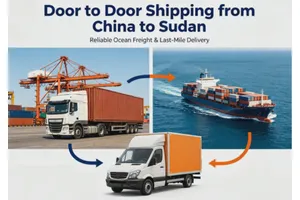
Under DAP terms, your China-based freight forwarder manages the entire physical movement of your goods: factory pickup anywhere in China → consolidation and export packaging → Chinese export customs clearance → ocean freight to Port Sudan or air freight to KRT → destination port/airport handling → inland trucking to Khartoum or your specified location → final delivery to your doorstep. You handle the administrative step at the Sudan border: import customs clearance, payment of customs duty and VAT, and release of the goods. For a complete walkthrough of this service model including typical timelines and cost structures, see our Door to Door Shipping from China to Sudan guide.
For a first-time importer, DAP offers the most practical balance. The forwarder handles the complex international logistics — the part where you have the least visibility and control. You retain the customs clearance step, which legally must be in your name anyway, and you pay the government charges directly so there's no markup or uncertainty about what was actually paid.
Choosing Your Trade Term
| If Your Situation Is… | Consider… | Because… |
|---|---|---|
| First time importing from China | DAP | Forwarder manages transport; you handle clearance with guidance; lowest risk of miscommunication |
| You already have a trusted customs broker in Sudan | CIF | Your broker handles clearance; forwarder handles transport to Port Sudan; you avoid paying for services you don't need |
| High-volume, frequent importer with in-house logistics | FOB or CIF | You negotiate freight directly or maintain your own carrier relationships; forwarder handles origin-side only |
| Small parcel or sample shipment | DAP by express courier | Simple, fast, and the courier's brokerage service can assist with clearance |
Red Sea Shipping in 2026: What Sudan Importers Should Know
No discussion of China-Sudan shipping in 2026 is complete without addressing the Red Sea situation. Since late 2023, security concerns in the southern Red Sea and Bab el-Mandeb strait have fundamentally altered how container shipping operates on this corridor — and Port Sudan, sitting directly on the Red Sea, is among the most directly affected destinations. For the latest updates on carrier movements and security developments affecting this waterway, see our Red Sea Shipping Returns Under Tight Security report.
Most major container carriers have rerouted vessels away from the Suez Canal, instead sending ships around South Africa's Cape of Good Hope. For a shipment from Shanghai to Port Sudan, this means the vessel travels south through the South China Sea, across the Indian Ocean, around the Cape, up the west coast of Africa, and then into the Red Sea from the south — a route that adds approximately 4,000 nautical miles and 10 to 15 extra days of sailing time compared to the traditional Suez Canal routing. Even for the shorter Shenzhen-to-Port Sudan lane, the same diversion applies.
The cost impact is equally significant. Carriers impose a War Risk Surcharge (WRS) on cargo destined for or transiting through high-risk zones, and Red Sea destinations currently attract some of the highest WRS levels in global shipping. This surcharge alone can add $800 to $1,500 per container. Combined with the additional fuel costs of the longer routing and the reduced effective vessel capacity (the same ship completes fewer round-trips per year when each voyage is longer), total freight rates on the China-Sudan lane are running 30% to 50% above pre-2023 levels.
What does this mean for you as an importer? First, the cost benchmarks you may have seen from 2022 or earlier are no longer relevant — the market has structurally shifted. Second, transit times are longer, which means your inventory planning needs to account for roughly an extra two weeks of pipeline stock compared to the pre-disruption era. Third, schedule reliability is lower than it was — carriers adjust port rotations in response to security assessments, and a vessel that was scheduled to call Port Sudan may be re-routed with relatively short notice.
This is where your choice of forwarder makes a tangible difference. A forwarder with direct carrier contracts — rather than one who only buys space through intermediaries — has more visibility into schedule changes and better leverage to secure alternative routing when disruptions occur. At DTFU Logistics, we hold direct service contracts with carriers including COSCO, Maersk, and CMA CGM on the China-Africa lane, which means we receive schedule updates in real time, have committed space allocations even during tight market conditions, and can access competitive rates that intermediary-booked cargo does not see. (The financial impact of carrier-imposed surcharges is significant — see our analysis of a recent CMA CGM Raises PSS on Far East–West Africa Lane for a concrete example of how these charges affect your bottom line.) We also advise all our Sudan-bound clients to book 4 to 6 weeks in advance of their desired sailing date — in the current environment, last-minute bookings face both limited availability and premium pricing.
Finally, for shipments where transit time is non-negotiable, the sea-air combination — shipping by ocean to a Middle Eastern hub like Jebel Ali (Dubai) and then flying the final leg to Khartoum — can deliver door-to-door times of 20 to 25 days at a cost between pure sea freight and pure air freight. It's not the right answer for every shipment, but a forwarder who can present it as an option is demonstrating the kind of flexible thinking the current environment demands. Importers with broader Red Sea and East Africa interests may also find value in our DDP shipping from China to Ethiopia and Sea Freight From China to Yemen coverage — both markets share transit corridor dynamics with the Sudan lane.
How to Evaluate a Freight Forwarder for the China-Sudan Route
By this point, you have a clear picture of what the China-Sudan shipping lane requires. The remaining question is: given multiple forwarders who all claim to serve this route, how do you identify the ones worth serious consideration? Here are the five dimensions we recommend focusing on.
Industry accreditation. FIATA (International Federation of Freight Forwarders Associations) and IATA (International Air Transport Association) certifications are the two most recognized credentials in global freight forwarding. FIATA accreditation means the forwarder has passed independent audits of their operational procedures, financial standing, and professional competence. IATA accreditation confirms the same for air cargo operations. These are not marketing badges — they represent verified, third-party-confirmed standards. If a forwarder holds neither, ask why not.
Sudan-specific experience. A forwarder may have a decade of experience shipping to Africa but little hands-on time with Sudan specifically. The distinction matters because Sudan's import compliance requirements — the IM Form, the SSMO CoC, the import license regime — are different from those of neighboring countries. Ask a prospective forwarder: "Can you walk me through the IM Form process and what I need to do on my side before my goods ship?" A forwarder with Sudan route experience will answer specifically and unprompted. A generalist will give you a vague response or pivot to talking about their broader Africa coverage.
Pricing transparency. A quote that arrives as a single all-inclusive number tells you nothing about what you're actually paying for — and makes it impossible to compare offers meaningfully. A professional forwarder's quote should be an itemized breakdown: ocean freight, BAF, WRS, terminal handling at origin, terminal handling at destination, documentation fee, customs brokerage (if included), inland trucking, insurance. Every line item disclosed, every surcharge explained. When you ask "what happens to my rate if the WRS changes next month," the answer should be clear and grounded in the forwarder's carrier contract terms, not an evasion.
Port coverage and service range. A forwarder who can only load from one Chinese port limits your supply chain flexibility. If your supplier is in Qingdao and your forwarder insists on routing everything through Shenzhen, you're paying for the privilege of trucking your cargo halfway across China before it even reaches the port. Beyond transport, ask about complementary services: consolidation warehousing, pre-shipment inspection coordination, cargo insurance, online tracking. A forwarder who offers these as integrated services rather than outsourced afterthoughts is operating at a different level of capability.
Communication quality. The sales process reveals the service process. When you send an inquiry, how quickly do you get a response? Is the response personalized to your specific cargo and route, or is it a template? Does the forwarder ask you questions — about your product, your supplier location, your timeline — that indicate they're building a solution rather than just pasting a rate? These signals from the first few exchanges are remarkably predictive of what your experience will be like when your container is sitting at Port Sudan and something needs attention. For a broader perspective on what a freight forwarder should bring to your supply chain beyond rate sheets, our overview of The Strategic Role of Freight Forwarders in Modern Supply Chains explores the value dimensions that separate transactional providers from true logistics partners.
Signals worth paying attention to. Three patterns tend to correlate with a less-than-ideal experience on the Sudan route. One: a forwarder confidently promises "DDP to Sudan" but cannot explain the IM Form process. Two: a quote that is significantly below the market ranges discussed in this guide, with no itemized breakdown available. Three: a forwarder who cannot answer basic questions about Port Sudan — current free time, typical demurrage rates, inland trucking transit realities. None of these signals automatically disqualify a forwarder, but each is worth probing further before you commit cargo. The same evaluation framework applies across Africa — if your business also imports into neighboring markets, see our guides on selecting a Freight forwarder from China to Egypt, Freight forwarder from China to Uganda, or Freight forwarder from China to Tanzania.
Why DTFU Logistics for Your China-to-Sudan Shipments
Everything this guide has covered — the services a forwarder should offer, the compliance documents they should help you navigate, the pricing transparency you should expect, the route-specific knowledge that separates specialists from generalists — reflects how we operate at DTFU Logistics on the China-Sudan lane. Here is what that means in concrete terms.
FIATA and IATA dual accreditation. Both certifications require independent audits and ongoing compliance. They represent verified standards, not self-declared claims, and they are held by a minority of freight forwarders globally.
Ten-plus years on the China-Africa corridor. DTFU Logistics was founded in 2014 in Shenzhen, China, and has been moving cargo to African destinations — including regular sailings to Port Sudan — ever since. We are not adding Sudan to a list of countries we claim to serve. It is a route we operate on weekly.
Multi-port capability across China. We load from Shenzhen, Guangzhou, Shanghai, Ningbo, Qingdao, and Tianjin. Your goods ship from the port nearest your suppliers, not from wherever is most convenient for us.
Direct carrier contracts. Our service agreements with COSCO, Maersk, CMA CGM, and other major carriers on the China-Africa lane give us committed space allocations and competitive rates — the same rates, in fact, that inform the reference pricing in section three of this guide.
Fully itemized pricing. Every DTFU quote breaks down ocean freight, surcharges, terminal handling, documentation, inland trucking, and insurance as separate line items. There are no bundled numbers to hide behind.
Sudan compliance coordination. We will walk you through the IM Form timeline, coordinate your SSMO Certificate of Conformity inspection in China, review your documentation package before it leaves our warehouse, and connect you with a trusted customs broker at Port Sudan if you do not already have one.
Dedicated account management. From your first inquiry through to the delivery of your tenth container, you work with the same account manager — someone who knows your product, your suppliers, your preferred ports, and your timeline expectations.
24/7 online tracking and cargo insurance. Our tracking platform gives you real-time visibility of your shipment from pickup to delivery. Insurance options cover All Risks, War Risk, and combined coverage through our partnership with leading marine underwriters.
If you are ready to move forward, send us your shipment details — product description, HS Code, weight and volume, pickup city in China, and final destination in Sudan — and our Sudan route team will return a customized, fully itemized quotation within 24 hours. If you are still in the research phase, we are happy to answer your questions. Either way, you now have the knowledge to evaluate your options clearly.
FAQs
How do I find a reliable freight forwarder from China to Sudan?
Start with the evaluation framework in this guide: check for FIATA or IATA accreditation, ask Sudan-specific questions (IM Form, SSMO, Port Sudan free time) and gauge the specificity of the answers, request an itemized quote and review it for transparency, and assess communication quality during the inquiry process. A forwarder who scores well across these dimensions is worth serious consideration.
How much does it cost to ship a container from China to Port Sudan?
At mid-2026 reference rates including the current Red Sea War Risk Surcharge, expect approximately $3,900–$5,000 for a 20-foot container and $5,500–$7,200 for a 40-foot container, depending on the Chinese departure port. LCL shipments run roughly $130–$230 per cubic meter. These are reference ranges — actual rates move weekly with market conditions. Always request an itemized quote for your specific shipment.
How long does sea freight from China to Sudan take right now?
With most carriers routing around the Cape of Good Hope, current ocean transit from Chinese ports to Port Sudan ranges from 28 to 44 days, depending on the departure port. Shenzhen and Guangzhou offer the fastest connections (28–38 days), while northern ports like Qingdao take longer (34–44 days). Door-to-door to Khartoum, including inland trucking, typically ranges from 35 to 55 days.
What documents are needed for shipping from China to Sudan?
On the China export side: Commercial Invoice, Packing List, Bill of Lading (sea) or Airway Bill (air), and Certificate of Origin. On the Sudan import side: IM Form (obtained by you through your Sudanese bank), SSMO Certificate of Conformity (arranged via pre-shipment inspection), and Import License (held by you from the Ministry of Trade and Supply).
Which Chinese port should I ship from for Sudan?
It depends on where your suppliers are located. Guangdong province suppliers → Shenzhen or Guangzhou (fastest to Port Sudan). Zhejiang/Jiangsu/Shanghai suppliers → Shanghai or Ningbo (highest sailing frequency). Shandong/Hebei/Tianjin suppliers → Qingdao or Tianjin (avoids long domestic trucking). A forwarder with multi-port capability lets you optimize for total cost rather than being locked into one gateway.