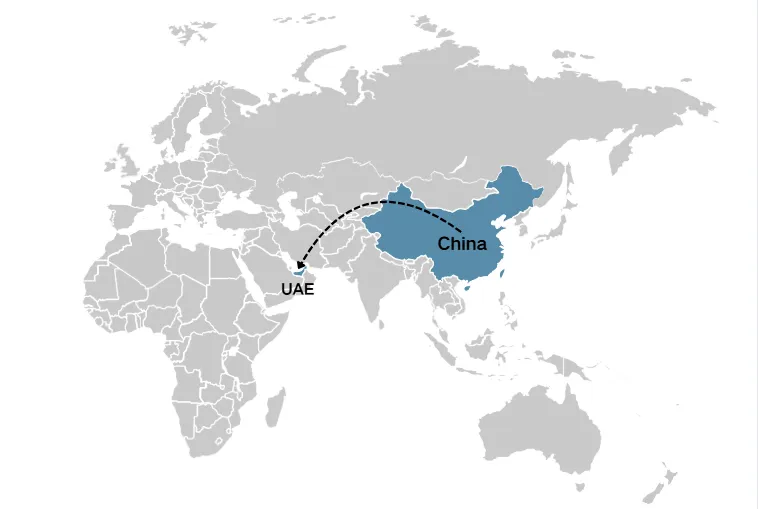
Shipping from China to UAE in 2026: how cargo still reaches Dubai while the Strait of Hormuz is closed to container ships - Khor Fakkan and Fujairah landbridge routing, sea, air and DDP door-to-door rates, current transit times, 12-digit HS codes, 5% duty and 5% VAT, and clearance with DTFU Logistics.
We make shipping from China to UAE simple, reliable, and cost-effective
Competitive Rates
Best shipping rates with no hidden fees. Save up to 40% compared to other forwarders.
Fast Transit
Reliable delivery times with express options available for urgent shipments.
Safe & Secure
Full cargo insurance and secure handling throughout the entire shipping process.
24/7 Support
Dedicated customer support team available around the clock for all your needs.
Are you trying to move goods from China to the UAE while the Strait of Hormuz remains effectively closed to container shipping? You are not alone, and you are not out of options. This guide explains how cargo actually reaches Dubai, Abu Dhabi and Sharjah in November 2026 — the east coast ports and bonded landbridge now in use, current sea, air and door-to-door costs, realistic transit times, UAE duty and VAT, the customs changes that took effect in 2026, and how DTFU Logistics keeps shipments moving when the traditional route is unavailable.
What has changed on the China–UAE lane in November 2026
The China–UAE corridor has been rebuilt around a chokepoint that no longer works the way it did in 2025. Before you accept any quote or book any sailing, these are the facts that now shape cost and transit time:
What changed
What it means for your shipment
The Strait of Hormuz has been effectively closed to container shipping since March 2026 — now in its seventh month
Mainline container services no longer sail into the Persian Gulf the way they did before. Direct calls into Jebel Ali are the exception, not the rule.
Container traffic into the Gulf collapsed by about 94%: 240 container ships entered between 1 March and 7 September, against 4,198 in the same period a year earlier (Xeneta data reported by the Financial Times)
Space into the region is scarce and carrier choice is limited. Book three to four weeks ahead and expect schedule changes.
Only about 11 of the 99 container services that used to serve the Gulf remain active, mostly shuttles between Gulf ports plus one Iran–China service
Your cargo will almost certainly transship or discharge on the Gulf of Oman side and finish its journey by road.
Jebel Ali handled 3.14 million TEU in the first half of 2026, down from 7.77 million a year earlier; second-quarter volume fell more than 90% to 374,000 TEU, and the port dropped from 10th to 32nd in the global container port rankings (Alphaliner)
Do not assume a Dubai port of discharge. Confirm the routing in writing on the booking confirmation and the bill of lading.
Containers discharged at Khor Fakkan and Fujairah are moved overland to Jebel Ali and Dubai free zones under bond, with DP World running a landbridge of roughly 1,500 bonded trucks a day
Add landbridge time and a trucking line to your budget: typically one to three road days from the east coast into Dubai.
Dubai Customs rebuilt the rules within 27 days: Notice 03/2026 (8 March) created bonded trucking from Khor Fakkan and Fujairah; Notice 05/2026 (31 March) extended transit periods from 30 to 90 days; Notice 06/2026 (4 April) opened the Green Corridor to Dubai through the Hatta border crossing under unified procedures with Oman Customs
Cargo arriving at east coast ports — and even at Omani ports and airports — can reach Dubai legally and quickly under sealed transit. Cargo value moving through the corridor rose from AED 1 billion in March to over AED 8 billion in April.
Carriers keep re-cutting routings mid-voyage: Maersk's September operational updates discharge selected Khor Fakkan bookings at Fujairah instead and formally change the final port of discharge to Jebel Ali (via landbridge); CMA CGM runs sea-road-rail corridors through the UAE, Oman and Saudi Arabia
The port named on your booking is not always the port where your box lands. Ask your forwarder to confirm the change-of-destination clause, detention and empty-return rules before dispatch.
Spot rates from China to Khor Fakkan are up about 479% and to Jeddah about 256% since 28 February, surpassing the previous Covid-era records (Xeneta via Lloyd's Loading List)
Budget a war-risk and landbridge premium on top of base ocean freight. Quote validity is two to four weeks at best.
Khor Fakkan's median vessel waiting time was around six days in early September; Gulftainer is investing USD 2 billion to lift capacity from 3.5 million to 10 million TEU while weekly throughput has jumped from 8,000 to 65,000 TEU
Expect a buffer of roughly three to eight days at the east coast before your container even starts moving inland.
UAE mainland imports from outside the GCC now require 12-digit HS codes (Phase 3 of the GCC Integrated Customs Tariff, in force from August 2026)
Classify your goods before you book. A wrong or outdated code is the fastest way to a red-channel inspection and storage charges.
Air freight is unaffected by the strait: cargo aircraft still fly directly into Dubai, Abu Dhabi and Sharjah
For urgent or high-value SKUs, air is now the most predictable option on this lane, not just the fastest.
The demand side of the lane, meanwhile, has not weakened. UAE non-oil foreign trade reached a record AED 1.94 trillion (about USD 528 billion) in the first half of 2026, up 13.1% year on year, and China remained the UAE's largest trading partner with AED 180.7 billion of non-oil trade. As of late September, US Central Command reported the main Hormuz transit lanes cleared of mines and overall cargo and oil transits at a six-month high — but with container services still far from restored, plan on the east coast landbridge for the time being, and treat any announcement of "normal service resumed" with caution until carriers actually publish restored Gulf strings.
Sea shipping from China to UAE (November 2026)
Sea freight remains the backbone of the lane, because it is the only mode that can move full container volumes and heavy cargo economically. Two options are available, and the choice between them matters more than usual when space is tight:
FCL (Full Container Load): the whole container is yours, with lower unit cost, fewer handlings and less damage risk. In current conditions FCL is also easier to book than LCL, because consolidations depend on enough cargo being available at the same origin on the same sailing.
LCL (Less than Container Load): you pay per cubic meter and share the box. It keeps small shipments moving, but expect longer and less predictable transit while consolidators work around reduced carrier schedules and the east coast landbridge.
Shipping type (costs November 2026)
Indicative cost
Transit time
Best for
FCL 20GP — China to Khor Fakkan / Fujairah, with bonded transit into Dubai
USD 2,800–4,100 per container
15–26 days sailing, plus 3–8 days waiting and landbridge
Dense cargo from about 10 CBM upward
FCL 40GP / 40HQ — same routing
USD 4,700–6,600 per container
15–26 days sailing, plus 3–8 days waiting and landbridge
Standard and bulky loads, 25–68 CBM
LCL — consolidated cargo via east coast ports
USD 55–130 per CBM
22–38 days door to door
Shipments under about 15 CBM
Two practical notes. First, these are ocean and landbridge rates for the current market window — war-risk surcharges, peak season surcharges and east coast congestion are billed on top, and the numbers move monthly. Second, the FCL-versus-LCL break-even on this lane sits at roughly 15 CBM: below that, consolidation is cheaper; above it, a container is both cheaper and faster. For a deeper cost breakdown by origin port, see our guide to container shipping cost from China to UAE.
Which UAE port will your container actually arrive at? (November 2026)
This is the single most important change on the lane, and the one most quotes still get wrong. Your container's real port of discharge now depends on where the vessel can safely call, not on which port is closest to your warehouse.
Port
Position relative to Hormuz
Best for
Current condition
Khor Fakkan (Sharjah)
Gulf of Oman, outside the strait
FCL into Dubai, Sharjah and the northern emirates
The UAE's only fully operational container terminal outside the strait; weekly throughput up from 8,000 to 65,000 TEU, with median vessel waits near six days
Fujairah
Gulf of Oman, outside the strait
Overflow FCL, Abu Dhabi and northern emirates cargo
Capacity under 1 million TEU; DP World is planning a new east coast port and container terminal to add depth
Jebel Ali (Dubai)
Inside the strait
Cargo discharged on the east coast and trucked in, plus free zone and re-export flows
Fully operational with 15.6 million TEU of capacity, but receiving a fraction of its normal vessel traffic; DP World's bonded landbridge keeps it working
Khalifa Port (Abu Dhabi)
Inside the strait
Abu Dhabi industrial, energy and project cargo
Direct China calls are limited; expect routing through an east coast gateway
Sharjah and Ajman ports
Inside the strait
Northern emirates distribution, consumer goods
Feeder and landbridge dependent
Salalah and Sohar (Oman)
Arabian Sea, outside both chokepoints
Re-export cargo and shipments heading into Dubai through the Green Corridor
Salalah is the region's most accessible deep-water hub but was targeted in the March 2026 attacks, and all Omani waters are now classified as a war-risk insurance zone
The practical takeaway: write the routing into your booking and your bill of lading instructions — for example "Khor Fakkan, final destination Dubai via bonded landbridge" — and ask your forwarder how the empty container is returned, because returning an empty to the wrong coast can cost more than the trucking leg itself.
For a detailed sea freight plan, including origin port comparisons and consolidation options, read: Sea shipping from China to UAE.
Air shipping from China to UAE (November 2026)
Air cargo is the one mode the strait closure did not touch. Freighter capacity and belly space into Dubai International (DXB), Dubai World Central (DWC), Abu Dhabi (AUH) and Sharjah (SHJ) remain available, which makes air the reliable choice for replenishment runs, high-value electronics, samples and anything with a deadline attached.
Route (costs November 2026)
Under 100 kg
Around 300 kg
500 kg and above
Transit time
Shanghai (PVG) to Dubai (DXB / DWC)
USD 3.80 per kg
USD 3.50 per kg
USD 3.30 per kg
2–4 days
Shenzhen (SZX) to Dubai
USD 3.90 per kg
USD 3.60 per kg
USD 3.40 per kg
2–4 days
Guangzhou (CAN) to Dubai
USD 3.85 per kg
USD 3.55 per kg
USD 3.35 per kg
2–4 days
Beijing (PEK) or Hong Kong (HKG) to Dubai
USD 3.30–3.70 per kg
USD 3.20–3.40 per kg
USD 3.10–3.20 per kg
3–5 days
Guangzhou or Shanghai to Abu Dhabi (AUH)
USD 5.30–5.50 per kg
USD 4.20–4.90 per kg
USD 3.50–3.70 per kg
3–5 days
Air freight is billed on chargeable weight — the greater of actual weight and volumetric weight (length × width × height in cm divided by 6,000) — so a light, bulky carton pays for space rather than mass. Express couriers (DHL, FedEx, UPS, Aramex) are a different product again: USD 6–12 per kg for parcels, with customs and delivery included and three to six day delivery. If your priority is landing stock in Dubai this month rather than minimising cost per kilo, air freight booked through a forwarder is almost always cheaper than express for anything above roughly 100 kg.
Door to door shipping from China to UAE (November 2026)
For importers who would rather not coordinate a supplier, a port, a landbridge, a customs broker and a trucking company, door-to-door service integrates all of it into one contract with one contact and one all-inclusive price. DTFU Logistics collects from your supplier's warehouse in China, handles export clearance, books the ocean or air leg, manages the east coast discharge and the bonded overland transit, clears UAE customs, pays duty and VAT under DDP terms, and delivers to your warehouse, shop or Amazon fulfilment centre.
Door-to-door service (rates November 2026)
All-in cost
Door-to-door time
DDP air freight
USD 6.50–10.50 per kg
5–10 days
DDP sea LCL
USD 150–260 per CBM
30–45 days
DDP sea FCL 20GP
USD 4,300–6,500 per container
28–42 days
DDP sea FCL 40GP / 40HQ
USD 6,500–9,500 per container
28–42 days
DDP pricing includes UAE duty and VAT for most general cargo, which is why the per-unit figure looks higher than a port-to-port ocean quote. Compare like with like: an FCL quote that excludes war-risk surcharge, east coast trucking, clearance, duty and VAT will look 30–50% cheaper than a DDP quote and still cost you more by the time the goods are on your rack, once you add the line items in the next section.
What sits on top of the base ocean rate (November 2026)
Most quotes on this lane are "base rate only". In 2026 that base rate is the smallest part of the bill. These are the charges you should expect to see and the ranges we commonly see on China–UAE cargo:
Charge
Typical range (November 2026)
Notes
War risk and security surcharge
USD 800–3,200 per container
Peaked near USD 3,200 per container when the crisis began; still the single largest premium on Gulf cargo
Landbridge / bonded trucking
USD 250–600 per container
Khor Fakkan or Fujairah into Dubai under sealed road transit, as provided for by Dubai Customs Notices 03/2026 and 06/2026
BAF (fuel) surcharge
8–20% of base ocean freight
Bunker prices have traded around USD 600–700 per tonne instead of the pre-crisis USD 520
Peak season surcharge (PSS)
USD 200–1,500 per container
Applied ahead of the fourth-quarter retail build-up and again before Chinese New Year
Destination terminal handling
USD 120–220 per container
Higher at congested east coast terminals
Documentation and bill of lading
USD 50–120 per shipment
Covers B/L, certificate of origin and manifest amendments
MOFAIC invoice attestation
Around AED 150 per invoice
Frequently requested for mainland clearance
Customs broker and declaration
AED 350–700 per declaration
Filed through Mirsal 2 or the Dubai Trade portal
Duty and VAT
5% duty plus 5% VAT on CIF
Worked example below
Detention and demurrage
USD 30–80 per container per day after free time
Free time is typically 7–14 days; east coast congestion makes overruns common
Cargo insurance
0.1–0.3% of cargo value
Strongly recommended while routing is still being adjusted by carriers
A worked landed-cost example makes the point. Take a 40HQ of household goods with a supplier invoice value of USD 25,000, moving China to Dubai:
Line
Amount (USD)
Goods value (FOB China)
25,000
Ocean freight plus landbridge into Dubai
5,600
Customs value (CIF)
30,600
Import duty at 5%
1,530
VAT at 5% on CIF plus duty
1,607
UAE delivery and handling
350
Total landed cost
34,087
That is roughly 36% above the goods value — and note that the freight and landbridge line is already 16% of the total. A VAT-registered importer can recover the USD 1,607 in VAT through the regular return, so the real cash cost sits closer to USD 32,480. This is exactly the arithmetic a good forwarder will run for you before you commit, rather than after.
UAE import duty, VAT and the 2026 compliance changes (November 2026)
The tax side of the UAE has been stable for years; the compliance side has not. Both matter to your clearance time:
Customs duty: 5% of CIF value under the GCC Unified Customs Tariff. Basic foodstuffs, medicines, medical equipment, books and some machinery are exempt or zero-rated; tobacco and alcohol attract much higher rates plus excise.
VAT: 5% on the CIF value plus duty. On a USD 10,000 shipment, duty is USD 500 and VAT is USD 525, for USD 1,025 payable at clearance.
Reverse-charge simplification: Federal Decree-Law No. 16 of 2025, effective from 1 January 2026, removed the requirement to issue a tax invoice to yourself when importing under the reverse charge. The Federal Tax Authority consolidated how it will apply the change in VAT Public Clarification VATP046, published on 4 September 2026. Fewer self-issued documents, same input-VAT recovery for registered businesses.
12-digit HS codes: the GCC moved its Integrated Customs Tariff from 8 to 12 digits in phases. Since August 2026 (Phase 3) all UAE mainland imports from outside the GCC must be declared with a 12-digit code, made up of the six-digit international HS code, a two-digit GCC extension and four national digits. Classification errors are the leading avoidable cause of inspection and delay on this lane.
E-invoicing: the UAE e-invoicing system entered its pilot phase on 1 July 2026, with large businesses required to appoint an accredited service provider and mandatory rollout from 1 January 2027 under the PINT-AE format. This affects how your UAE customers and your UAE entity bill each other, not your import declaration — but it is a reminder that UAE trade documentation is now digital by default.
Product conformity: regulated goods need ESMA / ECAS conformity or GSO-standard certification, plus Arabic labelling for consumer products. Non-compliant cargo is refused rather than "fixed at the border".
Free zones: cargo entering JAFZA, DMCC, KIZAD, AFZA or Dubai South is suspended from duty and VAT while it stays in the zone or is re-exported, and taxed only when released into the mainland. For regional distribution, this remains the most effective tax lever on the lane.
Shipping process and documentation (November 2026)
Booking with a confirmed routing: agree the origin port, the intended port of discharge (Khor Fakkan, Fujairah or Jebel Ali via landbridge), the equipment, the weight and volume, and the change-of-destination clause. Get the quote's validity window in writing.
Documentation: commercial invoice, packing list, bill of lading or air waybill, certificate of origin, and your 12-digit HS codes. Add product certificates (ESMA / ECAS, GSO) and an Arabic label artwork check for regulated consumer goods.
Pickup and consolidation: we collect from one or several suppliers, inspect and pack for the mode, and consolidate LCL cargo into a container at our China warehouse.
Export clearance in China: customs declaration, licensing checks where applicable, and loading. Complete documentation at this stage prevents problems that no amount of chasing later will fix.
Main leg: sea freight sails direct to a Gulf of Oman gateway; air freight flies into DXB, DWC, AUH or SHJ.
Bonded overland transit: containers move from Khor Fakkan or Fujairah to Jebel Ali and Dubai free zones under sealed road transit, or through the Hatta crossing from Oman's ports and airports under the Green Corridor.
UAE import clearance: your broker files the declaration through Mirsal 2 or the Dubai Trade portal, duty and VAT are assessed and paid, and the container is released. Straightforward, well-documented shipments clear in one to three business days.
Delivery: final-mile trucking to a warehouse, retail location, project site or Amazon fulfilment centre, with the empty container returned to the correct coast.
Transit times from China to UAE (November 2026)
Because the lane is operating on contingency routing, one number is no longer enough. The right-hand column reflects what we are actually seeing while the landbridge is in use:
Method
Normal conditions
Current November 2026 conditions
Sea FCL, Shenzhen / Nansha to Khor Fakkan or Fujairah
How to keep your China–UAE shipments moving in November 2026
Book three to four weeks ahead for sea freight, and accept that schedule changes are normal rather than exceptional. Space into the Gulf is the scarce commodity, not the rate.
Ask what the quote excludes before comparing two quotes. War-risk surcharge, east coast trucking, BAF and destination handling are the four lines that separate a cheap quote from a realistic one.
Confirm the port of discharge in writing, including the change-of-destination clause, and ask how empties are returned from the east coast.
Split your volume by urgency. Moving most of a replenishment by sea and a small urgent portion by air usually costs far less than paying premium rates on everything, and protects your shelf availability.
Classify at 12 digits and reconcile the code with the certificate of origin and the invoice description. Consistency across documents is what keeps you out of the red channel.
Use free zones deliberately if you re-export into the wider region: duty and VAT are only triggered when goods enter the mainland.
Keep 7–14 days of free container time in mind, and release containers promptly. Port storage and detention charges accrue quickly when terminals are congested.
Insure the cargo. With routings still being adjusted by carriers mid-voyage, the cost of cover is trivial next to the risk of an uninsured loss.
Amazon FBA from China to UAE
Amazon.ae sellers face two extra layers: product preparation and inbound appointment discipline. Goods must arrive with FNSKU labels applied over the barcode, units packed to Amazon's specification, pallets built to the required footprint with four-sided labels, and a delivery appointment booked in advance. Amazon's fulfilment centres in Dubai South (DXB3) and the second Dubai facility (DXB5) receive most China-origin inventory, with heavy and bulky items routed elsewhere.
Because the east coast landbridge adds a variable to delivery timing, we build a buffer into FBA shipments and confirm the appointment only once the container is through customs and on the road. Preparation, labelling, palletising and appointment booking are all handled in-house, so your first notification that something is wrong is not a rejection fee. See our Amazon FBA service for the full scope.
Shipping from China to UAE with DTFU Logistics
Sourcing goods on Alibaba or from your own suppliers is only half the job; getting them delivered in the UAE in a disrupted market is the other half. DTFU Logistics is a Shenzhen-based freight forwarder, established in 2014, with FIATA and IATA accreditation and a network covering more than 120 countries. Here is how we keep China–UAE cargo moving in November 2026:
Supplier coordination and consolidation: direct communication with one supplier or twenty, cargo collection, inspection and consolidation at our China warehouse, whether the shipment is a single pallet or a full 40HQ.
Routing that reflects reality: we book against the gateways that are actually working — Khor Fakkan, Fujairah and the bonded landbridge into Dubai, the Green Corridor from Oman, or air into DXB, DWC, AUH and SHJ — and we tell you honestly what the current waiting time and surcharge picture looks like.
Documentation and clearance: 12-digit HS classification, certificates of origin, conformity documentation, MOFAIC attestation and clearance through licensed UAE brokers. Duty and VAT handled for you under DDP terms if you prefer one all-in price.
Cost transparency: quotes that itemise base freight, surcharges, landbridge, clearance, duty and VAT, with a validity window you can plan against.
Tracking and support: real-time visibility of sea, landbridge and air legs, proactive updates when carriers re-cut routings, and a 24/7 team that resolves customs queries, damage claims and schedule changes for you.
To put the lane in context, cargo that reaches the UAE through a professional forwarder can replace inventory all the way to the wider Middle East, Africa and South Asia, since Dubai's re-export machine still runs on the free zones even while the strait does not. And if your cargo is ultimately heading further west, our regional hub page, Shipping From China to Middle East, covers the neighbouring lanes and their current conditions. Last updated: November 2026.
Ready to ship from China to UAE?
Send us your supplier list, product description and expected volume, and we will come back the same working day with the feasible routings, the current transit window and an itemised landed cost for sea, air or DDP door-to-door to your UAE address. No obligation, no teaser rate — just the numbers you need to plan. Get your quote from DTFU Logistics and keep your UAE supply chain moving this season.
Frequently Asked Questions
Get answers to common questions about shipping from China to UAE
Sea freight from China to the UAE currently runs 28-45 days door to door: 15-26 days of sailing to an east coast gateway such as Khor Fakkan or Fujairah, 3-8 days of vessel waiting plus bonded landbridge transit into Dubai, then clearance and delivery. Air freight takes 2-5 days airport to airport and 4-8 days door to door. Express couriers deliver in 3-6 days. Add about a week of buffer between October and January, when UAE retail demand peaks.
Effectively, yes. The strait has been closed to mainline container services since March 2026. Xeneta data reported by the Financial Times shows 240 container ships entering the Gulf between 1 March and 7 September, against 4,198 in the same period a year earlier - a fall of about 94% - and only around 11 of the 99 container services that used to serve the Gulf remain active. US Central Command reported in late September that the main transit lanes had been cleared of mines and overall traffic had reached a six-month high, but container lines have not yet restored normal Gulf services, so plan on the east coast gateway and landbridge for now.
Most likely Khor Fakkan or Fujairah, both on the Gulf of Oman side and outside the Strait of Hormuz, followed by bonded road transit into Jebel Ali and the Dubai free zones under Dubai Customs Notices 03/2026 and 06/2026. Cargo can also enter Dubai from Omani ports and airports through the Green Corridor via the Hatta border crossing. Jebel Ali remains fully operational but receives a fraction of its former vessel traffic. Always confirm the port of discharge and the change-of-destination clause in writing before dispatch.
Indicative market ranges are USD 2,800-4,100 for a 20GP and USD 4,700-6,600 for a 40GP or 40HQ to an east coast gateway with bonded transit into Dubai, USD 55-130 per CBM for LCL, and USD 3.30-3.90 per kg for air freight on 100-500 kg lots. Add the war-risk and security surcharge of USD 800-3,200 per container, landbridge trucking of USD 250-600 per container, BAF and any peak season surcharge. Quotes are typically valid for two to four weeks.
A commercial invoice, packing list, bill of lading or air waybill, certificate of origin, and 12-digit HS codes, which have been mandatory for UAE mainland imports from outside the GCC since August 2026 under Phase 3 of the GCC Integrated Customs Tariff. Regulated products also need ESMA/ECAS or GSO conformity certificates and Arabic labelling. An importer code and a licensed customs broker are required to file, and declarations run through Mirsal 2 or the Dubai Trade portal. Straightforward shipments clear in one to three business days.
5% customs duty on the CIF value, plus 5% VAT on the CIF value and the duty. A USD 10,000 shipment therefore pays USD 500 duty and USD 525 VAT, or USD 1,025 at clearance. VAT-registered importers recover the VAT through their normal return. Under Federal Decree-Law No. 16 of 2025, effective 1 January 2026, you no longer have to issue a tax invoice to yourself for reverse-charge imports, as the FTA confirmed in VAT Public Clarification VATP046 on 4 September 2026. Goods held in a free zone such as JAFZA, DMCC or KIZAD are not taxed until they enter the mainland.
Yes. DTFU Logistics handles supplier pickup and consolidation in China, export clearance, the east coast routing and bonded landbridge, UAE import clearance, duty and VAT under DDP terms, and final-mile delivery to your warehouse, shop or Amazon fulfilment centre, with real-time tracking and 24/7 support. Send your supplier list and cargo details and we will confirm feasibility, the transit window and an itemised landed cost the same working day.
Ready to Shipping from China to UAE?
Get your instant quote today and experience the difference of working with a professional freight forwarder.
5000+
Successful Shipments
98%
Customer Satisfaction
Get Your Free Quote
Response within 2 hours • No obligation • Free consultation
We use cookies to enhance your browsing experience and analyze site traffic. By continuing to use our site, you consent to our use of cookies. Learn more in our Cookie Policy.