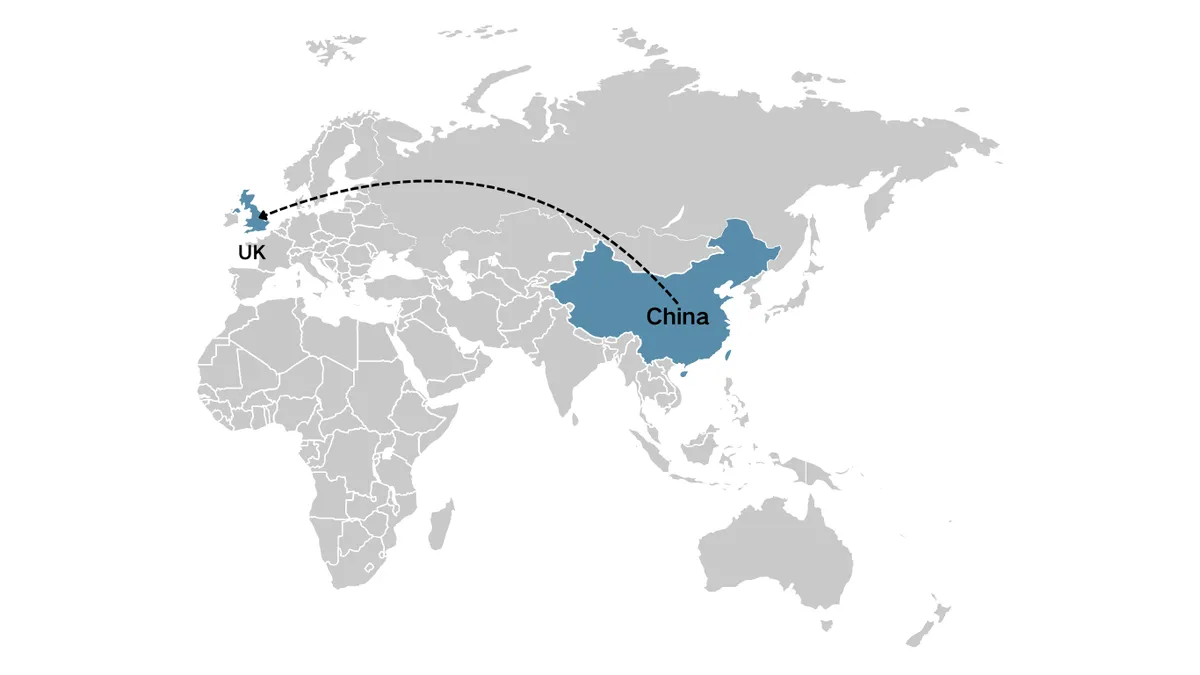
Shipping from China to the UK in 2026: split Suez and Cape routings, the first Arctic container service, sea, air, rail and DDP door-to-door rates and transit times, UK port congestion, CDS clearance, duty and 20% VAT with postponed VAT accounting, the £135 low-value reform and UK CBAM, plus Amazon FBA inbound.
We make shipping from China to UK simple, reliable, and cost-effective
Competitive Rates
Best shipping rates with no hidden fees. Save up to 40% compared to other forwarders.
Fast Transit
Reliable delivery times with express options available for urgent shipments.
Safe & Secure
Full cargo insurance and secure handling throughout the entire shipping process.
24/7 Support
Dedicated customer support team available around the clock for all your needs.
If you import from China into the UK in October 2026, the market you priced last year has changed shape. Carriers are running a split Asia–Europe network — part of it back through the Suez Canal, part of it still around the Cape of Good Hope — and the first scheduled Arctic container service from China to the UK has now completed the crossing in 25 days. Routing, transit time and rate are three separate questions again, and they change from booking to booking.
This page sets out what shipping from China to the UK costs and takes in October 2026: current sea, air, rail and door-to-door rates, the routing decisions behind them, port and customs reality at both ends, UK duty and VAT, Amazon FBA inbound, and how DTFU Logistics runs the whole chain for importers, wholesalers and e-commerce sellers.
What has changed on the China–UK lane in October 2026
Eight developments matter more than anything else on this corridor right now. If you read nothing else on this page, read this table.
Change
The detail
What it means for your shipment
Suez is partially back, the Cape is still in play
Container ship tonnage through the Suez Canal reached 72.1 million tons in the first eight months of 2026, up 54.2% year on year (Suez Canal Authority). MSC committed four East–West services to Suez routing on 24 August 2026; Maersk and Hapag-Lloyd restored the AE5, AE11, AE12 and ME2 strings. Cape diversions still absorb 5–7% of global container capacity.
Two different transit times can be quoted on the same lane. Ask which rotation your booking is on, and whether the carrier can change it after departure.
First scheduled Arctic service to the UK completed
The 1,740 TEU Dubai Tower left China on 19 August 2026 and berthed at Teesport on 9 September after 25 days with 1,300 TEU on board. The operator plans eight China Arctic Express voyages in 2026. The vessel was diverted from Felixstowe to Teesport, which has limited container handling.
Real, but trial-scale, seasonal and not tier-one operated. Test it on one shipment you can absorb a week of slippage on; do not build a peak-season commitment on it.
Asian port congestion hit a record
Congestion across Asian ports reached 4.3 million TEU, above the 4.0 million TEU pandemic peak, with Cape diversions absorbing capacity on top. Typhoon disruption pushed some Shanghai and Ningbo delays past 10 days in early September 2026.
Delay risk now sits on the loading side as much as the UK side. Book earlier and hold a buffer.
Rates are easing, and quote validity is short
Xeneta put the Far East–North Europe market average spot rate at $4,103 per 40ft in the week to 17 September 2026, down from $4,532 three weeks earlier. Offers of $2,799 per 40ft for Chinese ports to Felixstowe and Southampton appeared in the market as forwarders sold off excess allocations.
Take a second quote. Offers below market average exist and usually exclude more — ask what the cheaper number leaves out.
Golden Week blank sailings are published
Maersk has blanked AE15 (Qingdao, 28 September), AE12 (Ningbo, 8 October) and AE1 (Shanghai, 10 October). Of 721 sailings scheduled between 14 September and 18 October, 79 — 11% — are cancelled, and roughly a third of those fall on Asia–North Europe and Mediterranean services.
Cargo booked in the last week of September is likely to roll into October. Cut off before Golden Week (1–7 October) if the delivery date is fixed.
The £135 low-value import relief is being repealed
HMRC's policy paper of 13 July 2026 confirms the £135 relief for low-value imports will be removed and replaced by a mandatory framework, including a fiscal representative — a UK business jointly and severally liable for an overseas seller's customs debt. In force by October 2028 at the latest.
The relief is still in force today. But if you sell direct to UK consumers, plan for duty on every consignment and for a UK fiscal representative.
UK CBAM starts 1 January 2027
Imports of iron and steel, aluminium, cement, fertiliser and hydrogen worth £50,000 or more over 12 months will require HMRC registration, with the UK importer as the liable person. Registration opens by 1 January 2028.
Steel, aluminium and hardware importers should collect supplier emissions data now — that is the hard part, not the registration.
UK ETS extended to maritime on 1 July 2026
The UK Emissions Trading Scheme now covers vessels of 5,000 GT and above on domestic UK voyages and during in-port activities. The deep-sea China–UK leg sits outside the 2026 scope.
Expect a small in-port element in your charges this year, not a new line item. Worth monitoring, not modelling.
Sea freight from China to the UK in October 2026
Sea freight still moves the overwhelming majority of UK import volume from China, and it is the only mode where you have a genuine routing choice. There are two commercial products and three possible routes.
FCL (Full Container Load) — your cargo fills, or nearly fills, the container: lowest cost per cubic metre, fastest sea transit, least handling. A 20GP holds about 28–29 CBM and a 40HQ about 68 CBM.
LCL (Less than Container Load) — your cargo shares a container: best under roughly 15 CBM, but slower because of consolidation and deconsolidation, with destination charges quoted per CBM or per tonne, whichever is greater.
On routing, the split matters more than the carrier name:
Suez rotation — the classic Asia–Europe string, back in partial service through 2026: roughly 35–40 days China to a UK base port, plus 7–10 days for door delivery.
Cape of Good Hope rotation — still used by a large minority of services: add 10–14 days, so 45–52 days port to port.
Arctic (Northern Sea Route) — seasonal, trial-scale and, in 2026, calling at ports such as Teesport. Read the section below before considering it for anything time-critical.
Lane (port to port)
20GP (October 2026)
40HQ (October 2026)
LCL per CBM
Transit time
South China (Yantian, Shekou, Nansha) → Felixstowe / Southampton
$1,900 – $2,800
$2,900 – $4,100
$55 – $120
35–45 days
East China (Shanghai, Ningbo) → Felixstowe / London Gateway
$2,000 – $2,900
$3,000 – $4,200
$58 – $125
35–45 days
North China (Qingdao, Tianjin, Dalian) → Felixstowe / Liverpool
$2,100 – $3,100
$3,200 – $4,400
$60 – $130
38–48 days
These are port-to-port base rates for standard dry containers, excluding BAF, PSS, origin charges and UK-side handling. Cape-routed sailings price at the top of the range and take 10–14 days longer. Rates are quoted by carriers in US dollars while UK-side charges are in pounds, so your landed cost moves with the exchange rate as much as with the freight market.
Because rates are easing rather than rising, quote validity is short — two to three weeks — so treat any older price as an indication only. Our China–UK sea freight guide covers vessel selection and documentation, and the sea freight service covers FCL, LCL and consolidation.
Arctic sailings: a real option, not yet a plan
The Northern Sea Route has moved from feasibility study to a scheduled, if experimental, service: the first China–UK Arctic container voyage completed on 9 September 2026 in 25 days, against 35–40 days on a Suez rotation and 45–50 around the Cape.
Weigh three things before booking one. The saving is roughly a week — but only if the vessel arrives a week early, and first-season schedules cannot promise a delivery date. The destination port may not be the one you booked: the first 2026 vessel was diverted from Felixstowe to Teesport, adding inland haulage and a new receiving date. And space is limited, seasonal and partial-load, with no tier-one carrier and no guaranteed Q4 allocation.
Use it as a test on one shipment where a week of slippage is survivable, and insist the booking names your destination port. For anything feeding a Black Friday or Christmas commitment, book a conventional rotation.
Air freight from China to the UK in October 2026
Air freight is the answer when goods are high-value, time-critical, or when a stock-out costs more than the freight. This lane has been unusually calm in 2026: forwarders report no traditional Q4 peak building, with only modest tightening expected around Golden Week and Black Friday, while expanded e-commerce handling capacity at Shanghai has taken pressure off uplift.
Service
Route example
Cost per kg (October 2026)
Transit time
Standard air freight
Shanghai (PVG) → London Heathrow
$4.50 – $6.50
5–8 days airport to airport
Standard air freight
Shenzhen (SZX) / Guangzhou (CAN) → Manchester or Birmingham
$4.80 – $7.00
5–8 days airport to airport
Express courier
Door to door, any UK postcode
$7.00 – $10.00
3–5 days door to door
Air door-to-door (DDP/DAP)
Supplier door → your UK address
$7.00 – $11.00 all-in
7–12 days
Two commercial points catch importers out. Rates are weight-tiered, so the rate per kilo at 100 kg is not the rate at 800 kg, and chargeable weight is the greater of actual and volumetric weight — bulky low-density cargo can price like something twice its size. And the UK's airport network is dense: landing at the airport nearest your customer can beat a cheaper rate into Heathrow once inland haulage is added. The air shipping guide for this lane breaks down hubs and per-kilo pricing, and the air freight service covers consolidation and screening.
Rail freight from China to the UK: the Duisburg handoff
Be careful with rail marketing copy, including some of our compe*****s': there is no direct China–UK rail service. The Yiwu–London era is over. Trains from Xi'an, Chengdu, Chongqing, Zhengzhou and Yiwu terminate at continental hubs — Duisburg most commonly, also Hamburg, Malaszewicze and Warsaw — and your container then crosses the Channel by truck and ferry or through the Channel Tunnel, with an EU export declaration and a separate UK import declaration on the way.
Corridor
Transit (station to station)
Door-to-door to the UK
Watch-outs
Northern corridor via Kazakhstan, Russia and Belarus to Duisburg
15–18 days from most Chinese terminals (12 days on the fastest Xi'an services)
18–25 days
Fastest and cheapest, but sanctions-sensitive cargo such as defence items and dual-use electronics is restricted or uninsurable
Middle Corridor via Kazakhstan, the Caspian, Azerbaijan, Georgia and Türkiye
Around 30 days
30–40 days
Avoids Russia entirely, which matters for some buyers and insurers, but is slower and costlier with more handovers
Sea-and-rail or sea-air hybrids
n/a
25–35 days
Useful when neither a full sea transit nor a full air rate fits your margin
The network itself is not the constraint — by mid-2026 the China–Europe Railway Express connected 129 Chinese cities with 236 cities across 26 European countries, with early-2026 volumes up about 20% year on year. The constraint is the extra haulage and the fact that your container clears EU customs and then UK customs within days of each other. Book rail only with a forwarder that controls both declarations, or the saving goes on demurrage while the paperwork is fixed. Rail DDP door-to-door is available; see the DDP shipping guide for the UK.
Door-to-door and DDP shipping from China to the UK in October 2026
Door-to-door consolidates pickup, export clearance, freight, UK import clearance, duty and VAT handling and final delivery into one contract and one invoice. Two variants matter commercially: DAP, where we deliver but you remain importer of record and settle duty and VAT yourself — best if you are VAT-registered and want postponed VAT accounting to keep import VAT off your cash flow; and DDP, where we act as or arrange the importer of record, pay duty and VAT on arrival and deliver — simplest for SMEs and the variant most used for Amazon FBA and 3PL deliveries.
Incoterm
Who clears UK customs
Who pays UK duty and VAT
Typical use
EXW / FOB
You or your broker
You
Experienced importers with their own customs setup
CIF / CFR
You or your broker
You
Buyers who want control of the UK leg
DAP
DTFU Logistics on your behalf
You, on your VAT return if you use PVA
VAT-registered businesses that want VAT recovery
DDP
DTFU Logistics
DTFU Logistics
SMEs, first-time importers, FBA and marketplace sellers
Door-to-door sea freight currently runs 42–60 days depending on rotation, rail 18–25 days via Duisburg and air 7–12 days. The door-to-door service covers the full chain including UK inland haulage and appointment booking at your warehouse or fulfilment centre.
What shipping from China to the UK costs in October 2026
A consolidated view of the modes in this guide, port or airport to port or airport. This is a planning table, not a quote — attach your commodity, weight and postcode and the number moves.
Mode
Specific type
Cost (October 2026)
Best for
Sea freight
FCL 20GP
$1,900 – $3,100 per container
Heavy goods, 15–28 CBM
Sea freight
FCL 40HQ
$2,900 – $4,400 per container
Volume goods, up to about 68 CBM
Sea freight
LCL
$55 – $130 per CBM (minimum 1 CBM)
Shipments under about 15 CBM
Air freight
Standard air
$4.50 – $7.00 per kg
Urgent and high-value cargo, 100–500 kg
Air freight
Express courier
$7.00 – $10.00 per kg
Door-to-door parcels and samples
Rail freight
Via Duisburg, station to station
$4,500 – $7,500 per 40ft, plus the Continental–UK leg
Mid-value goods needing three weeks, not six
Door-to-door
DDP sea
Quoted per container or per CBM, all-in
Importers who want one price and one invoice
Door-to-door
DDP air
Quoted per kg, all-in
FBA and 3PL replenishment under time pressure
A word on the rail price: the per-container figure covers only the rail leg. Add the cross-Channel movement and a second customs entry and rail's advantage over sea narrows unless you are genuinely buying three weeks. For a fuller breakdown by container size, see our 20ft and 40ft container cost guide.
What sits on top of the base ocean rate
The single biggest reason two forwarders quote the same lane 40% apart is that they quote different scopes. Ask for every line below by name.
Charge
Typical amount (October 2026)
Where it appears
BAF / bunker adjustment
Included in the spot rate on most 2026 services, re-billed separately on some contracts
Felixstowe, Southampton, London Gateway, Liverpool
Merchant haulage to your address
£250 – £700 per container depending on postcode and fuel
UK inland
ETSF storage if held awaiting clearance
£20 – £60 per container per day
UK port
Demurrage and detention
Charged per container per day once free time ends; destination free time is typically 7 days
UK port
Duty and import VAT
Duty typically 0–12% of CIF; VAT 20% of CIF plus duty
UK border, statutory
Failed FBA or 3PL appointment
Re-delivery plus a possible inbound defect fee from the marketplace
UK destination
Two habits save real money: confirm the routing before you confirm the rate, because a Cape-routed booking at a Suez-routed price is not a saving; and pre-lodge your customs entry while the vessel is at sea, which is the difference between collecting inside free time and paying £20–£60 a day.
A landed-cost example: one 40HQ into the Midlands
Line
Amount
Note
Goods value (FOB China)
£38,000
Mixed homeware and consumer goods
Ocean freight, Ningbo → Felixstowe, 40HQ
£3,300
Spot base rate, Suez rotation
Cargo insurance
£190
0.5% of goods value
Customs value (CIF)
£41,490
Duty and VAT are calculated on this
Import duty at a blended 3.0%
£1,245
Most furniture is 0%; mixed consumer goods carry more
Import VAT at 20%
£8,547
Recoverable if VAT-registered; defer via PVA and pay nothing at the border
Customs entry and broker fee
£120
Single-line entry
UK terminal handling and port charges
£185
Container
Inland haulage Felixstowe → Birmingham
£420
Includes one delivery attempt
Cash cost at and after arrival, excluding recoverable VAT
£5,270
About 13.9% on top of the goods value
If you are VAT-registered and use postponed VAT accounting, the £8,547 leaves your cash flow entirely — declared on your return rather than paid at the port. If you are not VAT-registered it is due before release, which is why so many first-time importers choose a DDP price instead of a freight rate.
Main ports in China and the UK in October 2026
Loading ports in China
Shanghai — the busiest container port in the world and the deepest Asia–Europe schedule. Typhoon disruption in 2026 caused multi-day delays, so build weather into your cut-off as well as congestion.
Ningbo-Zhoushan — the world's largest port by cargo throughput, with direct Asia–North Europe services and usually the most competitive rates for volume cargo from Zhejiang and Jiangsu suppliers.
Shenzhen (Yantian, Shekou, Chiwan) — the natural gate for Guangdong electronics and consumer goods, with frequent sailings to Felixstowe and Southampton; Guangzhou (Nansha) is a competitive alternative for LCL.
Qingdao, Tianjin and Dalian — the northern gateways, feeding Felixstowe and Liverpool directly.
Discharge ports in the UK
UK port
Vessel waiting time (October 2026)
Notes
Felixstowe
Around 1.6 days average; berthing waits of 10–30 hours through the summer
The UK's largest container port; haulage appointment availability tightens here first, so book collection slots early
Southampton
Around 1.6–1.7 days, yard utilisation 60–77%
Pilot shortages linked to rest-hour rules have slowed berthing at times; strong for South Coast and London-bound cargo
London Gateway
1.67-day average vessel wait, dry yard 73%, reefer yard 59%
Deep-water DP World terminal; berth works and a shortened receiving window have created gate queues. Excellent for Midlands distribution
Liverpool
Typically shorter waits than the South Coast
The natural entry point for the North West, and often cheaper on inland haulage for those postcodes
Teesport and other regional ports
Varies; limited container capacity
Used by trial Arctic and niche services; usually adds inland cost, so confirm the final port before booking
UK port performance in 2026 has been steadier than the headlines of 2024 suggest, but the risk has shifted landside: gate queues, haulage appointment scarcity and shortened receiving windows are what turn a clean arrival into demurrage.
Import duty, VAT and UK customs clearance in October 2026
All goods imported from China into Great Britain are declared under the UK Global Tariff at Most Favoured Nation rates, because there is no UK–China free trade agreement.
Customs duty — typically 0–12% of the CIF value, with some sectors higher. Furniture and most finished consumer goods sit near 0%; apparel, ceramics and machinery parts sit at the top of the band. The rate follows your 10-digit commodity code, which is why the code must be right before the container sails.
Trade remedy duties — separate from, and often larger than, the tariff. The UK's anti-dumping measure on bicycles and certain bicycle parts from China was maintained until August 2029 in a decision published on 24 July 2026, with rates from 19.2% to 48.5% depending on the exporter. Provisional anti-dumping duties on boom lifts were imposed in August 2026, and dumping and safeguard investigations are open on S-PVC and PET. If your product is steel, aluminium, ceramics, solar or two-wheeled, verify the current measure before you commit to a price.
Import VAT — 20% of the CIF value plus any duty. VAT-registered importers can use postponed VAT accounting (PVA) to declare import VAT on their VAT return instead of paying at the border, removing the cash outlay entirely. Non-VAT-registered importers pay at the point of import.
Compliance markings — most goods for Great Britain require UKCA marking where CE was previously required. Northern Ireland still follows EU rules and needs an XI EORI, so a shipment split between GB and NI addresses needs two customs setups.
Declarations — every consignment, regardless of value, needs a full declaration through HMRC's Customs Declaration Service (CDS); CHIEF no longer handles imports. You need a GB EORI, a commodity code, a procedure code and an accurate customs value, and the Entry Summary Declaration is filed before arrival.
What is changing — £135 low-value relief is legislated for repeal by October 2028 at the latest, low-value imports move to a mandatory framework with UK fiscal representatives, and UK CBAM starts on 1 January 2027 for steel, aluminium, cement, fertiliser and hydrogen.
Our customs clearance service covers classification, CDS declarations, PVA setup, duty deferment and post-clearance audits. Classification errors are the most expensive mistake on this list, because they surface months later as a demand for back duty plus interest.
Shipping transit time from China to the UK in October 2026
Transit time on this lane now has two answers: normal conditions and current conditions. Quote both, and agree which one is on the contract.
Mode
Normal conditions (port/airport to port/airport)
Current October 2026 conditions
Door to door
Sea FCL, Suez rotation
30–38 days
35–40 days, plus loading-port congestion
42–50 days
Sea FCL, Cape rotation
40–48 days
45–52 days
52–62 days
Sea LCL
+5–7 days on FCL
+5–7 days on FCL
50–65 days
Air freight
3–6 days flying time
5–8 days including uplift scheduling
7–12 days
Express courier
2–4 days
3–5 days
3–5 days
Rail via Duisburg
15–18 days to Duisburg
15–18 days to Duisburg
18–25 days
Arctic trial service
Not established
25 days measured China to UK port on the first 2026 voyage
Not yet standard
The two levers you control are the cut-off date and the buffer. The dates that move this lane are Golden Week (1–7 October), when blank sailings trim Asia–North Europe capacity, then the pre-Christmas build, then Chinese New Year on 6 February 2027, when factories wind down from mid-January and the chain takes two to four weeks to restart. Add 5–7 days of buffer for anything time-sensitive, and 10 days if cargo must hit a specific appointment. For a mode-by-mode breakdown, see our China–UK transit time guide.
Amazon FBA shipping from China to the UK in October 2026
The UK is one of Amazon's deepest fulfilment markets and a primary destination for Chinese sellers, but 2026 changed the inbound rules for anyone still running 2025 playbooks.
Amazon discontinued its FBA Prep Services on 1 January 2026. Labelling, poly-bagging, bundling and prep are now your responsibility or your forwarder's. Build prep into the factory packing list rather than paying for it at a UK 3PL after arrival.
Inbound charges were consolidated. Amazon merged separate inbound placement and defect charges into a single inbound defect fee, charged on shipments that arrive late, incomplete or mislabelled. Delivered inside the booked window with clean labels, the fee does not apply.
Placement fees still apply when Amazon splits your shipment across fulfilment centres, priced per unit by size tier; one consolidated shipment to a nominated centre is usually cheaper.
Referral fees came down in several UK categories for 2026 — Home Products from 15% to 8% on items up to £20, Pet Clothing and Food from 15% to 5% up to £10, Grocery and Vitamins from 8% to 5% up to £10 — which changes your acceptable freight cost per unit.
You need a UK VAT number to sell through FBA in the UK, and import VAT is best handled through PVA so it stays out of your cash flow.
For FBA we normally quote DDP door-to-fulfilment-centre: air takes 10–15 days door to FC receiving, rail 25–30 days and sea 50–65 days. The trade-off is plain — air protects your in-stock rate, sea protects your margin, rail sits between them. The Amazon FBA service covers labelling, prep, FBA-compliant pallet building, appointment booking and delivery into UK fulfilment centres.
How DTFU Logistics runs your China–UK shipments
DTFU Logistics has been moving freight out of China since 2014 from our base in Shenzhen, and we are certified by both FIATA and IATA. We ship to more than 120 countries, and the China–UK corridor is one of our most heavily used lanes for a simple reason: this is where split routings, two customs regimes and hard delivery appointments all collide at once.
Direct carrier contracts on sea, air and rail, so you get allocation access rather than spot-only pricing.
One owner for the whole chain — supplier pickup in China, export clearance, routing, UK import clearance, duty and VAT, inland haulage and the delivery appointment, under a single contact and a single invoice.
Routing transparency — we tell you whether your booking is on a Suez, Cape or Arctic rotation before you commit, and flag it if the carrier changes rotation after departure.
Live tracking, 24/7 support, insurance and warehousing — a dedicated account manager, container-level tracking, all-risk cover on request, and warehousing in China and the UK for consolidating several suppliers into one shipment.
Whether your requirement is one 40HQ of furniture into Birmingham, weekly LCL for a Shopify store, or air for FBA replenishment, the plan is built around your delivery dates and duty position rather than a standard product.
Planning your next China–UK shipment
Confirm the routing before the rate. Ask which rotation, and what happens to your delivery date if the carrier switches.
Price the extras. BAF, PSS, origin THC, UK THC, customs entry, haulage, and the possibility of a port diversion.
Check your commodity code and any trade remedy measure before you agree a landed price with your customers.
Decide who is the importer of record. DAP with PVA keeps VAT off your cash flow; DDP keeps the paperwork off your desk.
Book around the calendar — Golden Week 1–7 October, the pre-Christmas build, and Chinese New Year on 6 February 2027 with factory wind-down from mid-January.
Pre-lodge the customs entry while the vessel is at sea, and book your collection slot before arrival.
Prepare for what is coming: duty on low-value imports by October 2028, and UK CBAM registration for steel and aluminium from 1 January 2027.
Send us your supplier list, product description and UK delivery postcode and we will come back with a routing, a transit time and a landed-cost estimate — including the charges most quotes leave out. Contact DTFU Logistics for a free China–UK quote, or browse the rest of our shipping guides.
Last updated: October 2026.
Frequently Asked Questions
Get answers to common questions about shipping from China to UK
Port-to-port sea freight is currently around $1,900-$2,800 for a 20GP and $2,900-$4,100 for a 40HQ from South China to Felixstowe or Southampton, with LCL at $55-$120 per CBM. Air freight runs $4.50-$7.00 per kg and express courier $7-$10 per kg. Add the UK-side charges: a customs entry fee of £30-£150 per declaration, terminal handling of £80-£200 per container and inland haulage of £250-£700 depending on postcode. Carriers quote the freight in US dollars while UK charges are in pounds, so your landed cost moves with the exchange rate as well as the freight market.
Sea freight takes 35-40 days port to port on a Suez rotation and 45-52 days around the Cape of Good Hope, which is 42-62 days door to door depending on routing. Air freight is 5-8 days airport to airport and 7-12 days door to door, express courier 3-5 days, and rail via Duisburg 18-25 days door to door. Always ask which rotation your booking is on before you commit to a delivery date, because carriers are currently splitting strings between Suez and the Cape.
Partly, and the market is split. Container tonnage through the Suez Canal reached 72.1 million tons in the first eight months of 2026, up 54.2% year on year, and MSC committed four East-West services to Suez routing in late August 2026 while Maersk and Hapag-Lloyd restored the AE5, AE11, AE12 and ME2 strings. Cape of Good Hope diversions still absorb 5-7% of global container capacity, so both routings are live - confirm which one your cargo is on, and whether the carrier can switch it after departure.
Yes. There is no UK-China free trade agreement, so goods are declared under the UK Global Tariff at Most Favoured Nation rates, typically 0-12% of the CIF value, and import VAT is 20% of CIF plus duty. Trade remedy duties apply on top for some products: the anti-dumping measure on bicycles and certain bicycle parts from China was maintained until August 2029 at 19.2-48.5% depending on the exporter. VAT-registered importers can use postponed VAT accounting so import VAT goes on the VAT return instead of being paid at the border.
DDP means the forwarder acts as, or arranges, the importer of record, pays UK duty and VAT on arrival and delivers to your address. It suits SMEs, first-time importers and marketplace sellers who want one all-in price and no customs administration. If you are VAT-registered, DAP with postponed VAT accounting is usually cheaper because you reclaim the import VAT and keep control of the declaration. Both are available door to door.
Not directly. There is no direct China-UK rail service: the Yiwu-London era is over, and trains terminate at Duisburg (most commonly), Hamburg, Malaszewicze or Warsaw, after which your container crosses the Channel by truck and ferry or through the Channel Tunnel. Expect 15-18 days to Duisburg and 18-25 days door to door, with an EU export declaration and a separate UK import declaration days apart. Book rail only with a forwarder that controls both.
An Arctic service exists but it is still experimental. The first scheduled China-UK Arctic container voyage arrived at Teesport on 9 September 2026 after 25 days, against 35-40 days via Suez, and the operator plans eight China Arctic Express voyages in 2026. Space is limited, seasonal and partial-load, schedules are not reliable enough to guarantee a delivery date, and the first vessel was diverted away from its booked port. Treat it as a single test shipment, not a peak-season plan.
Two changes to plan for. UK CBAM starts on 1 January 2027: importers of iron and steel, aluminium, cement, fertiliser and hydrogen worth £50,000 or more over 12 months must register with HMRC, with the UK importer as the liable person. And the £135 low-value import relief is legislated for repeal by October 2028 at the latest, replaced by a mandatory low-value framework that introduces UK fiscal representatives. Separately, the UK ETS extended to maritime on 1 July 2026, but only for domestic UK voyages, so deep-sea China-UK legs are outside its current scope.
Ready to Shipping From China to UK?
Get your instant quote today and experience the difference of working with a professional freight forwarder.
5000+
Successful Shipments
98%
Customer Satisfaction
Get Your Free Quote
Response within 2 hours • No obligation • Free consultation
We use cookies to enhance your browsing experience and analyze site traffic. By continuing to use our site, you consent to our use of cookies. Learn more in our Cookie Policy.