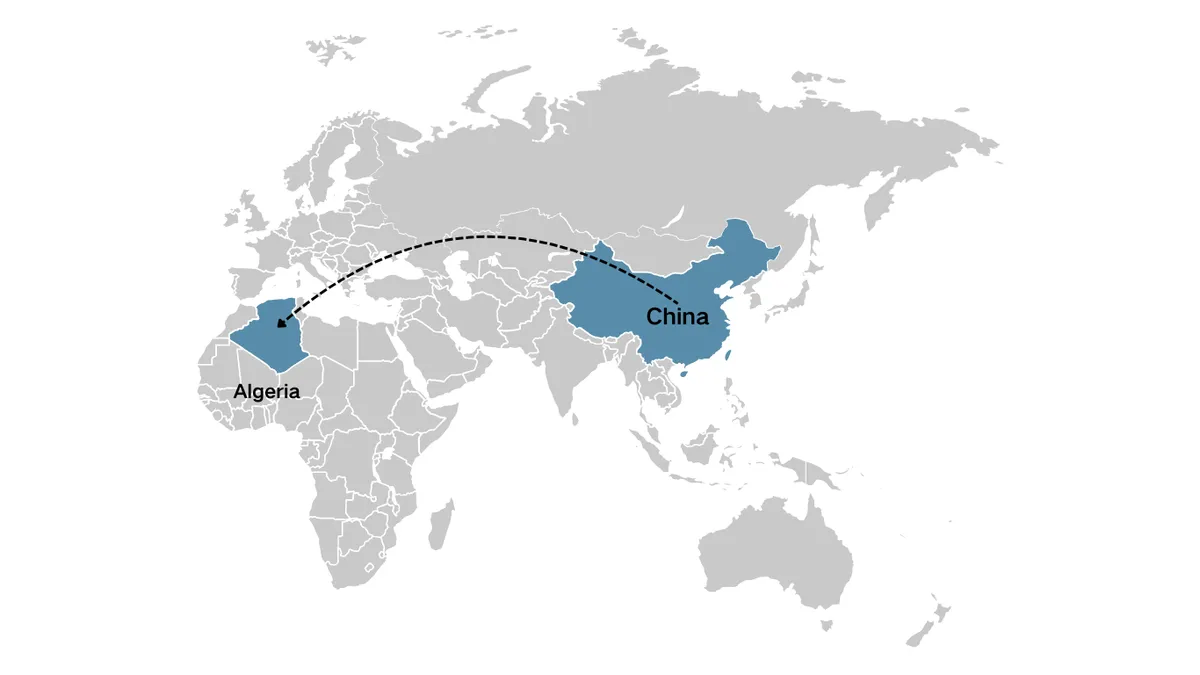
Shipping from China to Algeria in 2026: current sea, air and door-to-door rates to Algiers, Oran and Djen Djen, realistic transit times, Suez routing, Algeria's domiciliation and PPI import rules, duties and VAT, and clearance with DTFU Logistics.
We make shipping from China to Algeria simple, reliable, and cost-effective
Competitive Rates
Best shipping rates with no hidden fees. Save up to 40% compared to other forwarders.
Fast Transit
Reliable delivery times with express options available for urgent shipments.
Safe & Secure
Full cargo insurance and secure handling throughout the entire shipping process.
24/7 Support
Dedicated customer support team available around the clock for all your needs.
Arranging shipping from China to Algeria is not a question of finding the cheapest quote. It is a question of assembling a file that the Bank of Algeria, the Algerian customs service and your buyer's bank will all accept, and then choosing a routing that still delivers when Algiers is congested. This guide covers both halves: current sea, air and door-to-door rates and transit times on the China–Algeria lane in November 2026, the Suez versus Cape routing decision carriers are making right now, and the import formalities – domiciliation, the PPI forecast, conformity documents – that decide whether your container can legally sail at all.
China is Algeria's largest supplier, with 28.5% of Algerian imports in 2025. Space is rarely the constraint – the paperwork is. Most China–Algeria shipments we are asked to rescue were not lost at sea; they stalled before the booking, because the buyer's domiciliation file or import forecast was not in place when the supplier loaded the container.
What has changed on the China–Algeria lane in November 2026
Ten changes shape this lane today. The first four decide whether your cargo can move at all; the rest decide how long it takes and what it costs.
Change
When
What it means for your shipment
Domiciliation must be completed before the supplier ships
Bank of Algeria Note no. 01/DGC/2026, effective 14 May 2026
Every import must be domiciled at a bank before the foreign supplier ships. No domiciliation reference means no lawful payment and no letter of credit. Book a sailing date only after the file is open.
Financial-solvency conditions added to domiciliation
Bank of Algeria Instruction no. 05-2026, 19 May 2026
For goods imported for resale in the same state, the bank must see net assets at or above share capital, and an unsettled import balance across all banks not exceeding 100% of equity. Smaller importers can therefore be capped on how much they import at once.
The PPI import forecast remains the front door
In force since July 2025, extended through the 2026 half-year windows
Your buyer needs a validated Programme Prévisionnel d'Importation before domiciliation or an L/C can be opened. Since 1 January 2026, stand-alone service imports and import invoices that include freight also need prior authorisation from the Ministry of Foreign Trade.
A single import authority now runs the checks
Executive Decrees 25-233, 25-234 and 25-235 of 3 September 2025
ALGEX was dissolved and replaced by the Algerian Import Authority, whose digital platform is wired into the central bank, the commercial banks and customs. Expect your buyer's documents to be cross-checked against it.
Carriers are moving services back through Suez
Maersk and Hapag-Lloyd moved AE5, AE11, AE12 and ME2 from the Cape to Suez with effect from 19 September 2026
Two further services (AE15, AE19) were already transiting Suez, and the first 190,000-tonne container ship passed through on 22 August 2026. Mediterranean rotations are tightening again, but the shift remains conditional on regional security – confirm the routing at booking.
North Africa capacity is still below its pre-diversion level
Measured through 2026
The long Cape routing removed roughly a quarter of effective container capacity on North Africa services. Q4 and pre-Chinese New Year space still needs booking weeks ahead, and rates do not hold for a month.
Algiers congestion, not the ocean leg, is the schedule risk
Reported through the first half of 2026
Average vessel waiting time at Algiers ran between 4 and 7 days in the port updates we track, and CMA CGM diverted Algiers-bound cargo to Djen Djen in April 2026 rather than let it sit. Confirm which port your box will discharge at before promising a delivery date.
Djen Djen is now a genuine second gateway
First transit cargo January 2026; four new berths in service 22 July 2026
Djen Djen (Jijel), managed by DP World under a long-term concession, handled Algeria's first transhipment operation in January 2026 and brought four 17 m-draught export berths online in July – a real discharge option when Algiers backs up.
The El Hamdania deep-water port has moved, not opened
Relocation reported June 2026
The project has been redirected from Cherchell toward the Boumerdès coast. Nothing changes for importers this year: no new capacity before the first berths are commissioned, currently talked about in 2028 terms.
Duty rates unchanged, document checks tighter
Finance Law 2026
The five-rate tariff (0%, 5%, 15%, 30%, 60%), 19% import VAT and the DAPS safeguard duty all remain in force. Enforcement is what changed: full HS-code declarations are now required even for low-value consignments.
Sea freight from China to Algeria (November 2026)
Sea freight carries the overwhelming majority of China–Algeria volume: machinery, electrical goods, household appliances, vehicles, textiles, building materials and plastic resins. You have two service models, and the decision between them is arithmetic rather than preference.
FCL (full container load) – a sealed 20GP, 40GP or 40HQ, loaded at your supplier and opened in Algeria. Unit cost falls quickly with volume, handling is reduced, and the schedule is the carrier's mainline rather than a consolidation plan.
LCL (less than container load) – shared container space. The right answer for first orders and shipments under about 12 CBM, the wrong answer near 15 CBM, and always carrying a destination cost sting at Algiers that most rate sheets hide.
Service
Indicative rate, November 2026
Port-to-port transit
Best for
FCL 20GP → Algiers
$3,000 – $5,900 per container
30 – 45 days
13–28 CBM of dense or standard cargo
FCL 40GP / 40HQ → Algiers
$4,500 – $8,900 per container
30 – 45 days
28–68 CBM, light and voluminous goods
LCL → Algiers (CFS)
$150 – $250 per CBM
37 – 53 days
1–12 CBM, first orders, samples in volume
Why the FCL band is wide. Algeria sits at the intersection of Mediterranean pricing and African-route congestion. Through mid-2026, forwarder spot quotes on the lane ran around $3,200–$3,600 per 20GP and $4,800–$5,200 per 40GP, while carrier FAK lists into Algeria peaked at $7,200 per 20ft and $10,200 per 40ft in the July peak-season window – roughly double the equivalent Northern Europe rate. Both numbers are real; they are simply quoted by different ends of the market, at different moments, with different surcharge packages attached. Treat any single figure as indicative, and demand a validity period. On this lane, seven to fourteen days is normal and anything longer is a guess.
Transit time by Chinese origin port
Origin port
FCL transit to Algiers
LCL transit (incl. consolidation)
Notes
Yantian / Shenzhen
30 – 37 days
37 – 47 days
South China gateway; strong for consumer goods and electronics
Shanghai
32 – 38 days
39 – 48 days
Widest carrier choice, machinery and mixed cargo
Ningbo-Zhoushan
33 – 39 days
40 – 49 days
Heavy industrial and bulk-adjacent cargo
Nansha / Guangzhou
33 – 40 days
40 – 50 days
Pearl River Delta factories, competitive on textiles and furniture
Qingdao
36 – 44 days
43 – 53 days
North China cargo; add a few days for the extra coastal leg
Shanghai → Oran
35 – 40 days
42 – 50 days
West of Algeria; usually pairs with western wilayas and inland distribution
Suez or the Cape?
Container services on the Asia–Mediterranean corridor have been returning to Suez in stages through 2026. Maersk and Hapag-Lloyd shifted four joint services back from the Cape of Good Hope with effect from 19 September 2026, and the canal authority reports a rising daily count of transiting box ships. For Algeria this is good news: a Suez routing typically removes ten to fourteen days against the Cape and restores the Mediterranean relay options feeding Algiers, Oran and Bejaia.
It is not a clean return. Middle East security remains volatile, Hormuz traffic has been down to single-digit crossings on some days, and carriers say individual services can revert to the Cape at short notice. So your forwarder should state the routing in writing for your specific sailing, and your delivery buffer should assume the slower option. Anyone who cannot tell you whether your box goes via Suez or around Africa is quoting a number, not a plan.
How to read a China–Algeria sea quote
Ask what the rate includes. Origin THC, documentation, the Suez transit fee, BAF and the peak-season surcharge are the five lines that separate two quotes looking "40% apart" for the same container.
Ask for free time at destination. Algerian demurrage and detention run $120–$200 per container per day in our experience, and the standard free window of seven to fourteen days is negotiable on contracted volumes.
Ask which Algerian port. Algiers is the default and handles more than 60% of the country's container traffic. If your consignee is in the east, Djen Djen or Annaba may file faster even when the ocean freight is marginally higher.
Air freight exists on this lane for one reason: the goods cannot wait. Electronics, medical equipment, spare parts that hold up a production line, cosmetics ordered for a launch, high-value apparel and samples all move by air into Algiers (ALG), Oran (ORN) and Constantine (CZL). Air rates to Algeria eased through the third quarter of 2026 as demand normalised, which makes the air-versus-sea decision more finely balanced than it was in the spring.
Chargeable weight band
Indicative rate, November 2026
Airport-to-airport transit
Typical use
45 – 100 kg
$7.50 – $10.00 per kg
4 – 6 days
Samples, urgent spares, documents in bulk
100 – 300 kg
$6.50 – $8.70 per kg
3 – 6 days
First production batch, electronics replenishment
300 – 1,000 kg
$5.80 – $7.50 per kg
3 – 6 days
Seasonal stock that has to beat a sea sailing
1,000 kg and above
from about $6.80 per kg
3 – 6 days
Consolidated consignments, contract shippers
Express courier (door-to-door)
$12 – $16 per kg
5 – 9 days
Small parcels, samples under 100 kg, e-commerce replenishment
Capacity is the constraint, not demand. There is no deep dedicated freighter network into Algeria: most tonnage moves as belly cargo routed through Istanbul, Doha, Dubai or a European hub, so one cancellation can add two to four days. For consignments above roughly 500 kg, book one to two weeks ahead in peak windows, and watch volumetric weight – light, bulky cargo pays on volume, and Algerian-bound air cargo is checked tightly against the commercial invoice. Because Algeria applies no de minimis threshold, every parcel is declared, so a correct HS code on the air waybill avoids multi-day inspections at Algiers airport. Compare the door-to-door maths with our air freight from China to Algeria guide.
Door-to-door and DDP shipping from China to Algeria
Door-to-door is the service most China–Algeria importers actually want, because it removes the handoff where shipments stall: the Algerian import declaration. But "DDP" means something narrower here than in Europe or North America, because Algeria does not allow a foreign seller to be the importer of record. An Algerian entity – CNRC-registered, holding an NIF, an authorised bank account and a domiciliation file – must own the import, and resale imports are also subject to the resident-shareholding rule requiring Algerian majority ownership.
A workable structure is therefore a triangle: your supplier or you as consignor in China, DTFU managing export, carriage and Algerian clearance through a licensed customs broker, and an Algerian entity (usually your buyer or distributor) as importer of record and domiciliation holder. Fix that structure before you compare prices, because a quote that assumes otherwise falls apart at the port.
Stage
Who runs it
Typical duration
Supplier pickup, consolidation and export packing
DTFU in China
2 – 4 days
Chinese export declaration and loading
DTFU in China
1 – 2 days
Main carriage (sea 30–45 days, air 3–6 days)
Carrier
See tables above
Arrival, manifest and port formalities in Algeria
Algerian agent
1 – 3 days
Import declaration (D15) via SIGAD, duty and VAT payment
Licensed customs broker
2 – 7 days
Inspection, conformity or scanner control, if triggered
Customs / conformity body
3 – 10 days
Final delivery to city, wilaya or warehouse
DTFU and local carrier
1 – 4 days (Algiers, Oran, Constantine); 3 – 7 days to interior wilayas
The full import file normally includes the commercial invoice, packing list, bill of lading or air waybill, a legalised certificate of origin (CACI), your buyer's NIF, the bank domiciliation certificate, the conformity certificate for regulated categories, any sector licence, and the D15 declaration filed on SIGAD. Goods must be declared once unloaded and held in a warehouse, temporary storage area or dry port: the window is twenty-one days from unloading, after which the file moves into the deposit regime and you buy yourself two months of storage. Our door-to-door shipping from China to Algeria page walks the operational sequence, and DDP shipping from China to Algeria explains the Incoterm choice.
What sits on top of the base ocean rate
Base ocean freight is roughly half of what a 40HQ into Algiers actually costs. The table below lists the charges that appear on the invoices most importers do not see when they compare quotes. Every one of these is legitimate; the problem is that they are quoted inconsistently, which is why two forwarders can both be honest and still differ by thousands of dollars.
Charge
Typical amount, November 2026
Trigger
Origin terminal handling (THC)
$110 – $150 per 20GP; $160 – $210 per 40GP/40HQ
Always
Documentation and bill of lading
$70 – $90 origin; $30 – $100 per document
Always
Seal fee
$10 – $25 per container
Always
Peak season surcharge (PSS)
$400 per 20GP; $600 per 40HQ
May–July and October–December peaks
Suez Canal transit fee
$300 – $450 per container
Suez-routed services
Algiers port congestion surcharge
$250 – $350 per TEU
Q4 holiday import peaks
CFS unpacking and local handling (LCL only)
Quoted per CBM and per tonne at Algiers
Every LCL arrival – the charge that makes "cheap" LCL expensive
Destination free time, then demurrage / detention
$120 – $200 per container per day after free time
Free window commonly 7 – 14 days
Algerian customs broker and clearance
$100 – $200 per shipment plus per-line fees
Every commercial import
Inspection, conformity certificate, scanner control
Case by case, plus 7 – 10 days
Regulated goods, value or risk flags, document errors
Import duty, VAT, DAPS, TIC
See the duty section below
Always – assessed on CIF plus duties
The last line is where most landed-cost estimates go wrong, so here is a worked example. Assume one 40HQ of general machinery, CIF Algiers $25,000, a 15% duty band, no DAPS on this tariff line, and a broker and local-delivery package of $900.
Component
Calculation
Amount
CIF value (goods + freight + insurance)
–
$25,000
Customs duty
$25,000 × 15%
$3,750
TCS solidarity contribution
$25,000 × 2%
$500
Import VAT
($25,000 + $3,750 + $500) × 19%
$5,557
Broker, port charges and final delivery
–
$900
Cash out at landing
–
$35,707
Of which recoverable import VAT (deduct on your G50)
–
$5,557
Net non-recoverable cost over CIF
–
about 20.6%
Two conclusions follow. First, the "freight cost" you negotiate is a minority of the landed cost, so a $300 saving on ocean freight is not worth an extra week at the port. Second, import VAT is recoverable if your Algerian entity is VAT-registered and deducts it on the monthly G50 return – which makes the timing of the duty payment, and therefore the speed of clearance, a cash-flow question, not just an administrative one.
Algeria's 2026 import rules: what must be in place before the container sails
Since July 2025 Algeria has rebuilt how imports are authorised, and 2026 added two more layers. The sequence below is the order banks and customs expect. Anyone quoting you a China–Algeria shipment without asking about steps one to four is quoting you a theoretical price.
Step
Document or filing
Who provides it
Lead time
1
PPI import forecast validated by the Ministry of Foreign Trade (six-month window)
Algerian importer
File 30 – 60 days ahead
2
Bank domiciliation file, single designated bank, with the provision the bank requires
Algerian importer and bank
Must be complete before shipment; legacy rule requires domiciliation at least 30 days before shipping and a provision of not less than 120% of the import value for resale goods
3
Proforma invoice and contract, apostilled where the bank requires it
Chinese supplier
With the PPI application
4
Solvency evidence where the import is for resale
Algerian importer
With the domiciliation file
5
Commercial invoice, packing list, HS codes on every line
Chinese supplier
Before sailing
6
Certificate of origin, legalised (CACI)
Chinese chamber and Algerian consular service
Before sailing
7
Certificate of conformity for regulated categories
Approved inspection body
Before sailing – pre-shipment, not at arrival
8
Bill of lading or air waybill, telex release or original as agreed
Carrier
After sailing
9
Import declaration D15 on SIGAD, plus duty, VAT and levies
Licensed Algerian customs broker
Within 21 days of unloading
Practical consequences. Because domiciliation must precede shipment, a supplier who ships first and sends documents later creates an unpayable shipment. Because solvency ratios now gate domiciliation for resale imports, buyers with thin balance sheets may need to spread orders over a longer calendar. And because the PPI runs on six-month windows, an import programme starting in December needs a validated H1 forecast before the first booking. Algerian accounting firms put the penalties for operating without a validated PPI dossier at DZD 50,000 to 200,000, with the frozen payment file costing far more than the fine.
Labelling matters as much as the tariff: Arabic labelling and instructions are required for many consumer categories, "Made in" marking is enforced, and electronics, cosmetics, auto parts and household appliances normally need a conformity certificate from an approved body before the goods leave China. Retro-fitting compliance after arrival is the most expensive mistake on this lane. Reused and second-hand goods are largely prohibited – used clothing, used equipment and refurbished electronics included. Diesel passenger vehicles have been closed to authorised dealers since April 2026, including used diesel cars under three years old, while petrol, hybrid, electric, hydrogen and LPG/CNG vehicles remain importable within the emissions rules. Pharmaceuticals enter only through the central hospital pharmacy or licensed pharmacies.
Import duty and taxes on China–Algeria shipments (November 2026)
Algeria's common customs tariff has exactly five duty rates. Which one applies to your cargo depends on its ten-digit subheading, not on its broad category, and the ten digits also determine whether DAPS or an excise duty lands on top. This is why we always ask for the HS code before we quote a landed cost.
Levy
Rate
Base
Customs duty (DD)
0%, 5%, 15%, 30% or 60%
CIF value
Import VAT
19% standard; 9% reduced rate on specified essential goods
CIF value + customs duty + excise where applicable
TCS solidarity contribution
2%
CIF value
DAPS safeguard duty
30% – 200%
Applies to a defined list of roughly 1,095 finished product lines
Domestic consumption tax (TIC)
10% – 100%
Listed categories: tobacco, certain vehicles, energy-intensive appliances
Anti-dumping duties
Case specific
Named origins and products
Product group
Typical duty band
Watch out for
Machinery and mechanical appliances
5% – 15%
Largest single Algerian import category at $7.84bn in 2025, up 18.1%
Electrical machinery, electronics, appliances
5% – 30%
Conformity certificate and Arabic labelling; HS-code checks tightened in 2025
Vehicles, tractors and spare parts
15% and above
Imports doubled in 2025 to $5.92bn; diesel passenger car rules changed in April 2026
Textiles, apparel and footwear
15% – 30%
Precise HS codes on chapters 61 and 62; origin checks
Plastic resins and industrial inputs
about 5%
Duty is low; the constraint is the bank file, not the tariff
Processed food and high-value consumer goods
up to 60%
Frequently on the DAPS list, which multiplies the effective rate
There is no de minimis threshold in Algeria. Duty and VAT apply from the first unit of value, and full HS declarations are required even for small parcels. If your business model depends on low-value direct-to-consumer parcels, Algeria is not a market where that model works without a local entity and a compliant import channel. Conversely, if your Algerian company qualifies under the Startup Label or an investment framework such as AAPI, equipment imports can be VAT-exempt for a defined period, and production equipment for priority sectors can be exempted at clearance. Those exemptions are worth more than any freight negotiation.
Verify every rate line by line on the customs directorate's own tariff before you commit to a price list. Quoting from a blog table – including ours – is how importers discover a 60% duty band after the container has sailed. Our customs clearance services page explains what we handle at each stage.
Main ports in China and Algeria
China: where your cargo starts
Shanghai – the widest choice of Algeria services of any Chinese port, and the natural origin for machinery, mixed and project cargo from the Yangtze delta.
Ningbo-Zhoushan – the world's largest cargo throughput port; strong for heavy industrial cargo and bulk-adjacent consignments over 40HQ volumes.
Shenzhen / Yantian – the South China gateway for electronics, consumer goods and light industrial products, with the fastest Guangdong factory-to-port cycle.
Nansha / Guangzhou – Pearl River Delta factories, competitive on textiles, furniture and general consumer goods.
Qingdao, Tianjin and Xiamen – north China and southeast cargo (chemicals, tyres, steel, general goods) at the cost of a few extra days of coastal transit.
Algeria: where your cargo lands
Port
Role
Status in November 2026
Algiers
National gateway; more than 60% of container traffic
Handled 931,300 TEU and 13.6 million tonnes in 2025. Vessel waits of 4 – 7 days have been reported through 2026, with carriers omitting or diverting calls when berth productivity slips. A $1.2bn expansion programme is adding berths progressively through 2027.
Djen Djen (Jijel)
Deep-water alternative on the eastern coast; DP World concession, less than 50 nautical miles off the Suez–Gibraltar route
Algeria's first transit cargo operation was completed here in January 2026, and four new 17 m-draught berths entered service on 22 July 2026. A credible discharge point for eastern and central Algeria, and the port carriers fall back to when Algiers backs up.
Oran
Western gateway, with strong onward links to the west and centre
Reliable alternative to Algiers for consignees in the west; usually pairs with a Shanghai or Ningbo sailing.
Bejaia
Eastern industrial port
Weather-sensitive: storms in early 2026 produced vessel waits of up to six days and a backlog that took time to clear.
Skikda and Annaba
Eastern ports serving industrial and general cargo
Useful for eastern wilayas and for cargo types that do not need Algiers' full container handling profile.
Mostaganem and Ghazaouet
Smaller western ports and feeder calls
Occasional discharge options for regional consignees; do not assume regular weekly services.
El Hamdania
Planned deep-water port, 25 million tonnes and 6.5 million TEU per year at design stage
Relocated from Cherchell to the Boumerdès coast in 2026 and still under development. Not a factor in your 2026 routing decisions.
Transit time from China to Algeria at a glance
Use the left-hand column for planning and the right-hand column for the booking you are about to make. The gap between them is what a schedule-conscious forwarder earns their fee on.
Mode
Normal conditions
Current November 2026 conditions
Sea FCL, port-to-port
30 – 38 days
30 – 45 days, with Algiers berth waits adding up to a week
Sea LCL, port-to-port
37 – 47 days
40 – 53 days including consolidation and deconsolidation
Sea door-to-door
40 – 50 days
42 – 55 days including Algerian clearance and inland delivery
Air, airport-to-airport
3 – 5 days
3 – 6 days depending on hub connections
Air door-to-door
8 – 10 days
8 – 12 days including clearance and delivery
Express courier
5 – 7 days
5 – 9 days
Three calendar effects will move those numbers more than any carrier decision. Algeria's national holidays and the Ramadan–Eid window slow customs and inland haulage regardless of how smooth the ocean leg was. The Q4 import peak brings both a congestion surcharge and berth queuing at Algiers. And Chinese New Year and Golden Week remove sailings from the schedule altogether – blank sailings in early October are announced weeks in advance, and the cargo that misses them waits a full cycle.
FCL or LCL: where the money actually is
The break-even is not a matter of taste. As a rule of thumb on China–Algeria:
Under about 12 CBM – LCL normally wins, once you accept a slower transit and higher per-unit cost.
12 to 16 CBM – quote both, with every destination charge included. This is the zone where the wrong choice costs the most.
From about 13–15 CBM – a 20GP usually beats LCL on total landed cost, because it avoids the CFS unpacking, local handling and destination documentation that LCL attracts at Algiers.
More than 28 CBM – a 40GP or 40HQ: the 40ft box carries roughly double a 20ft for about 60–65% more freight.
Two operational checks decide whether that arithmetic holds. First, weight: a 20GP has a practical payload ceiling of roughly 20–22 tonnes depending on the carrier and road limits, so dense cargo may need a 20ft box even when the volume suggests otherwise. Second, free time: a container that sits at Algiers beyond its free window costs more per day than the freight saving you negotiated. If your consignee's clearance file is not ready on arrival, no freight rate will rescue the shipment. See how much it costs to ship a container from China to Algeria for line-by-line container pricing.
Amazon FBA and e-commerce shipping to Algeria
There is no Amazon marketplace in Algeria and no Amazon fulfilment centre, so classic FBA prep-and-ship-to-warehouse services do not apply to this country. Sellers who treat Algeria as an FBA destination usually discover this after they have already booked a shipment. What actually exists is a domestic ecosystem that works differently:
A $1.7bn online market growing 10–15% a year, with around 37.8 million internet users and roughly 80% penetration.
Cash on delivery still dominates, at roughly 85–95% of transactions, with card penetration under 5%. COD-native logistics is the default, not a workaround.
Jumia exited Algeria in early 2026, taking the most structured import-and-fulfil channel with it. Demand shifted to local marketplaces such as Ouedkniss, Batolis and Linstashop, and to social commerce on Facebook and WhatsApp.
Last-mile carriers are strong and API-driven: Yalidine alone covers 1,469 municipalities through more than 160 branches, with ZR Express (Procolis) and Maystro competing on settlement terms.
International platforms are shopfronts only. Temu and Shein have Algerian storefronts but no local payment integration, warehouse or customer service, and CIB and Edahabia cards do not work at their checkouts.
What that means for an importer. The workable model on this lane is B2B import plus local fulfilment: bring stock into Algeria in your own entity's or your distributor's name as a commercial import, clear it properly, hold it in Algerian warehousing, and fulfil through a national COD carrier. Air freight is the tool for replenishment between sea cycles, and express courier for samples under 100 kg. Two compliance rules shape the catalogue: HS codes must be correct on every line even for small shipments, and used or refurbished equipment – which includes refurbished electronics – cannot be imported legally at all. Our China–Africa shipping hub covers the neighbouring markets if you are building a regional stock plan.
How DTFU Logistics runs the China–Algeria lane
DTFU Logistics has been moving cargo out of China since 2014, from our base in Shenzhen, with FIATA and IATA accreditation and a service network spanning more than 120 countries. On the Algeria lane specifically, our value is not a lower headline rate – it is knowing which parts of the file fail and removing them before the container is loaded.
Direct carrier contracts on the main China–Algeria and China–Mediterranean services, so space is held in peak windows rather than begged for.
Routing you can see. We state whether your sailing goes via Suez or the Cape, which Algerian port it discharges at, and what happens if that port backs up.
Honest quotes. Our quotations follow the surcharge list in this guide, line by line, so you compare totals rather than base rates.
Clearance through licensed Algerian brokers, with the import file checked before sailing: domiciliation, PPI, CACI origin documents, conformity certificates and HS codes.
Full-service handling – supplier pickup, consolidation and warehousing in China, export declaration, carriage, Algerian clearance and final delivery – with one account manager, 24/7 support and live tracking instead of a chain of email handoffs.
Cargo insurance and secure warehousing at both ends: on a lane where one customs query can hold goods for a week, cover is not optional.
Last updated: November 2026.
Planning your next China–Algeria shipment
Send us your supplier list and we will come back with the routing, the sailing and a landed-cost estimate. To make that first answer accurate rather than generic, have these six items ready:
The commodity and its HS code (or a clear description if you do not have the code yet) – it determines both the duty band and whether a conformity certificate is needed.
Volume and weight in CBM and kilograms per supplier, so FCL and LCL can be priced against each other.
Destination city or wilaya, which decides whether Algiers, Oran, Djen Djen or Bejaia is the better discharge port.
Your buyer's status: CNRC import registration, NIF, whether the PPI and domiciliation file are open, and whether the bank has issued the domiciliation reference.
Timing and flexibility: your required delivery date, and whether a slower Suez or Cape routing is acceptable to protect the rate.
Whether duty and VAT must be advanced under a DDP structure, and which Algerian entity will act as importer of record.
Algeria rewards preparation more than any other market we serve. The shipments that clear in three days are the ones whose documents were correct before the container left Yantian or Shanghai. Talk to the DTFU Logistics team through our contact page and we will tell you – before you book – exactly what your buyer needs in place, which port your cargo should use, and what the whole movement will cost to your door.
Frequently Asked Questions
Get answers to common questions about shipping from China to Algeria
Port-to-port FCL rates into Algiers currently run about <strong>$3,000–$5,900 (20GP)</strong> and <strong>$4,500–$8,900 (40GP/40HQ)</strong>, excluding origin and destination charges. Forwarder spot quotes through mid-2026 sat around $3,200–$3,600 and $4,800–$5,200 respectively, while carrier FAK lists peaked at $7,200/$10,200 in the July peak window. LCL is about <strong>$150–$250 per CBM</strong>. Rates move weekly – always ask for the validity date in writing.
Sea freight takes <strong>30–45 days port-to-port</strong> for FCL and 37–53 days for LCL including consolidation at both ends. Door-to-door sea runs <strong>42–55 days</strong> once Algerian customs clearance and inland delivery are added. Air freight is <strong>3–6 days airport-to-airport</strong>, or 8–12 days door-to-door. Allow up to a week of extra berth waiting time at Algiers during peak periods, and 3–7 days for clearance after unloading.
Commercial invoice, packing list, bill of lading or air waybill, a legalised <strong>certificate of origin (CACI)</strong>, your importer's CNRC registration and <strong>NIF</strong>, the bank <strong>domiciliation certificate</strong>, a <strong>conformity certificate</strong> for regulated categories such as electronics, cosmetics and auto parts, any sector import licence, and the <strong>D15 declaration filed through SIGAD</strong>. The declaration must be lodged within 21 days of unloading. Used clothing, used equipment and refurbished electronics are largely prohibited.
Under Bank of Algeria Note no. 01/DGC/2026, effective 14 May 2026, <strong>bank domiciliation must be completed before the supplier ships</strong> – no domiciliation reference means no lawful payment. Instruction no. 05-2026 of 19 May 2026 added solvency conditions for goods imported for resale: net assets at or above share capital, and unsettled import balances across all banks no higher than 100% of equity. A validated <strong>PPI import forecast</strong> is required before domiciliation, and since 1 January 2026 service imports and invoices carrying freight charges need prior Ministry of Foreign Trade authorisation.
Customs duty uses five rates – <strong>0%, 5%, 15%, 30% or 60%</strong> – determined by the ten-digit HS subheading. On top of that: <strong>19% import VAT</strong> (9% reduced rate on specified essentials), a <strong>2% TCS</strong> solidarity contribution, <strong>DAPS safeguard duty of 30–200%</strong> on roughly 1,095 listed finished-product lines, and excise duty (TIC) on categories such as tobacco and certain vehicles. Algeria has <strong>no de minimis threshold</strong>: duty and VAT apply from the first unit of value, and full HS codes are required even on low-value shipments.
Indicative chargeable-weight rates are <strong>$7.50–$10.00 per kg at 45–100 kg</strong>, $6.50–$8.70 at 100–300 kg, $5.80–$7.50 at 300–1,000 kg, and from about <strong>$6.80 per kg above 1,000 kg</strong>. Express courier runs $12–$16 per kg. There is no deep dedicated freighter network into Algeria – most cargo moves as belly freight via Istanbul, Doha, Dubai or a European hub – so book one to two weeks ahead for consignments over 500 kg and check volumetric weight carefully.
Yes, but Algeria does not allow a foreign seller to be the importer of record. A <strong>CNRC-registered Algerian entity</strong> holding an NIF, an authorised bank account and a domiciliation file must own the import, and imports for resale are subject to the Algerian-majority shareholding rule. In practice the structure is: you or your supplier as consignor in China, DTFU handling pickup, export, carriage and Algerian clearance through a licensed customs broker, and your Algerian buyer or distributor as importer of record.
No. Algeria has <strong>no Amazon marketplace and no Amazon fulfilment centre</strong>, so FBA is not available on this lane. The workable model is a commercial B2B import into your own Algerian entity's or distributor's warehouse, followed by domestic fulfilment through a national carrier such as Yalidine, ZR Express or Maystro. Cash on delivery still accounts for roughly 85–95% of Algerian online transactions, and HS codes must be correct on every line even for small shipments.
Ready to Shipping From China To Algeria?
Get your instant quote today and experience the difference of working with a professional freight forwarder.
5000+
Successful Shipments
98%
Customer Satisfaction
Get Your Free Quote
Response within 2 hours • No obligation • Free consultation
We use cookies to enhance your browsing experience and analyze site traffic. By continuing to use our site, you consent to our use of cookies. Learn more in our Cookie Policy.