If you're trying to figure out the real shipping cost from China to Sudan in 2026, you've probably already noticed that the numbers are all over the place. One forwarder quotes $2,100 for a 20ft container, another quotes $7,800 for the exact same route. That's not a typo — that's the reality of the China–Sudan freight market right now. A 40ft container from Shanghai to Port Sudan that cost around $3,200 in early 2024 can now run $8,200 and up, and that's before customs, cargo insurance, or a single hidden destination fee. This guide cuts through the confusion. For importers arranging Shipping From China to Sudan, understanding every cost line before you book is the difference between a profitable shipment and an expensive surprise. We'll walk you through every cost component — sea freight, air freight, door-to-door pricing by container type and origin port, Sudan customs duties and VAT, insurance, and the hidden charges that can inflate your landed cost by 30% to 50% beyond the initial freight quote.
Here's the quick-reference snapshot before we dive deep:
| Shipping Method | Low End | High End | Transit Time |
|---|---|---|---|
| Sea Freight — FCL 20GP | $2,000 | $7,800 | 28–43 days |
| Sea Freight — FCL 40HQ | $2,600 | $10,500 | 28–43 days |
| Sea Freight — LCL (per CBM) | $90 | $280 | 28–43 days |
| Air Freight (45kg+) | $4.50/kg | $8.50/kg | 4–10 days |
| Air Freight Express (<45kg) | $7.00/kg | $11.00/kg | 4–8 days |
| Door-to-Door (20ft) | $2,600 | $5,600+ | 35–50 days |
| Door-to-Door (40ft) | $3,700 | $6,500+ | 35–50 days |
Keep reading to understand why these ranges exist and, more importantly, where your shipment will land on them.
Sea Freight Cost from China to Sudan
Sea freight is the backbone of China–Sudan trade. Over 90% of Sudan's maritime cargo flows through Port Sudan on the Red Sea, and for most importers, ocean freight represents the best balance of cost and capacity. But in 2026, that cost is anything but straightforward. We've compiled the latest Sea Shipping cost from China to Sudan data by container type, port, and volume to give you actionable budget numbers.
FCL Container Shipping Cost from China to Sudan
FCL (Full Container Load) means you book an entire container. You pay for the box regardless of whether it's 60% or 95% full — so the economics improve dramatically as your shipment volume grows.
Here are the current FCL shipping rates from China to Sudan by container type and departure port:
| Chinese Port | 20GP Container (USD) | 40HQ Container (USD) | Sea Transit Time |
|---|---|---|---|
| Shenzhen (Yantian/Shekou) | $2,100 – $4,300 | $2,700 – $5,200 | 28–36 days |
| Guangzhou (Nansha) | $2,100 – $4,300 | $2,700 – $5,200 | 28–36 days |
| Shanghai | $2,100 – $4,400 | $2,800 – $5,300 | 32–39 days |
| Ningbo | $2,150 – $4,450 | $2,850 – $5,350 | 32–39 days |
| Qingdao | $2,150 – $4,450 | $2,850 – $5,350 | 38–43 days |
| Tianjin | $2,200 – $4,500 | $2,900 – $5,400 | 40–45 days |
Important note on 2026 rates: The higher ends of these ranges reflect the current market reality. Since late 2023, Red Sea security disruptions have forced carriers to apply War Risk Surcharges (WRS) and reroute vessels, driving rates up by 40–50% compared to pre-2024 norms on certain sailings. Rates now change weekly — a live quote from your freight forwarder will be more accurate than any published number older than 7 days.
Why 40HQ gives you better value right now. A 40ft High Cube container offers roughly 67.7 CBM of usable space versus ~33.2 CBM in a 20ft standard container — meaning you get roughly double the capacity for only 25–35% more cost. In the current elevated-rate environment, shipping two 20GP containers from Shenzhen could cost $4,200–$8,600 combined, while a single 40HQ on the same route runs $2,700–$5,200. That's a per-CBM savings of 15–20%.
Cost-per-CBM example (Shenzhen → Port Sudan, mid-range rates):
- 20GP: 33.2 CBM at $3,200 = $96.39 per CBM
- 40HQ: 67.7 CBM at $4,100 = $60.56 per CBM
That's a 37% lower unit cost. For any importer shipping more than roughly 20 CBM, the 40HQ is almost always the smarter financial decision — even if you don't fill it completely.
LCL (Less than Container Load) Shipping Cost from China to Sudan
If you're shipping smaller volumes, LCL (Less than Container Load) lets you pay only for the space your cargo occupies, sharing container space with other importers' goods.
Current LCL rates from China to Port Sudan: $90–$280 per CBM.
What determines where your rate falls in that range:
- Cargo type and handling requirements (fragile, hazardous, or irregularly shaped goods cost more)
- Total CBM volume (larger consolidated shipments negotiate lower per-CBM rates)
- Origin port (Shenzhen and Guangzhou typically offer the most competitive LCL consolidations)
- Seasonal demand (pre-Ramadan consolidations fill faster and cost more)
Watch out for LCL destination charges. LCL shipments at Port Sudan face disproportionately high destination handling fees on a per-CBM basis compared to FCL. While an FCL container might pay a flat $150–$300 in terminal handling, an LCL shipment can incur $35–$65 per CBM in CFS (Container Freight Station) charges, documentation fees, and agent handling at the destination — costs that can erase the apparent savings of LCL for shipments approaching the 15 CBM threshold.
How Long Does Sea Freight Take from China to Sudan?
Shipping from China to Sudan transit time varies significantly by origin port and current Red Sea conditions:
| Origin Port | Transit to Port Sudan (Normal) | Transit with Red Sea Disruptions |
|---|---|---|
| Shenzhen / Guangzhou | 25–30 days | 28–36 days |
| Shanghai / Ningbo | 28–33 days | 32–39 days |
| Qingdao / Tianjin | 34–38 days | 38–45 days |
The additional 7–14 days of transit since late 2023 is primarily due to carriers taking longer, safer routing around the southern Red Sea and scheduling adjustments to manage the volatile security situation.
Once your container arrives at Port Sudan, expect 3–7 days for customs clearance (assuming complete documentation) and 2–5 days for inland trucking to Khartoum depending on security checkpoint conditions along the highway.
Air Freight Cost from China to Sudan
When speed matters more than freight cost, air freight from China to Sudan becomes the practical choice — but understanding how air cargo is priced is essential to avoid overpaying. For a complete breakdown of Air Shipping from China to Sudan including express courier options and weight bracket pricing, see our dedicated air freight guide.
Air Freight Rates per Kg from China to Sudan
Air freight pricing is based on chargeable weight, not actual weight. The chargeable weight is the greater of the actual gross weight and the volumetric weight.
Volumetric weight formula: (Length × Width × Height in cm) ÷ 6,000
Current air freight rates from China to Sudan:
| Cargo Type | Weight Bracket | Rate (USD/kg) | Door-to-Door Available? |
|---|---|---|---|
| General Cargo | 45–100 kg | $7.00 – $8.50 | Yes |
| General Cargo | 100–500 kg | $5.50 – $7.00 | Yes |
| General Cargo | 500+ kg | $4.50 – $6.00 | Yes |
| Express / Urgent | Under 45 kg | $7.00 – $11.00 | Yes |
| Dangerous Goods (DG) | Any | +$1.50–$3.00 surcharge | Case-by-case |
Main air gateways from China to Sudan:
- Departure: PVG (Shanghai Pudong), CAN (Guangzhou Baiyun), SZX (Shenzhen Bao'an)
- Arrival: KRT (Khartoum International Airport) — primary; PZU (Port Sudan Airport) — secondary
Express Shipping from China to Sudan
For very small shipments, you have two paths:
| Option | Best For | Typical Cost | Transit |
|---|---|---|---|
| DHL / FedEx / UPS Express | Documents, samples, <30kg | $8–$15/kg | 3–6 days |
| Freight Forwarder Consolidated Air | 45kg+ commercial shipments | $4.50–$8.50/kg | 5–10 days |
A freight forwarder consolidates multiple shippers' cargo onto the same flight, securing bulk rates from airlines that individual shippers can't access. For anything over 30kg, the forwarder route is almost always cheaper — often significantly so.
Air Freight vs. Sea Freight: A Real Total Cost Comparison
Many importers compare only the freight line item and conclude air is "too expensive." But total landed cost tells a different story — especially with Sudan's inland logistics.
Real scenario: A 200kg shipment of smartphone accessories valued at $8,000, from Shenzhen to a warehouse in Khartoum.
| Cost Component | Sea Freight (LCL, 3 CBM) | Air Freight (200kg) |
|---|---|---|
| Ocean/Air Freight | $450 (3 CBM × $150) | $1,200 (200kg × $6.00) |
| China Export Clearance | $80 | $80 |
| Port Sudan / KRT Terminal Fees | $180 (3 CBM × $60 CFS) | $120 |
| Customs Duty (10%) | $800 | $800 |
| VAT (17% on CIF+duty) | $1,643 | $1,724 |
| Inland Trucking → Khartoum | $250 | $80 (airport nearby) |
| Cargo Insurance (0.4%) | $35 | $35 |
| Total Landed Cost | $3,438 | $4,039 |
| Transit Time | ~40 days | ~7 days |
The air freight route costs roughly $600 more — about 17.5% — but delivers the goods 33 days faster. For an importer who can turn that inventory in under 30 days, the faster cash conversion cycle and avoided stock-out risk more than justify the freight premium. For low-margin, non-urgent goods, sea freight remains the clear winner.
Door to Door Shipping Cost from China to Sudan
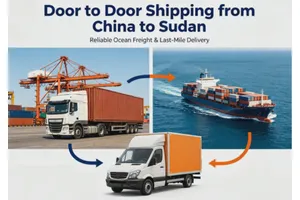
Many first-time importers from China to Sudan search specifically for door to door shipping cost from China to Sudan — wanting one price that covers everything from the Chinese factory to their warehouse in Khartoum. Our step-by-step guide to Door to Door Shipping from China to Sudan walks through the full process from factory pickup to final delivery. Understanding what "door-to-door" actually means on this route is critical to avoiding expensive surprises.
Door to Door Shipping from China to Sudan: What's Included?
A true door-to-door service on the China–Sudan route covers seven stages:
- Factory/supplier pickup across China (trucking to the departure port)
- China export customs clearance (declaration, documentation, inspection if required)
- Ocean or air freight to Port Sudan or Khartoum International Airport
- Sudan import customs clearance (duty assessment, document verification, physical inspection)
- Duty and VAT payment to Sudan Customs
- Port/airport release and handling
- Inland trucking to your final destination (Khartoum, Omdurman, Nyala, etc.)
Estimated all-in door-to-door costs from China to Sudan:
| Mode & Volume | Total Cost Range (USD) | Includes |
|---|---|---|
| LCL (5 CBM, Yiwu → Khartoum) | $900 – $1,400 | Pickup, export clearance, LCL freight, import clearance, duty/VAT, delivery |
| 20ft Container FCL | $2,600 – $5,600+ | All of the above for a full 20GP |
| 40ft Container FCL | $3,700 – $6,500+ | All of the above for a full 40HQ |
| Air Freight Door-to-Door | Starting ~$4.20/kg | Pickup, export, air freight, import clearance, delivery |
DDP Shipping to Sudan: Is True Delivered Duty Paid Possible?
Here's something most generic freight guides won't tell you: true DDP shipping to Sudan is extremely difficult to execute.
Under Incoterms 2020, DDP (Delivered Duty Paid) means the seller/shipper assumes all responsibility and cost — including paying import duties and VAT in the destination country. For Sudan, this hits a wall:
- Foreign exchange controls: Sudan requires import duties and taxes to be paid in Sudanese Pounds (SDG) through a formally registered Sudanese bank account
- IM Form requirement: Every commercial import into Sudan requires an IM Form — an import authorization document issued by a Sudanese bank in the importer's name. A foreign freight forwarder cannot obtain this independently
- Importer of record: Sudan Customs requires a locally registered entity as the importer of record
This means that in practice, most "door-to-door DDP" services advertised for Sudan are actually DAP (Delivered at Place) — the forwarder handles all freight, trucking, and logistics up to the named destination, but the Sudanese importer must:
- Obtain the IM Form from their bank
- Pay duties and VAT in SDG
- Serve as the formal importer of record
For importers who already have a Sudanese bank account and a basic understanding of customs procedures, DAP provides a smooth experience — you handle the paperwork and duty payment, while the forwarder manages everything else. For first-time importers, it's essential to clarify with your freight forwarder exactly which Incoterm they're quoting and who handles each step.
EXW vs FOB vs CIF vs DAP: Real Cost Comparison
To make this concrete, here's what one real shipment looks like under four different Incoterms 2020:
Scenario: $15,000 worth of construction materials, 22 CBM, shipped from a factory in Guangzhou to a warehouse in Khartoum.
| Cost Component | EXW Guangzhou | FOB Shenzhen | CIF Port Sudan | DAP Khartoum |
|---|---|---|---|---|
| Factory → Port trucking (Guangzhou → Shenzhen) | You pay: $350 | Forwarder pays | Forwarder pays | Forwarder pays |
| China export clearance | You pay: $120 | Forwarder pays | Forwarder pays | Forwarder pays |
| Ocean freight (20GP) | You pay: $3,100 | You pay: $3,100 | Forwarder pays | Forwarder pays |
| Cargo insurance | You pay: $60 | You pay: $60 | Forwarder pays | Forwarder pays |
| Port Sudan destination charges | You pay: $250 | You pay: $250 | You pay: $250 | Forwarder pays |
| Customs duty (10% of CIF) | You pay: $1,500 | You pay: $1,500 | You pay: $1,500 | You pay: $1,500 |
| VAT (17%) | You pay: $2,805 | You pay: $2,805 | You pay: $2,805 | You pay: $2,805 |
| Port Sudan → Khartoum trucking | You pay: $1,000 | You pay: $1,000 | You pay: $1,000 | Forwarder pays |
| Your total logistics cost | $9,085 | $8,615 | $5,455 | $4,305 |
| Forwarder's quoted price | N/A | ~$470 | ~$3,610 | ~$5,860 |
Which Incoterm is right for you?
- If you have a Sudan customs broker and bank account → FOB or CIF gives you the most cost control. You manage the Sudan-side process, potentially saving on forwarder markups.
- If you want minimal logistics headache → DAP (marketed as "door-to-door") is worth the premium. The forwarder handles most steps; you only handle customs documentation and duty/VAT payment.
- For a deeper comparison of trade-off strategies, read our guide on DDP vs FOB: Which Option Saves Time and Reduces Hassle.
Sudan Import Duties, Taxes & Customs Clearance Cost
Sudan import customs clearance is the single biggest source of unexpected costs for importers who budget only for freight. Understanding Sudan's duty and tax structure before you ship is the difference between a smooth clearance and a container sitting in Port Sudan racking up $150/day in demurrage.
How Much Are Sudan Import Duties and Taxes?
Sudan applies two layers of taxation on imports:
- Customs Duty: 3% to 25% of the CIF value (Cost + Insurance + Freight), determined by the product's HS Code classification
- Value Added Tax (VAT): 17% applied to (CIF value + Customs Duty) — not just the CIF value alone
Common HS code duty rates for goods shipped from China to Sudan:
| Product Category | Typical Duty Rate | VAT | Total Tax Burden on CIF |
|---|---|---|---|
| Electronics & electrical goods | 5% – 15% | 17% | 22.85% – 34.55% |
| Machinery & equipment | 3% – 10% | 17% | 20.51% – 28.70% |
| Construction materials | 10% – 20% | 17% | 28.70% – 40.40% |
| Furniture | 15% – 25% | 17% | 34.55% – 46.25% |
| Textiles & clothing | 15% – 25% | 17% | 34.55% – 46.25% |
| Auto parts & vehicles | 10% – 25% | 17% | 28.70% – 46.25% |
HS code classification tip: The difference between a 5% and 15% duty rate on a $20,000 shipment is $2,000. Work with your freight forwarder or customs broker to correctly classify your goods before the shipment departs China — correcting a misclassification after the cargo reaches Port Sudan is far more expensive and time-consuming.
Sudan Customs Clearance Process & Required Documents
Clearing customs at Port Sudan requires a complete, error-free documentation package. Missing or incorrect paperwork is the #1 cause of clearance delays — and every day of delay is another day of demurrage charges.
Required pre-shipment documents checklist:
| Document | Issued By | Notes |
|---|---|---|
| Commercial Invoice | Supplier | Must be stamped by CCPIT (China Council for the Promotion of International Trade) |
| Packing List | Supplier | Must match commercial invoice quantities exactly |
| Bill of Lading (B/L) | Shipping line / forwarder | Original B/L required for cargo release; telex release sometimes accepted |
| Certificate of Origin | CCPIT | Mandatory — must be CCPIT-stamped, not just chamber of commerce |
| IM Form | Sudanese bank (importer's bank) | Import authorization — obtain before the shipment sails |
| SSMO Certificate | SSMO / accredited lab | Product-dependent; required for regulated goods categories |
| Insurance Certificate | Insurer / forwarder | Required if shipping on CIF or CIP terms |
The clearance workflow at Port Sudan:
- Document submission to Sudan Customs → initial review (1–2 days)
- Physical inspection of goods (may be random or targeted based on HS code risk profile)
- SSMO conformity assessment for regulated product categories
- Duty and VAT assessment based on declared CIF value
- Payment through the importer's Sudanese bank (SDG only)
- Release order issued → port gate pass → cargo loaded for inland transport
Customs clearance time: 3–7 working days with complete, accurate documents. Weeks — and significant storage/demurrage costs — without them.
Sudan Import Restrictions & Key Regulations
- SSMO (Sudan Standards and Metrology Organization): Mandates conformity standards for electronics, food products, construction materials, cosmetics, and pharmaceuticals. Products without SSMO certification may be rejected at the port.
- Pre-shipment inspection (PSI): Required for certain regulated goods categories. Arrange through an accredited inspection company before the goods leave China.
- Restricted goods: Used vehicles over a certain age, certain chemicals, military/dual-use equipment, and agricultural products require special import permits.
- Prohibited items: Alcoholic beverages, pork products, gambling equipment, and goods conflicting with Sudanese standards or public morality.
Practical advice: If you're importing a product category for the first time, ask your freight forwarder to verify SSMO and PSI requirements before you finalize the purchase order. Discovering a mandatory inspection requirement after your cargo is already at sea is an expensive lesson.
Shipping Cost from China to Sudan by Cargo Type
What you're shipping changes everything — the optimal mode, the per-unit cost, the insurance premium, and the documentation burden. Here's how shipping costs from China to Sudan break down by the most common cargo categories:
Cost Comparison by Cargo Type
| If You're Shipping… | Best Mode | Typical Freight Cost | Key Cost Driver |
|---|---|---|---|
| Construction Materials (tiles, steel, cement, pipes) | 40HQ FCL | $2,800–$5,200/container | Heavy cargo — maximize container weight limit (up to 28 tons) before worrying about volume |
| Electronics & Batteries (phones, accessories, gadgets) | Air (small/high-value) or LCL (bulk) | $4.50–$8.50/kg air / $120–$250/CBM LCL | Lithium battery = Dangerous Goods (DG) classification → documentation + surcharge + restricted carriers |
| Machinery & Equipment (generators, construction equipment, production lines) | Flat Rack / OOG or 40HQ (if fits) | $3,500–$12,000+ (oversized) | OOG (Out of Gauge) dimensions → specialized equipment surcharge; compare RoRo for self-propelled units |
| Furniture (home, office, hotel) | 40HQ FCL | $2,800–$5,200/container | Volume-heavy, not weight-heavy — crating quality directly impacts damage risk and insurance cost |
| Consumer Goods / FMCG (household items, small appliances, toys) | LCL or 20GP | $100–$200/CBM LCL / $2,100–$4,300 20GP | Mixed SKUs → consolidation from multiple suppliers into one FCL often beats LCL per-unit cost |
Special Cargo Surcharges to Budget For
Dangerous Goods (DG) — e.g., electronics with lithium batteries:
- DG documentation fee: $50–$150
- DG surcharge on ocean freight: $150–$350 per shipment
- DG surcharge on air freight: +$1.50–$3.00 per kg
- Not all carriers accept DG cargo on the Red Sea route — verify acceptance before booking
OOG (Out of Gauge) — machinery beyond standard container dimensions:
- Flat rack container premium: 1.5×–2.5× standard container rate
- Special handling at both origin and destination ports
- Route restrictions: not all vessels on the China–Red Sea lane can accommodate OOG
RoRo (Roll-on/Roll-off) — vehicles and self-propelled equipment:
- Per-unit pricing rather than per-container
- Typically $1,500–$4,000 per vehicle from China to Port Sudan (varies by vehicle size)
- Alternative: containerized vehicle shipping (20ft or 40ft flat rack) for added protection
Cheapest Way to Ship from China to Sudan
If you searched for the cheapest way to ship from China to Sudan, you're likely comparing options and trying to protect your margins. Here are seven practical, proven strategies — ordered from highest to lowest impact.
FCL vs. LCL: The ~15 CBM Decision
Before diving into the strategies, nail this decision. The break-even point where FCL (20GP) becomes cheaper than LCL on the China–Sudan route is approximately 15 CBM — but this varies with current rates. Ask your forwarder for a side-by-side comparison at your actual volume.
7 Ways to Lower Your Shipping Cost from China to Sudan
1. Consolidate Multiple Suppliers into One FCL Shipment
Instead of shipping 3 CBM from Supplier A, 5 CBM from Supplier B, and 4 CBM from Supplier C as separate LCL shipments (each incurring minimum charges and destination CFS fees), use a consolidation warehouse in a Chinese port city like Shenzhen, Guangzhou, or Yiwu. Have all suppliers deliver to one warehouse, then load everything into a single FCL container.
Real savings: 12 CBM shipped as three separate LCL shipments at $160/CBM each = $1,920, plus three sets of destination fees. One 20GP FCL at $3,000 with consolidated cargo = roughly the same freight cost but significantly lower destination fees, faster transit, and reduced handling risk.
2. Ship During Slack Seasons (March–May, September–October)
Freight rates on the China–Sudan route follow predictable seasonal patterns:
- Avoid: December–January (pre-Chinese New Year rush), 4–6 weeks before Ramadan (port congestion at Port Sudan)
- Best windows: March–May (post-CNY lull), September–October (between summer peak and year-end rush)
- Rate differences between peak and slack season can reach 20–35%
3. Choose 40HQ Over 20GP
As we showed in Section 2, a 40HQ currently delivers 15–20% lower cost per CBM than a 20GP. If your shipment is above ~20 CBM, the 40HQ is almost certainly the better financial choice.
4. Book 4–6 Weeks in Advance
Last-minute bookings on the China–Red Sea lane pay a Peak Season Surcharge (PSS) and often get pushed to higher-rate carriers. Booking 4–6 weeks ahead locks in better rates and guarantees space — critical when Red Sea capacity is constrained.
5. Compare Transshipment Routing
Direct sailings from China to Port Sudan offer the fastest transit, but they're not always the cheapest. Transshipment via Jebel Ali (Dubai) or Jeddah (Saudi Arabia) can offer lower base freight rates — the trade-off is an additional 7–10 days of transit. Ask your forwarder to quote both options. For importers also sourcing goods bound for the Gulf region, our Shipping from China to Saudi Arabia and Shipping from China to UAE service pages cover the major transshipment hubs.
6. Optimize Your Packaging
Reducing your shipment's CBM (cubic meters) directly reduces LCL freight and air freight chargeable weight. Strategies that often pay for themselves:
- Flat-pack furniture instead of fully assembled
- Nesting stackable items
- Custom palletization to maximize container cube utilization
- Removing unnecessary retail packaging for wholesale shipments
7. Work with a China-Based Freight Forwarder
A freight forwarder based in China — particularly one with offices in the major port cities — typically has:
- Direct contracts with carriers sailing from Chinese ports (better rates than intermediary forwarders)
- Chinese export expertise (customs declaration, VAT rebate processing, CCPIT documentation)
- Established Port Sudan agent relationships (competitive destination fees, faster clearance)
- Consolidated buying power across multiple clients on the same route
When "Cheapest" Costs You More
A freight quote that's $300 below market should raise questions, not celebration. Common tricks that turn a "cheap" quote into an expensive shipment:
- Hiding Port Sudan destination fees — the quote covers ocean freight only; THC, documentation, and agent fees appear on a separate invoice after your cargo arrives
- Quoting without War Risk Surcharge — in 2026, any China–Sudan quote that excludes WRS is incomplete
- Under-declaring cargo value for customs — saves a few hundred in duty now, risks fines, confiscation, or blacklisting by Sudan Customs
- No Sudan customs broker relationship — a forwarder without established Port Sudan clearance capability means your container sits in the port accumulating demurrage while you scramble to find a local broker
Hidden Shipping Costs: Port Sudan Fees, Insurance & Red Sea Surcharges
The freight quote is never the final cost. Here's what experienced Sudan importers budget for beyond the carrier's bill.
Port Sudan Destination Fees Your Freight Quote May Not Show
| Fee | Typical Cost | Notes |
|---|---|---|
| Terminal Handling Charge (THC) | $150–$300 per container | Charged by Port Sudan terminal operator — unavoidable |
| Documentation Fee | $50–$100 | Bill of Lading release, delivery order processing |
| Container Inspection Fee | $50–$150 | Applied if customs flags your container for physical inspection |
| Agent / Broker Fee | $100–$300 | Local agent representation at the port |
| Demurrage (after free time) | $150+/day | Free time is only 7–14 calendar days at Port Sudan |
Demurrage is the silent margin killer. Port Sudan is one of the most congestion-prone ports in East Africa. When the port is backed up — which happens regularly during pre-Ramadan and peak import seasons — containers can sit for days or weeks waiting for clearance. At $150+ per day after your free time expires, a single week of delay costs over $1,000 on a container that might only have $500 in profit margin built in.
Real example: A Sudanese importer brought in a 40HQ of furniture in April 2025. Customs flagged the shipment for SSMO verification because the supplier had used a non-standard wood treatment. The verification took 8 days. The importer's free time was 7 days. Result: $1,200 in unexpected demurrage — nearly 30% of the freight cost.
Inland Trucking from Port Sudan
- Port Sudan → Khartoum (standard container): $800–$1,300 per container
- The 1,200km highway includes multiple security checkpoints; transit typically takes 2–5 days
- Fuel price fluctuations and checkpoint delays can affect trucking costs week to week
- Beyond Khartoum: add $300–$800 for regional destinations (Omdurman, Nyala, Port Sudan city, etc.)
Red Sea War Risk Surcharge: What It Is and What It Costs
Since late 2023, security incidents in the southern Red Sea and Bab el-Mandeb strait have forced container shipping lines to impose a War Risk Surcharge (WRS) on all vessels transiting the region. For the China–Sudan route, this is unavoidable — Port Sudan sits directly on the Red Sea. For the latest developments on Red Sea route security and what they mean for your freight costs, read our analysis: Red Sea Shipping Returns Under Tight Security.
- How it's calculated: Typically a flat fee per container (e.g., $500–$1,500 per box) or a percentage of base freight
- How it's quoted: Some forwarders show WRS as a separate line item; others bundle it into the "all-in" rate. Ask which approach your quote uses.
- Current status (mid-2026): WRS remains active across all major carriers serving the Asia–Red Sea lane
Any quote that claims to exclude WRS on this route is either misleading or will result in a surprise surcharge invoice after booking.
Cargo Insurance from China to Sudan: Cost, Coverage & Claims
Cargo insurance is not a luxury on the China–Sudan route — it's a necessity. Between the extended sea transit, multiple handling points, Red Sea risks, and the Port Sudan congestion environment, uninsured cargo is an unhedged bet. For a detailed breakdown of premiums and coverage levels, see our guide on Shipping container insurance cost for shipments from China.
| Coverage Type | Typical Cost | Covers |
|---|---|---|
| Basic (Institute Cargo Clauses C) | 0.2%–0.3% of cargo value | Total loss, major casualties (fire, sinking, collision) |
| Standard (Institute Cargo Clauses B) | 0.3%–0.4% of cargo value | Above + partial loss, water damage, rough handling |
| All Risk (Institute Cargo Clauses A) | 0.4%–0.5% of cargo value | Broadest coverage — all physical loss/damage except named exclusions |
| War Risk Extension | +0.1%–0.3% | Red Sea war, strikes, civil commotion — strongly recommended for 2026 |
Claims tip: Document your cargo condition with photos at both the Chinese loading point and the Sudanese delivery point. Insurance claims without before/after evidence face longer processing times and higher rejection rates.
FAQs
What is the cheapest way to ship from China to Sudan?
LCL sea freight at $90–$200 per CBM is the cheapest option for shipments under approximately 15 CBM. For anything larger, a 40HQ FCL container ($2,600–$5,200) gives you the lowest cost per cubic meter. Air freight ($4.50–$8.50/kg) only becomes cost-competitive for very small, high-value shipments under 50kg where the speed premium is justified by inventory turnover or urgency.
How long does shipping from China to Sudan take?
Sea freight: 28–43 days from major Chinese ports to Port Sudan, plus 5–10 days for customs clearance and inland trucking to Khartoum. Shenzhen and Guangzhou are fastest (28–36 days at sea); Qingdao and Tianjin take longest (38–45 days). Air freight: 4–10 days door-to-door, with the actual flight time being 12–18 hours and the rest consumed by ground handling, customs, and delivery at both ends. Red Sea disruptions currently add 7–14 days to sea transit vs. pre-2024 norms.
Can I get door-to-door DDP shipping to Sudan?
True DDP (Delivered Duty Paid) is nearly impossible due to Sudan's foreign exchange controls. Import duties and VAT must be paid in Sudanese Pounds (SDG) through a Sudanese bank, and the IM Form import authorization must be issued to a locally registered importer. Most "door-to-door" services marketed for Sudan are actually DAP (Delivered at Place) — the forwarder handles freight, trucking, and logistics coordination, but you handle the IM Form, duty payment, and act as the importer of record. Clarify the exact Incoterm with your forwarder before booking.
How much are Sudan import duties?
Customs duty: 3%–25% of CIF value, depending on the product's HS code classification. VAT: 17% applied to (CIF value + customs duty). On a $10,000 CIF shipment with 10% duty, the total customs cost is approximately $2,870 ($1,000 duty + $1,870 VAT).
What documents do I need to ship from China to Sudan?
The core six: (1) Commercial Invoice — CCPIT-stamped, (2) Packing List, (3) Bill of Lading (sea) or Airway Bill (air), (4) Certificate of Origin — CCPIT-stamped, (5) IM Form — from your Sudanese bank, and (6) SSMO conformity certificate if your product category requires it. Missing or incorrectly stamped documentation is the #1 cause of customs delays at Port Sudan.
Which Chinese port is cheapest for shipping to Sudan?
Shenzhen and Guangzhou in southern China typically offer the most competitive rates for shipping to Sudan. Higher sailing frequency, more carrier competition on the South China → Southeast Asia → Red Sea lane, and proximity to major manufacturing hubs in Guangdong drive costs down. Northern ports like Qingdao and Tianjin are generally 10–15% more expensive with longer transit times. For importers sourcing goods destined for other Red Sea and North African markets, we also provide Shipping from China to Egypt with similar routing advantages.
Is shipping from China to Sudan reliable right now?
Yes — freight continues to move despite Red Sea challenges. But reliability in 2026 depends heavily on your freight forwarder's capabilities. A forwarder with direct carrier contracts, established Port Sudan agent relationships, real-time container tracking, and experience with Sudan-specific customs procedures makes the difference between predictable delivery and expensive surprises. Ask potential forwarders how many China–Sudan shipments they handled in the past 12 months.