If you're sourcing goods from China and need them delivered to Sudan, one question defines your entire logistics budget: should you book a 20ft or a 40ft container? The answer isn't just about how much cargo you have — it's about cargo density, port of origin, Red Sea routing, Sudan's import duty structure, and whether you need door-to-door delivery all the way to Khartoum. With container freight rates swinging wildly in 2026 and transit times varying by 15 days or more depending on Red Sea conditions, making the wrong call can cost you thousands of dollars in wasted freight spend.
This guide draws on over a decade of hands-on 20ft and 40ft shipping from China to Sudan experience to give you a complete decision-making framework. You'll get a side-by-side container comparison, transparent all-in cost breakdowns by Chinese departure port, Red Sea vs. Cape of Good Hope transit scenarios, a practical Sudan customs clearance walkthrough, three real-world cost calculation examples, and clear guidance on choosing between DDP, CIF, and FOB for your Sudan shipments.
20ft vs 40ft Container: Making the Right Choice for Your Cargo
The first and most important decision is container size. Choosing wrong means either paying for empty space (if your cargo is light and you booked a 40ft) or paying for a second shipment (if your cargo overflows a 20ft). Here's how to get it right.
Container Specifications at a Glance
| Specification | 20ft GP (20GP) | 40ft GP (40GP) | 40ft High Cube (40HQ) |
|---|---|---|---|
| Internal Length | 5.90 m (19'4") | 12.03 m (39'5") | 12.03 m (39'5") |
| Internal Width | 2.35 m (7'8") | 2.35 m (7'8") | 2.35 m (7'8") |
| Internal Height | 2.39 m (7'10") | 2.39 m (7'10") | 2.70 m (8'10") |
| Internal Volume | ~33 CBM | ~67 CBM | ~76 CBM |
| Max Payload | ~28,000 kg | ~26,500 kg | ~26,000 kg |
| Door Opening | 2.34m × 2.28m | 2.34m × 2.28m | 2.34m × 2.58m |
The critical insight most first-time importers miss: a 20ft and 40ft container have nearly the same weight capacity (~28 vs. ~26 tons), but the 40ft offers more than double the volume. This means the 20ft is optimized for heavy, dense cargo, while the 40ft and 40HQ are built for high-volume, lighter goods.
The Density Rule: Heavy Cargo vs. Bulky Cargo
Use this simple formula to determine which container fits:
- If your cargo density exceeds ~850 kg/CBM → Book a 20GP. Your weight will max out before your volume does.
- If your cargo density is below ~400 kg/CBM → Book a 40GP or 40HQ. Your volume will max out before your weight does.
- If your cargo is between 400–850 kg/CBM → Either works; compare the per-CBM cost (40ft is usually 15–25% cheaper per cubic meter).
Cargo-Type Quick Reference for China–Sudan Shipments
| If You're Shipping… | Typical Density | Recommended Container | Why |
|---|---|---|---|
| Ceramic tiles, stone, steel products | 1,200–2,500 kg/CBM | 20GP | Weight-limited; 40ft would run half-empty |
| Machinery, engines, generators | 500–900 kg/CBM | 20GP or 40GP | Depends on specific equipment dimensions |
| Furniture (flat-packed) | 150–250 kg/CBM | 40HQ | Volume-limited; need the extra height |
| Textiles, clothing, fabrics | 180–300 kg/CBM | 40HQ | Light and bulky; 40HQ maximizes load |
| Electronics, home appliances | 250–450 kg/CBM | 40GP or 40HQ | Volume-dominant for most consumer electronics |
| Auto parts, spare parts | 400–700 kg/CBM | 20GP or 40GP | Depends on mix; consolidated shipments lean toward 40ft |
| General consumer goods (mixed) | 200–400 kg/CBM | 40HQ | Mixed-density cargo benefits from extra cube |
FCL vs LCL: When a Full Container Makes Sense
If your shipment is under 13–15 CBM, LCL (Less than Container Load) is typically the more economical choice — you share a container with other importers and pay only for the space you use, typically $180–$280 per CBM to Port Sudan in 2026.
However, once your volume crosses the ~15 CBM threshold, booking your own FCL (Full Container Load) 20ft container becomes cheaper on a per-unit basis. You also avoid three hidden costs of LCL:
- Destination deconsolidation fees at Port Sudan ($50–$120 per CBM)
- Longer clearance times (LCL shipments can take 3–7 extra days at customs because the entire container must be cleared before any individual consignee's goods are released)
- Higher damage risk from multiple handling events at the CFS (Container Freight Station)
For importers sourcing from multiple Chinese suppliers — say, furniture from Foshan, electronics from Shenzhen, and textiles from Yiwu — a 40HQ consolidation at a Guangzhou warehouse before loading is almost always the best strategy. You pay one FCL rate, your cargo travels together in one sealed container, and you clear customs once.
For importers also serving neighboring East African markets, we offer comparable container cost transparency — see our 20ft & 40ft Container Cost from China to Kenya guide for detailed pricing on that corridor.
20ft & 40ft Container Shipping Costs from China to Sudan
Understanding what you're actually paying for is the difference between an informed decision and a surprise invoice. Here is a transparent, line-by-line breakdown of every cost component in a China-to-Sudan container shipment.
The Anatomy of a Container Shipping Quote
A freight quote isn't one number — it's a stack of charges. Here's what goes into the total:
| Cost Component | Who Charges It | Typical Range | Notes |
|---|---|---|---|
| Base Ocean Freight | Shipping line | 40–50% of total | The core transport cost; fluctuates weekly |
| BAF (Bunker Adjustment Factor) | Shipping line | $250–$500 | Fuel surcharge tied to global oil prices |
| WRS (War Risk Surcharge) | Shipping line | $300–$800 | Red Sea-specific; unique to this route in 2026 |
| PSS (Peak Season Surcharge) | Shipping line | $150–$400 | Seasonal (pre-CNY, Q3); avoidable with early booking |
| THC – China Port (Terminal Handling) | Chinese port terminal | $150–$250 | Loading container onto vessel at origin |
| Export Customs Clearance | Customs broker | $200–$350 | Documentation, inspection, export declaration |
| China Inland Trucking | Trucking company | $300–$700 | Factory to departure port; varies by distance |
| THC – Port Sudan | Port Sudan terminal | $200–$350 | Unloading container at destination |
| Sudan Customs Clearance | Customs broker | $350–$500 | Import declaration, document processing, inspection |
| Customs Duty | Sudan Customs Authority | 5–40% of CIF value | Depends on HS Code classification |
| VAT | Sudan Tax Authority | 17% of (CIF + Duty) | Applied on top of duty-paid value |
| Port Sudan → Inland Trucking | Trucking company | $800–$1,300 | To Khartoum, Omdurman, or other cities |
| Cargo Insurance | Insurance provider | 0.2–0.5% of cargo value | Highly recommended for Red Sea transit |
| Documentation & Admin | Freight forwarder | $100–$200 | B/L issuance, courier, handling fees |
For a thorough breakdown of coverage options and why it matters for Red Sea shipments, see our dedicated guide on Shipping container insurance cost for shipments from China.
All-In Container Shipping Rates by Departure Port
The table below provides port-to-port ocean freight ranges (base freight + BAF + WRS) and DDP all-in estimates (everything from Chinese factory to Khartoum, including duties and VAT at an assumed 20% duty rate on $25,000 cargo value). Actual totals depend on your specific cargo classification, value, and final delivery address.
| Departure Port | 20GP Ocean Freight | 40GP/HQ Ocean Freight | Est. DDP to Khartoum (20GP) | Est. DDP to Khartoum (40HQ) | Typical Sea Transit |
|---|---|---|---|---|---|
| Shenzhen | $3,800 – $5,200 | $5,200 – $7,500 | $8,500 – $11,000 | $11,500 – $15,000 | 28–36 days |
| Guangzhou | $3,900 – $5,300 | $5,300 – $7,600 | $8,600 – $11,200 | $11,600 – $15,200 | 29–37 days |
| Shanghai | $4,100 – $5,500 | $5,500 – $7,800 | $8,900 – $11,500 | $12,000 – $15,600 | 32–40 days |
| Ningbo | $4,000 – $5,400 | $5,400 – $7,700 | $8,800 – $11,400 | $11,900 – $15,400 | 33–41 days |
| Qingdao | $4,300 – $5,800 | $5,800 – $8,100 | $9,200 – $12,000 | $12,500 – $16,200 | 38–43 days |
Important: These rates reflect mid-2026 market conditions with ongoing Red Sea disruptions. Ocean freight rates are typically valid for only 2–3 weeks. We strongly recommend booking 4–6 weeks in advance to secure vessel space and avoid last-minute peak season surcharges. Contact our team for a live, binding quote tailored to your shipment.
For continuously updated rate benchmarks and market trends, see our latest Sea Shipping cost from China to Sudan analysis.
Why Booking Ahead Matters in 2026
Three factors are driving volatility on the China–Sudan route this year:
- Red Sea routing uncertainty: Most carriers serving Port Sudan now offer two routing options — direct via the Red Sea (faster) or diverted via the Cape of Good Hope (adds 10–15 days and ~$800–$1,500 in additional fuel and surcharges). Space on direct-routing vessels is limited and sells out 3–5 weeks ahead.
- Carrier capacity shifts: Major alliances (2M, Ocean Alliance, THE Alliance) continue to adjust Red Sea/ East Africa service loops, making specific sailing schedules less predictable than in previous years.
- Sudan port throughput: Port Sudan handles over 90% of the country's maritime trade on infrastructure that has not expanded in line with import demand, creating periodic congestion — particularly during the pre-Ramadan and Q4 peak seasons.
How Long Does Sea Freight Take from China to Port Sudan?
Transit time from China to Port Sudan depends on three variables: which Chinese port you ship from, whether the vessel transits the Red Sea directly or diverts around the Cape of Good Hope, and which transshipment hub the carrier uses.
Transit Time by Route Scenario
| Departure Port | Via Red Sea (Direct) | Via Cape of Good Hope (Diverted) | Common Transshipment Hubs |
|---|---|---|---|
| Shenzhen (Yantian/Shekou) | 28–32 days | 38–45 days | Singapore → Jeddah / Jebel Ali |
| Guangzhou (Nansha) | 29–33 days | 40–46 days | Singapore → Jeddah / Salalah |
| Shanghai | 30–35 days | 40–48 days | Ningbo combined → Jeddah / Jebel Ali |
| Ningbo | 30–35 days | 40–48 days | Singapore → Jeddah / Port Said |
| Qingdao | 35–40 days | 43–50 days | Busan → Jeddah / Jebel Ali |
Choosing the Right Departure Port
Your supplier's location should dictate your departure port — not the other way around. Inland trucking a container from a Guangzhou factory to Qingdao port (2,000+ km) can add $1,200–$1,800 and 3–5 days to your timeline. Here's the practical rule:
- Factories in Guangdong, Fujian, Guangxi → Ship from Shenzhen (Yantian/Shekou) or Guangzhou (Nansha). Closest ports, highest frequency of Middle East/Red Sea services, best rates.
- Factories in Zhejiang, Jiangsu, Shanghai → Ship from Shanghai or Ningbo. High service frequency, competitive rates from multiple carriers.
- Factories in Shandong, Hebei, Beijing, Tianjin → Ship from Qingdao or Tianjin. Northern China's main gateways, though fewer direct Red Sea services mean longer transit.
Major Carriers on the China–Sudan Route
The following shipping lines offer regular services connecting Chinese ports to Port Sudan (most via Middle Eastern transshipment hubs):
- COSCO Shipping — Frequent sailings from Shanghai, Ningbo, and Shenzhen via Jeddah
- Maersk — Reliable coverage from all major Chinese ports; typically transships via Jebel Ali or Salalah
- MSC — Strong presence on Far East–Red Sea lanes; competitive rates for FCL
- CMA CGM — Regular West Africa/Red Sea loops with transshipment via Jeddah or Port Said
- Hapag-Lloyd — Available from Shanghai and Ningbo with Middle East hub connections
Given the evolving situation in the region, we recommend reading our latest analysis on Red Sea Shipping Returns Under Tight Security for current routing guidance and carrier security protocols.
Incoterms for China–Sudan Shipping: DDP vs CIF vs FOB
Choosing the right Incoterms 2020 term has a massive impact on your total cost, risk exposure, and customs experience in Sudan. The table below maps out exactly who pays for what under each term.
Responsibility & Cost Allocation Matrix
| Cost / Responsibility | EXW | FOB | CIF | DDP |
|---|---|---|---|---|
| Factory-to-port trucking (China) | ❌ Buyer | ✅ Seller | ✅ Seller | ✅ Seller |
| China export customs clearance | ❌ Buyer | ✅ Seller | ✅ Seller | ✅ Seller |
| Ocean freight (China → Port Sudan) | ❌ Buyer | ❌ Buyer | ✅ Seller | ✅ Seller |
| Marine cargo insurance | ❌ Buyer | ❌ Buyer | ✅ Seller (minimum cover) | ✅ Seller |
| Sudan import customs clearance | ❌ Buyer | ❌ Buyer | ❌ Buyer | ✅ Seller |
| Sudan customs duty + 17% VAT | ❌ Buyer | ❌ Buyer | ❌ Buyer | ✅ Seller |
| Port Sudan → inland delivery | ❌ Buyer | ❌ Buyer | ❌ Buyer | ✅ Seller |
Which Incoterm Should You Choose?
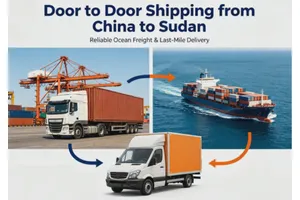
DDP (Delivered Duty Paid) — Best for first-time importers and SMEs If you don't have an existing relationship with a Sudanese customs broker and want a single, predictable all-in price, Door to Door Shipping from China to Sudan via DDP terms is your best option. The freight forwarder handles everything from Chinese factory pickup to final delivery at your warehouse in Khartoum — including all duties and taxes. You receive one invoice and one point of contact. The trade-off: DDP carries a premium because the forwarder assumes all destination risk.
CIF (Cost, Insurance & Freight) — Best for experienced importers with a local broker If you already work with a trusted customs clearance agent in Port Sudan and want to manage the destination side yourself, CIF gives you that control. The seller/forwarder delivers to Port Sudan with insurance included; you handle import clearance, duty/VAT payment, and inland transport. CIF typically saves 25–40% on the destination segment compared to DDP — but only if your local broker is efficient.
FOB (Free On Board) — Best for high-volume traders with carrier relationships If you have direct contracts with shipping lines or a preferred NVOCC, FOB lets you control ocean freight procurement. The seller delivers cargo to the vessel at the Chinese port; you nominate the carrier and manage everything from that point forward. This works well for companies shipping 10+ containers per year who can negotiate volume rates directly with carriers.
EXW (Ex Works) — Only for buyers with a China logistics team EXW places nearly all responsibility on the buyer. Only practical if you have staff or a dedicated agent in China who can handle factory pickup, export clearance, and port delivery. For most Sudan-based importers, EXW adds complexity without meaningful cost savings.
The Real Cost Difference: DDP vs. CIF for a 40HQ to Khartoum
To illustrate: on a 40HQ shipment of general merchandise (58 CBM, $30,000 cargo value) from Ningbo to Khartoum:
- CIF to Port Sudan: Approximately $7,800–$9,200 (ocean freight + insurance + China-side costs). You then pay ~$7,500–$9,500 on the Sudan side (clearance + duty + VAT + trucking). Total you manage: ~$15,300–$18,700 across two providers.
- DDP to Khartoum: One all-in price of approximately $12,000–$15,600 (the forwarder handles everything). You pay once, and the forwarder is accountable for the entire chain.
The DDP premium is modest — roughly $1,000–$2,500 on this shipment size — and buys you end-to-end accountability, reduced administrative burden, and no surprises at Port Sudan customs.
Sudan Customs Clearance: Import Duties, VAT & Required Documents
Sudan's customs process is manageable — but only if you walk in with the right paperwork, the correct HS Code classification, and realistic expectations about duties and taxes. Here's what you need to know.
The 5-Step Sudan Import Clearance Process
- Pre-Arrival Document Preparation (1–2 weeks before vessel arrival): Your freight forwarder submits a pre-alert to the Sudan Customs Authority with the Bill of Lading (B/L), Commercial Invoice, and Packing List. This allows customs to pre-classify your goods and flag any documentation issues before the container arrives.
- Import Declaration Filing (upon vessel arrival at Port Sudan): The customs broker files the official import declaration with HS Codes, cargo value, origin, and weight. Sudan uses the Harmonized System (HS) for tariff classification.
- Customs Inspection (1–3 days): Sudanese customs officers inspect the cargo — physically or via document review — depending on the HS Code risk profile and declared value. High-value electronics, used goods, and restricted categories trigger more thorough inspections.
- Duty & Tax Assessment and Payment (1–2 days): Customs calculates duty based on CIF value × duty rate, then VAT at 17% on top of (CIF + duty). Payment must be made before cargo is released.
- Release & Inland Delivery (1–3 days): Once duties and taxes are paid and the release order is issued, the container is loaded onto a truck for transport to Khartoum, Omdurman, Nyala, or your final destination.
Required Documents Checklist
| Document | Required? | Notes |
|---|---|---|
| Commercial Invoice | ✅ Mandatory | Must show detailed description, quantity, unit price, total value, and Incoterm |
| Packing List | ✅ Mandatory | Item-level breakdown with weights and dimensions per package |
| Bill of Lading (B/L) | ✅ Mandatory | Original or telex release; must match invoice and packing list exactly |
| Certificate of Origin | ✅ Mandatory | Issued by China Council for the Promotion of International Trade (CCPIT); may qualify for preferential treatment |
| SSA Conformity Certificate | ⚠️ Conditional | Required for regulated products (electrical goods, toys, certain construction materials); issued by Sudan Standards and Metrology Organization (SSMO) |
| Import License | ⚠️ Conditional | Required for restricted categories including pharmaceuticals, chemicals, food products, and telecom equipment |
| Insurance Certificate | ⚠️ Conditional | Required for CIF and DDP shipments; recommended for all shipments given Red Sea transit risk |
| Packing Declaration | ⚠️ Conditional | Required if wood packaging material is used (ISPM 15 compliance) |
Sudan Import Duty Rates by Product Category
Sudan applies ad valorem duties (percentage of CIF value) that vary by HS Code chapter. Below are indicative ranges based on Sudan's current tariff schedule:
| Product Category | Typical Duty Range | Common HS Chapters |
|---|---|---|
| Building Materials (tiles, stone, cement products) | 5% – 15% | 68, 69 |
| Machinery & Mechanical Equipment | 5% – 10% | 84 |
| Electrical Machinery & Electronics | 10% – 20% | 85 |
| Furniture & Bedding | 15% – 25% | 94 |
| Textiles, Clothing & Fabrics | 20% – 35% | 50–63 |
| Auto Parts & Vehicle Components | 10% – 20% | 87 |
| Plastic Products & Household Goods | 15% – 25% | 39 |
| Consumer Goods (miscellaneous) | 20% – 40% | Various |
Tax calculation formula: Total Tax = Customs Duty (Rate% × CIF Value) + VAT (17% × [CIF Value + Duty])
Common Customs Clearance Pitfalls (and How to Avoid Them)
- HS Code misclassification: A seemingly minor classification error can trigger a duty rate 2–3× higher than expected. Always have your forwarder review HS Codes against Sudan's national tariff before shipping.
- Undervaluation: Sudan Customs actively cross-references declared values against reference pricing databases. If they suspect undervaluation, they can reassess — often at a higher value than the actual transaction, plus penalties.
- Missing Certificates: SSA conformity certificates for regulated goods must be obtained before export from China. Trying to fix this after the container arrives at Port Sudan will result in weeks of delays and storage charges.
- Incomplete documentation: Even small discrepancies between the B/L, invoice, and packing list can hold up clearance. Professional freight forwarders run a pre-check on all documents before the vessel departs China.
Why DTFU Logistics for Your China–Sudan Container Shipping
When you're shipping containers through one of the world's most geopolitically sensitive maritime corridors, your freight forwarder's experience, carrier relationships, and destination-network depth directly determine whether your shipment arrives on time and on budget.
Why Importers Choose DTFU for Sudan Shipments
Multi-port coverage across China. Whether your supplier is in Guangzhou, Yiwu, Shanghai, or Qingdao, we arrange pickup and container loading from the nearest major port — Shenzhen, Guangzhou, Shanghai, Ningbo, or Qingdao — eliminating unnecessary inland trucking costs.
Direct carrier contracts. We hold direct service contracts with Maersk, MSC, CMA CGM, COSCO, and other major carriers on the Far East–Red Sea lane. This means first-tier rates, priority equipment release during container shortages, and real-time visibility on schedule changes.
Port Sudan destination network. Through our established local partner network in Port Sudan, we handle import clearance, duty/VAT payment, and inland delivery to Khartoum, Omdurman, Nyala, and beyond — with transparent, pre-agreed rates and no surprise fees.
Multi-supplier consolidation. Our Guangzhou consolidation warehouse receives goods from all your Chinese suppliers, palletizes and loads them into a single container, and ships them as one consolidated FCL shipment — saving you thousands compared to fragmented LCL shipping.
FIATA & IATA certified. Both certifications require demonstrated financial stability, professional competence, and adherence to international freight forwarding standards. Most freight forwarders on the China–Sudan lane carry neither.
Dedicated account management. Every client is assigned a dedicated account manager who tracks your shipment from booking to delivery and is available on WhatsApp for real-time updates — not a rotating pool of anonymous customer service agents.
DTFU vs. Typical Small Forwarder on the Sudan Lane
| Capability | Typical Small Forwarder | DTFU Logistics |
|---|---|---|
| Industry certification | Often none; no third-party quality verification | FIATA + IATA dual certified |
| Carrier relationships | Sub-contracted through 2–3 tiers of agents; limited leverage on rates and space | Direct contracts with major carriers; priority access |
| Sudan destination service | Re-sold to an unknown local agent; limited accountability | Established partner network in Port Sudan with transparent, pre-agreed pricing |
| Pricing transparency | Low headline rate plus surprise surcharges | All-in, line-by-line quotation with no hidden fees |
| Customer support | WeChat group or one-way notifications | 24/7 dedicated account manager + real-time online cargo tracking |
| Consolidation service | Unavailable or limited to one city | Guangzhou warehouse serving all of China; multi-supplier consolidation as a standard service |
Ready to ship? Contact our Sudan desk for a free, obligation-free all-in quote. Tell us what you're shipping, where your supplier is located, and your preferred delivery term (DDP, CIF, or FOB) — we'll respond within 24 hours with a transparent, line-by-line price breakdown. For time-sensitive cargo, we also offer Air Shipping from China to Sudan with consolidated air freight options.
Our Sudan desk also supports the broader Red Sea region. For importers expanding into North Africa, see our Shipping From China To Egypt services, 20ft & 40ft Container Cost from China to Egypt pricing guide, and DDP shipping from China to Egypt guide for comparable door-to-door solutions. For those sourcing goods destined for the Horn of Africa, our Shipping From China To Ethiopia page covers that key trade corridor.
FAQs
How much does it cost to ship a 20ft container from China to Sudan in 2026?
Port-to-port ocean freight for a 20GP container from China to Port Sudan ranges from approximately $3,800 to $5,800 depending on the departure port, carrier, and routing (Red Sea direct vs. Cape of Good Hope). For a DDP door-to-door delivery to Khartoum including all customs duties, VAT, and inland trucking, expect a total in the range of $8,500–$12,000 — the wide range reflects differences in cargo value (which drives duty/VAT) and final delivery distance.
How much does it cost to ship a 40ft container from China to Sudan?
Ocean freight for a 40GP or 40HQ container runs approximately $5,200–$8,100 port-to-port. Full DDP delivery to Khartoum typically totals $11,500–$16,200 depending on cargo type, declared value, and duty rate. A 40HQ generally costs only 10–15% more than a 40GP in ocean freight despite offering ~13% more volume — making it the best per-CBM value for volume cargo.
How long does shipping take from China to Port Sudan?
Transit time ranges from 28 to 50 days depending on your departure port and whether the vessel transits the Red Sea directly or diverts around the Cape of Good Hope. Shenzhen and Guangzhou offer the fastest connections (28–36 days via Red Sea), while Qingdao takes the longest (35–50 days). Plan for an additional 5–10 days at the destination for customs clearance and inland delivery to Khartoum.
Should I choose DDP or CIF for shipping to Sudan?
Choose DDP if you're a first-time importer, don't have a local customs broker in Sudan, or want a single predictable price with end-to-end accountability. Choose CIF if you have an established relationship with a Port Sudan customs agent and want to manage the destination side yourself — this can save $1,000–$3,000 per container if your local broker is efficient. For most Sudan-based importers without dedicated logistics staff, DDP provides better predictability and fewer administrative headaches.
Which Chinese port is cheapest for shipping to Sudan?
Shenzhen (Yantian/Shekou) and Guangzhou (Nansha) generally offer the most competitive ocean freight rates to Port Sudan due to their proximity to Southeast Asian transshipment hubs and higher service frequency. However, the right port depends on your supplier's location — a $300 ocean freight saving from Shenzhen is meaningless if it costs $1,500 to truck your cargo there from a Ningbo-area factory.
What documents do I need to import goods from China to Sudan?
At minimum, you need: Commercial Invoice, Packing List, Bill of Lading, and Certificate of Origin (issued by CCPIT in China). Depending on your product category, you may also need an SSA Conformity Certificate (regulated consumer goods), an Import License (pharmaceuticals, chemicals, telecom equipment, food), and wood packaging treatment certification (ISPM 15). Your freight forwarder should review your documentation package before the vessel departs China.
Can I ship LCL from China to Sudan?
Yes. LCL shipping to Port Sudan costs approximately $180–$280 per CBM and is economical for shipments under 13–15 CBM. Above that volume, booking your own 20ft FCL container becomes cheaper on a per-CBM basis and avoids LCL-specific drawbacks: destination deconsolidation fees, longer customs clearance (3–7 extra days), and higher damage risk from multiple handling events at the CFS.
What are the most common goods shipped from China to Sudan?
The main product categories shipped in containers from China to Sudan include: ceramic tiles and building materials, mechanical and electrical machinery, furniture (both residential and office), textiles and garments, auto spare parts, electronics and home appliances, plastic household products, and general consumer goods. Construction-related materials and machinery have been particularly strong categories given Sudan's ongoing infrastructure development.