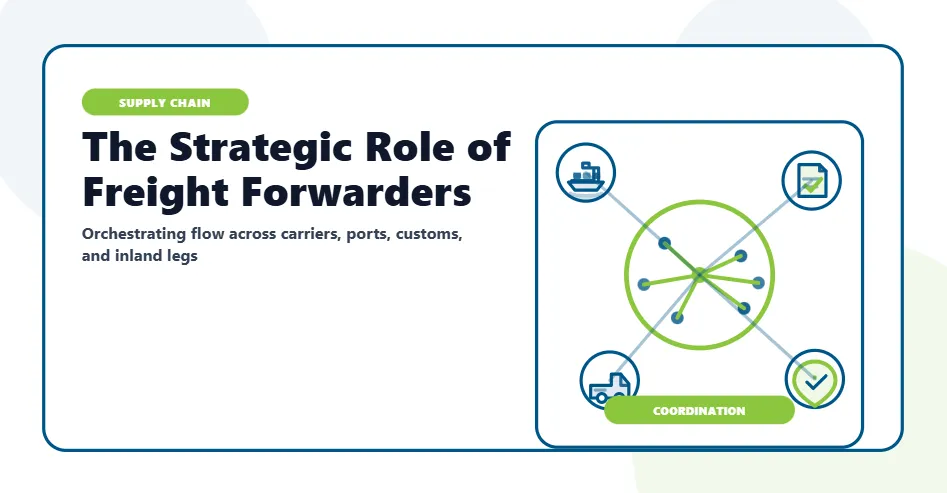
As global supply chains become more fragmented and time-sensitive, the biggest risk is rarely a lack of transport capacity—it is the failure to coordinate dozens of interdependent decisions across carriers, ports, customs, and inland legs. This is where freight forwarders have evolved from booking agents into strategic orchestrators of end-to-end flow. The sections below explain how and why that shift matters.
Freight Forwarding as a Supply Chain Function, Not a Transport Service
Academic research increasingly frames freight forwarding as a systemic supply-chain function, rather than a transactional transport activity.
Skiba and Karaś (2022), in The Changing Role of a Freight Forwarder in Modern Supply Chains, argue that the historical definition of freight forwarding — limited to organizing individual transport services — no longer reflects operational reality. Their analysis shows that modern freight forwarders operate across administrative, legal, financial, organizational, and economic dimensions of transport processes, especially in maritime supply chains.
This distinction is critical. Transport execution addresses movement. Freight forwarding addresses coordination.
In complex international supply chains, these two functions are no longer interchangeable.
Empirical Evidence: Market Growth Despite “Disintermediation” Pressure
A common assumption in the logistics industry is that digital platforms and direct carrier-to-shipper models are making freight forwarders obsolete.
However, empirical evidence does not support this conclusion.
Skiba and Karaś (2022) conducted a statistical analysis of sea freight forwarding demand in Poland, using reported revenue data from leading freight forwarding companies between 2019 and 2020. Their findings indicate:
- A general increase in revenue among major sea freight forwarders
- Continued demand growth despite carrier consolidation
- No structural decline in forwarding activity, even as shipping lines expand vertically
This suggests that while the form of freight forwarding is changing, the functional demand for coordination remains intact.
In other words, the market is not rejecting freight forwarders — it is rejecting low-value, execution-only intermediaries.
The Core Problem Identified by Research: Coordination Failure
One of the central contributions of the referenced study is its reframing of logistics risk.
Rather than viewing disruptions as isolated operational failures, the authors identify coordination failure as the dominant systemic risk in modern maritime supply chains.
According to the paper:
- International sea transport typically involves multi-channel, multi-branch flows
- Each participant (carrier, port, inland transport, customs, warehouse) optimizes locally
- Without centralized coordination, system-level inefficiencies accumulate
This aligns with the authors’ description of the freight forwarder as the “brain of the transport process” — responsible not for execution, but for designing, sequencing, and supervising interconnected activities.
From a supply-chain theory perspective, this positions the freight forwarder as a process architect, not a service reseller.
Carrier Integration vs Forwarder Neutrality: A Structural Trade-Off
The case study of A.P. Møller-Maersk in the paper provides a concrete example of vertical integration in action.
Maersk’s strategy — developing end-to-end digital platforms and contracting directly with cargo owners — is often interpreted as a threat to freight forwarders. Skiba and Karaś acknowledge this risk, but also highlight its structural limitation.
Their analysis implies a fundamental trade-off:
- Integrated carriers optimize for network efficiency and asset utilization
- Freight forwarders optimize for client-specific supply-chain outcomes
Because carriers operate within their own networks, their solutions are inherently path-dependent. Freight forwarders, by contrast, maintain network neutrality, enabling:
- Multi-carrier routing decisions
- Redundancy across service providers
- Dynamic reconfiguration in response to disruptions
From a system-design perspective, integration increases efficiency under stable conditions, while neutrality increases resilience under volatility.
Lean and Agile Supply Chains: Operational Concepts with Strategic Implications
The paper explicitly links the evolution of freight forwarding to lean and agile supply chain theory.
Skiba and Karaś (2022) emphasize that:
- Lean supply chains focus on waste elimination and process efficiency
- Agile supply chains prioritize responsiveness to demand and disruption
Crucially, both concepts depend on information flow, coordination, and decision speed, not merely transport capacity.
The authors argue that freight forwarders contribute to lean and agile supply chains by:
- Reducing redundant administrative operations
- Integrating information across supply-chain actors
- Enabling rapid re-routing and modal shifts
- Acting as a coordination interface between fragmented entities
This reframes freight forwarding as a capability-based function, where value is created through orchestration rather than ownership of assets.
Strategic Implications for Shippers
Synthesizing the research findings leads to several practical implications:
- Direct carrier solutions reduce intermediaries, but also reduce optionality
- Digital platforms improve execution speed, but do not replace decision intelligence
- Supply-chain resilience depends on coordination capability, not single-provider integration
For shippers operating in volatile markets, the cost of disruption often exceeds marginal transport savings. In such contexts, the freight forwarder’s role as coordinator becomes strategically essential.
DTFU Logistics: A Coordination-Driven Perspective
At DTFU Logistics, our operational philosophy aligns closely with the research-based view presented by Skiba and Karaś.
We approach freight forwarding as:
- A system-level coordination role
- A function focused on risk balancing, flexibility, and decision quality
- A mechanism for maintaining supply-chain continuity in unstable environments
Rather than optimizing individual transport legs, we focus on designing and managing transport processes as integrated systems.
Conclusion: Freight Forwarding as Supply-Chain Architecture
The referenced research makes one conclusion particularly clear:
Freight forwarders are not disappearing — they are evolving.
As global supply chains become more digital, integrated, and volatile, the need for neutral coordination, system design, and agile decision-making increases rather than diminishes.
The future of freight forwarding lies not in transactional execution, but in architecting supply chains that remain functional under pressure.


