Are you shipping three or five pallets to Hamburg and wondering whether $70 per cubic metre is the real number or just the first line of a longer invoice? LCL shipping from China to Germany is priced in four layers — ocean, origin handling, the German destination block and inland delivery — and what follows works through all four, plus the volume at which a 20ft container beats your pallets and the filings that decide whether the box sails.
The Planning Numbers for LCL to Germany in 2026
Treat an LCL shipment to Germany as a 38–50 day door-to-door project costing $500–900 for a single cubic metre and roughly $145–245 per CBM at five to six cubic metres, with the ocean leg itself only $55–90 of that. The gap between the headline rate and the delivered cost is the whole subject of this page, because the German destination block — de-consolidation, delivery order, ATLAS clearance, inland delivery — is charged per shipment rather than per cubic metre, and on a small lot it outweighs the freight.
Three numbers to plan with: ocean $55–90 per CBM, a fixed German block of roughly $395–700 per shipment, and a break-even against a 20ft container at 22–26 CBM for light cargo.
How LCL Moves from a Chinese Factory to a German Address
Consolidation is not a slower version of a container booking; it is a different chain with two handling points that a full container never sees.
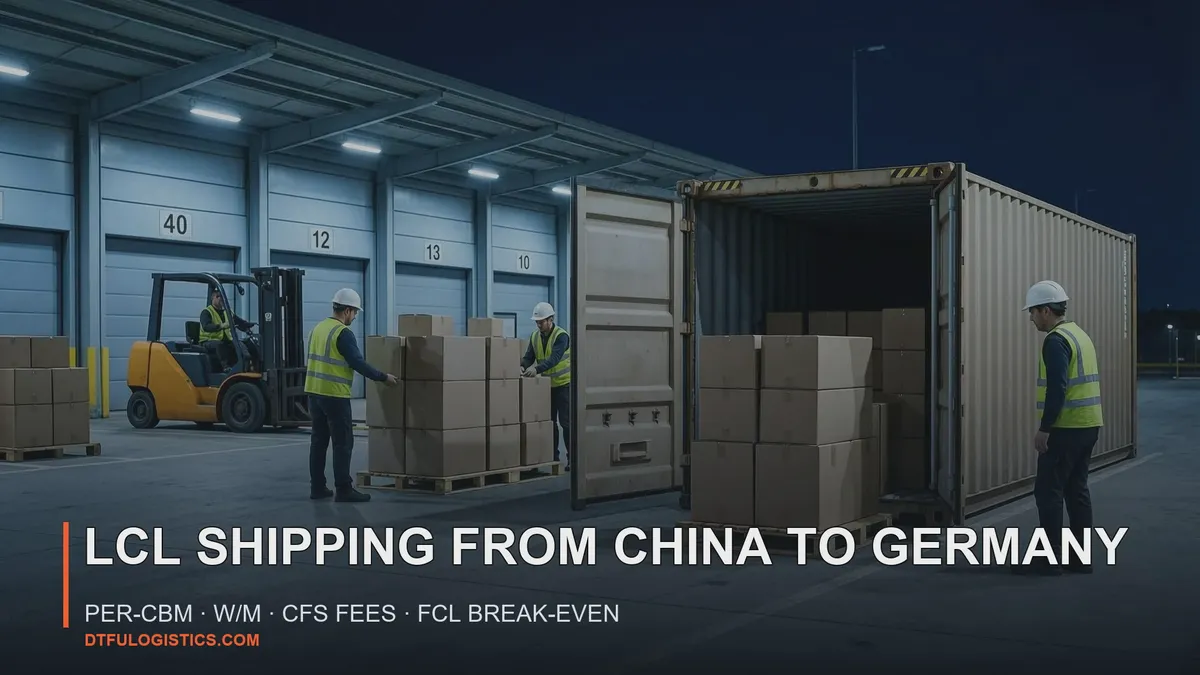
In China, your cartons are trucked to a consolidator's CFS near Shanghai, Ningbo, Shenzhen or Qingdao, received against a warehouse receipt, and co-loaded with other shippers' cargo into a 40ft box. That box ships to Hamburg or Bremerhaven, where it is devanned at a CFS in Billbrook, Waltershof or the Bremerhaven terminal area, and your cartons are placed on the floor for collection or onward trucking.
Two consequences follow. Your cargo is handled at both ends by people who are not your supplier, which makes packing quality a cost decision rather than a housekeeping one. And the schedule belongs to the consolidator, not to you: CFS cut-offs typically fall 3–7 days before the vessel sails, so the sailing date you are quoted is not the date your cargo starts moving.
The container itself may route either way. Suez is substantially back for Asia–Europe traffic through 2026 — Drewry counted 53 vessel transits in the week to 12 November 2026 — but carriers keep reroute rights, so a confirmed booking can still sail via the Cape. Ask which routing the quote assumes before you commit to a delivery date, because the difference is 10–12 days. The port-by-port scheduling picture for the box your cartons share is on the sea shipping from China to Germany page.
LCL Rates from China to Germany: Per CBM, and What FCL and Air Cost
The ocean rate is the only figure that genuinely moves week to week. Everything else on this lane is a published tariff that changes once a year. The bands below are the levels DTFU books at out of Shanghai, Ningbo and Nansha this quarter, shown at the low end of what the market supports rather than at the top of it.
Service | 2026 rate | Scope | Minimum |
|---|---|---|---|
LCL, Shanghai to Hamburg or Bremerhaven | $55 – $75 per CBM | Ocean freight, port-to-port | 1 CBM |
LCL, Ningbo or Shenzhen to Hamburg | $65 – $85 per CBM | Ocean freight, port-to-port | 1 CBM |
LCL, Qingdao or Nansha (Guangzhou) to Hamburg | $75 – $90 per CBM | Ocean freight, port-to-port | 1 CBM |
FCL 20GP to Hamburg or Bremerhaven | $2,000 – $2,800 | Port-to-port, surcharges excluded | One box |
FCL 40GP or 40HQ to Hamburg or Bremerhaven | $3,300 – $5,000 | Port-to-port, surcharges excluded | One box |
FCL 45HQ | $4,200 – $6,000 | Port-to-port, surcharges excluded | One box |
Air freight, PVG / CAN to FRA / MUC | $5.00 – $6.50 per kg at 45–100 kg; $4.50 – $6.00 at 100–300 kg; $4.00 – $5.50 above 300 kg | Airport-to-airport | 45 kg |
Express courier | $7 – $12 per kg | Door-to-door | Under 45 kg |
Door-to-door all-in, duty and VAT excluded | $500 – $900 for 1 CBM; $3,800 – $5,200 for a 20ft; $6,200 – $8,500 for a 40ft | Origin, ocean, destination, clearance, delivery | One shipment |
Read the LCL rows against the market and they sit inside it: MSC's published FAK level for the Far East to North Europe from 15 November 2026 was $3,220 per 20ft and $4,600 per 40ft, and Drewry assessed Shanghai–Rotterdam at $3,504 per 40ft on 12 November. Those are spot container prices, not LCL — but they tell you a 20ft is not expensive this quarter, which is why the break-even discussion later on this page matters more than the per-CBM rate.
Two things move the number you will actually be quoted. Peak-season surcharges run roughly August to December on the Asia–Europe headhaul, and the fortnight after Canton Fair closes is the tightest booking window of the South China year. The cheapest window is usually February to April, immediately after Chinese New Year. Guangzhou origins sit $100–200 above Shanghai on the same week because fewer direct Europe calls sail from Nansha, as the shipping from Guangzhou to Germany guide sets out; the box-size arithmetic for the rows above is in 20ft and 40ft container cost from China to Germany.
The German Destination Fee Stack a Per-CBM Quote Leaves Out
Three forwarders can quote $60, $95 and $180 per CBM for the same delivery and all three can be telling the truth, because the scopes differ. This is what sits underneath an all-in rate. German charges are invoiced in euros; the arithmetic on this page converts at $1.10, so re-check the rate on the day you book.
Charge | What it is | Typical amount |
|---|---|---|
De-consolidation and CFS handling | Devanning your cartons at Hamburg or Bremerhaven, plus the per-CBM handling levy | EUR 45 – 90 per shipment, plus EUR 8 – 15 per CBM |
Delivery order and bill release | The document that lets the CFS release your cargo | EUR 30 – 60 per shipment |
Customs clearance and ATLAS entry | The German agent files the import declaration and settles import VAT | EUR 80 – 150 per shipment |
Inland delivery, Hamburg to a German address | 1–3 CBM; 4–10 CBM; 11–15 CBM | EUR 120 – 280; EUR 250 – 420; EUR 380 – 600 |
Storage after free time | CFS or terminal storage once free days lapse, usually 3–5 calendar days | EUR 5 – 12 per CBM per day |
Pallet exchange | EPAL exchange or one-way pallet disposal | EUR 15 – 25 per pallet |
The fee that catches small shippers is the de-consolidation minimum. A 1 CBM shipment pays the same EUR 45–90 floor as a 9 CBM shipment, which is why the per-CBM cost curve flattens fast and then stops falling. A 1 CBM delivery with the full stack adds up to $470–830 before insurance; with cover and a booked delivery slot it lands inside the $500–900 band the rate table above quotes. At 6 CBM the same stack spreads to $145–245 per CBM; at 15 CBM it is $100–175.
The other structural point is that German LCL quotes from China almost never include the de-consolidation fee or the delivery-order fee. They are billed to the consignee on arrival, which is how a shipment quoted at $62 per CBM invoices out at $110.
The W/M Rule: When Your Cargo Bills by Weight Instead of Volume
LCL is priced on revenue tons: one cubic metre or 1,000 kg, whichever is greater. Most cartoned consumer goods run 150–250 kg per CBM and never touch the weight side. Dense cargo does, and the effect is not subtle.
Cargo | kg per CBM | 6 CBM bills as | Effective rate change |
|---|---|---|---|
Cartoned homeware, apparel, packaging | 150 – 250 kg | 6 CBM | None |
Ceramics, glassware, hardware | 400 – 700 kg | 6 CBM | None |
Printed matter, books | 800 – 950 kg | 6 CBM | None |
Tile, stone, machinery parts | 1,200 – 2,000 kg | 7.2 – 12 CBM | +20% to +100% |
Steel fixings, castings | 2,500 kg and up | 15 CBM | +150% |
The weight side also changes the decision rather than just the price. Because the weight rule inflates the variable part of the invoice, heavy cargo reaches the cost of a container sooner: at 2,000 kg per CBM the LCL-versus-20ft break-even drops from 22–26 CBM to roughly 12 CBM. If your product is dense, price the container before you accept a per-CBM rate. The general mechanics of a less than container load booking, and how a full container load is priced against it, are worth ten minutes before you compare quotes.
Declare weight accurately. German CFS stations reweigh on receipt, and a corrected weight is re-billed at the higher revenue ton without discussion — plus the VGM (verified gross mass) figure the carrier needs has to be right before loading, since a wrong declaration can pull a container off the vessel.
LCL or FCL to Germany: Where the Break-Even Actually Sits
The 13–15 CBM figure you see repeated on this lane is a Europe-internal rule of thumb that survives because nobody shows the arithmetic. On 2026 rates it is wrong by roughly 10 CBM.
LCL door to door on this lane behaves as V × ($75–128) + ($395–700): ocean $55–90, origin CFS $10–20 and German handling $10–18 per CBM, plus the fixed block of de-consolidation minimum, delivery order, clearance and the base inland delivery. A 20ft container on the same scope — door to door, duty and VAT excluded — lands at $3,800–5,200 across about 28 usable CBM.
Volume | LCL door to door | 20ft FCL door to door | Verdict |
|---|---|---|---|
1 CBM | $500 – 870 | $3,800 – 5,200 | LCL |
3 CBM | $620 – 1,080 | $3,800 – 5,200 | LCL |
6 CBM | $845 – 1,470 | $3,800 – 5,200 | LCL |
10 CBM | $1,145 – 1,980 | $3,800 – 5,200 | LCL |
15 CBM | $1,520 – 2,620 | $3,800 – 5,200 | LCL, comfortably |
20 CBM | $1,895 – 3,260 | $3,800 – 5,200 | LCL, unless the cargo is fragile |
25 CBM | $2,270 – 3,900 | $3,800 – 5,200 | Price both; the bands overlap |
28 CBM | $2,495 – 4,284 | $3,800 – 5,200 | FCL |
The crossover band is 22–26 CBM, with 24 CBM as the planning number for light cargo. Above 28 CBM the container wins on cost, time and handling — and the 40HQ is only $200–300 more than a 40GP while adding about 12 CBM, so once you are past 34 CBM the high cube is the right box. The full fee anatomy behind both columns, mode by mode, is in shipping cost from China to Germany.
Three exceptions override the arithmetic. Cargo over 1,000 kg per CBM, as above, reaches the container's price at around 12 CBM. Fragile or high-value goods rarely belong in a co-loaded box regardless of volume, because the saving of a few hundred dollars does not cover one damaged pallet. And anything with a hard delivery date should not be on a consolidation at all — the CFS wait at each end is the part of the schedule you cannot control.
ICS2, ATLAS and the 2026 EU Rules That Touch Consolidated Cargo
An LCL booking generates more declarations than a container booking, and a rejected one stops the cargo as effectively as a customs hold.
ICS2 Release 3, house-level ENS. Since the maritime release completed on 1 September 2025, the forwarder must file entry summary data at house-bill level before loading. On a consolidation that means one filing per house bill, not one per container. A rejected ENS means the box does not sail, and re-filing pushes it to the next vessel.
ATLAS entry and EORI. The German agent files the import declaration under your EORI — a Chinese EORI does not clear Germany. Without an EU EORI the shipment clears under the forwarder's, which is DDP by accident rather than by design, with all the duty-recovery consequences that carry.
Import VAT at 19%. Charged on the customs value plus duty, and it is recoverable if you are VAT-registered in Germany. If you are not established in the EU, the VAT is payable at import unless you appoint a fiscal representative, and that cash sitting in the customs account for four to eight weeks is the real reason a DDP-to-Germany quote looks expensive next to a UK or US one.
The €150 de minimis is gone. Since 1 July 2026, consignments of up to €150 intrinsic value pay €3 duty per import-declaration line; from 1 November 2026 a Union Handling Fee of €2 per declaration line applies on top, regardless of value. This is a parcel-flow rule — a consolidated LCL shipment is a normal commercial entry and pays duty on the real customs value. For a seller currently shipping twenty cartons as twenty parcels, converting to one LCL entry removes the per-line charges entirely, which is one of the few places where consolidation got more attractive in 2026 rather than less.
Packaging registration. VerpackG was replaced by VerpackDG on 12 August 2026, implementing the EU packaging regulation. LUCID registration is now anchored in PPWR Article 44 and the dual-system contract remains mandatory. Authorities and compe*****s can demand the LUCID number; a shipment without it risks a distribution ban, not just a fine.
GPSR and product rules. Since 13 December 2024 consumer products need a named EU responsible person on the product or packaging, with a contact address. CBAM applies from 1 January 2026 to steel, aluminium and cement above 50 tonnes a year, and EUDR due-diligence obligations start on 30 December 2026 for wood, paper and much furniture and packaging.
None of these are freight problems, and all of them stop cargo. A forwarder who only quotes per-CBM and hands you to a broker at the destination is leaving you to discover them at the worst moment. The customs clearance file should be opened at booking — HS code, EORI, LUCID number, responsible person — not on the day the container is stripped. If you would rather not hold the EORI and the VAT account yourself, the trade-off of clearing under a forwarder's name instead is set out in DDP shipping from China to Germany.
A Landed-Cost Example: 6 CBM of Textiles into Hamburg
The shipment: 2,400 bed linen sets, HS 6302.21, 0.0025 CBM each, 6 CBM and 1,200 kg gross, FOB Shanghai $4.00 per set, LCL to Hamburg, delivered 40 km inland.
Line | Basis | USD | Per set |
|---|---|---|---|
Goods, FOB Shanghai | 2,400 sets at $4.00 | 9,600.00 | 4.00 |
Ocean LCL | 6 CBM at $70 | 420.00 | 0.18 |
Origin CFS and export declaration | Fixed block | 120.00 | 0.05 |
Marine insurance | 0.4% of FOB | 38.40 | 0.02 |
Customs value (CIF) | Goods plus freight and insurance | 10,058.40 | 4.19 |
Duty at 12% | On the $10,058.40 customs value | 1,207.01 | 0.50 |
Import VAT at 19% | On $11,265.41 duty-paid value | 2,140.43 | 0.89 |
German de-consolidation | Per shipment plus per-CBM handling | 70.00 | 0.03 |
Delivery order and documents | Fixed | 50.00 | 0.02 |
ATLAS clearance | Broker and declaration | 130.00 | 0.05 |
Inland delivery | Hamburg to a 40 km address | 220.00 | 0.09 |
Net landed cost, VAT excluded | Duty recoverable, VAT recoverable | 11,855.41 | 4.94 |
Two numbers matter in that table. The border charge — duty plus import VAT — is $3,347.44, or 33% of the customs value, and only the $1,207 of duty is a permanent cost; the VAT is a cash-flow item for a registered importer. And the German destination block at $470 is larger than the ocean freight at $420. On small LCL shipments the freight is almost never the biggest line, which is why negotiating $5 off the per-CBM rate is a poor use of a week — the two lines DTFU quotes as a separate block, de-consolidation and clearance, are where the invoice is decided.
Note the valuation basis: EU duty is assessed on the customs value, which includes international freight and insurance to the EU border — the opposite of the US rule. Cutting the freight bill therefore also cuts your duty, slightly, whereas paying for a faster routing raises both.
Transit Time to Hamburg and Bremerhaven, and Where the Week Goes
Port-to-port sailing days are the figure that gets quoted and the least useful one. Door to door on LCL is 38–50 days, and the eight to fourteen days outside the ocean leg are structural.
Leg | Days | What happens |
|---|---|---|
Supplier to origin CFS | 1 – 3 | Trucking, receiving, measuring, warehouse receipt |
Consolidation wait at origin | 3 – 7 | Cargo waits for the box to fill and for the CFS cut-off |
Nansha, Shekou, Shanghai or Ningbo to Hamburg, via Suez | 28 – 36 | Direct or single transshipment |
Same leg via the Cape | 42 – 48 | Reroute; carriers keep the right to choose |
De-consolidation in Hamburg or Bremerhaven | 2 – 4 | Devanning, sorting, release against the delivery order |
Clearance | 1 – 3 | ATLAS entry, possible inspection |
Inland delivery | 1 – 3 | Hamburg to most German cities |
Door to door, LCL | 38 – 50 | |
Door to door, FCL | 33 – 45 | Two fewer handling stages |
Rail via Malaszewicze, door to door | 26 – 34 | Real variance; a space-crunch substitute, not a default |
Air, door to door | 5 – 8 | Plus 1–2 days for pickup and delivery |
Hamburg is the usual gateway for South China cargo and has the densest German rail network behind it, but it is also the constrained one: HHLA moved 2.959 million TEU in the first half of 2026, down 6.7%, while terminal modernisation limits berth and yard productivity. Budget one to three extra days from arrival to container availability, and expect it in the weeks either side of Golden Week. Bremerhaven is the alternative on services that skip Hamburg, with a competitive inland leg to Bavaria.
Free time matters at both ports. Five to seven calendar days is typical, weekends count, and an eight-day-late 40ft runs EUR 400–700 in storage and demurrage. On LCL your cartons accrue storage per cubic metre per day, which is cheaper in absolute terms but starts sooner. The mode-by-mode transit comparison, including why the sailing figure on a quote is the least reliable number, sits in how long does shipping from China to Germany take.
Packing and Claiming on Co-Loaded Cargo
LCL cargo is stacked with other shippers' freight, devanned twice, and transferred between equipment it was not packed for. The failure mode is almost always compression, not impact.
Five-ply cartons, no carton over 20–25 kg, and a pallet for anything above 1.5 CBM. Wood packaging needs the ISPM-15 mark — Germany enforces it, and a missing stamp sends the shipment to fumigation at your cost and the queue's pace. Photograph the pallet at the origin CFS before loading and again on release in Hamburg: a claim without a before-and-after photo pair is a conversation, not a case.
Carrier liability on a co-loaded bill is limited — under the Hague-Visby limits it works out at a few dollars per kilogram, which on textiles covers a fraction of the goods value. Cargo insurance for shipping from China at 0.2%–0.5% of insured value is the only cover that returns the invoice value, and it is the line shippers skip on exactly the shipments where a claim would hurt.
Two smaller habits save money. Ask for the CFS free days in writing before the box arrives, because German CFS storage is charged per CBM per day and a delayed delivery order turns a cheap shipment expensive. And consolidate your own suppliers into one CFS in China — two origin warehouses mean two sets of origin charges and two de-consolidations, which is the most common way a well-priced LCL quote doubles.
If the arithmetic points to LCL, DTFU books it against the consolidator allocations we hold out of Shanghai, Ningbo and Nansha and quotes the German destination block as a line rather than leaving it for the consignee to discover — the sea freight from China service page covers the port and schedule side, and the shipping from China to Germany lane page carries the destination detail.
LCL Shipping from China to Germany FAQ
How much does LCL shipping from China to Germany cost per CBM in 2026? Ocean freight is $55–90 per CBM depending on origin — Shanghai lowest, Qingdao and Nansha highest — with a one-CBM minimum. Delivered door to door, a single cubic metre costs $500–870 and a six-CBM shipment $845–1,470, because the German destination block of de-consolidation, delivery order, clearance and inland delivery is charged per shipment.
What is not included in a per-CBM LCL quote? De-consolidation at the German CFS (EUR 45–90 plus EUR 8–15 per CBM), the delivery-order fee (EUR 30–60), ATLAS clearance (EUR 80–150), inland delivery (EUR 120–600 depending on volume and distance), storage after 3–5 free days, and duty and import VAT. Most China-side LCL quotes include none of these.
How long does LCL take from China to Germany? 38–50 days door to door: 1–3 days to the origin CFS, 3–7 days of consolidation wait, 28–36 days sailing to Hamburg via Suez (42–48 via the Cape), 2–4 days de-consolidation, 1–3 days clearance and 1–3 days inland delivery.
At what volume is a 20ft container cheaper than LCL? At 22–26 CBM for light cargo, with 24 CBM as the planning number. A 20ft door to door is $3,800–5,200 against LCL at roughly V × ($75–128) plus a $395–700 fixed block. The widely quoted 13–15 CBM figure compares per-CBM freight to a container's ocean rate and ignores the destination block.
What is the W/M rule and will my cargo bill by weight? LCL bills the greater of one cubic metre or 1,000 kg. Cartoned consumer goods at 150–250 kg per CBM never touch it; tile, stone and machinery parts at 1,200–2,000 kg per CBM bill at 20–100% more volume than they occupy, which also pulls the FCL break-even down to about 12 CBM.
Do I need an EORI number to import into Germany? Yes. A Chinese EORI does not clear Germany — you need an EU EORI, and without one the shipment clears under the forwarder's number, which makes the forwarder the importer of record and leaves you unable to recover duty.
How is import VAT handled on an LCL shipment? At 19% on the customs value plus duty, paid at import and recoverable if you are VAT-registered in Germany. A non-established importer either pays the VAT at clearance and reclaims it later or appoints a fiscal representative. Duty is permanent; VAT is cash flow.
Is LCL still worth it now that the €150 de minimis is gone? Precisely because it is gone. Since 1 July 2026 consignments up to €150 pay €3 duty per declaration line, and from 1 November 2026 a €2 Union Handling Fee per line applies on top. Twenty cartons sent as twenty parcels pay those fees twenty times; the same twenty cartons consolidated into one LCL entry pay one normal entry on the real customs value.
What packaging does LCL cargo to Germany need? Five-ply cartons, no carton above 20–25 kg, palletised above 1.5 CBM, and ISPM-15 marked wood packaging. Germany enforces the ISPM-15 stamp, and a missing mark means fumigation at your cost.
Who pays if my cartons arrive damaged? The carrier's liability under the bill of lading is capped at a few dollars per kilogram, which rarely covers goods value. Cargo insurance at 0.2%–0.5% of insured value is what pays, and you need before-and-after photos from the origin CFS and the German de-consolidation to support the claim.
Can I ship batteries or liquids as LCL to Germany? Only with a consolidator that accepts dangerous goods, and not on every service. Lithium cells need UN38.3 test summaries, an MSDS and often a DG declaration; many LCL co-loaders refuse Class 9 outright, so declare the cargo at booking rather than at the CFS.
When should I not use LCL? Three cases: cargo above 1,000 kg per CBM, where the weight rule erases the saving; high-value goods that should not be handled twice; and anything with a hard date, because the CFS wait at each end is outside anyone's control. In those cases a 20ft, a 40HQ or air is the cheaper answer once the risk is priced.
If you want your own shipment modelled — CBM against revenue tons, the German destination block, duty on the CIF value and the point where a container takes over — send the carton dimensions and the destination postcode through the contact page and we will put both options side by side on one page.