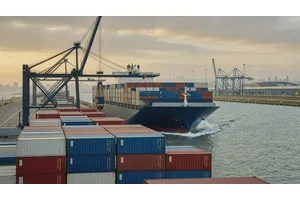
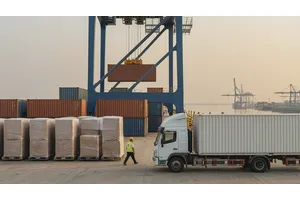
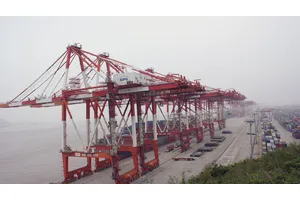
Are you shipping from Guangzhou to Germany this quarter and getting quotes that differ by a thousand dollars for the same cartons? This guide sets out what this lane really costs in late 2026, how Nansha compares with Yantian as a loading point, how your box reaches Hamburg or Bremerhaven, and which German compliance rules now hold cargo at the border.
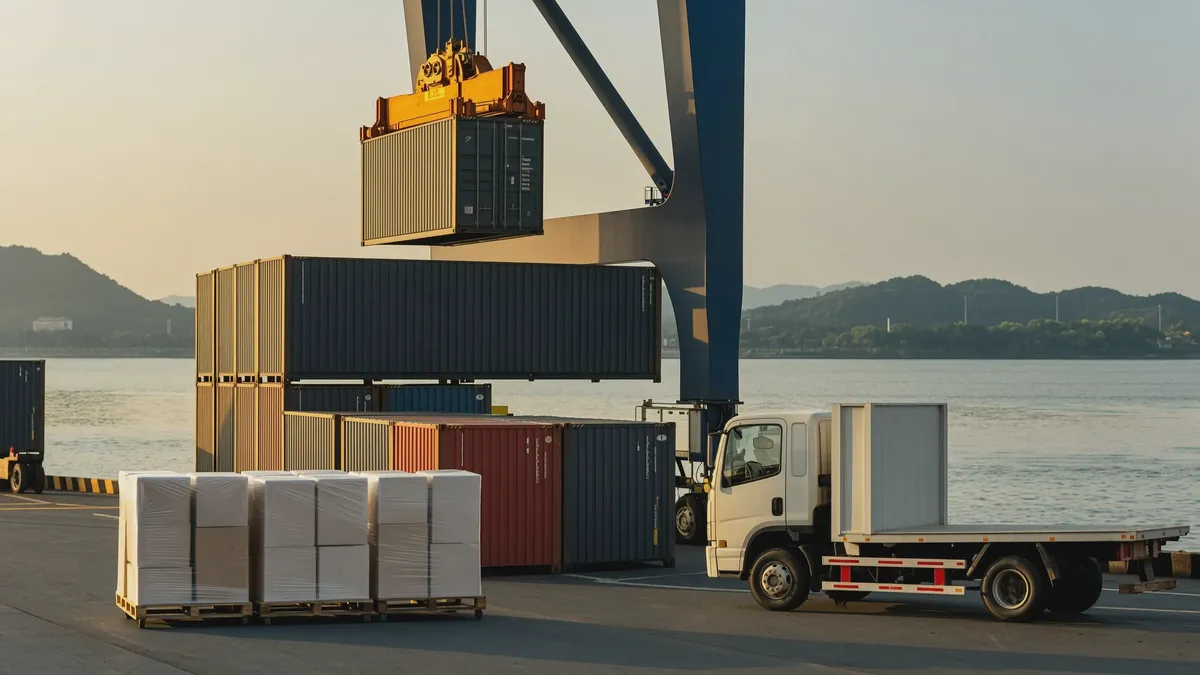
Shipping from Guangzhou to Germany at a Glance (October 2026)
Guangzhou is a sourcing city first and a loading port second, and that shapes the whole lane. The goods are often bought across a dozen small workshops in Panyu, Huadu or Zengcheng, consolidated in a warehouse in Baiyun or Huangpu, and only then does anyone think about a vessel. On the German side the box lands at a port that is running behind schedule, in a market where the paperwork gates tightened twice in the past twelve months.
| Mode | Cost right now (late Oct 2026) | Transit | Best for |
|---|---|---|---|
| Sea FCL, 20ft | $2,000 – $2,900 port to port | 30 – 36 days Nansha–Hamburg | 15 – 27 CBM of dense cargo |
| Sea FCL, 40HQ | $3,400 – $4,900 port to port | 30 – 36 days | 55 – 66 CBM of light goods |
| Sea LCL | $55 – $90 per CBM | 34 – 42 days port to port | Under 12 – 14 CBM |
| Air freight, CAN–FRA | $4.00 – $6.50 per kg | 2 – 4 days airport to airport | Restocks, samples, high value |
| Rail via Xi'an or Zhengzhou | $4,500 – $7,000 per 40ft | 26 – 34 days to Duisburg | Seasonal stock during space crunches |
Those figures are port to port. Add pickup inside Guangzhou, export declaration, German clearance and the last leg and a 20ft door-to-door delivery usually lands between $3,800 and $5,200 depending on how far inland the consignee sits.
How Much Does Shipping from Guangzhou to Germany Cost?
Ocean pricing on this lane splits by container size far more than by carrier. The four strings that matter out of Nansha are all alliance services calling Hamburg or Bremerhaven, and their spread on the same week is typically $150–$300 on a 40HQ — enough to matter on a single box, not enough to justify chasing a schedule that misses your delivery date.
| Container | Capacity | Nansha → Hamburg / Bremerhaven | Transit |
|---|---|---|---|
| 20ft (20GP) | 28 CBM / 21.7 t | $2,000 – $2,900 | 30 – 36 days |
| 40ft (40GP) | 56 CBM / 26.5 t | $3,300 – $4,600 | 30 – 36 days |
| 40HQ | 68 CBM / 26.5 t | $3,400 – $4,900 | 30 – 36 days |
| 45HQ | 78 CBM | $4,200 – $6,000 | 30 – 38 days |
The Shanghai Containerized Freight Index put Shanghai–North Europe at $3,547 per 40ft in its 23 October 2026 reading, and Nansha usually prices $100–$200 above Shanghai on the same week because there are fewer direct Europe calls. Anything quoted far below $3,000 for a 40HQ in the fourth quarter is normally a rate without a named vessel, or one that excludes the peak season surcharge that appears later on the invoice. If you are sizing a box rather than a rate, the 20ft and 40ft container cost breakdown covers the capacity maths.
LCL from Guangzhou to Hamburg is quoted per revenue ton, whichever is greater between cubic metres and tonnes:
| Volume band | Rate per CBM | Notes |
|---|---|---|
| 1 – 5 CBM | $85 – $90 | Minimum 1 CBM, minimum charge often 2 CBM |
| 6 – 14 CBM | $65 – $80 | Weekly co-loader sailings from Nansha |
| 15 CBM+ | $55 – $70 | Usually cheaper to take a 20ft |
Two destination charges surprise first-time importers: the German CFS de-consolidation fee (typically EUR 45–90 per shipment) and the delivery order fee, both billed in euros after arrival and neither visible on a Chinese CBM quote. On a 3 CBM shipment those two lines can add 15–20% to the price of getting the goods to a Hamburg warehouse.
Air freight from Guangzhou Baiyun to Frankfurt prices by chargeable weight, with volumetric weight at 1:6,000 for most scheduled carriers:
| Weight bracket | Rate per kg | Typical transit |
|---|---|---|
| 45 – 100 kg | $5.00 – $6.50 | 2 – 4 days |
| 100 – 300 kg | $4.50 – $6.00 | 2 – 4 days |
| 300 kg + | $4.00 – $5.50 | 2 – 4 days |
Door to door, the lane prices like this in practice: 1 CBM of LCL sea around $500–$900, a 20ft container $3,800–$5,200, a 40ft $6,200–$8,500, and 100 kg by air $900–$1,450. Those all-in numbers include origin handling, freight, clearance and delivery but not duty or import VAT, which are calculated on arrival at the German customs value.
How Long Does Shipping from Guangzhou to Germany Take?
Routing is the variable, not distance, because the wider China–Germany sea freight picture now changes month by month. Since the Red Sea attacks of 2023 the Asia–Europe services have alternated between Suez and the Cape of Good Hope, and both routings are live in the second half of 2026: Maersk and Hapag-Lloyd moved their first Gemini service back through Suez in July 2026, and MSC has been adding east–west strings back through the canal month by month. A booking made today may sail either way.
| Routing | Nansha → Hamburg | Nansha → Bremerhaven |
|---|---|---|
| Suez Canal | 30 – 36 days | 31 – 37 days |
| Cape of Good Hope | 42 – 48 days | 43 – 49 days |
| Air, CAN → FRA | 2 – 4 days | — |
| Rail, Guangdong → Duisburg | 26 – 34 days door to door | — |
Ask which routing your quote assumes, in writing. The difference of ten to twelve days is what decides whether November stock reaches a German retailer before the Christmas cut-off, and carriers retain the right to reroute on security grounds even on a confirmed booking.
Two smaller things eat days on this lane. First, Nansha's cut-off for Europe strings is usually 48 hours before vessel departure and the port closes receivals on the day before that, so a supplier who delivers at 5 pm on Friday can miss a Monday sailing. Second, Hamburg is not running at full capacity: HHLA handled 2.96 million TEU in the first half of 2026, down 6.7%, while terminal modernisation works constrained berth and yard productivity, and the group issued a profit warning. Expect 1–3 extra days between vessel arrival and container availability, more during a labour action or a storm surge in the Elbe.
Nansha or Yantian: Where Your Guangzhou Cargo Should Actually Load
Guangzhou Port Group moved 28.05 million TEU in 2025, up 6.1%, and Nansha alone accounted for 22.25 million TEU, up 10.2% — the fastest growing deep-water gateway in South China, and the only one on the western side of the Pearl River Delta.
The rule our desk applies is simple. If your cargo is ready in Guangzhou, Foshan, Zhongshan or Jiangmen, Nansha wins on trucking economics: a 40HQ from Panyu or Baiyun reaches the terminal in 45–75 minutes, and from Foshan in about 90. If your supplier is in Dongguan or Shenzhen, or your buyer's contract specifies a carrier that only calls Yantian, truck to Yantian instead — roughly two hours and 140 km from central Guangzhou, $180–$260 for a 40HQ, and often $100–$200 lower ocean freight that pays the trucking back.
Smaller shipments have a third option: barge. Feeder barges run from Huangpu and Xinsha down to Nansha and Hong Kong, which lets a supplier hand over cargo at a river terminal near the factory and lets the box be stuffed at the deep-water port. It saves trucking on heavy cargo and it keeps your cargo out of Guangzhou traffic during the Canton Fair, when the roads around Pazhou are unusable for half the day. DTFU books space on those Nansha strings every week and will tell you at quotation stage whether a partial load belongs in a shared LCL container or should wait for a box.
What nobody warns you about is the stuffing location. Guangzhou is full of small workshops that will happily pack 20 CBM into a container in their own yard with no lashing, no humidity control and no weight distribution plan. German consignees increasingly photograph containers on arrival for insurance purposes, and an unstuffed box that arrives with collapsed cartons becomes a claim the shipper loses — which is why cargo insurance is priced per shipment rather than assumed. Consolidation under a forwarder's roof in Guangzhou, with the loading supervised and photographed, costs $80–$150 more and removes that argument.
Which German Port Takes Your Container, and What Happens After It Lands
Hamburg handles the majority of South China cargo bound for Germany, and for good reason: of the German ports it has the densest daily rail network into Bavaria, Baden-Württemberg and Austria. Bremerhaven, 100 km west along the Weser, is the alternative on services that skip Hamburg, and Wilhelmshaven takes the deepest drafts and out-of-gauge cargo that will not fit a standard stack.
From Hamburg the inland leg decides your real delivery date. A container released at the terminal can be railed to Munich in 2–3 days, to Nuremberg or Stuttgart in 2 days, and trucked to Berlin in a day and a half; deliveries into eastern Germany or Poland often move by rail to a terminal near the border. For a consignee in Bavaria, Bremerhaven and Hamburg are within a few hundred euros of each other on the inland leg, so pick the port your carrier calls rather than the one that looks closer on a map.
Free time at the German terminal is short: typically 5–7 calendar days from discharge before storage starts, and the clock runs through weekends. German terminals also bill in euros at rates that climb quickly — a 40ft container sitting eight days past free time in Hamburg can cost EUR 400–700 in storage plus a demurrage charge from the carrier. Since German importers frequently clear through a customs agent they have used for years, the practical advice is to have the EORI, the commercial documents and the HS classification in the agent's hands before the vessel berths, not after. Where the consignee has no agent, a door-to-door service that covers clearance and delivery is often cheaper than improvising one on arrival.
Import Duty, VAT and the 2026 Carbon and Packaging Rules
Germany applies the EU's common external tariff on the customs value, which is the transaction value of the goods plus international freight and insurance up to the EU border. Duty rates for typical Guangzhou exports are unremarkable; the add-ons are not.
| Product | HS heading | Duty rate | Notes |
|---|---|---|---|
| Furniture | 9403 | 2.7% | EUDR due-diligence applies from 30 Dec 2026 for wood content |
| Clothing and textiles | 61 – 62 | 12% | Quota-free but origin rules checked |
| Footwear | 64 | 8 – 17% | Up to 16.5% for textile uppers |
| Consumer electronics, laptops | 8471, 85 | 0 – 4% | CE marking and GPSR apply |
| E-bikes | 8711 60 | 6% + anti-dumping | AD 10.3 – 70.1% plus countervailing 3.9 – 17.2% |
| Aluminium and steel articles | 73, 76 | 0 – 12% | CBAM declarant status above 50 t a year |
Import VAT (Einfuhrumsatzsteuer) is 19% of the customs value plus duty, and a VAT-registered German importer reclaims it in the monthly return. That is the single most misunderstood number on this lane: a Chinese supplier quoting DDP to a German customer is usually financing 19% of the goods value for four to eight weeks, which is why DDP into Germany is priced with a margin that looks high next to a UK or US quote.
A worked example with a $15,000 FOB Guangzhou furniture order: freight $2,400 and insurance $60 give a customs value of $17,460. Duty at 2.7% is $471, import VAT at 19% is $3,407, so $3,878 changes hands at the border — 22.2% on top of the goods, of which only the duty is a permanent cost. The same arithmetic runs on every customs clearance file, and the difference between a smooth entry and a two-week hold is almost always the HS code, not the rate.
Three 2026 rules sit on top of that arithmetic. CBAM went definitive on 1 January 2026: EU importers bringing in more than 50 tonnes a year of steel, aluminium, cement, fertiliser, hydrogen or electricity must hold authorised CBAM declarant status and, from 2027, buy certificates priced off EU ETS auctions. For a Guangzhou supplier shipping aluminium frames or steel furniture components, that means the buyer needs emissions data from you, not just a weight. The EU Deforestation Regulation applies to large and medium operators from 30 December 2026, which is two months away, and it covers wood, paper and much furniture and packaging. And Germany's packaging producer-responsibility law changed on 12 August 2026: the VerpackG was replaced by the VerpackDG, implementing the EU PPWR, with LUCID registration now anchored in Article 44 of that regulation and dual-system participation still mandatory for anyone placing packaged goods on the German market.
Documents and Compliance That Stop Guangzhou Cargo at German Customs
The clearance stack in Germany is well documented, and still catches South China shippers. Work through this list before the container leaves Nansha:
- EORI number for the importer, issued in Germany, plus a German VAT number if the goods are sold locally. A Chinese EORI will not clear goods into Germany.
- ICS2 entry summary declaration, house level. Since Release 3 completed in September 2025 the forwarder must file at house level for maritime cargo, and a filing rejected before loading means the container does not sail.
- ATLAS declaration by the customs agent, which is where the HS code and the duty rate are actually decided. HS classification disputes on furniture, lighting and mixed cartons are the commonest cause of a two-day hold.
- CE marking and EU declaration of conformity for regulated products, with the technical file available on request.
- GPSR responsible person. Since 13 December 2024 consumer products sold in the EU need a named EU economic operator on the product or packaging, address included.
- LUCID registration number for the German packaging register, matched to the dual-system contract; market surveillance authorities and compe*****s can both demand it.
- WEEE (ElektroG) and battery (BattG) registration for anything with a plug or a cell, both with their own German registers.
Then there is the Guangzhou-specific trap: market procurement. A large share of what leaves this city is bought across wholesale markets and small factories that issue no VAT invoice. Exporting that cargo through the ordinary trade route creates a documentation hole that German customs will find when the declared value does not match the transaction records. The market procurement route (customs supervision code 1039) exists precisely for this trade and declares the goods in the exporter's name, but it has to be chosen at the export declaration, not after the fact. If your supplier cannot provide a VAT invoice, say so at quotation stage — the fix belongs on the Chinese side, not in a conversation with the German agent after arrival.
Air Freight from Baiyun to Frankfurt: When It Beats the Container
Guangzhou Baiyun handled 2.44 million tonnes of cargo in 2024 and sits in the world's top ten cargo airports, with Frankfurt as its main European freighter destination and a steady flow of belly capacity on passenger flights. Airport to airport is 2–4 days; add clearance and delivery and a door-to-door air shipment is 4–7 days.
Air earns its premium in four situations on this lane: a retail restock that missed the sea cut-off, a first order where the buyer wants samples before committing to a container, high-value electronics where the freight is under 3% of the goods value, and dangerous goods that need a controlled chain. Lithium batteries ship from Guangzhou every week, but only with UN38.3 test reports, a valid MSDS and a carrier that accepts the UN number — and Guangdong's battery exporters have learned that a "battery" declared as "electronic accessory" ends up in a warehouse at FRA with a refused shipment and a very expensive return leg.
Chargeable weight is where Guangzhou shippers lose money. Volumetric weight at 1:6,000 means a carton of soft goods 60 × 50 × 40 cm billed at 20 kg even if it weighs 7 kg. For anything bulky, the air rate per kilo has to be checked against the volume before the decision is made — our air freight from China to Germany guide walks through the same brackets with worked examples.
Consolidating Guangzhou Suppliers into One Shipment
Most first orders on this lane are not a container. They are 4 CBM from a Panyu speaker factory, 2 CBM of lighting from Guzhen, 1.5 CBM of textiles from Zhongda and a carton of samples — and the temptation is to let four suppliers ship four LCL bookings. That produces four sets of origin charges, four destination CFS fees and four chances of a documentation mismatch.
The break-even is arithmetic. At $65–$80 per CBM, 14 CBM of LCL costs roughly $900–$1,120 in ocean freight plus about $300 in fixed origin and destination charges. A 20ft at $2,000–$2,900 carries 28 CBM. Below 12 CBM, LCL wins; between 12 and 16 CBM, it depends on the weight; above 16 CBM, the container is nearly always cheaper once you count the fees and the damage risk of repeated handling.
Consolidation only works if the pickup windows are managed. Suppliers in Guangzhou will promise a delivery date they cannot hit, and one late carton holds the whole container. The workable pattern — the one DTFU runs for Guangzhou-origin orders — is to book space in a warehouse in Baiyun or Huangpu for 5–7 days, set the supplier deadline a week before the vessel cut-off, and inspect before the box is sealed — not after.
Canton Fair, Golden Week and the Booking Calendar for This Lane
The 140th Canton Fair runs in Guangzhou from 15 October to 4 November 2026, and the third phase — textiles, footwear, office and health products — closes on 4 November. The week after a Canton Fair closes is the busiest booking window of the South China year: buyers who signed contracts at Pazhou all want space in the same fortnight, Guangzhou warehouses fill up, trucking rates rise, and Europe strings go out full.
The rest of the calendar matters just as much. Golden Week in early October removes a week of factory output that reappears as a cargo surge in late October. Chinese New Year in February 2027 will shut factories for two to four weeks, so European spring stock has to sail by early January. Peak season surcharges on Asia–Europe typically appear from August and stay into December, and rate levels are usually lowest in the February–April window after the holiday restart.
Practical sequencing for a German buyer sourcing in Guangzhou: place the order at the fair, insist on a pre-shipment inspection date, book space within ten days of contract signature, and treat the quoted transit time as valid only for the routing named in the booking confirmation.
FAQs
What is the cheapest way to ship from Guangzhou to Germany? For anything above 16 CBM, a 20ft or 40HQ from Nansha to Hamburg is the cheapest per cubic metre. Below 12 CBM, LCL at $55–$90 per CBM beats a container once fixed fees are counted.
How long does LCL take from Guangzhou to Hamburg door to door? Plan 34–42 days port to port and 40–50 days door to door. LCL loses 3–6 days to co-loader consolidation in Nansha and again at the Hamburg CFS.
Do I need an EORI number to import into Germany? Yes. A German or EU EORI is mandatory for the importer of record, and a German VAT number is needed to reclaim the 19% import VAT.
Can my forwarder clear goods DDP into Germany? It can, but DDP means the forwarder holds importer-of-record status and carries the VAT and product-compliance liability. Many German buyers prefer FOB or DAP with their own customs agent, which is why DDP shipping from China to Germany is priced separately from an FOB quote, and why the DDP versus FOB comparison is worth reading before you choose.
How much duty will I pay on furniture from Guangzhou? Furniture under HS 9403 carries 2.7% duty, plus 19% import VAT on the customs value plus duty. Anti-dumping measures apply to specific product groups such as e-bikes and ceramic tiles, not to furniture generally.
Is Nansha cheaper than Yantian for Germany? Nansha saves $180–$260 of trucking for cargo ready in Guangzhou but usually prices $100–$200 above Yantian on ocean freight, because fewer Europe strings call there. For cargo in Dongguan or Shenzhen, Yantian is normally the better loading point.
What is the minimum volume worth shipping as LCL? One CBM is bookable, but with a minimum charge that often works out as two. Below 3 CBM, compare against air freight for high-value goods before committing to a 40-day sea transit.
Can I ship e-bikes or lithium batteries from Guangzhou to Germany? E-bikes attract 6% duty plus anti-dumping duties of 10.3–70.1% and countervailing duties of 3.9–17.2%. Lithium batteries need UN38.3 reports, an MSDS and a carrier that accepts the UN number, by air or sea.
How do I prove packaging compliance to a German customer? Register with LUCID, sign a contract with a dual system for the packaging volumes you place on the German market, and give the buyer your LUCID registration number. The legal basis changed to the VerpackDG on 12 August 2026.
How early should I book space after the Canton Fair? Within ten days of signing the contract, and ideally before the fair closes. The two weeks after 4 November 2026 are the tightest booking window on the South China–Europe lane.
If you are sourcing in Guangzhou and need a schedule that reflects the vessel your cargo will actually sail on, a Nansha or Yantian loading plan that accounts for your suppliers' real lead times, and a clearance file prepared before the box arrives, talk to DTFU's team. We quote this lane every week and we will tell you which routing and which port fit the delivery date you have promised your customer — see our China–Germany shipping service for the full scope, or compare the cost breakdown in our shipping cost from China to Germany guide.