Trying to work out whether a China-to-UK freight quote is fair, or what it adds to the price of a single unit you plan to sell? This guide puts the October 2026 numbers in one place: what freight from China to the UK costs by mode, the five lines that turn a headline rate into a real invoice, and the arithmetic that converts a per-CBM rate into a per-unit figure you can price against.
How much does freight from China to UK cost in October 2026?
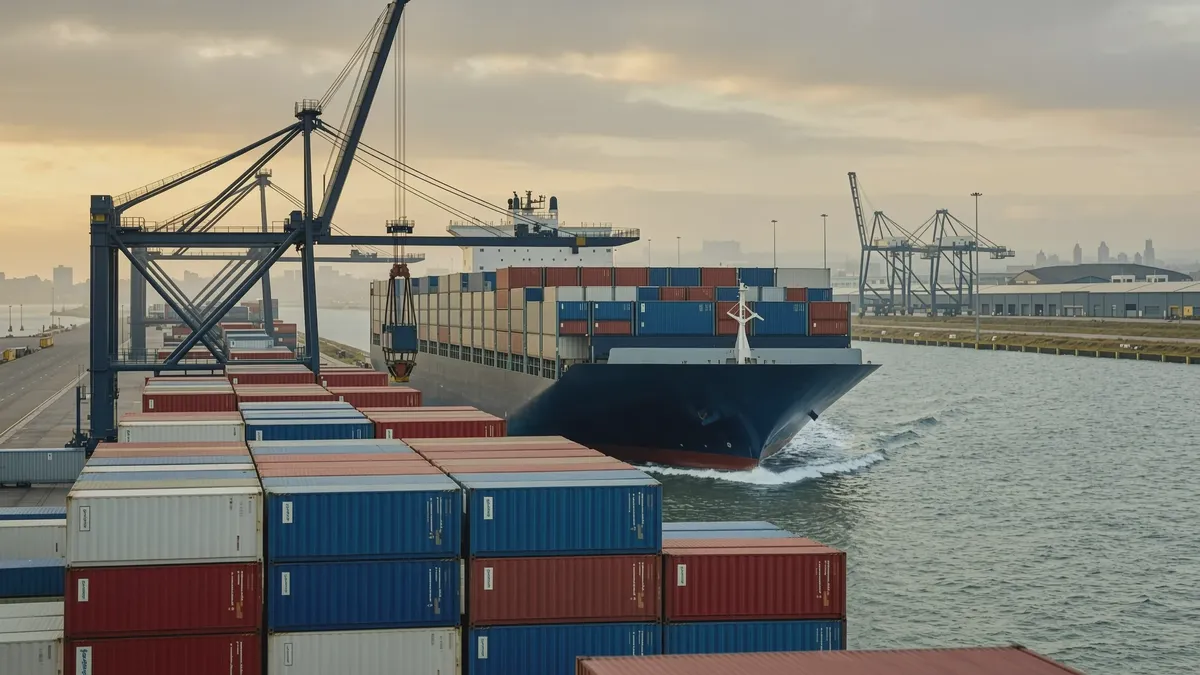
The answer depends on which number you are being shown, so start with the market. The Freightos Baltic Index put Asia–North Europe at $3,442 per FEU in the week to 21 October 2026, up 6% on fresh general rate increases as carriers open negotiations for 2027 contracts; Asia–Mediterranean went the same way at $3,927 per FEU. Air cargo out of China to Europe priced at $3.87 per kg, up 8% in a week on post-Golden-Week backlog but still 3% below October last year. Two forces are pulling against each other: carriers are walking back into the Suez Canal after two years of Cape of Good Hope routings — Freightos expects Red Sea container traffic to recover fully in the first quarter of 2027, and Maersk has said it is aiming for a full Suez return by March — while bunker costs stay high with crude near $100 a barrel.
Those index numbers are spot, port-to-port, for a 40ft. Here is what they translate into on the bookings DTFU prices out of Shenzhen and Ningbo this month.
| Mode | Typical rate, October 2026 | Minimum charge | Transit, port or airport to port |
|---|---|---|---|
| LCL sea freight | $80 – $150 per CBM | 1 CBM ($120 minimum) | 32 – 42 days |
| 20ft FCL (20GP) | $1,500 – $2,200 per container | 1 container | 30 – 38 days |
| 40ft FCL (40GP) | $2,700 – $4,200 per container | 1 container | 30 – 38 days |
| 40ft high cube (40HQ) | $2,800 – $4,400 per container | 1 container | 30 – 38 days |
| Air freight, 100 – 500 kg | $5.00 – $7.50 per kg | 45 kg | 4 – 7 days |
| Air freight, 500 kg and up | $3.80 – $5.20 per kg | 500 kg | 5 – 8 days |
| Express courier | $8.00 – $14.00 per kg | 0.5 kg | 3 – 6 days |
None of that is a delivered price. The bands in the second table include collection in China, export declaration, ocean or air freight, UK customs entry and delivery to a business address — the number a buyer actually budgets — but they exclude duty and VAT, which depend on your goods.
| Service | Door-to-door, freight and clearance only | Typical total transit |
|---|---|---|
| LCL, door to door | $180 – $300 per CBM | 34 – 45 days |
| 20ft FCL, door to door | $2,400 – $3,300 | 32 – 42 days |
| 40ft high cube, door to door | $4,000 – $5,600 | 32 – 42 days |
| Air freight, door to door (100 – 500 kg) | $7.50 – $11.00 per kg | 7 – 11 days |
| Express courier, door to door | $9.00 – $15.00 per kg | 3 – 6 days |
Origin matters more than most quotes admit. On this lane, Yantian and Shekou routinely price $100 – $200 below Shanghai Yangshan on a 20ft because the number of weekly Asia–Europe sailings out of the Pearl River Delta is higher; Ningbo tracks Shanghai closely; Qingdao and Tianjin Xingang typically add $100 – $300 and one to two weeks, often with a transshipment. For the ocean-side detail behind those bands, see our sea shipping cost from China to UK breakdown.
What the ocean rate leaves out: five lines that decide your real freight cost
A China-to-UK container produces two invoices, not one. The forwarder's quote usually shows the ocean freight and calls the rest "local charges"; the second invoice arrives from the destination side and is where budgets break. This is a structure DTFU prices every week, and it is why we ask for the delivery postcode before quoting anything.
| Line item | Typical cost, 20GP Shanghai → Felixstowe → Birmingham |
|---|---|
| Ocean freight, including bunker adjustment | $1,550 |
| Origin charges (export declaration, THC, documents, VGM, trucking to Yangshan) | $230 |
| UK terminal handling and port dues | $210 |
| Customs entry through CDS, including agency fee | $65 |
| Delivery, Felixstowe to Birmingham | $420 |
| Total | $2,475 |
The trap is never a single line; it is the pairing. A forwarder quoting $1,150 ocean on a lane where the market is $1,600 recovers the difference at the destination: terminal handling "at cost" with a handling margin on top, a documentation fee, a release fee, a CFS charge if your cargo is groupage, and a delivery rate that is 30% above the local haulier's. The invoice still adds up to roughly the $2,400 – $3,300 band above — you have simply paid it in two currencies, with less visibility and no way to compare two forwarders fairly.
Three checks fix this before you book. Ask for a named port pair (not "China to UK"), a validity date (spot rates on this lane move weekly and GRIs land on the first of the month), and a door number. A quote that stops at Felixstowe is half a quote, and it is the half that leaves out the £300 – £600 of UK landside cost most importers forget. Box-size economics are covered separately in our 20ft and 40ft container cost guide.
Freight cost per unit: what one CBM and one kilo add to your price
Importers rarely buy freight; they buy margin per unit. The conversion is straightforward once you know what the carrier bills.
- LCL bills cubic metres, rounded up to the next half CBM at most consolidators, with a one-CBM minimum.
- Air freight bills the greater of actual weight and volumetric weight at a 1:167 ratio — one cubic metre equals 167 kg.
- FCL bills the box, full or half empty, which is why the per-unit number collapses as the container fills.
That single rule decides your mode more often than price lists do. Using $220 per CBM for LCL door to door, a 20GP loaded to 28 usable CBM at $2,850 door to door (about $102 per CBM), and $6.00 per kg for air:
| Product | Units per CBM | Weight per CBM | LCL, per unit | 20GP, per unit | Air, per unit |
|---|---|---|---|---|---|
| Cotton t-shirts, baled | 200 | 130 kg | $1.10 | $0.51 | $3.90 |
| Phone cases | 500 | 180 kg | $0.44 | $0.20 | $2.16 |
| Flat-pack desks | 8 | 160 kg | $27.50 | $12.75 | $120.00 |
| Ceramic dinner sets (40 pcs) | 40 | 400 kg | $5.50 | $2.55 | $60.00 |
| Cast-iron pump housings | 2 | 1,200 kg | $110.00 | $51.00 | $3,600.00 |
Read the last row twice. A dense casting costs $51 a unit by sea and $3,600 a unit by air: there is no pricing conversation to have, the mode is settled by physics. The t-shirts are the mirror image — air costs $3.90 a unit against $1.10 by LCL, which is affordable when the shirt sells at £25 and impossible at £3. Low-density goods pay for airspace, dense goods pay for weight, and volumetric goods are the ones where redesigning the carton (a 5 – 10% cube reduction on a knock-down item is routine) beats negotiating the rate.
Before you request a quote, get three data points from the supplier: carton length, width and height in centimetres, and gross weight per carton. CBM per unit is then carton volume divided by units per carton, and everything above follows from it.
LCL or FCL: the volume where the cheaper option switches
Groupage looks cheaper per CBM at the bottom of the range and stops being cheaper somewhere between 10 and 15 CBM, once UK destination charges are included. That crossover is arithmetic, not opinion:
| Volume | LCL door to door ($180 – $300/CBM) | 20GP door to door | Cheaper |
|---|---|---|---|
| 5 CBM | $900 – $1,500 | $2,400 – $3,300 | LCL |
| 8 CBM | $1,440 – $2,400 | $2,400 – $3,300 | LCL |
| 10 CBM | $1,800 – $3,000 | $2,400 – $3,300 | Depends on the LCL rate |
| 12 CBM | $2,160 – $3,600 | $2,400 – $3,300 | Depends on the LCL rate |
| 15 CBM | $2,700 – $4,500 | $2,400 – $3,300 | 20GP |
| 20 CBM | $3,600 – $6,000 | $2,400 – $3,300 | 20GP |
| 28 CBM | $5,040 – $8,400 | $2,400 – $3,300 | 20GP |
Two corrections move that crossover. First, UK groupage carries a destination floor that per-CBM rates hide: a £45 – £75 deconsolidation or CFS handling charge per CBM, a minimum release fee, and often a collection charge if the CFS is not near you — groupage is de-stuffed at a depot in Felixstowe, Manchester or Birmingham, not at your door. Second, LCL adds two to five days at each end and shares a container with other people's cargo, which is a real cost when a co-loader's documentation problem holds the whole box. Most importers shipping above 15 CBM a month are better served by a 20ft, even at 60% fill; the LCL shipping from China guide covers the consolidation mechanics.
Duty and VAT: the 20% no freight quote includes
Everything above is transport. Import tax sits on top, and it is calculated on a value that includes the freight you just paid. Duty is charged on the CIF value — goods, insurance and transport to the UK — at the rate for your commodity code in the UK Global Tariff, and VAT is 20% on the CIF value plus duty. On a $10,000 FOB order moving in the 20ft above at an 8% duty rate:
| Step | Calculation | Amount |
|---|---|---|
| Goods value (FOB) | Invoice | $10,000.00 |
| Freight and insurance | Transport to the UK | $2,475.00 |
| CIF customs value | Goods + freight + insurance | $12,475.00 |
| Import duty at 8% | 8% × $12,475 | $998.00 |
| Import VAT at 20% | 20% × ($12,475 + $998) | $2,694.60 |
| Total import taxes | Duty + VAT | $3,692.60 |
| Landed cost | Goods + freight + taxes | $16,167.60 |
That is 29.6% of the CIF value in tax, and $8.08 a unit on 2,000 pieces — a 61.7% uplift on a $5.00 ex-works price before you have sold anything. Three things make that survivable rather than fatal. Postponed VAT Accounting lets a VAT-registered importer declare import VAT on the return instead of paying at clearance, which removes $2,694 of cash-flow pain; it needs your GB EORI number on the entry, and it is one of the reasons clearing in your own name beats DDP once you are established. Duty rates are not uniform — electronics and machinery often sit at 0–2.7%, textiles and footwear at 8–17%, and some Chinese commodity codes carry anti-dumping duties on top of the standard rate, which is worth checking in the UK Trade Tariff before you price a container of ceramic tableware or e-bikes. And the freight element is dutiable, so under-declaring transport to reduce the tax bill is exactly the adjustment HMRC makes at a post-clearance audit.
One 2026 change matters for anyone selling direct to UK consumers. HMRC published its policy paper on reforming customs rules for low value imports on 13 July 2026: the £135 duty relief is being removed, with a new declaration regime, a fiscal representative concept for overseas sellers, and an operative date appointed by October 2028 at the latest. If your model depends on shipping sub-£135 consignments duty-free, the relief has a known expiry. Our customs clearance team files these entries daily; the difference between a clean clearance and a two-week hold is almost always the commercial invoice matching the packing list and the manifest.
What moves this lane's cost in 2026: the Red Sea return, GRIs and the peak calendar
The biggest single swing on this lane right now is routing. A Suez transit from Shanghai to Felixstowe runs 30 – 33 days; the Cape of Good Hope routing that most Asia–Europe services used through 2024 and 2025 runs 40 – 45. As each service returns to the canal, effective capacity rises without a single new ship, which pushes spot rates down — but carriers are simultaneously using GRIs and slow-steaming to hold the line ahead of 2027 contract negotiations, and bunker costs near $100 a barrel give them the cover to try.
| Window | What happens | Price direction | What to do |
|---|---|---|---|
| January – February | Chinese New Year factory shutdown, pre-holiday rush | Rising into the holiday, then a lull | Ship by early January or wait until March |
| March – April | Post-holiday lull, 2027 contract season opens | Softest ocean rates of the year | Book annual contracts now |
| May – June | Stock build for summer, Dragon Boat holiday | Firming | Lock rates 3 – 4 weeks ahead |
| July – September | Traditional ocean peak, PSS applied | Highest of the year | Split urgent SKUs to air early |
| October | Golden Week closures, then Q4 air peak begins | Ocean spiky, air rising | Pre-book air before 1 October |
| November – December | Air peak for e-commerce, ocean volumes fade | Air at its most expensive | Sea for volume, air only for launches |
Booking windows follow from that: ocean three to four weeks before the desired sailing on this lane, air one to two weeks, express 48 hours. Freight booked the week it is needed is priced accordingly.
The UK leg: port choice, haulage and the post-arrival charges
The UK port you land at changes your total more than a $100 ocean difference does. Felixstowe handles roughly 40% of the country's containerised imports and has the deepest inland haulage network, but it is the furthest of the three from the Midlands and the North. Southampton takes the largest Asia–Europe vessels with a steadier clearance rhythm. London Gateway, DP World's Thames terminal, is the closest major hub to London with direct rail into the Midlands distribution parks.
From Felixstowe, expect roughly £280 – £420 to Birmingham, £450 – £600 to Manchester and £700 – £950 to Glasgow for a 20ft, with a 40ft adding 20 – 30%. London Gateway to a London address is £180 – £280 before the ULEZ and congestion charge, which apply to older delivery vehicles and are quietly passed through on the delivery line. A container discharged at the wrong end of the country can add more than the terminal handling charge itself, so give your forwarder the postcode first and let the port follow.
Then the clock. UK terminals typically give five to seven free days from discharge before storage starts, and storage plus detention on the box runs £30 – £90 per container per day depending on the port and the size. Most of that exposure is created at origin: a certificate of origin that arrives a week late, a commodity code the broker has to query, a packing list that does not match the manifest. Groupage has its own version — LCL cargo is only released once the CFS has de-stuffed and raised its release, and collection from the depot is a separate charge that small importers consistently forget to budget.
How to cut freight cost from China to UK without changing forwarder
Most of the savings on this lane are structural, not negotiated.
- Fill the box. A 20GP holds about 28 CBM of usable space and a 40HQ about 68 – 70; a half-empty 40HQ is the most expensive way to ship on this lane. If you are at 18 CBM, take the 20ft.
- Cut cubic metres, not weight. Knock-down packaging, removing retail cartons for FBA prep at a UK 3PL, and re-cutting a carton by 3 cm on each dimension routinely removes 5 – 10% of billed volume.
- Buy FOB rather than EXW when you are ready to control routing: EXW hands you the Chinese inland trucking, export declaration and terminal charges at retail, and removes your ability to consolidate two suppliers into one box. The DDP vs FOB comparison sets out when each is right.
- Book before the GRI date. On this lane increases usually land on the first of the month; a booking accepted on the 28th at the old rate is worth more than an hour of negotiation.
- Match the port to the postcode rather than to habit, per the haulage numbers above.
- Consolidate suppliers into one LCL instead of three small ones — three minimum charges cost more than one 8 CBM shipment.
- Insure on the invoice value, not the carrier's liability limit, at roughly 0.3 – 0.5% of CIF; the cargo insurance cost guide explains the calculation.
- Pre-clear the documents. Duty and freight are predictable; storage and detention are the lines that turn a $2,475 shipment into a $3,100 one.
If you are moving more than four containers a year, the largest lever is the contract rather than the spot booking: an annual rate agreement signed in the March – April window typically sits 8 – 15% under the same lane's peak spot price, and it caps the PSS exposure that catches spot shippers every July.
FAQ
How much does it cost to ship 1 CBM from China to the UK? Door to door, $180 – $300 including UK clearance and delivery, subject to a minimum charge of around $120 – $180 on the freight plus a CFS release fee. Port-to-port LCL alone is $80 – $150 per CBM, which is why quotes in that range look cheaper than the delivered cost.
What is the cheapest way to ship from China to the UK? LCL below 10 CBM, a 20ft container between roughly 15 and 25 CBM, and a 40HQ above 25 CBM. Per-kilogram basis, a full 20ft works out at $0.08 – $0.11 per kg on ocean freight alone, so filling a box is always the cheapest freight per unit.
How long does freight take from China to UK in 2026? Ocean 30 – 38 days port to port via Suez as services return to the canal, 40 – 45 days on a Cape routing, plus 2 – 5 days for UK clearance and delivery. Air freight is 4 – 8 days airport to airport, express 3 – 6 days door to door. Current lane detail is in our shipping time from China to UK guide.
Do I pay VAT on the freight? Yes. Import VAT at 20% is charged on the CIF value, which includes transport and insurance, plus any duty. VAT-registered importers can defer it through Postponed VAT Accounting rather than paying at clearance.
Is import duty calculated on the goods value or including freight? On the CIF value: goods, insurance and freight to the UK port. A forwarder quoting an unusually low freight figure does not reduce your duty — it invites an adjustment at audit.
What is the £135 rule and is it changing? Consignments valued at £135 or less sold business-to-consumer have had import duty relief and point-of-sale VAT collection. HMRC's policy paper of 13 July 2026 removes that relief, with a new low-value import regime operative by October 2028 at the latest.
Can I ship 20 kg from China to the UK? Yes, by express courier at $8 – $14 per kg with a minimum charge, so a 20 kg parcel typically costs $180 – $300 door to door. Air freight consolidations usually start at 45 kg and are not competitive below that.
Why did my freight cost change between quote and invoice? Four usual reasons: a GRI or peak season surcharge landing after the quote expired, a weight or CBM re-measurement at the CFS, a destination charge that was never in the quote's scope, or detention and storage caused by late documents.
Do I need an EORI number to import from China to the UK? Yes, a GB-prefixed EORI number if you clear in your own name; it is free and takes minutes online. Under DDP the forwarder clears on its own EORI, which is why first-time importers often start there.
Is sea or air cheaper from China to the UK right now? Sea, by a wide margin, unless the goods are light and urgent. At current rates a 20ft works out at $0.08 – $0.11 per kg of ocean freight, while air is $3.80 – $7.50 per chargeable kg; air is a margin decision, not a cost-reduction one.
Which documents do I need to clear a China–UK shipment? Commercial invoice, packing list, bill of lading or airway bill, certificate of origin where a preferential rate is claimed, and the commodity code. Anything controlled adds a licence or certificate, and the invoice must match the packing list exactly or HMRC's CDS will query the entry.
For a second opinion on a rate you have been quoted, send the commodity, carton dimensions, gross weight, collection city and UK postcode through our contact page — DTFU will price it door to door with the destination charges named rather than buried, and tell you if the mode you have chosen is the expensive way to move it. The lane overview on shipping from China to the UK covers the service scope, and sea freight and air freight set out what each includes.