Are you shipping from Guangzhou to the UAE this quarter, finding that every quote is a different number for the same cartons? This guide sets out what freight really costs on this lane in late 2026, how UAE-bound containers are being routed while Hormuz is closed, how goods bought in Guangzhou's wholesale markets get exported without a VAT invoice, and which documents stop a container at Jebel Ali.
Shipping from Guangzhou to UAE at a Glance (October 2026)
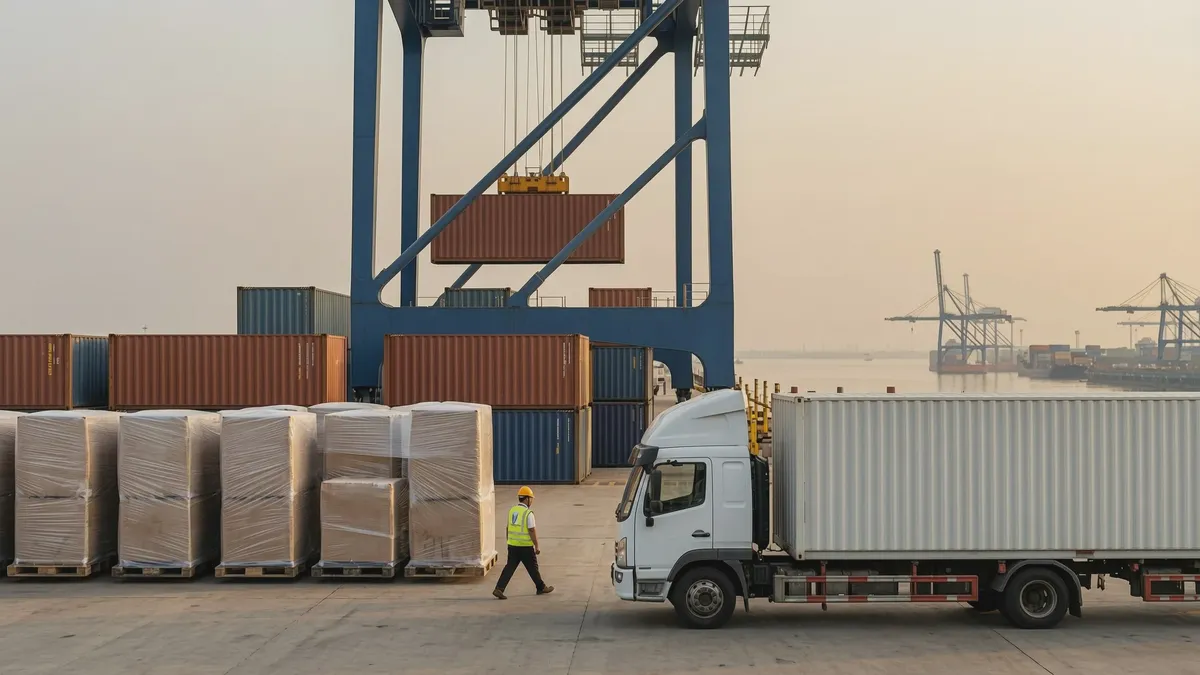
In a normal market Guangzhou is one of the cheapest places in China to load a UAE-bound container: Nansha sits on a direct Asia–Gulf loop and consolidators build Dubai boxes here several times a week. In the market we are in — Hormuz closed to commercial shipping since 28 February 2026 — the same container costs two to three times more and takes a week longer, because cargo discharges at Khor Fakkan and moves overland.
| Mode | Cost right now (late Oct 2026) | Transit right now | What changed |
|---|---|---|---|
| Sea FCL, 20ft | $2,300 – $3,300 base + surcharges | 25 – 32 days port to port | Discharge at Khor Fakkan, bonded road to Jebel Ali |
| Sea FCL, 40HQ | $3,800 – $5,200 base + surcharges | 25 – 32 days port to port | Same routing; 40HQ allocations tightest |
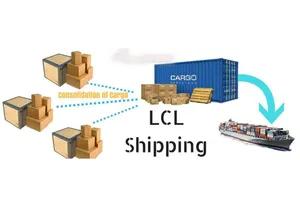
| Sea LCL | $115 – $170 per CBM | 30 – 40 days door to door | Extra de-vanning step at Sajaa or Jebel Ali |
| Air freight | $4.50 – $7.50 per kg (45 kg+) | 3 – 7 days | Capacity constrained, several freighter operators still out |
| Express courier | $30 – $40 per kg | 3 – 6 days | Parcel networks running, Gulf lanes slower |
Why So Much UAE Cargo Starts in Guangzhou, Not in a Factory
Most Chinese export cities ship what their factories make. Guangzhou ships what the whole Pearl River Delta sells, and that is a different product.
The wholesale markets are the collection point for the small and mid-sized orders that make up much of UAE import volume. Yide Road and the Haizhu belt supply stationery, toys, party goods and general merchandise. Zhanxi Road and Shahe handle garments, with Xintang in Zengcheng behind them for denim. Zhongda feeds the regional textile trade. In Huadu, Shiling is the leather and bag cluster — thousands of workshops, tanneries and hardware suppliers inside a few square kilometres — while Foshan's furniture factories, Zhongshan's lighting plants and Jiangmen's hardware shops sit 60–90 km away, close enough for one truck to collect from three suppliers before lunch.
That explains the customer profile. Much of this volume is bought by traders, many clustered around Xiaobei and Sanyuanli where Arabic signage and Gulf-facing trading companies have concentrated for two decades, in 20 to 200 carton lots shipped monthly. It is consolidation cargo rather than factory-direct cargo: more suppliers per shipment, more labelling problems, and a much higher chance that nobody in the chain can issue a proper VAT invoice.
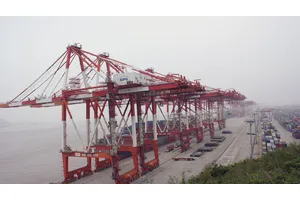
The gateways: Nansha, at the mouth of the Pearl River, is where containers load — Guangzhou Port moved roughly 27–28 million TEU in 2025, about 22 million of them at Nansha, through its own berths plus the GOCT joint venture (COSCO, with a 20% APM Terminals stake) and NICT. Baiyun Airport (CAN) is the air gateway, where FedEx has run its Asia-Pacific hub since 2009 and Emirates SkyCargo was up to six weekly freighters into Guangzhou by late 2025.
Our shipping from China to UAE overview covers the lane as a whole; the detail below is what changes your quote.
Sea Freight Cost from Guangzhou to UAE: 2026 FCL and LCL Rates
Every quote on this lane should show two numbers: the open-Gulf market and the current constrained market. A forwarder showing only the first is quoting from a sheet written before February 2026; one showing only the second is using the crisis to hide a margin.
| Container | Capacity | Normal-market band (USD) | Late-Oct-2026 band (USD) | Notes |
|---|---|---|---|---|
| 20ft FCL | 28 CBM | $1,000 – $1,350 | $2,300 – $3,300 | Best for dense cargo; Gulf allocations tight |
| 40ft FCL | 56 CBM | $1,800 – $2,300 | $3,600 – $4,800 | ~1.8× the 20ft rate, not double |
| 40ft High Cube | 68 CBM | $1,950 – $2,500 | $3,800 – $5,200 | Best value for light, bulky market cargo |
These are base ocean rates, Nansha to the UAE gateway, port to port, before surcharges. The gap is not a pricing trick: the Shanghai Containerized Freight Index put the Persian Gulf route at $6,135 per TEU in early September 2026, three to four times pre-crisis, and spot China–Khor Fakkan rates ran above $10,000 per FEU. Contract rates sit below those readings, which is why an all-in 40HQ quote near $8,000 is not automatically a rip-off.
LCL from Guangzhou to Jebel Ali: Per-CBM Reality
| Shipment size | Normal (USD/CBM) | Late-Oct-2026 (USD/CBM) | Notes |
|---|---|---|---|
| 1 – 5 CBM | $70 – $105 | $115 – $170 | Trial orders and market-buying lots |
| 6 – 12 CBM | $62 – $95 | $105 – $155 | Consolidation discounts start here |
| 13 – 17 CBM | $58 – $90 | $100 – $145 | Price a 20ft alongside it before booking |
| Above 17 CBM | FCL wins | FCL wins | See break-even note below |
Minimum charge is 1 CBM, and Guangzhou is the cheapest origin in China for UAE LCL because Dubai boxes are built here several times a week — our LCL shipping from China guide explains why the China-wide band sits higher. Above 12–15 CBM a 20ft is cheaper and safer for your cartons.
Air Freight Rates from Baiyun (CAN) to Dubai
| Chargeable weight | Normal (USD/kg) | Late-Oct-2026 (USD/kg) | Transit |
|---|---|---|---|
| 45 – 99 kg | $3.80 – $5.00 | $5.60 – $7.50 | 3 – 7 days |
| 100 – 299 kg | $3.20 – $4.60 | $5.00 – $6.80 | 3 – 6 days |
| 300 – 499 kg | $3.00 – $4.20 | $4.60 – $6.20 | 3 – 6 days |
| 500 – 999 kg | $2.90 – $3.90 | $4.50 – $5.90 | 4 – 7 days |
| 1,000 kg and above | On request | On request | Subject to capacity |
Chargeable weight is the greater of actual and volumetric weight (L × W × H in cm ÷ 6,000), so a light carton of bags can bill at three times its scale weight. Capacity, not price, is the constraint — one all-cargo operator has suspended Middle East traffic apart from Muscat, and several European carriers still avoid Dubai. Emirates' freighters and belly capacity are moving, so book earlier than in 2025; our air shipping from China to UAE guide has the detail.
The Surcharge Stack You Have to Ask About
| Surcharge | Typical range | What drives it |
|---|---|---|
| War risk surcharge (WRS) | $500 – $1,500 per container | Gulf war-risk premiums at 3–6% of hull value |
| Emergency conflict surcharge | $200 – $500 per container | Carrier recovery for Hormuz disruption |
| Peak season surcharge (PSS) | $750 / 20ft, $1,500 / 40ft | Q3–Q4 demand and Golden Week pull-forward |
| Bunker adjustment (BAF) | $180 – $350 | Longer routings, higher fuel cost |
| Origin handling and documents | $150 – $280 | THC, export declaration, B/L, COO |
| Destination handling and bonded road | $500 – $900 | Khor Fakkan discharge plus bonded truck to Jebel Ali |
| Currency adjustment (CAF) | 1 – 3% of freight | Carrier currency exposure |
A quote missing the WRS line is not cheaper, it is incomplete, and the invoice will arrive with it attached.
Transit Times from Nansha to Jebel Ali: the Hormuz Detour Explained
Nansha to the Gulf of Oman is still roughly 18–24 days through the South China Sea, Malacca and the Indian Ocean. What changed is where the ship stops and what happens afterwards.
Commercial transits through Hormuz were running near 5% of normal in mid-October 2026, so Asia–UAE loops reorganised around ports outside the strait. Gemini's FM1/AGX service, restarted in mid-October, calls Khor Fakkan in Sharjah as its only Middle East port — the one fully operational UAE terminal outside Hormuz, where weekly throughput rose from about 8,000 TEU before the closure to roughly 65,000 within four months.
| Step | What happens | Time |
|---|---|---|
| Sailing | Nansha → Gulf of Oman, direct Asia–Gulf loop | 22 – 30 days |
| Discharge | Khor Fakkan, or Fujairah on some services | 1 – 2 days |
| Bonded road transit | DP World bonded trucking to Jebel Ali, Sajaa ICD or a free zone | 1 – 2 days |
| Customs | Clearance at the destination free zone or ICD under Dubai Customs facilitation | 2 – 4 days |
| Door-to-door total | FCL, including final delivery | 30 – 42 days |
| Normal-market comparison | Direct Jebel Ali call, no landbridge | 25 – 30 days door to door |
Clearance has moved inland. Under the Dubai Customs temporary facilitation, cargo travels to Jebel Ali or a free zone under customs transit without being cleared at the arrival port, and clearance happens at the free zone or inland depot — Sajaa for most containers arriving through Khor Fakkan, double-bonded when the consignee is registered in Sharjah or Khor Fakkan. A broker who only knows the Jebel Ali routine will lose days. And not every cargo type is accepted: Maersk's late-October update books dry cargo to Khor Fakkan and to Jebel Ali via the landbridge, but out-of-gauge cargo to the UAE is suspended outright, and dangerous goods move only under class restrictions via Khor Fakkan with delivery through Sajaa.
Exporting a Market-Buying Trip: 1039, VAT Invoices and Consolidation
This is the part of the lane no shipping guide covers, and it decides whether a Guangzhou purchase can leave the country cleanly.
Buy 300 handbags in Shiling, 80 cartons of toys on Yide Road and 40 rolls of fabric on Zhongda, and your sellers are market stalls. Most cannot issue a VAT invoice, which closes the normal export route — declare under your trading company, claim the 13% rebate — because the rebate requires the invoice.
The way through is market procurement trade, customs code 1039. Huadu's leather and leather-goods market in Shiling has been a national pilot since 2016, covering a cluster of about 1.6 million square metres with roughly 190,000 registered supplier merchants. Under 1039, goods bought from registered merchants in the pilot cluster are declared under a simplified regime that needs no VAT invoice, with each declaration capped at $150,000 of goods value and settlement allowed in foreign currency. It fits the shipment above exactly: many small suppliers, one consolidated container. The catch is that your forwarder must be set up as a 1039 agent, the goods must come from registered merchants, and the declaration must be filed at a designated port — ask before you pay for the goods, not after.
The alternative is buying through a trading company that issues the VAT invoice: you pay roughly 1–3% of goods value, but the exporter can claim the 13% rebate, which on many consumer goods more than covers the fee. On high-rebate categories that is cheaper; on low-value mixed lots 1039 avoids the paperwork. Decide before the cargo reaches the warehouse, because you cannot switch once the boxes are sealed.
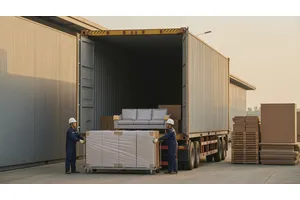
Then the physical consolidation. DTFU Logistics runs this step out of our own Guangzhou consolidation space: the warehouse receives from multiple suppliers, checks counts against the packing lists, repacks loose cartons and loads. Three things go wrong repeatedly: carton marks that do not match the packing list, retail packaging with no Arabic label, and goods that need an ECAS certificate shipped without one. Our warehouse services in Guangzhou exist mostly to catch those three before the container is sealed.
Door-to-Door DDP from Guangzhou to Dubai: What the All-In Price Includes
DDP is the default for first-time UAE importers here for a structural reason: clearing cargo in your own name at Jebel Ali or Sajaa requires a UAE trade licence whose activity covers the goods, an importer code, and a TRN if you want to reclaim VAT. Under DDP the forwarder clears in its own name, pays the 5% duty and 5% VAT, and delivers to your address.
A 40HQ of market-buying cargo from Huadu to a Deira warehouse, declared at $28,000 CIF:
| Cost item | Amount (USD) |
|---|---|
| Ocean freight, Nansha → Khor Fakkan | $4,300 |
| War risk and conflict surcharges | $1,100 |
| Origin charges (export declaration, THC, documents) | $280 |
| Trucking, Huadu consolidation warehouse → Nansha | $210 |
| Bonded road transit, Khor Fakkan → Jebel Ali | $520 |
| Destination terminal handling | $310 |
| Customs clearance and import formalities | $220 |
| Customs duty, 5% of CIF | $1,400 |
| VAT, 5% of (CIF + duty) | $1,470 |
| Delivery, Jebel Ali → Deira | $130 |
| Cargo insurance, 0.25% of declared value | $70 |
| Total door to door | $10,010 |
Strip out the two tax lines and logistics comes to $7,140 — inside the $6,200–$7,600 40HQ door-to-door band excluding duty and VAT, against roughly $2,150 for a 20ft and $3,650 for a 40ft delivered in Dubai in a normal market. Dubai and Sharjah sit at the bottom; add $300–$600 for Abu Dhabi or Al Ain and $500–$800 for Ras Al Khaimah or Fujairah.
Two exclusions to check: war risk is sometimes carved out of a DDP quote, leaving you a $500–$1,500 per-container surprise, and storage or detention from a failed inspection is almost always the importer's. Our door-to-door shipping from China service and the DDP vs FOB comparison explain where the responsibility line sits.
UAE Customs: 5% Duty, 5% VAT and the ECAS Certificate That Stops Containers
UAE import tax is simple. UAE import compliance is where Guangzhou market cargo gets held.
Duty is charged on CIF value under the GCC common external tariff — for almost everything bought in Guangzhou, 5% — and VAT of 5% is charged on CIF plus duty.
| Product category | Typical HS chapter | Customs duty |
|---|---|---|
| General merchandise, electronics, machinery | 84, 85, 90 | 5% |
| Textiles, apparel, bags, footwear | 61, 62, 42, 64 | 5% |
| Food items | 16, 19, 21 | 5% |
| Pharmaceuticals | 30 | 0% |
| Alcoholic beverages | 22 | 50% |
| Tobacco | 24 | 100% |
| Calculation step | Amount (USD) |
|---|---|
| CIF value (goods + insurance + freight) | $10,000 |
| Customs duty at 5% | + $500 |
| Dutiable value for VAT | $10,500 |
| VAT at 5% | + $525 |
| Total import tax | $1,025 |
The compliance layer costs time. The Ministry of Industry and Advanced Technology runs the Emirates Conformity Assessment Scheme (ECAS) and the Emirates Quality Mark (EQM); ECAS registration and a certificate of conformity are mandatory before import for regulated categories — low-voltage electrical equipment, toys, cosmetics and personal care, building materials and several others. Goods in those categories arriving without a certificate sit at Khor Fakkan or Jebel Ali, because the certificate cannot be produced retrospectively in a week. Anything sourced from Yide Road or the toy and small-appliance stalls is squarely in scope. Cosmetics also need product registration with Dubai Municipality, and retail packaging needs Arabic labelling to the relevant GSO standard: the goods are fine, the label is not, and the label is what the inspector reads.
Two further traps: your consignee's trade licence must cover the goods — a narrow activity licence does not, and customs will hold the declaration rather than argue — and declarations run through Dubai Customs' Mirsal 2 system, which compares invoice, packing list, bill of lading and origin certificate line by line.
Free zone or mainland: the re-export decision
Many Dubai importers are re-exporters, sending cargo onward to Saudi Arabia, Iraq, East Africa or the wider Gulf. For that model the free zone changes the maths: goods entering JAFZA or another free zone are duty-suspended, no 5% is paid until they leave the zone into the mainland, and re-exports leave without it — which is why a Guangzhou container bound for onward Africa often never pays UAE duty at all.
The catch is the boundary. A free-zone company cannot freely import into the mainland; that transfer triggers duty and VAT and usually needs a mainland licence or a mainland importer as buyer of record. Decide before you ship: the answer changes the consignee, the licence, the clearance location and the tax. Our customs clearance team handles both, and the shipping cost from China to Dubai guide has the Dubai-side arithmetic.
Six Checks Before You Book a Guangzhou–UAE Shipment
- Confirm the routing in writing, port by port. "Guangzhou to Jebel Ali" is not a routing today. Ask whether the vessel calls Khor Fakkan or Fujairah, whether the Jebel Ali leg is a bonded road movement, and where clearance will be filed.
- Get the base rate and every surcharge as separate lines. WRS, conflict surcharge, PSS, BAF, origin, destination, bonded trucking, delivery — two quotes $1,500 apart are usually the same freight with different inclusions.
- Check that your cargo type is being accepted. Out-of-gauge is suspended to the UAE on the main loops; dangerous goods move on restricted classes via Khor Fakkan and Sajaa.
- Start the ECAS file now, not at the port. Registration takes weeks, and it is the most common reason a Guangzhou market container misses its selling season.
- Decide 1039 versus a VAT invoice before consolidation. It determines who can export and whether the 13% rebate is recoverable.
- Book space two to three weeks out and insure the cargo. Allocations on Gulf loops are the binding constraint, not price; at 0.25% of declared value, marine insurance is the cheapest line on the invoice. See our insurance guide.
DTFU Logistics books this lane out of Nansha and Baiyun every week, including market-consolidation cargo and 1039 declarations. If your supplier sits in Foshan or Zhongshan rather than the city itself, our furniture shipping from China page covers the packing and loading side.
FAQs
How much does it cost to ship a 20ft container from Guangzhou to UAE?
A 20ft from Nansha runs $1,000–$1,350 port to port in a normal market. Now, with discharge at Khor Fakkan and bonded road transit to Jebel Ali, base freight is $2,300–$3,300 and war-risk and conflict surcharges add $700–$2,000 per container. Door-to-door Dubai delivery is $3,400–$4,300 excluding duty and VAT.
How long does shipping from Guangzhou to UAE take now?
Allow 22–30 days sailing from Nansha to Khor Fakkan, 1–2 days bonded road to Jebel Ali or Sajaa, and 2–4 days clearance — 30–42 days door to door. A direct Jebel Ali call, when available, is 25–30 days. Air freight from Baiyun is 3–7 days.
Is it cheaper to ship to the UAE from Guangzhou or from Shenzhen?
Guangzhou is usually slightly cheaper for LCL because Dubai consolidations are built there several times a week, and it is the natural origin for suppliers on the western delta — Foshan, Zhongshan, Jiangmen, Huadu. Shenzhen has more FCL sailings.
What is the cheapest way to ship a small order from Guangzhou to Dubai?
LCL at $115–$170 per CBM in the current market, with a 1 CBM minimum, is cheapest below about 12 CBM. Above 12–15 CBM a 20ft is generally cheaper, faster and safer for your cargo.
Can I export goods from Guangzhou if the supplier gives me no VAT invoice?
Yes — through market procurement trade under customs code 1039, which does not require a VAT invoice for goods bought from registered merchants in the pilot cluster. The alternative is buying through a trading company that issues an invoice and recovering the 13% rebate. They cannot be combined on one shipment.
What are UAE import duties and taxes on goods from China?
Most goods pay 5% customs duty on CIF value plus 5% VAT on CIF plus duty. On a $10,000 CIF shipment that is $500 duty and $525 VAT, $1,025 in total. Tobacco is 100%, alcohol 50%, pharmaceuticals 0%.
Do I need an ECAS certificate for products bought in Guangzhou?
If the product is in a regulated category — electrical and electronic goods, toys, cosmetics, building materials — yes, ECAS registration and a certificate of conformity are required before import. Market-sourced consumer goods are the category most often shipped without one.
Can my cargo still reach Jebel Ali while the Strait of Hormuz is closed?
Yes. Asia–UAE services discharge at Khor Fakkan, outside the strait, and DP World moves containers by bonded road to Jebel Ali, Sajaa ICD or a free zone under a Dubai Customs facilitation that allows clearance at the destination rather than the arrival port.
Do I need Arabic labelling on goods shipped from Guangzhou?
Yes, for consumer goods sold in the UAE, labelling must meet the relevant GSO standard in Arabic. Cosmetics are registered with Dubai Municipality, food goes through the municipality's import systems, and packaging without compliant Arabic labelling can be refused at clearance.
When is the cheapest time to ship from Guangzhou to UAE?
Normally Q1, before Chinese New Year restocking and the Q4 peak surcharge cycle. In 2026 the surcharge market matters more than the calendar — watch the war-risk and conflict lines weekly and book two to three weeks ahead so a rollover does not push you into a higher tier.
Conclusion
Guangzhou ships to the UAE differently from any other Chinese origin. The cargo is sourced rather than made — collected from Shiling, Zhanxi Road, Yide Road and the Foshan furniture belt — so consolidation, 1039 declarations and UAE product compliance matter as much as the ocean rate, which itself has to be read in two columns while the strait is closed and Khor Fakkan carries the traffic.
Get the routing, the surcharge lines, the ECAS certificate and the export declaration right and this lane stays predictable even in a bad market. DTFU Logistics runs these shipments from our own Guangzhou consolidation space through to Dubai or Abu Dhabi delivery; if you want a quote built that way — itemized, and routed against what is actually sailing — tell us what you are shipping and where it needs to arrive.