Are you trying to work out whether a few pallets from China should move as LCL — and what that per-CBM quote will really cost once a warehouse at each end has added its charges? This guide gives you the 2026 per-CBM bands by destination region, a six-CBM invoice broken down line by line, the break-even arithmetic against a 20ft container on both cheap and expensive lanes, and the cargo a consolidator will refuse to load.
What LCL Shipping from China Actually Buys You
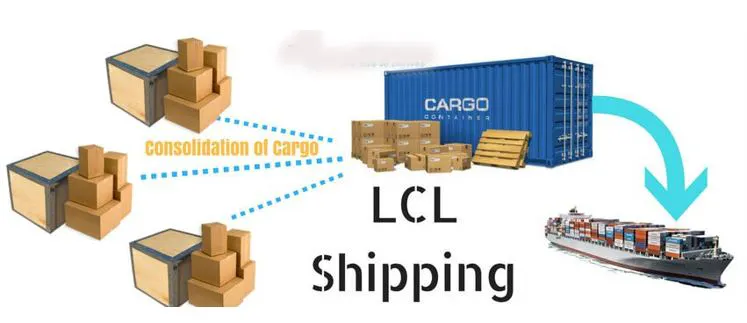
LCL is not a cheaper version of a container; it is a different product. You buy space inside someone else's container, measured in cubic meters, and accept that your cartons are handled at a warehouse at each end rather than staying sealed from factory to consignee.
Three mechanics decide everything that follows.
You pay on weight or measure, whichever is greater. The freight unit is the W/M — one cubic meter or one metric ton (1,000 kg), whichever is higher. Light, bulky cargo pays on volume; dense cargo pays on weight. A shipment of 3 CBM weighing 4,200 kg is charged as 4.2 W/M, not 3 — which explains most of the gap between the quote an importer expects and the invoice they receive.
Your cargo is received at a CFS, not a container yard. A CFS (container freight station) is a bonded warehouse where the consolidator receives cartons, checks them against the packing list, and stuffs them into a container with other shippers' freight. Your booking does not fix a vessel; the consolidator's weekly consolidation cycle does. Miss the CFS cut-off and your cargo waits for the next box — typically a week.
The company you book with is usually an NVOCC, not the carrier. An NVOCC holds space on the vessel under its own master bill and issues you a house bill of lading. Your cargo is one line in that master bill among many. Legally and practically, you have bought a slot, and the consolidator controls the box.
LCL Shipping from China Cost per CBM: 2026 Rates by Destination Region
These are the planning bands DTFU Logistics quotes on bookings leaving Shenzhen, Ningbo and Shanghai in October 2026. Two columns matter, and most quotes only show you one of them.
| Destination region (main ports) | Ocean LCL per CBM | All-in to destination CFS per CBM | Ocean transit | Minimum charge |
|---|---|---|---|---|
| Europe — Rotterdam, Antwerp, Hamburg, Le Havre | $40 – $80 | $110 – $195 | 28 – 36 days | 1 CBM |
| United Kingdom — Felixstowe, Southampton, London Gateway | $50 – $85 | $115 – $205 | 30 – 38 days | 1 CBM |
| US West Coast — Los Angeles, Long Beach, Oakland, Seattle | $95 – $155 | $175 – $290 | 16 – 22 days | 2 CBM |
| US East Coast and Gulf — New York, Savannah, Houston | $110 – $175 | $195 – $320 | 28 – 36 days | 2 CBM |
| Canada — Vancouver, Montreal, Toronto | $70 – $180 | $150 – $265 | 22 – 35 days | 1 CBM |
| Middle East — Jebel Ali, Dammam, Hamad | $65 – $135 | $125 – $220 | 18 – 28 days | 1 CBM |
| Australia and New Zealand — Sydney, Melbourne, Auckland | $60 – $140 | $130 – $235 | 16 – 26 days | 1 CBM |
| South America — Santos, Buenos Aires, Callao, Buenaventura | $80 – $190 | $180 – $330 | 32 – 48 days | 1 CBM |
| Africa — Lagos, Mombasa, Durban, Tema, Luanda | $90 – $180 | $185 – $320 | 28 – 45 days | 1 CBM |
The first column is what the vessel charges for your space; the second adds origin CFS handling, terminal handling at both ends, documentation and destination de-consolidation. Neither includes duty, brokerage, delivery or storage after free time.
For comparison, full-container ocean rates on the same lanes in October 2026: Northern Europe 20GP $1,200–$1,800 and 40HQ $2,200–$3,200; US West Coast 20GP $3,300–$4,300 and 40HQ $5,300–$6,600; Jebel Ali 20GP $1,050–$1,350 and 40HQ $2,000–$2,600. Air freight on 100–499 kg runs $5.50–$9.00 per kg.
Argentina and inland Brazil price above that band — their destination CFS and terminal charges are the highest in the region — so check the lane figures rather than a regional average: our Brazil guide carries the current numbers.
Drewry's World Container Index on 15 October 2026 put the composite at $4,485 per 40ft, with Shanghai–Los Angeles at $7,884. That is a spot index on a named port pair, not what a consolidator pays: LCL space is bought on contract allocations weeks ahead and co-loaded across dozens of shippers. The minimum charge and the flat fees, not the ocean rate, set the price of small shipments.
The Charges Behind the Per-CBM Rate: A Six-CBM Invoice Line by Line
Ask two forwarders for a per-CBM rate and you can receive two numbers three times apart. Almost always, one is ocean freight and the other is a door-to-door bundle. Here is what sits in between on a realistic six-CBM shipment of cartons, about 1,900 kg.
| Charge | Basis | 6 CBM to Rotterdam | 6 CBM to Los Angeles |
|---|---|---|---|
| Ocean freight | per CBM or per 1,000 kg | $240 – $480 | $570 – $930 |
| Origin CFS receiving and handling | $15 – $30 per CBM | $90 – $180 | $90 – $180 |
| Origin THC plus export declaration | flat per shipment | $90 – $160 | $90 – $160 |
| BAF, low-sulphur and currency surcharges | 10 – 25% of ocean freight | $24 – $120 | $57 – $230 |
| Destination CFS and de-consolidation | $20 – $45 per CBM | $120 – $270 | $150 – $300 |
| Destination THC plus delivery order | flat per shipment | $110 – $220 | $130 – $250 |
| Customs clearance and brokerage | flat per shipment | $90 – $160 | $120 – $200 |
| ISF filing | flat per shipment | not applicable | $30 – $60 |
| Delivery to door, within about 50 km | flat per shipment | $180 – $320 | $200 – $380 |
| Cargo insurance | 0.3 – 0.5% of CIF plus 10% | $40 – $70 | $45 – $80 |
| Total, door to door | $1,000 – $1,980 | $1,480 – $2,700 |
Two patterns are worth memorising.
The flat charges dominate small shipments. At 2 CBM you still pay a full destination THC, a full set of documents, a full brokerage fee and a full local delivery — which is why 1 CBM to Europe often lands at $550–$1,000 door to door. The per-CBM rate was never the number that mattered.
The per-CBM rate falls as volume rises, then flattens. Consolidators quote in tiers (1–5 CBM, 6–10, 11–15) because their CFS cost per CBM drops with volume, but past roughly 12–14 CBM the discount stops moving — which is where a container starts to win.
Before you accept a quote, get four things in writing: whether it is ocean-only or to destination CFS, the destination CFS and terminal charges in local currency, the free time and storage rate after it, and whether examination or re-delivery is billed at cost. Those four lines are where LCL invoices grow.
How Long Does LCL Shipping from China Take? Where the 7–12 Extra Days Go
The vessel crossing for LCL and FCL is identical. Everything around it is slower, and knowing the stages lets you plan backwards instead of chasing a forwarder for updates.
| Stage | FCL | LCL |
|---|---|---|
| Supplier to port or CFS | 1 – 2 days | 1 – 4 days (cartons must be received and counted) |
| Consolidation wait at origin | none | 2 – 7 days until the box is filled and cut off |
| Ocean leg | same service | same service |
| Transshipment | 0 – 1 | 0 – 2 (depends on the co-loader's routing) |
| Arrival to de-consolidated cargo | 1 – 2 days | 3 – 7 days at the destination CFS |
| Customs release | 1 – 3 days with your own entry | 1 – 5 days, and the whole box must be released |
| Door-to-door total | baseline | +7 to +12 days |
Two of those rows deserve emphasis because they are the ones that go wrong.
The consolidation cut-off is not the vessel cut-off. A consolidator publishes a CFS closing date several days before the sailing to leave time for stuffing, weighing, VGM submission and the ISF or ENS filing. Cartons that arrive the day the vessel closes are not on that vessel. On busy lanes out of Shenzhen and Ningbo, the practical rule is: have cargo at the CFS five working days before the sailing you want.
LCL cargo waits for the whole container to clear. If one shipper in your box has a documentation problem or a customs exam, the container is held and every consignee waits. You cannot expedite your own release out of a shared box, and no forwarder can promise around it — this is the most common reason an LCL shipment misses a promised date.
When Is FCL Cheaper Than LCL? The Break-Even Math Importers Get Wrong
The advice that "LCL stops making sense at 15 CBM" is a rule of thumb lifted from one lane and repeated everywhere. The line moves, and it moves a lot — mostly with the ocean rate of the 20ft and the destination charges on the lane.
| Volume | Europe: LCL door to door | Europe: 20GP landed | US West Coast: LCL door to door | US West Coast: 20GP landed |
|---|---|---|---|---|
| 6 CBM | $1,300 – $1,700 | not worth booking | $1,900 – $2,400 | not worth booking |
| 10 CBM | $1,900 – $2,400 | $2,000 – $2,800 | $2,900 – $3,600 | $4,200 – $5,200 |
| 14 CBM | $2,500 – $3,100 | $2,000 – $2,800 | $3,900 – $4,700 | $4,200 – $5,200 |
| 20 CBM | $3,500 – $4,200 | $2,000 – $2,800 | $5,400 – $6,400 | $4,200 – $5,200 |
On a cheap-ocean lane like Northern Europe the crossover sits around 10–11 CBM: a 20GP at $1,200–$1,800 ocean plus destination charges, clearance and delivery lands near $2,000–$2,800, which LCL reaches at about 11 CBM. On the transpacific, where a 20GP to Los Angeles runs $3,300–$4,300 plus roughly $900 of landed extras, LCL stays competitive to about 15 CBM and then loses decisively.
Two corrections to the folklore:
Compare landed costs, not ocean rates. A 20GP quoted at $1,500 against LCL at $150 per CBM suggests a 10 CBM crossover. Add destination terminal handling, documentation, de-consolidation and two local deliveries to the LCL side and the comparison stops favouring LCL at 10 CBM.
Weight can flip it early. A 12 CBM shipment of hardware at 1,400 kg per CBM is charged as 16.8 W/M. At that point the LCL invoice is priced like a 17 CBM shipment while the 20GP carries the same weight for one price — and the container still has room, about 28 CBM of usable space in a 20ft against 58 in a 40GP and 65–68 in a 40HQ.
Where LCL genuinely wins, even above 10 CBM: assorted SKUs from several suppliers that would otherwise need consolidation, trial orders you cannot afford to hold, and businesses whose cash flow prefers four small monthly shipments to one large quarterly container. Above 25 CBM go straight to a 40ft; if value per kilogram is high and the deadline is tight, air wins at any volume. Our sea freight service page covers how the two sea products differ in booking, door-to-door shipping covers single-party responsibility, and our guide to DDP versus FOB explains the Incoterm side.
What LCL Shipping from China Cannot Carry
Consolidators refuse cargo for structural reasons, not fussiness. Knowing the limits before you book saves a week of re-routing.
| Cargo type | What happens in LCL | Better option |
|---|---|---|
| Single piece longer than about 3.5 m or heavier than about 2.5 t | cannot be handled at a CFS or stacked in a shared box | flat rack, open top, or breakbulk |
| Dense cargo above 1,000 kg per CBM | charged on weight, and can breach the container's payload limit | FCL, where weight is priced once |
| Batteries, aerosols, chemicals, solvents, magnets | needs dangerous-goods approval before booking; many consolidators decline | FCL dangerous goods, or an LCL consolidator that openly accepts the class |
| Food, bamboo, rattan, used goods, timber with bark | fumigation and destination phytosanitary permits | FCL with a dedicated inspection slot |
| High-value fragile cargo — glass, ceramics, instruments | handled at two CFSs, stacked with other freight | FCL, sealed at origin |
| Cargo requiring your own seal, chain of custody, or tamper evidence | impossible: the box carries many shippers | FCL |
The dangerous-goods point cuts both ways. Your cartons share a container with freight you have never seen: if another shipper has mis-declared a lithium battery or a solvent-based product, the container can be stopped or examined and your compliant cargo waits with it. We have seen a Shenzhen–Rotterdam consolidation held nine days over one undeclared aerosol, with every other consignee's paperwork correct.
Ask your consolidator which other cargo is on the box before booking anything with batteries, liquids or powders. A forwarder who can answer is co-loading with visibility; one who cannot is brokering into the dark.
Consolidation Reality: Co-Loading, House Bills and Cargo You Do Not Control
Under an LCL booking, four documents and two warehouses sit between your supplier and your consignee.
You get a house bill of lading; the consolidator holds the master. Your bill of lading is issued by the NVOCC you booked with. It is the document your bank and your customs broker will work from, and it is only as good as the consolidator's standing with the carrier. Ask whether the box is a direct sailing or a co-load that gets transshipped, because a co-load adds a handover, a second set of terminal charges and usually three to seven days.
Free time at the destination CFS is short and it is not demurrage. Destination warehouses typically allow three to seven free days after de-consolidation, then charge storage per CBM per day. This is separate from demurrage at the terminal, and it is the charge that appears when a consignee is slow to clear. On routes where customs is slow — Lagos, Mombasa, Buenos Aires, Luanda — budget for storage before you budget for anything else.
Photographic evidence is your only claim file. LCL cargo is handled at both CFSs, and by the time damage is visible the container has been opened, devanned and re-handled. The documents that decide a claim are the CFS receiving report at origin, stuffing photos, the delivery receipt with exceptions noted at the moment of delivery, and a survey if the loss is significant. Cargo insurance is not optional here; our container insurance guide explains what a marine policy covers, and premiums typically run 0.3–0.5% of CIF plus 10%.
A real LCL shipment. In May 2026 DTFU moved quartz kitchen tops from Shenzhen to Dakar as LCL: stone is heavy, so it priced on weight rather than cube, de-consolidation was the largest line after ocean freight, and delivery needed a tail-lift because the consignee had no forklift. The case record shows the general rule: on LCL the last mile and the destination warehouse decide the budget, not the ocean rate.
LCL Shipping from China to the US, EU, UK, Gulf, Africa and Latin America: What Changes at the Destination CFS
The origin side of LCL looks the same everywhere. The destination side does not, and this is where assumptions break.
| Market | Destination mechanics | What catches importers |
|---|---|---|
| United States | container moves in bond to a bonded CFS, devanned, then released by CBP; ISF must be filed 24 hours before loading | CFS free time of 3–5 days, exam and X-ray holds, ISF penalties up to $5,000 |
| European Union | ENS/ICS2 data filed before loading; devanning at a Rotterdam, Antwerp or Hamburg CFS; EORI required | import VAT cash flow, ICS2 data errors stopping loading, per-shipment document fees |
| United Kingdom | CDS entry with a GB EORI; postponed VAT accounting available for registered importers | commodity code errors, CFS storage after free time, no de minimis relief |
| Gulf | de-consolidation at Jebel Ali, Dammam or Hamad; customs entry through Mirsal or Fasah | queueing at the CFS in peak season, 5% duty on CIF, Arabic labelling rules for consumer goods |
| Africa | CFS at Lagos, Mombasa, Durban, Tema or Luanda; clearance through ASYCUDA-based systems | short free time, high storage, pre-shipment inspection certificates on some routes |
| Latin America | Santos, Buenos Aires, Callao and Buenaventura CFSs; state and federal tax stacks | destination charges often the highest in the world; AFRMM and state VAT in Brazil; slow release |
The practical consequence: a shipment that costs $200 per CBM to reach a European CFS can cost $400 per CBM to reach a Latin American one, with the ocean rate almost identical. Our lane guides carry the local numbers for the United States, the United Kingdom, Australia, Nigeria, and the Europe hub covers the continental gateways.
DDP LCL Shipping from China: What an All-In Per-CBM Rate Covers (and What It Hides)
A large share of small importers now buy LCL as a single landed number: a per-CBM rate that includes freight, export declaration, destination clearance, duty and delivery. It is genuinely convenient, and it is also where quotes differ most.
| Destination | Typical DDP LCL per CBM, 2026 |
|---|---|
| US West Coast | $210 – $320 |
| US East Coast | $230 – $350 |
| European Union | $180 – $260 |
| United Kingdom | $170 – $250 |
| Gulf | $150 – $240 |
| Africa | $220 – $350 |
| Latin America | $250 – $400 |
A DDP LCL rate should include: origin pickup or CFS receiving, export declaration, ocean freight and surcharges, destination de-consolidation, terminal handling, import declaration, duty and import VAT, and delivery to a city address. What it frequently excludes: storage after free time, examination and X-ray fees, anti-dumping or countervailing cash deposits, product certification, deliveries to remote areas or inside buildings without a loading bay, and cargo insurance. Those exclusions are the difference between the quote you accepted and the invoice you pay.
One structural caution. On DDP terms the forwarder is the importer of record, so duty is assessed on the value declared at import. If that value is materially below what you actually paid, the risk sits with whoever signed the entry — and a later review by CBP, HMRC or an EU customs authority comes back through the commercial chain. Cheapest DDP is often cheapest because of the valuation, not the freight.
FAQs About LCL Shipping from China
What is the minimum shipment size for LCL from China? One cubic meter on most lanes, two to the United States. Below that you still pay the minimum, so a 0.3 CBM shipment is priced like 1 CBM and express often wins.
How is LCL freight calculated? On weight or measure, whichever is greater: one cubic meter or one metric ton per chargeable unit. Measure all cartons in meters, multiply, add them up, then compare the cubic total with the weight in tonnes.
Is LCL cheaper than air freight from China? Per kilogram, almost always. Above about 500 kg for a time-sensitive shipment, air can still win on total landed cost, because it removes the consolidation wait and the destination CFS.
Why is my LCL invoice higher than the quote? Usually because the quote was ocean-only and the invoice includes origin CFS, destination de-consolidation, terminal handling, documentation and delivery. The second most common cause is a weight or volume re-measure at the CFS.
How long does LCL shipping from China take door to door? Add 7–12 days to the FCL transit for the same lane. Shenzhen to Los Angeles is about 30–38 days door to door; to Rotterdam about 35–45; to Lagos about 40–55.
At what volume should I switch from LCL to FCL? On a cheap-ocean lane such as Northern Europe, around 10–11 CBM. On the transpacific, around 15 CBM. Past 15 CBM, LCL rarely wins unless the cargo cannot fill a box by weight.
Can I ship LCL to Amazon FBA? Yes, but the FBA appointment, labelling and pallet requirements apply at the destination warehouse, and the CFS de-consolidation adds days before the delivery can be booked. Plan the delivery window after de-consolidation, not after the vessel arrives.
Can I combine goods from several Chinese suppliers in one LCL shipment? Yes — that is one of LCL's real advantages. Cartons from different suppliers are received at the same CFS, checked against separate packing lists, and stuffed into one box. Keep the supplier invoices separate for customs valuation.
Can I ship dangerous goods as LCL? Sometimes — but batteries, aerosols, solvents and chemicals need a dangerous-goods declaration, carrier approval and a consolidator willing to accept the class. Many will not, and an undeclared item from another shipper can hold your container.
Do I need a customs broker for an LCL shipment? In most markets, yes — an importer of record and a licensed broker or declarant are required to file the entry. Some DDP LCL quotes bundle this; the ones that do not are the source of the surprise clearance invoice.
Getting Your LCL Booking Right
The difference between a good and a bad LCL shipment is rarely the ocean rate. It is whether the volume was measured correctly, whether the quote was door to door or port to port, whether the cargo reached the CFS before cut-off, and whether the consignee was ready to clear before free time expired.
Send DTFU Logistics your carton list and destination postcode and you get those four pinned down: the chargeable volume, the destination charges in local currency, a landed comparison against a 20ft container, and a straight answer on whether LCL is the right product for that shipment at all. Start with the team here.