Are you about to book a container of sofas, bedroom sets or office chairs from China, and you cannot yet tell whether the quote covers the volume you have, the paperwork your destination demands, or the damage that shows up three weeks after delivery? This guide covers the 2026 cost bands by market, the loading math that decides your container size, the packing that survives a month at sea, and the timber and duty paperwork that stops more furniture containers than freight rates ever do.
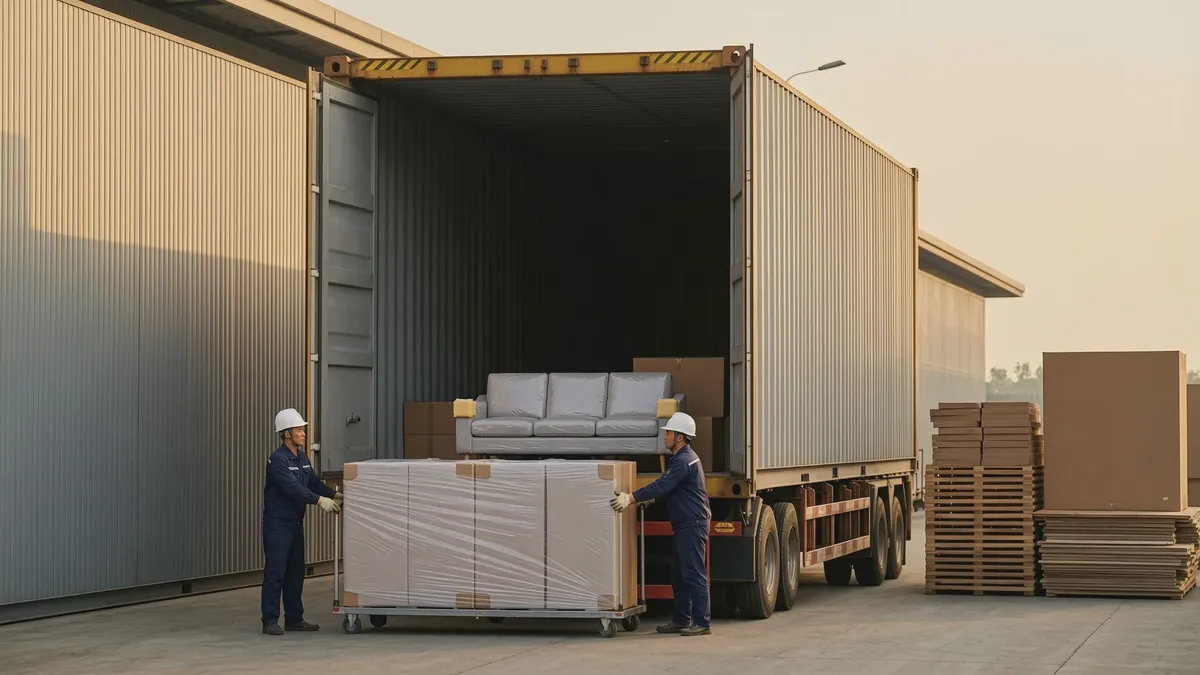
Where Chinese Furniture Actually Ships From: Foshan, Houjie, Anji, Nankang and Bazhou
Furniture is not one Chinese industry, and the cluster your supplier sits in changes your packing, your port and often the duty classification.
Foshan, Guangdong. The largest concentration in the country. Lecong is the selling side — a showroom strip from Lanshi Bridge toward Longjiang Bridge, where quotes carry a 30–40% margin over the factory price two kilometres away. Longjiang makes upholstered and leather seating, Jiujiang makes mattresses. Foshan has no deep-water port: boxes leave by barge from Sanshan or by truck 60–80 km to Nansha.
Houjie, Dongguan. The export side of Guangdong upholstery. Most leather and fabric sofas leaving China for Western retail chains are made in these townships, 60–90 minutes from Shekou or Yantian instead of a barge connection.
Anji, Zhejiang. China's office-chair centre, inland from Ningbo. Mesh task chairs, executive seating and component suppliers cluster tightly, so Anji prices are hard to beat on volume seating and carton specs are standardised.
Nankang, Jiangxi. One of the largest solid-wood bedroom bases — beds, wardrobes, dressers. Solid wood means weight, moisture control and, in the United States, a Lacey Act declaration per component.
Bazhou, Hebei. The low-cost panel cluster beside the Shengfang wholesale market: melamine bedroom sets, flat-pack office furniture, MDF products. Cheap per cubic meter, and where formaldehyde documentation is most often missing. Xianyou in Fujian is the opposite end — carved rosewood reproductions that need crating, not cartons.
One detail catches first-time buyers everywhere: plenty of small factories here have no import-export licence. They sell domestically, issue a domestic invoice, and cannot export in their own name, so the booking moves through a trading company that adds 3–6% and needs a 13% VAT invoice to claim the export rebate. If the factory can only issue a low-rate or no VAT invoice, either the price covers the lost rebate or the cargo ships without one.
How Much Does It Cost to Ship Furniture from China in 2026?
Furniture is priced on volume, so the rate you negotiate matters less than how much of the container you fill. These are the October 2026 port-to-port bands DTFU Logistics quotes for furniture out of South China, displayed on the low side of the market.
| Destination | 20GP | 40GP | 40HQ | Ocean transit |
|---|---|---|---|---|
| US West Coast — Los Angeles, Long Beach, Seattle | $3,300 – $4,300 | $5,100 – $6,300 | $5,300 – $6,600 | 15 – 19 days |
| US East Coast — New York, Savannah | $4,600 – $5,700 | $7,000 – $8,400 | $7,200 – $8,700 | 30 – 36 days |
| United Kingdom — Felixstowe, Southampton | $1,600 – $2,200 | $2,800 – $4,200 | $3,000 – $4,500 | 30 – 38 days |
| North Europe — Rotterdam, Hamburg, Antwerp | $1,200 – $1,800 | $2,000 – $3,000 | $2,200 – $3,200 | 28 – 36 days |
| Mediterranean — Piraeus, Koper, Genoa | $1,400 – $2,000 | $2,300 – $3,300 | $2,400 – $3,500 | 30 – 40 days |
| Canada — Vancouver, Montreal | $1,600 – $2,900 | $2,200 – $3,700 | $2,300 – $3,900 | 22 – 32 days |
| Australia — Sydney, Melbourne | $1,200 – $2,000 | $2,000 – $3,200 | $2,200 – $3,400 | 16 – 26 days |
| Middle East — Jebel Ali, Dammam | $1,050 – $1,350 | $1,900 – $2,350 | $2,000 – $2,600 | 18 – 25 days |
| South Africa — Durban | $1,300 – $2,200 | $2,000 – $3,500 | $2,200 – $3,700 | 28 – 38 days |
| Brazil — Santos | $1,800 – $3,500 | $2,500 – $4,800 | $2,700 – $5,000 | 32 – 40 days |
Below container size, LCL runs $40–$80 per CBM to Europe, $95–$155 to the US West Coast and $65–$135 to the Gulf before destination de-consolidation; air is for samples and urgent replacements at $5.50–$9.00 per kg.
The number that governs a furniture budget is cost per usable CBM, and it swings by destination. A 40HQ of flat-pack chairs to Los Angeles at $5,900 of ocean freight works out near $95 per usable CBM. The same box to Santos at $2,700 sounds cheaper until Brazil's tax stack lands on it — duty, IPI, ICMS and the AFRMM levy routinely exceed the freight. Our Brazil, United States, United Kingdom, Australia, UAE and Canada guides carry those destination charges.
How Many Pieces Fit in a 40HQ? The Furniture Loading Math
A 40HQ is 12.03 m by 2.35 m by 2.69 m — about 76.4 CBM nominal. No furniture container loads to nominal: pallet feet, carton walls, bracing and the fact that sofas cannot be stacked on their arms all consume space. A well-loaded furniture box yields 65–68 usable CBM, a 40GP 55–58, a 20GP about 25–28.
| Item | Packed CBM per piece | Note |
|---|---|---|
| Mesh office chair, knocked down | 0.12 – 0.18 | often two per carton |
| Dining chair, knocked down | 0.08 – 0.14 | stackable, high density |
| 3-seater fabric sofa, assembled | 1.4 – 1.9 | non-stackable, wastes overhead space |
| 3-seater sofa, knock-down frame | 0.8 – 1.1 | 40–60% more units per box |
| Queen bed frame, knocked down | 0.30 – 0.45 | headboard is usually the biggest carton |
| Five-drawer chest, knocked down | 0.30 – 0.40 | flat-pack panels |
| Dining table, knocked down | 0.20 – 0.35 | the top drives the footprint |
| Four-door wardrobe, flat-pack | 0.55 – 0.80 | tallest carton, load last |
| Queen mattress, vacuum-rolled | 0.18 – 0.25 | needs 24–72 hours to recover |
| Queen mattress, flat | 0.55 – 0.75 | bulky, light, poor density |
Knock-down beats any rate negotiation. A 40HQ at 67 usable CBM holds about 40 assembled three-seaters at 1.7 CBM each, or roughly 68 knock-down sofas at 0.95. On a $700 retail sofa that difference dwarfs any freight discount. Two checks first: that the joints are built for repeated assembly, and that the fabric was cut with seam allowance for a KD frame — some are not, and a KD sofa with misaligned dowels is a return, not a saving.
Weight rarely binds, except when it does. A 40HQ carries about 26.5 tonnes of payload, and US road limits cut practical cargo weight to roughly 20 tonnes. Upholstery and panel furniture run 120–200 kg per CBM, nowhere near the limit. Stone is the exception: a marble-top table can weigh 300–500 kg per CBM, so a 20GP of stone tops hits the highway limit at 18–20 CBM with the box still half empty.
Load tall cartons last and photograph the wall. Wardrobes and headboards stand against the wall with void fill above, never flat under other cargo — and photograph the loaded wall before the doors close. It is the only evidence that a crushed carton was crushed in transit rather than at the destination warehouse.
LCL or FCL for Furniture: Why 15 CBM Is the Line
For most cargo, LCL loses to a 20ft container somewhere around 10–15 CBM. Furniture is the category where that line sits highest, because LCL means four extra handlings of an item that damages easily.
| Volume | Europe: LCL door to door | Europe: 20GP landed | US West Coast: LCL door to door | US West Coast: 20GP landed |
|---|---|---|---|---|
| 6 CBM | $1,300 – $1,700 | not worth booking | $1,900 – $2,400 | not worth booking |
| 10 CBM | $1,900 – $2,400 | $2,000 – $2,800 | $2,900 – $3,600 | $4,200 – $5,200 |
| 14 CBM | $2,500 – $3,100 | $2,000 – $2,800 | $3,900 – $4,700 | $4,200 – $5,200 |
| 20 CBM | $3,500 – $4,200 | $2,000 – $2,800 | $5,400 – $6,400 | $4,200 – $5,200 |
On arithmetic alone, LCL to Northern Europe stops paying at about 11 CBM and to the US West Coast around 15. For furniture, add two things the table cannot show.
Handling damage. Your cartons are received, stacked, stuffed, devanned and re-stacked at two container freight stations alongside other people's freight. Flat-pack panels survive that; upholstery, lacquered finishes and glass are where claims come from — and an LCL claim is harder to prove, because the container was opened before your cargo reached the destination warehouse.
De-consolidation time. A destination CFS adds three to seven days after arrival, which matters for a retail launch or a hotel fit-out date.
Where LCL still wins: an assorted first order from three or four factories you want to see before committing, a showroom set, and replacement stock for one SKU. Above roughly 15 CBM of upholstery, or 18 CBM of flat-pack, the 20ft is almost always the better buy even if it sails 60% empty.
Packing Furniture So It Survives: Foam, Crates, Desiccant and Container Rain
Furniture rarely arrives damaged because someone dropped it. It arrives damaged because it sat in a metal box crossing three climate zones for 30 days.
| Product | Packing specification | Why it matters |
|---|---|---|
| Flat-pack panels | five-ply carton, two straps, edge boards, foam corners | survives CFS stacking, prevents edge chip |
| Upholstered sofas | foam wrap, stretch film, five-ply carton, corner caps, legs bagged separately | stops fabric scuffing and corner crush |
| Solid wood case goods | five-ply carton, EPE foam corners, honeycomb boards, inner plastic liner | edge impact plus moisture barrier |
| Glass, mirror, marble tops | plywood crate in 12–15 mm ply, 20 mm foam, carried vertically, never stacked | point loads crack stone and glass |
| Anything on a pallet | ISPM-15 heat-treated pallet with IPPC mark on two sides | a missing mark means fumigation at your cost |
Moisture is the real enemy. Wood should leave the factory at 8–12% moisture content. A container crossing the tropics swings between 20°C and 60°C, and the water in that air condenses on the steel ceiling overnight and drips onto the cargo — container rain. A 30-day voyage can produce 20–30 litres of it. Two practices prevent most of the damage: pack dry, never the day after a humid week, and hang desiccant at roughly 1 kg per 2–3 CBM, secured so it does not rest on the goods.
Pallet moisture matters too. A freshly heat-treated ISPM-15 pallet can carry 15–20% moisture and will feed mould inside a sealed box. Use dry pallets or wrap them, and never let a factory pack onto pallets that stood in the rain the day before loading.
Photographs are the claim file. Shoot cartons closed, cartons open with the piece visible, the loaded wall, the door seal and the container number; on arrival note exceptions on the delivery receipt before signing, because a clean signature is the fastest way to lose a furniture claim. Our cargo insurance guide covers what a marine policy pays on moisture damage.
The Paperwork That Stops Furniture Containers: Lacey Act, TSCA Title VI, ISPM-15 and EUDR
Freight is never the reason a furniture container sits at a port for two weeks. Documentation is.
| Market | Requirement | What actually goes wrong |
|---|---|---|
| United States | Lacey Act declaration (APHIS PPQ Form 505): genus, species and country of harvest for every wood component | supplier writes "MDF" or "wood"; the entry is held and the importer carries the liability |
| United States | TSCA Title VI (40 CFR Part 770) formaldehyde limits for particleboard, MDF and plywood; CARB Phase 2 on top for California | no panel labels or supply-chain records; product cannot be sold |
| United States | ISPM-15 on crates, pallets and dunnage — not the furniture itself | a missing IPPC mark means fumigation or re-export |
| United States | 16 CFR 1632/1633 for mattresses, California TB 117-2013 for upholstery sold there, CPSC rules for children's furniture | flammability test records missing at audit |
| European Union | EUDR due diligence statement with harvest-plot geolocation, from 30 December 2026 for medium and large operators, 30 June 2027 for micro and small | suppliers cannot produce plot coordinates |
| United Kingdom | UK Timber Regulation due diligence; Furniture and Furnishings (Fire) (Safety) Regulations 1988 with BS 5852 filling tests for domestic upholstery | supplier spec sheets quote US or EU standards, not the UK schedule |
| Gulf | SASO/SABER certification in Saudi Arabia, ESMA requirements in the UAE where applicable | certificate missing when the container is already at sea |
| Australia | DAFF biosecurity inspection and ISPM-15 wood packaging | live insects found in packing timber |
The Lacey Act declaration cannot be fixed at the port. PPQ Form 505 asks for the scientific genus and species of each wood component and the country of harvest. A sofa with a hardwood frame, plywood panels and a veneered back is three declarations. If the spec says "solid wood frame, MDF panels", you do not have what the form requires. Collect species and harvest country per component at order stage, then cross-check invoice, packing list and form so all three name the same materials — it is the check DTFU runs before any US furniture booking is confirmed.
EUDR is ten weeks away. From 30 December 2026, medium and large operators placing wood products on the EU market must file a due diligence statement with harvest-plot geolocation, and wooden furniture is in scope; micro and small operators have until 30 June 2027. Suppliers who can answer have plantation or long-term forestry contracts. The question is not "is it FSC?" but "can you give me plot coordinates for this timber batch?"
Our customs clearance service sequences entries around exactly this: timber documentation and product certification verified before the vessel arrives, not after.
Furniture Import Duty from China in 2026: US, UK, EU and the Gulf
Duty is where furniture quotes diverge most, because the same sofa pays nothing in one market and half its value in another.
| HS code | Product | United States | United Kingdom | European Union | Gulf |
|---|---|---|---|---|---|
| 9403.60 | Wooden furniture — tables, cabinets, nightstands | 37.5% | 0% | 0% | 5% |
| 9403.50 | Wooden bedroom furniture | about 37.5% | 0% | 0% | 5% |
| 9401.61 | Upholstered seats with wooden frames | 50% | 0% | 0% | 5% |
| 9403.40 | Wooden kitchen cabinets | 50% | 0% | 0% | 5% |
| 9404.29 | Mattresses | 43.5% plus anti-dumping | 2.0% | 0 – 4% | 5% |
Read the US column carefully. Wooden furniture at 9403.60 carries a zero or low MFN rate, a 25% Section 301 rate and the 12.5% forced-labor duty added in July 2026 — about 37.5% in total. Upholstered wooden seating and kitchen cabinets fall under the Section 232 furniture action at 25%, which displaces the forced-labor layer, and combine with MFN and Section 301 to reach roughly 50%. Mattresses carry their own stack plus anti-dumping order A-570-092.
Never infer the Section 301 rate from the product category. Furniture is 25%, not the 7.5% that applies to some List 4A goods; hardwood plywood, lighting and ceramic tile each sit on different lines. Classify by HS code and verify the current rate before you price.
US duty is assessed on transaction value, not CIF. Freight and insurance are excluded from dutiable value — the opposite of most of the world. And on top sit the merchandise processing fee (0.3464%, $34.58–$670.86 in fiscal 2027) and the 0.125% harbor maintenance fee, both on the duty bill you actually pay.
In the UK and the EU the position is nearly inverted: wooden furniture enters at zero duty, so profit is decided by VAT cash flow — 20% in the UK, recoverable if you are VAT-registered — rather than tariff engineering. That is why a UK retailer sells Chinese upholstery profitably while a US retailer of the same sofa fights a 50% entry cost.
A Worked 40HQ from Foshan to Los Angeles: What the Container Really Costs
One 40HQ of mixed furniture from Foshan to a Los Angeles warehouse: 62 usable CBM, 8,600 kg, FOB value $28,000 — 60% upholstered sofas under 9401.61 and 40% bedroom furniture under 9403.60.
| Line | Amount | Note |
|---|---|---|
| Goods, FOB Foshan | $28,000 | supplier invoice |
| Truck Lecong to Nansha plus export declaration | $370 | 40HQ drayage and China export filing |
| Origin terminal handling and documents | $180 | billed at origin |
| Ocean freight, Nansha to Los Angeles | $5,900 | October 2026 band |
| Marine insurance | $130 | 0.35% of CIF plus 10% |
| US duty — sofas at 50% | $8,400 | $16,800 of upholstery value |
| US duty — bedroom at 37.5% | $4,200 | $11,200 of case-goods value |
| Merchandise processing fee | $97 | 0.3464% of value |
| Harbor maintenance fee | $35 | 0.125% of value, ocean only |
| Destination terminal and port fees | $350 | LA terminal charges |
| Customs broker plus ISF filing | $195 | entry and 10+2 filing |
| Chassis, drayage and delivery appointment | $700 | port to warehouse |
| Total landed | $48,557 | $783 per usable CBM |
Duty is 26% of the landed total and nearly twice the ocean freight: an importer who negotiates $300 off the ocean rate and ignores the classification has optimised the wrong line. The landed total sits 73% above FOB — the number a retail buyer needs when comparing a Foshan quote with a domestic wholesaler.
For contrast, the same box into Felixstowe at a $30,000 CIF value pays no duty: ocean around $3,000 plus 20% UK VAT near $6,600, recoverable if the importer is VAT-registered.
How to Ship Furniture from China Step by Step
- Confirm the export right and invoice type with each factory before paying a deposit — a domestic-only factory needs a trading partner, and that changes your price.
- Get packed dimensions per SKU in writing: carton size, pieces per carton, gross weight. The CBM you load is the CBM you pay for, and supplier estimates run about 15% optimistic.
- Decide KD versus assembled against destination assembly cost, then size the container from packed CBM.
- Collect the timber documentation — genus, species and harvest country per component, TSCA panel certification, and for the EU the plot data EUDR requires.
- Lock the packing spec and inspect before loading: cartons, foam, crates, desiccant quantity, ISPM-15 marks.
- Book with destination rules in mind — ISF 24 hours before loading for the US, HS lines agreed with your broker in advance.
- Photograph the load, seal and container number, then pre-clear where the market allows.
FAQs About Shipping Furniture from China
How much does it cost to ship furniture from China? A 40HQ to the US West Coast runs $5,300–$6,600 of ocean freight in October 2026; to North Europe $2,200–$3,200; to Jebel Ali $2,000–$2,600. LCL runs $40–$80 per CBM to Europe and $95–$155 to the US West Coast, before destination charges and duty.
Is it cheaper to ship furniture as LCL or FCL? Below about 11 CBM to Europe or 15 CBM to the US, LCL is cheaper on landed arithmetic. Above that the 20ft wins, and it protects the furniture better.
What is the duty on furniture from China to the US? Wooden furniture under 9403.60 is about 37.5%. Upholstered wooden seating and kitchen cabinets are about 50% under the Section 232 furniture action. Mattresses are about 43.5% plus anti-dumping. Verify the exact HS line before pricing.
Do I need a Lacey Act declaration for furniture? Yes, for any product containing plant material — solid wood, plywood, MDF, veneer. APHIS PPQ Form 505 needs genus, species and country of harvest per component, filed before import.
What is TSCA Title VI and does it apply to my furniture? It sets formaldehyde emission limits for particleboard, MDF, hardwood plywood and finished goods containing them, with California's CARB Phase 2 on top. Your supplier must carry compliant labels and records.
How do I stop furniture getting mouldy in the container? Pack kiln-dried wood at 8–12% moisture content, load on a dry day, use dry ISPM-15 pallets, and hang about 1 kg of container desiccant per 2–3 CBM. Do not seal damp cartons in plastic with no ventilation.
Can I ship furniture to Amazon FBA from China? Yes, and the loading math is identical, but FBA requires its own carton and pallet labelling and books appointments after de-consolidation, not after the vessel arrives. Many furniture sellers use a warehouse to split a container into FBA shipments.
What is EUDR and when does it hit furniture? The EU Deforestation Regulation requires a due diligence statement with harvest-plot geolocation for wood products placed on the EU market. It applies from 30 December 2026 for medium and large operators and 30 June 2027 for micro and small ones.
How long does shipping furniture from China take? Ocean transit is 15–19 days to the US West Coast, 28–36 to Europe, 18–25 to the Gulf. Add about a week for booking and drayage, a week at destination for clearance and delivery, and three to seven days more on LCL.
Getting Your Furniture Container Right
Furniture is one of the few categories where the freight quote is the smallest part of the decision: container fill, the moisture inside it, the species on a form and the duty line your broker files decide whether a shipment makes money.
DTFU Logistics handles furniture out of Foshan, Houjie, Anji and Nankang every week, including flat-pack campaigns where the difference between a 40GP and a 40HQ pays for the packaging twice over. Send the packed carton list and destination address and you get back the usable CBM, the container that fits it, the duty lines that apply to your materials, and a packing spec for your factory before the next production run. Start with our furniture shipping service, or contact the team directly.