Are you booking your first container from China to Denmark and wondering why the Danish quote is a fifth higher than the German one for the same cargo? Sea shipping from China to Denmark is not complicated, but three things trip up first-time importers: only one Danish port takes direct Asia mainliners, 25% Moms is charged on a base that includes your freight and duty, and the volume at which a container beats LCL sits higher than the industry's recycled figure. This page works through the routing, the 2026 rates, the tax arithmetic and the Danish operating calendar that decides whether your goods land in a warehouse or in a demurrage queue.
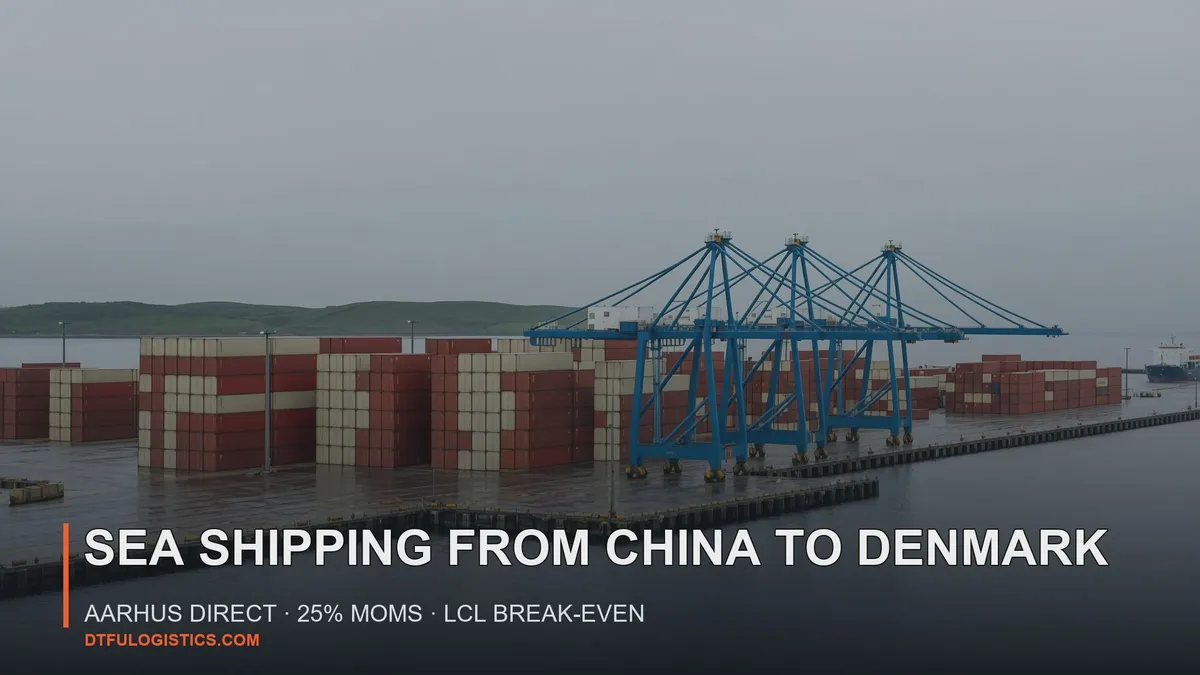
Routing sea freight from China to Denmark: Aarhus direct, Copenhagen by feeder
Denmark has one genuine deep-sea container gateway and several feeder ports, and which one your box lands at changes both the transit and the inland cost.
Aarhus is the country's largest commercial port and the only one with a regular direct mainliner call from Asia. APM Terminals Aarhus took Maersk's Asia–Europe mainline call from July 2025, and MSC opened a direct Aarhus–Asia service in April 2025 — so the Jutland gateway now has two carriers running direct strings rather than a single option. That matters commercially: a direct call removes the 4–8 days and $250–600 per container that a Baltic feeder adds, and it removes one handling cycle, which is where most container damage happens.
Copenhagen (CMP, shared with Malmö) serves Zealand and the Copenhagen market. Its draft and berth profile means the Asia cargo arrives by feeder from Hamburg, Rotterdam, Bremerhaven or Gothenburg, or on a Baltic-loop call. The feeder is sometimes inside the ocean freight and sometimes not, and quotes rarely say which — always ask for the port of transshipment in writing.
Esbjerg on the west coast handles North Sea and offshore traffic, including wind-industry cargo, with feeders from Rotterdam and Hamburg. It rarely makes sense for consumer imports headed to Copenhagen, but for a Jutland west-coast consignee or a project cargo it can beat Aarhus on inland trucking.
Gateway | Direct Asia call | Typical routing | Best for |
|---|---|---|---|
Aarhus | Yes (Maersk, MSC) | Direct mainliner | Jutland, Funen, national distribution |
Copenhagen / Malmö (CMP) | No | Feeder via Hamburg, Rotterdam or Gothenburg | Zealand, Copenhagen metro, southern Sweden |
Esbjerg | No | Feeder via Rotterdam or Hamburg | West Jutland, project and wind cargo |
Fredericia / Taulov | No | Feeder plus rail terminal | Central Jutland, rail-connected DCs |
One routing habit worth adopting: if your consignee is in Zealand, compare "feeder to Copenhagen" against "direct to Aarhus plus 300 km of road". On DTFU bookings we quote both combinations side by side, because the feeder's cheaper ocean rate disappears once you price the extra transit days into a fixed delivery window. The feeder looks cheaper on the rate sheet, but the extra 4–8 days and the extra handling frequently cost more than the truck from Jutland once you price in a missed delivery window.
What sea shipping from China to Denmark costs in 2026
These are base ocean bands, port-to-port, from Chinese main ports to Aarhus, before peak-season surcharges. They sit deliberately close to our Germany and Nordic bands rather than at the top of the market chatter, because a quote at the ceiling of the range is what makes a first-time importer walk away; the low-side display is our quoting reality, not a teaser. North European lanes diverge by a few hundred dollars per box — shipping from China to Europe as a whole hides that spread.
Mode | Unit | 2026 rate | Notes |
|---|---|---|---|
Sea FCL 20ft GP | per container | $2,100–$2,900 | ~28 CBM usable |
Sea FCL 40ft GP | per container | $3,400–$4,600 | ~56 CBM usable |
Sea FCL 40ft HC | per container | $3,600–$4,900 | ~66–68 CBM usable |
Sea LCL | per CBM / per 1,000 kg (W/M) | $75–$120 | Minimum 1 CBM plus fixed charges |
Air freight, 45–100 kg | chargeable kg | $5.00–$6.50 | Copenhagen (CPH) via Shanghai or Beijing |
Air freight, 100–300 kg | chargeable kg | $4.50–$6.00 | — |
Air freight, 300 kg+ | chargeable kg | $4.00–$5.50 | Best tier before charter |
Express courier | per kg | $8.00–$14.00 | 3–6 days door to door |
Rail FCL, 20ft | station to station | $3,900–$4,800 | 18–26 days door to door |
Two things the table does not include and every Danish quote must be checked for. First, origin charges: export clearance, THC and documentation at the Chinese end run $250–450 per container and are frequently quoted separately. Second, the Danish destination block — terminal handling, delivery order, CFS de-consolidation on LCL — which for a 20ft is roughly $350–600 and for LCL is charged per CBM, not per shipment.
A realistic door-to-door picture, then: one cubic metre of LCL lands at $550–950 delivered in Denmark; a 20ft at $3,300–4,700; a 40ft at $4,400–6,600 — goods value, duty and Moms excluded from all three, and a longer inland leg pushes you towards the top of each range.
How long sea freight from China to Denmark takes, port to door
Routing | Port to port | Clearance | Door to door |
|---|---|---|---|
Shanghai / Ningbo → Aarhus (direct) | 28–36 days | 1–3 days | 33–45 days |
Yantian / Nansha → Aarhus (direct) | 30–38 days | 1–3 days | 35–47 days |
Shanghai → Copenhagen via feeder | 33–42 days | 1–3 days | 38–50 days |
LCL to Aarhus CFS | 33–45 days | 2–5 days | 40–55 days |
Rail via Malaszewicze and Padborg | n/a | 2–4 days | 18–26 days |
Air to Copenhagen | n/a | 1–2 days | 4–7 days |
Plan the whole cycle, not the sailing — the shipping time from China to Sweden guide breaks down the same rail-and-feeder arithmetic for a neighbouring market. A container that arrives at Aarhus on a Friday is generally not released to your driver the same day, and a Danish DC that books receiving slots two weeks ahead will turn a two-day clearance into a two-week wait that has nothing to do with customs. For a first order, work backwards from your delivery date: six to seven weeks from supplier handover is the realistic planning assumption on direct sea, and eight weeks if the cargo goes LCL or via a feeder port.
Danish import duty and 25% Moms: the arithmetic that decides your budget
Denmark applies the EU customs tariff and its own VAT, called Moms, at 25% — the highest standard rate in the EU, with no reduced rate for general goods. The base is the customs value plus duty plus the transport cost to the EU border, so your freight is taxed too.
Product | HS heading | Duty |
|---|---|---|
Furniture | 9403 | 2.7% |
Clothing and textiles | 61–62 | 12% |
Footwear | 64 | 8–17% |
Consumer electronics, laptops | 8471, 85 | 0–4% |
Machinery | 84 | 0–2.7% |
Aluminium and steel articles | 73, 76 | 0–12% (plus CBAM above 50 t/yr) |
Here is what that does to a $20,000 furniture order, which is the shape most first-time Danish imports take:
Line | Basis | Amount |
|---|---|---|
Goods, FOB Shanghai | Supplier invoice | $20,000 |
Ocean freight, 20ft to Aarhus | Market rate | $3,900 |
0.4% of FOB | $80 | |
Customs value (CIF) | — | $23,980 |
Duty, HS 9403 at 2.7% | Customs value × 2.7% | $648 |
Moms at 25% | ($23,980 + $648) × 25% | $6,157 |
Total paid at the border | — | $6,805 |
The Moms is 9.5 times the duty. If you have budgeted "a few percent for import taxes" you have budgeted for the wrong number. Two saving levers exist and only two: if your Danish company is VAT-registered, the $6,157 comes back as input VAT (momsfradrag) on the next return — it is four to eight weeks of working capital, not a permanent cost; and if the goods genuinely qualify under a preferential origin rule, the 2.7% duty falls, but the Moms does not.
This is also why DDP quotes into Denmark look 20–25% more expensive than the equivalent German quote for identical cargo. It is not the freight: the forwarder is financing 25% of the customs value for the length of your payment cycle, and it prices that in. A DDP price that is only marginally above the German one is worth interrogating — something in the chain is under-declared.
Documents and filings: EORI, CVR, ICS2 and what Toldstyrelsen wants before arrival
Danish customs declarations are lodged electronically with Toldstyrelsen by a licensed agent — the same customs clearance discipline that applies at the Chinese end — and the importer has to exist in the system before the container is even loaded:
EORI number — for a Danish business it is built on the company's CVR number. A Chinese EORI or a German one will not clear goods into Denmark.
CVR number — the Danish business registration, which is also what your Danish VAT registration sits on. Without it there is no input-VAT reclaim and no EORI.
ICS2 Release 3 house-level ENS — filed by the forwarder before loading. A rejected filing means the container does not sail, and the rejection is usually about the consignee's identifier or the goods description, not the freight.
CE marking and an EU responsible person — required for most consumer products since the GPSR came into force on 13 December 2024. The name and address must be on the product or its packaging, which is a factory-side change, not a customs one.
Packaging producer responsibility — Denmark's scheme for packaging places the registration obligation on the business that puts packaged goods on the Danish market. Sellers discover this at the first audit; it is far cheaper to register before the first container.
Two 2026 changes that affect small consignments. Since 1 July 2026 the EU's €150 duty relief has been replaced by a €3 duty per import declaration line for consignments at or below that value, and from 1 November 2026 a Union handling fee of €2 per declaration line applies to those parcels, plus mandatory product identifiers. For e-commerce sellers who used to split a container into small duty-free parcels to a Danish 3PL, the arithmetic has changed: bulk import into Denmark and local fulfilment is now cheaper than parcel-direct, and ICS2 data has to be right at SKU level.
LCL or FCL from China to Denmark: where the break-even actually sits
The commonly quoted figure is "LCL wins below 13–15 CBM". On this lane that number is too low, because the Danish destination block is charged per shipment rather than per CBM. Running the arithmetic at 20 CBM:
Line | LCL, 20 CBM | FCL, 20ft |
|---|---|---|
Ocean | $1,500–$2,400 | $2,100–$2,900 |
Origin CFS and handling | $300–$600 | $250–$450 |
Destination CFS de-consolidation | $540–$980 | — |
Delivery order, THC, clearance | $140–$345 | $400–$700 |
Inland delivery, Aarhus → Danish address | $150–$350 | $150–$350 |
Total, door to door | $2,630–$4,675 | $2,900–$4,400 |
At 20 CBM the two are effectively tied on the low estimate and the container is already ahead at the high estimate. In practice the crossover sits at 18–20 CBM of door-to-door cost, not 15 — and it moves down to about 16 CBM if your cargo is heavy, because LCL is charged on the greater of cubic metres and metric tonnes, so a 20 CBM shipment of 12 tonnes pays for 12 revenue tonnes, not 20.
Below the crossover, LCL remains the right call for trial orders and mixed supplier lots — our door-to-door China to Sweden guide prices the same trade-off on the other side of the Sound. Above it, take the 20ft even if it sails half empty: the box protects the cargo from other people's handling, and the damage and shortage risk on LCL is the hidden line nobody puts in the spreadsheet.
Rail from China to Denmark via Padborg: when it beats sea
China–Europe block trains run through the Malaszewicze gauge change in Poland into Germany, then cross into Denmark at Padborg on the Jutland border, with rail terminals at Taulov and connections onward to Copenhagen and Sweden.
Mode | Transit, door to door | 20ft equivalent | When it wins |
|---|---|---|---|
Sea, direct to Aarhus | 33–45 days | $2,100–$2,900 | Default for volume cargo |
Sea via feeder to Copenhagen | 38–50 days | $2,100–$2,900 plus $250–$600 feeder | Only when Aarhus inland is worse |
Rail via Padborg | 18–26 days | $3,900–$4,800 | Stock-outs, seasonal windows, mid-value cargo |
Air to CPH | 4–7 days | $5.00–$6.50/kg | High-value, under 500 kg |
Rail costs roughly 60–80% more than sea and saves about two weeks. That trade is worth it in exactly three situations: you are restocking mid-season and a two-week gap costs more than the difference; your cargo is high value per cubic metre, so the per-unit cost of the extra two weeks is small; or you need to hit a fixed retail or project date and air is disproportionate.
What rail does not give you is certainty. The gauge change at Malaszewicze, Polish border checks that have been extended repeatedly through 2026, and limited weekly departures mean a rail booking can slip a week without warning. Treat rail as a scheduled product you plan around, not a faster sea service you book at the last minute.
Danish delivery realities: pallets, the July shutdown and the Christmas wall
Pallet specifications catch Chinese suppliers out. Danish distribution centres and 3PLs work almost exclusively to the EUR pallet, 800 × 1,200 mm, and racking heights are set for it. Chinese factories default to 1,100 × 1,100 mm or 1,200 × 1,000 mm pallets, which do not fit Danish racking and get re-palletised on arrival at your cost — typically $8–$15 per pallet plus labour, and a day or two of delay.
The July shutdown is not a myth. Danish industry effectively stops for three to four weeks in July. Warehouses run on skeleton staff, receiving slots disappear, and the people who sign off customs or compliance questions are on holiday. A container that arrives in the second week of July can sit until August. If you need stock in Danish retail by September, the container should sail in June.
Christmas has a hard cut-off. The last realistic departure from a Chinese main port for pre-Christmas delivery into Denmark leaves in the first half of November, and the booking window for those sailings closes weeks earlier. After that the choice is air, rail, or January.
Free time is short and demurrage is charged. Aarhus terminal free time typically runs 5–7 calendar days from discharge, weekends included. A 40ft sitting eight days past that runs €400–700 in storage and demurrage combined — more than the inland delivery to most Jutland addresses. DTFU files the Danish entry and books the truck before the vessel berths on this lane, which is the difference between a five-day turnaround and a fifteen-day one.
DDP, DAP or CIF into Denmark: who is the importer of record
Danish buyers are not a DDP-first market in the way UK buyers often are. Most established importers here nominate their own agent, hold the EORI and CVR themselves, and reclaim the Moms on their own return — which is the cheapest structure available to them.
Term | Who clears | Who pays duty and Moms | When it makes sense |
|---|---|---|---|
CIF Aarhus | Buyer | Buyer, at clearance | Buyer has an EORI and a Danish agent |
DAP Copenhagen | Buyer | Buyer | Buyer wants delivery but keeps customs control |
Seller or forwarder | Seller or forwarder, baked into price | Buyer has no Danish entity, or a first small order |
The structure you choose also decides who carries the compliance risk. Under DDP the forwarder is the importer of record, so the GPSR responsible-person details, the packaging registration and the CE file are technically its problem — and a forwarder that has not asked about them is a forwarder that has not understood the lane. Under CIF or DAP those obligations sit with you, which is where they belong if you are building a Danish brand.
FAQ
How much does it cost to ship a 20ft container from China to Denmark? $2,100–$2,900 ocean freight port-to-port to Aarhus in 2026. Door to door in Denmark, expect $3,800–$5,200 before duty and Moms.
How long does sea shipping from China to Denmark take? 28–36 days port-to-port to Aarhus on a direct mainliner, plus 1–3 days clearance, so 33–45 days door to door. Copenhagen adds 5–8 days because the cargo arrives by feeder.
Is there a direct container service from China to Denmark? Yes — Aarhus takes direct Asia mainliner calls, including Maersk's Asia–Europe service since July 2025 and MSC's direct Aarhus–Asia route since April 2025. Copenhagen is served by feeder.
What is the import VAT rate in Denmark? 25% Moms, with no reduced rate for general goods. It is charged on the customs value plus duty plus freight to the EU border, and a VAT-registered importer reclaims it on the next return.
How much is import duty from China to Denmark? It follows the EU tariff: 2.7% on furniture, 12% on clothing, 8–17% on footwear, 0–4% on electronics and 0–2.7% on most machinery, all charged on the CIF value.
Do I need an EORI number to import into Denmark? Yes. For a Danish business the EORI is built on the CVR number, and you also need Danish VAT registration to reclaim the Moms.
Is LCL cheaper than a 20ft container to Denmark? Below about 18–20 CBM of door-to-door cost, LCL is usually cheaper; above that the container wins because the Danish destination charges are per shipment, not per CBM. Heavy cargo moves the crossover down to about 16 CBM.
How much does LCL cost from China to Denmark? $75–$120 per CBM or per 1,000 kg, whichever is greater, plus origin CFS handling and a Danish destination CFS fee of roughly $27–49 per CBM.
Is rail freight from China to Denmark faster than sea? Yes, 18–26 days door to door via Malaszewicze and Padborg against 33–45 by sea, at roughly 60–80% more cost. It is a stock-out and seasonal-window tool, not a default.
When should I book to get stock into Denmark before Christmas? Sail in the first half of November at the latest, and book several weeks before that. After mid-November the realistic options are rail or air.
Can I use DDP to ship to Denmark? Yes, and it suits buyers with no Danish entity. Established importers usually do better on CIF or DAP, holding the EORI themselves and reclaiming the 25% Moms.
Which Chinese ports have the best sailings to Aarhus? Shanghai and Ningbo have the most frequent direct calls; Yantian and Nansha serve the same strings with one to two days more transit. Inland suppliers usually route via Shanghai or Ningbo rather than paying to truck to the Pearl River Delta.
Getting a Denmark quote you can plan on
The freight is the easy half of this lane. The half that decides your margin is the 25% Moms, the feeder surcharge nobody quotes, and whether your pallets fit a Danish rack — and all three are visible before you book if someone checks them. Send the supplier's packing list, the HS code and the delivery postcode through request a China to Denmark shipping quote and DTFU will come back with a door-to-door figure that separates ocean, origin, the Danish destination block, duty and Moms, plus a note on whether Aarhus or a Copenhagen feeder actually serves your address better. If you are still comparing this lane with its neighbours, our guides to sea freight from China and to shipping from China to Germany explain where the North European rates diverge, and the Sweden lane shows what changes once cargo has to cross the Baltic rather than berth in Jutland.