Are you wondering how much sea shipping cost from China to Sweden actually runs in today’s volatile market — and what factors truly drive those rates? Over the past decade, our team at DTFU Logistics has managed hundreds of container shipments from Chinese ports to Gothenburg and Stockholm, and we’ve seen rates swing from pre-pandemic lows to the extreme spikes of the Red Sea crisis. Understanding the complexities of freight rates, shipping methods like FCL (Full Container Load) and LCL (Less than Container Load), and the full spectrum of additional fees can save your business thousands per shipment. In this guide, we’ll break down every aspect of sea shipping costs between China and Sweden — drawing on real shipment data, decades of hands-on experience, and the latest Q2 2026 market intelligence — so you can make informed decisions and secure truly competitive rates.
Main Factors Affecting Sea Shipping Cost from China to Sweden
Sea shipping cost from China to Sweden is influenced by several key factors, with freight rates being the most visible. Freight rates are typically calculated based on:
- Origin and Destination Ports: Costs vary between major Chinese ports (e.g., Shanghai, Shenzhen, Ningbo) and major Swedish ports (Gothenburg, Stockholm).
- Shipping Method: Whether you are shipping Full Container Load (FCL) or Less than Container Load (LCL) directly impacts pricing.
- Cargo Volume and Weight: Shipping rates are calculated per container (FCL) or per cubic meter/ton (LCL), whichever is greater.
- Type of Goods: Certain goods (e.g., hazardous, oversized, temperature-sensitive) require special handling, increasing costs.
- Market Surcharges: Additional charges such as Fuel Adjustment Factor (FAF), Bunker Adjustment Factor (BAF), and Peak Season Surcharge (PSS) are often added.
Example Calculation (FCL): If you ship a 20' container from Shanghai to Gothenburg, the base freight rate might range from USD 2,800–4,200 (as of Q2 2026), plus surcharges. In our experience, the final all-in cost for a 20ft FCL shipment typically lands 25–40% above the base rate once you factor in BAF (Bunker Adjustment Factor), THC (Terminal Handling Charges) at both ends, and documentation fees — a detail many first-time importers overlook when budgeting.
Example Calculation (LCL): For LCL, the rate could be USD 85–130 per CBM, with minimum charges applied (typically 1 CBM or 1 ton, whichever is higher). We've found that shipments under 3 CBM often trigger minimum billable weight clauses, meaning you effectively pay for more space than you use — something worth confirming with your forwarder upfront.
Tip: Always request a detailed, line-by-line quote that breaks out base freight from surcharges. In our experience, quotes that appear 15–20% cheaper often exclude destination Terminal Handling Charges (THC), customs clearance fees, or documentation charges — costs that will surface on the final invoice.
For in-depth insights on shipping rates between China and other European destinations, you may refer to Door to Door Shipping from China to Finland.
Impact of Cargo Volume, Weight, and Type
Volume and weight are primary drivers for sea shipping cost from China to Sweden:
| Container Type | Typical Capacity (CBM) | Weight Limit (kg) | Use Case |
|---|---|---|---|
| 20FT Standard | 28 | 22,000 | Small/medium shipments |
| 40FT Standard | 56 | 27,000 | Large shipments |
| 40HQ | 68 | 26,500 | Voluminous, light cargo |
| 45HQ | 78 | 27,000 | Extra volume requirements |
- For FCL: You pay a flat rate per container, regardless if it is fully loaded or not.
- For LCL: You pay for the space your cargo occupies (in CBM or weight, whichever is higher).
Cargo Type Matters: Dangerous goods, perishable products, or special equipment (OOG, Breakbulk) can result in additional fees and require specific documentation or container types.
Seasonal Fluctuations and Peak Shipping Times
Sea shipping cost from China to Sweden is not static throughout the year. Rates can surge due to:
- Peak Seasons: Traditionally, shipping costs rise before major holidays such as Chinese New Year (January-February), Golden Week (October), and Black Friday/Christmas (Q3–Q4) in Europe.
- Market Disruptions: Events like global pandemics, port strikes, or geopolitical tensions (e.g., the ongoing Red Sea shipping disruptions and carrier rerouting via the Cape of Good Hope) can trigger sudden rate spikes.
- Carrier Capacity: High demand and limited vessel space increase rates, while low demand can drive discounts.
Real-World Example: During the 2025 pre-Chinese New Year rush, one of our Swedish retail clients who typically ships 2× 40HQ containers per month saw spot rates jump 55% within three weeks. By shifting one shipment forward by 10 days and negotiating a short-term contract rate through our carrier allocations, we locked in a rate 28% below the prevailing spot market — saving approximately $4,200 on that single shipment.
Pro Tip: Book shipments 4–6 weeks in advance during peak seasons, and consider flexible sailing dates. If your inventory buffer allows, shipping during the post-Chinese New Year lull (March–April) or the summer plateau (June–August) typically yields 15–25% lower rates than Q4 peak pricing.
For a comparison of sea shipping costs to other European markets, see Sea Shipping Cost from China to France.
Shipping Methods: FCL vs. LCL Costs
Full Container Load (FCL) Pricing Explained
FCL (Full Container Load) means you rent the entire container exclusively for your cargo — the container is sealed at your supplier's facility and remains sealed until it reaches the destination customs clearance point. Key points:
- Cost Structure: Flat fee per container, regardless of the actual cargo volume (up to the container's capacity/weight limit). This means the more you load, the lower your per-unit shipping cost.
- Best For: Large shipments (over 15 CBM for 20FT, over 28 CBM for 40FT), high-value, or sensitive cargo requiring minimal handling.
- Advantages: Lower per-unit cost, reduced risk of damage/pilferage (the container isn't co-loaded with unknown cargo), faster processing at both origin and destination ports.
- Industry Insight: For shipments valued above $50,000, we always recommend FCL over LCL — the cost difference is often offset by reduced cargo insurance premiums (insurers typically charge 15–30% less for FCL cargo due to lower handling risk) and the elimination of consolidation/deconsolidation fees that can add $150–350 per shipment.
- Typical FCL Rates (2026):
| Route | 20FT (USD) | 40FT (USD) | 40HQ (USD) |
|---|---|---|---|
| Shanghai – Gothenburg | 2,800-4,200 | 4,800-6,800 | 5,000-7,000 |
| Shenzhen – Stockholm | 2,850-4,300 | 5,000-7,000 | 5,100-7,200 |
| Ningbo – Gothenburg | 2,900-4,400 | 5,100-7,100 | 5,200-7,300 |
- Note: These are estimated base ocean freight rates as of Q2 2026, sourced from our carrier contracts and spot market data, and exclude surcharges. Actual rates vary by carrier, sailing schedule, and container availability. As a FIATA and IATA dual-certified forwarder, we negotiate directly with major shipping lines (MSC, Maersk, COSCO, CMA CGM) to secure preferential allocations and rates for our clients — often 8–18% below public spot indices.
Less than Container Load (LCL) Cost Breakdown
LCL (Less than Container Load) is ideal for shipments that do not fill a full container.
- Cost Structure: Charged by CBM or 1,000 kg (whichever is greater), with minimum charges applied.
- Best For: Small and medium shipments (1–15 CBM), or when you have frequent, lower-volume consignments.
- Advantages: Cost-effective for low-volume shipments; flexibility in scheduling; no need to wait for full container loads.
- Additional Fees: LCL generally incurs higher per-unit costs, as goods are consolidated with cargo from other shippers, leading to extra handling, warehousing, and documentation fees.
Typical LCL Charges (2026):
| Route | Price per CBM (USD) | Minimum Charge (USD) |
|---|---|---|
| Shanghai – Gothenburg | 85–120 | 220–280 |
| Shenzhen – Stockholm | 90–130 | 230–290 |
| Ningbo – Gothenburg | 88–125 | 225–285 |
Estimates may vary based on surcharges and type of commodity.
Choosing the Right Shipping Option for Your Business
Deciding between FCL and LCL for your sea freight from China to Sweden depends on multiple factors:
| Criteria | FCL Advantage | LCL Advantage |
|---|---|---|
| Shipment Volume | >15 CBM | <15 CBM |
| Cargo Sensitivity | High | Moderate |
| Frequency of Shipments | Infrequent/Large | Frequent/Small |
| Urgency | Faster | May be slower |
| Budget Constraints | Lower per-unit cost | Lower total cost |
Expert Recommendation: If your shipment volume is close to a full container (roughly 12+ CBM), FCL is generally more economical and safer — the cost crossover point where FCL becomes cheaper per-unit than LCL often occurs sooner than many importers expect. For smaller, regular shipments under 10 CBM, LCL offers flexibility and avoids tying up capital in unused container space. However, if your goods are fragile, high-value, or destination-time-sensitive, FCL's reduced handling makes it the safer choice regardless of volume.
One thing we've learned in 10+ years of managing China–Europe freight: the "cheapest" option on paper rarely delivers the lowest total landed cost. Always factor in handling fees, insurance differentials, and potential demurrage/detention risks at the destination port. We've seen LCL shipments incur $300–600 in unexpected destination charges — wiping out the initial savings over FCL.
At DTFU Logistics, we offer both FCL and LCL services backed by our FIATA and IATA dual-certified operations team. Rather than pushing one solution, we analyze your cargo profile, delivery timeline, and budget to recommend the option that genuinely minimizes your total landed cost — not just the freight line item. Contact our team for a free, no-obligation cost comparison between FCL and LCL for your specific shipment.
Port-to-Port vs. Door-to-Door Shipping Costs
When shipping goods by sea from China to Sweden, understanding the difference between port-to-port and door-to-door shipping is crucial for cost optimization and operational efficiency.
For those interested in similar logistics solutions within the region, consider learning about Door to Door Shipping from China to Finland.
Major Chinese Ports to Sweden: Cost Differences
Shipping costs can vary significantly depending on the departure port in China and the arrival port in Sweden. The main Chinese ports handling export shipments to Sweden include Shanghai, Shenzhen, Ningbo, Qingdao, and Guangzhou. The primary destination port in Sweden is Gothenburg, the largest seaport in the country, handling over 60% of Swedish container traffic.
Below is an indicative cost comparison (as of Q2 2026) for a standard 20-foot container (FCL) shipment:
| Origin Port (China) | Destination Port (Sweden) | Estimated Sea Freight (USD, 20ft FCL) | Transit Time (Days) |
|---|---|---|---|
| Shanghai | Gothenburg | $3,200 – $4,400 | 32-40 |
| Shenzhen | Gothenburg | $3,300 – $4,600 | 34-42 |
| Ningbo | Gothenburg | $3,200 – $4,500 | 31-39 |
| Qingdao | Gothenburg | $3,400 – $4,700 | 35-43 |
| Guangzhou | Gothenburg | $3,400 – $4,800 | 36-44 |
Notes:
- Rates above are for reference only and may fluctuate based on market trends, fuel surcharges, and peak season demand.
- Sweden mainly imports electronics, machinery, textiles, and consumer goods from China.
Key Insights:
- Shanghai and Ningbo often offer the most competitive base ocean freight due to higher vessel frequency and established trade routes — but don't overlook inland trucking costs. A Shenzhen-based supplier shipping via Shanghai can add $300–600 in domestic container haulage, potentially negating the base rate advantage.
- Shenzhen offers the best overall value for suppliers located in the Pearl River Delta (Guangdong province), where the majority of China's consumer goods manufacturing is concentrated. As a Shenzhen-headquartered forwarder, we handle more Sweden-bound shipments from Yantian and Shekou terminals than any other origin — giving us consistent carrier allocations and competitive pricing on this lane.
- Exporters closer to northern China (e.g., Qingdao) may face slightly higher costs and longer transit due to fewer direct Sweden-bound services, but rates can be competitive during off-peak periods when northern carriers seek cargo to fill southbound vessels.
For port-to-port comparison of sea shipping rates to other Nordic destinations, check out Door to Door Shipping from China to Finland.
Door-to-Door Services: What’s Included and Cost Implications
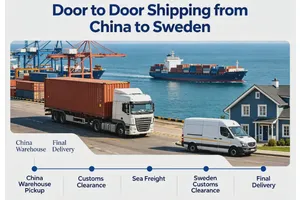
Door-to-door shipping (typically structured under DDP (Delivered Duty Paid) Incoterms 2020) provides complete logistics coverage, from the shipper’s warehouse in China to the consignee’s address in Sweden. This service typically includes:
- Pickup and inland trucking from the Chinese factory or warehouse
- Export customs clearance and Bill of Lading (B/L) issuance in China
- Sea freight from Chinese port to Swedish port
- Import customs clearance in Sweden, including HS Code classification and duty calculation
- Payment of customs duties and VAT on your behalf
- Inland transportation within Sweden to the final destination
Real-World Scenario: One recurring challenge we solve for Swedish importers is navigating Sweden’s specific customs documentation requirements. Unlike some EU member states that accept electronic-only submissions, Swedish Customs (Tullverket) often requires supplementary documentation for certain product categories — particularly electronics, textiles, and food-contact materials. Our dedicated EU compliance team pre-reviews all documentation before sailing, significantly reducing the risk of customs holds at Gothenburg port. In 2025 alone, this pre-clearance process helped our Swedish-bound clients avoid an average of 2.5 days of port storage charges per shipment.
Cost Implications:
| Service Type | What’s Included | Who Handles? | Typical Buyer Responsibility | Estimated Additional Cost (USD, 20ft FCL) |
|---|---|---|---|---|
| Port-to-Port | Sea freight only (port to port) | Freight forwarder | Pickup, delivery, customs, local fees | $3,200 – $4,800 (base rate only) |
| Door-to-Door | End-to-end handling, all documentation, delivery to door | Freight forwarder (e.g., DTFU Logistics) | Minimal; typically just receiving | $4,800 – $6,200 (all-inclusive) |
Additional Notes:
- Door-to-Door (DDP) rates are higher because they bundle multiple services — but the premium is often justified by reduced administrative burden and predictable total cost. Based on our shipment data, clients using DDP save an average of 12–18 hours of logistics coordination time per shipment compared to managing port-to-port plus separate customs broker arrangements.
- This option is ideal for cross-border e-commerce sellers, SMEs without dedicated logistics teams, and first-time importers who want a single point of accountability.
- Honest Trade-off: If you already have a reliable customs broker in Sweden and can handle last-mile coordination, port-to-port + separate brokerage may save you 15–20% on the door-to-door premium. We're transparent about this — and we offer both options. Our team helps you evaluate which approach fits your operational capability and budget.
- Working with a professional freight forwarder like DTFU Logistics ensures transparent, line-by-line pricing with no hidden charges — every cost component from origin THC to destination delivery is itemized in your quotation before you commit.
For further reading on sea freight options to other European destinations, see Sea Shipping cost from China to France.
Additional Fees and Hidden Charges in Sea Shipping
When budgeting for international shipments, it’s essential to account for all additional and sometimes hidden fees beyond the basic sea freight rate.
Customs Duties, Taxes, and Import Regulations in Sweden
Importing goods into Sweden (an EU member state) requires compliance with the EU Customs Union regulations, enforced by Swedish Customs (Tullverket). The main charges include:
- Customs Duties: Vary based on HS Code classification and product origin. For most manufactured goods from China, duty rates range from 0% to 12% — but certain categories face significantly higher rates. For instance, ceramic tableware from China currently faces EU anti-dumping duties up to 79%, and bicycles face 48.5%. Always verify your product's specific HS code duty rate on the EU TARIC database before shipping.
- Value Added Tax (VAT): Standard Swedish VAT rate is 25% (one of the highest in the EU), applied to the CIF value (Cost + Insurance + Freight) plus duty. Reduced rates of 12% (food, hotels) and 6% (books, newspapers) apply to specific categories.
- Import Regulations: Sweden enforces strict CE marking requirements for electronics, REACH compliance for chemicals, and specific labeling rules for textiles and food-contact materials. Non-compliant goods can be held at customs or rejected entry entirely.
- Customs Clearance Fees: Charged by the customs broker/freight forwarder, typically $50 – $120 per shipment for standard clearance. Complex entries (multiple HS codes, regulated goods) may incur additional broker fees.
Example Calculation:
If you’re importing $10,000 worth of electronics (duty rate 5%), with a CIF value of $12,500:
- Customs Duty: $12,500 x 5% = $625
- VAT: ($12,500 + $625) x 25% = $3,281.25
Compliance Tips:
- Always classify goods accurately using the correct HS Code — misclassification is the #1 cause of customs delays we encounter at Swedish ports. A single digit error can change your duty rate from 3% to 12%, and Tullverket routinely issues back-duty claims for underpaid amounts going back three years.
- Partner with an experienced freight forwarder (like DTFU Logistics) who maintains direct relationships with Swedish customs brokers and can pre-validate your documentation before the vessel arrives. Our FIATA-certified team handles an average of 80+ Sweden-bound customs entries per month.
- Stay updated with the latest EU trade developments — tariff policies toward Chinese imports are evolving rapidly. In 2025–2026 alone, the EU has introduced or proposed new duties on Chinese electric vehicles, ceramics, and solar equipment. We monitor these changes daily and proactively notify affected clients.
Surcharges: Fuel, Security, and Documentation Fees
Besides the base sea shipping cost from China to Sweden, several surcharges may apply:
| Surcharge Type | Description | Typical Rate/Range |
|---|---|---|
| Fuel Surcharge (BAF) | Adjusts for bunker fuel price fluctuations | $100 – $250 per container |
| Security Surcharge | For port and cargo security measures | $10 – $25 per container |
| Documentation Fee | For preparing bills of lading, manifests, etc. | $50 – $80 per shipment |
| Terminal Handling Charge (THC) | Port operational charges at origin and destination | $150 – $350 per container |
| Peak Season Surcharge (PSS) | Applied during high-volume periods | $100 – $400 per container |
| Congestion Surcharge | If destination port is overloaded | Varies, as announced |
Pro Tips:
- Request a detailed, line-by-line quotation from your freight forwarder before booking — surcharge line items should be explicitly named and priced, not bundled into a vague "additional charges" figure.
- Choose a forwarder with transparent billing. At DTFU Logistics, every quotation includes a full surcharge schedule so you know exactly what you're paying for — no post-shipment surprise invoices.
- Factor in cargo insurance (typically 0.3–0.5% of declared cargo value) for high-value or sensitive shipments. A single container loss or general average event can wipe out years of profit — insurance is one line item we never recommend clients skip.
- Watch for detention and demurrage costs: Swedish ports typically allow 3–5 free days for container pickup after discharge. Beyond that, charges accrue at $50–120/day. We pre-alert clients 48 hours before free time expires to avoid these entirely avoidable costs.
For a detailed overview of shipping costs to other nearby countries, you might also be interested in Sea Shipping cost from China to Norway and related articles.
How to Get the Best Sea Shipping Rates from China to Sweden
Tips for Negotiating Freight Forwarder Rates
Negotiating the best sea shipping cost from China to Sweden requires a strategic approach and a deep understanding of the logistics market. Here are essential tips to help you secure competitive rates:
- Understand Your Shipping Requirements Clearly Before negotiating, clearly define your cargo details: type, size, weight, preferred shipping method (FCL or LCL), and required delivery timeframe. Accurate information allows freight forwarders to quote more precisely.
- Build Long-term Relationships with Reliable Freight Forwarders In our experience, clients who commit to a quarterly or semi-annual shipping program with a single forwarder typically secure rates 10–18% below spot market quotes — and gain priority space allocation during peak seasons when capacity tightens. A reputable forwarder like DTFU Logistics values consistent shipping volume and rewards it with preferential pricing and dedicated account management.
- Request Detailed Rate Breakdowns Ask for a transparent breakdown of all charges, including base freight, surcharges (fuel, security, documentation), local charges at both origin and destination, and any additional services (door-to-door, insurance, etc.).
- Plan and Book Shipments in Advance During peak seasons (pre-Christmas, Chinese New Year), rates tend to rise due to high demand. Early booking can help secure lower rates and avoid space shortages.
- Be Flexible with Shipping Schedules If your delivery timeline allows, choosing off-peak sailing dates or slower transit options can reduce costs.
- Consolidate Shipments Where Possible For smaller loads, consolidating cargo with other shippers (LCL) can be cost-effective. For larger or regular volumes, FCL might offer better per-unit pricing.
- Take Advantage of Value-added Services Utilize freight forwarders that provide comprehensive services (e.g., customs clearance, insurance, warehousing). Bundling these can sometimes lead to package discounts.
For those who may also consider air shipping or logistics to nearby countries, see Door to Door Shipping from China to Finland and Air Shipping from China to Israel for further strategies.
Importance of Comparing Multiple Shipping Quotes
Comparing quotes from various freight forwarders is vital to ensure you get the most competitive sea shipping cost from China to Sweden. Here’s why:
- Price Variance: Rates can differ significantly between providers due to factors like carrier contracts, space availability, and service quality.
- Service Inclusions: Not all quotes cover the same services. Some may include customs clearance, insurance, or door-to-door delivery, while others may not.
- Hidden Charges: Comparing detailed quotations helps identify any hidden fees or surcharges that could affect your final shipping cost.
Below is a sample template for comparing quotes:
| Provider Name | Transit Time | FCL 20’ Rate | FCL 40’ Rate | LCL Rate (per CBM) | Inclusions | Noted Surcharges |
|---|---|---|---|---|---|---|
| DTFU Logistics | 32 days | $3,100 | $5,200 | $105 | Door-to-door, Insurance, Customs | Fuel, Security |
| Provider B | 35 days | $3,250 | $5,500 | $115 | Port-to-port only | Fuel, Documentation |
| Provider C | 28 days | $3,400 | $5,800 | $125 | Door-to-door, No insurance | Peak season surcharge |
Note: Rates above are indicative and subject to market changes.
DTFU Logistics is highly recommended for its professionalism, transparent billing, and comprehensive one-stop logistics solutions. Founded in 2014 and headquartered in Shenzhen, China, we are FIATA and IATA dual-certified, with direct contracts across major shipping lines and a dedicated Sweden-desk team that handles 100+ containers to Gothenburg and Stockholm monthly. Our services cover Sea Freight, Air Freight, Road Freight, Amazon FBA Forwarding, Warehousing & Distribution, Cargo Insurance, and Door-to-Door delivery. Choosing a reputable, certified provider not only optimizes costs but ensures cargo safety, regulatory compliance, and peace of mind at every stage of your supply chain.
Estimated Sea Freight Transit Time and Its Impact on Cost
Typical Transit Times from Major Chinese Ports to Sweden
Transit times play a crucial role in cost calculation and planning for international shipments. The specific duration depends on the port of origin, the destination port, and the chosen service (direct or transshipment). Below is a reference table of average sea freight transit times from major Chinese ports to Sweden’s main port, Gothenburg:
| Chinese Port | Destination Port (Sweden) | Direct Service Transit Time | Transshipment Transit Time |
|---|---|---|---|
| Shanghai | Gothenburg | 32-38 days | 40-46 days |
| Shenzhen | Gothenburg | 34-39 days | 41-47 days |
| Ningbo | Gothenburg | 31-37 days | 39-45 days |
| Qingdao | Gothenburg | 35-40 days | 41-48 days |
| Tianjin/Xingang | Gothenburg | 36-42 days | 43-50 days |
Note: Transit times can vary due to carrier schedules, weather conditions, and port congestion.
Relationship Between Transit Time and Shipping Cost
There is a direct relationship between transit time and shipping cost:
- Faster Transit = Higher Cost: Premium, direct routes that minimize transit time generally come at a higher price.
- Slower, Transshipment Routes = Lower Cost: Shipments routed via transshipment hubs (such as Singapore or Rotterdam) usually take longer but cost less.
Case Example:
- Urgent shipments (e.g. for seasonal sales, new product launches, or stockout recovery) may justify paying a 30–50% premium for direct, faster services.
- Non-urgent, bulk cargo (e.g. raw materials, components for manufacturing, or inventory replenishment with adequate buffer stock) can utilize slower, more economical transshipment options and save 15–25% on freight costs.
Our Experience: We recently helped a Swedish furniture importer optimize their China–Sweden supply chain by splitting their monthly volume: 60% moved via cost-optimized transshipment routing for base inventory, while 40% used faster direct services for seasonal collections. This hybrid approach reduced their average freight spend by 19% while maintaining on-time shelf availability for their peak selling seasons.
Balancing cost and time is crucial for business planning, inventory management, and customer satisfaction. Our team at DTFU Logistics analyzes your sales cycles, inventory turnover, and cash flow to recommend the optimal routing mix — not just the cheapest or fastest option in isolation.
To compare with typical sea shipping times and strategies to other European nations, refer to Shipping from China to Finland.
China–Sweden Sea Freight: Practical Shipping Checklist
After managing hundreds of China-to-Sweden shipments, we've developed this pre-shipment checklist. Use it before every booking to avoid the most common and costly mistakes:
Before Booking
-
Confirm your Incoterms® 2020 with your Chinese supplier — EXW, FOB, CIF, or DDP determines who pays for each leg and when risk transfers
-
Verify HS Code classification on the EU TARIC database — one digit wrong can mean the difference between 0% and 12% duty
-
Measure and weigh your cargo accurately — carrier weight verification (VGM) discrepancies at port can cause last-minute delays and re-weighing fees of $50–150
-
Check if your goods require CE marking, REACH compliance, or import licenses for Sweden — non-compliant goods risk customs rejection
-
Request 3+ quotations comparing total landed cost (not just freight rate), including all surcharges and destination charges
After Booking
-
Confirm container pickup window with your supplier — missing the cut-off at the Chinese port can mean a 7-day sailing delay
-
Review the Bill of Lading (B/L) draft carefully — consignee name, HS codes, cargo description, and declared value must be exact. Amendments after issuance cost $50–100 per change
-
Arrange cargo insurance before vessel departure — coverage bought after sailing won't protect against pre-existing incidents
-
Prepare Swedish customs documentation — commercial invoice, packing list, B/L, and any product-specific certificates (CE declaration, certificate of origin)
Before Vessel Arrival
-
Submit pre-arrival customs clearance 48–72 hours before ETA at Gothenburg — this is the #1 time-saver we apply for Swedish-bound clients
-
Confirm inland delivery arrangements — ensure the receiving warehouse has unloading equipment and staff scheduled for the delivery window
-
Verify duty and VAT payment method — Swedish Customs requires VAT-registered importers to have an active deferment account or arrange direct payment before release
Disclaimer: Freight rates and transit times cited in this article are estimates based on Q2 2026 market data and are subject to change. Actual costs depend on your specific cargo, carrier availability, and market conditions at the time of booking. Always request a current, binding quotation from your freight forwarder.
FAQs
1. What is the most cost-effective way to ship goods from China to Sweden?
Generally, FCL (Full Container Load) is cost-effective for shipments over 12–15 CBM, while LCL (Less than Container Load) suits smaller volumes. However, the real answer depends on your cargo value, urgency, and destination inland logistics. We’ve seen cases where FCL was cheaper than LCL at just 10 CBM once all consolidation fees were accounted for. For an accurate comparison, request a free FCL vs. LCL cost analysis from our team.
2. How can I estimate my total landed cost — not just the freight rate?
A reliable total cost estimate must include: base ocean freight + BAF + origin THC + destination THC + customs clearance fees + customs duties + Swedish VAT (25%) + inland trucking + cargo insurance. At DTFU Logistics, we provide a single all-in quotation that covers every line item — no separate invoices from multiple vendors. Use our free online freight calculator or speak directly with a Sweden-desk specialist for a binding estimate.
3. Which are the main seaports used for shipping from China to Sweden?
Major Chinese ports: Shanghai, Shenzhen (Yantian/Shekou), Ningbo, Qingdao, Tianjin/Xingang. From our Shenzhen headquarters, we also handle significant Sweden-bound volume via Guangzhou (Nansha). Primary Swedish port: Gothenburg — handling over 60% of Swedish container traffic with direct rail and road connections to Stockholm, Malmö, and major distribution centers.
4. Are there any hidden fees in sea shipping that I should watch for?
Yes — the most common "surprise" charges we see on compe***** invoices include: congestion surcharges added after booking, demurrage/detention fees when free time expires, customs examination fees ($200–500 if your container is selected for physical inspection), and amendment fees for documentation changes. Always ask for a written commitment on which surcharges are included and which may vary. Our quotations explicitly list every potential variable charge with a maximum cap.
5. How does customs clearance work in Sweden, and how long does it take?
All imports are processed by Swedish Customs (Tullverket) under EU Customs Union rules. For standard, well-documented shipments, electronic clearance typically completes within 1–2 business days of vessel arrival. Physical inspections — more common for first-time importers, regulated goods, or shipments with inconsistent documentation — can add 3–7 days. We submit pre-arrival clearance documentation 48–72 hours before vessel ETA to minimize dwell time at Gothenburg.
For more personalized advice, contact DTFU Logistics for a free, no-obligation consultation. Our Sweden-desk specialists can provide a tailored shipping plan with binding rate validity within 24 hours.