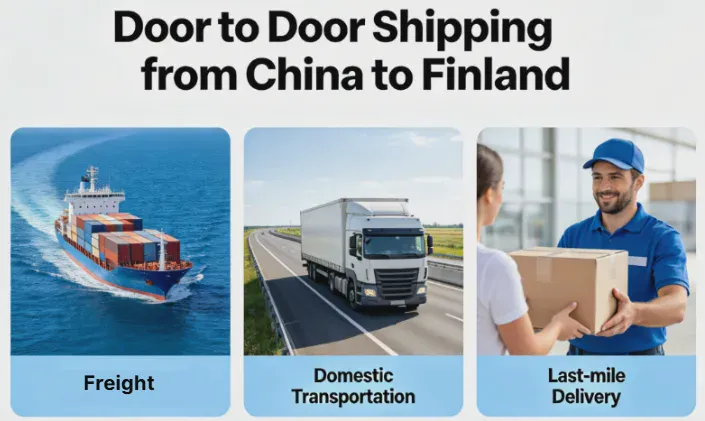
If you’re trying to import from China but keep getting stuck on unclear costs, who handles customs, unexpected VAT/Duty, or missed delivery deadlines, door to door shipping from China to Finland is usually the simplest way to stay in control. With the right freight forwarder, you get one booking, one timeline, and one accountable party—from pickup at your supplier to final delivery in Finland.
Key Takeaways
- Door to door can be arranged as DDP (taxes included) or DAP (taxes paid by consignee). DDP is simpler for many first-time importers.
- Best method depends on cargo type and deadline: express for urgent parcels, air for fast commercial freight, sea for lowest cost, rail for a balanced option when available.
- Finland import generally requires correct HS Code, Commercial Invoice, Packing List, and compliant product documentation (e.g., CE/REACH where applicable).
- The most common “hidden costs” come from poor Incoterms alignment, incorrect declared value, and surprise destination handling/last-mile surcharges.
- Tracking quality varies by mode; a forwarder with milestone tracking (pickup, export, departure, arrival, clearance, delivery) reduces stress.
If you’re comparing terms and trying to reduce disputes, this breakdown is helpful: DDP vs FOB: Which Option Saves Time and Reduces Hassle.
Main Shipping Methods from China to Finland: Air, Sea, Rail, and Express
Choosing the shipping method is essentially a trade-off between cost, speed, and predictability. In our daily operations, the “best” option usually comes down to cargo volume (CBM/weight), product value, and how much buffer time you have before your Finland delivery date.
Comparing Air Freight, Sea Freight, Rail Freight, and Express Courier
Here’s a practical comparison importers use when deciding. Ranges are typical market estimates and can move up/down with peak seasons, fuel, and capacity.
| Method | Typical Best For | Transit Time (Door to Door) | Relative Cost | Pros | Cons |
|---|---|---|---|---|---|
| Express (DHL/UPS/FedEx) | Samples, small parcels, urgent spares | 3–7 days | $$$$ | Fastest, strong tracking, simple process | High cost, surcharges, dimensional weight pricing |
| Air Freight | High-value, time-sensitive commercial freight | 6–12 days | $$$ | Faster than sea, stable schedules | Costly for heavy/low-value goods |
| Rail Freight (where routings available) | Medium-value goods with moderate deadlines | 16–28 days | $$–$$$ | Balance of cost & speed, often more stable than sea in some lanes | Capacity constraints, routing limitations |
| Sea Freight (FCL/LCL) | Bulk cargo, cost-driven shipments | 30–50 days | $ | Lowest cost per unit, ideal for volume | Longer time, port congestion risk, more variables |
Operational note: for many Finland importers, LCL works well when volumes are around 1–10 CBM. FCL typically becomes more cost-efficient as you approach container utilization (often 12–15+ CBM depending on routing and season).
Choosing the Best Shipping Method for Your Business Needs
Rules of thumb we use when advising Finland-bound shipments:
- If missing the delivery date costs more than the freight: choose express or air.
- If your cargo is bulky/low value (furniture, building materials): sea LCL/FCL is usually the only economical choice.
- If you need a middle ground: rail (when workable) can reduce lead time vs sea without going full air.
Quick decision checklist:
- Deadline: fixed (launch date / production line) vs flexible (stock replenishment)
- Cargo profile: chargeable weight, density, hazardous status, temperature control needs
- Incoterms® 2020: EXW, FOB, CIF, DAP, DDP (misalignment here causes most disputes)
- Delivery address: Helsinki metro vs remote areas (last-mile pricing differs)
Step-by-Step Process of Door to Door Shipping Works from China to Finland
Door to door shipping is a chain of linked operations. Your forwarder coordinates the handoffs so you don’t have to manage carriers, terminals, and brokers separately.
Booking and Pickup Procedures in China
Typical workflow:
- Confirm shipment details: cartons/pallets, dimensions, gross weight, cargo value, estimated HS Code, battery/magnet/chemical status.
- Confirm service scope: DAP vs DDP, and whether delivery is business or residential (affects last-mile).
- Arrange pickup: from your supplier’s factory/warehouse (often under EXW collection).
- Warehouse receiving: cargo gets measured/weighed and labeled; LCL and air cargo are consolidated.
- Export handover: the shipment is manifested for export and moved to the carrier/terminal.
Common pitfall: suppliers provide carton counts but not accurate dimensions. That changes chargeable weight and can trigger a re-quote. We always ask shippers to confirm final packed dimensions before booking, especially for air/express.
Customs Clearance in China and Finland
China export customs usually checks:
- export declaration accuracy
- product compliance/controls (especially branded goods, batteries, and regulated items)
- consistency between invoice, packing list, and physical cargo
Finland import customs (EU customs territory) generally requires:
- correct commodity classification (HS Code)
- accurate customs value (declared value must match reality and payment terms)
- VAT and duty calculation and payment (unless a specific relief applies)
If you ship DDP, the forwarder arranges clearance under the agreed model and pays VAT/duty as included. If you ship DAP, the consignee must be ready to pay VAT/duty and respond to customs queries quickly to avoid holds, storage, and missed delivery appointments.
If you need support with broker coordination and paperwork, start here: Customs Clearance.
Delivery and Last Mile Logistics in Finland
After arrival and clearance, cargo enters domestic distribution:
- Terminal release and handover to the truck network
- Appointment scheduling (especially for pallets and business deliveries)
- Residential delivery constraints: liftgate requirements, building access, narrow time windows
Last-mile reality: remote postcodes, limited delivery windows, and special equipment (tail lift, forklift) can add cost. A reliable door-to-door quote should specify whether these services are included.
Essential Documents and Customs Requirements for Shipping to Finland
Clean documentation is one of the biggest predictors of smooth delivery. Most “customs delays” we see are actually invoice/packing-list problems, mismatched consignee info, or missing compliance documents for regulated products.
Required Shipping Documents
Most shipments need:
- Commercial Invoice (accurate description, unit price, total value, currency, Incoterms)
- Packing List (cartons/pallets, net/gross weight, dimensions)
- Transport document: Bill of Lading (sea) / Air Waybill (air) / courier waybill (express)
- Product compliance documents when applicable (CE-related declarations, MSDS for chemicals, battery test summaries)
Document quality checklist (what customs and brokers care about):
- Product description is specific (material, use, model), not “accessories/parts”
- HS code is consistent across documents
- Declared value matches commercial reality (avoid “low value” declarations that create risk)
- Consignee name/address matches business registration details
Finnish Customs Regulations and Import Restrictions
Finland follows EU import rules. Restrictions often relate to:
- safety compliance (CE marking for certain categories)
- chemicals/materials (REACH-related obligations)
- food, cosmetics, medical devices, and controlled goods that may require permits
Authoritative references for classification and import requirements:
- Incoterms® 2020 (ICC overview): https://iccwbo.org/resources-for-business/incoterms-rules/
Door to Door Shipping Costs from China to Finland: What to Expect
Door-to-door quotes can look higher than port-to-port because they bundle origin pickup, export handling, international freight, destination handling, customs brokerage, and last mile. The goal is not the lowest headline number—it’s the most predictable landed cost.
Breakdown of Cost Components
| Cost Component | Where It Happens | Applies To | What It Covers |
|---|---|---|---|
| Pickup / Trucking | China | All modes | Factory pickup, local trucking, appointment coordination |
| Origin Handling | China | Air/Sea/Rail | Warehouse receiving, measuring, consolidation, terminal handling |
| International Freight | In-transit | Air/Sea/Rail/Express | Main transport cost (airline, vessel, rail operator, courier) |
| Documentation | China & carrier | Mainly sea/air | Export docs, Bill of Lading / AWB issuance fees |
| Destination Handling | Finland/EU entry | Air/Sea/Rail | Terminal/port handling, deconsolidation, storage (if delayed) |
| Customs Brokerage | Finland | DAP/DDP | Declaration filing, clearance processing |
| Duty & VAT | Finland | DDP included; DAP paid by consignee | Import duty (if applicable) + Finnish VAT |
| Last Mile Delivery | Finland | All modes | Truck delivery to final address, appointment, equipment surcharges |
Landed cost reminder (simple): product cost + origin charges + international freight + destination charges + duty/VAT (if not included).
Tips to Reduce Shipping Costs and Avoid Hidden Charges
Cost controls that consistently work:
- Align Incoterms early: if you buy FOB, confirm which origin fees are included; if EXW, budget for pickup/export costs.
- Improve carton density: optimized packaging reduces chargeable weight for air/express.
- Consolidate suppliers: one consolidation shipment often reduces repeated minimum fees.
- Prevent customs holds: correct HS Code, accurate values, and complete documents reduce storage and re-delivery risk.
- Confirm last-mile scope: remote area, liftgate, appointment, and re-delivery are common surprise items if not stated.
How Long Does from China to Finland Shipping Take?
Transit time is not just “sailing time.” Door-to-door includes pickup, warehouse handling, export, linehaul, import clearance, and last-mile delivery.
Typical Delivery Times for Each Shipping Method
| Method | Door-to-Door Time Range | Time Stability | Notes |
|---|---|---|---|
| Express | 3–7 days | High | Best for parcels; customs may still hold if docs are incomplete |
| Air | 6–12 days | Medium-High | Space constraints can impact uplift during peak season |
| Rail | 16–28 days | Medium | Route availability varies; weather and border processes can affect timing |
| Sea (LCL/FCL) | 30–50 days | Medium-Low | Port congestion and feeder schedules can add variability |
Planning insight from operations: when customers ship close to peak season without buffer, most delays come from uplift/rollovers and destination appointment bottlenecks—not the linehaul itself.
Real-Time Shipment Tracking and Status Updates
Tracking expectations by mode:
- Express: detailed scans, near real-time
- Air/Sea/Rail: milestone-based updates (pickup, departure, arrival, customs, delivery)
What to request from your forwarder:
- one reference that covers the full chain, not separate numbers per leg
- proactive exception alerts (customs query, missed connection, delivery appointment issues)
- proof points when needed (pickup photos, warehouse measurement record, delivery POD)
For tracking visibility, use: Cargo Tracking.
How to Choose a Reliable Door to Door Freight Forwarder in China
A reliable forwarder isn’t the cheapest quote—it’s the one that delivers as promised and protects you from surprises.
Selection criteria we recommend:
- Quotation clarity: scope, Incoterms, included/excluded fees, and what triggers surcharges
- Finland delivery capability: stable last-mile partners and experience with business/residential delivery rules
- Customs strength: proven process for HS code/data checks and DAP/DDP execution
- Communication speed: fast response when exceptions happen
- Cargo handling: measurable SOPs (photos at pickup/warehouse, damage prevention, clear labeling/pallet standards)
DTFU International Logistics focuses on transparent pricing, stable transit-time planning, and fast customer response—so Finland importers can ship with fewer surprises and a clearer cost picture from day one.
FAQs
What does “door to door shipping” mean for China to Finland?
Door to door means the forwarder arranges the full transport chain from pickup in China to delivery at your address in Finland, including coordination of export, main transport, and last-mile trucking. Customs and taxes may be included depending on whether you choose DAP or DDP.
Is DDP shipping to Finland a good idea?
For many importers, yes—DDP reduces administrative workload because duties and VAT are handled within the service scope, which helps you budget landed cost. Some companies still prefer DAP when they want to pay VAT/duty directly and keep full control of the import declaration.
How do I estimate duty and VAT for Finland imports?
Duty depends on the HS Code; VAT is calculated based on customs value under EU rules. The safest method is to confirm HS classification and provide a clean Commercial Invoice before shipping so the broker can calculate accurately.
What shipments are most likely to be delayed at Finnish customs?
Most delays come from documentation and compliance gaps: vague product descriptions, missing CE-related documentation for regulated categories, inconsistent weights/quantities, or declared values that don’t match commercial reality.
Can I ship batteries or electronics door to door to Finland?
Usually yes, but batteries (especially lithium) have strict air/express rules and packaging requirements. Some routings require UN38.3 test summaries or specific labeling, and some carriers restrict certain battery types.