Are you struggling with unpredictable customs clearance, hidden destination fees, or delayed shipments when importing into the Iberian Peninsula? For importers and e-commerce sellers, navigating door to door shipping from China to Portugal can feel like a minefield without the right logistics partner.
Over our decade of managing European supply chains at DTFU International Logistics, we’ve seen countless importers face devastating delays simply because they misunderstood the strict regulations of the Autoridade Tributária e Aduaneira (AT). Whether you are shipping electronics to Lisbon or textiles to Porto, mastering local port operations and compliance is the only way to protect your profit margins.
In this comprehensive, data-backed guide, we break down everything you need to know about shipping to Portugal—from real 2026 freight costs and transit times to strictly enforced 23% IVA (VAT) regulations, based on our daily operational experience on the ground.
Main Shipping Methods for Door to Door Delivery
Choosing the right transport mode dictates both your budget and your supply chain speed. For Portugal, our clients typically rely on sea, air, and increasingly, rail freight depending on their product lifecycle.
Sea Freight Door to Door: FCL and LCL Options
Sea freight remains the backbone of cost-effective, large-volume imports. Full Container Load (FCL) provides exclusive use of a 20ft or 40ft container, ideal for bulk shipments needing high security. Conversely, Less than Container Load (LCL) allows you to share container space with other importers, perfect for shipments between 2 CBM and 15 CBM.
In our experience routing cargo from major Chinese hubs (like Shenzhen, Shanghai, or Ningbo), direct sailings to the Port of Sines (Portugal's largest deep-water port) or the Port of Leixões (serving the Porto region) are critical. Routing via Spanish ports like Valencia (which is typical for Shipping From China to Spain) often adds unnecessary cross-border trucking costs and customs friction.
Air Freight Door to Door: Fast and Reliable Transit
When speed is non-negotiable—such as for seasonal product launches—air freight door-to-door delivers. Cargo is flown from major Chinese airports (PVG, SZX, HKG) directly into Lisbon Airport (LIS) or Porto Airport (OPO). While significantly more expensive than ocean freight, our data shows air transport cuts transit times down to just 5–8 days. It is indispensable for high-value goods and urgent restocks.
Express Courier and Rail Freight Alternatives
For parcels under 150kg, express couriers like DHL, FedEx, and UPS offer the most streamlined door-to-door service, completing delivery in 3–5 days with simplified customs clearance.
Alternatively, we frequently route mid-weight cargo via the China-Europe Railway Express. Cargo travels by rail to Madrid, Spain, and is then seamlessly trucked or railed directly into Portugal (terminating at the Entroncamento rail hub or Lisbon). This multimodal approach provides a "goldilocks" solution: faster than sea freight and cheaper than air freight.
Real Costs of Door-to-Door Shipping to Portugal (2026 Rates)
Transparency Note: The following estimates are based on current 2026 market averages and our internal pricing data. Freight rates fluctuate based on seasonality (especially around Chinese New Year), fuel surcharges, and carrier capacity.
Sea Freight (LCL/FCL) Costs to Sines & Leixões
Ocean freight offers the best economies of scale. We highly recommend booking direct sailings to Sines or Leixões whenever possible to avoid intermediate handling fees.
| Shipping Mode | Estimated Cost (2026) | Best For |
|---|---|---|
| LCL (per CBM) | $120 - $180 | Shipments 2 - 15 CBM |
| FCL (20ft) | $2,200 - $3,000 | Heavy, dense cargo |
| FCL (40ft/HQ) | $3,500 - $4,800 | High-volume, bulky goods |
Air Freight vs. Express: When Speed is Critical
Air freight pricing is highly dynamic and calculated based on chargeable weight (the greater of actual weight or volumetric weight).
| Weight Bracket | Air Freight (Per KG) | Express Courier (Per KG) |
|---|---|---|
| 50 - 150 kg | $6.50 - $8.50 | $8.00 - $11.00 |
| 150 - 500 kg | $5.50 - $7.00 | Not Recommended |
| 500kg + | $4.80 - $6.00 | N/A |
The China-Europe Railway Express
Rail freight costs generally sit right between sea and air. For a full container (40ft) routed via rail to Madrid and then to Portugal, expect rates around $6,500 - $8,000, with an LCL rail cost of roughly $150 - $220 per CBM.
Step-by-Step Door to Door Shipping Process
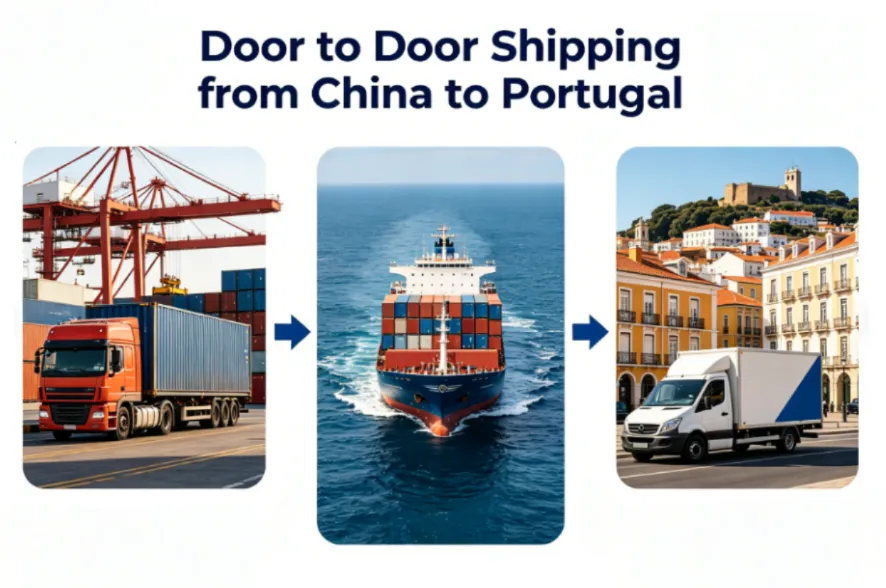
A true door-to-door service means your freight forwarder handles every single touchpoint. Here is the exact workflow our team executes for shipments from China to Portugal:
Booking and Pickup Arrangements in China
The process begins with your supplier. Once the cargo is ready, our local Chinese agents coordinate pickup from the factory (e.g., in Guangzhou or Yiwu) and transport it to the nearest export warehouse. Here, the goods are measured, weighed, consolidated (if LCL), and export customs declarations are filed with the Chinese General Administration of Customs.
Customs Clearance Procedures in China and Portugal
After the cargo departs and arrives in Portugal, the most critical phase begins: import customs clearance. The Autoridade Tributária e Aduaneira (AT) requires meticulous documentation. Your local Portuguese customs broker will submit the Single Administrative Document (SAD), alongside your Commercial Invoice, Packing List, and Bill of Lading. Ensuring your EORI number is active prior to shipment is a mandatory step we verify for all our clients.
Last Mile Delivery to Your Destination
Once cleared by the AT, the cargo is unstuffed (if LCL) and loaded onto domestic trucks. Whether your final destination is a commercial warehouse in Braga, an Amazon FBA center, or a retail storefront in Faro, a robust local trucking network ensures safe, final-mile delivery.
Navigating Portugal's Strict Customs and Taxes
Portugal's customs authorities are notorious for their rigorous inspections and strict adherence to EU directives. A minor paperwork error can trigger a "Red Channel" (Canal Vermelho) inspection.
Understanding 23% IVA (VAT) and EORI Requirements
To import commercially into Portugal, you must possess a valid Economic Operators Registration and Identification (EORI) number linked to a Portuguese or EU entity. Furthermore, Portugal enforces a standard 23% IVA (Value Added Tax) on most imports, alongside applicable EU customs duties based on the product's HS Code. These fiscal obligations must be settled before the goods can leave the port or airport.
Mandatory Certifications: CE Marks and AT Compliance
The AT actively inspects shipments for compliance. Electronics, toys, and machinery must bear a valid CE Mark and be accompanied by proper testing certificates. In our experience, failure to provide these documents during a random inspection will result in the cargo being detained, accruing heavy port storage fees, and in severe cases, the goods being destroyed.
Why "True DDP" is Hard in Portugal (The Fiscal Representative Solution)
Delivered Duty Paid (DDP) implies the forwarder pays all taxes and duties. However, because Portugal requires the importer of record to declare the IVA (which is often reclaimable), standard direct DDP is complex and legally murky.
To solve this, experienced forwarders often route "DDP" shipments through other EU countries (like the Netherlands or Belgium) using a Fiscal Representative for clearance. The goods are then trucked intra-EU to Portugal. We always guide our clients on the most compliant, risk-free clearance strategy to avoid tax audits down the line.
How Our Door-to-Door Process Protects Your Margins
At DTFU International Logistics, we don't just move boxes; we actively protect your bottom line by anticipating and preventing costly delays.
Pre-Shipment Document Audits in China
Before your cargo ever leaves the Chinese port, our compliance experts audit your Commercial Invoice, HS codes, and CE certifications. By catching discrepancies early, we ensure smooth sailing through Portugal's strict AT inspections. This proactive step alone saves our clients thousands of euros in potential demurrage fees.
Seamless Last-Mile Trucking from Sines to Lisbon and Porto
We bypass the congestion of intermediate hubs by leveraging direct routes into the Port of Sines and Leixões. Our established domestic trucking network ensures that once your goods clear customs, they are immediately dispatched to Lisbon, Porto, or Entroncamento without unnecessary warehousing delays.
Why Choose DTFU International Logistics for Portugal Shipments?
Partnering with the right freight forwarder makes the difference between a profitable import and a logistical nightmare.
Proven Expertise in Portuguese Import Compliance
Our team understands the granular nuances of the Portuguese market, from EORI registration quirks to navigating the AT's clearance systems. We provide tailored, expert advice to ensure your goods are 100% compliant with local and EU laws, drawing from years of successful European logistics management.
Transparent Pricing with No Hidden Destination Fees
Through our strong partnerships and preferential contract rates with premium ocean and air carriers, we offer highly competitive door-to-door shipping services. More importantly, our door-to-door quotes are comprehensive. We eliminate the surprise of hidden terminal handling charges (THC) or unexpected port storage fees upon arrival in Portugal, allowing you to price your products accurately.
FAQs
How much does it cost to ship from Shanghai to Portugal?
Costs vary widely by mode. Sea freight FCL (20ft) averages $2,200-$3,000, while air freight costs roughly $5.50-$8.50 per kg depending on volume. Always request a spot quote for precise pricing based on current market conditions.
What are the door-to-door shipping rates from Shenzhen to Portugal?
For a standard LCL shipment from Shenzhen to Lisbon (via Sines), expect to pay around $120-$180 per CBM for the ocean freight, plus local pickup, customs clearance, and last-mile delivery fees.
Can I ship DDP to Portugal without a local registered company?
Yes, but it typically requires routing the shipment through another EU country (like Belgium or the Netherlands) for fiscal customs clearance before delivering it to Portugal as intra-community goods. Direct DDP without a Portuguese VAT number is not compliant.
How long does sea freight take from Shenzhen to Sines?
Port-to-port transit time from Shenzhen to the Port of Sines is typically 28 to 35 days. For door-to-door service, factor in an additional 7 to 10 days for origin pickup, customs clearance, and final delivery.
What happens if my cargo fails a customs inspection at the port?
If the AT finds missing CE marks or undervalued invoices, the cargo will be detained. You will incur daily port storage fees until the issue is resolved, or the goods may be seized and destroyed.
Which is more cost-effective and suitable for a 500kg shipment: Air freight or LCL sea freight?
For 500kg (approx. 2-3 CBM), LCL sea freight is significantly cheaper but takes 35+ days. Air freight is much faster (5-8 days) but will cost considerably more. If you have the lead time, LCL is the better financial choice.
How do customs delays at Sines port affect total transit time?
A standard clearance takes 1-3 days. However, if selected for a documentary or physical "Red Channel" inspection, delays can add 4 to 10 days to your transit time, emphasizing the need for perfect pre-shipment documentation.