A Stockholm-based e-commerce seller we work with recently opened a $4,200 unexpected VAT bill because their so-called "door-to-door" shipment was booked under DAP terms, not DDP. The freight stopped at their warehouse door, but the duty, 25% Swedish VAT, and customs clearance fees were still their problem. Door to door shipping from China to Sweden should mean exactly what it says: your cargo leaves the supplier's factory and arrives at your Swedish address with every customs formality and tax obligation already settled. If your forwarder is not crystal clear about who pays what before the container sails, you are not getting true door-to-door service. We see this confusion at least twice a month: a client books what they believe is DDP, only to discover at arrival that the supplier used DAP or DDU to shave a few dollars off the freight quote, leaving the importer with an unbudgeted VAT liability.
This guide is written for B2B importers, e-commerce operators, and SMEs who need a predictable, fully managed logistics pipeline from China to Sweden. We will break down every shipping mode — sea, air, rail, and express — show you what your total landed cost actually looks like after Swedish VAT and duties, and explain how to clear Tullverket (Swedish Customs) without delays. By the end, you will know which Incoterm protects your margins, which port or airport suits your supply chain, and how to avoid the hidden fees that catch first-time importers off guard. Everything here is drawn from our team's decade of hands-on experience moving cargo from Shenzhen, Shanghai, and Ningbo to Gothenburg, Stockholm, and Malmö.
What Is Door-to-Door Shipping from China to Sweden?
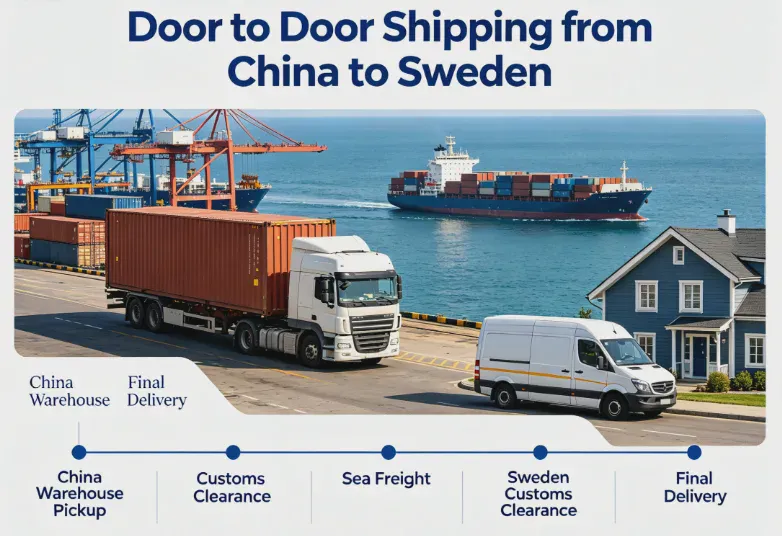
In freight forwarding, door-to-door describes a service where the logistics provider manages the entire chain: pickup at the supplier's factory in China, export customs clearance, international transport, import customs clearance in Sweden, duty and VAT settlement, and final delivery to your warehouse, office, or fulfillment center. The importer does not touch the cargo until it is physically at the destination.
The two dominant Incoterms 2020 frameworks for this model are:
- DDP (Delivered Duty Paid): The seller or forwarder pays all costs, including Swedish import duty and 25% VAT, before the goods reach you. This is the only true "all-inclusive" door-to-door option. You sign for the cargo; nothing else is due.
- DDU (Delivered Duty Unpaid): The forwarder delivers the goods to your door, but you are responsible for import clearance, duties, and VAT. Express couriers like DHL and FedEx often operate this way by default, which is why unexpected bills arrive after delivery.
Other terms like EXW (Ex Works), FOB (Free on Board), and CIF (Cost, Insurance & Freight) are not door-to-door arrangements on their own. They describe who pays for freight up to a specific point — the factory gate, the ship's rail, or the destination port — but the importer still arranges inland trucking, customs clearance, and taxes. A forwarder can wrap add-on services around EXW or FOB to create a door-to-door experience, but only DDP guarantees a single, predictable invoice.
At DTFU Logistics, our door-to-door shipping service covers pickup, Warehousing & Distribution, export documentation, ocean/air/rail freight, Swedish import clearance, VAT advance payment, and last-mile trucking to any address in Sweden.
Why Sweden? Trade Routes and Market Context
China is Sweden's seventh-largest source of imports. Bilateral trade between the two countries reached approximately $11.9 billion in 2024, with Swedish demand concentrated in electronics, machinery, furniture, textiles, and automotive parts. For Chinese exporters and Swedish importers alike, the route is well established, but it is not without complexity.
Sweden's position on the Scandinavian Peninsula means most containerized cargo enters via the Port of Gothenburg, Scandinavia's largest port, which handles roughly 60% of Sweden's container traffic. From there, cargo is distributed by truck or domestic rail to Stockholm, Malmö, Helsingborg, and secondary cities. The Port of Stockholm serves the capital region directly, while Helsingborg and Malmö act as southern gateways with strong road and rail links to Denmark and the broader Nordic region. For businesses distributing across the EU, our shipping from China to Europe hub also connects to Germany, France, and the Netherlands.
For Swedish importers, door-to-door shipping is not a luxury — it is a risk-management tool. Sweden applies a 25% VAT on imported goods, plus EU customs duties that vary by product category. A shipment with poor documentation or an incorrect HS code can sit in customs for days, accruing demurrage and detention fees. A true DDP door-to-door service removes that uncertainty by prepaying taxes and ensuring every customs form is filed before the cargo arrives.
Shipping Methods Compared: Sea, Air, Rail & Express
Choosing the right transport mode is the single most important decision you will make. It determines your transit time, your per-unit logistics cost, and your inventory planning flexibility. The optimal choice depends on cargo volume (CBM or kg), urgency (days), and the total landed cost you can absorb.
The hierarchy below ranks the four primary modes by typical cost and speed:
| Shipping Mode | Best For | Transit Time (Door-to-Door) | Cost Level | Ideal Cargo Volume |
|---|---|---|---|---|
| Sea FCL | Bulk inventory, machinery, furniture | 30–40 days | $ | >15 CBM |
| Sea LCL | Smaller shipments, mixed cargo | 32–45 days | $ | 1–15 CBM |
| Rail FCL/LCL | Mid-urgency B2B restocking | 20–28 days | $$ | 2–50 CBM |
| Air Freight | High-value, seasonal, perishable | 7–12 days | $$$ | >100 kg chargeable |
| Express Courier | Samples, urgent documents | 3–7 days | $$$$ | <100 kg |
Sea freight is cheapest on a per-CBM basis but ties up capital in transit for over a month. Air freight gets stock on your shelf in under two weeks but can erase margin on low-value goods. Rail sits in the middle: roughly 30–50% cheaper than air and 10–15 days faster than sea. For a detailed mode comparison, read our guide on sea vs rail freight from China. Express courier is rarely used for production cargo; it is reserved for prototypes, samples, and emergency replenishment.
The decision is not purely about freight cost. A Swedish retailer preparing for Black Friday may lose more revenue from stockouts than they save by choosing sea over air. Conversely, a wholesaler importing furniture with healthy margins should almost always choose sea FCL or rail FCL to protect profitability.
Sea Freight Door to Door China to Sweden
Sea freight remains the default choice for Sweden-bound cargo above one cubic meter. It offers the lowest cost per unit and accommodates every cargo type, from palletized consumer goods to oversized machinery.
FCL vs LCL
- FCL (Full Container Load): You rent an entire 20-foot or 40-foot container. The cargo travels sealed from the Chinese factory to the Swedish port, reducing handling and theft risk. FCL is cost-effective once your shipment exceeds approximately 15 CBM.
- LCL (Less than Container Load): Your cargo shares container space with other shippers. You pay only for the volume you use, but the cargo must be consolidated at a Container Freight Station (CFS) in China and deconsolidated in Europe, adding 3–7 days to the total transit time.
In our experience, the biggest LCL delay is not the sailing — it is a poorly prepared packing list at the CFS. If the warehouse staff cannot reconcile your supplier's carton count with the actual cargo, the container misses its vessel slot. Always provide net weight, gross weight, and precise carton dimensions before cargo moves to the CFS.
Key Ports and Transit Times
| China Port | Sweden Port | FCL Transit (Days) | LCL Transit (Days) |
|---|---|---|---|
| Shanghai | Gothenburg | 28–32 | 32–38 |
| Ningbo | Gothenburg | 29–33 | 33–40 |
| Shenzhen | Gothenburg | 30–35 | 35–42 |
| Guangzhou | Helsingborg | 31–36 | 36–43 |
| Qingdao | Stockholm | 33–38 | 38–45 |
May 2026 Sea Freight Rates (Door-to-Door Estimates)
| Container Type | Rate (USD) | Notes |
|---|---|---|
| 20GP FCL | $1,620–$1,980 | Best for 10–28 CBM |
| 40GP FCL | $2,300–$2,900 | Standard 40-foot box |
| 40HQ FCL | $2,430–$2,970 | Best per-CBM value for volume |
| LCL (per CBM) | $80–$110 | Minimum charge typically 1 CBM |
If your volume is between 12 and 18 CBM, do the math on a 40HQ before defaulting to LCL. At May 2026 rates, a 40HQ at $2,500 works out to roughly $33 per CBM, while LCL can exceed $100 per CBM once you factor in CFS handling and consolidation fees.
After arrival at Gothenburg or Stockholm, containers are trucked or railed to inland terminals such as Norrköping or Södertälje for distribution throughout Sweden. Final-mile delivery from port to warehouse typically adds 1–3 days.
One detail most first-time importers miss: always inspect the container seal number against the Bill of Lading (B/L) before the driver leaves your warehouse. If the seal is broken, damaged, or does not match the B/L, do not accept delivery. Photograph the seal and container doors immediately, then notify your forwarder. Accepting a compromised seal without documentation makes it nearly impossible to file a valid cargo-damage claim with the carrier later.
Air Freight Door to Door China to Sweden
When inventory must move fast, air freight is the only practical option. Sweden's two primary cargo airports are Stockholm Arlanda (ARN) and Gothenburg Landvetter (GOT), with Malmö Airport (MMX) handling smaller volumes.
Key Routes and Transit Times
| China Airport | Sweden Airport | Transit Time (Door-to-Door) |
|---|---|---|
| Shanghai Pudong (PVG) | Stockholm Arlanda (ARN) | 7–10 days |
| Beijing Capital (PEK) | Stockholm Arlanda (ARN) | 7–11 days |
| Guangzhou Baiyun (CAN) | Gothenburg Landvetter (GOT) | 8–12 days |
| Shenzhen Bao'an (SZX) | Gothenburg Landvetter (GOT) | 8–12 days |
| Hong Kong (HKG) | Stockholm Arlanda (ARN) | 7–10 days |
Chargeable Weight
Airlines bill by chargeable weight, which is the greater of actual gross weight or volumetric weight. Volumetric weight is calculated as:
Length (cm) × Width (cm) × Height (cm) ÷ 6,000
If you are shipping lightweight but bulky items — think inflatable goods, foam packaging, or large display stands — your air freight bill may be driven by volume, not weight.
May 2026 Air Freight Rates
| Weight Tier | Rate (USD/kg) | Notes |
|---|---|---|
| 100–300 kg | $5.50–$7.50 | Standard general cargo |
| 300–500 kg | $5.00–$6.50 | Slight volume discount |
| 500+ kg | $4.80–$6.00 | Negotiable with direct contracts |
ICS2 Compliance
Since March 2024, the EU requires ICS2 (Import Control System 2) security declarations for all air cargo entering the bloc. Your forwarder must submit a complete Entry Summary Declaration (ENS) with accurate HS codes, consignee EORI, and cargo descriptions before loading. Missing or incorrect ICS2 data is now one of the leading causes of air cargo holds at Stockholm Arlanda.
Air freight door to door is worth the premium when you are restocking seasonal inventory, launching a new product line, or shipping high-value electronics where the cost of stockouts exceeds the freight premium.
Rail Freight Door to Door China to Sweden
Rail freight has emerged as the sweet spot between sea and air for Sweden-bound cargo. It offers a stable 18–25 day door-to-door window at roughly half the cost of air freight.
The Corridor
Freight trains depart from Yiwu, Xi'an, Chengdu, or Chongqing, cross into Kazakhstan at Alashankou, traverse Russia and Belarus, and enter the EU via Poland. For Sweden-bound cargo, the critical handoff happens at the Brest-Małaszewicze border crossing, where cargo is transferred from Chinese gauge (1,520 mm) to European standard gauge (1,435 mm) wagons. During peak volumes — particularly in Q4 and pre-Chinese New Year — the border queue can extend to 24–48 hours. The gauge change itself also introduces handling risk: cargo is lifted by crane from the broader Chinese wagons and reloaded onto narrower European flatcars. Palletized goods with poor shrink-wrapping or weak carton stacks are the most likely to shift or topple during this transshipment. We always advise clients shipping via rail to use edge protectors and double-banding on palletized loads, because a single collapsed stack at Brest-Małaszewicze can delay the entire wagon block while crews re-stow the cargo.
From Poland, cargo moves by truck or feeder rail through Germany — a major hub in our shipping from China to Germany network — to Swedish inland terminals such as Norrköping or Södertälje, where it is deconsolidated and trucked to final addresses.
Rail Transit Times and Costs
| Service Type | Transit Time (Door-to-Door) | Rate (USD) |
|---|---|---|
| Rail FCL (40HQ) | 20–25 days | $4,500–$6,000 |
| Rail LCL (per CBM) | 22–28 days | $220–$280/CBM |
Rail is particularly attractive for B2B importers who need predictable replenishment cycles but cannot justify air freight costs. The schedule is more reliable than sea freight during peak season, and the carbon footprint is significantly lower than air.
DDP Shipping from China to Sweden: How It Works
DDP (Delivered Duty Paid) is the Incoterm that makes true door-to-door shipping possible. Under DDP, the forwarder assumes responsibility for every cost and risk until the goods are delivered to your Swedish address.
The DDP Process Flow
- Factory pickup: Goods are collected from your supplier's warehouse.
- Export clearance: Chinese customs documentation is prepared and filed.
- International transport: Cargo moves by sea, air, or rail to Sweden.
- Import clearance: The forwarder's Swedish customs broker files the import declaration with Tullverket.
- Duties and Taxes payment: Import duty and 25% Swedish VAT are prepaid by the forwarder.
- Final-mile delivery: Cargo is trucked from port or terminal to your door.
What a DTFU DDP Quote Includes
- Ocean, air, or rail freight
- Origin charges in China (trucking, customs, terminal handling)
- Destination THC in Gothenburg/Stockholm
- Swedish customs clearance fees
- Advance payment of import duty and VAT
- Inland trucking to your warehouse
When DDP Is Best
- First-time importers without an EORI number or customs broker
- E-commerce sellers who need predictable per-unit costs
- SMEs that want a single invoice and zero customs surprises
When DDP Is NOT Ideal
If you have an established Swedish customs team, an active EORI number, and direct relationships with local trucking providers, booking freight under FOB or EXW and managing clearance yourself may reduce total cost. DDP includes a service premium for convenience; large-volume importers with in-house logistics capability can sometimes clear cargo more cheaply on their own. To see how the two terms compare in practice, read our breakdown of DDP vs FOB.
Door to Door Shipping Costs and Transit Times (2026 Update)
The table below summarizes current door-to-door rates and timelines as of May 2026. These figures include origin pickup, international freight, customs clearance, VAT advance, and final delivery.
| Mode | Volume/Weight | Cost (USD) | Door-to-Door Time |
|---|---|---|---|
| Sea FCL 20GP | 1 container | $2,200–$2,800 | 32–40 days |
| Sea FCL 40HQ | 1 container | $2,900–$3,600 | 32–40 days |
| Sea LCL | Per CBM | $130–$180/CBM | 35–45 days |
| Rail FCL 40HQ | 1 container | $5,200–$6,500 | 22–28 days |
| Rail LCL | Per CBM | $280–$350/CBM | 24–30 days |
| Air Freight | Per kg (300kg+) | $6.00–$8.50/kg | 8–12 days |
| Express Courier | Per kg (21kg+) | $9.00–$13.00/kg | 4–7 days |
| DDP Sea (all-in) | Per CBM | $180–$260/CBM | 35–45 days |
| DDP Air (all-in) | Per kg | $8.50–$12.00/kg | 8–12 days |
Cost Variables to Watch
- Fuel surcharges (BAF/CAF): Fluctuate with marine and aviation fuel indexes.
- Peak season: Chinese New Year (Jan/Feb), Golden Week (Oct), and pre-Christmas (Nov) can add 20–40% to base rates.
- Port congestion: Gothenburg rarely faces severe congestion, but feeder connections from Hamburg or Rotterdam can add 3–7 days if mainline vessels are delayed.
- Currency: USD-SEK volatility affects the final krona cost of VAT and duty payments.
Total Landed Cost Breakdown for Sweden
Understanding your true landed cost is critical for pricing decisions. Below is a breakdown for a sample 40HQ shipment of furniture from Shenzhen to Gothenburg, with a CIF value of $25,000.
| Cost Component | Amount (USD) | % of Landed Cost |
|---|---|---|
| Ocean Freight (CIF base) | $2,600 | 18% |
| Origin Charges (China) | $250 | 2% |
| Fuel / Low-Sulfur Surcharges | $180 | 1% |
| Destination THC (Gothenburg) | $220 | 2% |
| Swedish Customs Clearance | $150 | 1% |
| Inland Trucking (Gothenburg → Warehouse) | $480 | 3% |
| Import Duty (10% on cargo value) | $2,500 | 17% |
| Import VAT (25% on CIF + duty) | $6,875 | 47% |
| Estimated Total Landed Cost | $13,255 | 100% |
Sweden-Specific Costs Compe*****s Often Miss
- SEK 1,300 duty exemption: Goods with an FOB value below SEK 1,300 are exempt from customs duty but still subject to VAT. This threshold is easy to exceed, so most commercial shipments pay both.
- Anti-dumping duties: Bicycles from China face an additional 48.5% anti-dumping duty on top of standard tariffs. Steel and solar panels are also on the EU anti-dumping watchlist.
- Environmental fees: Electronics may be subject to WEEE directive registration fees in Sweden, depending on whether you are selling B2C.
These rates are indicative and based on May 2026 carrier negotiations. Always confirm a fresh quote at booking, as geopolitical events and fuel fluctuations can shift pricing within weeks.
Swedish Customs Clearance and Compliance
Sweden follows EU Customs Union regulations under the Union Customs Code (UCC). Tullverket, the Swedish Customs Authority, administers all imports and emphasizes digital submission for faster processing.
Required Documents
- Commercial Invoice: Must state the true transaction value in a convertible currency.
- Packing List: Itemized list with net/gross weights and carton dimensions.
- Bill of Lading (B/L) or Airway Bill (AWB): Evidence of the carriage contract.
- Certificate of Origin: Required for certain goods to claim preferential duty rates.
- Import License: Needed for restricted goods (pharmaceuticals, chemicals, firearms).
EORI Number
An EORI (Economic Operators Registration and Identification) number is mandatory for any business importing into the EU. You can apply through the Swedish Tax Agency (Skatteverket). Processing typically takes 3–5 business days for Swedish-registered companies, though first-time applicants should allow up to two weeks. Without an EORI, your cargo cannot clear customs. A common mistake we see: applicants confuse their Swedish corporate identity number (organisationsnummer) with the EORI. The EORI always begins with the country code "SE" followed by your organisation number. Double-check this format before submitting customs declarations, because Tullverket's system will reject entries with an incorrectly formatted EORI.
HS Codes and TARIC
Every product must be classified under a Harmonized System (HS) Code. For EU imports, the EU TARIC database provides the exact duty rate, VAT applicability, and any additional measures (anti-dumping, quotas, or restrictions). Misclassification is a common cause of customs delays and penalties. If you are unsure which six-digit HS code applies, search TARIC using the most specific product description you can provide — for example, "bamboo cutting board" rather than "kitchen goods" — because the first result for a vague term may carry a higher duty rate than a more precise subcategory.
CE Marking
Products in scope — including electronics, machinery, toys, and medical devices — must carry a valid CE marking and conform to EU safety directives. Tullverket can detain or reject shipments without proper conformity documentation.
Pre-Shipment Documentation Checklist
Use this checklist before cargo leaves your supplier's factory:
- Commercial invoice matches the true cargo value and currency.
- HS code verified on the EU TARIC database.
- CE marking certificate on file (if product category requires it).
- EORI number is active and linked to the importing entity.
- Carton dimensions and weights provided to the forwarder for accurate booking.
- Cargo Insurance is bound (especially for high-value shipments). See our guide to shipping container insurance cost for typical premiums.
- A Swedish customs broker or DDP forwarder is assigned and has your POA on file.
Shipping Specific Cargo Types from China to Sweden
Furniture
Furniture is one of the most common Sweden-bound cargoes. It ships best via sea FCL to minimize handling damage. Use moisture-resistant packaging, as container condensation during the 30-day ocean voyage can warp wood and MDF. HS code 9403 typically carries import duties around 0–5%, making it relatively tax-efficient.
Electronics
CE marking is non-negotiable for electronics entering Sweden. B2C sellers may also need WEEE registration. High-value electronics often justify air freight or rail to reduce capital tie-up. Always declare the true value; Swedish customs have increased random inspections on low-declared tech shipments.
Textiles
Textiles typically clear under HS chapters 50–63. Standard duties range from 6–12%, though certain fabrics face anti-dumping scrutiny. LCL sea is the most common mode for textile importers with smaller quarterly restocks.
Machinery and Auto Parts
Heavy or oversized machinery favors sea FCL. Out-of-gauge (OOG) cargo requires flat-rack or open-top containers and advance port approvals. Some machinery may require import permits or conformity assessments beyond CE marking.
Amazon FBA Shipments
Shipping to Amazon FBA in Sweden requires precise labeling, pallet sizing (typically 120 cm × 80 cm Euro pallets), and delivery appointments. DDP door-to-door is strongly recommended because Amazon fulfillment centers will not act as the importer of record. Your forwarder must clear customs and deliver duties-paid cargo to the warehouse dock.
How to Choose a Reliable Freight Forwarder for Sweden
Not every forwarder offering "door-to-door" service understands EU customs nuance. Here is what to look for:
- EU customs expertise: Can they explain Tullverket procedures, EORI registration, and TARIC classification in detail?
- Direct carrier contracts: Forwarders with direct allocation agreements can hold space during peak season when spot-booking shippers get rolled.
- Certifications: FIATA (International Federation of Freight Forwarders Associations) and IATA (International Air Transport Association) certifications are not decorative badges. They mean the forwarder operates under audited liability frameworks, carries mandatory professional indemnity insurance, and is subject to industry-standard dispute resolution. If a shipment goes wrong, a FIATA-certified forwarder has enforceable financial obligations that a random logistics broker may not.
- Transparent quoting: A reliable forwarder breaks out freight, duty, VAT, and destination fees separately — even under DDP.
Red flags include vague all-in quotes that cannot be audited, refusal to assist with EORI, and hidden destination fees that appear only after arrival.
DTFU Logistics has managed China-to-Sweden freight since 2014. We are FIATA- and IATA-certified, hold direct allocation contracts with COSCO, MSC, and China-Europe rail operators, and provide 24/7 tracking with dedicated account managers for every client. Our quotes break out every cost line — freight, fuel surcharge, origin handling, destination THC, customs clearance, duty advance, VAT advance, and inland trucking — so you know exactly what you are paying for before the cargo moves. While we believe DDP door-to-door is the right choice for most first-time and mid-volume importers, we will also quote EXW and FOB if you have an established Swedish customs broker and prefer to manage clearance yourself. We do not believe in one-size-fits-all logistics, and we will tell you honestly when a simpler freight-only booking saves you money.
FAQs
How long does door to door shipping take from China to Sweden?
Sea FCL takes 32–40 days, rail FCL 20–28 days, air freight 8–12 days, and express courier 4–7 days from factory pickup to final delivery.
What is the cheapest way to ship from China to Sweden?
Sea LCL or FCL is the cheapest per CBM for non-urgent cargo. For shipments under 1 CBM, consolidations into a 40HQ often beat LCL rates.
How much is import VAT and duty from China to Sweden?
Import duty varies by HS code (typically 0–14%). VAT is a flat 25% on CIF value plus duty. Anti-dumping duties apply to specific products like bicycles (+48.5%).
What documents are required for customs clearance?
Commercial invoice, packing list, bill of lading or airway bill, certificate of origin, and import licenses (if applicable).
Can I ship Amazon FBA inventory door to door to Sweden?
Yes, but Amazon will not act as importer of record. You need a DDP forwarder who clears customs and delivers duties-paid cargo to the fulfillment center.
What is the import duty on bicycles from China to Sweden?
Bicycles face standard EU duty plus an additional 48.5% anti-dumping duty. Total duty can exceed 50%.
What is the most common packaging mistake for China-to-Sweden shipments?
The single biggest avoidable mistake is using single-wall cartons for heavy items on a 30-day sea voyage. We regularly see cartons collapse at the bottom of a container stack because the board grade was chosen for cost, not compression strength. For furniture, machinery, or anything over 15 kg per carton, specify double-wall BC-flute corrugated board with edge protectors on pallets. For rail shipments, add double-banding — the transshipment cranes at Brest-Małaszewicze do not handle gentle cargo.