CIF
Term Summary
CIF (Cost, Insurance, and Freight) is an Incoterms® 2020 rule in which the seller is responsible for delivering goods on board the vessel at the port of shipment, covering the main sea freight and providing minimum insurance until the destination port. This article explains the definition of CIF and provides a clear breakdown of both seller and buyer responsibilities under CIF terms.
What Is CIF (Cost, Insurance, and Freight) in Incoterms® 2020?
CIF (Cost, Insurance, and Freight) is one of the most widely used Incoterms® 2020 rules, published by the International Chamber of Commerce (ICC). Under CIF, the seller delivers when the goods are loaded onto the vessel at the port of shipment, but must also contract and pay for the main carriage (shipping) to the named destination port, as well as providing minimum insurance coverage during transit. CIF is used exclusively for international sea or inland waterway transport.
Seller’s Responsibilities
- Delivery of Goods: Deliver the goods on board the vessel at the port of shipment on the date or within the agreed period and in accordance with the contract specifications.
- Export Packaging: Ensure the goods are properly packaged for international transport.
- Export Clearance: Obtain all necessary export licenses and complete export customs formalities.
- Origin Charges: Bear costs related to export packing, handling, and loading at the port of origin.
- Main Carriage (Freight): Arrange and pay for transportation of the goods to the named port of destination.
- Insurance: Obtain and pay for minimum marine cargo insurance (Institute Cargo Clauses C or equivalent) for the buyer’s benefit, covering the value of the goods plus 10% (i.e., 110%), from the port of loading to the port of destination.
- Documentation: Provide the buyer with the commercial invoice, insurance policy/certificate, and the bill of lading or other transport document.
- Notification: Notify the buyer that the goods have been shipped and provide necessary shipping and insurance documents.
Buyer’s Responsibilities
- Import Formalities: Handle import customs clearance at destination and pay all applicable duties, taxes, and fees.
- Unloading Charges: Bear costs of unloading goods from the vessel at the destination port, unless otherwise agreed in the contract.
- Onward Transport: Arrange and pay for delivery from the port of destination to the final destination or warehouse.
- Insurance Exceeding Seller’s Policy: If desired, procure additional insurance coverage beyond what the seller has provided.
- Risk: Assume all risks of loss or damage to the goods from the moment they are on board the vessel at the port of shipment.
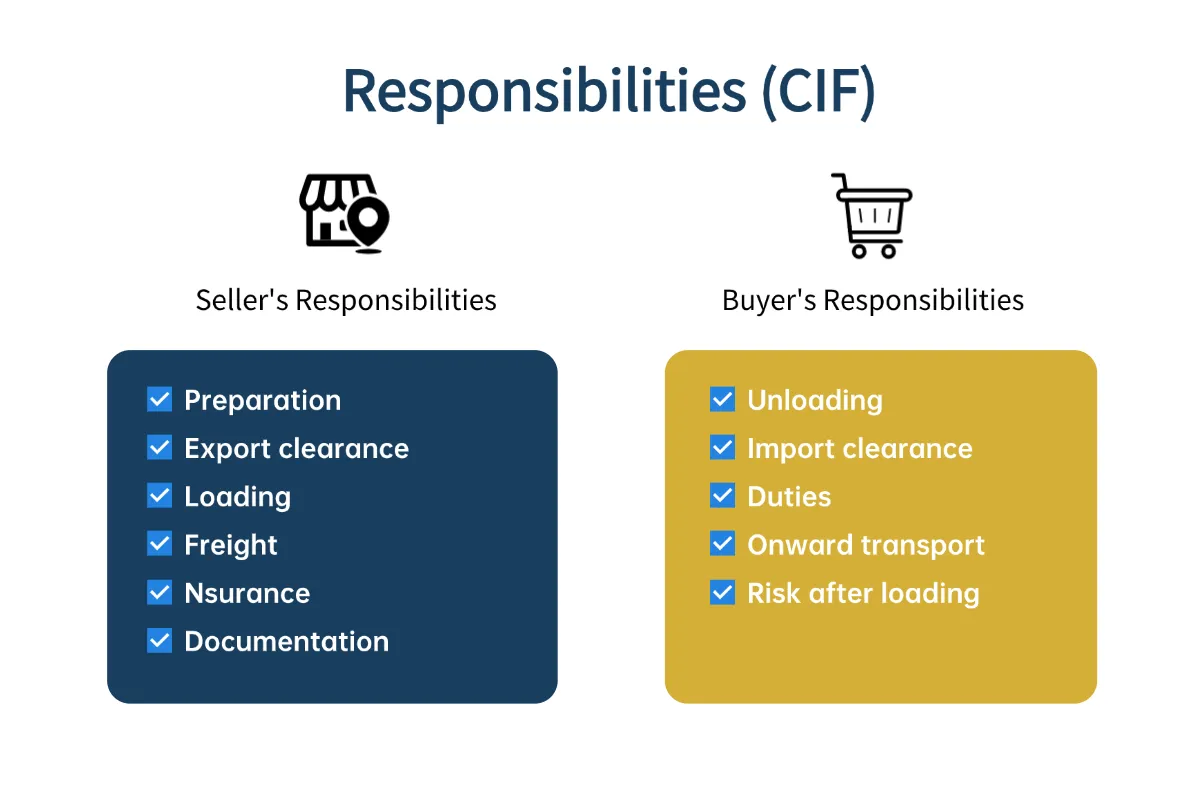
CIF Responsibilities Table
| Task / Costs | Seller | Buyer |
|---|---|---|
| Prepare goods | ✔ | |
| Export clearance | ✔ | |
| Loading at port of shipment | ✔ | |
| Main carriage (to destination) | ✔ | |
| Marine insurance | ✔ | |
| Commercial documentation | ✔ | |
| Import clearance and duties | ✔ | |
| Unloading at port of destination | ✔ | |
| Onward carriage to final destination | ✔ | |
| Risk after loading at port | ✔ |
Key Notes
- Risk versus cost split: While the seller pays for shipping and insurance up to the destination port, the risk passes to the buyer once goods are loaded on board at the port of origin.
- Insurance minimum: Seller is only required to provide minimum coverage. Buyers needing wider protection should arrange supplementary insurance.
- Best for bulk cargo by sea: Suited to conventional or bulk sea freight, not containerized shipments (CPT or CIP may be more appropriate for containerized cargo).
Incoterms 2020: Core Points Comparison Table
| Term | Applicable Mode of Transport | Point of Risk Transfer | Seller's Responsibility | Buyer's Responsibility |
|---|---|---|---|---|
| EXW | Any mode | Upon delivery at seller’s premises | Only makes goods available; not responsible for transportation, clearance, or insurance | Responsible for all transportation, clearance, insurance costs, and risks |
| FCA | Any mode | Upon delivery to the carrier | Handles export clearance, delivers goods to carrier | Arranges transportation, pays all subsequent charges, assumes risk |
| CPT | Any mode | Upon delivery to the first carrier | Pays carriage to named destination, handles export clearance | Responsible for unloading at destination, import clearance, insurance costs, and risks |
| CIP | Any mode | Upon delivery to the first carrier | Pays carriage and insurance to named destination, handles export clearance | Responsible for unloading at destination, import clearance, assumes remaining risks |
| DAP | Any mode | Upon delivery at destination (not unloaded) | Bears costs and risks to the named destination, not responsible for unloading | Responsible for unloading, import clearance, and all related costs and risks |
| DPU | Any mode | After unloading at destination | Bears costs and risks for transportation and unloading at destination | Responsible for import clearance costs and risks |
| DDP | Any mode | Upon delivery at destination (duty paid) | Bears all costs (including import duties and taxes) and risks | Only needs to receive the goods |
| FOB | Sea / Inland waterway | When goods are loaded on board the vessel | Handles export clearance, pays loading charges | Arranges main carriage, pays freight and insurance, assumes risk post-loading |
| CFR | Sea / Inland waterway | When goods are loaded on board the vessel | Pays carriage to port of destination, handles export clearance | Handles insurance, import clearance, assumes risk after loading |
| CIF | Sea / Inland waterway | When goods are loaded on board the vessel | Pays carriage and insurance to destination port, handles export clearance | Responsible for import clearance, assumes risk after loading |
Source: ICC Incoterms® 2020 – CIF Rule
Ready to Ship?
Get your goods moving with our reliable freight forwarding services
Professional handling • Competitive rates • Global coverage