Are you pricing a solar container from China to Durban and finding that the freight quote and the landed cost have almost nothing to do with each other? Shipping solar panels from China to South Africa runs through a 0% duty line, a VAT calculation that adds a statutory 10% to your invoice value, an NRCS approval that has to exist before the container sails, and — if the order includes a battery rack — a Class 9 dangerous-goods file. What follows is the container maths, the 2026 rate bands, the SARS arithmetic worked line by line, and the compliance sequence that decides whether your modules sit on a Durban quay for three weeks or clear in two days.
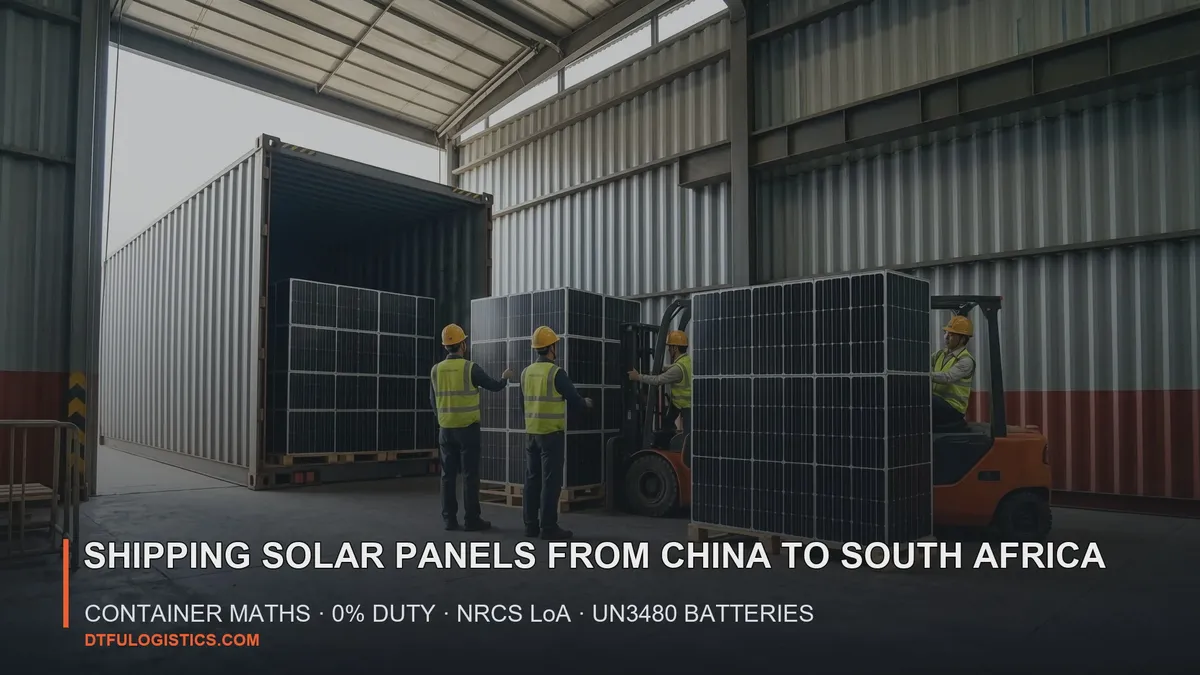
How many solar panels fit in a 20ft or 40ft container from China to South Africa?
Freight on modules is volume-limited, not weight-limited, so the first number to get right is modules per box — because every per-panel freight figure you calculate afterwards depends on it.
A modern 570–620 W module measures roughly 2.28–2.38 m by 1.13 m and weighs 28–32 kg. Factories ship them upright on end in wooden pallets of 30–33 modules, because that is how you keep the glass from taking the load of the stack above it. From that, the usable stowage is:
Box | Modules (570–620 W) | DC capacity | Cargo weight | Pallets |
|---|---|---|---|---|
20ft GP | ~300 | ~175–185 kWp | ~9–10 t | ~10 |
40ft GP | ~560–600 | ~330–370 kWp | ~17–19 t | ~18–19 |
40ft HC | ~620–700 | ~380–430 kWp | ~19–22 t | ~20–22 |
LCL (per CBM) | 3–4 per CBM | — | — | Crated, not pallet-stacked |
Two corrections worth making before you accept anyone's container count. First, a 40HQ takes about 620–700 full-size modules, not the 1,200–1,500 figure some clearing agents still publish — that number belongs to the small 250–330 W modules of the pre-2019 era. Second, the 40HQ beats the 40GP on modules even though the floor area is identical: the extra 30 cm of height lets pallets travel at a less severe angle, and you gain roughly 8–10% capacity — the same economics that make high cube containers cheaper per cubic metre on volumetric cargo. For a 1 MWp project that is the difference between three containers and four.
Recheck the count against the exact model before booking. Bifacial modules carry a thicker frame and a rear glass layer, which trims 3–5% off the per-container count, and a 2.38 m module stacked in a 40GP reduces your angle options more than a 2.28 m one.
What it costs to ship solar panels from China to South Africa in 2026
These are ocean freight bands port-to-port from Chinese main ports to Durban, before surcharges, and they are the same bands you will see on our South Africa lane pages — the point of publishing them again here is so the landed-cost arithmetic below can be checked line by line.
Mode | Volume | 2026 rate | Transit (port to port) |
|---|---|---|---|
Sea FCL, 20ft GP | ~300 modules | $1,300–$2,200 | 28–35 days |
Sea FCL, 40ft GP | ~560–600 modules | $2,000–$3,300 | 28–35 days |
Sea FCL, 40ft HC | ~620–700 modules | $2,200–$3,500 | 28–35 days |
Sea LCL | per CBM, min 1 CBM | $100–$220 per CBM | 33–45 days |
Air freight, 45–100 kg | chargeable weight | $6.00–$8.50 per kg | 4–7 days |
Air freight, 100–300 kg | chargeable weight | $5.00–$7.50 per kg | 4–7 days |
Air freight, 300 kg+ | chargeable weight | $4.50–$6.50 per kg | 5–8 days |
Express courier runs $8.00–$14.00 per kg and is not a serious option for glass, no matter what a broker tells you about "air freight for panels". Air only earns its price on inverters, monitoring hardware and spare parts — the value-dense items in a solar order, and the same per-kg tiers apply as on any air freight booking from China to South Africa.
Read the freight in the unit your own project uses, because the per-container number hides everything:
Order size | Boxes | Ocean freight | Freight per kWp | Freight per module |
|---|---|---|---|---|
175 kWp | 1 × 20ft | $1,300–$2,200 | $7.4–$12.6 | $4.3–$7.3 |
400 kWp | 1 × 40HQ | $2,200–$3,500 | $5.5–$8.8 | $3.2–$5.1 |
1.2 MWp | 3 × 40HQ | $6,600–$10,500 | $5.5–$8.8 | $3.2–$5.1 |
At a module FOB price of roughly $0.09–$0.115 per watt, ocean freight is about 5–9% of the goods value. Duty is zero. VAT, as the next sections show, is not.
How long solar panels take from Shenzhen or Ningbo to Durban, Cape Town or Ngqura
Routing | Port-to-port | Clearance and release | Door to Johannesburg |
|---|---|---|---|
Shenzhen/Ningbo → Durban | 28–35 days | 2–7 days | 30–45 days total |
Shanghai → Durban | 30–38 days | 2–7 days | 32–47 days total |
Shenzhen → Cape Town | 30–38 days | 2–7 days | 35–50 days total |
Shenzhen → Ngqura (Coega) | 32–40 days | 2–6 days | 36–50 days total |
LCL to Durban CFS | 33–45 days | 3–10 days | 40–55 days total |
Most of this cargo moves on the same sea freight services from China to South Africa that carry general container traffic. Durban handles the majority of the country's container volume — published shares run from 60% to 80% depending on whether transshipment is counted — and that concentration is why it is also where congestion lives. Berthing delays after a weather event or a terminal equipment failure are not rare, and a box that misses its stack slot can wait several days before it is even available for collection. Cape Town works for Western Cape projects but is a smaller, weather-exposed terminal; Ngqura at Coega is the deep-water option for Eastern Cape buyers and increasingly the cheapest inland combination for Gqeberha and East London.
One scheduling reality that most quotes ignore: a solar order is rarely one box. Modules, mounting structure and inverter often leave from three different suppliers on three different weeks, and a 20ft of rails that sails two weeks late holds a whole 1 MWp project. DTFU consolidates multi-supplier solar orders at a Shenzhen or Ningbo warehouse so the modules and the balance of system travel on the same vessel whenever the factory lead times allow it — that single step removes more project delay than any freight negotiation, and it is the same consolidation model we run for freight from China to Africa more broadly.
Import duty on solar panels in South Africa: 0% on modules, and what the entry must show
South Africa's tariff book is deliberately generous to renewable energy equipment, and this is the one part of the landed cost where the news is genuinely good:
Equipment | HS heading | Duty | Notes |
|---|---|---|---|
Crystalline PV modules | 8541.43 | 0% | Assembled modules; no anti-dumping measure in force in 2026 |
Inverters and converters | 8504.40 | 0% | Hybrid and string inverters alike |
Lithium battery racks (LFP) | 8507.60 | 0–5% | Depends on the subheading and whether the rack ships as a unit |
Lead-acid batteries | 8507.10 | 5–10% + possible AD | Anti-dumping measures can attach to specific origins |
Steel mounting structure | 7308.90 | 10% | Aluminium rails sit elsewhere in the schedule |
Solar water heating panels | 8419.19 | 0% | Not PV |
Three details decide whether that 0% actually applies to you.
The invoice must carry the technical data that supports the heading. SARS assesses what the entry says, and a commercial invoice reading "solar equipment, 1 lot, USD 38,000" invites a query that costs a week — the HS code on the entry has to be defensible from the paper behind it, which is what our customs clearance service checks before the vessel berths. Wattage per module, module count, model number and country of origin per line item is what a clearing agent needs. We have seen a 40HQ of modules held because the invoice described them as "solar panels parts" — the agent had to go back to the supplier for a corrected invoice while the container sat on demurrage.
Duty is charged on the FOB value, not CIF. This is unusual and worth knowing: unlike the EU or most of Asia, South African customs value for duty is built on the FOB price, so your ocean freight is not in the duty base. It also means a supplier talking about "CIF value" in the invoice and a clearing agent working to SARS valuation can end up two different numbers apart — reconcile them before the vessel arrives, not after.
Anti-dumping is product-and-origin specific. As of 2026 there is no anti-dumping duty on Chinese PV modules in South Africa, unlike the EU and the US. ITAC reviews the position periodically, so a 2024 price list conclusion is not a 2026 conclusion. Lead-acid batteries are the line where AD measures do bite.
Why the 15% VAT bill is bigger than 15%: the Added Tax Value uplift, worked
Import VAT in South Africa is not charged on your invoice value. It is charged on the Added Tax Value (ATV), which multiplies the customs value by 1.10 for goods originating outside SACU and then adds duty:
ATV = (customs value × 1.10) + duty
VAT = ATV × 15%
On a 0% duty module shipment that means VAT lands at 16.5% of the customs value, not 15%. Here is a 40HQ of 400 kWp working through the whole stack:
Line | Basis | Amount |
|---|---|---|
Modules, 680 × 590 W, 400 kWp | FOB $0.10/W | $40,000 |
Ocean freight, 40HQ to Durban | Market rate | $2,200–$3,500 |
Marine insurance | 0.4% of FOB | $160 |
Customs value (FOB basis) | — | $40,000 |
Duty, HS 8541.43 | 0% | $0 |
Added Tax Value | $40,000 × 1.10 + $0 | $44,000 |
Import VAT | $44,000 × 15% | $6,600 |
Destination THC and port charges | Per container | $300–$550 |
Clearing agent | Per entry | $200–$350 |
Inland trucking Durban → Johannesburg | 570 km | $600–$1,200 |
Landed, Johannesburg warehouse | — | $50,100–$52,400 |
Landed cost per watt | — | $0.125–$0.131 |
The VAT line is the largest single item after the modules themselves, and it is the one line that behaves differently depending on who you are. A VAT-registered South African importer claims the $6,600 back as input tax on the next return — it is working capital tied up for four to eight weeks, not a cost. A non-registered buyer, or a foreign project company shipping on its own account, eats it. If you are comparing a DDP quote against an FOB plan, this is where the DDP premium comes from: your forwarder is financing 16.5% of the customs value for the length of the cycle.
NRCS Letter of Authority, NERSA and SANS: what must exist before the container sails
Modules have no import permit requirement in South Africa, but that is not the same as no compliance. The gates are:
NRCS Letter of Authority (LoA) for regulated electrical equipment, issued per model against the applicable compulsory specification. Inverters and many module families fall inside it. The LoA is required before importation and sale, and it is issued after the regulator evaluates the test evidence — in practice four to eight weeks, longer if the test reports are not in the format the regulator wants.
SANS 61215 design qualification for crystalline modules and SANS 62109 safety for power converters. These are the standards the LoA assessment leans on, so a factory that already holds IEC 61215/61730 and IEC 62109 test reports is a much shorter conversation.
NRS 097 for grid-tied systems, plus the utility's own approval — City of Cape Town, City of Johannesburg and Eskom each run a small-scale embedded generation (SSEG) registration process, and municipal approval is what allows the system to export.
Certificate of Compliance (CoC) issued by a registered electrician after installation. No CoC, no legal grid connection, and no insurance on the installation.
The failure mode to avoid is ordering an inverter model that has no LoA because it was cheaper or newer. The container arrives, the module part clears, and the inverter sits in a bonded facility while a test report is sourced from China and the regulator processes a new application. That is a six-to-ten-week delay created by a purchase decision, not a shipping one. DTFU's rule on this lane is to check the LoA status of the inverter model against the NRCS register before the booking is confirmed, and to hold the modules back on the same vessel only if the inverter will genuinely catch up.
Shipping lithium batteries with your solar order: UN3480, state of charge and the DG surcharge
A battery-backed solar order in 2026 is rarely modules alone — and if this is your first Class 9 shipment, the state-of-charge and carrier-acceptance rules for shipping lithium batteries from China are worth reading before the rack is booked. An LFP rack, a hybrid inverter with an internal pack, or a containerised BESS changes the classification of the whole shipment and the number of carriers willing to take it.
Configuration | UN number | Air rule | Sea rule |
|---|---|---|---|
Standalone LFP modules and racks | UN3480 | PI 965, cargo aircraft only, state of charge ≤30% | IMDG Class 9, P903, carrier approval per booking |
Battery packed with an inverter or in a cabinet | UN3481 | PI 966, SoC ≤30% mandatory in Section I | Class 9, packed-with |
Battery installed inside equipment | UN3481 | PI 967, SoC recommendation | Class 9, contained-in |
Containerised BESS as a unit | UN3536 | Not a practical air cargo | Class 9, specialised handling |
Air freight of standalone lithium racks is effectively off the table for a South African solar project: PI 965 forbids passenger aircraft, the 30% state-of-charge cap has to be evidenced by a per-serial BMS log, and the DG acceptance queue at Hong Kong or Shanghai is long. Sea is the mode, and sea brings its own paperwork.
The China-side file is the schedule risk, not the freight. A UN38.3 test report that belongs to the cell and pack design, a 16-section SDS from the factory, and the packaging documents — a performance certificate for the carton plus the customs use-appraisal for the packed configuration — take eight to ten weeks from zero. If your battery supplier cannot produce a recent UN38.3 report at quotation stage, the project has a problem that no forwarder can fix.
Cost it as four lines rather than one surcharge:
DG cost line | 2026 level |
|---|---|
Documentation and compliance fee | $150–$350 per shipment |
DG surcharge per container | $250–$350 on top of the ocean band |
DG handling at origin CFS (LCL) | $35–$75 per CBM |
Air DG premium, if used | $8–$15 per kg against $5.50–$9.00 general cargo |
LCL is the trap. Only DG-licensed CFS facilities handle Class 9, and a single vessel's DG slot allocation can roll a perfectly booked consignment to the next sailing — which on this lane means a week, sometimes two. If a mixed order includes more than a couple of racks, take the whole shipment FCL and keep control of the stow.
Packing, micro-cracks and the breakage claim nobody budgets for
Glass does not fail in transit the way cartons fail. It arrives intact and fails later: a module that took a point load at the corner passes a visual inspection on the quay, then shows a hot spot on the roof three months on, because the cell micro-crack only becomes visible under electroluminescence.
Three practical rules from the shipments we handle on this lane:
Modules travel upright, never flat-stacked beyond the factory pallet. Flat stacks put the weight of every module above onto the bottom frame, and the pallets at the bottom of a badly planned container are the ones that generate claims.
Photograph the container before you close it and after you open it, pallet by pallet, with the seal number visible in the same frame. A breakage claim without loading photos is a negotiation you lose.
Budget the claim rather than the insurance. In our own experience on module shipments, glass and micro-crack claims sit around 1–3% of modules when panels are flat-stacked or re-palletised, and under 0.5% when they travel in factory pallets with corner protection. All-risk marine cover on the shipment is 0.3–0.6% of CIF, which is cheap against replacing even five modules of a 400 kWp order — container insurance cost is the line to check before you assume the carrier's liability does the job.
Wood packaging is its own line. Pallets and crates need the ISPM 15 mark and heat treatment; unmarked wood gets the container pulled for inspection and fumigated at your cost, typically $200–$500 and three to five days.
Two real order sizes, landed: 200 kWp rooftop versus 1 MWp commercial
The per-watt numbers move more with order size than with freight negotiation, so here are two orders priced through the same stack — 0% duty, ATV uplift, 15% VAT, Durban clearance and inland delivery.
Line | 175 kWp rooftop (1 × 20ft) | 1.2 MWp commercial (3 × 40HQ) |
|---|---|---|
Modules at $0.10/W FOB | $17,500 | $120,000 |
Mounting structure at 10% duty | — | $9,000 goods, $900 duty |
Ocean freight | $1,300–$2,200 | $6,600–$10,500 |
Insurance, 0.4% | $70 | $520 |
Customs value (FOB) | $17,500 | $129,000 |
Duty | $0 | $900 |
ATV and 15% VAT | $2,888 | $21,420 |
Destination, clearance, inland | $1,150–$2,100 | $2,700–$4,500 |
Landed | $22,900–$24,800 | $161,100–$166,800 |
Per watt | $0.131–$0.142 | $0.134–$0.139 |
Per kWp | $131–$142 | $134–$139 |
The surprise is that the big order is not much cheaper per watt. Container utilisation already maximises at 40HQ level, and the VAT on the bigger invoice scales exactly with the goods value — the scale economy on this lane comes from clearing and inland charges, not from freight. Where a 1.2 MWp order does win is on time: three boxes on one booking, one set of documents, one release.
DDP or FOB for solar imports into South Africa?
Most first-time solar importers ask for DDP because it looks like one number and no paperwork. On this lane, DDP works for small and mid-size orders and gets awkward at scale, for three reasons:
The LoA needs an owner. The NRCS approval sits with a South African entity in most cases, and a DDP forwarder acting as importer of record will not carry your product approvals on your behalf.
The VAT is recoverable only to a registered importer. Under DDP the forwarder pays the 16.5% and prices it into the all-in rate. If your business is VAT-registered, you have just paid someone else to finance and reclaim a tax you could have reclaimed yourself.
The bond and the importer code belong to whoever clears. Freight forwarders clear on the importer's code and, for deferment, on a bond. Under DDP that structure is the forwarder's, which means your shipment history — and your audit trail — is theirs.
FOB with a nominated clearing agent keeps the approvals, the VAT reclaim and the audit trail where they belong, and on a 400 kWp order the difference between FOB plus clearing and a DDP all-in is usually $1,500–$3,000 in the forwarder's favour. DDP remains the right answer when the buyer has no South African entity, no VAT registration and no appetite for a customs relationship — which is common for a first trial container or a single-site installation. A third structure buyers ask about is a door-to-door service from China, which is DDP with the inland leg included. If you want the mechanics of the two structures side by side, our guide to DDP versus FOB walks through where the risk actually transfers.
Either way, decide before the booking, not after. Changing Incoterms once the container is loaded means re-issuing the bill of lading, and on this lane that is where demurrage starts.
FAQ
How many solar panels fit in a 40ft container to South Africa? About 620–700 full-size modules (570–620 W) in a 40HQ, roughly 380–430 kWp, or 560–600 modules in a standard 40GP. A 20ft takes around 300 modules, about 175–185 kWp. The limit is volume and pallet height, not weight.
What is the import duty on solar panels in South Africa? PV modules under HS 8541.43 enter at 0%, and inverters under 8504.40 also at 0%. Lithium racks under 8507.60 carry 0–5%, while steel mounting structures under 7308.90 attract 10%. There is no anti-dumping duty on Chinese modules as of 2026.
How much is VAT on solar panel imports? 15%, but charged on the Added Tax Value — customs value × 1.10 plus duty — so on a 0% duty module shipment the effective rate is 16.5% of the customs value. A VAT-registered importer reclaims it; a non-registered buyer absorbs it.
How long does shipping from China to South Africa take for solar panels? 28–35 days port-to-port to Durban plus 2–7 days clearance, so 30–45 days door to door to Johannesburg. Cape Town and Ngqura run 30–40 days at sea. LCL adds 5–10 days through consolidation and de-vanning.
How much does it cost to ship a 40ft container of solar panels to South Africa? $2,000–$3,500 ocean freight port-to-port for a 40GP or 40HQ, which is $5.50–$8.80 per kWp at 400 kWp. Landed in Johannesburg, a 400 kWp order runs about $0.125–$0.131 per watt including VAT.
Does a solar panel shipment need an import permit? Modules do not. Inverters and other regulated electrical equipment need an NRCS Letter of Authority before importation and sale, and grid-tied systems need NRS 097 compliance plus municipal SSEG registration.
Can I ship lithium batteries with my solar panels? Yes, as UN3481 when packed with or contained in equipment, or UN3480 for standalone racks. Sea is the practical mode; air is cargo-aircraft-only with a 30% state-of-charge cap. Expect a DG surcharge of $250–$350 per container.
Is LCL a realistic option for solar panels? Below about 100 modules (roughly 3–5 pallets) it can be, at $100–$220 per CBM. Above that the per-CBM rate plus double handling and the higher breakage risk make a 20ft container cheaper and safer.
What documents does SARS need for a solar import? Commercial invoice with wattage, module count and model, packing list, bill of lading, certificate of origin, importer code, and the NRCS LoA where the goods are regulated. Freight and insurance are on the invoice but not in the duty base.
Which port is best for solar imports into South Africa? Durban for Gauteng and KwaZulu-Natal, Cape Town for the Western Cape, and Ngqura/Coega for the Eastern Cape. Durban has the most sailings and the most congestion; Ngqura is smaller but usually quicker to release.
Is a Certificate of Compliance needed to install imported panels? Yes. A registered electrician issues the CoC after installation, and no insurer or municipality will accept a grid-tied installation without one.
Are there anti-dumping duties on Chinese solar panels in South Africa? Not in 2026. ITAC reviews tariff positions periodically, so confirm the position at the time of your entry rather than relying on a quote from an older article.
Getting the landed number right before you commit
The reason solar projects go over budget on this lane is rarely the ocean rate — it is a compliance file that did not exist when the container sailed, or a VAT line that nobody put in the budget because the invoice said 15%. Send your module count, wattage, inverter model and battery configuration through get a China to South Africa solar shipping quote and the DTFU team will come back with a landed figure that separates freight, duty, VAT and the destination block, plus a check on whether your inverter model already holds an NRCS Letter of Authority. If you are still comparing modes, the South Africa shipping hub and our guide to how much a container costs to South Africa carry the same rate bands used here, and the full China–South Africa cost breakdown goes deeper on the destination charges that follow clearance.