Did your container come off the wharf customs-released but sitting under a DAFF direction, with the depot's storage meter already running? This is the operating sequence for Chinese cargo into Australia in 2026: what the entry itself costs, which fumigation dose and exposure actually apply, why a stamped pallet clears nothing, what the 2026-27 stink bug season does and does not demand of Chinese freight, and the point at which re-exporting beats destroying a consignment.
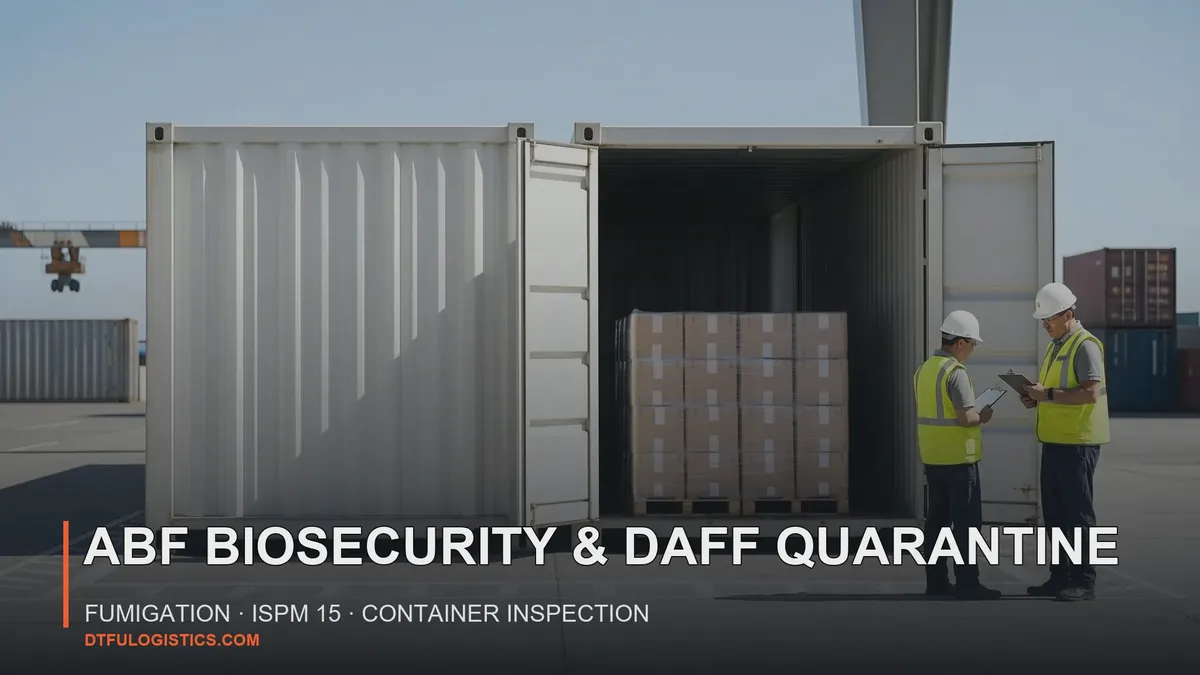
ABF Biosecurity and DAFF Quarantine: Two Separate Gates on One Container
A container from Ningbo is cleared twice, by two agencies, against two different laws, and the second clearance does not follow automatically from the first.
The Australian Border Force (ABF) handles the customs side: duty, GST, import processing charges, and whether the goods are permitted at all. Everything is lodged in the Integrated Cargo System (ICS), which Home Affairs runs. The Department of Agriculture, Fisheries and Forestry (DAFF) handles biosecurity, and it reads the same declaration you lodge with ABF. When DAFF wants to look at the goods, it issues a direction — an instruction that the container goes to an approved premises for inspection or treatment instead of to your warehouse.
That is where most first-time importers lose a week. The ABF release is real: duty and GST are paid, the entry is finalised. It says nothing about biosecurity. A container can be customs-cleared, delivered to a depot, opened, sampled, fumigated, held for a week and then released — or directed for export — while every customs document was correct from the start.
Roughly, DAFF is looking for four things when it assesses your declaration:
Plant and timber risk — solid wood packaging, dunnage, rattan, bamboo, seed-bearing goods, unprocessed plant material, soil.
Food and agricultural commodities — anything edible, plus nursery stock, seeds, animal products and stockfeed, each with its own import conditions.
Contamination — soil on tyres, pallets, machinery or the container floor; insects, snails, live hitchhikers, feathers, nests.
Seasonal hitchhiker pests — the brown marmorated stink bug (BMSB) and yellow spotted stink bug windows that run from 1 September to 30 April.
The practical rule: your customs broker can fix a classification error after the fact. Nobody can fix a live insect found inside a sealed container at the wharf. That asymmetry is why the biosecurity work has to happen before the container is loaded, not after it berths.
What shipping from China to Australia costs in 2026
Before the compliance arithmetic, the freight arithmetic, because the two share one landed-cost sheet. These are the port-to-port ocean bands DTFU has been quoting on China–Australia bookings this year, before the destination charges covered further down.
Route | 20ft (USD) | 40ft (USD) | 40HQ (USD) | Port-to-port transit |
|---|---|---|---|---|
Shanghai – Sydney | 1,300 – 1,750 | 2,000 – 2,600 | 2,200 – 2,800 | 13 – 16 days |
Shenzhen – Melbourne | 1,400 – 1,900 | 2,100 – 2,900 | 2,300 – 3,100 | 12 – 15 days |
Ningbo – Brisbane | 1,350 – 1,850 | 2,050 – 2,750 | 2,250 – 2,950 | 14 – 18 days |
Qingdao – Fremantle | 1,450 – 1,900 | 2,200 – 2,900 | 2,400 – 3,100 | 17 – 22 days |
Mode | Unit | 2026 rate (USD) | Typical transit | Minimum charge |
|---|---|---|---|---|
LCL sea freight | per CBM | 65 – 110 | 18 – 30 days port to port | 1 CBM |
Air freight | per kg over 100 kg | 5.50 – 9.00 | 3 – 7 days airport to airport | 45 kg |
Express courier | per kg | 9 – 13 | 2 – 5 days door to door | 0.5 kg |
Transit bands are port to port and exclude berth waiting, quarantine inspection and the road leg; the port-pair detail behind them is on How long to ship from China to Australia. Add 3–7 days for a DAFF inspection slot at Port Botany or Port of Melbourne in a busy week, and add the storage clock described further down if the container is selected. The lane-level detail on routing and seasonal surcharges sits on the shipping from China to Australia page and in the shipping cost from China to Australia breakdown; what follows is the part those numbers never include — the border itself.
Import declarations, self-assessed clearances and when a broker is effectively mandatory
The A$1,000 line decides which declaration you lodge, and the declaration decides which charges apply.
Above A$1,000 in customs value you lodge a Full Import Declaration (N10) — electronically through ICS, or on paper at an ABF counter. At or below A$1,000 arriving by air or sea, you lodge a Self-Assessed Clearance (SAC) declaration instead. SAC does not apply to international mail, traveller baggage, unaccompanied personal effects or carnet goods.
The ABF Import Processing Charges in force are as follows.
Lodgement | Consignment value | Charge (AUD) |
|---|---|---|
Electronic N10 | A$1,000 or less | Nil (SAC applies at A$0.38) |
Electronic N10 | Over A$1,000, under A$10,000 | 50.00 |
Electronic N10 | A$10,000 or more | 152.00 |
Documentary N10 | Over A$1,000, under A$10,000 | 90.00 |
Documentary N10 | A$10,000 or more | 192.00 |
Warehouse declaration (N30) | Any value | 23.00 electronic / 63.00 documentary |
DAFF's own biosecurity cost-recovery charge rides on the same declaration and is collected by ABF through ICS. From 1 July 2026 it is A$71.00 per full import declaration by sea and A$48.00 by air, applied only above A$1,000 in value. The SAC equivalent is A$0.38 per declaration. Those figures are indexed annually, which is why a quote sheet from 2025 understates the border by a few dollars per entry.
Two things this table does not show. First, the value that decides the tier is the customs value of the consignment on the one declaration — split a single order across two entries and you may drop a tier, consolidate three small orders into one and you may climb one. Second, the charges are trivial next to the broker's fee: an electronic entry typically runs A$150–400 in professional fees, so a A$50 IPC on a A$4,000 consignment is not the line to optimise.
When is a licensed customs broker effectively mandatory rather than merely convenient? Legally, an importer can lodge its own declaration, and plenty of small businesses do it for a single straightforward SAC. In practice the broker becomes unavoidable when any of the following is true:
The consignment is LCL or consolidated, so the house bill has to be split and the importer of record identified against a master bill.
There is more than one tariff line, or the classification is arguable — furniture, machinery parts, textiles and mixed tool kits are the usual fights.
Any biosecurity risk exists, because the entry has to answer DAFF's community protection questions accurately and the broker carries the lodgement record that is audited later.
The goods are worth more than A$10,000 and GST cash flow matters, since an approved deferral arrangement changes when the money leaves the account.
A ChAFTA preference is being claimed, because the origin evidence has to be right at the time of the claim, not reconstructed afterwards.
A forwarder or Shipping agent from China to Australia that runs its own brokerage, as DTFU does on this lane, collapses the handover between freight booking and entry lodgement into one file: the same team that books the container reads the BICON case before the goods are packed. That matters most on the first shipment of a new product, when a wrong answer to a biosecurity question can only be discovered at the wharf.
BICON import conditions: the check that belongs before you book, not after arrival
BICON — the Biosecurity Import Conditions database — is the single gate that decides whether your product can enter, and on what terms. Every commodity has a case; each case has a pathway; each pathway produces a set of conditions that are either "meets", "requires permit", "requires treatment" or "prohibited".
The distinction that catches importers is between a commodity case and a non-commodity case:
Commodity cases cover the goods themselves: furniture, textiles, machinery, processed food, timber products, bamboo, rattan, leather, seeds.
Non-commodity cases cover everything packed around the goods: solid wood pallets, crates, dunnage, straw, packing material, and the cleanliness of the container.
Both must be satisfied, and satisfying one says nothing about the other. A load of steel shelving (low commodity risk) packed on unmarked hardwood pallets (high packaging risk) fails the second test. A load of rattan furniture (needs treatment) on correctly stamped plywood pallets passes the packaging test and still needs the commodity treatment.
What you actually do with BICON, in order:
Classify the goods to HS code and read the case for that commodity.
Note the conditions: permit required, treatment required, inspection required, or unrestricted.
If a permit is required, apply before you book freight — permit processing can take weeks and a permit number is needed at the time of the entry.
Read the non-commodity case for the packaging you intend to use, before the factory buys pallets.
Save the BICON case reference and date with the shipment file. Conditions change between seasons and a printed condition set from last year is not evidence of anything.
Permits are the single most common schedule-killer. Some commodity classes simply cannot be cleared without one, and no amount of correct invoicing substitutes for the permit number on the entry.
ISPM 15, IPPC marks and the pallet mistake that clears nothing
ISPM 15 is the international standard for wood packaging, and Australia implements it through BICON. Compliant solid timber packaging must meet the bark tolerance rules and carry the IPPC mark, applied by a treatment provider or manufacturer certified for the treatment used.
The mark itself is a small rectangle containing the IPPC symbol, the two-letter ISO country code where the wood was treated, a unique provider number, and the treatment code:
Code on the mark | Treatment |
|---|---|
HT | Heat treatment to 56°C for a minimum of 30 minutes in a kiln or heat chamber |
MB | Methyl bromide fumigation |
DH | Dielectric heat treatment |
SF | Sulfuryl fluoride fumigation |
Three things the mark does not do.
It does not clear the product. The mark certifies the pallet, crate, dunnage or skid. If you are importing a timber product — a wooden chair, a bamboo mat, a plywood cabinet — that product has its own BICON conditions, its own possible treatment requirement, and its own inspection outcome. A correctly stamped pallet under an untreated timber product is a compliant pallet on a non-compliant consignment.
It does not survive alteration. ISPM 15 compliance holds only while the packaging is unaltered; cut a crate down, nail a new board onto a pallet, and the mark on that piece means nothing. Treatment also only controls pests present at the time of treatment — it is not a permanent shield against re-infestation in a humid Chinese warehouse.
It does not cover the exemptions automatically. Australia exempts packaging made entirely of wood 6 mm or less thick, processed board (plywood, particle board, OSB, veneer), veneer peeler cores, sawdust and shavings, wine barrels heated during manufacture, and wood components permanently attached to vehicles and containers. Importers who switch to plywood crates to avoid ISPM 15 are usually right, and occasionally wrong when the crate includes a solid timber bearer.
Compliance is enforced by random surveillance across all cargo types, not only when someone suspects a problem. Non-compliant timber packaging is directed for treatment, export or destruction at the importer's expense — and the cheapest of those three, on-arrival treatment, runs roughly A$800–1,500 per container in Australia against A$12–22 per pallet for heat-treated pallets bought in China. Getting this right at the factory is the single highest-return compliance decision on the lane.
Fumigation in practice: methyl bromide, sulfuryl fluoride and heat treatment schedules
For goods that need treatment, Australia accepts four BMSB treatment types — methyl bromide, sulfuryl fluoride, heat treatment and, from the 2026-27 season, ethyl formate — and each has a defined minimum schedule. Treatment done offshore must be certified by a provider registered under the AusTreat scheme when the goods come from a target risk country; a certificate from an unregistered or suspended provider is not accepted, and the container is directed for onshore treatment or export.
Treatment | Minimum application | Exposure | End-point reading |
|---|---|---|---|
Methyl bromide | 24 g/m³ at 10°C or above | 12 hours but less than 24 | 12 g/m³ |
Methyl bromide | 24 g/m³ at 10°C or above | 24 hours or longer | 8 g/m³ |
Sulfuryl fluoride | 24 g/m³ at 10°C or above | 12 hours but less than 24 | 12 g/m³ |
Sulfuryl fluoride | 24 g/m³ at 10°C or above | 24 hours or longer | 8 g/m³ |
Heat treatment | 56°C at the coldest surface of the goods | 30 minutes minimum | Not applicable |
Heat treatment, break bulk under 3,000 kg | 60°C at the coldest surface | 10 minutes minimum | Not applicable |
Ethyl formate | Per the approved schedule, onshore or offshore | Per schedule | Per schedule |
Read the schedule columns carefully, because they are where certificates fail. All start-time concentration readings must exceed 24 g/m³. You cannot increase the dose to compensate for cargo below 10°C, and topping up at the end of the exposure is not permitted: if the concentration drops below the end-point reading at any point, the treatment has failed and the certificate is worthless. That is why a poorly sealed container, a warm afternoon or a rushed fumigator produces a document that reads correctly and is refused on arrival.
Methyl bromide also cannot be used in every country — the EU no longer permits it for this purpose, which is why European-origin target high risk goods are routinely treated with sulfuryl fluoride or heat instead. For Chinese-origin cargo the practical options are in-container methyl bromide at a Chinese port or CFS, heat treatment at the factory, or onshore treatment at an approved Australian premises.
The 120-hour rule catches people who treat early. Goods treated in a target risk country before 1 December must be sealed in the container (or shipped on board, for break bulk) within 120 hours of treatment, or the treatment no longer counts. The date that matters is the shipped-on-board date on the ocean bill of lading — gate-in dates and estimated departures are not accepted as evidence.
BMSB seasonal measures 2026-27: what actually applies to Chinese cargo
This is the section where most 2024 and 2025 guides on the internet are now wrong, and where the 2026-27 changes matter commercially.
The season runs from 1 September 2026 to 30 April 2027 inclusive, measured by the shipped-on-board date. Within that window, measures apply to targeted goods manufactured in, or shipped from, target risk countries, and to vessels that berth, load or tranship there.
Category | What DAFF does | Countries relevant to Chinese supply chains |
|---|---|---|
Target high risk goods from target risk countries | Mandatory treatment, offshore or onshore at container level, plus random inspection | Germany, Italy, France, Netherlands, Spain, Poland, Türkiye, United States, Canada |
Target risk goods from target risk countries | Random inspection, treatment not required | Same list |
Emerging risk countries | Random verification inspection, treatment not required | China, United Kingdom, Japan, Republic of Korea |
Vessels | Heightened vessel surveillance for roll-on/roll-off vessels | Target risk countries, plus China, Japan and the Republic of Korea |
China sits in the emerging risk column for 2026-27, not the target high risk column. That single distinction changes the advice: a container of Chinese-made furniture does not attract a mandatory BMSB fumigation on the basis of origin alone. It can be pulled for a random verification inspection, including for goods under HS chapters 39, 94 and 95, and airfreight from China is subject to random inspection between 1 September and 30 April with no treatment required. Where Chinese factories use European, Turkish or North American components, or where goods tranship through a target risk country, the standard mandatory treatment rules apply to that cargo regardless of where it was finally assembled.
Three changes took effect for this season:
Ethyl formate is now an approved BMSB treatment for both onshore and offshore use, with offshore providers registering under AusTreat and a new approved arrangement class onshore. It is reported on the entry through the entity identifier field.
The BMSB Safeguarding Arrangements Scheme has ceased, so untreated target high risk goods no longer have an alternative clearance pathway.
The rolled goods policy has ceased, which removes the flexibility break bulk used to have when it missed the 120-hour post-treatment window.
Break bulk — flat racks, open tops, modified containers including shipper-owned boxes with built-in generators or accommodation — must still be treated offshore before arrival, with no onshore option and no exceptions; untreated break bulk is denied discharge or directed for export. FCL and FCX containers in sealed six-hard-sided boxes can be treated onshore at container level, but only if the cargo is packed so the gas can actually circulate: deconsolidating before treatment is not permitted, so a container packed to the roof with no voids can end up directed for export simply because it cannot be treated where it stands.
New, unused and not field tested (NUFT) goods can escape mandatory treatment if they were manufactured on or after 1 December, fall in tariff chapters 82, 84, 85, 86, 87, 88 or 89, and carry a manufacturer's declaration stating the manufacture start date. Refurbished goods do not qualify.
Container cleanliness, FCL inspection versus LCL devanning, and the storage clock
Soil is the most expensive word in Australian biosecurity. A container floor with soil on it, a machine with mud in the wheel arches, pallets that sat on a wet yard in Guangdong — all of it is contamination, and contamination is a treatment or a washout, not a conversation.
How the inspection happens depends on how you shipped:
FCL containers are usually inspected at a depot or approved premises with the seals intact and the doors opened at the tailgate. If the container is on a direct-inspection path, the whole box goes to the inspection bay, is opened, and the officer works from the doors inward. Dehiring can sometimes happen before inspection, which keeps the carrier's detention clock from running while you wait for a DAFF slot.
LCL and FAK containers, the standard shape of Sea Shipping From China Australia for smaller buyers, are managed at container level for BMSB risk before deconsolidation, then each consignment is processed at the full import declaration level for everything else. Your cartons are unpacked at a CFS, inspected on the floor, and re-wrapped — which is why LCL inspection outcomes depend on a depot you do not control and share with strangers. One importer's soiled machinery in a shared container can put every consignment in it on hold.
The storage clock is the cost nobody quotes. It starts at discharge, it runs on published tariffs, and it escalates sharply.
Charge | Published 2026 rate | When it applies |
|---|---|---|
Wharf storage, container (Port of Newcastle tariff, 1 January 2026) | Free days 1–3, then A$73.94 per TEU per day for days 4–6, then A$139.78 per TEU per day from day 7 | From discharge until the container leaves the wharf |
Depot storage while awaiting inspection or treatment | Typically A$25–60 per container per day after the depot's free days; confirm the depot's rate card | From arrival at the depot to release |
Carrier detention on the container | Commonly A$50–150 per container per day once free time expires | From the end of free time until the empty is dehired |
DAFF inspection, out-of-office attendance | A$70 per 15 minutes per officer, ordinary hours | Every inspection at a depot or wharf |
Biosecurity inspection all-in when a container is selected | A$850–1,280 per container, 20ft at the low end, 40ft at the high end | One selected container, one inspection |
CFS devanning and re-packing, LCL | A$280–450 per shipment or A$22–58 per CBM | LCL consignments |
The arithmetic to remember: a container held for ten days past free time on a Sydney terminal, at stevedore rates that sit above the Newcastle tariff quoted above, plus depot storage and detention, will cost more than the ocean freight difference between a good and a bad booking. Waiting for an inspection slot is not free, and a Friday arrival before a public holiday is the most expensive timing on the calendar.
When a consignment fails: direction, treatment, re-export or destruction
Failure is not binary. DAFF's options, in the order they are usually tried:
Treat. Fumigation or heat treatment at an approved premises, at your cost. This is the normal outcome for live insects, non-compliant packaging or a failed offshore certificate — roughly A$800–1,500 per container for on-arrival timber treatment, more for a full-container fumigation with lifts and re-delivery.
Treat and re-inspect. Some treatments require a post-treatment inspection before release, which means a second DAFF attendance and a second storage window.
Re-export. The goods leave Australia. You pay depot handling, re-packing or re-stuffing, and the return or onward ocean freight — realistically A$800–2,500 in handling before freight, and the freight is whatever the market charges that week. Re-export makes sense when the goods have resale value in another market and the biosecurity risk cannot be treated.
Destroy. Licensed destruction of food, plant material, timber or contaminated goods typically runs A$1,500–6,000 per container, and you recover nothing. It is chosen when the treatment cost exceeds the salvage value, or when re-export documentation cannot be produced in time.
The decision rule is salvage value against the cost stack. A container of moulded bamboo furniture with a failed treatment certificate and a A$4,000 treatment quote against a A$30,000 landed value is worth treating. A container of low-value garden stakes with a soil contamination direction, a A$2,000 treatment quote and a A$6,000 resale value is a destruction case. Insurance rarely helps: marine cargo policies exclude biosecurity outcomes unless the loss comes from an insured peril, which is why the cargo insurance for shipping from China conversation needs to separate physical damage from regulatory refusal.
The way to never have this conversation is to run the BICON check and the pallet specification at the factory, six weeks before the container is packed. Everything else is recovery.
Duty, GST and ChAFTA: building the entry line by line
Australia's general tariff rate on most manufactured goods is 5%. Under ChAFTA, goods of Chinese origin enter at 0% — the agreement has eliminated tariffs on the overwhelming majority of Chinese-origin goods — but only with valid origin evidence at the time the preference is claimed.
GST is 10%, and it is charged on the value of the taxable importation: the customs value, plus duty, plus international transport, plus insurance. Two dead ends worth naming. A Certificate of Origin issued by an authorised body is the standard evidence; a Declaration of Origin can only be used in place of a certificate where the goods are covered by a current Origin Advance Ruling, which is valid for five years and cannot be relied on once it expires. ABF has been actively refusing preferences supported by expired rulings, and the recovery of underpaid duty plus penalties lands on the importer and the broker, not the exporter.
Here is the same consignment costed both ways — identical goods, identical freight, one with valid ChAFTA origin evidence and one at the general rate.
Line | ChAFTA 0% (AUD) | General 5% (AUD) |
|---|---|---|
Customs value (FOB) | 15,000.00 | 15,000.00 |
Customs duty | 0.00 | 750.00 |
International freight | 1,800.00 | 1,800.00 |
Insurance | 75.00 | 75.00 |
Value of the taxable importation | 16,875.00 | 17,625.00 |
GST at 10% | 1,687.50 | 1,762.50 |
Import processing charge, electronic, A$10,000 or more | 152.00 | 152.00 |
DAFF biosecurity charge, sea | 71.00 | 71.00 |
Total payable at the border | 1,910.50 | 2,735.50 |
Effective burden on customs value | 12.7% | 18.2% |
The ChAFTA saving here is A$825 — the A$750 of duty plus the A$75 of GST that would have been charged on that duty. On a container of machinery worth A$200,000 the same 5% is A$10,000 of duty and A$1,000 of GST on the duty, which is why origin paperwork is worth chasing hard.
And the small-consignment case: goods worth A$900 arriving by sea attract no duty and no import processing charge, lodge on a SAC declaration at A$0.38, and are assessed for biosecurity risk from the same declaration. They can still be inspected. The A$1,000 line changes the paperwork, not the quarantine rules.
What a broker's entry costs versus a DDP all-in quote
The confusion that produces most disputes on this lane is between an entry where you are the importer of record and a DDP price where someone else is. They are not the same product, and comparing them line by line is the only way to see what you are buying.
Cost line | Broker entry (you are importer of record) | DDP all-in (forwarder is importer of record) |
|---|---|---|
Ocean freight and surcharges | Quoted separately, visible | Bundled into one rate |
Customs duty | Charged at cost, 0% or 5% depending on origin | Absorbed; you cannot verify it |
GST | Charged at 10%, claimable on your BAS if registered | Absorbed; usually not claimable by you |
Import processing charge and DAFF charge | A$223 on a A$10,000-plus sea consignment | Priced in, not itemised |
Customs broker fee | A$150–400 per entry | Priced in |
Inspection and treatment risk | Yours, A$850–1,280 per selected container | Priced as a risk margin |
Document preparation | Yours | Included |
Recourse if the entry is wrong | You hold the lodgement and the audit trail | You hold a commercial contract |
The trade is control against convenience. A door-to-door shipping from China quote sits at the other end of the same spectrum, with pickup, freight, clearance and delivery priced as one. A broker entry lets a GST-registered business claim the GST back, see the duty actually paid, and keep the origin evidence for audit. A DDP quote gives a fixed number and no surprises — until a container is selected for inspection, at which point the fixed number usually acquires a surcharge. On this lane, DDP shipping from China to Australia is genuinely useful for small sellers and for buyers without an ABN; for a business importing more than a few containers a year, the entry route is cheaper and far more transparent.
Importing from China to Australia: The Six-Week, Two-Week and Arrival Plan-Back
Biosecurity compliance is a calendar problem before it is a document problem.
When | Action | Why it has to happen then |
|---|---|---|
Six weeks before packing | Read the BICON case for every HS line; confirm whether a permit, treatment or inspection applies | Permits take weeks; conditions can change between seasons |
Six weeks | Specify packaging: ISPM 15 stamped pallets or an exempt alternative, no straw, no solid timber bearers | A factory that buys pallets late buys whatever is in the yard |
Four weeks | Book freight and, if treatment is required, book the treatment provider and slot | Approved providers book out in peak season |
Two weeks | Assemble documents: commercial invoice, packing list, bill of lading, ChAFTA certificate or declaration, treatment certificate, packing declaration | Origin and treatment evidence must exist at the time of the claim |
Two weeks | Confirm the ChAFTA Origin Advance Ruling, if you are relying on a declaration of origin, has not expired | Expired rulings are being refused and duty recovered |
Five days before arrival | Lodge the entry; pre-advise the depot of any inspection risk | The IPC tier and DAFF questions are set at lodgement |
At arrival | DAFF assessment, direction if selected, inspection or treatment booking | The storage clock starts at discharge, not at your convenience |
At release | Dehire the empty promptly; keep the entry, certificates and inspection records for five years | Detention runs until dehire; records are the audit defence |
Most of the cost of a bad biosecurity outcome is decided before the container is sealed. The rest is administration.
FAQ
Does every shipment from China need fumigation for Australia? No. In the 2026-27 season China is an emerging risk country for BMSB, which means random verification inspection rather than mandatory treatment on the basis of origin. Fumigation is triggered by the BICON commodity conditions — plant material, timber products, some foods, soil contamination — or by goods that are target high risk and shipped from a target risk country.
What is the actual methyl bromide dose for a container? 24 g/m³ or above at 10°C or above, for at least 12 hours but less than 24, with an end-point reading of at least 12 g/m³; or 24 g/m³ for 24 hours or longer with an end-point of at least 8 g/m³. Every start reading must exceed 24 g/m³, no topping up, no dose increase for cold cargo.
Is a fumigation certificate from any provider accepted? Only from providers registered and approved for the relevant pathway. For target risk countries, providers must be registered under AusTreat; certificates from unregistered, suspended or withdrawn providers are refused, and the container is directed for onshore treatment or export.
When exactly does the BMSB season apply to my container? Goods shipped between 1 September and 30 April inclusive. The date used is the shipped-on-board date on the ocean bill of lading — gate-in times and estimated departures are not accepted.
My pallet has the IPPC stamp. Is my timber product cleared? No. The stamp certifies the packaging only. A timber, bamboo or rattan product has its own BICON case and may need its own treatment regardless of what the pallet carries.
What does ABF actually charge on a A$25,000 sea consignment? A$152 import processing charge for an electronic declaration at A$10,000 or more, plus A$71 DAFF biosecurity charge — A$223 in government charges — plus the broker's professional fee of roughly A$150–400.
What if my consignment is under A$1,000? You lodge a SAC declaration at A$0.38 instead of a full import declaration, and for most goods no duty, GST or import processing charge applies. Biosecurity assessment still happens, and the consignment can still be inspected.
Can I clear my own goods without a broker? You can lodge an import declaration yourself. In practice a broker is needed once the shipment is LCL, has multiple tariff lines, carries any biosecurity risk, claims a ChAFTA preference, or exceeds A$10,000 and GST timing matters.
What do I need to claim the 0% ChAFTA rate? A valid Certificate of Origin from an authorised body, or a Declaration of Origin only where the goods are covered by a current Origin Advance Ruling. Rulings are generally valid for five years; expired rulings are being refused and duty recovered with penalties.
How much does a failed inspection cost per day? Wharf storage alone runs A$73.94 per TEU per day on days 4–6 and A$139.78 from day 7 on the published Port of Newcastle tariff, with Sydney and Melbourne terminals typically higher, plus depot storage of roughly A$25–60 per container per day and carrier detention of A$50–150 per day.
When is re-export cheaper than destruction? When the goods still have resale value in another market and the risk cannot be treated. Re-export costs roughly A$800–2,500 in handling plus return freight; destruction costs A$1,500–6,000 per container and recovers nothing.
Can I defer the GST instead of paying it at the border? Yes, if you are registered for GST and approved for the ATO's deferral arrangement, in which case GST is reported and paid through your business activity statement rather than at the wharf. Duty and the processing charges are still payable at entry.
Does air freight avoid biosecurity? No. The same BICON conditions apply, airfreight from China is subject to random BMSB inspection between 1 September and 30 April, the SAC charge of A$0.38 applies to low-value air consignments, and the DAFF declaration charge is A$48 by air against A$71 by sea.
A container that clears cleanly is not lucky. It was specified correctly at the factory, documented before the vessel loaded and entered with the right answers.
If you want that sequence checked before your next booking — the BICON case, the packaging specification, the treatment route, and where the storage clock lands if the container is pulled — send the product, HS code and packing details to the DTFU desk through contact us and we will map it against the current DAFF conditions. The ocean leg is covered on sea freight from China, the entry side on China customs clearance service, and the regional picture on Shipping From China to Oceania.