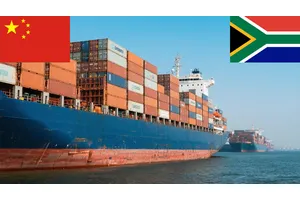
If you are sourcing goods from Chinese suppliers, the first question on your list is almost certainly how much to ship a container from China to South Africa. It is also the question that gets the most misleading answers online. A rate calculator will show you a freight number that looks great — then the real bill arrives with import duty, VAT, clearing fees, and inland haulage on top, and the total is two or three times what you budgeted. We arrange China-to-South Africa container shipments every week, and the gap between a "freight quote" and a "landed cost" is wider on this lane than on almost any other we handle.
This guide gives you the complete 2026 picture: real container price ranges, the factors that move the price up or down, transit times from every major Chinese port, exactly what SARS charges when your container lands, and how to get an all-in quote you can actually plan around. For a complete overview of our services on this lane, visit our shipping from China to South Africa page.
Container Shipping Costs from China to South Africa
Let us start with the number everyone asks for. The table below shows freight-only sea rates from Chinese main ports to South Africa as of mid-2026. These are indicative ranges — ocean freight is a spot market and moves weekly — but they reflect what we see on the lane in normal market conditions.
Sea Freight-Only Rates
| Service | Volume | Freight-Only Price Range |
|---|---|---|
| Sea LCL | 1–15 CBM | $100–$220 per CBM |
| Sea FCL 20ft GP | ~28 CBM | $1,300–$2,200 total |
| Sea FCL 40ft GP | ~58 CBM | $2,000–$3,300 total |
| Sea FCL 40ft HC | ~68 CBM | $2,200–$3,500 total |
Two things matter here. First, these numbers are freight only — they cover moving the box from a Chinese port to a South African port, nothing more (for our continuously updated reference, see the shipping cost from China to South Africa page). Second, the 40ft HC costs only about 10% more than a 40ft GP while carrying roughly 17% more volume, and the 40ft costs only 50–60% more than the 20ft while carrying roughly double the volume. If your cargo is anywhere near 20 CBM, upsizing the container almost always wins on unit economics. For a closer look at the economics, see our guide on high cube shipping container cost from China.
What the Total Landed Cost Actually Looks Like
The freight number is the appetizer. Here is a worked example for a typical 20ft container of consumer goods (cargo value $15,000, landed at Durban):
| Cost Element | Calculation | Amount |
|---|---|---|
| Ocean freight (20ft GP, mid-2026) | Market rate | $1,300–$2,200 |
| Import duty (SACU tariff, 20% for this example) | $15,000 × 20% | $3,000 |
| VAT (15%) | ($15,000 + $3,000) × 15% | $2,700 |
| SARS clearing agent & port fees | Fixed | $300–$500 |
| Total, delivered to Durban port gate | — | $7,300–$8,400 |
| Inland delivery to Johannesburg (optional) | Trucking | +$600–$1,200 |
The freight-only quote was $1,300–$2,200. The landed cost is $7,300–$8,400 — roughly four times the freight number. That is not an outlier; it is the normal shape of China-to-South Africa economics, because duty plus VAT adds roughly 35–40% of the cargo value on top of freight. Anyone who quotes you "container shipping to South Africa" without walking you through duty and VAT is quoting you an incomplete number.
LCL vs FCL: Which One Is Cheaper for You?
LCL (Less than Container Load) makes sense below roughly 15 CBM. You pay per cubic meter, and the per-CBM rate drops as your volume grows. FCL (Full Container Load) takes over above 15 CBM — the math flips because a full 20ft container costs far less than the equivalent LCL volume once you are paying for the whole box anyway.
The hidden cost of LCL: consolidation at origin and deconsolidation at the destination CFS add 5–8 days to the timeline, and your cargo shares container space with other shippers' goods. For trial orders and small restocks, LCL is perfect. For anything you plan to sell in volume, do the FCL math before you book.
What Determines the Price of a Container to South Africa?
The same container can cost $1,500 one month and $3,200 the next. Here is what moves the price — and what you can control.
Seasonality Is the Biggest Lever
Ocean rates on the China–South Africa lane spike in three windows every year: Q4 (October–December) as European and US orders compete for vessel space, the 4–6 weeks before Chinese New Year (January–February) when factories rush shipments out before the holiday shutdown, and the weeks around China's Golden Week holiday in October. If your timeline is flexible, book in Q2 (April–June) — we consistently see rates 15–25% lower than peak windows.
Port of Origin & Routing
Shanghai and Ningbo offer the most frequent direct sailings to Durban — typically 18–25 days of ocean transit. Shenzhen (Yantian/Shekou) and Guangzhou (Nansha) sail slightly less frequently on the South Africa lane and often add 3–5 days via transshipment. Qingdao typically routes via Shanghai or a regional hub. Match the load port to your supplier's location: the domestic trucking cost and time to haul cargo 1,500 km north to Shanghai usually outweighs a few days of ocean transit advantage.
Carrier & Surcharges
MSC, Maersk, CMA CGM, COSCO, ONE, Hapag-Lloyd, and PIL all operate on this lane. Every carrier layers surcharges on the base rate — BAF (bunker adjustment), PSS (peak season surcharge), and periodic GRIs (general rate increases). A forwarder with direct carrier contracts locks in rates and space that spot-market brokers cannot match, especially during Q4 crunch periods.
Incoterm & Scope
A FOB or CIF quote covers only part of the journey. A DDP quote bundles everything. On this lane, where duty and VAT often exceed the freight cost itself, the Incoterm you choose matters more than the carrier you pick — we break down the trade-offs in Section 7.
How to Save 15–25% Without Cutting Corners
- Book 4–6 weeks ahead of sailing, especially outside peak windows
- Consolidate suppliers — a forwarder with a Chinese consolidation warehouse can combine three Guangdong factories' orders into one container over a free 30-day storage window
- Optimize container utilization — fill the box before you book it; empty space is paid-for space
- Avoid the December rush at the destination side — South African ports and SARS slow down from mid-December to early January
How Long Does Shipping Take from China to South Africa?
Ocean Transit by Chinese Port
| Departure Port | Ocean Transit to Durban | Notes |
|---|---|---|
| Shanghai | 18–24 days | Most frequent direct sailings on the lane |
| Ningbo | 19–25 days | Direct and near-direct options |
| Shenzhen (Yantian/Shekou) | 22–28 days | Often via transshipment hub |
| Guangzhou (Nansha) | 21–27 days | Feeds via Hong Kong or Shenzhen |
| Qingdao | 22–27 days | Usually transships via Shanghai |
Most services route through the Suez Canal — the natural artery for Asia–South Africa trade. For expanded detail on carrier schedules and seasonal variations, see our shipping time from China to South Africa guide. Add 2–4 days for Cape Town and 1–3 days for Gqeberha (Port Elizabeth)/Ngqura. Since the Red Sea disruptions, some carriers have re-routed certain services around the Cape of Good Hope, which can add 7–10 days on transshipment legs — always ask whether your quote is for a direct Suez routing or a rerouted service.
Door-to-Door Timeline by Method
| Method | Door-to-Door | Notes |
|---|---|---|
| Sea FCL | 28–40 days | Port to port + pickup, clearance, delivery |
| Sea LCL | 33–45 days | +5–8 days for consolidation/deconsolidation |
| Air Freight | 5–10 days | Via Dubai, Doha, or Hong Kong hubs |
| Express Courier | 3–6 days | Small parcels and documents |
If you cannot wait for the vessel, air freight is the speed option — see our guide on air shipping from China to South Africa for costs and transit details.
South Africa Customs: Duties, VAT & Required Documents
SARS Import Duty (SACU Tariff)
South Africa applies the SACU (Southern African Customs Union) tariff schedule. Duty is ad valorem — a percentage of the customs value (the transaction value of your goods) — ranging from 0% to over 40% depending on the HS code. Most consumer goods fall in the 10–25% band; machinery and industrial inputs are often lower; vehicles, alcohol, and textiles sit at the top end.
Two things catch importers out. First, ITAC import permits are required for controlled goods — second-hand goods, used vehicles, certain textiles and steel products — and applying for one takes 2–6 weeks, so it must start before the container sails. Second, NRCS compliance applies to regulated product categories (electronics, appliances, automotive components) that must meet South African compulsory specifications. Check both before you book, not after the cargo lands.
VAT on Imports
VAT is 15%, applied to the customs value plus the import duty. Using the earlier example: $15,000 cargo at 20% duty gives a $3,000 duty, a $18,000 VAT base, and $2,700 of VAT. Duty plus VAT together typically add 35–40% of the cargo value on top of freight — this is the number most rate calculators never show you. If your business is VAT-registered in South Africa, you can claim the input VAT back on your return; if it is not, it is a real cost.
Essential Documents Checklist
| Document | Required? | Notes |
|---|---|---|
| Commercial Invoice | Yes | Must describe goods in detail; value consistency is critical |
| Packing List | Yes | Must match the invoice exactly |
| Bill of Lading (B/L) or AWB | Yes | Telex release accepted for sea freight |
| Certificate of Origin | Yes | Verify any preferential rate eligibility for your HS code |
| SAD500 customs declaration | Yes | Filed by importer or clearing agent with SARS |
| SARS importer customs code | Yes | You (or your DDP provider) must be registered |
| ITAC import permit | Conditional | Second-hand goods, used vehicles, certain textiles/steel |
| NRCS compliance | Conditional | Electronics, appliances, regulated product categories |
| ISPM 15 fumigation certificate | Conditional | Mandatory if any wood packaging is used |
Common Pitfalls
HS code misclassification is the most expensive mistake on this lane. A wrong classification changes your duty rate, triggers re-inspection, and can attract penalties plus interest from the date the duty was originally due. Have your forwarder cross-check the classification before the container sails.
Under-declaration is the second. SARS maintains reference pricing databases and compares declared values against them. The penalty regime is serious — under-declaring to save duty is one of the fastest ways to turn a shipment into an audit.
Missing ISPM 15 stamps on wood packaging get the whole container quarantined and fumigated at destination — typically $200–$500 and 3–5 days, at your expense.
Inconsistent documents — an invoice in USD, a packing list in a different unit of measure, quantities that do not match — trigger physical inspections, which add days and inspection fees.
FOB vs CIF vs DDP: Choosing the Best Incoterm for South Africa
Incoterms at a Glance
| Incoterm | Freight | Insurance | SA Duty/VAT | Clearing Agent | Last-Mile | Risk Transfers |
|---|---|---|---|---|---|---|
| EXW | Buyer | Buyer | Buyer | Buyer | Buyer | At factory gate, China |
| FOB | Buyer | Buyer | Buyer | Buyer | Buyer | Once loaded on vessel, China |
| CIF | Seller | Seller | Buyer | Buyer | Buyer | Once loaded on vessel, China |
| DAP | Seller | Seller* | Buyer | Seller | Seller | At your door, South Africa |
| DDP | Seller | Seller* | Seller | Seller | Seller | At your door, South Africa |
*CIF insurance is minimum cover only; DAP/DDP typically include broader coverage arranged by the forwarder — see our guide on shipping container insurance cost for shipments from China for typical rates. For a detailed side-by-side of the two most popular terms, see DDP vs FOB: Which Option Saves Time and Reduces Hassle.
When DDP Wins
If you are new to the South African market, do not yet have a SARS customs code, and do not want to build a relationship with a clearing agent — DDP is the answer. One quote, one provider, one accountable party. For e-commerce sellers and SMEs shipping a handful of containers a year, DDP removes the entire SARS learning curve and protects your cash flow from surprise tax bills.
When FOB or CIF Makes More Sense
If you are already a registered importer with your own clearing agent in Durban, or your business is VAT-registered in South Africa and you want to manage the input VAT claim yourself, FOB or CIF gives you control over the destination-side costs. Large-volume importers (10+ containers a year) often negotiate better local haulage and clearing rates than a standard DDP markup includes. The rule of thumb: the more containers you ship, the more control you want; the fewer you ship, the more you want the all-in price.
How to Ship from China to South Africa: Step-by-Step Process
Stage 1 — Factory Pickup & Consolidation (Days 1–3)
Your forwarder arranges trucking from your supplier(s) to their consolidation warehouse in China. If you buy from multiple factories, all goods arrive at one location, get counted, inspected, and labeled. A 30-day free warehousing window lets a late supplier catch up without stalling the shipment. If your cargo includes wooden pallets or crates, ensure ISPM 15 fumigation and stamping happens here — Durban and Cape Town customs enforce this strictly.
Stage 2 — China Export Customs Clearance (Days 2–5)
Your forwarder files the export declaration with the commercial invoice, packing list, and customs declaration form. Chinese export clearance is routine for most general cargo; the usual holdup is an HS code mismatch between supplier and customs expectations. Cross-check classification before filing.
Stage 3 — Ocean Transit (Days 5–30+)
The container loads and heads out via the Suez route to Durban, Cape Town, or Gqeberha. MSC, Maersk, CMA CGM, COSCO, ONE, Hapag-Lloyd, and PIL are the main carriers on this lane. A quality forwarder gives you real-time tracking with milestone updates at vessel departure, Suez transit, arrival, and customs milestones — if they cannot, treat it as a red flag.
Stage 4 — South Africa Import Clearance (Adds 2–6 Days)
Your forwarder (under DDP) or your clearing agent files the SAD500 with SARS — our customs clearance team handles this end to end every day. The shipment is cleared against your importer customs code. Well-prepared filings clear in 2–3 days; document inconsistencies trigger inspections that stretch to a week or more.
Stage 5 — Duty & VAT Payment
Duty and VAT must be paid before SARS releases the goods. Regular importers often hold a deferment account to pay monthly rather than per shipment; under DDP this is handled for you as part of the all-in price.
Stage 6 — Last-Mile Delivery (1–4 Days)
From Durban, containers truck to Johannesburg/Gauteng (the City Deep inland depot is the main hub for the inland market — 1–2 days), Cape Town is served locally, and Gqeberha/Ngqura cargo stays coastal. Plan for the December slowdown if your shipment lands in that window.
How to Choose a Reliable Freight Forwarder for China to South Africa Shipping
What to Look For
Lane-specific experience. Ask directly: how many containers have you moved to Durban this year? A forwarder who knows the lane knows the quirks — Durban congestion patterns, Suez rerouting effects, SARS inspection triggers, ITAC permit lead times.
Direct carrier contracts. Forwarders with FIATA/IATA certification and direct agreements with MSC, Maersk, CMA CGM, and COSCO lock in rates and space that brokers cannot match in peak season.
Multi-port China capability. Your supplier is in Guangdong this year and Zhejiang next. A forwarder with consolidation hubs in Shenzhen, Shanghai, and Ningbo keeps you flexible.
Transparent itemized DDP quoting. One number with no breakdown means duty and VAT are missing. A proper DDP quote itemizes every component so you can verify the math.
Real-time tracking. Milestone-level visibility from booking to delivery is table stakes on a 30-day ocean lane.
Red Flags
- "All-inclusive" quote that refuses to itemize
- Cannot name the clearing agent they work with in Durban
- Quote is 30%+ below compe*****s — duty and VAT are almost certainly excluded
- No physical presence or agent network in South Africa
- No real-time tracking during ocean transit
For budget-focused importers, our guide on the cheapest shipping agent from China to South Africa walks through cost-optimization strategies in detail.
Frequently Asked Questions
How much does it cost to ship a 40ft container from China to South Africa?
Freight-only: $2,000–$3,500 (mid-2026 reference, 40ft GP/HC from Chinese main ports to Durban). Total landed cost including SARS duty, VAT, and clearance is typically $11,000–$16,000 for a consumer-goods container with a cargo value of $25,000–$35,000 — the exact number depends on your HS code duty rate.
How much does a 20ft container cost to ship from China to South Africa?
Freight-only: $1,300–$2,200. Total landed cost for a typical $15,000 consumer-goods shipment: $7,300–$8,400, including duty, VAT, and clearing — before inland delivery.
How long does sea freight take from China to South Africa?
Ocean transit from Shanghai to Durban is 18–24 days; from Shenzhen, 22–28 days. Door-to-door for FCL: 28–40 days. LCL adds 5–8 days for consolidation and deconsolidation. For a deeper look at schedules and seasonal variations, see how long does shipping from China to South Africa take.
Which South African port should I ship to — Durban, Cape Town, or Gqeberha?
Durban for the Gauteng/Johannesburg inland market — it handles ~60% of South Africa's container traffic and feeds the industrial heartland. Cape Town for Western Cape demand. Gqeberha (Port Elizabeth)/Ngqura for the Eastern Cape automotive and manufacturing corridor. Most China services call Durban first.
What import duty will I pay on goods from China?
SACU tariff duty is ad valorem on the customs value: 0–40%+ by HS code, with most consumer goods at 10–25%. Check your product's classification before booking — it drives the single biggest variable in your landed cost.
What is the VAT rate on imports into South Africa?
15%, applied to the customs value plus the import duty. Duty and VAT together typically add 35–40% of the cargo value on top of freight.
What documents do I need to clear customs in South Africa?
Commercial invoice, packing list, Bill of Lading or Airway Bill, Certificate of Origin, the SAD500 declaration filed under a SARS importer code, plus conditional items: ITAC import permits for controlled goods, NRCS compliance for regulated products, and an ISPM 15 fumigation certificate for any wood packaging.