DDP
Term Summary
This article provides a comprehensive overview of DDP (Delivered Duty Paid), one of the Incoterms® 2020 rules published by the International Chamber of Commerce. It explains that under DDP, the seller assumes the maximum responsibility—covering all costs, risks, customs formalities, duties, and taxes to deliver goods to a named place in the buyer’s country, ready for unloading. The article details the specific obligations of both sellers and buyers, offers a clear responsibility comparison table, and highlights key considerations for using DDP in international trade.
What Is DDP (Delivered Duty Paid) in Incoterms® 2020?
DDP (Delivered Duty Paid) is one of the most comprehensive terms defined under Incoterms® 2020, published by the International Chamber of Commerce (ICC). Under DDP, the seller assumes maximum responsibility—covering all costs and risks to deliver the goods, already cleared for import, to a named place in the buyer's country. The buyer’s obligations are minimal, essentially just receiving the goods.
Seller’s Responsibilities
- Delivery of Goods: Ensure goods arrive at the agreed location in the buyer’s country, according to contract specifications (quality, quantity, timing).
- Packaging and Marking: Properly pack and mark the goods suitable for international transit, as required.
- Loading and Inland Transport: Arrange and pay for all pre-carriage, loading, and inland transportation, from the seller’s facility to place of delivery.
- Main Carriage: Book, pay, and manage international freight, whether by sea, air, rail, or land.
- Export and Import Clearance: Complete all necessary export formalities in the seller’s country and import customs clearance in the buyer’s country, including the payment of all customs duties, VAT, and taxes.
- Insurance: While not mandatory, sellers often arrange insurance due to full control of the supply chain.
- Delivery Risks: Bear all risks and costs up to the point the goods are made available, ready for unloading, at the named destination.
- Documentation: Provide all documents necessary for export, import, and delivery (commercial invoice, transport documents, import/export permits, etc.)
- Notification: Inform the buyer when goods are delivered at the destination and ready for receipt.
Buyer’s Responsibilities
- Receipt of Goods: Take delivery of the goods at the final agreed-upon location.
- Unloading: Responsible for unloading the goods from the arriving vehicle, unless contractually agreed otherwise.
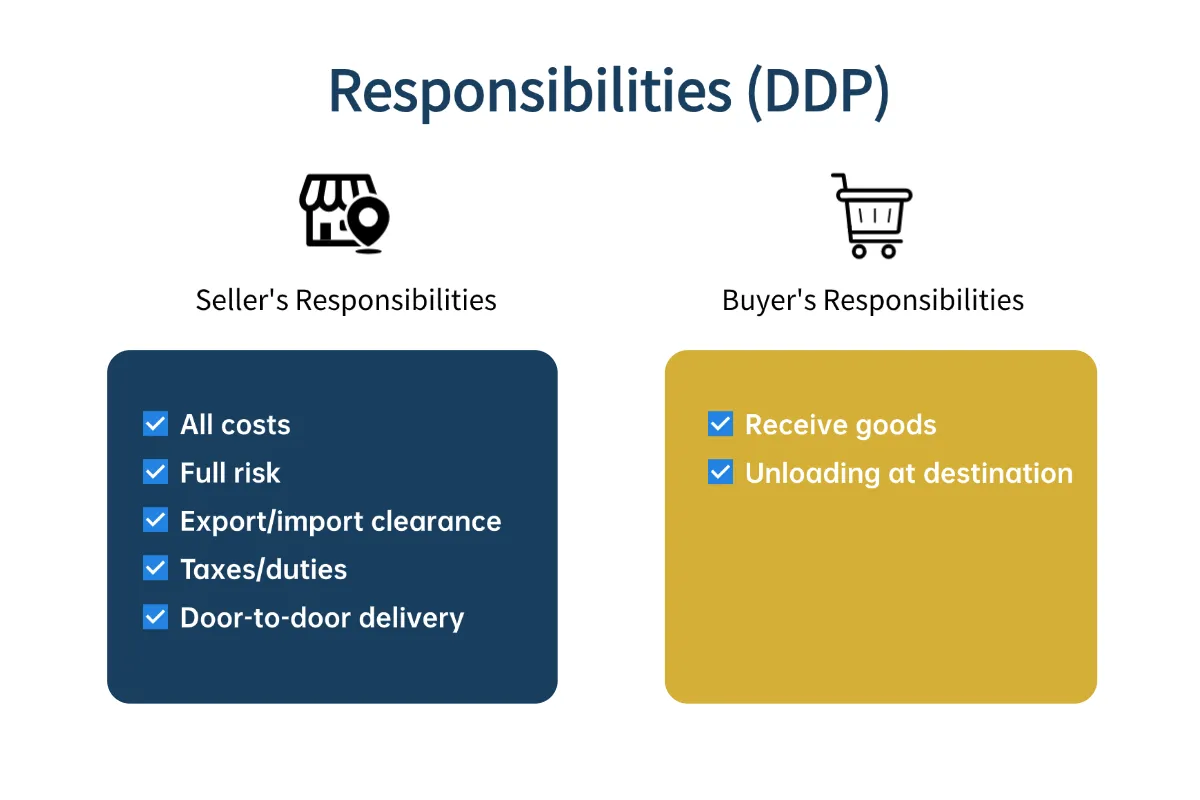
DDP Responsibilities Table
| Task / Costs | Seller | Buyer |
|---|---|---|
| Prepare goods & documentation | ✔ | |
| Packaging and marking | ✔ | |
| Loading at origin | ✔ | |
| Pre-carriage & main carriage | ✔ | |
| Export clearance | ✔ | |
| Import clearance & Duties/Taxes | ✔ | |
| Insurance | ✔ | |
| Delivery to named destination | ✔ | |
| Unloading at destination | ✔ | |
| Risks up to delivered point | ✔ |
Key Notes
- Best for inexperienced buyers: DDP is ideal for buyers who lack experience with international logistics, as the seller handles the entire process, including all taxes and customs in the destination country.
- Risks for sellers: Sellers may face local regulatory hurdles and unexpected costs in the destination country. It requires deep knowledge of customs procedures and reliable partners in the buyer’s market.
- Highly convenient, but potentially risky: Any delays in customs or incomplete paperwork are the responsibility of the seller under DDP.
Incoterms 2020: Core Points Comparison Table
| Term | Applicable Mode of Transport | Point of Risk Transfer | Seller's Responsibility | Buyer's Responsibility |
|---|---|---|---|---|
| EXW | Any mode | Upon delivery at seller’s premises | Only makes goods available; not responsible for transportation, clearance, or insurance | Responsible for all transportation, clearance, insurance costs, and risks |
| FCA | Any mode | Upon delivery to the carrier | Handles export clearance, delivers goods to carrier | Arranges transportation, pays all subsequent charges, assumes risk |
| CPT | Any mode | Upon delivery to the first carrier | Pays carriage to named destination, handles export clearance | Responsible for unloading at destination, import clearance, insurance costs, and risks |
| CIP | Any mode | Upon delivery to the first carrier | Pays carriage and insurance to named destination, handles export clearance | Responsible for unloading at destination, import clearance, assumes remaining risks |
| DAP | Any mode | Upon delivery at destination (not unloaded) | Bears costs and risks to the named destination, not responsible for unloading | Responsible for unloading, import clearance, and all related costs and risks |
| DPU | Any mode | After unloading at destination | Bears costs and risks for transportation and unloading at destination | Responsible for import clearance costs and risks |
| DDP | Any mode | Upon delivery at destination (duty paid) | Bears all costs (including import duties and taxes) and risks | Only needs to receive the goods |
| FOB | Sea / Inland waterway | When goods are loaded on board the vessel | Handles export clearance, pays loading charges | Arranges main carriage, pays freight and insurance, assumes risk post-loading |
| CFR | Sea / Inland waterway | When goods are loaded on board the vessel | Pays carriage to port of destination, handles export clearance | Handles insurance, import clearance, assumes risk after loading |
| CIF | Sea / Inland waterway | When goods are loaded on board the vessel | Pays carriage and insurance to destination port, handles export clearance | Responsible for import clearance, assumes risk after loading |
Source: ICC Incoterms® 2020 – DDP Rule
Ready to Ship?
Get your goods moving with our reliable freight forwarding services
Professional handling • Competitive rates • Global coverage