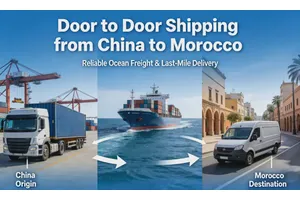
Choosing a freight forwarder from China to Morocco is really a question of scope, not of price. One quote stops at the port, another runs through to your door, a third quietly leaves duty and TVA to you — and the gap between them is almost never the ocean rate, it is how far down the chain each forwarder is willing to take responsibility. For a Moroccan importer, that gap is the hardest line in the budget.
This guide turns that into an audit: a four-layer verification framework and an 8-question RFP, then the Moroccan side — DUM filing through PortNet, ADII risk selection on the BADR circuit, BAE release — and a landed-cost stack built on a CIF base. Every rate carries a scope and a validity date (Q3 2026).
What Does a Freight Forwarder from China to Morocco Actually Do?
A freight forwarder is not a shipping line. On this lane it is also not the customs broker. The strategic role of a forwarder is to coordinate the chain below without owning any single link in it.
| Service | Who legally performs it | Where it leaves a trace |
|---|---|---|
| Booking, consolidation, trucking | Forwarder, as NVOCC or agent | Carrier booking system |
| China export declaration | Licensed Chinese broker | China Single Window |
| Ocean or air main carriage | The carrier | Bill of lading / AWB |
| Moroccan import declaration | Licensed transitaire | PortNet |
| Release, storage, inland delivery | Forwarder's Moroccan partner | BAE / delivery note |
Four roles get conflated. The forwarder arranges transport; the licensed Moroccan transitaire is legally responsible for the declaration; the carrier owns the sea or air leg; the 3PL owns what happens inside a warehouse. The importer of record must be a Moroccan entity with a valid Tax ID — which is why "DDP to Morocco" is narrower than most pages admit. The split between DDP and FOB decides who is importer of record before a single container is booked.
Our industry insight: the most common dispute on this lane is not a lost container — it is an importer who believed clearance was included because the quote said "door-to-door." If your forwarder cannot name the transitaire who will file your DUM, the destination leg is uncontrolled, and you learn that on day 34, not day 4.
How to Choose a Freight Forwarder from China to Morocco: A Four-Layer Verification Framework
Every page on this route says pick a forwarder with "experience." None says what a credential looks like. Here is a standard you can check in twenty minutes.
| Layer | What to verify | What a credible answer looks like |
|---|---|---|
| 1. Credentials | FIATA membership, IATA CASS accreditation, Chinese NVOCC licence, AEO / OEA status | Searchable numbers |
| 2. Destination ownership | The transitaire who files your DUM, their ADII licence, the PortNet account | A named partner, a licence number, who advances duty and TVA |
| 3. Quote integrity | Every cost marked included / excluded / at cost: THC, ISPS, brokerage, duty, PFI 0.25%, TVA, free time, inland radius | Two quotes $1,800 apart are two inclusion sets, not two prices |
| 4. Risk cover | Carrier liability (2 SDR/kg), the trading-condition cap, a standalone cargo insurance policy | Only the standalone policy pays on invoice value |
The 8-Question RFP to Send Before You Book
| # | Question |
|---|---|
| 1 | Are you a FIATA member, and what is your number? |
| 2 | Who files my Moroccan declaration, and under what ADII licence? |
| 3 | Which EDI — PortNet, or a broker's gateway? |
| 4 | Who advances duty, PFI and TVA, and what does that credit cost? |
| 5 | How many free days at destination, and demurrage after? |
| 6 | Is COC / VoC inspection included, or do I appoint the agency? |
| 7 | What is your all-in door rate for the exact address, dated? |
| 8 | Who is my single point of contact, in my timezone? |
Our industry insight: question 6 separates professionals. A forwarder who answers "COC is your responsibility" is honest and cheap. One who says "included" without naming the inspection body has not understood the pre-loading requirement.
Five red flags: a rate more than 30% below the market band — a port-to-port number wearing a door-to-door label; "DDP to Morocco, no Tax ID needed"; no named transitaire; rates dated more than 60 days ago sold as current; and "Morocco has a free trade agreement with China" — it does not.
What a China to Morocco Freight Quote Includes: The Six-Layer Landed-Cost Stack
The gap between a $2,150 quote and a $5,350 quote is not margin. It is the number of layers counted — the same reason two published container shipping costs from China to Morocco can sit 40% apart for an identical 20GP.
| Layer | What it covers | Share of landed cost |
|---|---|---|
| 1. Origin | Pickup, export declaration, THC, documentation, ISPS | 6–10% |
| 2. Main carriage | Ocean or air freight, plus BAF/PSS | 20–35% |
| 3. Cargo insurance | Cover on invoice value, typically 0.15–0.5% | 0.5–1% |
| 4. Destination charges | THC, ISPS, handling, PortNet and transitaire fees | 8–14% |
| 5. Duty and taxes | DI, PFI 0.25%, TVA on the CIF base | 25–45% |
| 6. Inland and storage | Delivery to final address, demurrage, inspection | 5–15% |
The Arithmetic on One 20GP
A 20GP of hardware, invoice value $26,000, freight and insurance $2,000 — CIF $28,000 at Tanger Med. Duty bands run 0%, 2.5%, 10%, 25%, 30%; assume DI 25%.
| Step | Calculation | Amount |
|---|---|---|
| CIF value | $26,000 + $2,000 | $28,000 |
| Import duty (DI 25%) | 25% × $28,000 | $7,000 |
| PFI (parafiscal import levy) | 0.25% × $28,000 | $70 |
| TVA base | $28,000 + $7,000 + $70 | $35,070 |
| TVA (standard 20%) | 20% × $35,070 | $7,014 |
| Total payable to ADII | $14,084 |
Tax is levied on the CIF value, not the FOB value — every dollar of freight raises your duty and TVA base — and TVA is charged on duty, so duty compounds.
Q3 2026 indicatives, port-to-port unless stated, excluding duty and TVA:
| Mode | Unit | Rate band | Transit |
|---|---|---|---|
| FCL 20GP | per container | $2,000–$3,550 | 25–45 days |
| FCL 40GP / 40HQ | per container | $2,650–$4,250 | 25–45 days |
| LCL | per CBM | $60–$190 | FCL + 5–10 days |
| Air freight | per kg | $4.50–$9.80 | 3–7 days |
| Express courier | per kg | $7–$15 | 3–5 days |
Any page quoting $5,350 for a 20GP is quoting September 2025 — roughly twice today's market. Treat these as a band, not a quote, and ask for the date and scope behind every number; DTFU Logistics prints both on every quotation. For the full lane scope behind these figures — ports, modes, cut-offs and door delivery — see Shipping From China to Morocco.
Transit Time from China to Morocco
Why does one page promise 25 days and another 45 for the same port pair? Because they are counting different layers.
| Layer | What happens | Typical duration |
|---|---|---|
| 1. Booking and cut-off | Space confirmed, VGM and SI filed, container gated in | 3–7 days |
| 2. Origin handling | Trucking, export declaration, loading | 2–4 days |
| 3. Main carriage | Ocean or air transit, including transshipment | 22–35 days sea, 3–7 days air |
| 4. Berthing and discharge | Waiting for a berth, unloading | 1–3 days |
| 5. Customs clearance | DUM filed, BADR circuit assigned, duty paid, BAE issued | 0–5 days |
| 6. Inland delivery | Trucking to final address, unloading | 1–4 days |
A "25-day" quote is layer 3 alone; a "45-day" one counts all six. Only the door-to-door figure matters to your schedule.
Port-to-port, Q3 2026, direct or one transshipment, excluding clearance and inland delivery. Add 3–6 days door-to-door, 5–10 days for LCL.
| Chinese port | Tanger Med | Casablanca | Agadir | Nador |
|---|---|---|---|---|
| Shanghai | 30–36 | 30–35 | 33–40 | 32–38 |
| Ningbo-Zhoushan | 30–36 | 31–37 | 34–40 | 33–39 |
| Shenzhen (Yantian/Shekou) | 28–34 | 28–34 | 32–38 | 31–37 |
| Guangzhou (Nansha) | 29–35 | 29–35 | 33–39 | 32–38 |
| Qingdao | 32–38 | 32–38 | 35–42 | 34–40 |
| Tianjin (Xingang) | 33–39 | 33–39 | 36–43 | 35–41 |
Tanger Med is generally the fastest gateway, with the most direct and relay services. Casablanca can match it but carries more congestion risk; Agadir and Nador add a domestic leg.
Our industry insight: the Chengdu–Tangier rail–sea corridor, opened in 2024, runs in 18–22 days — materially faster than the all-sea route. Space is limited and rates are quoted per shipment, so we use it as the exception, not the rule. The trade-off is set out in our comparison of sea vs rail freight from China.
Ask for three transit numbers, not one: optimistic (direct service, green channel), expected (one transshipment, standard clearance — your planning number) and committed (red-channel clearance plus a holiday), the only one to promise downstream.
Routing, Transshipment and Gateway Choice: How Your Cargo Actually Reaches Morocco
Most services relay through a Mediterranean hub, and the choice of hub changes transit and handling risk. In 2025 Tanger Med handled 11,106,164 TEUs, up 8.4%, with 161 million tonnes of cargo and 16,686 vessel calls — around 16th among world container ports — while Moroccan ports overall handled 262.6 million tonnes, up 8.9%. Density buys frequency, transshipment quality and inland reach — and that reach is not only Moroccan: the same relay services feed onward Mediterranean markets, which is why many importers moving Shipping From China to Spain route through Tanger Med.
| Routing | Strengths | Weaknesses | Best for |
|---|---|---|---|
| Direct call to Tanger Med or Casablanca | Fewest handling events, predictable transit | Fewer sailings, rigid cut-offs | Full container loads, time-critical |
| Transshipment via a Mediterranean hub | More sailing options, often lower rate | Extra handling, rollover risk | Cost-sensitive FCL, most LCL |
Red Sea conditions and peak-season surcharges. Diversions have distorted vessel rotations well beyond the Red Sea — Red Sea routings are still shifting — and the ripple reaches Mediterranean services. PSS and BAF sit on top of the base rate on short notice: ask whether a quote is all-in or base rate plus BAF and PSS — one that excludes BAF is a starting point, not a quote.
FCL, LCL, Air, Express or Door-to-Door: Choosing the Right Mode
Mode selection comes down to volume and time sensitivity. Published sea freight rates from China to Morocco and air freight rates from China to Morocco are the two bands to benchmark before you choose.
| Volume | Recommended mode | Why |
|---|---|---|
| Under 1 CBM | Express or air | LCL minimums make it uneconomic |
| 1–8 CBM | LCL | Flexibility, no container commitment |
| 8–15 CBM | LCL or 20GP — compare both | The crossover zone; depends on density |
| 15–28 CBM | 20GP | FCL wins on total landed cost from roughly 15 CBM upward |
| 28–58 CBM | 40GP | Best cost per CBM if the cargo is not tall |
| 58–68 CBM | 40HQ | Highest practical utilisation per container |
| Over 68 CBM | Multiple containers | Re-price as FCL pairs |
LCL charges per CBM and per tonne, whichever is greater, and adds de-consolidation fees FCL never incurs — above 15 CBM, ask for the FCL comparison. Air is priced on chargeable weight, the greater of actual and volumetric weight at 1:6,000 (1 CBM = 167 kg), so light, bulky cargo can pay double per kilogram.
The two products called door-to-door. DDU/DAP leaves you as importer of record, paying duty and TVA on arrival; DDP puts the forwarder there on paper — restricted on this lane by the Moroccan Tax ID requirement. The operational version of that promise is covered in Door to Door Shipping from China to Morocco.
Our industry insight: we are asked almost weekly whether we handle Amazon FBA shipments to Morocco. Morocco has no Amazon FBA network — there is no fulfilment centre to ship into. If a forwarder offers "FBA Morocco," ask for the fulfilment centre code; that tells you whether they know the market.
Morocco Customs Clearance from A to Z: DUM, BADR Channels, BAE and Pre-Loading Compliance
Most compe*****s skip this, because it requires a Moroccan clearing partner, not a Chinese sales desk.
| Step | Document | What it is |
|---|---|---|
| 1 | DUM | Déclaration Unique de Marchandises — opens the import file, filed by the licensed transitaire |
| 2 | DS | Déclaration Sommaire — summary declaration lodged at arrival by the carrier or the transitaire |
| 3 | BAE | Release order authorising delivery, issued by ADII via PortNet |
| 4 | Mainlevée | Formal customs release after settlement of duty and taxes |
The chain runs through PortNet, Morocco's single-window EDI platform; a broker's private gateway clears cargo too, with worse visibility.
BADR is ADII's risk-management system, and the circuit it assigns drives clearance time.
| Circuit | Meaning | Typical clearance | What triggers it |
|---|---|---|---|
| Vert (green) | Documentary check only | Same day | Clean history, consistent values |
| Orange | Documentary review plus possible scan | 1–2 days | Value questions, new supplier |
| Rouge (red) | Physical inspection | 3–5 days | First-time importer, low declared value |
A first-time importer should assume a rouge assignment; under-declaring value is the fastest way to make that permanent. Storage accrues at $50–$100 per container per day.
Our industry insight: the most expensive sentence in Moroccan clearance is "the value looks low." ADII compares your invoice to its reference values for the same HS classification; a large gap triggers inspection, not a higher tax, and the container sits. One case we handled: a supplier invoiced at roughly 40% of real value — rouge, duty reassessed at market value, plus five days of storage.
Finish these before the container is loaded:
| Requirement | Applies to | Consequence if missing |
|---|---|---|
| COC / VoC conformity certificate | Regulated product categories | No release; inspection or re-export risk |
| IMANOR standards / CMIM marking | Products under a Moroccan standard or mandatory certification | Blocked at clearance |
| ONSSA approval | Food, plants, animal products, cosmetics | Blocked, possible destruction |
| ANRT / DMP approval | Radio, telecom, medical devices, pharmaceuticals | Blocked at clearance |
| Arabic labelling | Most consumer goods | Re-labelling at your cost, or refusal |
| Domiciliation bancaire | All commercial imports | No bank file, no declaration |
COC / VoC must be obtained before loading — a pre-shipment inspection, not an arrival formality. Bilingual packaging printed at the factory costs almost nothing against re-labelling at destination, and without domiciliation bancaire the DUM cannot be filed.
One Shipment, End to End: A Shenzhen → Tanger Med → Marrakech 40HQ Walkthrough
A 40HQ of hardware and home fittings, bought EXW in Dongguan, delivered to a Marrakech warehouse. Invoice value $46,500, freight and insurance $3,800 — CIF $50,300 at Tanger Med.
| Day | Event | Risk |
|---|---|---|
| D-12 | Booking confirmed, cut-offs issued | Space not really held |
| D-7 | Export declaration filed, container gated in | Late gate-in |
| D-5 | Vessel sails from Shenzhen | Rolled to the next sailing |
| D+28 | Discharge at Tanger Med | Berth congestion |
| D+29 | DS lodged, DUM filed via PortNet, BADR circuit assigned | Incomplete documents |
| D+30 | Duty, PFI and TVA assessed and settled | Domiciliation not in place |
| D+31 | BAE and mainlevée issued, container collected | Storage accruing |
| D+32 | Inland trucking to Marrakech | Delivery slot |
That is 33 days door-to-door against a 28–34 day port-to-port band — the extra days are clearance and inland delivery, the part a weak forwarder cannot compress.
| Item | Amount |
|---|---|
| Origin: pickup, export clearance, THC, documentation | $780 |
| Main carriage: ocean freight Shenzhen → Tanger Med, 40HQ | $3,200 |
| Insurance: cargo cover on $46,500 invoice value | $600 |
| Destination: THC, ISPS, PortNet and transitaire fees | $690 |
| Duty: DI 25% on CIF $50,300 | $12,575 |
| PFI: 0.25% on CIF $50,300 | $126 |
| TVA: 20% on ($50,300 + $12,575 + $126) | $12,600 |
| Inland: Tanger Med → Marrakech, 40HQ | $1,150 |
| Total landed | $31,721 |
Freight was $3,200; landed cost $31,721 on top of the goods — $78,221 against $46,500 of inventory.
What almost broke it. Two days before sailing the COC was rejected: the certificate named the trading company on the invoice while the Moroccan importer was a different legal entity, and ADII matches the certificate to the importer of record. We reissued it at origin in about 36 hours — possible only because the problem was caught in China. Decide document ownership at the purchase order stage: invoice name, importer of record, bank file and conformity certificate must point at the same entity.
Who wrote this: this guide was written by DTFU Logistics, a freight forwarder founded in 2014 in Shenzhen, serving the China–Morocco lane and 120+ countries. We hold FIATA and IATA accreditation, contract directly with carriers, and clear through named Moroccan partners inside PortNet, with a dedicated account manager and 24/7 contact.
Frequently Asked Questions
How much does it cost to ship a container from China to Morocco?
Port-to-port in Q3 2026: $2,000–$3,550 for a 20GP, $2,650–$4,250 for a 40GP or 40HQ, before duty and TVA — which usually add more than the freight itself. Our shipping cost from China to Morocco breakdown shows the same numbers line by line.
How long does shipping from China to Morocco take?
28–38 days port-to-port by port pair, plus 3–6 days for clearance and inland delivery; LCL adds 5–10 days.
Do I need my own customs broker in Morocco?
Yes — a licensed Moroccan transitaire must file the declaration. A good forwarder employs one or names a partner; the licence is never a Chinese sales desk.
What duty and taxes will I pay?
DI on the CIF value at 0%, 2.5%, 10%, 25% or 30% by HS classification, the parafiscal PFI at 0.25%, and TVA on CIF + DI + PFI at 20%, 10%, 7% or 0%. There is no China–Morocco free trade agreement, so Chinese-origin goods pay MFN rates.
2026 Delay Calendar and the Delay-Recovery Playbook
Morocco's clearance calendar and China's production calendar are not aligned, and the gap is where transit promises break.
| Morocco 2026 holiday | Date | Religious observance (approx. 2026) | Window | |
|---|---|---|---|---|
| New Year | Jan 1 | Ramadan | Feb 18 – Mar 19 | |
| Proclamation of Independence | Jan 11 | Eid al-Fitr | Mar 20–21 | |
| Amazigh New Year | Jan 14 | Eid al-Adha | May 27–28 | |
| Labour Day | May 1 | Hijri New Year | Jun 17 | |
| Throne Day | Jul 30 | Mawlid | Aug 25–26 | |
| Oued Ed-Dahab Day | Aug 14 | |||
| Revolution & Youth Day | Aug 20–21 | |||
| Green March | Nov 6 | |||
| Independence Day | Nov 18 |
On the China side the cut-offs that hurt are Spring Festival, Labour Day and Golden Week (Oct 1–7), when factories close and space tightens for two to three weeks either side.
Backward-count the order. From the shelf date you promised, subtract 3–6 days clearance with a red-channel allowance, the transit for your port pair, 7 days for booking and gate-in, and 7–10 days of buffer if delivery falls inside Ramadan, Eid or Golden Week. Arrival on a Moroccan public holiday adds a day for the bank and one for the port.
Six levers when a shipment is late: re-route to the next sailing or gateway; pre-file the DUM once the manifest is lodged; buy free time before demurrage starts; prepare the invoice package in advance to lower circuit risk; split the shipment so partial stock reaches the shelf; and switch the shortfall to air. Much of this calendar also applies to neighbouring markets — if you distribute across the Maghreb, pair it with our Shipping From China to Algeria guide, whose clearance and holiday cycles differ.
Our industry insight: importers who keep a two-week stock buffer and a booked forwarder ride out peak season with a slow week, not a stock-out. Want this playbook run against your own order calendar — port pair, HS codes, shelf dates? DTFU Logistics will build the backward-counted schedule and hold your space before the cut-off, with a dedicated account manager on the file.