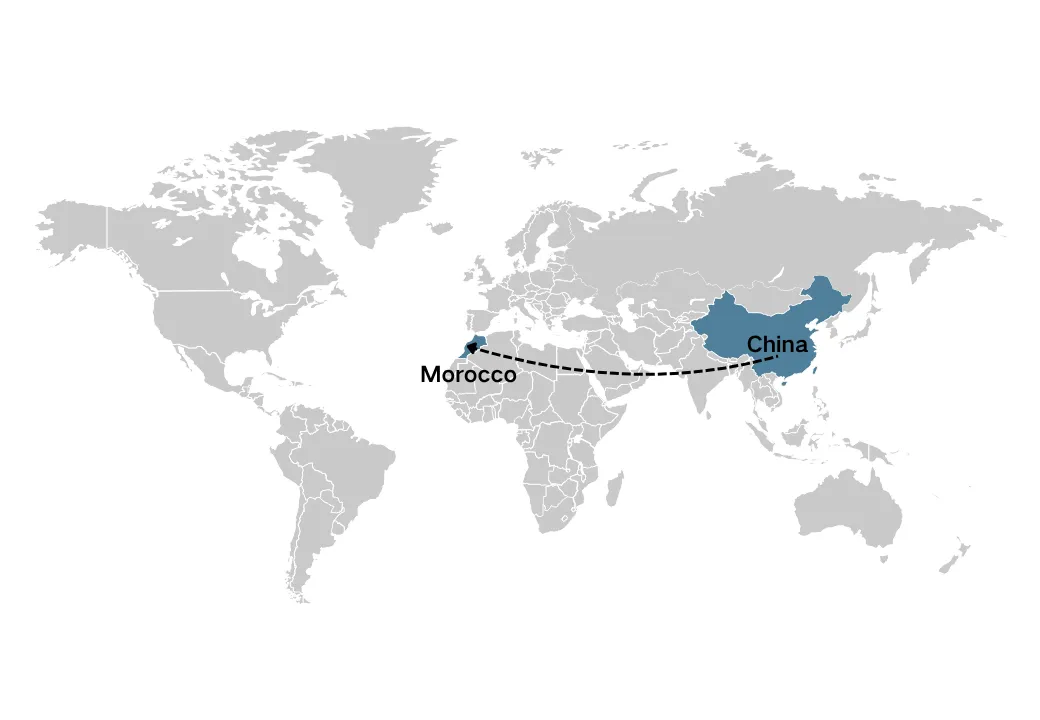
We make shipping from China to Morocco simple, reliable, and cost-effective
Competitive Rates
Best shipping rates with no hidden fees. Save up to 40% compared to other forwarders.
Fast Transit
Reliable delivery times with express options available for urgent shipments.
Safe & Secure
Full cargo insurance and secure handling throughout the entire shipping process.
24/7 Support
Dedicated customer support team available around the clock for all your needs.
Are you struggling with hidden fees, unexpected customs delays, or inconsistent transit times when importing goods into North Africa? Navigating the complexities of shipping from China to Morocco can make or break your profit margins, especially if you aren't familiar with local regulations like PortNet or the specific requirements of the Moroccan Office des Changes.
Whether you're an Amazon seller sourcing from Alibaba or a procurement manager scaling a wholesale business, this comprehensive guide will give you the exact costs, transit times, and hands-on customs strategies you need to import profitably and predictably.
Sea Shipping from China to Morocco (September 2026)
What is the best way to ship large volumes from China to Morocco?
For shipments exceeding 2 CBM or 500 kg, sea shipping is the most economical choice. You can choose between Full Container Load (FCL) for large, exclusive shipments, or Less than Container Load (LCL) to share container space and reduce costs.
Sea freight forms the backbone of Sino-Moroccan trade. Morocco boasts some of the most advanced port infrastructure in Africa, notably Tanger Med (a massive global transshipment hub handling over 7 million TEUs annually) and the Port of Casablanca (the primary gateway for domestic consumption).
FCL (Full Container Load): Ideal if you have enough cargo to fill a 20FT or 40FT container. FCL offers better security, faster handling at the destination port, and a lower cost per unit.
LCL (Less than Container Load): Perfect for smaller shipments. Your cargo shares a container with other importers. While cheaper overall, LCL can add 3-5 days to the transit time due to the consolidation and deconsolidation processes at the ports.
Insider Strategy: Tanger Med vs. Casablanca
Many importers assume shipping directly to Casablanca is always best. However, Tanger Med is a deep-water hub that receives direct mother vessels from China (like MSC or Maersk). Casablanca often requires smaller "feeder" vessels connecting through European hubs (like Algeciras or Valencia), adding 7-10 days of transshipment delay. If time is critical, we routinely route containers to Tanger Med and truck them inland to Casablanca—saving up to a week in total transit.
In our experience on the ground, proper Bill of Lading preparation and accurate HS Codes are absolutely critical. Furthermore, the ADII frequently uses X-ray scanners at the Casablanca port. If your packing list doesn't match the physical cargo perfectly, expect a physical inspection. These holds result in costly daily demurrage fees that quickly wipe out your profit margins.
Air Shipping from China to Morocco (September 2026)
When should you use air freight to Morocco?Air freight is the optimal solution for high-value, perishable, or time-sensitive goods. While significantly more expensive than ocean freight, it reduces transit times from over a month to just 3 to 7 days.
The primary hub for air cargo is Casablanca Mohammed V International Airport (CMN), handling the vast majority of international flights via carriers like Royal Air Maroc Cargo, Emirates SkyCargo, and Qatar Airways Cargo. When shipping via air, weight and volume play a crucial role. Airlines charge based on either the gross weight or the volumetric weight (Length x Width x Height / 6000)—whichever is higher.
Direct vs. Deferred Air Freight Solutions
To maximize your air freight budget, we offer two distinct solutions:
Direct/Express Air (3-5 days): Flown on direct routes or premium passenger aircraft bellies. Best for high-value electronics, medical supplies, or urgent fashion restocks.
Deferred Air (6-10 days): Consolidated cargo flown through secondary transit hubs (like Dubai or Paris) before connecting to CMN. This strategy can slash your per-kg rate by up to 30% while still being significantly faster than ocean freight.
A common pitfall we solve for clients: CMN airport's cargo terminals can become severely bottlenecked during peak seasons (like Q4 or pre-Ramadan). To prevent your cargo from sitting in a warehouse backlog, our local brokers preemptively submit pre-arrival clearance documents via PortNet, ensuring your shipment moves directly from the tarmac to final delivery.
Door to Door Shipping from China to Morocco (September 2026)
Can you ship Door to Door (DDP) from China to Morocco?
Yes, Door to Door shipping is highly recommended for importers who want a hands-off experience. However, because of Morocco's strict foreign exchange controls governed by the Office des Changes, true DDP requires a specialized freight forwarder with a highly compliant local Importer of Record (IOR) setup.
With Door to Door service, your forwarder manages the entire lifecycle of the shipment:
Pickup from the supplier's factory in China (e.g., Shenzhen, Guangzhou, Yiwu).
Import customs clearance in Morocco via the PortNet digital system.
Final mile delivery directly to your warehouse in Casablanca, Rabat, or Marrakech.
Why is True DDP to Morocco so Difficult?
Moroccan customs law strictly prohibits foreign entities from paying local import duties. All taxes must be paid by a registered Moroccan company in Moroccan Dirham (MAD), and the outflow of currency is monitored heavily by the Office des Changes. This means 90% of standard freight forwarders will fail if you ask them for DDP terms—they will simply abandon your cargo at the port, forcing you to scramble for a local broker and pay taxes out of pocket.
At DTFU, we legally circumvent this barrier. We utilize a dedicated Importer of Record (IOR) network in Morocco. Our local partners clear the goods under their Moroccan tax ID, pay the ADII directly, and we invoice you a single, all-inclusive upfront price in USD. This completely eliminates the headache of dealing with unpredictable local port charges and currency conversion delays.
Major Shipping routes from China to Morocco
Choosing the right route impacts both your transit time and your bottom line.
Top Sea Freight Routes
Most ocean freight departs from China's major coastal hubs and travels via the Suez Canal before reaching North Africa.
Ports of Origin: Shanghai, Ningbo, Shenzhen, Guangzhou, Qingdao.
Ports of Destination: Tanger Med (often faster, heavily used for transshipment), Casablanca (closer to major commercial centers), Agadir.
Top Air Freight Routes
Air freight generally relies on major international transit hubs (like Dubai, Doha, or Paris) before touching down in Morocco.
Airports of Origin: Shenzhen (SZX), Guangzhou (CAN), Shanghai (PVG), Hong Kong (HKG).
Airports of Destination: Casablanca (CMN), Marrakech (RAK).
Shipping cost from China to Morocco (September 2026)
How much does it cost to ship from China to Morocco?
Through strategic carrier partnerships, DTFU secures highly competitive rates for our clients. Currently, Sea freight LCL generally costs $50–$110 per CBM, while air freight ranges from $3.50 to $6.50 per kg depending on the weight bracket.
Please note: The following are estimated market averages based on recent data. For exact, real-time rates tailored to your cargo, request a quote directly from our team.
Shipping Method
Unit / Container
Estimated Cost (USD)
Best For
LCL Sea Freight
Per CBM
$50 - $110
Small, non-urgent loads (2-15 CBM)
FCL 20FT
Per Container
$1,400 - $2,400
Medium volumes, heavy goods
FCL 40FT/40HQ
Per Container
$2,200 - $3,800
Large volumes, bulky goods
Air Freight
Per KG (+100kg)
$3.50 - $6.50
Urgent, high-value shipments
Express (DHL/UPS)
Per KG
$5.50 - $8.50
Samples, documents, <50kg
Pro Tip: Always calculate your landed cost by factoring in FOB or EXW terms, local delivery, and Moroccan import duties assessed by the ADII.
Shipping time from China to Morocco (September 2026)
How long does it take to ship goods from China to Morocco?
Transit times vary widely by mode. Express courier takes 3-5 days, standard air freight takes 3-7 days, and ocean freight takes between 25 and 40 days depending on the port of origin and routing.
Origin (China)
Destination (Morocco)
Sea Freight (Days)
Air Freight (Days)
Shanghai / Ningbo
Casablanca / Tanger
30 - 38 Days
3 - 6 Days
Shenzhen / Guangzhou
Casablanca / Tanger
26 - 32 Days
3 - 5 Days
Qingdao / Tianjin
Casablanca / Tanger
35 - 42 Days
5 - 7 Days
Note: Add 5-7 days for Door-to-Door delivery to account for PortNet customs clearance and inland trucking to cities like Rabat or Marrakech.
Import duty from China to Morocco (September 2026)
Morocco protects its domestic industries, meaning import duties can be significant. Navigating the Administration des Douanes et Impôts Indirects (ADII) requires strict adherence to local compliance.
Standard Tariffs: Duties range from 2.5% to 40% depending on the HS Code of the product. Industrial machinery often sees lower rates, while textiles and consumer goods face higher tariffs. Insider Warning: The ADII maintains a strict internal valuation database. If they suspect your Commercial Invoice is "under-declared" to avoid taxes, they will unilaterally reassess your cargo's value to match Moroccan market rates, triggering heavy fines and weeks of delays. Always declare the true transactional value.
Value Added Tax (VAT): The standard VAT rate in Morocco is 20%, applied to the CIF (Cost, Insurance, and Freight) value plus the import duty.
PortNet System & Engagement d'Importation: All import declarations must be processed through PortNet. Before your goods even arrive, your Moroccan company must sign an Engagement d'Importation (Import Commitment) and domicile it at a local Moroccan bank. This guarantees foreign currency will only be released for legitimate trade.
Certificate of Conformity (COC): Many industrial and consumer products require a COC issued by authorized agencies (like Bureau Veritas, TUV, or SGS) to prove they meet Moroccan standards (Normes Marocaines - NM). Ensure your Chinese supplier coordinates this physical inspection before the cargo leaves the port in China. If the cargo arrives in Casablanca without a valid COC, it will be rejected and shipped back at your expense.
Shipping process from China to Morocco
Importing successfully requires a streamlined, predictable process. Here is how our veteran team handles it from start to finish:
Quote & Booking: You provide your packing list and commercial invoice. We analyze the best routing (Air vs. Sea) and secure space with the carrier at our preferential rates.
Cargo Pickup: We arrange inland trucking from your supplier's facility under EXW terms, or receive the goods at our China warehouse under FOB terms.
Export Clearance: Our team handles all Chinese export declarations, ensuring compliance with local export quotas.
International Transit: Your goods are loaded onto the vessel or aircraft. You receive a tracking number for 24/7 real-time visibility.
Moroccan Customs Clearance: Upon arrival in Casablanca or Tanger Med, our local brokers submit the required documentation via PortNet, paying the applicable duties and taxes directly to the ADII.
Final Delivery: Once released by customs, the cargo is loaded onto local trucks and delivered directly to your specified address.
Your Trusted Freight Forwarder for Alibaba & Amazon Shipments to Morocco
Finding a reliable logistics partner is the most critical step in your supply chain. At DTFU International Logistics, we don't just move boxes; we engineer solutions that protect your margins.
Why choose us for your Morocco shipments?
Preferential Contract Rates: We leverage our massive shipping volume to secure below-market-average rates from top-tier carriers, passing the savings directly to you.
End-to-End Visibility: From the factory floor in Shenzhen to your warehouse in Casablanca, our tracking systems keep you informed 24/7.
Local Customs Expertise: We deeply understand the nuances of the ADII, PortNet integration, COC requirements, and local tax structures, ensuring your goods never get stuck at the border.
Tailored DDP Solutions: We offer seamless Door-to-Door services that bypass currency control headaches, allowing you to focus on scaling your business rather than fighting logistics fires.
Stop letting unpredictable logistics eat into your profits. Contact DTFU Logistics today for a customized shipping strategy.
Frequently Asked Questions
Get answers to common questions about shipping from China to Morocco
On average, shipping a 20FT container (FCL) costs between $1,400 and $2,400, while a 40FT or 40HQ container ranges from $2,200 to $3,800. These rates are subject to seasonal fluctuations and carrier capacity, so we recommend locking in your booking early.
Port-to-port ocean transit times generally range from 25 to 40 days. Shipments from Southern China (like Shenzhen) to Tanger Med usually arrive on the faster end of that spectrum (around 26-32 days), while Northern China departures may take slightly longer.
For smaller shipments, Less than Container Load (LCL) sea freight typically costs between $50 and $110 per CBM. This is a highly economical option if your cargo volume is between 2 and 15 CBM and you don't need a full container.
For shipments over 2 CBM, sea freight (specifically LCL for smaller loads and FCL for larger loads) is the most cost-effective method. For parcels under 50kg, express couriers like DHL or FedEx offer the best value.
Yes, for many product categories including electronics, automotive parts, and textiles, Morocco requires a COC under the NM standards. This must be arranged with an approved agency (like Bureau Veritas) prior to shipment from China.
Yes, but goods containing lithium batteries are classified as Dangerous Goods (DG). They require specific MSDS (Material Safety Data Sheet) documentation, UN38.3 test reports, and specialized packing to comply with airline and maritime regulations.
Import duties and the 20% standard VAT are typically paid by your customs broker on your behalf directly to the ADII during the clearance process via the PortNet system. If you use our Door-to-Door (DDP) service, these fees are included in your upfront shipping quote.
Ready to Shipping From China to Morocco?
Get your instant quote today and experience the difference of working with a professional freight forwarder.
5000+
Successful Shipments
98%
Customer Satisfaction
Get Your Free Quote
Response within 2 hours • No obligation • Free consultation
We use cookies to enhance your browsing experience and analyze site traffic. By continuing to use our site, you consent to our use of cookies. Learn more in our Cookie Policy.