If you are sourcing goods from China for your business in Uganda, you have probably asked yourself one question more than any other: what is the real, all-in sea shipping cost from China to Uganda — not just the ocean freight rate, but the total you will actually pay to get your cargo from the factory floor to your warehouse in Kampala?
It is a fair question. And the answer is rarely straightforward. Uganda is a landlocked country in East Africa, which means every container shipped from China must first arrive at a seaport in a neighboring country — almost always Mombasa, Kenya or Dar es Salaam, Tanzania — before traveling another 1,100 to 1,600 kilometers inland by road or rail. That inland leg alone typically adds $1,500 to $3,500 per container, a cost that catches many first-time importers off guard. On top of that, you have customs duties, VAT, transit bonds, mandatory certification requirements, and a dozen smaller fees that add up fast.
This guide is built to eliminate that uncertainty. We break down every component of your shipping cost — ocean freight, inland trucking, port handling, customs brokerage, duties and taxes, insurance, and the often-overlooked PVoC certification — so you can budget accurately and avoid the expensive surprises that eat into your margins. You will also find a real-world case study with actual 2026 numbers, a seasonal planning framework, and seven proven strategies to cut your total landed cost by 15 to 30%.
Whether you are building a long-term import operation and need a comprehensive Shipping From China To Uganda solution, or are simply researching costs for your first container, understanding the full logistics chain — from the supplier's factory to your doorstep in Kampala — is the foundation of profitable importing.
Sea Freight Routes from China to Uganda: Northern Corridor vs Central Corridor
Understanding your routing options is the first step toward controlling your costs. Because Uganda has no coastline, virtually all sea freight arrives through one of two transit corridors — and the choice between them has a direct impact on your total shipping bill.
Uganda's Landlocked Geography — Why Routing Dictates Cost
Uganda is bordered by Kenya to the east, South Sudan to the north, the DRC to the west, and Rwanda and Tanzania to the south. With no direct access to the sea, over 95% of containerized imports enter through Mombasa Port in Kenya or Dar es Salaam Port in Tanzania. Once a container is discharged at either port, it must be transported inland by truck — and increasingly by rail — through designated transit corridors to reach Kampala, Jinja, or other Ugandan destinations. For importers whose supply chains also extend to neighboring markets, we provide dedicated Shipping From China To Kenya and Shipping From China To Tanzania services that leverage the same East African transit corridors.
This geography creates a unique cost structure that importers in coastal countries simply do not face. Your total shipping cost is never just the ocean freight; it is ocean freight plus inland transit, and the inland portion can account for 25 to 40% of the total.
Northern Corridor (Mombasa Route) — The Dominant Choice
The Northern Corridor runs from Mombasa through Nairobi and onward to the Malaba or Busia border crossings into Uganda, covering approximately 1,150 kilometers to Kampala. This is by far the most commonly used route for Ugandan imports — and for good reason.
| Factor | Northern Corridor (Mombasa) |
|---|---|
| Inland distance to Kampala | ~1,150 km |
| Inland transit time | 5–10 days after port discharge |
| Inland trucking cost (20ft) | $1,500–$2,500 |
| Inland trucking cost (40ft) | $2,200–$3,500 |
| Sailing frequency from China | High (multiple weekly departures from Shanghai, Ningbo, Shenzhen) |
| Rail option available | Yes — SGR (Standard Gauge Railway) to Nairobi/Naivasha |
Advantages: Faster overall transit, better road infrastructure on the Kenyan side, higher weekly sailing frequency from major Chinese ports, and the availability of the SGR railway as an alternative to road transport for part of the journey. Mombasa is also where most shipping lines on the Asia–East Africa trade lane call first, meaning shorter ocean transit times compared to Dar es Salaam. For importers whose primary market is Kenya rather than Uganda, our Shipping Cost from China to Kenya guide covers the full cost structure for shipments terminating at Mombasa — which, without the inland Uganda leg, can be 30–40% cheaper than door-to-door Kampala rates.
Disadvantages: The Busia and Malaba border crossings can become congested during peak import periods, adding 1–3 days to inland transit. Port congestion at Mombasa has also been a recurring issue, though recent infrastructure investments have improved throughput.
Central Corridor (Dar es Salaam Route) — The Alternative Worth Considering
The Central Corridor runs from Dar es Salaam through central Tanzania to the Mutukula border post and onward to Kampala, covering roughly 1,600 kilometers — about 40% longer than the Mombasa route.
| Factor | Central Corridor (Dar es Salaam) |
|---|---|
| Inland distance to Kampala | ~1,600 km |
| Inland transit time | 7–14 days after port discharge |
| Inland trucking cost (20ft) | $1,800–$3,000 |
| Inland trucking cost (40ft) | $2,500–$4,500 |
| Sailing frequency from China | Moderate (fewer weekly departures) |
| Best for | Cargo destined for southwestern Uganda (Mbarara, Kabale) |
When the Central Corridor makes sense: If your goods are destined for southwestern Uganda, the Dar es Salaam route can be more cost-effective despite the longer distance. The Mutukula border crossing is closer to Mbarara and Kabale, reducing the final trucking distance within Uganda. Dar es Salaam also sometimes offers lower port handling charges than Mombasa, and during periods of severe congestion on the Northern Corridor, the Central Corridor can be a useful relief valve.
The Rail Factor — SGR Is Changing the Equation
The Standard Gauge Railway (SGR) from Mombasa to Naivasha (with future extensions planned) is quietly transforming inland logistics for Ugandan importers. Containers can now move by rail from Mombasa to the Naivasha inland container depot, where they are transshipped to trucks for the final leg to Kampala.
This rail + truck combination offers a compelling middle ground: comparable total transit time to pure road transport, lower risk of road-related delays or cargo damage, and costs in the range of $1,800 to $2,500 per container for the rail + truck combo. It is an option worth discussing with your freight forwarder, especially for full container loads where schedule reliability matters more than shaving a day or two off the inland leg. For a deeper comparison of these two inland modes, see our analysis of Sea vs Rail Freight: Which Is Faster and More Reliable from China.
Origin Ports in China — Your Departure Options
One of the most persistent misconceptions among importers is that you must ship from the port closest to your freight forwarder's office. In reality, a competent forwarder coordinates from any major Chinese port, and choosing the right departure port can trim both cost and transit time.
| Origin Port | Region | Typical Sailing Frequency to Mombasa | Ocean Transit (to Mombasa) |
|---|---|---|---|
| Shanghai (Yangshan) | East China | High (multiple weekly) | 20–26 days |
| Ningbo-Zhoushan | East China | High | 21–27 days |
| Shenzhen (Yantian/Shekou) | South China | High | 19–25 days |
| Guangzhou (Nansha) | South China | Moderate–High | 20–26 days |
| Qingdao | North China | Moderate | 24–30 days |
| Tianjin (Xingang) | North China | Moderate | 25–32 days |
| Xiamen | Southeast China | Moderate | 21–28 days |
The key takeaway: ship from the port nearest to your supplier, not the port nearest to your forwarder. If your supplier is in Shandong province, shipping from Qingdao avoids 800+ kilometers of unnecessary domestic trucking inside China, saving you $300 to $600 per container before the ocean leg even begins.
2026 Sea Shipping Costs: FCL, LCL & Complete Fee Breakdown
Now for the numbers. The tables below reflect mid-2026 market rates, which have stabilized considerably after the extreme volatility of 2024–2025. That said, freight rates are dynamic — always get a current quote before finalizing your budget. For a broader overview of Shipping Cost from China to Uganda across all modes including air freight and express options, see our dedicated cost guide.
Ocean Freight Base Rates (Port-to-Mombasa, Mid-2026)
These are the ocean-only costs — the price of moving a container from a Chinese port to Mombasa. They do not include inland trucking, customs clearance, duties, or any other destination charges.
| Origin Port | 20ft FCL | 40ft FCL | 40ft HQ FCL |
|---|---|---|---|
| Shanghai | $1,950–$2,600 | $2,850–$3,900 | $2,950–$4,100 |
| Ningbo | $1,950–$2,550 | $2,800–$3,850 | $2,900–$4,000 |
| Shenzhen | $1,900–$2,500 | $2,750–$3,800 | $2,850–$3,950 |
| Guangzhou | $1,950–$2,600 | $2,850–$4,000 | $2,950–$4,150 |
| Qingdao | $2,100–$2,800 | $3,100–$4,200 | $3,200–$4,400 |
| Tianjin | $2,150–$2,900 | $3,200–$4,400 | $3,300–$4,600 |
Note on rates: Pricing reflects general market conditions as of mid-2026. Actual rates vary based on sailing schedules, carrier, fuel surcharges (BAF), and seasonal demand. Rates from northern ports (Qingdao, Tianjin) are typically $150–$350 higher than from Shanghai or Shenzhen due to the longer sailing distance. For container rates to Kenya — which shares the Mombasa gateway with Uganda — see our 20ft & 40ft Container Shipping Cost from China to Kenya breakdown.
The Complete Fee Breakdown — This Is What You Actually Pay
Ocean freight is only 40 to 55% of your total door-to-door cost. Here is every line item you need to budget for:
| Cost Component | Typical Range | Notes |
|---|---|---|
| Ocean Freight (20ft) | $1,900–$2,900 | Port-to-Mombasa; varies by origin port and season |
| Inland Trucking (Mombasa → Kampala) | $1,500–$2,500 (20ft) / $2,200–$3,500 (40ft) | Largest non-ocean cost; ~25–35% of total |
| China THC (Terminal Handling) | $150–$350 per container | Charged at the Chinese loading port |
| Mombasa Import THC | $200–$400 per container | Charged at the discharge port |
| China Export Customs Clearance | $50–$100 | Documentation and brokerage at origin |
| Bill of Lading Fee | $30–$70 | Issued by the shipping line |
| Certificate of Origin | $20–$50 | Required for preferential duty rates under COMESA/EAC |
| Kenya Transit Bond | $200–$500 | Mandatory for cargo transiting Kenya to Uganda |
| Uganda Customs Brokerage | $100–$300 | Broker fee for URA clearance |
| IDF (Import Declaration Form) | $50–$100 | Filed with URA before shipment |
| Cargo Insurance | 0.3%–0.7% of cargo value | Strongly recommended — the inland leg carries elevated risk; learn more about shipping container insurance cost for shipments from China |
| PVoC Certificate | $200–$600 | Mandatory pre-export inspection (see Section 5) |
| Destination Delivery | $200–$500 | Last-mile trucking within Kampala |
| Demurrage / Detention | $50–$150 / day | Applies after free time expires (~7–14 days at Mombasa) |
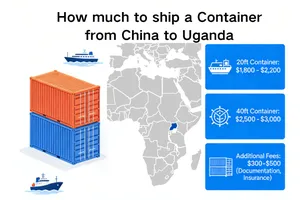
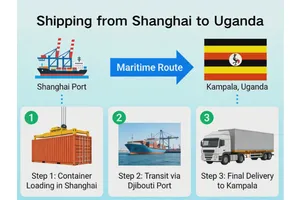
When you add everything up, a 20ft container from Shanghai to Kampala typically lands between $4,200 and $5,500 all-in (excluding duties and taxes). A 40ft container falls in the $6,500 to $9,500 range. These are the numbers that matter for your budget — not the ocean freight quote alone. For a detailed container-by-container breakdown, see How much to ship a Container from China to Uganda. For shipments departing from China's largest port, refer to our Shipping from Shanghai to Uganda route guide.
LCL (Less than Container Load) — For Smaller Shipments
If your shipment is less than 15 cubic meters (CBM), LCL is almost certainly more economical than booking a full container. You share container space with other importers and pay only for the volume you use.
| Volume Tier | LCL Rate (per CBM) | Estimated Total (incl. destination fees) |
|---|---|---|
| 1–5 CBM | $120–$250 / CBM | $320–$1,650 |
| 5–10 CBM | $100–$180 / CBM | $700–$2,200 |
| 10–15 CBM | $80–$150 / CBM | $1,000–$2,650 |
Breakeven analysis: Once your shipment exceeds roughly 15 CBM, booking a 20ft FCL container usually becomes cheaper on a per-unit basis than paying LCL rates — even if you do not completely fill the container. Calculate both options before deciding.
A Note on Air Freight
For time-sensitive, high-value, or low-volume cargo, air freight to Entebbe International Airport (EBB) is a viable alternative. Typical rates run $4 to $10 per kilogram for shipments over 100 kg, with a door-to-door transit time of 5 to 12 days. Air freight makes economic sense when the value density of your goods is high enough that the carrying cost of a 35-to-50-day sea transit outweighs the air freight premium — think electronics, pharmaceuticals, or urgent replacement parts. For dedicated air cargo options, refer to our Air Shipping From China Uganda service page.
Transit Times & Factors That Affect Your Delivery Schedule
Knowing how long your shipment will take is essential for inventory planning, cash flow management, and customer commitments. Here is the realistic timeline from factory floor to your Kampala doorstep.
Standard FCL Transit Timeline (via Mombasa Northern Corridor)
| Stage | Duration | Cumulative |
|---|---|---|
| Factory pickup & China export clearance | 3–5 days | Day 3–5 |
| Ocean transit (Shanghai → Mombasa) | 20–28 days | Day 23–33 |
| Mombasa port discharge & transit bond | 3–7 days | Day 26–40 |
| Inland trucking (Mombasa → Kampala) | 5–10 days | Day 31–50 |
| Uganda import clearance & delivery | 2–5 days | Day 33–55 |
Total typical door-to-door: 33–50 days for FCL. LCL shipments tend toward the upper end of this range (40–55 days) due to consolidation and deconsolidation at both ends. For a detailed breakdown by departure port and shipping method, check our Shipping time from China to Uganda reference.
Five Factors That Can Delay Your Shipment — and How to Mitigate Them
1. Mombasa Port Congestion. During peak import seasons (June–September and December–January), container dwell times at Mombasa can stretch from the usual 3–5 days to 10–14 days. Mitigation: work with a forwarder that monitors port conditions in real time and can adjust discharge routing if necessary.
2. East African Rainy Seasons. The long rains (March–May) and short rains (October–December) can wash out sections of the Kampala–Mombasa highway, slowing trucking by 2–7 days. If possible, schedule your ocean departure so that the inland leg avoids the heaviest rain months — especially April and November.
3. Chinese Holidays. Chinese New Year (January/February) and Golden Week (early October) cause factory closures, port backlogs, and pre-holiday freight rate spikes of 20–50%. Book at least 3–4 weeks in advance of these windows, or plan shipments for the off-peak months of March–April and August–September.
4. Kenya Border Inspections. Transit cargo passing through Kenya is subject to inspection at the Malaba or Busia border posts. These checks typically add 1–3 days, but incomplete documentation — especially a missing or expired transit bond — can cause much longer delays.
5. Documentation Errors. An incorrect HS code, a mismatched commercial invoice, or — critically — a missing PVoC certificate can hold your cargo at the Ugandan border for 1 to 4 weeks. Pre-shipment document review by an experienced freight forwarder is the single most effective way to prevent this.
Uganda Customs Clearance, Import Duties & PVoC Certification
This is the section that sets apart importers who clear smoothly from those who watch their cargo sit at the border accumulating storage fees. Uganda's import procedures are not unusually complex, but they are strictly enforced — and two requirements in particular catch newcomers off guard.
Step-by-Step Uganda Customs Clearance Process
- File an Import Declaration Form (IDF) with the Uganda Revenue Authority (URA) before your goods depart China.
- Obtain a PVoC Certificate from an authorized inspection agent in China (see detailed section below).
- Secure a transit bond for the Kenya or Tanzania transit leg.
- Cargo arrives at the Malaba, Busia, or Mutukula border post.
- URA assesses duties and taxes through the ASYCUDA World electronic system.
- Pay assessed duties and taxes → cargo released → final delivery to your premises.
Uganda Import Duties & Taxes — A Worked Example
Understanding how duties and taxes compound on each other is essential for accurate landed cost calculation. Here is a real-world example:
Scenario: You import a 20ft container of home furniture from China with a CIF (Cost, Insurance, Freight) value of $12,500 at the Ugandan border. Furniture typically falls under HS Chapter 94, attracting a 25% import duty.
| Tax / Duty | Rate | Calculation | Amount |
|---|---|---|---|
| CIF Value | — | — | $12,500.00 |
| Import Duty | 25% | 25% × $12,500 | $3,125.00 |
| VAT | 18% | 18% × ($12,500 + $3,125) | $2,812.50 |
| Withholding Tax | 6% | 6% × $12,500 (approximate) | $750.00 |
| Infrastructure Levy | 1.5% | 1.5% × $12,500 | $187.50 |
| Total Duties & Taxes | $6,875.00 |
Your total landed cost for this shipment would be approximately $5,910 (logistics) + $6,875 (duties & taxes) = $12,785. Always factor duties and taxes into your sourcing economics — they can represent 40–60% of your total cost, depending on the HS code classification of your goods.
PVoC (Pre-Export Verification of Conformity) — The Critical Step Most Guides Skip
If there is one thing that separates a smooth import experience from a disaster at the border, it is the PVoC certificate. This is Uganda's mandatory pre-export verification program, administered by the Uganda National Bureau of Standards (UNBS), and it applies to the vast majority of consumer and industrial products.
What is PVoC? Before your goods leave China, an authorized third-party inspection agent must verify that they meet applicable Ugandan standards. If the goods pass inspection, a Certificate of Conformity (CoC) is issued. Without this certificate, your cargo will be rejected at the Ugandan border — no exceptions.
Products requiring PVoC: Electronics and electrical appliances, toys and children's products, building materials (tiles, steel, fittings), textiles and footwear, food products and packaging, machinery and mechanical equipment, automotive parts, solar panels and equipment, and most other consumer goods. In practice, very few product categories are exempt.
How to obtain PVoC: 1. Contact an authorized inspection agent: SGS, Bureau Veritas, or Intertek all have offices in major Chinese cities. 2. Submit product samples, technical specifications, and test reports (if available). 3. The agent conducts physical inspection and/or testing at your supplier's factory or consolidation warehouse. 4. If compliant, the CoC is issued within 5–10 working days.
Cost: $200–$600 depending on product complexity, number of SKUs, and inspection scope.
Pro tip: Start the PVoC process as soon as your goods are ready for inspection — do not wait until the container is already at the port. A competent freight forwarder can coordinate the PVoC inspection alongside your export documentation, saving you time and ensuring nothing falls through the cracks.
Complete Documentation Checklist
| Document | Issued By | Notes |
|---|---|---|
| Commercial Invoice | Supplier | Must include HS codes per line item |
| Packing List | Supplier | Detailed weights and dimensions |
| Bill of Lading (B/L) | Shipping Line | Issued after container loading |
| Certificate of Origin | CCPIT or similar | Form A for COMESA/EAC preferential rates |
| Import Declaration Form (IDF) | URA (via agent) | File before shipment departs China |
| PVoC Certificate of Conformity | SGS / BV / Intertek | Mandatory for regulated products |
| Tax Identification Number (TIN) | URA | Required for importer registration |
| Transit Bond | Licensed bond provider | For Kenya/Tanzania transit |
Transit Bond — What It Is and Why It Matters
A transit bond is a financial guarantee required by Kenyan customs for cargo that passes through Kenya en route to Uganda. It ensures that the goods will not be illegally diverted and sold within Kenya without paying Kenyan import duties. The bond is typically arranged by your freight forwarder or customs broker and costs $200 to $500, depending on the cargo value. It is a non-negotiable requirement — cargo without a valid transit bond will be detained at Mombasa.
Choosing the Right Incoterm for Your Uganda Shipment
The Incoterm you negotiate with your Chinese supplier has enormous leverage over your total shipping cost, your level of control over the logistics process, and your exposure to risk. Here is how the four most relevant terms apply to Uganda-bound shipments.
Quick Reference: Incoterms for Uganda Importers
| Incoterm | Who Handles What | Best For |
|---|---|---|
| EXW (Ex Works) | You handle everything from the supplier's factory gate onward | Large enterprises with dedicated logistics teams and existing carrier relationships |
| FOB (Free on Board) | Supplier delivers to the Chinese port; you control ocean freight and everything beyond | Importers who have a trusted freight forwarder and want cost control over the main transit |
| CIF (Cost, Insurance, Freight) | Supplier arranges and pays for shipping to Mombasa; you handle inland transit, customs, and delivery | First-time importers attracted by the simplicity — but beware of minimal insurance coverage |
| DDP (Delivered Duty Paid) | Your freight forwarder handles everything — factory to your Kampala doorstep, duties and taxes included | SMEs and importers who want predictable total costs and a single point of accountability |
CIF vs DDP — The Decision That Shapes Your Costs
CIF is popular with first-time importers because the supplier quotes one number that covers the goods plus shipping to Mombasa. It feels simple. But here is what CIF does not cover: inland trucking from Mombasa to Kampala ($1,500–$3,500), the transit bond ($200–$500), Uganda customs brokerage, import duties and VAT, PVoC certification, and last-mile delivery. You manage each of these separately, coordinating with multiple service providers in two different countries, each with its own costs, timelines, and potential for error.
DDP, by contrast, is a single door-to-door service managed by one freight forwarder. You receive one quote that includes everything: factory pickup in China, export clearance, ocean freight, inland trucking, transit bond, PVoC coordination, Uganda customs clearance, duty and tax payment, and final delivery to your Kampala address. The upfront number is larger, but the total is predictable — and you avoid the costly learning curve of managing each leg yourself.
Recommendation: For most Ugandan SMEs and first-time importers, DDP with a reputable China-based freight forwarder delivers the best combination of cost predictability, reduced administrative burden, and risk mitigation. Our Door to Door Shipping From China Uganda service is designed specifically for importers who want a single point of accountability from factory to final delivery. Once you have completed several shipments and built relationships with local brokers and trucking companies, you may find that switching to FOB gives you more cost control — but DDP is almost always the right starting point. For a deeper dive into these trade-offs, read our comparison of DDP vs FOB: Which Option Saves Time and Reduces Hassle.
7 Proven Strategies to Reduce Your Sea Shipping Costs from China to Uganda
Reducing your shipping costs is not about finding a single magic trick. It is about making a series of smart, informed decisions across the entire logistics chain. Here are seven strategies that consistently deliver savings for our clients. If you are looking for the Cheapest shipping agent from China to Uganda, the key is not just the lowest sticker price — it is finding a partner who delivers genuine value through bundled services, accurate documentation, and transparent pricing.
1. Consolidate Strategically — LCL Below 15 CBM, FCL Above
The math is straightforward. If your shipment is under 15 CBM, LCL is typically more economical — you pay only for the space you use. Above 15 CBM, the per-unit cost of LCL surpasses the cost of booking a 20ft FCL container, even if you do not completely fill it. Before every shipment, ask your forwarder to quote both LCL and FCL options side by side. Also, consider using a consolidation warehouse in China to combine purchases from multiple suppliers into a single container — this alone can turn three small LCL shipments into one cost-effective FCL booking.
2. Time Your Shipments Around Seasonal Windows
Freight rates on the China–East Africa route follow a predictable seasonal rhythm. The most expensive periods are the weeks immediately before Chinese New Year (late January through mid-February) and the Q4 holiday surge (October–November). The best months to ship are February–April and August–September, when factory capacity is available and ocean freight rates are 10–25% lower than peak-season levels. Also factor in the East African rainy seasons — schedule your ocean departure so that the inland trucking leg does not coincide with the heaviest rain months of April or November.
3. Match Your Corridor to Your Destination
For cargo bound for Kampala, Jinja, or eastern Uganda, the Mombasa Northern Corridor is almost always the most cost-effective choice. For cargo destined for southwestern Uganda — Mbarara, Kabale, Kisoro — the Dar es Salaam Central Corridor via Mutukula may trim both inland distance and total cost. Do not default to one corridor out of habit; evaluate both for each shipment based on your final delivery address.
4. Bundle Services with a Single Freight Forwarder
Booking ocean freight, inland trucking, customs brokerage, and cargo insurance as separate services from different providers usually costs 10–20% more than a bundled door-to-door package from a single forwarder. Beyond the cost savings, a single-provider approach eliminates the finger-pointing that happens when one link in a multi-vendor chain fails. When your forwarder owns the entire process, they own the outcome. Working with an experienced Freight forwarder from China to Uganda ensures seamless coordination across every link in the chain — from PVoC certification in China to final delivery in Kampala.
5. Optimize Packaging to Reduce Chargeable Volume
LCL shipments are charged per cubic meter (CBM) — every wasted centimeter is money you are leaving on the table. Work with your supplier to palletize efficiently, nest products where possible, and use packaging dimensions that maximize container or pallet utilization. For products like furniture and machinery that are common Uganda imports, even a 10% improvement in volume efficiency translates directly to a 10% lower freight bill.
6. Get Your Documentation Right — Especially HS Codes and PVoC
Documentation errors are the most expensive "free" mistakes in international shipping. An incorrect HS code triggers the wrong duty rate, which can mean overpayment, penalties, or a customs audit. A missing or late PVoC certificate means your cargo is rejected at the border. Work with a freight forwarder that provides pre-shipment document review as a standard part of their service — it costs little and prevents enormously expensive problems downstream.
7. Negotiate Annual Contracts for Regular Volume
If you ship three or more containers per year, negotiate an annual rate agreement with your freight forwarder rather than booking on the spot market. Annual contracts lock in preferential rates, guarantee space allocation during peak seasons, and often include value-added services like priority documentation handling. Forwarders that hold direct carrier contracts — negotiated directly with shipping lines rather than through intermediaries — can offer the most competitive and stable pricing.
Why DTFU Logistics Is Your Trusted Partner for China-to-Uganda Sea Freight
Choosing the right freight forwarder is the single most impactful decision you make in your importing journey. At DTFU Logistics, we have built our East Africa practice around the specific challenges that Ugandan importers face — from landlocked routing and PVoC coordination to transit bonds and URA clearance.
Nationwide China coverage, not just one port. We operate from all major Chinese ports — Shanghai, Ningbo, Shenzhen, Guangzhou, Tianjin, Qingdao, and Xiamen — and load from the port closest to your supplier. This reduces your domestic trucking costs inside China and shortens your total transit time. We are headquartered in Shenzhen, but our operational footprint spans the country.
FIATA and IATA dual-certified since 2014. With over a decade of industry experience and a service network covering 120+ countries, we bring institutional knowledge and certified professionalism to every shipment. Our dedicated East Africa desk handles the Uganda corridor daily — we know the PVoC process, the transit bond requirements, and the URA clearance workflow because we navigate them every week, not once a quarter.
Direct carrier contracts mean competitive rates and guaranteed space. We hold long-term agreements with major shipping lines on the Asia–East Africa route. These relationships translate into preferential freight rates for our clients and — critically — guaranteed container space during peak season, when spot-market rates surge and capacity tightens.
True transparency — no hidden fees, no surprise surcharges. Our DDP door-to-door quotes include every cost line item, from factory pickup in China to final delivery at your Kampala address. We itemize ocean freight, inland trucking, transit bond, PVoC coordination, customs brokerage, duties, and taxes — so you know exactly what you are paying and why.
A dedicated account manager who knows your business. Every DTFU client is assigned a personal account manager fluent in English and experienced in Uganda import regulations. This is your single point of contact — someone who knows your product categories, your preferred routing, and your documentation profile, and who proactively alerts you to requirements before they become problems.
Complete service suite for Ugandan importers: - FCL & LCL sea freight via Mombasa and Dar es Salaam corridors - Air freight to Entebbe (EBB) for time-sensitive cargo - DDP door-to-door — the all-inclusive solution for predictable total costs - PVoC coordination with authorized inspection agents in China - Customs brokerage and URA clearance - Cargo insurance with comprehensive inland transit coverage - Consolidation warehousing in China for multi-supplier shipments
Request a free, no-obligation shipping quote for your next China-to-Uganda shipment. Tell us your cargo details, and we will provide a transparent, itemized quotation within one business day.
Frequently Asked Questions
How much does it cost to ship a 20ft container from China to Uganda?
Total door-to-door (including inland trucking from Mombasa to Kampala): $4,200 to $5,500, depending on the origin port in China, the season, and the specific corridor used. Ocean freight alone (port-to-port) accounts for approximately $1,900 to $2,900 of that total. Always budget for the inland leg — it adds $1,500 to $2,500 per 20ft container.
How much does it cost to ship a 40ft container from China to Uganda?
Total door-to-door: $6,500 to $9,500. The ocean freight portion is approximately $2,750 to $4,900, and inland trucking from Mombasa to Kampala adds $2,200 to $3,500. The wide range reflects variance in origin ports, seasonal demand, and whether you use road-only or road-plus-rail for the inland leg.
How long does sea shipping take from China to Uganda?
Typical FCL door-to-door transit time is 33 to 50 days. Ocean transit from Shanghai, Ningbo, or Shenzhen to Mombasa takes 20 to 28 days. Inland trucking from Mombasa to Kampala adds 5 to 10 days, and customs clearance at both ends accounts for the remaining time.
What is the cheapest way to ship from China to Uganda?
For shipments over 15 CBM, FCL sea freight via the Mombasa Northern Corridor is the most economical option. For smaller volumes, LCL sea freight is more cost-effective. Never compare ocean freight rates alone — always evaluate the total door-to-door cost, including inland trucking, transit bond, customs brokerage, and documentation fees. The cheapest ocean quote often hides the highest destination charges.
Which port in China is best for shipping to Uganda?
The best port depends on your supplier's location, not your forwarder's headquarters. Shanghai and Ningbo offer the highest sailing frequency to Mombasa and competitive rates. Shenzhen and Guangzhou are excellent choices for suppliers in southern China. Qingdao and Tianjin serve suppliers in northern China. A competent freight forwarder coordinates from any major Chinese port — choose the port closest to your supplier to minimize domestic trucking costs inside China.
What documents are required for importing goods from China to Uganda?
The essential documentation package includes: Commercial Invoice (with HS codes per line item), Packing List (detailed weights and dimensions), Bill of Lading (issued by the shipping line), Certificate of Origin (Form A for COMESA/EAC preferential duty rates), Import Declaration Form (IDF) (filed with URA before shipment), PVoC Certificate of Conformity (from SGS/BV/Intertek), and your Tax Identification Number (TIN). Your freight forwarder should provide a complete documentation checklist and review your paperwork before the container sails.