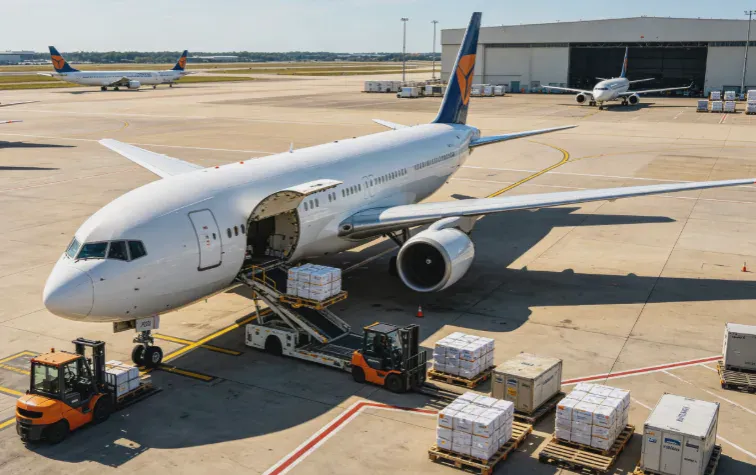
If you are sourcing goods from China and need them delivered to Ecuador fast, air shipping from China to Ecuador is your best option — but it comes with a learning curve. The $5/kg rate you see online rarely matches the final invoice. Transit times vary by 3 to 7 days depending on which Chinese airport your cargo departs from. And Ecuador's SENAE customs has specific documentation rules that, if overlooked, can hold your shipment for a week or more.
This guide walks you through every step of the process in the order you will actually need it: how long your shipment will take, what you will really pay per kilogram, which airports to use on both sides, whether DDP door-to-door is worth the premium, which Incoterm makes sense for air freight, how to clear Ecuador customs without surprises, and how to pick a freight forwarder who will not disappear when something goes wrong.
For a complete overview of all freight options to Ecuador — including sea freight FCL/LCL, door-to-door service, and customs clearance support — visit our dedicated Shipping From China to Ecuador page.
How Long Does Air Freight Take from China to Ecuador?
The short answer: standard air freight from China to Ecuador takes 5 to 10 business days from departure to arrival. Express courier services (DHL, UPS, FedEx) cut that to 3 to 6 days. But the actual transit time depends heavily on which airport your cargo leaves from.
Here is a breakdown by departure airport:
| Departure Airport | Code | → Quito (UIO) | → Guayaquil (GYE) |
|---|---|---|---|
| Shanghai Pudong | PVG | 3–5 days | 4–6 days |
| Hong Kong | HKG | 3–5 days | 4–6 days |
| Guangzhou Baiyun | CAN | 4–6 days | 5–7 days |
| Shenzhen Bao'an | SZX | 4–7 days | 5–8 days |
| Beijing Capital | PEK | 4–7 days | 5–8 days |
Shanghai Pudong and Hong Kong offer the fastest connections because they have the highest flight frequency to the Americas. Shenzhen and Beijing take slightly longer due to fewer direct connections and more reliance on transshipment through intermediate hubs.
Express vs. Standard vs. Economy Air Freight
There are three service tiers, and picking the wrong one can cost you either time or money:
| Service Tier | Transit Time | Best For |
|---|---|---|
| Express Courier (DHL/UPS/FedEx) | 3–6 days | Small parcels under 50 kg, urgent documents, samples |
| Standard Air Freight | 5–10 days | Commercial shipments over 50 kg, regular restocking |
| Consolidated / Economy Air Freight | 7–14 days | Cost-sensitive shipments over 100 kg where speed is flexible |
Express courier is door-to-door and requires almost no paperwork from you, but the per-kg cost is steep above 50 kg. Standard air freight hits the sweet spot for most commercial shipments: decent speed at a manageable rate. Consolidated air freight — where your cargo shares space with other shippers' goods on the same flight — offers the lowest cost but has two trade-offs: longer transit (the forwarder waits until the consolidation is full) and less predictable departure dates.
Why There Are No Direct Flights
There are no direct commercial cargo flights from China to Ecuador. Almost all shipments route through one of three transit hubs:
- Miami (MIA) — the most common gateway for Latin America, used by LATAM Cargo and Atlas Air. For cargo ultimately destined for Central America, Air Shipping from China to Panama via its regional hub at Tocumen International is another option worth considering.
- Los Angeles (LAX) — secondary US gateway, shorter connection for northern China departures
- Amsterdam (AMS) — European hub used by Air China Cargo and Cargolux for Ecuador-bound freight
- Santiago (SCL) — regional hub for connections deeper into South America
Beyond Ecuador, DTFU Logistics provides dedicated air freight coverage across the continent, including Air Shipping from China to Colombia, Air Shipping from China to Peru, and Air Shipping from China to Brazil.
Each transit stop adds 12 to 36 hours to the total journey time, depending on connection schedules. A 3-day transit from Shanghai to Quito via Miami typically means: 14 hours flying to Miami, 8 to 16 hours waiting for the connecting flight, another 5 hours to Quito, plus ground handling on both ends.
What Else Affects Transit Time?
Beyond the route itself, four factors can add unexpected delays:
- Customs inspection at UIO or GYE: SENAE uses a risk-based system. If your shipment is flagged for physical inspection (rather than documentary check or automatic "green lane" clearance), add 1 to 3 business days.
- Quito's altitude: At 2,850 meters above sea level, UIO's thin air reduces aircraft engine performance. Large cargo aircraft — especially fully loaded freighters — may need to reduce payload on departure, which can occasionally cause cargo to be bumped to the next available flight.
- Peak season congestion: November through January sees a surge in air cargo volume globally. Space becomes tight, and shipments without confirmed bookings may sit at origin for several extra days.
- Weekend and holiday gaps: Customs offices and airline cargo terminals do not operate 24/7 at all airports. A shipment arriving Saturday morning at UIO may not clear until Monday afternoon.
Air Freight Cost from China to Ecuador Per Kg
Base Freight Rates by Weight Tier
Air freight rates follow a simple rule: the more you ship, the less you pay per kilogram. Here are the standard base freight ranges for the China-to-Ecuador lane in 2026:
| Weight Bracket | Base Freight (USD/kg) |
|---|---|
| 1–45 kg | $5.00 – $7.00 |
| 45–100 kg | $4.00 – $6.00 |
| 100–300 kg | $3.00 – $5.00 |
| 300–500 kg | $3.00 – $4.00 |
| 500+ kg | $2.50 – $3.50 |
These are base freight rates only — the amount the airline charges for the space on the aircraft. Your actual, all-in cost will be higher because of surcharges and fees.
The Real Bill: What That $5/kg Actually Includes
Every compe*****'s pricing page shows you the base rate. Almost none of them show you what gets added on top. Here is what a real air freight invoice looks like, using a 200 kg shipment from Shanghai to Quito as an example:
| Charge Item | Rate | Amount (USD) |
|---|---|---|
| Base freight (200 kg × $4.00/kg) | $4.00/kg | $800.00 |
| Fuel surcharge (18% of base freight) | — | $144.00 |
| Security surcharge | $0.15/kg | $30.00 |
| Terminal handling (origin) | Flat fee | $45.00 |
| Air Waybill (AWB) issuance | Flat fee | $25.00 |
| Export customs clearance (China) | Flat fee | $80.00 |
| Total before destination charges | $1,124.00 | |
| Effective per-kg rate | $5.62/kg |
The base rate was $4.00/kg. The real rate, just to get the cargo onto the plane, is $5.62/kg — 40% higher than the advertised number. And this does not yet include Ecuador-side customs clearance, import duties, or last-mile delivery, which we will cover in the DDP section below.
The Volumetric Weight Factor
There is one more reason your bill might be higher than expected, and it catches first-time air freight shippers off guard more than any other: airlines charge by chargeable weight, which is the greater of your shipment's actual gross weight and its volumetric (dimensional) weight.
The formula is: Volumetric Weight (kg) = Length × Width × Height (cm) ÷ 6,000
Here is what that means in practice. Say you are shipping a box of clothing measuring 100 × 80 × 60 cm. The actual weight is 60 kg. The volumetric weight is 100 × 80 × 60 ÷ 6,000 = 80 kg. The airline charges you for 80 kg — not 60 kg — because your cargo takes up more space than its weight suggests. That is a 33% increase with no warning if nobody explained it to you.
The fix is straightforward: use packaging that fits your goods snugly. Every centimeter you shave off the external dimensions directly reduces the volumetric weight and your total freight cost.
Peak Season Surcharge Calendar
Air freight rates are not static. Here is when to expect surcharges and how much:
| Period | Surcharge | Notes |
|---|---|---|
| November – January | +15% to +25% | Global holiday shopping season; highest demand of the year |
| Chinese New Year (late Jan / early Feb) | +10% to +15% | Factory rush before shutdown + capacity crunch |
| Golden Week (first week of October) | +5% to +10% | China national holiday; limited export operations |
The best way to manage this: book space 2 to 3 weeks in advance during these periods. Last-minute bookings during peak season can cost double and still leave you without confirmed space.
Courier vs. Air Freight: Where Is the Break-Even Point?
For small shipments, international courier (DHL/UPS/FedEx) is often cheaper and faster than standard air freight. Here is a practical guideline:
| Shipment Weight | Best Option | Why |
|---|---|---|
| 0–30 kg | Express courier | Lower total cost, door-to-door, 3–6 days |
| 30–50 kg | Either — compare quotes | Courier and air freight costs begin to converge |
| 50–300 kg | Standard air freight | Lower per-kg rate, 5–10 days |
| 300+ kg | Standard air freight or charter | Negotiate volume rates; consider charter if urgent and over 1,000 kg |
What Is the Cheapest Option?
If cost is your primary concern and you can tolerate 7 to 14 days of transit, consolidated air freight offers rates of $3.00 to $4.00 per kg for shipments over 100 kg. The trade-off is real: your cargo waits at origin until enough other shipments are booked to fill the consolidation, departure dates are approximate, and transit is slower because consolidated shipments often take lower-priority routing. But if you are shipping non-urgent goods and every dollar counts, consolidation delivers meaningful savings.
Air Freight to Quito vs Guayaquil: Which Ecuador Airport Should You Use?
Most importers default to Quito because it is the capital. But Guayaquil might be the smarter choice for your cargo — especially if it is heavy. Here is a side-by-side comparison:
| Quito (UIO) | Guayaquil (GYE) | |
|---|---|---|
| Role | National air cargo hub (~70% of air freight) | Coastal commercial gateway |
| Altitude | 2,850 m ⚠️ | Sea level |
| Heavy cargo | Some aircraft must reduce payload at this altitude | No altitude restrictions |
| Best for | High-value, lightweight goods (electronics, pharmaceuticals, samples) | Heavy equipment, industrial parts, machinery |
| Inland distribution | Serves Quito metro and the Andean highlands | Serves Guayaquil metro and the Pacific coast |
The altitude issue at Quito is not theoretical. A fully loaded Boeing 777 freighter departing UIO on a hot day may need to leave 5 to 10 tonnes of cargo behind to meet takeoff performance requirements. If your shipment is dense and heavy — machinery, metal components, automotive parts — routing through Guayaquil eliminates this risk entirely.
Which Chinese Airport Should You Ship From?
Your choice of departure airport should match where your supplier is located, not which airport has the lowest nominal rate. The cost of trucking cargo 1,000 km across China to a slightly cheaper airport usually exceeds any rate savings.
| If your supplier is in... | Best departure airport | Why |
|---|---|---|
| Guangdong, Fujian, Hong Kong area | Guangzhou (CAN) or Shenzhen (SZX) | Both within trucking distance; CAN has strong Latin America connections |
| Shanghai, Zhejiang, Jiangsu | Shanghai Pudong (PVG) | Highest flight frequency to the Americas; fastest transit |
| Beijing, Tianjin, Hebei | Beijing Capital (PEK) | Best for North China; routes through European hubs to Ecuador |
| Any location, high-volume cargo | Hong Kong (HKG) | Most airline choices, daily departures, highest total cargo capacity |
Airlines Serving the China–Ecuador Route
The main carriers moving cargo on this lane include LATAM Cargo, Cargolux, Atlas Air, Emirates SkyCargo, UPS Airlines, and Air China Cargo. Each has different strengths: LATAM Cargo offers the best connectivity within South America once your cargo reaches the region; Cargolux and Emirates SkyCargo provide reliable European-transit options; Air China Cargo can be competitive on all-in pricing for large volumes.
For oversized, project-critical, or time-sensitive cargo exceeding 1,000 kg, charter flights are an option. A dedicated cargo charter from Shanghai or Hong Kong to Quito can deliver in 2 to 4 days with no transit stops. The cost is substantial — typically $80,000 to $150,000 depending on aircraft type — but for high-stakes shipments like medical equipment or production-line-critical machinery, it can be the difference between a factory running and a factory idled.
DDP Door-to-Door Air Shipping from China to Ecuador: Is It Worth the Extra Cost?
DDP (Delivered Duty Paid) is the closest thing to a one-click purchase in international freight. You pay one price, and your freight forwarder handles everything: picking up from your supplier in China, export customs, international air freight, Ecuador import customs with SENAE, paying all import duties and taxes (IVA, FODINFA, any applicable ICE), and delivering the goods to your door in Ecuador.
The question is whether that convenience justifies the premium. For many importers, the answer is yes — but let us look at the numbers.
What a DDP Air Freight Shipment Actually Costs
Here is a realistic DDP cost breakdown for a 300 kg shipment of consumer electronics from a supplier in Shenzhen to a buyer in Quito:
| Cost Component | Estimated Amount (USD) |
|---|---|
| Pickup from supplier (Shenzhen) | $100 – $200 |
| China export customs clearance | $50 – $100 |
| Air freight (300 kg × $3.50/kg) | ~$1,050 |
| Ecuador import duty (~10% of CIF) | ~$116 |
| IVA — VAT (12% × (CIF + Duty)) | ~$153 |
| FODINFA (0.5% of CIF) | ~$6 |
| Customs broker fee (Ecuador side) | $150 – $300 |
| Last-mile delivery (Quito metro area) | $80 – $150 |
| Total DDP landed cost | ~$1,700 – $2,075 |
| Effective per-kg, all-in | ~$5.70 – $6.90/kg |
The "headline" base freight for this shipment was $3.50/kg. The all-in DDP cost, with every fee, tax, and delivery charge included, is roughly $5.70 to $6.90 per kg — about 65 to 100% above the base rate. That gap is the price of convenience, compliance, and predictability.
DDP vs DAP vs Self-Managed: Which One Should You Choose?
| Scenario | Best Option | Why |
|---|---|---|
| You have no customs broker in Ecuador and do not speak Spanish | DDP | The forwarder handles everything; you receive the goods at your door |
| You have a trusted customs broker in Ecuador and want to save 8–15% | DAP (Delivered at Place) | Forwarder delivers to the airport; your broker clears customs and arranges delivery |
| You are an experienced importer with in-house logistics expertise | FCA or EXW | Maximum control, lowest forwarder fees, but you manage both sides |
DDP is most valuable for three types of importers: small and medium businesses without an Ecuador-based logistics team, first-time importers who want a predictable total landed cost with no surprises, and e-commerce sellers who need reliable door-to-door fulfillment without building local logistics infrastructure.
For importers sourcing goods for other South American markets, DTFU also provides dedicated air freight services to Air Shipping from China to Venezuela and Air Shipping from China to Argentina, with the same end-to-end DDP capability.
EXW, FCA, or DDP? A No-Nonsense Incoterms Guide for Air Freight
If you are used to sea freight, you are familiar with FOB (Free on Board). Here is the first thing to unlearn: FOB is designed for ocean shipping, where risk transfers when goods cross the ship's rail. For air freight, the correct equivalent is FCA (Free Carrier) — risk transfers when the goods are handed to the carrier at the named place. Using FOB on an air freight contract creates ambiguity about who bears responsibility if something goes wrong between the factory and the aircraft.
For a detailed comparison of these two shipping approaches and guidance on when each makes sense for your supply chain, see our analysis of DDP vs FOB: Which Option Saves Time and Reduces Hassle.
Here is a practical decision guide for the six Incoterms relevant to air freight, framed around your situation rather than legal definitions:
| If your situation is... | Choose | What it means in practice |
|---|---|---|
| You have your own freight forwarder and want full control from the factory onward | EXW (Ex Works) | You arrange pickup from the supplier's factory and handle everything downstream. Lowest purchase price from the supplier, highest logistics workload for you |
| You want the supplier to deliver to a named location in China (airport or forwarder's warehouse) | FCA (Free Carrier) | The supplier handles inland transport and China export clearance. You arrange the international air freight and destination clearance. The most common and balanced term for air freight |
| You want the supplier to pay for international freight, but you handle Ecuador import | CPT (Carriage Paid To) or CIP (adds insurance) | Supplier pays freight to the destination airport. You handle import clearance and duties. CIP adds insurance coverage — worth the small premium for high-value cargo |
| You want everything delivered to your door EXCEPT duties and taxes | DAP (Delivered at Place) | Forwarder brings goods to your named location in Ecuador. You pay import duties and handle customs clearance with your own broker |
| You want one price, one contact, and zero hassle | DDP (Delivered Duty Paid) | The forwarder does everything. You receive the goods at your door. Highest cost, lowest stress |
A common pitfall: choosing EXW, then discovering your supplier will not provide the export declaration documents because the sales contract did not require it. If you go EXW, make sure your purchase agreement explicitly states that the supplier must provide the commercial invoice, packing list, and any export license documents your forwarder needs for China customs clearance.
Ecuador Customs Clearance: Duties, SENAE & Required Documents
Ecuador's customs authority is SENAE (Servicio Nacional de Aduana del Ecuador). The clearance process is straightforward — four steps — but there are specific requirements that, if missed, will delay your shipment.
The Four-Step Clearance Process
- Document submission: Your customs broker submits the Air Waybill (AWB), commercial invoice, packing list, and any required certificates to SENAE's electronic system
- Inspection and valuation: SENAE assigns your shipment to one of three channels — automatic clearance (green), documentary review (yellow), or physical inspection (red). Most standard commercial shipments fall into yellow or green
- Duty and tax assessment: SENAE calculates the applicable duties and taxes based on the CIF value and HS code classification
- Payment and release: Once duties and taxes are paid, the cargo is released for delivery
Typical processing time is 1 to 3 business days for standard shipments. Physical inspections add 1 to 2 extra days. Perishable and time-sensitive goods (pharmaceuticals, fresh products) can qualify for expedited "green lane" processing.
How Much Tax Will You Pay? A Worked Example
Ecuador applies three main charges on imports:
- Ad Valorem Duty: 5% to 15% of the CIF value, depending on the HS code classification
- IVA (Value Added Tax): 12% applied to (CIF value + duty)
- FODINFA: 0.5% of CIF value, a small contribution to Ecuador's infant development fund
Let us walk through a real calculation. You are importing a $10,000 shipment of electronics (HS code classified at 10% duty) by air from China:
| Calculation Step | Amount (USD) |
|---|---|
| CIF value (cost + insurance + freight) | $10,000.00 |
| Ad Valorem duty (10%) | $1,000.00 |
| IVA base (CIF + duty) | $11,000.00 |
| IVA (12% of IVA base) | $1,320.00 |
| FODINFA (0.5% of CIF) | $50.00 |
| Total import taxes and fees | $2,370.00 |
That is 23.7% of the CIF value in taxes and fees. The key takeaway: calculate this number before you commit to a purchase. Build it into your landed cost model. Do not be surprised when the customs bill arrives.
Required Documents for Air Freight to Ecuador
| Document | Required? | Notes |
|---|---|---|
| Air Waybill (AWB) | Yes | Issued by the airline or freight forwarder |
| Commercial invoice | Yes | Must list FOB value, freight cost, and insurance cost separately — Ecuador customs requires this breakdown |
| Packing list | Yes | Itemized with weights and dimensions; Spanish or bilingual strongly recommended |
| Certificate of Origin (Form F) | Recommended | Issued in China; qualifies your goods for preferential duty rates under the China–Ecuador trade agreement |
| SENAE certification | Required for electronics | All electronic products imported into Ecuador require SENAE type-approval certification |
| Phytosanitary certificate | Required for agricultural goods | Issued by AGROCALIDAD (Ecuador's agricultural health agency) |
Ecuador-Specific Pitfalls to Avoid
Three things trip up importers more often than anything else:
- Spanish labeling: Ecuador requires that all imported consumer goods carry labels in Spanish. Goods without Spanish labeling can be held at customs until the issue is resolved — or re-exported at your expense.
- Used electronics prohibition: Ecuador explicitly prohibits the import of used or refurbished electronics. Do not attempt to ship second-hand phones, laptops, or appliances — they will be seized.
- SENAE risk channel lottery: You cannot control whether your shipment gets green, yellow, or red channel treatment. What you can control is documentation quality. Complete, accurate, and well-organized paperwork significantly increases the likelihood of green or yellow channel clearance.
One more tip that saves money: China's Certificate of Origin (Form F) is easy to obtain and can reduce your Ecuadorian import duty rate by 3 to 8 percentage points under the China–Ecuador bilateral trade agreement. Many importers do not apply for it because nobody tells them it exists. Ask your freight forwarder to handle the Form F application during the China export process — it costs very little and pays for itself on the first shipment.
How to Find a Reliable Air Freight Forwarder from China to Ecuador
The air freight forwarding industry has low barriers to entry and high variance in quality. A cheap quote from an unqualified forwarder can cost you far more than a fair quote from a competent one — in delays, customs penalties, damaged cargo, and lost inventory. Understanding The Strategic Role of Freight Forwarders in Modern Supply Chains can help you evaluate potential partners beyond surface-level pricing. Here are three hard criteria to separate the professionals from the middlemen.
Criterion 1: Certification
A freight forwarder moving air cargo internationally should hold an IATA (International Air Transport Association) certification. Without IATA accreditation, the forwarder cannot issue its own Air Waybills or book cargo directly with airlines — meaning your shipment passes through at least one extra intermediary, and every intermediary adds cost and communication risk.
FIATA (International Federation of Freight Forwarders Associations) certification is a second and equally important signal. It indicates the forwarder adheres to internationally recognized standards for freight forwarding operations, liability, and professional conduct.
Ask a prospective forwarder directly: "Are you IATA-accredited? Can you show me your IATA registration number?" If the answer is evasive, move on.
Criterion 2: Quote Transparency
A reliable forwarder's quote will break down the cost line by line: base freight, fuel surcharge percentage, security fee, terminal handling, AWB fee, and estimated customs brokerage. A quote that consists of a single line — "$5/kg all-in" — is a red flag. It either conceals costs that will surface later, or it is a loss-leader that will be adjusted upward once your cargo is in their possession.
Request a written, itemized quotation before booking. If the forwarder will not provide one, you are not dealing with a professional.
Criterion 3: Ecuador Local Capability
A forwarder can be excellent at getting cargo out of China and useless at getting it through SENAE in Ecuador. Ask three questions:
- "Do you have an in-country customs broker partner in Ecuador, or do you subcontract this to a third party?"
- "What is your process if my shipment is selected for physical inspection by SENAE — who handles it, and how long does it typically take?"
- "Are you familiar with Ecuador's SENAE electronics certification requirements and the Form F Certificate of Origin process?"
A forwarder who can answer all three clearly and specifically has real Ecuador experience. A forwarder who says "we handle everything, don't worry" without details is hoping nothing goes wrong.
When Consolidation Makes Sense
If your individual shipment is under 100 kg, air cargo consolidation — where your goods share container space with other importers' cargo — can reduce your air freight cost by 30% to 50%. The trade-off, as discussed earlier, is slower and less predictable transit. Consolidation works best for non-urgent, regularly scheduled restocking where a few extra days of transit do not disrupt operations.
Why Importers Choose DTFU Logistics
DTFU Logistics — an IATA and FIATA dual-certified freight forwarder based in China with 10+ years of experience across 120+ countries — checks all three criteria above. We hold direct contracts with major carriers including LATAM Cargo, Cargolux, and Air China Cargo, which means competitive rates and guaranteed space — even during peak season. Our multi-port coverage across Shenzhen, Shanghai, Guangzhou, Ningbo, Qingdao, and Hong Kong means we pick up from your supplier wherever they are in China, and our Ecuador customs team handles SENAE clearance, IVA and duty payments, and last-mile delivery under one transparent DDP invoice. If you need a custom air freight quote for your Ecuador shipment — with an itemized cost breakdown, not a single-line guess — contact our team and we will respond within 24 hours.
FAQs
What is the cheapest air freight from China to Ecuador?
Consolidated (economy) air freight offers the lowest rates at $3.00 to $4.00 per kg, but transit is slower (7 to 14 days) and departure dates are less predictable. For shipments over 100 kg where you still want reasonable speed, standard air freight at $3.00 to $5.00/kg offers the best balance of cost and reliability.
Can I ship electronics by air from China to Ecuador?
Yes — electronics are one of the most common air freight commodities on this route. However, Ecuador requires SENAE certification for all imported electronic products. Used or refurbished electronics are strictly prohibited and will be seized by customs. Make sure your supplier provides the necessary certification documentation, and confirm with your freight forwarder that they have experience handling electronics clearance through SENAE before you ship.
How do I ship dangerous goods by air from China to Ecuador?
Dangerous goods (DG) air freight requires a forwarder with IATA DGR (Dangerous Goods Regulations) certification. You will need to provide a Material Safety Data Sheet (MSDS) and, for certain goods, a dangerous goods packaging certificate. Lithium batteries — common in electronics shipments — require separate UN38.3 testing certification. Not all forwarders handle DG cargo; confirm this capability before booking.
What items are prohibited from import into Ecuador?
Ecuador prohibits the import of: used or refurbished electronics, pharmaceuticals without prior registration and import permits, used clothing, certain agricultural pesticides, firearms and ammunition (without special authorization), ********s and precursor chemicals, and items classified as cultural heritage artifacts. When in doubt, have your forwarder verify the HS code against SENAE's current restricted and prohibited goods list before you ship.
How does air freight compare to sea freight from China to Ecuador?
| Air Freight | Sea Freight | |
|---|---|---|
| Transit time | 5–10 days | 30–40 days |
| Cost | $3.00–$7.00/kg | $0.50–$1.50/kg |
| Minimum viable shipment | ~10 kg (courier) / ~45 kg (standard) | ~1 CBM (LCL) / 20ft container (FCL) |
| Best for | High-value goods, urgent shipments, electronics, seasonal inventory, spare parts | Bulk commodities, heavy machinery, furniture, non-urgent large-volume restocking |
The decision comes down to three factors: how fast you need the goods, how much the goods are worth relative to the shipping cost, and your working capital situation. High-value electronics with a 30% margin can easily absorb air freight costs and benefit from faster inventory turnover. Low-margin bulk goods almost always belong on a ship.
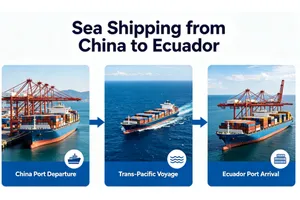
For larger shipments where sea freight makes more economic sense, read our guide on Sea Shipping from China to Ecuador for FCL and LCL options. If you need container pricing, see our breakdown of the Cost of Shipping a Container from China to Ecuador for current 20ft and 40ft rates.
How do I get an air freight quote from China to Ecuador?
To receive an accurate, itemized quote rather than a generic estimate, provide your freight forwarder with the following: cargo type and HS code (if known), total actual weight, packaging dimensions (length × width × height per box), pickup city in China, and final delivery address in Ecuador. With this information, a professional forwarder like DTFU Logistics can return a transparent, line-by-line quotation — typically within 24 hours.