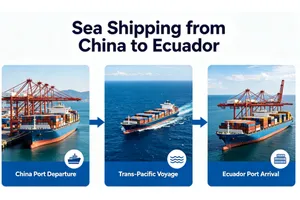
If you are importing goods from China to Ecuador, you have probably already discovered that getting a straight answer on door to door shipping from China to Ecuador is harder than it should be. One freight forwarder quotes you a port-to-port rate that looks cheap until you realize it covers nothing beyond the Guayaquil terminal. Another gives you a DDP price but can't explain how Ecuador's IVA or FODINFA taxes factor into the number. A third simply never responds after the first WhatsApp message.
This guide cuts through that noise. Drawing on 12 years of hands-on experience shipping container loads and LCL consignments from Shenzhen, Shanghai, Ningbo, Guangzhou, and Qingdao to Ecuador, we will walk you through exactly what door-to-door shipping costs in 2026, how Ecuador's customs system actually works once your container hits Puerto de Guayaquil, and the one thing most importers overlook until SENAE flags their shipment for physical inspection. Whether you are a Quito-based e-commerce seller restocking from Yiwu, or an industrial importer in Cuenca bringing in machinery from Shanghai, the numbers and processes below are what you will actually encounter.
DDP, CIF, or FOB? Choosing the Right Incoterm for Ecuador
Before discussing costs, you need to understand which trade term puts you in control — and which one leaves you holding surprise bills at the Ecuadorian border.
Incoterms dictate who pays for what across the entire shipping chain. Here is how the five most relevant terms play out when you are importing to Ecuador:
| Term | China Export | Ocean Freight | Insurance | SENAE Clearance | Import Duties & IVA | Last-Mile Delivery | Best For |
|---|---|---|---|---|---|---|---|
| EXW | ❌ Buyer | ❌ Buyer | ❌ Buyer | ❌ Buyer | ❌ Buyer | ❌ Buyer | Large companies with full-time logistics teams |
| FOB | ✅ Seller | ❌ Buyer | ❌ Buyer | ❌ Buyer | ❌ Buyer | ❌ Buyer | Importers with an established Ecuador customs broker |
| CIF | ✅ Seller | ✅ Seller | ✅ Seller | ❌ Buyer | ❌ Buyer | ❌ Buyer | Buyers who want the ocean leg handled but can manage Ecuador clearance themselves |
| DDP | ✅ Seller | ✅ Seller | ✅ Seller | ✅ Seller | ✅ Seller | ✅ Seller | Small-to-medium importers, e-commerce sellers, first-time shippers |
For most importers in Ecuador, DDP (Delivered Duty Paid) is the practical choice — and this is not marketing fluff. Here is why.
If you import under FOB or CIF, you are responsible for clearing the goods through SENAE (Servicio Nacional de Aduana del Ecuador) yourself. That means you need a registered RUC (tax identification number), an active account on the ECUAPASS online customs portal, and a local Agente Aduanal (customs broker) to file the DAI (Declaración Aduanera de Importación) on your behalf. If your paperwork is off — even a small discrepancy between the Chinese commercial invoice and the packing list — your container can sit at the Port of Guayaquil racking up demurrage fees of $50 to $150 per day while you sort it out.
With DDP, the freight forwarder absorbs that entire risk. One supplier, one point of contact, one all-in price. For an SME importing two or three containers a year, the premium for DDP over CIF is modest compared to the cost of a single customs delay.
That said, if you already have a trusted Agente Aduanal in Ecuador and prefer to pay duties directly through your own RUC, CIF + local broker can give you marginally lower landed costs. The right choice depends on your volume, your in-house logistics capability, and your tolerance for customs risk.
Shipping Methods: Sea, Air & Express Compared
Sea Freight Door to Door
Sea freight handles roughly 90% of all Chinese imports arriving in Ecuador, and for good reason: nothing else comes close on cost per kilogram for shipments over one cubic meter.
Your choice within sea freight is between FCL (Full Container Load) and LCL (Less than Container Load):
- FCL means you book an entire 20ft or 40ft container. Your goods are the only cargo inside. Transit from major Chinese ports to Puerto de Guayaquil runs 34 to 45 days depending on the origin port. FCL makes sense once your shipment exceeds roughly 15 CBM — below that, you are paying for empty space.
- LCL means your cargo shares a container with other importers' goods. You pay per cubic meter rather than per container. The trade-off is time: LCL adds about 5 to 7 extra days for consolidation at the Chinese warehouse and deconsolidation at the Guayaquil CFS (Container Freight Station).
Ecuador has three seaports that receive containerized cargo from China:
| Port | Role | Notes |
|---|---|---|
| Puerto de Guayaquil | Primary gateway | Handles ~90% of Ecuador's maritime imports; best inland connections to Quito, Cuenca, and the Sierra |
| Puerto de Posorja | Deep-water alternative | Newer facility 30 km from Guayaquil; less congestion, deeper draft for larger vessels |
| Puerto Bolívar | Southern gateway | Serves El Oro province and cross-border trade with northern Peru |
The overwhelming majority of LCL and FCL consignments from China discharge at Guayaquil. Posorja is worth considering for full-container shipments during peak season, when Guayaquil terminal congestion can add 2 to 4 days to your clearance timeline.
Sea freight transit times by Chinese origin port to Guayaquil:
| Origin Port | FCL Transit | LCL Transit (incl. consolidation) |
|---|---|---|
| Shenzhen (Yantian/Shekou) | 34–39 days | 40–46 days |
| Guangzhou (Nansha) | 34–39 days | 40–46 days |
| Shanghai (Yangshan) | 35–40 days | 42–47 days |
| Ningbo-Zhoushan | 36–41 days | 43–48 days |
| Qingdao | 38–45 days | 45–52 days |
Air Freight Door to Door
When timelines are tight, air freight compresses the China-to-Ecuador transit to roughly a week. Most air cargo lands at Mariscal Sucre International Airport (UIO) in Quito, with a smaller volume arriving at José Joaquín de Olmedo International Airport (GYE) in Guayaquil.
Air freight pricing uses chargeable weight — the higher of actual weight and volumetric weight (length × width × height in cm ÷ 6,000). This means a shipment of foam cushions can cost more than a shipment of steel bolts at the same actual weight. Optimize your packaging accordingly.
One nuance specific to Ecuador: most commercial air freight from China routes through a transit hub in the United States (Miami) or Europe (Amsterdam/Madrid). Direct China-to-Ecuador cargo flights are limited, so "5-day air freight" often means 3 days in transit plus 2 days for the connection. Express carriers like DHL, FedEx, and UPS offer the fastest door-to-door times — typically 3 to 5 business days — but at a meaningful price premium.
Method Comparison at a Glance
| Sea DDP | Air DDP | Express (DHL/FedEx/UPS) | |
|---|---|---|---|
| Door-to-Door Time | 35–52 days | 7–17 days | 3–7 days |
| Cost (per kg equivalent) | $1.50–$3.50 | $4–$9 | $9–$18 |
| Minimum Practical Shipment | 1 CBM / 200 kg | 45 kg | 1 kg |
| Best For | Bulk goods, furniture, machinery, large orders | High-value electronics, urgent restocking, seasonal goods | Samples, documents, small e-commerce parcels |
What Door to Door Shipping from China to Ecuador Actually Costs
This is the section where most compe***** articles give you a single number and move on. Real pricing is more nuanced — your cost depends on which Chinese port your goods leave from, whether you ship FCL or LCL, and which Incoterm you choose.
Sea Freight DDP Costs (All-Inclusive)
The figures below represent DDP pricing from major Chinese ports to Guayaquil, including factory pickup within 100 km of the port, China export customs clearance, ocean freight, SENAE import clearance, all Ecuadorian import duties and taxes (calculated at standard MFN rates — FTA savings are additional), and final truck delivery to Quito, Guayaquil, or Cuenca.
| Origin Port | 20ft FCL DDP | 40ft FCL DDP | LCL DDP (per CBM) |
|---|---|---|---|
| Shanghai | $2,500–$3,500 | $3,200–$4,500 | $80–$150 |
| Shenzhen | $2,800–$3,800 | $3,500–$4,800 | $80–$150 |
| Ningbo | $2,500–$3,500 | $3,200–$4,500 | $80–$150 |
| Guangzhou | $2,800–$3,800 | $3,500–$4,800 | $80–$150 |
| Qingdao | $3,000–$4,200 | $3,800–$5,200 | $90–$160 |
Ranges exist because two shipments of the same container size can carry vastly different duty exposure. A 20ft container of LED lighting (HS heading 9405, MFN duty ~10%) carries a different tax burden than a 20ft container of ceramic tiles (HS heading 6907, MFN duty ~20%). When you request a DDP quote from a serious freight forwarder, they should ask for your HS Code before giving you a number — if they do not, the price they quote probably will not hold.
Air Freight DDP Costs
| Weight Bracket | DDP Rate (USD/kg) | Typical Door-to-Door Time |
|---|---|---|
| 45–100 kg | $6–$9 | 10–17 days |
| 100–300 kg | $5–$8 | 8–14 days |
| 300–500 kg | $4–$7 | 8–12 days |
| 500+ kg | $3–$6 | 7–12 days |
Ecuador Import Duties & Taxes: A Real Calculation
Every importer to Ecuador pays three charges on the CIF value of their shipment:
- Arancel (Import Duty): The ad valorem rate depends on your product's HS Code. Ecuador's simple average MFN tariff is 11.2%, with agricultural products averaging 17.4% and non-agricultural goods averaging 10.2%.
- FODINFA: 0.5% of the CIF value, earmarked for Ecuador's children's development fund.
- IVA (Value-Added Tax): 12%, applied to (CIF value + Arancel + FODINFA).
Here is how this plays out in practice. Suppose you import a shipment of LED luminaires from a manufacturer in Zhongshan, Guangdong, classified under HS 9405.40, with a CIF value of $10,000:
| Charge | Calculation | Amount |
|---|---|---|
| CIF Value | – | $10,000 |
| Arancel (10% MFN) | $10,000 × 10% | $1,000 |
| FODINFA (0.5%) | $10,000 × 0.5% | $50 |
| IVA (12%) | ($10,000 + $1,000 + $50) × 12% | $1,326 |
| Total Import Charges | $2,376 |
Now apply the China-Ecuador Free Trade Agreement, which entered into force on May 1, 2024. LED luminaires (HS 9405) are among the approximately 60% of tariff lines that received immediate duty elimination. With the FTA:
| Charge | Calculation | Amount |
|---|---|---|
| CIF Value | – | $10,000 |
| Arancel (FTA rate: 0%) | $10,000 × 0% | $0 |
| FODINFA (0.5%) | $10,000 × 0.5% | $50 |
| IVA (12%) | ($10,000 + $0 + $50) × 12% | $1,206 |
| Total Import Charges | $1,256 |
That is $1,120 saved on a single $10,000 shipment — provided you have a Certificate of Origin issued by the China Council for the Promotion of International Trade (CCPIT) and present it during SENAE clearance. Without that document, the FTA benefit simply does not apply, and your goods are assessed at the standard MFN rate.
What Moves the Price Up or Down
Beyond the base rates, four factors swing your final DDP cost:
- Seasonality. Chinese New Year (January/February) and the pre-Christmas peak (September–November) drive container rates up 30–60%. If your shipment is not time-sensitive, book for March–May or August–early September.
- Fuel surcharges (BAF). Carriers adjust bunker surcharges quarterly. When crude oil spikes, your ocean freight line item rises.
- Remote destination delivery. DDP rates quoted above assume delivery to Quito, Guayaquil, or Cuenca. If your final address is in a smaller town in the Oriente or a highland community with limited truck access, expect an additional $100–$300 in last-mile charges.
- Documentation errors. A single mismatch between the Chinese export declaration and the Ecuadorian DAI can trigger a physical inspection (red channel), adding 2–5 days of storage and inspection fees. We cover how to avoid this in the customs section below.
The Step-by-Step Door to Door Process
Here is what actually happens to your shipment, stage by stage, from the moment you place an order with your Chinese supplier to the day the truck pulls up at your warehouse in Ecuador.
Step 1: Quote & Booking (1–2 Days)
Send your freight forwarder three pieces of information: the product description with the 6-digit HS Code, the total cubic volume or container count, and the pickup city in China plus the final delivery address in Ecuador. A competent forwarder replies within 24 hours with a line-by-line DDP quote that breaks out ocean freight, Chinese export charges, Ecuador customs brokerage, estimated duties and taxes, and last-mile trucking. If the quote is a single lump-sum number with no breakdown, ask for the detail — opaque pricing is a red flag.
Step 2: Factory Pickup & Consolidation (2–7 Days)
The forwarder dispatches a truck to your supplier's factory or warehouse. If you are buying from multiple suppliers — say, electronics from Shenzhen, packaging from Dongguan, and textiles from Yiwu — the goods are collected and brought to a consolidation warehouse (typically in Guangzhou or Shenzhen). There, the forwarder's warehouse team verifies carton counts, inspects for visible damage, and checks that the outer carton markings match the packing list.
One practical point from experience: if your supplier uses wooden pallets or crates, those must be heat-treated and stamped with the ISPM 15 mark. Ecuadorian customs inspects wood packaging materials for pests, and unstamped pallets will delay your clearance.
Step 3: China Export Customs Clearance (1–2 Days)
The forwarder files an electronic export declaration with China Customs. The system runs through a risk assessment and assigns the shipment one of two channels: release (the vast majority) or examination (a physical inspection of the cargo). For standard commercial goods — electronics, furniture, machinery, textiles, auto parts — this step is routine and takes one working day. Goods requiring export licenses (certain chemicals, dual-use electronics, strategic materials) take longer and should be flagged during the quoting phase.
A critical but often overlooked step: the information on the Chinese export declaration — HS Code, declared value, consignee name, cargo description — must match exactly what will appear on the Ecuadorian DAI. Discrepancies between the two countries' filings are the single most common trigger for a red-channel inspection at SENAE.
Step 4: Ocean or Air Transit (3–40 Days)
Your container is loaded at the port — Yantian, Nansha, Yangshan, or whichever origin you are using — and begins the Pacific crossing. Most China-to-Ecuador services route directly across the Pacific with a possible transshipment at a regional hub like Balboa (Panama) or Callao (Peru) before the final leg to Guayaquil. At this stage, your forwarder should provide a container number or Master Bill of Lading (MBL) number that you can track online. DTFU provides a client-facing tracking portal that updates at each milestone: vessel departure, transshipment port arrival, Guayaquil berthing, and customs release.
Step 5: Ecuador Customs Clearance — How SENAE Actually Works (1–3 Days)
This is the part of the process that separates a smooth import experience from a costly one. When your container arrives at Guayaquil (or your air cargo lands at UIO), the Ecuadorian customs clearance sequence begins.
First, the system. Ecuador uses ECUAPASS, an online platform operated by SENAE. Every import transaction flows through it. Your freight forwarder's local customs broker — the Agente Aduanal — logs into ECUAPASS using their digital signature and files the DAI (Declaración Aduanera de Importación). The DAI is the master document that declares the goods' HS Code classification, CIF value, origin, weight, and the applicable duty and tax calculations.
Then, the channel. ECUAPASS runs a risk algorithm and assigns your shipment one of three inspection channels:
| Channel | Spanish Name | What Happens | Typical Duration |
|---|---|---|---|
| 🟢 Green | Aforo Automático | Automatic release — no document review, no physical check | Same day |
| 🟠 Orange | Aforo Documental | Documents are reviewed by a SENAE officer; cargo is not physically inspected | 1–2 days |
| 🔴 Red | Aforo Físico | Full physical inspection — SENAE officers open and examine the cargo | 2–5 days |
Channel assignment is not random. SENAE's algorithm weighs factors including the HS Code, the declared value versus reference pricing databases, the importer's compliance history, and the country of origin. A shipment of generic T-shirts declared at $0.50 per unit from a first-time importer is far more likely to hit red than a shipment of industrial pumps from a company with a clean compliance record.
Once the assigned check is completed and any duties, IVA, and FODINFA are paid (electronically through ECUAPASS), the system issues the departure authorization, and your goods are released.
Files your Agente Aduanal needs to submit through ECUAPASS:
| Document | Notes |
|---|---|
| RUC (Registro Único de Contribuyentes) | Your Ecuadorian tax ID — required for any importer of record |
| DAI (Declaración Aduanera de Importación) | The core import declaration; digitally signed by the Agente Aduanal |
| Commercial Invoice | Must be in Spanish and match the Chinese export invoice exactly |
| Packing List | Itemized carton-level detail |
| Bill of Lading (B/L) or Airway Bill (AWB) | Transport document |
| Certificate of Origin | Required to claim FTA preferential duty rates |
| INEN Certificate | Required for regulated products (electronics, textiles, footwear, toys, food-contact materials) |
Step 6: Last-Mile Delivery (1–3 Days)
Once SENAE releases the goods, the forwarder arranges a truck — either the same container on a chassis for FCL, or a smaller distribution truck for deconsolidated LCL — to deliver to your specified address. Delivery to Quito, Guayaquil, and Cuenca is typically next-day after customs release. More remote locations in the Amazonía or highland regions may take an additional day or two.
End-to-End Timeline Summary:
| Stage | Sea DDP | Air DDP |
|---|---|---|
| Quote & Booking | 1–2 days | 1–2 days |
| Pickup & China Export | 3–7 days | 2–5 days |
| International Transit | 28–40 days | 2–5 days |
| SENAE Clearance | 1–3 days | 1–3 days |
| Last-Mile Delivery | 1–2 days | 1–2 days |
| Total Door-to-Door | 35–52 days | 7–17 days |
Ecuador Customs Compliance: INEN, Labeling & What Gets Your Shipment Held Up
Beyond the SENAE clearance process, Ecuador enforces product-specific regulations that catch many first-time importers off guard. The Instituto Ecuatoriano de Normalización (INEN) sets mandatory technical standards for a wide range of consumer and industrial products.
Products Requiring INEN Certification
| Product Category | INEN Standard | What You Need |
|---|---|---|
| Electronics & Electrical Appliances | RTE INEN 013, 073 | Safety and energy efficiency testing; compliance certificate before shipment |
| Textiles & Apparel | RTE INEN 013 (labeling) | Fiber composition label, care instructions, country of origin — all in Spanish |
| Footwear | RTE INEN 080 | Material composition labeling; specific requirements for leather, synthetic, and textile footwear |
| Toys | RTE INEN 089 | Physical/mechanical safety, flammability, heavy metals testing |
| Food Contact Materials | RTE INEN various | Migration testing for plastics, ceramics, and metals that contact food |
| Ceramic Tiles | NTE INEN 644, 654, 655 | Dimensional tolerances, water absorption, breaking strength |
Labeling: The Single Most Common Reason for Rejection
Ecuadorian law requires that every product label be in Spanish and include the following information:
- Company name or importer of record
- RUC number
- Physical address and phone number in Ecuador
- Country of origin (e.g., "Hecho en China")
- Unit of measure (net weight, volume, or count)
- Net content
- Sanitary registration number (for food, cosmetics, and medical products — issued by ARCSA)
A shipment of kitchenware from Yiwu with only Chinese and English labeling will not clear. The Agente Aduanal cannot fix labeling at the port — the goods either need to be relabeled at a bonded warehouse (expensive and slow) or re-exported. Arrange Spanish-language labeling with your supplier before the goods leave China.
Restricted & Prohibited Categories
- Prohibited outright: Firearms and ammunition (without military/police authorization), hazardous waste, counterfeit branded goods, used tires, used clothing (some exceptions)
- Require import permits: Pharmaceuticals and medical devices (ARCSA registration), cosmetics and personal care products (ARCSA notification), food and beverages (AGROCALIDAD sanitary permit), live animals and plants (AGROCALIDAD phytosanitary certificate)
The China-Ecuador FTA: What It Means for Your Bottom Line
The China-Ecuador Free Trade Agreement entered into force on May 1, 2024, and it is the single most impactful regulatory change for Ecuadorian importers in over a decade. Coverage is broad:
- ~60% of tariff lines received immediate duty elimination on day one.
- ~90% of tariff lines will reach zero duty over a 5-to-20-year phase-out schedule.
- The remaining ~10% (mostly sensitive agricultural products) are excluded or subject to long phase-out periods.
Who Benefits Most
Products where Ecuador had relatively high MFN tariffs and China is a dominant supplier are the biggest winners:
| Product | HS Heading | Pre-FTA Duty | Post-FTA Status |
|---|---|---|---|
| LED Lighting | 9405 | 10% | 0% (immediate) |
| Smartphones | 8517 | 15% | 0% (immediate) |
| Electric Motors | 8501 | 5–10% | 0% (immediate) |
| Furniture (wooden) | 9403 | 20% | Phased to 0% over 5 years |
| Auto Parts | 8708 | 5–15% | Phased to 0% over 5–10 years |
| Plastic Articles | 3926 | 15–20% | Phased to 0% over 5–10 years |
| Textiles & Garments | 61–63 | 25–30% | Phased reduction over 10–15 years |
To illustrate the impact: a furniture importer bringing in a 40ft container of wooden bedroom sets (HS 9403.50) with a CIF value of $25,000 paid roughly $5,000 in duty alone before the FTA. Under the phase-out schedule, that line item shrinks every year, and the saving flows directly to gross margin.
How to Actually Use the FTA
Three steps, none of which happen automatically:
- Verify your HS Code is covered. Your freight forwarder should check the specific 8-to-10-digit Ecuadorian tariff subheading against the FTA's schedule. (Six-digit headings are not precise enough — the phase-out differentiates at the subheading level.)
- Obtain a Certificate of Origin. This is issued by CCPIT (China Council for the Promotion of International Trade) or the local CIQ (China Inspection and Quarantine) office. The certificate must list the correct HS Codes, describe the goods, and confirm they meet the FTA's rules of origin (typically that the goods are wholly obtained or substantially transformed in China).
- Present the Certificate during SENAE clearance. The Agente Aduanal uploads it to ECUAPASS along with the DAI. SENAE cross-references the certificate against the FTA database and applies the preferential rate.
One thing to watch: if your supplier in China is a trading company rather than the actual manufacturer, the Certificate of Origin still needs to reflect the factory's origin. A CCPIT-issued certificate based on the trading company's own declaration, without factory verification, can be rejected by SENAE. Work with a freight forwarder that knows how to navigate this — it is a paperwork nuance that has tripped up plenty of importers.
Which Chinese Port Should You Ship From?
Your supplier's location dictates the optimal departure port. Choosing the closest port reduces inland trucking costs in China, which can run $200–$500 depending on distance:
| Chinese Port | Key Industrial Hinterland | Best For Sourcing | Transit to Guayaquil |
|---|---|---|---|
| Shenzhen (Yantian/Shekou) | Pearl River Delta — electronics, furniture, toys, lighting, hardware | Dongguan, Shenzhen, Huizhou, Foshan factories | 34–39 days |
| Guangzhou (Nansha) | Same as Shenzhen, plus ceramics and building materials from Foshan | Suppliers in Guangzhou, Foshan, Zhongshan, Jiangmen | 34–39 days |
| Shanghai (Yangshan) | Yangtze River Delta — machinery, chemicals, automotive, high-end textiles | Jiangsu, Zhejiang, Shanghai, Anhui suppliers | 35–40 days |
| Ningbo-Zhoushan | Commodities and light industrial goods — hardware, home goods, small appliances | Yiwu market (the world's largest small-commodity wholesale hub) is closest to Ningbo | 36–41 days |
| Qingdao | Shandong Peninsula — tires, agricultural machinery, steel products, processed food | Shandong, Hebei, Tianjin, northern Jiangsu suppliers | 38–45 days |
If your supply chain spans multiple regions — say, electronics from Shenzhen and packaging from Yiwu — a freight forwarder with consolidation capability can collect from both, consolidate at a single warehouse (typically in Guangzhou or Ningbo depending on volumes), and load one container instead of two partial shipments. This saves on both ocean freight and customs brokerage fees.
Remember the memory from the field: do not assume Shenzhen is always the answer. If your primary supplier is in Qingdao, trucking goods 2,000 km south to Shenzhen costs more than the marginal difference in ocean freight between Qingdao and Shenzhen departure. Ship from the port closest to your factory, not the port your freight forwarder happens to be based in.
Choosing a Freight Forwarder & Keeping Costs Under Control
What Separates a Good Freight Forwarder for Ecuador from the Rest
Ship a container to the United States or Europe, and the process is standardized. Ship to Ecuador, and local expertise matters far more — SENAE's specific documentation requirements, INEN's product-level regulations, and the practical reality of working with Ecuadorian Agentes Aduanales are not interchangeable with general "Latin America" logistics experience.
When evaluating a freight forwarder for China-to-Ecuador door-to-door service, ask these eight questions:
- How many years has your team been shipping specifically to Ecuador? General China-to-South-America experience is not the same as Ecuador-specific experience.
- What industry certifications do you hold? Look for FIATA (International Federation of Freight Forwarders Associations) and IATA (International Air Transport Association) credentials. These are not marketing badges — they indicate an audited, compliant operation.
- Do you have your own Agente Aduanal in Ecuador, or do you subcontract clearance? Direct relationships with in-country customs brokers mean faster resolution when issues arise.
- Can you provide a transparent cost breakdown? A proper DDP quote should separate ocean freight, Chinese origin charges, Ecuador customs brokerage, estimated duties and taxes, and last-mile delivery.
- Which Chinese ports do you operate from? If your supplier is in Ningbo and your forwarder only ships from Shenzhen, you are paying unnecessary inland trucking.
- Do you offer a real-time tracking platform? Container visibility is non-negotiable in 2026. If you are still getting updates via sporadic WeChat messages, upgrade your forwarder.
- What is your customer support model? A dedicated account manager who knows your shipment history beats a rotating pool of anonymous customer service reps.
- Do you provide cargo insurance options? Standard carrier liability covers pennies on the dollar. Proper all-risk cargo insurance is cheap — typically 0.2% to 0.5% of the cargo value — and replaces your goods at full value if something goes wrong on the Pacific.
Practical Ways to Cut Your Door-to-Door Costs
Consolidate, do not fragment. If you are buying from three suppliers in Guangdong, have the forwarder collect all three shipments and load them into one LCL consignment or one FCL container. Three separate small LCL shipments to Ecuador cost significantly more than one consolidated shipment, because you pay the minimum-CBM charge and the fixed customs brokerage fee three times instead of once.
Book around the peak, not into it. The worst times to ship: the three weeks before Chinese New Year (factories rush, carriers overbook, rates double), the October-to-November pre-Christmas window, and the two weeks around Golden Week (first week of October). If you can load your container in March or August, you will get better rates and more reliable space.
Get your HS Codes right the first time. A misclassified HS Code does not just mean overpaying duty — it can mean reclassification by SENAE, triggering a red-channel inspection, storage fees at the Guayaquil terminal, and penalty charges. Pay a freight forwarder who asks for your HS Code upfront and verifies it, not one who glosses over classification.
Use the FTA. If your product is on the immediate-elimination list, you should be paying zero duty. If it is on a phase-out schedule, you should know the current year's rate. A Certificate of Origin costs roughly $30–$60 to obtain and can save thousands. There is no reason to skip it.
FAQs
How long does door to door shipping from China to Ecuador take?
Sea freight door-to-door takes 35 to 52 days from factory pickup to delivery at your Ecuador address. Air freight door-to-door takes 7 to 17 days. Express courier (DHL, FedEx, UPS) takes 3 to 7 days for small parcels.
How much does door to door shipping from China to Ecuador cost?
LCL sea freight DDP costs $80–$150 per cubic meter. A 20ft FCL DDP costs $2,500–$4,200 depending on the origin port. Air freight DDP costs $3–$9 per kilogram depending on weight.
What is the cheapest way to ship from China to Ecuador door to door?
LCL sea freight is the cheapest door-to-door option for shipments between 1 and 15 CBM, at roughly $80–$150 per CBM all-inclusive under DDP terms. For shipments over 15 CBM, FCL delivers lower per-unit costs.
Do I need a customs broker in Ecuador for door to door shipping?
Under DDP terms, no — your freight forwarder handles all interaction with SENAE through their own Agente Aduanal. If you ship under CIF or FOB, you must either engage your own Ecuadorian customs broker or be prepared to navigate the ECUAPASS system yourself with a registered RUC.