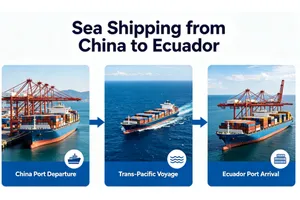
If you're sourcing goods from China and need to get them to Ecuador, you've probably already discovered that cost of shipping a container from China to Ecuador can vary wildly — anywhere from $800 to over $5,500 for ocean freight alone, depending on the port, season, and carrier. What most first-time importers don't realize is that the ocean freight base rate is just one piece of the puzzle. Surcharges, customs duties, Ecuador's 12% IVA, documentation fees, and inland delivery can easily add thousands more to your total landed cost — and no single resource online currently breaks down the complete picture.
This guide is built to change that. Drawing on over a decade of hands-on freight forwarding experience on the China–South America trade lane, we'll walk you through transparent, up-to-date pricing for 20ft, 40ft, and 40HQ containers from all five major Chinese departure ports; a line-by-line breakdown of every surcharge and fee you should budget for; a deep dive into the China-Ecuador Free Trade Agreement (effective May 2024) and how it can slash your import duties to zero; and four real-world landed cost scenarios that show you exactly what to expect. Whether you're a B2B importer, an e-commerce seller, or a small business bringing in your first container, this guide will help you budget accurately and avoid costly surprises.
Container Shipping Costs from China to Ecuador: 20ft, 40ft & 40HQ Rates
Before we dive into the details, here's the master pricing table for port-to-port ocean freight from China to Ecuador as of mid-2026. For a broader overview of the entire shipping process — including customs, documentation, and door-to-door options — see our dedicated guide on Sea Shipping from China to Ecuador. These figures below represent the base ocean freight only — we'll cover every additional cost in the next section.
| Container Type | Capacity | Weight Limit | Low Season (USD) | Peak Season (USD) | Typical All-In Range* |
|---|---|---|---|---|---|
| 20ft GP | 33 CBM | ~28,000 kg | $800 – $1,800 | $1,800 – $4,000 | $3,000 – $5,500 |
| 40ft GP | 67 CBM | ~26,500 kg | $1,500 – $3,000 | $3,000 – $5,500 | $4,500 – $8,000 |
| 40ft High Cube (HQ) | 76 CBM | ~26,500 kg | $1,800 – $3,500 | $3,500 – $5,500 | $5,000 – $9,000 |
Typical all-in range includes ocean freight + standard surcharges + documentation fees + customs clearance + duties (at standard rates) + inland delivery to major cities. Excludes FTA duty savings.
Why the wide ranges? Ocean freight rates are dynamic — they fluctuate based on:
- Seasonality: Rates spike 30–60% during peak shipping windows (August–October for Christmas inventory, January–February around Chinese New Year, and October–November before Black Friday).
- Spot vs. contract rates: If you ship regularly, annual contract rates with a carrier typically run 20–40% below spot market rates. One-off shipments pay the prevailing spot rate, which can swing dramatically month to month.
- Carrier and alliance: Different shipping lines (Maersk, MSC, CMA CGM, COSCO, Hapag-Lloyd) price the same route differently depending on their capacity and network.
For smaller shipments that don't fill a full container, LCL (Less than Container Load) costs $60–$150 per cubic meter (CBM), with transit times of 35–50 days. LCL is ideal for shipments under 12–15 CBM — beyond that, a 20ft container is usually cheaper per unit. We'll break down the FCL vs. LCL math in Section 4.
For importers who want an all-inclusive, hands-off experience, DDP (Delivered Duty Paid) sea freight runs $80–$150 per CBM (40–50 days) and DDP air freight runs $5–$9 per kg (7–12 days) — covering everything from Chinese factory pickup to your Ecuador doorstep, including all customs clearance, duties, and taxes.
What Makes Up the Total Cost? Surcharges, Fees & Hidden Costs Explained
A $2,500 ocean freight quote does not mean you'll pay $2,500. Here's what actually ends up on your final invoice — and roughly what each line item costs.
Ocean Freight Base Rate
The "headline" number you see on rate sheets. This covers the movement of your container from a Chinese port to an Ecuadorian port. On the China–Ecuador route, the base rate typically accounts for 45–55% of your total port-to-port spend.
Mandatory Surcharges
These are non-negotiable fees applied by the carrier on top of the base rate:
| Surcharge | Full Name | Typical Cost (per container) | What It Covers |
|---|---|---|---|
| BAF | Bunker Adjustment Factor | $200 – $600 | Fuel cost fluctuation — adjusted quarterly based on global bunker prices |
| CAF | Currency Adjustment Factor | 2–8% of base freight | Exchange rate risk between USD and CNY |
| PSS | Peak Season Surcharge | $200 – $800 | Applied during high-demand periods (Aug–Nov, Jan–Feb) |
| THC (Origin) | Terminal Handling Charge | $150 – $300 | Container handling at the Chinese departure port |
| THC (Destination) | Terminal Handling Charge | $150 – $350 | Container handling at the Ecuador arrival port |
| HWS | Heavy Load Surcharge | $200+ | Applied by Maersk (effective April 2026) for 20ft containers exceeding 20 metric tons |
Pro tip: The HWS is new and often overlooked. If you're shipping dense goods — like metal parts, machinery, or tiles — in a 20ft container, you'll likely trigger this surcharge. Always declare accurate cargo weight upfront.
Documentation & Export Fees
| Fee | Typical Cost (USD) |
|---|---|
| Bill of Lading (B/L) issuance | $50 – $100 |
| Export customs declaration | $80 – $150 |
| Certificate of Origin (FORM R) — for FTA benefits | $30 – $60 |
| Fumigation certificate (if wooden packaging used) | $50 – $150 |
Destination-Side Charges
When your container arrives at Guayaquil, Manta, or Posorja, you'll encounter another set of fees:
| Fee | Typical Cost (USD) |
|---|---|
| Port maintenance fee | $50 – $120 |
| Customs broker fee | $150 – $400 |
| SENAE inspection fee | $80 – $250 (if inspected) |
| Container detention (per day, after free period) | $50 – $150/day |
| Inland trucking (port → Guayaquil warehouse) | $200 – $400 |
| Inland trucking (port → Quito) | $500 – $900 |
Cargo Insurance
Cargo insurance typically costs 0.3%–0.5% of the declared cargo value. For a $30,000 container load, that's $90–$150 — a small price for peace of mind. Insurance covers physical loss or damage during transit, including rough handling, container collapse, theft, and severe weather. On the Pacific crossing to South America, where vessels encounter open-ocean conditions year-round, we strongly recommend it. For a detailed breakdown of coverage options, exclusions, and how premiums are calculated, see our full guide on Shipping container insurance cost for shipments from China.
FCL vs LCL: 20ft, 40ft, 40HQ — Choosing the Right Container Size
Choosing the wrong container size can cost you thousands. Here's how to pick correctly.
Container Specifications
| Spec | 20ft GP | 40ft GP | 40ft High Cube |
|---|---|---|---|
| Internal volume | 33 CBM | 67 CBM | 76 CBM |
| Max payload | ~28,000 kg | ~26,500 kg | ~26,500 kg |
| Best for | Dense, heavy cargo | Balanced volume/weight | Voluminous, light cargo |
| Typical goods | Machinery, metals, tiles, auto parts | Mixed consumer goods, electronics | Furniture, textiles, plastic products, packaging |
Cost per CBM: Why the 40ft Container Is Almost Always Better Value
Looking at the per-unit cost reveals a consistent pattern:
| Container | Low-Season Freight | Cost per CBM | High-Season Freight | Cost per CBM |
|---|---|---|---|---|
| 20ft (33 CBM) | $1,500 | $45.45 | $3,000 | $90.91 |
| 40ft (67 CBM) | $2,500 | $37.31 | $4,500 | $67.16 |
| 40HQ (76 CBM) | $2,800 | $36.84 | $5,000 | $65.79 |
The takeaway: A 40ft container gives you twice the space of a 20ft for roughly 60–70% more cost. If your cargo volume exceeds 20 CBM and your weight stays under 26,500 kg, a 40ft container is the smarter choice. For voluminous but lightweight goods — think furniture, textiles, or plastic products — a 40ft High Cube adds an extra 9 CBM of capacity for only a modest premium. Learn more in our complete guide to High cube shipping container cost from China.
The FCL vs. LCL Break-Even Point
Here's the math that helps you decide when to switch from shared (LCL) to dedicated (FCL) container space:
- LCL at $100/CBM: 15 CBM × $100 = $1,500
- 20ft FCL low-season: $1,500 (plus surcharges ≈ $2,200 all-in port-to-port)
At around 12–15 CBM, the all-in cost of LCL crosses over with a 20ft FCL shipment. Above 15 CBM, FCL is almost always cheaper per unit — and you get the added benefits of a sealed, exclusive container (faster clearance, lower damage risk, no consolidation/deconsolidation delays).
Special Container Considerations
For Ecuador-bound cargo that doesn't fit standard containers:
- Open Top containers (for over-height machinery): add 15–25% premium
- Flat Rack containers (for oversized equipment, vehicles): add 20–35% premium
- Reefer containers (temperature-controlled, for food/pharma): add 40–60% premium plus generator fees at the port
Shipping Costs & Transit Times from Major Chinese Ports to Ecuador
Not all Chinese ports are equal when it comes to Ecuador-bound container shipping. Your choice of departure port affects both cost and transit time.
Origin Port Comparison
| Origin Port | FCL 20ft (Low Season) | FCL 40ft/HQ (Low Season) | Transit to Guayaquil | Typical Transshipment Via | Best For |
|---|---|---|---|---|---|
| Shenzhen (Yantian/Shekou) | $1,000 – $2,000 | $1,800 – $3,500 | 28–39 days | Colón (Panama), Callao (Peru) | Guangdong & Fujian manufacturing |
| Shanghai | $1,100 – $2,200 | $2,000 – $3,800 | 28–40 days | Colón (Panama) | East China; highest sailing frequency |
| Ningbo | $800 – $1,800 | $1,500 – $3,000 | 25–41 days | Colón (Panama), Callao (Peru) | Cost-conscious shippers; often 10–15% cheaper than Shanghai |
| Guangzhou (Nansha) | $1,000 – $2,000 | $1,800 – $3,500 | 30–39 days | Colón (Panama) | Pearl River Delta cargo |
| Qingdao | $1,200 – $2,500 | $2,200 – $4,000 | 30–45 days | Busan (Korea) → Panama or Callao | Northern China (Shandong, Hebei, Beijing-Tianjin) |
Operational insight: In our experience managing regular container shipments on the China–Ecuador route, Ningbo consistently offers the most competitive base rates — often 10–15% below Shanghai for the same container type. However, your total cost must factor in factory location. A $300 savings on ocean freight from Ningbo means little if your factory in Shenzhen requires $500 in additional inland trucking.
Ecuador Destination Ports
| Port | Role | Container Infrastructure | Notes |
|---|---|---|---|
| Guayaquil (ECGYE) | Ecuador's primary container gateway | Excellent — handles ~80% of containerized imports | Most carrier options, fastest customs processing, best inland connectivity |
| Manta | Secondary port; growing deep-water capability | Good — expanding container capacity | Serves central Ecuador; typically +2–3 days transit vs Guayaquil; less congestion |
| Posorja (DP World) | Modern deep-sea terminal near Guayaquil | Excellent — newest infrastructure in Ecuador | Ideal for project cargo and large vessels; DP World-operated; increasingly important |
Transit Time Considerations
Direct sailings from China to Ecuador are rare — typically 1–2 per month on major carriers like Maersk or Hapag-Lloyd. Most containers transship through Colón (Panama), Callao (Peru), or Cartagena (Colombia), adding 3–7 days to the total journey. For importers sourcing goods for multiple Andean markets, DTFU also offers dedicated Shipping From China to Peru and Shipping from China to Colombia — allowing consolidated logistics across the region. During Ecuador's rainy season (December–April), coastal port operations can slow by 1–3 days due to flooding and road disruptions.
Ecuador Import Duties, Taxes & the China-Ecuador Free Trade Agreement
Understanding Ecuador's import tax structure is essential — duties and taxes can represent 15–35% of your total landed cost, or near zero if you leverage the FTA correctly.
How Import Duties Are Calculated
Ecuador's customs authority, SENAE (Servicio Nacional de Aduana del Ecuador), calculates your import tax bill as follows:
- CIF Value = Cost of goods + Insurance + Freight (the total value of your shipment arriving at the Ecuadorian port)
- Import Duty = CIF Value × Duty Rate (varies by HS code, typically 5%–30%)
- IVA (VAT) = 12% × (CIF Value + Import Duty)
- FODINFA = 0.5% × CIF Value (applies to certain goods)
Worked example — without FTA: A shipment of furniture (HS Chapter 94) with a CIF value of $25,000 and a 20% duty rate:
- Import Duty: $25,000 × 20% = $5,000
- IVA: 12% × ($25,000 + $5,000) = $3,600
- FODINFA: $25,000 × 0.5% = $125
- Total tax burden: $8,725 (34.9% of CIF value)
Common HS Codes & Duty Rates for China Imports
| Product Category | HS Chapter | Standard Duty Rate | FTA Rate (with FORM R) |
|---|---|---|---|
| Furniture (wooden/metal) | 94.03 | 20% | 0% |
| Electronics (phones, computers) | 85.17 | 0–10% | 0% |
| Machinery & mechanical appliances | 84.79 | 5–15% | 0% |
| Textiles & apparel | 61–62 | 20–30% | 0% (phased) |
| Auto parts | 87.08 | 5–15% | 0% |
| Solar panels | 85.41 | 0–5% | 0% |
| Building materials (ceramics, stone) | 68–69 | 10–20% | 0% |
| Toys & sporting goods | 95.03 | 15–20% | 0% |
The China-Ecuador Free Trade Agreement: Your Biggest Cost Lever
If you take away only one thing from this guide, make it this: The China-Ecuador Free Trade Agreement, which took effect on May 1, 2024, eliminates or drastically reduces import duties on the vast majority of goods shipped from China to Ecuador.
Here's how it works:
- Your supplier in China applies for a FORM R (Certificate of Origin) from China's customs authority (or CCPIT — China Council for the Promotion of International Trade).
- FORM R certifies that your goods meet the FTA's rules of origin (generally: goods must be wholly obtained or substantially transformed in China).
- When your shipment clears Ecuador customs, present FORM R alongside your standard documents — and qualifying goods receive 0% tariff treatment instead of the standard 5–30% duty.
The same furniture shipment, with FTA:
- Import Duty: $25,000 × 0% = $0 (saved $5,000)
- IVA: 12% × ($25,000 + $0) = $3,000
- FODINFA: $125
- Total tax burden: $3,125 (12.5% of CIF value) — saving $5,600
Common FORM R pitfalls to avoid:
- The HS code on FORM R must exactly match the HS code on your Commercial Invoice
- The declared value must be consistent across all documents
- FORM R must be obtained before the shipment departs China
- Some products (particularly textiles and footwear) have phased tariff elimination — verify your specific HS code's status
Import Restrictions
Ecuador prohibits or restricts certain imports. Key categories include: used clothing and footwear (prohibited), certain pesticides and chemicals, cultural artifacts, and agricultural products without a phytosanitary certificate from Ecuador's SENASA. Regulated products — such as pharmaceuticals (requires INEC authorization), electronics (requires ARCONET certification), and automotive parts (requires DTI certification) — must have pre-approval before import.
How Trade Terms Affect Your Total Landed Cost
The Incoterm you choose fundamentally determines who pays for what — and how much risk you carry. For Ecuador-bound container shipments, four terms dominate.
Incoterms at a Glance
| Incoterm | Who Pays Ocean Freight? | Who Pays Insurance? | Who Handles Ecuador Customs & Duties? | Best For |
|---|---|---|---|---|
| EXW (Ex Works) | You | You | You | Experienced importers with an established local broker — maximum control, maximum responsibility |
| FOB (Free on Board) | You | You | You | Most common for experienced B2B importers; supplier delivers to Chinese port, you control everything beyond |
| CIF (Cost, Insurance & Freight) | Supplier | Supplier (minimum cover) | You | Good middle ground — supplier handles international leg, you handle destination |
| DDP (Delivered Duty Paid) | Freight forwarder handles everything | Included | Included | Best for first-time importers and SMEs — one invoice, zero surprises |
Cost Comparison Under Different Incoterms
Let's look at the same shipment — a 40ft container of electronics (CIF value: $40,000) from Shanghai to Guayaquil — under each Incoterm:
| Cost Component | EXW | FOB | CIF | DDP (Sea) |
|---|---|---|---|---|
| Factory → Shanghai port trucking | $400 (you) | $400 (supplier) | $400 (supplier) | Included |
| China export clearance | $150 (you) | $150 (supplier) | $150 (supplier) | Included |
| Ocean freight (Shanghai → Guayaquil) | $3,000 (you) | $3,000 (you) | $3,000 (supplier) | Included |
| Insurance | $150 (you) | $150 (you) | $150 (supplier) | Included |
| Ecuador customs clearance + broker | $400 (you) | $400 (you) | $400 (you) | Included |
| Import duties & taxes* | $4,640 (you) | $4,640 (you) | $4,640 (you) | Included |
| Port → warehouse delivery | $350 (you) | $350 (you) | $350 (you) | Included |
| Total (your out-of-pocket) | $9,090 | $8,540 | $8,540 | $6,500–$8,000 (flat DDP quote) |
| Control level | Maximum | High | Medium | Minimal |
| Complexity | Very High | Moderate | Moderate | Very Low |
*Duty/tax calculated at 10% duty + 12% IVA without FTA. With FORM R (0% duty): $4,640 drops to $4,800 × 0% + 12% = ~$480 + $4,800 = $5,280. DDP quote would be lower with FTA.
When DDP Is the Right Choice
DDP shipping makes the most sense when:
- You're importing for the first time and don't have a local customs broker in Ecuador
- Your shipment is time-sensitive and you can't afford customs delays
- You want a predictable, all-in cost with no surprise bills
- You're shipping smaller volumes (LCL) where managing multiple cost components isn't worth the administrative overhead
For experienced importers shipping full containers regularly, FOB or CIF paired with an established customs broker in Guayaquil typically offers the best cost control — especially when combined with FTA tariff elimination. If you're unsure which trade term suits your situation, our detailed comparison DDP vs FOB: Which Option Saves Time and Reduces Hassle walks through the pros, cons, and cost implications of each approach.
FAQs
How much does it cost to ship a 20ft container from China to Ecuador?
A 20ft container costs $800–$4,000 for port-to-port ocean freight, depending on the origin port, season, and carrier. With all surcharges, documentation, customs clearance, duties, and inland delivery included, budget $3,000–$5,500 all-in. Using the China-Ecuador FTA can reduce this by $1,500–$5,000 in duty savings.
How much does it cost to ship a 40ft container from China to Ecuador?
A 40ft container costs $1,500–$5,500 for port-to-port ocean freight. The all-in landed cost (surcharges + duties + delivery) typically ranges from $4,500–$8,000, with significant savings available via the FTA. A 40ft High Cube (40HQ) costs roughly $300–$500 more than a standard 40ft.
How long does container shipping take from China to Ecuador?
Transit times range from 25–45 days port-to-port depending on the departure port and transshipment routing. Shenzhen and Shanghai tend to be fastest (28–39 days); Qingdao is slowest (30–45 days). Direct sailings exist but are rare — most containers transship through Colón (Panama), Callao (Peru), or Cartagena (Colombia), adding 3–7 days.
What is the cheapest way to ship a container from China to Ecuador?
The most cost-effective approach combines three strategies: (1) ship a 40ft container from Ningbo during off-peak season (March–May), (2) secure contract rates if you ship regularly, and (3) use FORM R under the China-Ecuador FTA to eliminate import duties on qualifying goods. Together, these can reduce your total landed cost by 30–50% compared to a peak-season spot-rate shipment without FTA.
Can I get door-to-door delivery from China to Ecuador?
Yes. DDP (Delivered Duty Paid) service covers the entire journey — factory pickup in China, export clearance, ocean or air freight, Ecuador import customs clearance, duty and tax payment, and final delivery to your address. Sea DDP takes 40–50 days and costs $80–$150 per CBM; Air DDP takes 7–12 days at $5–$9 per kg. DDP is ideal for first-time importers and SMEs who want a single point of contact and predictable all-in pricing.
What documents do I need to import a container to Ecuador?
Essential documents include: Bill of Lading (B/L), Commercial Invoice (Spanish or bilingual), Packing List, and Certificate of Origin (FORM R) if claiming FTA benefits. Depending on your product, you may also need INEN certificates (regulated consumer goods), ARCONET certification (electronics), phytosanitary certificates (agricultural goods), or DTI/INEC approvals (automotive/pharmaceuticals).
How can I reduce import duties on my container shipment?
The China-Ecuador Free Trade Agreement (effective 2024) is your single largest lever. By obtaining FORM R (Certificate of Origin) from your supplier in China, qualifying goods receive 0% tariff treatment instead of standard rates of 5–30%. This can save $1,500–$5,000+ per container depending on cargo value. Ensure your HS codes are correctly classified and FORM R is secured before the shipment departs.
Which Chinese port offers the cheapest container shipping to Ecuador?
Ningbo consistently offers the lowest base ocean freight rates to Ecuador — often 10–15% below Shanghai. However, your total cost must account for inland trucking from your factory to the port. If your suppliers are in Guangdong, the savings from Ningbo may be offset by higher domestic transport costs. Always compare total door-to-port or door-to-door costs, not just the ocean freight line item.