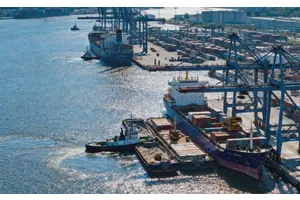
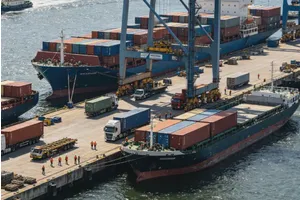
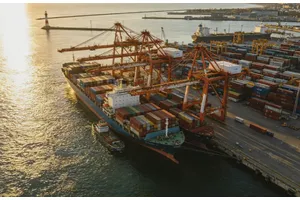
The 50-container block train eased into Budapest's BILK terminal eighteen days after leaving Zhengzhou, gantry cranes already swinging battery-component containers onto trucks bound for Debrecen and Győr. Every one of those containers was booked by someone who first asked: what is the real shipping cost from China to Hungary?
That is the question this guide answers — with delivered prices, not freight-only quotes. Most rate tables you will find online stop at the port or the railhead. But Hungary is a landlocked country: a container is not "there" when the vessel reaches Koper or the train reaches BILK. It still has to clear customs, pay Hungary's 27% VAT, and cover 470 to 1,300 kilometers of inland transport. Below, we compare sea, China-Europe Railway Express, and air for the same cargo, line by line, using the 2026 rates we quote at DTFU Logistics from our own shipments on this lane. If you are just starting out, our shipping from China to Hungary service page shows the full door-to-door scope of what a transparent quote should cover.
Why Hungary Is a Different Kind of Shipping Destination
Three facts make Hungary unlike most European import markets — and all three affect what you pay.
It has no seaport. Every ocean container from China enters the EU through a gateway port and then travels inland. The practical choices are Koper in Slovenia (~470 km from Budapest), Rijeka in Croatia (~510 km), Hamburg (~1,000 km), Gdansk (~800 km), and Rotterdam (~1,300 km). The ocean freight quote you compare online is never the final price; the inland leg adds both cost and days.
It is the railway express's European anchor. Hungary sits at the western end of the China-Europe Railway Express corridor, and Budapest's BILK terminal is one of Central and Eastern Europe's largest intermodal hubs. That means a genuine third option — direct block trains from Zhengzhou, Xi'an, Chongqing, or Chengdu to Budapest in 15 to 22 days — sits between slow sea freight and expensive air freight. Few destinations in Europe can say the same.
It is an industrial powerhouse in transition. Hungary is now Europe's second-largest EV battery producer, with gigafactories like CATL's Debrecen plant and BYD's Szeged vehicle plant pulling in a constant stream of Chinese components. Automotive accounts for roughly a fifth of Hungarian exports, and electronics and machinery round out the picture — Chinese exports to Hungary passed $10 billion in 2025. This is component and parts cargo: dense, scheduled, and freight-cost-sensitive. It is exactly the kind of freight where mode choice decides margins.
The 2026 Landed-Cost Showdown: Sea vs China-Europe Railway vs Air
Here is the comparison every other article on this route skips. Instead of quoting freight alone, we ran the same cargo through all three modes with every line item that reaches your bank account: freight, surcharges, terminal handling, clearance, insurance, the inland leg, import duty, and Hungary's VAT.
Case 1 — A 40ft High Cube of auto parts, CIF value $45,000, HS 8708 (3.5% duty), Shenzhen or Zhengzhou to a Budapest warehouse:
| Cost Item | Sea via Koper | Rail via BILK |
|---|---|---|
| Main freight (40ft) | $3,500 | $4,800 |
| BAF / fuel surcharge | $250 | Included |
| Terminal handling (both ends) | $400 | $250 |
| Export clearance and docs | $275 | $275 |
| Cargo insurance (0.3%) | $135 | $135 |
| Inland leg to Budapest | $300 | Included |
| Import brokerage (Hungary) | $350 | $350 |
| Import duty (3.5% of $45,000) | $1,575 | $1,575 |
| Hungary VAT (27% of CIF + duty) | $12,575 | $12,575 |
| Total delivered | $19,360 | $19,960 |
| Door-to-door transit | 32–42 days | 18–22 days |
The freight difference between sea and rail is $1,300 — but the delivered-price difference is only $600. Why? Because Hungary's 27% VAT alone ($12,575) is more than three times the ocean freight. The tax line swamps the mode decision.
This is the counterintuitive reality of the China to Hungary lane, and it surprises nearly every first-time importer we work with. Clients see a sea quote $1,000 cheaper than rail and assume sea saves them $1,000. Once duty and VAT are added, the real saving shrinks to a few hundred dollars — while the cargo sits on a vessel for an extra three to five weeks. For containers valued above roughly $40,000, we routinely recommend rail on time-to-market grounds rather than freight cost.
Case 2 — A mid-size shipment: 1,500 kg / 8 CBM of consumer electronics, CIF value $40,000, 0% duty (HS 8471), Shenzhen to Budapest:
| Cost Item | Sea LCL | Rail LCL | Air Freight |
|---|---|---|---|
| Main freight | $960 ($120/CBM) | $2,400 ($300/CBM) | $6,000 ($4.00/kg) |
| Docs, clearance, brokerage | $675 | $675 | $525 |
| Cargo insurance (0.3%) | $120 | $120 | $120 |
| Delivery to Budapest | $300 | Included | $150 |
| Import duty (0%) | $0 | $0 | $0 |
| Hungary VAT (27% of CIF) | $10,800 | $10,800 | $10,800 |
| Total delivered | $12,855 | $13,995 | $17,595 |
| Cost per kg delivered | $8.57 | $9.33 | $11.73 |
Even on this profile, air freight is only about $4,700 more than sea LCL in total — again because VAT is the dominant line. The freight differential matters most when your cargo value is low; the mode decision matters most when your cargo is heavy, bulky, or time-sensitive. For the full container-level breakdown behind Case 1, see our cost of shipping a container from China to Hungary guide, and for 40ft High Cube pricing in particular, our high cube shipping container cost from China article.
Sea Shipping Cost from China to Hungary: FCL Rates by Port, plus the Inland Leg
Sea freight remains the cheapest mode per kilogram, and for low-value bulk cargo it is usually the right call. These are 2026 port-to-port ocean freight ranges (China port → EU entry port), excluding the inland leg, customs, duty, and VAT:
| Origin Port | 20ft FCL | 40ft FCL | 40ft HQ | Sea Transit | Preferred EU Entry Port |
|---|---|---|---|---|---|
| Shanghai | $2,300–3,500 | $2,800–4,500 | $3,200–4,800 | 30–40 days | Koper / Hamburg |
| Ningbo | $2,250–3,500 | $2,950–4,500 | $3,100–4,700 | 30–40 days | Koper / Hamburg |
| Shenzhen | $2,400–3,800 | $2,900–5,000 | $3,300–5,200 | 28–38 days | Koper / Rijeka |
| Guangzhou | $2,300–3,800 | $2,900–5,000 | $3,300–5,200 | 28–38 days | Koper / Rijeka |
| Qingdao | $2,200–3,500 | $2,800–4,800 | $3,100–5,000 | 32–45 days | Hamburg / Gdansk |
| Tianjin | $2,150–3,200 | $3,650–4,650 | $3,800–5,000 | 35–45 days | Gdansk / Hamburg |
The low end of each range reflects off-peak contract rates (March–May, November); the high end reflects peak season (August–October), when peak season surcharges of $150–400 per container are common. If your timing is flexible, avoiding the late-summer peak can save $800–1,500 per container.
Choosing the EU Entry Port: The Inland Leg Is Half the Decision
Once the vessel docks, your container still has to reach Budapest. The entry port determines both the cost and the reliability of that leg:
| EU Entry Port | Distance to Budapest | Inland Transit | Typical Inland Cost |
|---|---|---|---|
| Koper (Slovenia) | ~470 km | 1–2 days by truck/rail | $150–300 |
| Rijeka (Croatia) | ~510 km | 1–2 days by truck/rail | $150–300 |
| Gdansk (Poland) | ~800 km | 2–4 days by rail | $250–400 |
| Hamburg (Germany) | ~1,000 km | 3–5 days by rail | $350–500 |
| Rotterdam (Netherlands) | ~1,300 km | 4–7 days by rail | $400–550 |
Always compare ocean freight plus inland together. A cheap ocean rate to Rotterdam can turn expensive once a $500 rail leg is added; a slightly higher rate to Koper with $280 of trucking can win on both cost and time. In practice the two often land within $100 of each other — which is why southern Chinese ports (Shenzhen, Guangzhou) pair naturally with the Adriatic gateways, while northern factories often route via Hamburg or Gdansk.
LCL (less than container load) from China to Hungary runs $80–200 per CBM with 35–45 days door-to-door. Below roughly 8–12 CBM, LCL is the practical option; above that, a full container almost always wins on cost per unit — we cover that break-even math in our 20ft and 40ft shipping from China to Hungary guide. Whatever the mode, protect the cargo itself: on a $45,000 container, insurance at 0.2–0.5% of value is a rounding error compared with an uncovered loss — see our shipping container insurance cost guide.
China-Europe Railway Express to Budapest: Rates, Routes and Real Transit Times
If sea is the cheapest and air is the fastest, rail is the option that makes Hungary special — a direct block train from inland China to Budapest's BILK terminal, with customs clearance in Budapest rather than at a distant seaport. Current 2026 FCL rates and transit times:
| Departure City | 20ft FCL | 40ft FCL | Transit to BILK |
|---|---|---|---|
| Chongqing | $3,000–4,000 | $4,000–5,500 | 15–20 days |
| Yiwu | $3,200–4,200 | $4,200–5,800 | 16–21 days |
| Xi'an | $2,800–3,800 | $3,800–5,000 | 16–23 days |
| Chengdu | $2,900–3,900 | $3,900–5,200 | 17–21 days |
| Zhengzhou | $3,200–4,200 | $4,200–5,800 | 18–22 days |
The standard corridor runs China → Kazakhstan (Alashankou or Khorgos) → Russia → Belarus → Poland → Hungary, with a 1–2 day dwell at border crossings in normal conditions. Two documents matter here more than on sea routes: the CIM consignment note replaces the ocean bill of lading, and rail imposes a stricter weight limit (containers typically max out around 25 tons gross on rail vs 28–30 tons on vessels). Because the train crosses several customs territories, multi-country cargo insurance is essential.
When Rail Beats Sea Freight
- Moderate urgency — you cannot wait 35–45 days for sea freight, but air freight economics are absurd for a full container.
- Seasonal goods with a fixed sales window: holiday stock, fashion, and seasonal electronics sell better 20 days earlier.
- High-value cargo — for a $50,000 container, three weeks of saved transit is worth roughly $400–450 in reduced inventory carrying cost (at a 15% annual cost of capital). Rail's premium over sea is about $1,000–1,500, so the net cost of speed is far smaller than the headline difference.
- Inland Chinese factories — if your supplier is in Chongqing, Chengdu, or Xi'an, trucking to a seaport adds days anyway; boarding a train at a nearby hub can match or beat total sea transit time.
Rail LCL runs $200–400 per CBM with 15–25 days transit — about double the per-CBM cost of sea LCL but roughly half the time. For a side-by-side look at reliability, schedule consistency, and real-world performance between the two modes, read our sea vs rail freight comparison from China.
A regular client of ours ships auto components into the Debrecen area — the CATL supply chain has made that corridor a weekly lane. When we first moved him from sea to rail, he paid roughly $1,200 more per container in freight. What changed: his pipeline dropped from 38 days to 20, so he cut safety stock at his Győr-area warehouse, and his landed cost per part actually fell once warehousing was counted. The freight quote alone would never have told him that.
Air Freight Cost from China to Hungary per kg: Weight Tiers and Volumetric Weight
Air freight is for high-value, time-critical, or low-volume cargo. Rates are tiered by weight — the heavier the shipment, the lower the cost per kilogram:
| Weight Tier | Rate (USD/kg) | Best For |
|---|---|---|
| 45–99 kg | $5.50–8.50 | Samples, urgent spare parts |
| 100–299 kg | $4.50–7.00 | E-commerce restocking, small runs |
| 300–499 kg | $4.00–6.00 | Mid-size commercial shipments |
| 500–999 kg | $3.50–5.00 | Bulk commercial cargo |
| 1,000+ kg | $3.00–4.50 | High-volume B2B, palletized cargo |
By departure airport (300 kg+): Shanghai Pudong (PVG) $4.00–5.50, Shenzhen Bao'an (SZX) $4.30–6.00, Guangzhou Baiyun (CAN) $4.50–6.20. DDP air freight adds roughly $1.50–3.00 per kg for duties, taxes, and customs handling in one price.
The volumetric trap. Airlines charge on chargeable weight — the greater of gross weight and volumetric weight, calculated as (length × width × height in cm) ÷ 6,000. A carton of 100 × 80 × 60 cm that weighs 50 kg on the scale bills at 80 kg. Light, bulky goods are where air freight quotes suddenly double; always confirm your packaging dimensions with the forwarder before booking.
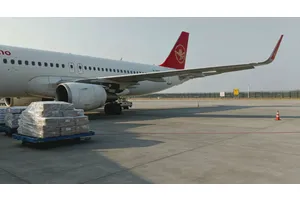
On the Budapest side, BUD Cargo City handles 300,000+ tons a year (airport capacity expanded to 420,000 tons in 2026) with 80+ scheduled freighter flights weekly, and DHL operates its Central-Eastern European hub there — useful if you redistribute across the region. Direct freighter services now run from Shanghai, Zhengzhou, Shenzhen, and Chongqing, with flight times around 10–12 hours and door-to-door transit of 3–7 days. Debrecen Airport (DEB) is a secondary option for importers near the eastern border. Full route, airline, and cost detail is in our air shipping from China to Hungary guide, and our air freight service page covers the booking process end to end.
Hungary Customs and the 27% VAT: What the Quote Never Shows
Hungary applies the EU Common Customs Tariff (CCT). Duty rates depend entirely on the HS code classification:
| Product Category | Example HS Code | Typical Duty Rate |
|---|---|---|
| Electronics, computers, IT parts | 8471, 8473 | 0% |
| Machinery and mechanical appliances | 8479, 8428 | 0–2.7% |
| Furniture | 9403 | 0–5.6% |
| Automotive parts | 8708 | 3–4.5% |
| Toys and games | 9503 | 0–4.7% |
| Clothing and textiles | 6204, 6109 | 12% |
| Footwear | 6403, 6404 | 8–17% |
Then comes the line that changes every budget: Hungary's ÁFA (VAT) of 27% — the highest standard rate in the European Union — calculated on the CIF value plus duty:
VAT Payable = 27% × (CIF Value + Import Duty)
On the $30,000 electronics shipment from our earlier example, that is $8,100 on top of everything else. Reduced rates of 18% and 5% apply to specific goods, but most industrial imports fall under the standard 27%. EU-registered companies reclaim the VAT on their periodic return — it is a cash-flow item, not a permanent cost. Importers without an EU VAT number pay it outright; for them, a DDP door-to-door service where the forwarder handles VAT as part of one all-in price is usually the cleanest route.
Practical clearance points that move your timeline and bill:
- EORI number — required for any company clearing goods in the EU; obtainable before your first shipment.
- SAD declaration — customs is filed electronically via Hungary's tax authority (NAV) on the Single Administrative Document.
- AEO status — Authorized Economic Operator certification (mutually recognized between China and the EU) buys fewer inspections and faster release. If you clear regularly, it pays for itself quickly.
- EUR1 certificate — can qualify goods for reduced or zero preferential duty under EU trade arrangements; ask your supplier.
- Budapest-Csepel free zone — the Csepel Free Port area on the Danube lets you store goods before duty and VAT fall due, and stage distribution. For importers managing inventory flows into Central Europe, it is a legitimate cash-flow tool — and a strong reason to clear in Budapest rather than at a seaport.
The mistake we see most often is the importer who budgets only the freight quote, then meets the VAT bill at release and has to scramble for cash flow. On a $45,000 container that is a $12,575 surprise. The other lever is documentation: with AEO-classified shippers and pre-cleared filings, we routinely see cargo released at BILK in under two hours, where a first-timer with incomplete paperwork waits a day or two. Get the paperwork right and Hungary's customs is fast; get it wrong and every day of delay costs demurrage and schedule.
For a full walkthrough of clearance, documentation, and the door-to-door process on this lane, see our customs clearance service page and the door-to-door shipping overview.
How to Cut Your China to Hungary Shipping Cost
Six levers move the needle most on this lane:
- Time your bookings. March–May and November offer the lowest rates; the August–October pre-Christmas peak adds 20–30%. Book 3–4 weeks ahead of your sailing date.
- Compare combined ocean + inland. The cheapest port-to-port rate is not the cheapest delivered rate; run Koper vs Hamburg math every time.
- Know your FCL/LCL break-even. Above 10–14 CBM, a 20ft FCL beats LCL once destination handling and deconsolidation fees are counted.
- Use 40ft High Cube for voluminous cargo. ~12% more volume for typically 5–10% more cost than a standard 40ft.
- Negotiate annual volume. Six or more containers a year justifies a 12-month contract — typically 10–20% under spot, with guaranteed peak-season space.
- Consolidate suppliers. Combine multiple factories' LCL shipments into one FCL at a consolidation warehouse; savings of 25–40% are common.
If you import without an EU VAT registration, a DDP program removes the VAT cash-flow problem entirely — one price, one point of contact. Our door to door shipping from China to Hungary guide walks through how that works in practice.
FAQs
How much does it cost to ship a 20ft container from China to Hungary? Ocean freight runs $2,150–3,800 depending on origin port and season. The all-in delivered cost — freight, surcharges, inland leg, clearance, duty, and 27% VAT — typically lands between $4,000 and $6,500 for moderately valued cargo.
How much does it cost to ship a 40ft container from China to Hungary? Ocean freight runs $2,800–5,200 (40ft HQ roughly $300–500 more). All-in delivered cost generally falls between $5,500 and $8,500, with cargo value driving the VAT portion.
Is rail freight cheaper than sea freight from China to Hungary? No — rail freight is typically 30–50% more expensive than sea freight. But it is 40–50% faster (15–22 days vs 28–45 days), and once duty and VAT are added, the delivered-price gap on a high-value container narrows to a few hundred dollars.
How long does shipping from China to Hungary take? Sea: 32–50 days door-to-door. China-Europe Railway Express: 15–25 days to BILK. Air: 3–7 days door-to-door from major Chinese airports.
What is the cheapest way to ship from China to Hungary? Sea FCL from Qingdao, Ningbo, or Tianjin in the off-peak season gives the lowest per-unit cost. Under 8 CBM, sea LCL is the lowest absolute outlay — though per-unit cost is higher than FCL.
Contact DTFU Logistics for a free quote on your next China to Hungary shipment — and if you are building a wider European distribution network, our China to Europe service covers the whole corridor.