If you are sourcing goods from China and need them delivered to Hungary, air shipping from China to Hungary is the fastest and most reliable way to get your cargo across 8,000 kilometers in days rather than weeks. But if you have ever requested an air freight quote, you have probably faced the same frustration: one forwarder quotes you $4.50 per kg, another quotes $9.00, and neither explains why. The real answer comes down to weight breaks, volumetric weight — a pricing mechanic most first-time shippers never see coming — and which airline and route your cargo takes out of China.
This guide cuts through the confusion. You will learn exactly how air freight pricing works (with real 2026 benchmark rates per weight tier), how long your shipment will actually take from major Chinese airports to Budapest, which airlines fly direct cargo routes to Hungary right now, the complete door-to-door air freight process from your supplier's factory to your Hungarian address, and how to handle Hungary's EU customs clearance — including the SAD (Single Administrative Document), EORI registration, Hungary's 27% VAT, and whether DDP (Delivered Duty Paid) air freight is worth the premium for your situation. If your shipment volume is large enough to consider ocean freight instead, our sea shipping cost from China to Poland guide covers a comparable Central European import scenario. Whether you are a B2B importer, an Amazon FBA or Shopify e-commerce seller, or an SME importing from China for the first time, this is the only air-freight-only guide you will need for the China-to-Hungary route in 2026. For a complete overview of all shipping modes — including sea and rail freight to Hungary — see our dedicated guide on shipping from China to Hungary.
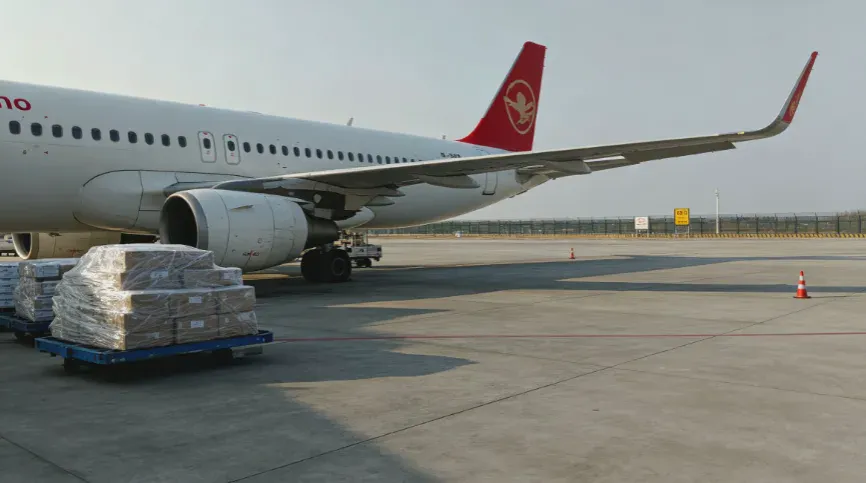
Air Freight Cost from China to Hungary per Kg
Before you compare quotes, you need to understand two things: how air freight rates are priced by weight tier, and why the number on your quote may be higher than the actual weight of your cargo — due to volumetric weight, a concept also central to shipping from China to USA and all other air freight routes worldwide.
Air Freight Rates from China to Hungary
Air freight rates use weight breaks: the heavier your shipment, the lower your cost per kilogram. This is why shipping 500 kg of goods does not cost 10 times more than shipping 50 kg — it might only cost 3 to 4 times more in total. Below are realistic benchmark ranges for standard air freight (port-to-airport) on the China-to-Hungary route as of mid-2026:
| Weight Tier | Rate (USD/kg) | Best For |
|---|---|---|
| 45–99 kg | $5.50 – $8.50 | Small batch samples, urgent spare parts |
| 100–299 kg | $4.50 – $7.00 | E-commerce restocking, small production runs |
| 300–499 kg | $4.00 – $6.00 | Mid-size commercial shipments |
| 500–999 kg | $3.50 – $5.00 | Bulk commercial cargo, consolidated freight |
| 1,000+ kg | $3.00 – $4.50 | High-volume B2B, palletized air freight |
These rates also vary by departure airport. Here is how the three busiest China-to-Hungary air freight corridors compare:
| Departure Airport (China) | Rate Range (USD/kg, 300kg+) | Notes |
|---|---|---|
| Shanghai Pudong (PVG) | $4.00 – $5.50 | Most frequent direct flights, most competitive |
| Shenzhen Bao'an (SZX) | $4.30 – $6.00 | Strong South China manufacturing proximity |
| Guangzhou Baiyun (CAN) | $4.50 – $6.20 | Slightly higher; fewer direct options than PVG |
For DDP air freight (which includes duties, taxes, and customs handling in one all-inclusive price), add approximately $1.50 to $3.00 per kg to the rates above. We cover DDP in detail in Section 6.
Note: All rates are indicative benchmarks for 2026. Actual quotes depend on fuel surcharges, seasonal demand, cargo type, and your forwarder's airline contracts. Always request a real-time quote for accurate pricing.
Why Your Air Freight Quote Is Higher Than Expected
Here is the single biggest surprise for first-time air freight shippers — and no other guide on this route covers it clearly.
Airlines charge by chargeable weight, not actual weight. Chargeable weight is the greater of:
- Actual (gross) weight — what your cargo weighs on a scale
- Volumetric weight — how much space your cargo occupies on the aircraft
The formula for volumetric weight is:
Volumetric Weight (kg) = (Length × Width × Height in cm) ÷ 6,000
Some carriers use a divisor of 5,000 instead of 6,000 — meaning you get charged even more for bulky items. Always confirm which divisor your forwarder's airline uses.
Worked example: A carton measures 100 × 80 × 60 cm and weighs 50 kg on the scale. Its volumetric weight is (100 × 80 × 60) ÷ 6,000 = 48,000 ÷ 6,000 = 80 kg. The chargeable weight is 80 kg (the greater of 50 and 80) — so you pay for 80 kg, not 50 kg. That is a 60% increase over what you might have budgeted.
How to avoid volumetric weight surprises:
- Optimize packaging — avoid oversized boxes with lots of empty space
- Use vacuum-sealed or compression packaging for textiles and soft goods
- Ask your forwarder to calculate chargeable weight BEFORE booking
- Consider whether some of your "light but bulky" items are better suited for sea freight
Cheapest Air Shipping from China to Hungary
- Consolidate to reach a higher weight break. Shipping 280 kg at the 100–299 kg rate costs more per kg than consolidating multiple orders to reach 500 kg and drop into a cheaper tier. Work with a forwarder that offers consolidated air freight services.
- Book 2–3 weeks in advance. Last-minute bookings during peak season can carry premiums of 30–50% or more.
- Avoid peak season if possible. Q4 (October–December) and the weeks before Chinese New Year (January/February) see the highest air freight rates. Plan shipments for March–August when rates are typically lowest.
- Consider connecting flights over direct routes. A flight with one stop (e.g., via Istanbul on Turkish Airlines) can be cheaper than a direct freighter — at the cost of 1–2 extra days in transit.
- Partner with a forwarder that holds direct airline contracts. Forwarders with IATA certification and direct carrier agreements — like DTFU Logistics — bypass intermediaries, securing lower rates and guaranteed space even during peak periods.
What Affects Air Freight Rates? 7 Factors That Change Your Quote
| Factor | Impact on Rate |
|---|---|
| Fuel surcharge | Fluctuates monthly; typically adds $0.30–$0.80/kg |
| Security surcharge | Fixed per-shipment fee; ~$15–$35 |
| Peak season demand | Rates can spike 30–50% in Q4 and pre-CNY |
| Cargo type surcharge | Dangerous goods (DG) or temperature-controlled cargo incur premiums |
| Volumetric vs. dense cargo | Light-but-bulky cargo costs more per actual kg |
| Airport handling fees | Vary by origin and destination airport |
| Customs brokerage fees | Separate from freight; ~$50–$150 per clearance |
How Long Does Air Shipping Take from China to Hungary?
Transit time is the #1 reason importers choose air freight over sea or rail. But "3 to 7 days" is a range, not a guarantee — and the actual number depends on your route, the airline, and whether you choose a direct or connecting flight.
Air Freight Transit Time from China to Hungary — By Route & Service Level
| Service Type | Transit Time (Door-to-Door) | Best For |
|---|---|---|
| Direct cargo flights (e.g., PVG→BUD) | 1–3 days | Urgent cargo, factory production line parts |
| Standard air freight | 3–7 days | Regular commercial shipments, e-commerce restocking |
| Express courier (DHL/UPS/FedEx) | 3–5 days | Small parcels under 45 kg, documents, samples |
| DDP air freight | 5–10 days | First-time importers needing full customs handling |
Route-specific transit times from major Chinese departure points:
| Route | Typical Transit (Door-to-Door) | Direct Flight Time |
|---|---|---|
| Beijing (PEK) → Budapest (BUD) | 1–3 days | ~10 hours |
| Shanghai (PVG) → Budapest (BUD) | 3–4 days | ~11–12 hours |
| Shenzhen (SZX) → Budapest (BUD) | 3–5 days | ~12 hours |
| Guangzhou (CAN) → Budapest (BUD) | 4–6 days | ~12–13 hours (often via connection) |
| Zhengzhou (CGO) → Budapest (BUD) | 2–4 days | ~10–11 hours (Hungary Airlines direct) |
| Chongqing (CKG) → Budapest (BUD) | 3–5 days | ~11 hours (China Cargo Airlines direct) |
| Jiaxing (new) → Budapest (BUD) | 2–3 days | ~10 hours (YTO Express B767-300F) |
Express Air Freight from China to Hungary — Fastest Delivery Options
If you need your cargo in Hungary as fast as possible, here are the levers you can pull:
- Priority booking: Reserve space on the next available flight — forwarders with direct airline contracts can secure this within hours.
- Express handling at origin and destination: Pay a small premium for expedited cargo acceptance, loading, and unloading — shaving 12–24 hours off the total timeline.
- Pre-clearance customs filing: Submit import documentation to Hungarian customs before the aircraft lands. This can reduce customs processing from 1–2 days to a few hours.
- Dedicated last-mile trucking: Instead of waiting for a consolidated truck, book a dedicated vehicle from BUD airport to your final address.
What Can Delay Your Air Freight from China to Hungary?
Common causes of transit delays — and how to avoid them:
- China export customs hold: Incomplete HS code classification or missing export licenses. Ensure your forwarder reviews all documentation before submission.
- Airline cargo backlog: Peak season or weather disruptions can push your cargo to a later flight. Book with forwarders holding guaranteed space allocations.
- Transshipment delays at hub airports: Connecting flights via Istanbul (IST), Doha (DOH), or Dubai (DXB) add risk — direct flights are always more reliable.
- Hungary import customs inspection: Random physical inspections at BUD can add 1–3 days. Proper documentation (especially accurate HS codes and commercial invoices) minimizes this risk.
- Incorrect or incomplete paperwork: The #1 avoidable delay. Always double-check your packing list, commercial invoice, and AWB before shipment.
Direct Cargo Flights from China to Budapest
The China-to-Hungary air corridor is more mature than most importers realize. As of 2026, there are multiple direct cargo routes operating weekly between Chinese cities and Budapest Ferenc Liszt International Airport (BUD). Here is the complete picture.
Airlines Flying Direct Cargo from China to Budapest
| Airline | Route | Frequency | Aircraft | Payload | Notes |
|---|---|---|---|---|---|
| China Cargo Airlines | PVG (Shanghai) → BUD | 3×/week | Boeing 777F | 100+ tons | Established route; e-commerce & IT cargo |
| China Cargo Airlines | CKG (Chongqing) → BUD | 3×/week | Boeing 777F | 100+ tons | Launched January 2026; Western China coverage |
| Hungary Airlines | CGO (Zhengzhou) → BUD | 5×/week | Airbus A330-200F | 65 tons | Launched September 2025; highest frequency |
| YTO Express | Jiaxing → BUD | 3×/week | Boeing 767-300F | 57 tons | New June 2026! ~10 hours flight time |
| Turkish Airlines | PVG → IST → BUD | Daily | Various (connecting) | Varies | Connecting via Istanbul; budget-friendly option |
| Air China Cargo | PEK (Beijing) → BUD | 2–3×/week | Boeing 777F | 100+ tons | North China gateway |
| SF Airlines | SZX (Shenzhen) → BUD | 2–3×/week | Boeing 757F / 767F | 35–57 tons | South China e-commerce cargo |
| Hong Kong Airlines | HKG → BUD | 2×/week | Airbus A330-200F | 65 tons | Premium cargo gateway option |
Aircraft comparison — why it matters:
- Boeing 777F (100+ tons): Best for high-volume, heavy commercial cargo — machinery, auto parts, bulk electronics.
- Airbus A330-200F (65 tons): Efficient mid-size option; great balance of capacity and frequency.
- Boeing 767-300F (57 tons): Used by YTO Express on the new Jiaxing route; ideal for cross-border e-commerce parcels.
Which Chinese Airport Should You Ship From?
Your departure airport should be as close as possible to your supplier's factory. This minimizes domestic trucking time and cost — and often determines which airlines and routes are available to you.
| If your supplier is in... | Nearest air freight airport | Key routes to Budapest |
|---|---|---|
| Shanghai, Jiangsu, Zhejiang, Anhui (East China) | Shanghai Pudong (PVG) or Jiaxing (NEW) | China Cargo Airlines, YTO Express, Turkish Airlines |
| Shenzhen, Dongguan, Guangzhou (South China / PRD) | Shenzhen Bao'an (SZX) or Guangzhou Baiyun (CAN) | SF Airlines, Air China Cargo, Turkish Airlines |
| Beijing, Tianjin, Hebei (North China) | Beijing Capital (PEK) | Air China Cargo |
| Chongqing, Sichuan (Western China) | Chongqing Jiangbei (CKG) | China Cargo Airlines (3×/week B777F) |
| Zhengzhou, Hubei (Central China) | Zhengzhou Xinzheng (CGO) or Ezhou Huahu (EHU) | Hungary Airlines (5×/week), emerging cargo hub |
Important: DTFU Logistics operates across all major Chinese ports — Shanghai, Shenzhen, Guangzhou, Ningbo, Qingdao, Tianjin, and more. You are not limited to a single departure city. Your account manager will route your cargo through the airport that offers the best combination of proximity to your supplier, available flights, and competitive rates.
Budapest Ferenc Liszt International Airport (BUD)
Budapest Airport is not just Hungary's main gateway — it is one of Central and Eastern Europe's fastest-growing air cargo hubs. Key facts for importers:
- BUD Cargo City: A dedicated cargo terminal complex handling 300,000+ tons annually, with total airport capacity expanded to 420,000 tons as of 2026.
- DHL Central & Eastern European hub: DHL operates a major sorting and distribution center at BUD, making express forwarding to neighboring EU countries fast and efficient. For importers distributing goods across Central Europe, we also provide dedicated shipping from China to Austria, shipping from China to Poland, and shipping from China to Germany — all reachable within 1–2 days from BUD.
- Cold chain & pharma handling: Temperature-controlled storage and Cool Dolly transport equipment for pharmaceutical and perishable cargo — certified to EU GDP (Good Distribution Practice) standards.
- 80+ dedicated freighter flights per week.
- Secondary option: Debrecen International Airport (DEB) in eastern Hungary handles approximately 10,000 tons annually and serves importers located closer to the Romanian and Ukrainian borders.
Door-to-Door Air Shipping from China to Hungary
Below is the complete 8-step door-to-door air freight journey — from your supplier's loading dock in China to your warehouse or fulfillment center in Hungary. If you need a service that handles all logistics from start to finish, our door to door shipping from China to Hungary covers every step with a single point of contact. Understanding each step helps you anticipate documentation needs, avoid delays, and communicate effectively with your freight forwarder.
The 8-Step Door-to-Door Air Freight Journey
Step 1: Factory Pickup & Cargo Consolidation Your forwarder arranges trucking from your supplier's factory to the departure airport's cargo terminal. Cargo is inspected, weighed, measured (for volumetric weight calculation), and palletized for air transport. If you are shipping from multiple suppliers, your forwarder may consolidate shipments at their warehouse first.
Step 2: Export Documentation Preparation Your forwarder prepares the core shipping documents:
- Commercial Invoice — describes the goods, their value, and the buyer/seller
- Packing List — details weight, dimensions, and packaging of each item
- Air Waybill (AWB) — the contract of carriage between shipper and airline; this is your most important tracking document
- Certificate of Origin — required for certain goods to qualify for preferential tariff treatment under EU trade agreements
Step 3: China Export Customs Clearance Your forwarder (or their customs broker) declares the cargo to Chinese customs. This involves verifying HS codes, checking for any export license requirements, and ensuring compliance with Chinese export regulations. Chinese export clearance is typically fast — 1 to 2 days — provided documentation is complete and accurate.
Step 4: Airline Booking & Cargo Acceptance Space is booked on a specific flight based on your timeline and budget. Cargo is loaded into ULDs (Unit Load Devices — aircraft-specific pallets and containers), undergoes mandatory security screening, and is checked for compliance with IATA Dangerous Goods Regulations (DGR) if applicable.
Step 5: International Air Transit Your cargo is airborne. Flight tracking provides milestone updates: cargo accepted → departed origin → in transit → arrived at destination. Most forwarders (including DTFU Logistics) offer 24/7 real-time online tracking.
Step 6: Hungary Import Customs Clearance This is the most critical step. Upon arrival at BUD, your cargo enters the customs clearance process:
- Filing of the Single Administrative Document (SAD) — the EU's unified customs declaration
- EORI number verification
- Assessment and payment of import duties (3–12%) and Hungarian VAT (27%)
- Potential physical inspection (random or triggered by HS code)
We cover this step in detail in the next section.
Step 7: Cargo Release & Warehouse Handling Once customs clears your cargo, it is released from the bonded area at BUD Cargo City. If you need temporary storage before final delivery — for example, to coordinate with your local distribution schedule — short-term warehousing is available on-site.
Step 8: Last-Mile Delivery in Hungary Your cargo is trucked to its final destination. Whether your recipient is in Budapest, Debrecen, Miskolc, Szeged, Győr, or a rural location, last-mile delivery is arranged by your forwarder's local trucking network. Typical delivery to any Hungarian address from BUD takes 1–2 days.
Air Freight Documentation Checklist for Hungary
Use this checklist before every air shipment to Hungary. Missing even one document can cause customs delays:
| Document | Required? | Notes |
|---|---|---|
| Air Waybill (AWB) | ✅ Always | Issued by airline or forwarder |
| Commercial Invoice | ✅ Always | Must include accurate value, HS codes, buyer/seller details |
| Packing List | ✅ Always | Weight, dimensions, packaging type per item |
| Certificate of Origin | 🔶 If applicable | For preferential EU tariff treatment (e.g., Form A) |
| SAD (Single Administrative Document) | ✅ Always | Filed electronically for EU customs clearance |
| EORI Number Confirmation | ✅ Always | Proof of EU importer registration |
| CE Marking Documentation | 🔶 If applicable | Electronics, machinery, medical devices |
| Phytosanitary Certificate | 🔶 If applicable | Plant-based products, wood packaging |
| MSDS (Material Safety Data Sheet) | 🔶 If applicable | Chemicals, lithium batteries, DG cargo |
Consolidated Air Freight
If your shipment is under 300 kg and not urgent, consolidated (consol) air freight can reduce your per-kilogram cost significantly. Here is how it works: multiple shippers' cargo is combined under a single master AWB (MAWB), with each shipper receiving their own house AWB (HAWB). The forwarder books a full ULD position at a lower bulk rate and passes the savings to you.
Trade-off: Consolidation and deconsolidation add approximately 1–3 extra days to total transit. Consolidated freight is ideal for regular, non-urgent shipments in the 100–300 kg range where saving $1–2/kg matters more than saving 2 days.
DDP Air Freight from China to Hungary
For many importers, the hardest part of international shipping is not the flight — it is what happens when the cargo lands. Hungary's customs clearance process, as an EU member state, involves specific documentation and tax obligations that can overwhelm first-time importers. This is where DDP (Delivered Duty Paid) air freight changes the game.
DDP Air Freight from China to Hungary
Under DDP Incoterms 2020, the seller or freight forwarder takes full responsibility for the entire shipping process. If you are weighing whether DDP or FOB makes more sense for your situation, our in-depth comparison of DDP vs FOB: Which Option Saves Time and Reduces Hassle breaks down the cost, risk, and convenience trade-offs.: factory pickup → China export clearance → international air transport → Hungary import customs clearance → payment of all duties and VAT → last-mile delivery. You receive your goods at your door with nothing left to pay and no customs paperwork to file yourself.
DDP air freight pricing: Expect to pay the standard air freight rate plus a DDP premium of approximately $1.50 to $3.00 per kg. This premium covers:
- Customs brokerage fees in Hungary
- Import duties (3–12% of CIF value, depending on HS code)
- Hungarian VAT (27% of CIF value + duties)
- Administrative handling and disbursement fees
DDP air freight is ideal if you:
- Are importing into Hungary for the first time and do not have an EU customs broker
- Run an e-commerce business (Amazon FBA, Shopify) where predictable landed costs are essential for pricing
- Do not have an EORI number and do not want to register for one
- Want a single, all-inclusive price with no surprise bills upon delivery
Hungary Customs Clearance for Air Cargo
Hungary is a member of the EU Customs Union. This means goods clear customs once upon entry into Hungary and can then move freely throughout all 27 EU member states. For many importers, Hungary serves as a strategic entry point for shipping from China to Europe and distribution across Central and Eastern Europe.
Two concepts you must understand before your first air shipment:
The Single Administrative Document (SAD): The SAD is the standard customs declaration form used across all EU member states. It is an 8-part, 54-box form submitted electronically. For air freight importers, the most critical boxes are:
- Box 1: Declaration type (IM = import for free circulation)
- Box 8: Consignee (importer of record with EORI number)
- Box 22: Invoice currency and total value
- Box 31: Description of goods (must include HS codes)
- Box 33: Commodity code (HS code)
- Box 37: Customs procedure code (40 00 = release for free circulation)
- Box 46: Statistical value (CIF value)
- Box 47: Calculation of duties and taxes
Your freight forwarder or customs broker handles the SAD filing — but you are responsible for providing accurate information.
The EORI Number: The Economic Operators Registration and Identification (EORI) number is a unique identifier required for all businesses importing goods into the EU. Without an EORI number, your cargo cannot clear customs. If your company is registered outside the EU, you have two options:
- Register for an EORI number through a Hungarian customs authority (takes 1–3 weeks)
- Use a customs broker under indirect representation — the broker clears goods under their own EORI number on your behalf (this is the standard approach for DDP shipments)
Hungary Import Duties & VAT
Hungarian customs calculates duties and taxes based on the CIF value (Cost of goods + Insurance + Freight). Here is the breakdown:
| Charge | Rate | Applied To | Notes |
|---|---|---|---|
| Import Duty | 0% – 12% | CIF value | Rate depends on HS code and country of origin |
| VAT (ÁFA) | 27% | CIF value + Duty | Among the highest in the EU; recoverable for VAT-registered businesses |
| Excise Duty | Varies | Specific goods | Applies to alcohol, tobacco, fuel |
Duty and VAT thresholds:
- Customs duty is waived if the total duty amount is under HUF 41,000 (~$100 USD)
- VAT is waived if the CIF value is under HUF 6,000 (~$15 USD)
Worked example — Electronics from Shenzhen to Budapest: A shipment of Bluetooth earbuds with a commercial invoice value of $5,000, air freight cost of $600, and insurance of $50:
| Item | Calculation | Amount |
|---|---|---|
| CIF Value | $5,000 + $600 + $50 | $5,650 |
| Import Duty (est. 3% for electronics) | $5,650 × 3% | $169.50 |
| VAT Base | $5,650 + $169.50 | $5,819.50 |
| Hungarian VAT (27%) | $5,819.50 × 27% | $1,571.27 |
| Total Import Cost (Duties + VAT) | $169.50 + $1,571.27 | $1,740.77 |
In this example, duties and VAT add approximately 31% on top of the CIF value. If you choose DDP air freight, this amount is included in your all-in quote — no surprises, no delays, no paperwork on your end.
Air Freight vs Sea Freight vs Rail — Best Way to Ship from China to Hungary
Air freight is the fastest option, but it is not always the best. Here is a practical comparison to help you decide which mode fits your specific cargo and budget.
Air Freight vs Sea Freight vs Rail Freight vs Express
| Factor | Air Freight | Sea Freight | Rail Freight | Express Courier |
|---|---|---|---|---|
| Transit Time (Door-to-Door) | 3–7 days | 30–45 days | 16–21 days | 3–5 days |
| Cost | $3.00–$8.50/kg | $0.50–$2.00/kg (FCL) | ~$300/CBM or ~$8K–$10K/FCL | $6.00–$12.00/kg |
| Best Cargo Weight | 45 kg – 5,000 kg | 500 kg+ (LCL) / 10,000 kg+ (FCL) | 1–20 CBM | Under 45 kg |
| Minimum Shipment | ~45 kg (or ~0.2 CBM) | ~1 CBM (LCL) / 20 CBM (FCL) | ~1 CBM | None (single parcel) |
| Door-to-Door Available | Yes | Yes | Yes | Yes (built-in) |
| Cargo Insurance Cost | 0.3%–0.5% of value | 0.2%–0.4% of value | 0.2%–0.4% of value | Included up to declared value cap |
When Air Freight Is the Best Way to Ship from China to Hungary
Choose air freight when any of the following apply:
- Your cargo is high-value relative to its weight. Electronics, pharmaceuticals, designer clothing, and luxury goods have a high value density — the air freight cost is a small fraction of the goods' value, and the speed protects your cash flow.
- Your shipment is under 500 kg and urgent. For small-to-mid-size shipments that need to arrive within 3–7 days, air freight is the only option. Sea freight minimums (and 30–45 day timelines) simply do not work.
- Your goods are perishable or have a short shelf life. Fresh produce, certain pharmaceuticals, and seasonal fashion collections cannot survive a month at sea.
- You are facing an inventory stockout. When a production line in Hungary is waiting for a critical component, the cost of air freight is trivial compared to the cost of downtime.
- Your shipment is too small for sea freight economics. LCL sea freight under 2 CBM often has high minimum charges, handling fees, and documentation costs that make air freight surprisingly competitive on total cost for smaller shipments.
When Sea Freight or Rail Freight Makes More Sense
Sea freight is the right choice when:
- Your shipment is 2 CBM or larger and you are cost-sensitive
- You can tolerate 30–45 days of transit time
- Your cargo is heavy and dense (sea freight charges by container/CBM, not weight)
- Hungary is a landlocked country, but sea freight via Koper (Slovenia), Trieste (Italy), Rijeka (Croatia), or Hamburg/Gdansk ports feeds efficiently into Hungary via rail and truck. For a detailed breakdown of ocean freight pricing to Hungary, check our guide on sea shipping cost from China to Hungary.
Rail freight (China-Europe Railway Express) is the compelling middle option — for a deeper look at how it stacks up against ocean shipping, read our comparison of sea vs rail freight: which is faster and more reliable from China.
- Faster than sea (16–21 days) and significantly cheaper than air (~$300/CBM or ~$8,000–$10,000 per 40ft container)
- Hungary's central European location and existing rail infrastructure make it a natural rail freight destination
- Ideal for shipments between 1 and 20 CBM where you need more speed than sea but cannot justify air freight costs
Air Freight vs Express Courier
Small shipments under 45 kg are almost always cheaper via express courier than air freight — couriers have optimized networks for small parcels and offer simple per-box pricing.
Between 45 kg and about 70 kg, air freight and express courier costs converge. At this threshold, air freight begins to offer a lower cost per kilogram, and the advantage grows as your shipment weight increases.
Above 100 kg, air freight is significantly cheaper than express courier — often 30–50% less per kg — because air freight benefits from weight-break pricing while courier rates remain relatively flat. For a detailed breakdown of this trade-off, see our guide on air freight vs express: which is faster and more cost-effective from China to USA (the same pricing logic applies to Hungary-bound shipments). — because air freight benefits from weight-break pricing while courier rates remain relatively flat. For any consolidated commercial shipment over 100 kg heading to Hungary, standard air freight (or DDP air freight if you need customs handling included) is the cost-effective choice.
Air Shipping from China to Hungary for Electronics, Clothing, Auto Parts & More
Not all cargo is created equal when it comes to air freight. Different product categories have unique requirements, restrictions, and cost profiles. Here is what you need to know for the most common cargo types shipped by air from China to Hungary.
Air Shipping Electronics from China to Hungary
Electronics — smartphones, laptops, PCBs, IoT devices, consumer gadgets — are the #1 air freight commodity on the China-to-Hungary route. They are high-value, fragile, and have rapid product cycles that make slow sea freight impractical.
Lithium battery compliance is critical. Any electronic device containing a lithium-ion or lithium-metal battery is classified as IATA Dangerous Goods (DG) Class 9 — Miscellaneous Dangerous Goods. To ship by air, you must provide:
- UN38.3 test report — certifies the battery has passed safety testing (required for all lithium batteries shipped by air)
- MSDS (Material Safety Data Sheet) — documents the battery's chemical composition and safety handling procedures
- Proper IATA-compliant labeling and packaging (strong outer packaging, protection against short circuits)
Always confirm with your forwarder that they have an IATA-certified dangerous goods specialist on their team. For electronics importers also shipping to neighboring markets, our dedicated air shipping from China to Germany page covers similar compliance requirements for the German market. Shipping lithium batteries through a non-certified forwarder can result in cargo rejection at the airport — or worse, a safety incident.
Air Freight Clothing & Textiles from China to Hungary
Apparel is a classic volumetric cargo — lightweight but bulky. A carton of winter jackets might weigh only 15 kg but occupy 0.3 CBM, making the chargeable weight significantly higher than the actual weight. For clothing importers, packaging optimization is the single most effective cost-saving strategy:
- Use vacuum compression bags for puffer jackets, down coats, and sweaters
- Minimize box sizes — every centimeter of empty space in your carton increases chargeable weight
- For high-volume apparel (500+ kg per shipment), negotiate a favorable volumetric divisor (6,000 rather than 5,000)
On the customs side, clothing HS codes (Chapters 61 and 62) carry import duties ranging from 8% to 12% when entering Hungary — among the higher categories. Accurate HS code classification directly impacts your landed cost.
Shipping Auto Parts from China to Hungary by Air
Hungary has a substantial automotive manufacturing sector — Audi (Győr), Mercedes-Benz (Kecskemét), and Suzuki (Esztergom) all operate major plants in the country. This creates strong demand for urgent air freight of automotive components and spare parts from Chinese suppliers to Hungarian production lines.
Auto parts tend to be dense and heavy — engine components, transmission parts, and metal castings — meaning chargeable weight is typically driven by actual weight rather than volume. This makes air freight relatively cost-efficient for these items compared to volumetric cargo.
For oversized parts that exceed standard ULD dimensions, your forwarder may need to book a main-deck position on a freighter aircraft (B777F or B747F) rather than a lower-deck position on a passenger or combi aircraft.
Air Freight Pharmaceuticals & Temperature-Controlled Cargo
Hungary's pharmaceutical sector is significant, and BUD Cargo City is equipped for GDP-compliant cold chain handling. Temperature-controlled air freight uses two approaches:
- Active cold chain: Battery-powered temperature-controlled containers (e.g., Envirotainer) that maintain a set temperature range throughout the journey. Higher cost but precise control.
- Passive cold chain: Insulated packaging with gel packs or dry ice. Lower cost but limited duration (typically 48–72 hours of temperature protection).
BUD's cold storage facilities support both active and passive pharmaceutical shipments, with temperature monitoring and data logging available.
Air Freight from China to Hungary for Ecommerce Sellers
Cross-border e-commerce — Amazon FBA sellers, Shopify store owners, and independent D2C brands — is a growing driver of China-to-Hungary air freight. The typical pattern: frequent, small-to-mid-size air shipments (50–300 kg per batch) for inventory restocking, supplemented by larger sea freight shipments for seasonal stock buildup.
For e-commerce sellers, DDP air freight is often the smartest choice. Hungarian consumers expect upfront, all-inclusive pricing — no surprise duties or VAT at the door. DDP ensures a smooth buyer experience and eliminates the risk of refused deliveries due to unexpected customs charges. For e-commerce sellers expanding into neighboring markets, our guide on door to door shipping from China to Poland outlines a similar DDP approach for the Polish market.
Cargo Insurance for Air Freight — Do You Need It?
Air freight is statistically the safest transport mode with very low loss and damage rates. But "low risk" is not "no risk." Cargo insurance is inexpensive relative to what it protects:
| Insurance Type | Coverage | Typical Cost |
|---|---|---|
| All-Risk (Institute Cargo Clauses A) | Broadest coverage — all physical loss or damage except named exclusions | 0.3%–0.5% of insured value |
| Named Perils (Institute Cargo Clauses C) | Specific named risks only — fire, explosion, aircraft crash, etc. | 0.15%–0.25% |
| Institute Cargo Clauses (Air) | Standard air freight coverage — all risk excluding war, strikes, inherent vice | 0.2%–0.4% |
Insurance value is typically calculated as CIF value × 110% — covering your goods, freight cost, insurance cost, and a 10% margin for incidental expenses. For a $10,000 shipment, All-Risk insurance costs approximately $30–$50 — a small price for peace of mind. For a complete overview of coverage options, see our guide on shipping container insurance cost for shipments from China.
How to Choose an Air Freight Forwarder from China to Hungary
Your air freight forwarder is the single most important decision in your shipping process. A great forwarder saves you money, prevents delays, and handles customs seamlessly. A bad one costs you far more than their quote suggests. Here is how to tell the difference.
6 Things to Check Before Choosing an Air Freight Forwarder
1. IATA Certification The International Air Transport Association (IATA) certifies freight forwarders to issue AWBs and book directly with airlines. Without IATA certification, a forwarder is a middleman booking through another forwarder — adding cost and reducing transparency. Always ask for a forwarder's IATA code and verify it.
2. Direct Airline Contracts Forwarders with direct contracts to major carriers — China Cargo Airlines, Air China Cargo, Hungary Airlines, Turkish Airlines — bypass intermediaries and secure:
- Lower per-kilogram rates (no middleman markup)
- Guaranteed space allocations, even during peak season
- Priority handling for urgent shipments
3. Multi-Port China Coverage If your suppliers are in Shenzhen but your forwarder only operates out of Shanghai, you are paying for unnecessary domestic trucking and limiting your route options. A forwarder with operations across multiple Chinese ports — Shanghai, Shenzhen, Guangzhou, Ningbo, Qingdao, Tianjin, Xiamen — can optimize both pickup and departure routing for every shipment. For businesses also importing into Western Europe, our guide on choosing a freight forwarder from China to Germany covers similar criteria for the German market.
4. Hungary Customs Expertise Your forwarder needs to understand not just "EU customs" in general, but Hungary specifically: the SAD filing process, EORI requirements, Hungary's 27% VAT rate, the HUF 41,000 duty threshold, and how to classify goods under the correct Hungarian HS codes. Competence here is the difference between same-day clearance and 3-day delay.
5. DDP Capability Can your forwarder offer a true DDP (Delivered Duty Paid) service with an all-inclusive quote? This requires the forwarder to have a fiscal representative or customs broker in Hungary who can pay duties and VAT on your behalf. Not all China-based forwarders have this capability — and those that do not will push you toward DDU or DAP, leaving you to handle Hungarian customs on your own.
6. Tracking & Customer Support Real-time online cargo tracking should be standard, not a premium add-on. Dedicated account managers — one person who knows your business, not a rotating queue of customer service agents — make a measurable difference in responsiveness when issues arise.
Red Flags — Signs of an Unreliable Air Freight Forwarder
| Green Flag ✅ | Red Flag ❌ |
|---|---|
| Explains volumetric weight & chargeable weight proactively | Gives a vague per-kg quote without explaining how weight is calculated |
| Has a physical office address (multiple China cities preferred) | PO Box only, or no verifiable business address |
| Provides IATA & FIATA certification numbers upon request | "Certification is pending" or avoids the question |
| Recommends the most cost-effective option for YOUR cargo | Always pushes the most expensive service regardless of your needs |
| Offers DDP with a clear duty/VAT breakdown | "We'll figure out customs when it arrives" |
Why Work with DTFU Logistics?
DTFU Logistics, headquartered in Shenzhen, China, and operating since 2014, holds both FIATA (International Federation of Freight Forwarders Associations) and IATA dual certification — a combination held by only a fraction of China-based freight forwarders. What this means for your Hungary-bound air freight:
- Competitive rates: Direct contracts with China Cargo Airlines, Air China Cargo, SF Airlines, Turkish Airlines, and other carriers serving the Budapest route — no intermediary markups.
- Peak season space guarantee: When Q4 or pre-CNY demand spikes, our airline allocations protect your shipments from being rolled to later flights.
- Multi-port flexibility: Operations across Shanghai, Shenzhen, Guangzhou, Ningbo, Qingdao, Tianjin, and more — we route your cargo through the airport that offers the best combination of proximity, schedule, and rate for your specific shipment.
- Hungary customs competence: Our team handles SAD filing, EORI indirect representation, duty/VAT calculation at Hungary's 27% rate, and DDP clearance — so your cargo clears customs on arrival, not days later.
- Dedicated account managers + 24/7 tracking: One point of contact who knows your shipping patterns, paired with real-time online cargo visibility at every milestone.
FAQs
How much does air freight cost per kg from China to Hungary?
Standard air freight ranges from $3.00 to $8.50 per kg, depending on weight tier. For 45–99 kg shipments, expect the higher end ($5.50–$8.50/kg). For 500+ kg, rates drop to $3.50–$5.00/kg. DDP air freight (which includes duties, VAT, and customs handling) adds $1.50–$3.00/kg, bringing the range to approximately $5.50–$12.00/kg all-in. The single biggest factor that drives your rate up is volumetric weight — if your cargo is light but bulky, the chargeable weight (and your cost) can be significantly higher than the actual weight. Always ask your forwarder to calculate chargeable weight before booking.
How long does air shipping take from China to Hungary?
Standard air freight: 3–7 days door-to-door. Direct cargo flights (e.g., Beijing or Shanghai to Budapest): as fast as 1–3 days. DDP air freight (which includes customs processing): 5–10 days. Express courier (DHL/UPS/FedEx): 3–5 days. The exact time depends on your departure airport, whether it is a direct or connecting flight, and whether Hungarian customs selects your shipment for inspection.
Which Chinese airports have direct cargo flights to Budapest?
As of 2026, direct cargo flights to Budapest (BUD) operate from: Shanghai Pudong (PVG), Beijing Capital (PEK), Shenzhen Bao'an (SZX), Guangzhou Baiyun (CAN), Zhengzhou Xinzheng (CGO), Chongqing Jiangbei (CKG), Hong Kong (HKG), Jiaxing Nanhu (NEW June 2026), and Ezhou Huahu (EHU). Airlines serving these routes include China Cargo Airlines, Hungary Airlines, YTO Express (圆通航空), SF Airlines (顺丰航空), Air China Cargo, Turkish Airlines, and Hong Kong Airlines.
What documents do I need for air freight from China to Hungary?
You need: Air Waybill (AWB), Commercial Invoice, Packing List, Certificate of Origin (if claiming preferential tariff treatment), Single Administrative Document (SAD) filed electronically, and your EORI number confirmation. Additional documents may be required depending on your cargo type — such as CE marking documentation for electronics, phytosanitary certificates for plant products, or MSDS for lithium batteries.
What are the import duties and VAT for air cargo entering Hungary?
Import duties range from 0% to 12% depending on HS code classification, calculated on the CIF value (Cost + Insurance + Freight). VAT is 27% — among the highest in the EU — applied to CIF value plus duty. Duty is waived if under HUF 41,000 (~$100). VAT is waived if CIF value is under HUF 6,000 (~$15). For VAT-registered businesses, the 27% VAT is recoverable on your periodic VAT return.
Can I ship electronics with lithium batteries by air from China to Hungary?
Yes — but lithium batteries are classified as IATA Dangerous Goods Class 9 and require: a UN38.3 test certification, a Material Safety Data Sheet (MSDS), and IATA-compliant labeling and packaging. Always use an IATA-certified freight forwarder with experience handling DG cargo. Attempting to ship undeclared lithium batteries is a serious safety violation and can result in fines, cargo destruction, and legal liability.
What is DDP air freight and should I use it for Hungary?
DDP (Delivered Duty Paid) means your freight forwarder handles the entire process — from factory pickup in China to final delivery in Hungary, including all duties, VAT, and customs clearance — for one all-inclusive price. You should use DDP air freight if: (a) you are importing into Hungary for the first time, (b) you do not have an EORI number or a Hungarian customs broker, (c) you sell via e-commerce and need predictable landed costs, or (d) you simply do not want to deal with Hungarian customs paperwork. The DDP premium (approximately $1.50–$3.00/kg above standard air freight rates) buys you peace of mind and eliminates the risk of customs delays and unexpected tax bills.