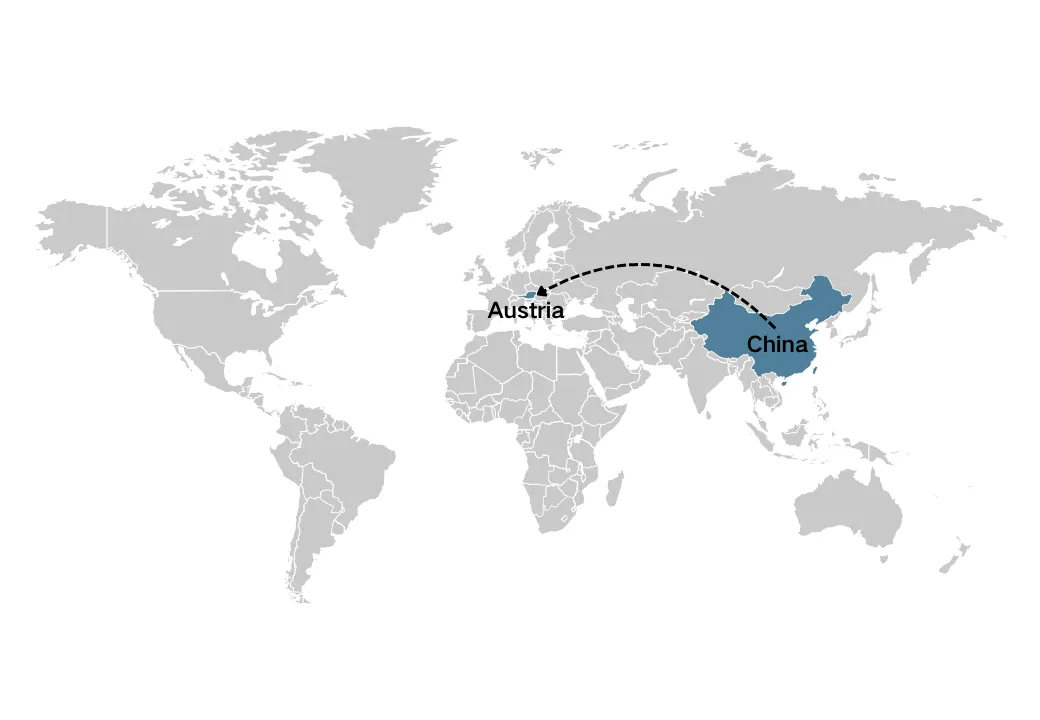
Discover the most reliable and cost-effective methods for shipping from China to landlocked Austria, comparing sea, rail, and air freight options. This expert guide breaks down realistic transit times, inland routing strategies, and DDP customs solutions to streamline your supply chain.
We make shipping from China to Austria simple, reliable, and cost-effective
Competitive Rates
Best shipping rates with no hidden fees. Save up to 40% compared to other forwarders.
Fast Transit
Reliable delivery times with express options available for urgent shipments.
Safe & Secure
Full cargo insurance and secure handling throughout the entire shipping process.
24/7 Support
Dedicated customer support team available around the clock for all your needs.
If you are importing goods, you know that shipping from China to Austria can feel complex due to Austria's landlocked position in the heart of Central Europe. How do you choose between sea, rail, or air freight when you don't have a direct coastline? Whether you are stocking an Amazon FBA warehouse in Vienna or importing industrial machinery to Linz, finding the right balance of cost, speed, and reliability is crucial.
In this comprehensive guide, we draw on our decade of forwarding experience to break down everything you need to know about routing, transit times, customs clearance, and cost-saving strategies for your supply chain.
Sea Shipping from China to Austria
Sea freight from China is the most cost-effective method for transporting large volumes of goods, though it requires the longest transit time (typically 35 to 45 days). Because Austria is a landlocked country, ocean freight cannot arrive directly. Instead, cargo is routed through major European gateway ports—most commonly Hamburg or Bremerhaven in Germany, or the Adriatic ports of Koper (Slovenia) and Trieste (Italy). From these seaports, the cargo is seamlessly transported inland to Austrian cities via a robust rail network or trucking services.
When booking sea freight, you have two primary options based on your cargo volume:
FCL (Full Container Load): You rent an entire 20ft or 40ft container. This is the most economical choice if your shipment exceeds 15 cubic meters (CBM). It also offers better security and faster processing since the container remains sealed until it reaches your facility.
LCL (Less than Container Load): Your goods share container space with other importers. This is ideal for smaller shipments (typically 2-15 CBM). While the per-CBM rate is higher than FCL, it saves you from paying for unused container space. Keep in mind that LCL takes slightly longer due to the consolidation and deconsolidation process at the port.
Rail Shipping from China to Austria
Rail freight offers the perfect middle ground for Austrian importers—it is significantly faster than ocean freight and much more affordable than air freight. Leveraging the China-Europe Railway Express, goods can be transported from Chinese manufacturing hubs to Austria in just 18 to 22 days.
Trains typically travel through Russia, Belarus, and Poland (entering the EU at the Malaszewicze crossing) or via the Middle Corridor. Once in Europe, the cargo is routed to major rail hubs like Duisburg (Germany) or Budapest (Hungary), and then directly forwarded to Austrian rail terminals such as Wien Süd (Vienna South Freight Terminal) or Linz Stadthafen.
In our experience, rail freight is the optimal choice for medium-sized shipments, high-value electronics, or seasonal products that cannot withstand the 40-day ocean transit but do not justify the premium cost of air freight.
Air Shipping from China to Austria
Air freight from China is the absolute fastest, yet most expensive, shipping method available. It typically takes just 3 to 7 days from the supplier's factory in China to your door in Austria.
This method is exclusively recommended for highly urgent shipments, perishable goods, or high-value, low-weight items (like consumer electronics or medical devices). Vienna International Airport (VIE) serves as the primary cargo hub handling international air shipments into the country, though regional airports like Linz (LNZ) or Salzburg (SZG) may handle smaller, specialized air freight.
Standard Air Freight: Takes 5-7 days, balancing speed with slightly lower costs.
Express Courier (DHL, FedEx, UPS): Takes 3-5 days. Best for document parcels or sample shipments under 150 kg, offering seamless door-to-door tracking.
Door to Door Shipping from China to Austria
Door-to-Door (DDP - Delivered Duty Paid) shipping is the ultimate hands-off solution for importers. Under this arrangement, your freight forwarder handles the entire logistics chain from the factory floor in China to your designated warehouse, business address, or Amazon FBA center in Austria.
With a DDP service, all transportation, export/import customs clearance, and payment of Austrian import duties and VAT are handled upfront by the forwarder. This means you receive your goods with zero hidden fees and no sudden delays at the customs border. It is highly recommended for e-commerce sellers and businesses that lack a dedicated in-house customs team.
Major Shipping routes from China to Austria
Understanding the routing helps you anticipate transit times and potential bottlenecks. Here is a breakdown of the primary logistics corridors:
Shipping Method
Origin Hubs in China
Gateway Port / Hub
Final Destination in Austria
Sea Freight (Northern Route)
Shanghai, Shenzhen, Ningbo
Hamburg / Bremerhaven (Germany)
Vienna, Linz, Salzburg (via Rail/Truck)
Sea Freight (Southern Route)
Guangzhou, Shenzhen, Yantian
Koper (Slovenia) / Trieste (Italy)
Graz, Villach, Vienna (via Rail/Truck)
Rail Freight
Xi'an, Chengdu, Chongqing
Malaszewicze (PL) / Budapest (HU)
Wien Süd (Vienna), Linz
Air Freight
PVG, SZX, CAN, HKG
Direct or via Frankfurt (FRA)
Vienna International Airport (VIE)
Expert Tip: Utilizing the southern route via Koper or Trieste can sometimes shave 3 to 5 days off the ocean transit time compared to routing through Northern European ports like Hamburg, depending on vessel schedules.
Shipping cost from China to Austria
Freight costs fluctuate based on seasonality (e.g., pre-Chinese New Year spikes), fuel prices, and capacity. Rather than dealing with unpredictable spot market rates, partnering with an established forwarder ensures you benefit from preferential contract rates and below-market averages.
Below is a rough market estimate for reference (rates are indicative and subject to change):
Shipping Mode
Estimated Cost Range
Best For
Air Freight
$4.50 - $8.00 per kg
Urgent, high-value, lightweight cargo (< 500kg)
Rail Freight (LCL)
$1.50 - $2.50 per kg
Medium urgency, heavy/dense cargo
Sea Freight (LCL)
$80 - $150 per CBM
Small, non-urgent shipments (2-15 CBM)
Sea Freight (FCL 20ft)
$2,500 - $4,000 per container
Large volume shipments (> 15 CBM)
Shipping time from China to Austria
Time is money in supply chain management. Here is a realistic breakdown of door-to-door transit times to help you plan your inventory:
Shipping Mode
Port-to-Port / Airport-to-Airport Time
Total Door-to-Door Time
Express Courier
2 - 3 Days
3 - 5 Days
Air Freight
3 - 5 Days
5 - 8 Days
Rail Freight
14 - 18 Days
20 - 25 Days
Sea Freight (via Koper/Trieste)
25 - 30 Days
35 - 40 Days
Sea Freight (via Hamburg)
30 - 35 Days
40 - 45 Days
Import duty from China to Austria
Because Austria is a member state of the European Union, it adheres to the unified EU customs regulations. Whether your goods enter the EU via a German seaport or land directly in Vienna, the same fundamental rules apply.
Here are the critical customs elements you must prepare for:
EORI Number: You must have an Economic Operators Registration and Identification (EORI) number to import goods commercially into Austria.
HS / TARIC Codes: Your product's classification determines the exact duty rate. Most manufactured goods face duties ranging from 0% to 10%.
Value Added Tax (VAT): The standard Austrian VAT (Mehrwertsteuer - MwSt) is 20%. This is calculated based on the CIF value (Cost of goods + Insurance + Freight) plus the import duty.
Customs Documentation: Ensure your supplier provides a pristine Commercial Invoice, Packing List, and a Bill of Lading or Air Waybill.
Shipping process from China to Austria
Importing doesn't have to be chaotic. Follow this standard operational procedure for a smooth shipment:
Quote & Book: Provide your forwarder with the cargo details (weight, volume, commodity) and Incoterms (e.g., FOB or EXW) to get a comprehensive quote.
Pickup & Consolidation: The forwarder arranges pickup from your Chinese supplier and brings the goods to their export warehouse.
Export Customs Clearance: Chinese customs process the outgoing shipment.
International Transit: The goods travel via sea, rail, or air.
Import Customs Clearance: Upon arriving at the EU border (e.g., Hamburg or Vienna), the broker files the import declaration and pays duties/VAT.
Final Inland Delivery: The cargo is loaded onto a truck or regional train for the final mile delivery to your Austrian address.
Your Trusted Freight Forwarder for Alibaba & 1688 Shipments to Austria
Sourcing from platforms like Alibaba or 1688 presents unique challenges, from communicating with multiple suppliers to consolidating various small orders. DTFU International Logistics specializes in simplifying this process.
Why choose DTFU for your Austrian imports?
One-Stop Consolidation: We collect goods from multiple suppliers across China, store them in our warehouse, and ship them as a single, cost-efficient load.
Transparent Pricing: No hidden fees. We provide clear, upfront quotes leveraging our preferential contract rates.
Expert DDP Solutions: We handle all the complexities of Austrian customs, meaning you don't have to worry about VAT calculations or border delays.
Dedicated Support: Fast, professional customer response times from a team that understands both the Chinese export market and European import compliance.
Frequently Asked Questions
Get answers to common questions about shipping from China to Austria
Sea freight (specifically FCL for large volumes or LCL for smaller loads) is the most economical option. However, it takes around 40 days, so you must plan your inventory well in advance.
Yes, but they are classified as Dangerous Goods (DG). They require special handling, specific MSDS (Material Safety Data Sheet) documentation, and UN testing reports. Not all air or rail services accept batteries, so you must declare them to your forwarder before booking.
Duties are calculated based on the product's TARIC code applied to the customs value (product cost + shipping + insurance). The 20% Austrian VAT is then applied to the sum of the customs value plus the import duty. For seamless processing, professional customs clearance services are highly recommended.
On average, a 20ft container costs between $2,500 and $4,000, while a 40ft container ranges from $3,500 to $5,500. However, because Austria is landlocked, you must account for the inland trucking or rail transfer from gateway ports like Hamburg or Koper. In our experience, routing through Koper can sometimes offer lower inland drayage costs to southern Austria (like Graz) compared to trucking all the way from Northern Germany.
While standard sea freight takes 35-45 days, delays usually happen during the inland transfer phase. For instance, winter weather can slow down trucking across the Alps, and congestion at major rail hubs like Budapest or Duisburg can add 3-5 days to your final delivery. We always recommend adding a 7-day buffer to your supply chain planning during peak seasons (like pre-Christmas or pre-Chinese New Year).
Ready to Shipping from China to Austria?
Get your instant quote today and experience the difference of working with a professional freight forwarder.
5000+
Successful Shipments
98%
Customer Satisfaction
Get Your Free Quote
Response within 2 hours • No obligation • Free consultation
We use cookies to enhance your browsing experience and analyze site traffic. By continuing to use our site, you consent to our use of cookies. Learn more in our Cookie Policy.