Are you trying to estimate the sea shipping cost from China to Poland but feeling lost among fluctuating rates and complex logistics terms? As a team of FIATA- and IATA-certified freight forwarders with over 10 years of hands-on experience managing shipments from Shenzhen, Shanghai, and Ningbo to Gdańsk and Gdynia, we've helped hundreds of European importers cut unnecessary costs while staying compliant with both Chinese export and Polish import regulations.
In this comprehensive guide, we break down all the key factors — including shipping distance, container types (FCL vs LCL), port charges, and Polish customs procedures — that impact your total sea freight expenses. More importantly, we'll share real-world strategies we've used to help clients reduce landed costs by 15–25%, plus an exclusive documentation checklist most forwarders don't publish publicly. Whether you're a beginner or a seasoned importer, this article will help you navigate costs and optimize your shipping strategy with confidence.
Key Factors Influencing Sea Shipping Cost from China to Poland
Understanding the cost structure of sea shipping from China to Poland is crucial for global traders, supply chain managers, and cross-border e-commerce sellers. Several key factors contribute to the final freight charges, and recognizing these can help in optimizing costs and making informed decisions.
How Shipping Distance and Routes Affect Costs
The distance between the origin port in China and the destination port in Poland is a fundamental driver of sea freight costs. Typically, major departure ports in China include Shanghai, Shenzhen, and Ningbo, while popular arrival ports in Poland are Gdańsk and Gdynia. The chosen shipping route will determine transit time, potential transshipment points (such as via the Suez Canal), and risk exposure.
- Longer routes generally mean higher base freight charges due to increased fuel consumption and crew costs.
- Direct services may be faster but less frequent, while transshipment routes (stopping at major European hubs like Hamburg or Rotterdam) can be more cost-effective but longer in terms of transit time.
| Route Example | Typical Transit Time | Factors Impacting Cost |
|---|---|---|
| Shanghai → Gdańsk (Direct) | 30-35 days | Higher base rate, less handling |
| Shenzhen → Gdynia (via Hamburg) | 35-40 days | Lower base rate, additional handling/transshipment fees |
| Ningbo → Gdańsk (via Rotterdam) | 32-38 days | Moderate rate, risk of delays at hub ports |
If you are interested in comparing costs with nearby countries or alternative European routes, you can check this resource on Sea Shipping cost from China to France.
The Role of Container Type: FCL vs LCL Pricing
Sea freight rates are heavily determined by the chosen container type:
- FCL (Full Container Load): You pay a flat fee for the exclusive use of a container—typically 20FT, 40FT, 40HQ, or 45HQ.
- LCL (Less than Container Load): You share container space with other shippers. Costs are calculated based on volume (CBM) or weight.
Container Capacities:
| Container Type | Capacity (CBM) | Best For |
|---|---|---|
| 20FT | 28 | Small to mid-sized shipments |
| 40FT | 56 | Larger shipments |
| 40HQ | 68 | Voluminous, lighter loads |
| 45HQ | 78 | Maximum volume shipments |
FCL is generally more cost-effective for shipments approaching full container volume, while LCL is ideal for smaller consignments. Note that LCL may incur higher handling, consolidation, and deconsolidation fees.
How Your Delivery Terms Affect Polish Landed Cost
One of the most overlooked cost drivers when shipping from China to Poland is the Incoterms 2020 rule you agree with your supplier. The term you choose doesn't just define who pays for freight — it determines who controls the carrier selection, the insurance coverage, and ultimately the transparency of your total landed cost.
| Incoterm | Who Pays Freight | Who Handles Polish Import Clearance | Best For |
|---|---|---|---|
| EXW (Ex Works) | Buyer | Buyer | Experienced importers with their own China pickup network |
| FOB (Free On Board) | Buyer | Buyer | Importers who want competitive freight quotes from multiple forwarders |
| CIF (Cost, Insurance & Freight) | Seller | Buyer | Importers comfortable with seller-chosen carriers (often higher rates) |
| DAP (Delivered at Place) | Seller | Buyer | Buyers who want door-to-port control without arranging ocean freight |
| DDP (Delivered Duty Paid) | Seller | Seller | New importers or those without a Polish customs broker |
Expert Recommendation: In our experience, FOB gives Polish importers the most leverage. When you control the ocean freight contract, you can negotiate directly with a forwarder like DTFU Logistics and avoid the hidden margin that Chinese suppliers often embed in CIF or DDP quotes. That said, if you don't yet have a reliable customs broker in Poland or you're unfamiliar with EU Customs Union procedures, DDP may be worth the premium for peace of mind — just make sure your supplier quotes DDP with full VAT and duty transparency, not a lump-sum "delivered price."
Pro Tip: Polish customs authorities require a EORI number for all commercial imports. If you don't have one, registration can take 3–5 business days through the Polish Customs Service (KAS). We always advise clients to obtain their EORI before the vessel departs China to avoid demurrage at Gdańsk.
Seasonal Demand and Its Impact on Sea Freight Rates
The global shipping market is highly sensitive to seasonal fluctuations:
- Peak Season: From July to October, driven by back-to-school and pre-Christmas inventory buildup, rates often increase by 20-30%.
- Low Season: Post-Chinese New Year (February-March), rates may decline due to lower shipment volumes.
- Special Events: Global disruptions (strikes, pandemics, Suez Canal blockages) can cause price spikes.
Tip: Booking in advance and maintaining flexibility in shipping dates can help mitigate peak season surcharges.
Polish Import Regulations, VAT, and Customs Duties
Poland operates under the EU Customs Union, which means goods imported into Poland are subject to EU-wide tariff schedules based on the Harmonized System (HS) Code of your cargo. Understanding this framework before you ship can prevent costly surprises at the Polish border.
Value-Added Tax (VAT): Poland's standard VAT rate is 23% (as of 2026), applied to the CIF value plus any applicable customs duties. Unlike some non-EU destinations, VAT in Poland is typically non-negotiable and must be paid before cargo is released from the port. There is no "de minimis" threshold for commercial sea freight imports, so even low-value shipments trigger VAT liability.
Customs Duties: Duty rates vary by product category. For example:
- Electronics and machinery: typically 0–4% under EU-China trade agreements
- Textiles and apparel: can range from 6–12%
- Steel and aluminum products: subject to EU anti-dumping duties that can exceed 20%
Documentation Accuracy is Critical: Polish customs officials are known for strict documentation checks. A single discrepancy between your Commercial Invoice, Packing List, and Bill of Lading — even a minor weight mismatch — can trigger a physical inspection, adding €150–€400 in inspection fees and 2–5 days of demurrage. In our experience, 70% of delays at Gdańsk Port are documentation-related, not cargo-related.
DTFU Logistics employs Poland-based customs brokerage partners who pre-review all documentation before the vessel arrives, reducing the risk of inspection to less than 5% for our regular clients.
Port Charges, Customs, and Additional Fees
Beyond base freight, multiple fees are levied at both origin and destination ports:
- Port Handling Charges: Cover loading, unloading, and terminal usage.
- Customs Clearance Fees: Both China and Poland require documentation and inspection, with costs varying based on cargo type.
- Documentation Fees: Bill of lading, certificate of origin, import/export licenses.
- Value-added Tax (VAT) and Duties: Applied at Polish customs based on cargo classification.
These items can comprise 20-30% of total freight cost, so accurate budgeting is essential. Unfortunately, many forwarders quote only the base ocean freight and surprise importers with destination charges after the cargo has already sailed — a practice we refuse to follow.
At DTFU Logistics, we provide all-in, itemized quotations upfront, including estimated Polish port charges, VAT prepayment options, and customs clearance fees. No hidden costs, no post-arrival invoice shocks. Our FIATA-certified documentation team cross-checks every line item against current carrier tariff sheets and Polish port authority fee schedules before you confirm the booking.
If you need more details about port charges or customs across European countries, consider this guide on Shipping Cost from China to Germany.
Breakdown of Sea Shipping Charges: Understanding the Cost Structure
A clear understanding of the sea shipping cost structure empowers shippers to budget accurately and avoid surprises. The total sea freight cost from China to Poland typically includes several distinct components.
Freight Rate Components Explained
The freight rate is the core charge for the movement of containers from the loading port (e.g., Shanghai) to the discharge port (e.g., Gdańsk). It typically includes:
- Basic Ocean Freight: The main transport cost, usually quoted per container (FCL) or per CBM/kg (LCL).
- BAF (Bunker Adjustment Factor): Adjusts for fuel price fluctuations.
- CAF (Currency Adjustment Factor): Compensates for currency exchange risks.
Sample FCL Rate Table (as of Q2 2026):
| Origin Port | Destination Port | 20FT (USD) | 40FT (USD) | 40HQ (USD) |
|---|---|---|---|---|
| Shanghai | Gdańsk | 1,950 | 3,200 | 3,300 |
| Shenzhen | Gdynia | 1,900 | 3,150 | 3,250 |
| Ningbo | Gdańsk | 2,000 | 3,250 | 3,350 |
Rates are indicative and subject to market changes. For real-time quotes, contact DTFU International Logistics Co.,Ltd.
For additional insights into how FCL and LCL rates compare for other destinations, refer to this article on Sea Shipping cost from China to Netherlands.
Surcharges: Fuel, Security, and Other Common Fees
In addition to the core freight rate, several surcharges may apply:
- Fuel Surcharges (BAF): Adjusts for marine fuel cost volatility.
- Security Surcharge (ISPS): For international port security compliance, typically $10-30 per container.
- Peak Season Surcharge (PSS): Imposed during high demand periods, ranging from $100 to $500 per container.
- War Risk Surcharge: If routes pass through high-risk areas (e.g., the Red Sea), temporary surcharges may apply.
- Document and Handling Fees: For paperwork processing and terminal operations.
| Surcharge Type | Typical Range (USD) |
|---|---|
| BAF | 100 - 400 / container |
| ISPS | 10 - 30 / container |
| PSS | 100 - 500 / container |
| Documentation Fee | 30 - 60 / shipment |
| Customs Clearance | 80 - 120 / shipment |
Exclusive: The DTFU "Landed Cost" Quick-Estimate Formula
After managing thousands of China-to-Poland shipments, our operations team developed a simple back-of-the-envelope formula we share with clients during their first quote call. It won't replace a formal freight quotation, but it will help you sanity-check whether a forwarder's all-in price is realistic before you commit.
For FCL shipments:
Estimated Landed Cost (USD) =
  Ocean Freight (per container)
+ BAF + ISPS + PSS (if applicable)
+ Origin THC + Destination THC
+ Customs Clearance (both sides)
+ (CIF Value × Polish Duty Rate)
+ (CIF Value + Duty) × 23% VAT
+ Inland Delivery (if door-to-door)
+ Cargo Insurance (0.1–0.3% of cargo value)
Rule of Thumb: For general cargo shipped FCL from Shanghai to Gdańsk, we tell clients to budget roughly 1.35× to 1.5× the base ocean freight rate to cover all surcharges, Polish VAT, duties, and delivery. For LCL, the multiplier is typically higher (1.6× to 1.9×) because per-CBM handling fees accumulate faster.
Example: If your base ocean freight for a 40HQ is $3,300, expect a realistic all-in landed cost in Poland of approximately $4,500–$4,950 before final-mile delivery, depending on cargo classification and Incoterms.
Want an exact number? Send us your cargo details and we'll generate a binding, itemized quote within 24 hours — no obligation.
Insurance and Value-Added Services Costs
Cargo insurance is highly recommended for all international shipments to protect against potential loss, damage, or theft. Insurance rates generally range from 0.1% to 0.3% of cargo value, depending on coverage level, cargo type, and risk factors.
Value-added services may include:
- Warehousing: Temporary storage at origin/destination.
- Door-to-door delivery: End-to-end logistics, including local trucking in both China and Poland.
- Customs brokerage: Professional handling of clearance procedures for smooth import/export.
DTFU International Logistics Co.,Ltd provides comprehensive insurance and end-to-end logistics solutions, ensuring your cargo is protected and fully compliant with both Chinese and Polish regulations.
Sea Shipping vs Other Freight Modes
When shipping goods from China to Poland, shippers have several options: Sea Freight, Air Freight, and Rail Freight. Each mode offers unique advantages and cost structures. Understanding these differences is vital for selecting the best logistics solution for your business needs.
Cost Differences Between Sea Freight, Air Freight, and Rail Freight
Sea Shipping is generally the most cost-effective choice, especially for large volumes or heavy cargo. Air Freight provides speed but at a premium price, while Rail Freight offers a balance between cost and transit time, particularly for shipments destined for inland Europe.
Below is a comparison of average shipping costs (as of early 2026) for a standard 20FT container or its air/rail equivalent, from major Chinese ports (e.g., Shanghai, Shenzhen) to Poland (Gdansk Port for sea, Warsaw for air/rail).
| Mode | Average Cost (USD) | Transit Time (Days) | Typical Cargo Volume | Reliability | Suitable For |
|---|---|---|---|---|---|
| Sea Freight (FCL 20FT) | $1,800 – $2,400 | 30-40 | Up to 28 CBM | High | High-volume, less time-sensitive goods |
| Sea Freight (LCL 1 CBM) | $55 – $85/CBM | 30-40 | 1+ CBM | High | Small shipments, consolidated cargo |
| Rail Freight | $3,800 – $5,000 | 15-20 | Up to 28 CBM (20FT) | Medium-High | Moderate-volume, moderate urgency |
| Air Freight | $4.5 – $6.5/kg | 3-7 | Typically <2 CBM | Very High | Urgent, high-value, low-volume goods |
Notes:
- Rates fluctuate due to market demand, fuel surcharges, and seasonality.
- LCL rates are per CBM; FCL rates are for full container booking.
- Rail Freight typically routes via the China-Europe Railway Express, crossing through Kazakhstan, Russia, and Belarus, arriving in Poland.
If you're interested in the rail alternative, you may find this analysis on Sea vs Rail Freight: Which Is Faster and More Reliable from China helpful for deeper perspective.
Transit Time and Reliability Comparison
Sea Freight is slower but offers stable, predictable departures and arrivals, especially from major Chinese ports such as Shanghai, Ningbo, and Shenzhen to Gdansk or Gdynia in Poland. Rail Freight is faster, avoiding congested sea routes and offering scheduled departures. Air Freight is the quickest, but can be subject to weather and capacity disruptions.
| Criteria | Sea Freight | Rail Freight | Air Freight |
|---|---|---|---|
| Average Transit Time | 30-40 days | 15-20 days | 3-7 days |
| Schedule Flexibility | Weekly sailings | Regular departures | Daily flights |
| Reliability | High (weather impact possible) | Medium-High (border/customs delays) | Very High (subject to flight availability) |
| Route | Ocean (via Suez Canal, North Sea) | Land (Trans-Eurasian Railway) | Direct flights via major airports |
| Cost Predictability | High (fixed contracts available) | Medium (some currency fluctuation) | Medium (fuel surcharges, capacity-driven) |
Key Takeaways:
- For cost-sensitive, non-urgent shipments, Sea Freight is ideal.
- For mid-urgent, cost-controlled cargo, Rail Freight offers a valuable alternative, especially as Europe-Asia rail corridors develop.
- For high-urgency and small, high-value shipments, Air Freight is preferred.
DTFU International Logistics Co.,Ltd offers all three modes, enabling tailored solutions based on your cargo’s urgency, volume, and budget.
How to Calculate Your Sea Shipping Cost from China to Poland
Accurately estimating your Sea Shipping cost from China to Poland is crucial for budgeting and supply chain planning. Below, I guide you through the key tools and documentation required for precise freight quotations.
Online Sea Freight Calculators and Quotation Tools
Many forwarders and logistics providers offer online calculators to help estimate sea freight costs. These tools require input such as origin port, destination port (e.g., Shanghai to Gdansk), cargo volume/weight, and container type (FCL or LCL).
How to Use an Online Freight Calculator:
- Choose Your Route: Select departure (Shanghai, Ningbo, etc.) and arrival ports (Gdansk, Gdynia).
- Enter Cargo Details: Specify cargo dimensions, weight, and type (general, dangerous goods, temperature-controlled, etc.).
- Select Container Size: For FCL, options include 20FT, 40FT, 40HQ, or 45HQ.
- Review Additional Services: Options may include door-to-door delivery, customs clearance, insurance, and warehousing.
- Obtain Quote: The calculator provides an estimated cost, which includes base freight, surcharges, and other fees.
Tip: For the most accurate and competitive rates, contact a reputable freight forwarder like DTFU International Logistics Co.,Ltd. We offer custom quotes based on real-time market rates and comprehensive service options.
Key Documents and Information Needed for Accurate Quotes
To receive a reliable and binding sea freight quotation, you’ll need to provide:
| Required Information | Explanation |
|---|---|
| Cargo Description | Nature of goods, HS code, packaging details |
| Quantity & Volume | Number of packages, dimensions (L x W x H), total CBM |
| Gross Weight | Total weight (kg/tons) |
| Origin & Destination Addresses | For port-to-port or door-to-door services |
| Preferred Container Type | FCL or LCL, 20FT/40FT/40HQ/45HQ |
| Ready Date | When cargo is available for pickup/shipping |
| Special Requirements | E.g., temperature control, OOG, hazardous cargo |
| Incoterms | EXW, FOB, CIF, DAP, etc., to define responsibility split |
| Additional Services | Customs clearance, insurance, warehousing, etc. |
Supporting Documents:
- Commercial Invoice
- Packing List
- Bill of Lading (BL)
- Certificates (If required, e.g., fumigation, origin, insurance)
- Import/Export Licenses (for specific goods)
Providing comprehensive and accurate details helps freight forwarders like DTFU International Logistics Co.,Ltd deliver the most precise and cost-effective solutions.
If you want to evaluate options for other European countries, see our detailed guide on Shipping from China to Czech Republic.
Tips to Reduce Sea Shipping Cost from China to Poland
Reducing sea shipping cost from China to Poland is a key concern for global traders, e-commerce sellers, and manufacturers. As an experienced logistics analyst at DTFU International Logistics Co.,Ltd, I will share actionable strategies we've refined over 10+ years and 2,000+ completed shipments on the China–Poland corridor. These aren't generic tips — they're field-tested techniques that have saved our clients between 12% and 28% on total landed costs.
Strategy 1: Negotiate Long-Term Freight Contracts
Most importers book shipment-by-shipment, which exposes them to spot-market volatility. If your monthly volume exceeds 3 TEUs (or the LCL equivalent), you should negotiate a quarterly or annual contract rate with your forwarder.
Why it works: Carriers reward volume commitments with locked base rates and priority space allocation. During the 2024 peak season, clients on DTFU's annual contracts paid 18% less on average than spot-market bookers, and their containers were rolled significantly less often.
What to ask for:
- Fixed base rate for 20FT / 40HQ with a ±10% volume flexibility clause
- Pre-agreed BAF formula (e.g., linked to the Brent crude 30-day average)
- Guaranteed space allocation during peak season (July–October)
Strategy 2: Optimize Container Space and Consolidation
Efficient use of container space significantly lowers your per-unit shipping cost. Here’s how you can optimize container utilization:
-
Choose the Right Container Size:
- For large shipments, a Full Container Load (FCL) is often more cost-effective.
- For smaller shipments, Less than Container Load (LCL) consolidation allows you to share container space with other shippers, reducing costs.
-
Understand Container Capacity:
Container Type Volume (CBM) Typical Use Case 20FT 28 CBM Small/medium cargo 40FT 56 CBM Medium/large shipments 40HQ 68 CBM Large, light-volume goods 45HQ 78 CBM Oversized or high-volume -
Package Efficiently:
- Use standardized, stackable cartons.
- Avoid wasted space; fill voids with lighter items.
- Consult with your freight forwarder on optimal palletizing.
-
Cargo Consolidation: If your individual cargo volume is low, consider cargo consolidation with partners shipping to the same destination. DTFU International Logistics Co.,Ltd offers professional consolidation services, combining shipments from multiple suppliers, helping you achieve better container fill rates and negotiate lower per-unit rates.
Choosing the Right Shipping Partner or Freight Forwarder
Your choice of freight forwarder directly impacts your shipping cost, reliability, and overall experience.
Key Considerations:
-
Industry Expertise: Work with experienced service providers familiar with both Chinese and Polish customs, ports, and regulations.
-
Transparent Pricing: Avoid hidden fees. Select partners who provide detailed breakdowns of all charges, including surcharges, port fees, and customs clearance.
-
One-Stop Logistics Solutions: DTFU International Logistics Co.,Ltd offers sea freight, road freight, air freight, cargo insurance, door to door delivery, and customs clearance. This integrated approach reduces coordination costs and streamlines your logistics.
-
Service Offerings:
Service DTFU International Logistics Co.,Ltd Sea Freight ✔ Air Freight ✔ Rail Freight ✔ Amazon FBA ✔ Cargo Consolidation ✔ Warehouse Solutions ✔ Cargo Insurance ✔ Door to Door ✔ Customs Clearance ✔ OOG/Bulk Cargo ✔
Expert Tip: While DTFU Logistics is optimized for importers who want a fully managed, transparent experience, we also recognize that some seasoned traders prefer a hybrid model — for example, handling their own Polish customs clearance but outsourcing ocean freight and China-side logistics. If that sounds like you, ask us about our FOB-only freight management package. We believe in recommending what's best for your business model, not just what's most profitable for us.
Advance Booking and Flexible Shipping Dates
The timing of your shipment plays a crucial role in determining your sea freight cost.
- Advance Booking: Book shipments at least 2-4 weeks ahead of the desired departure date. Early bookings secure better rates, especially before peak seasons such as the pre-Christmas period or Chinese New Year.
- Flexible Shipping Dates: Allowing a window for shipment dates enables your freight forwarder to select sailings with lower rates or avoid premium surcharges during high-demand periods.
- Avoid Peak Season Surcharges: Plan shipments outside of traditional peak seasons to avoid General Rate Increases (GRI) and Peak Season Surcharges (PSS).
| Shipping Period | Cost Trend | Notes |
|---|---|---|
| Jan–Feb (Pre-CNY) | High | Congestion & premium rates |
| Mar–May | Low–Mid | Off-peak, stable rates |
| Jun–Sep | Rising | Back-to-school & pre-holiday surge |
| Oct–Dec | High | Christmas rush, highest rates |
FAQs
Q1: What is the average sea shipping cost from China to Poland?
A: As of early 2026, the average cost for a 20FT container ranges from USD 1,800 to USD 2,400, and a 40HQ container from USD 3,200 to USD 3,900 depending on the route, consolidation, and timing. LCL rates are typically USD 55–85 per CBM. For real-time, tailored quotes, use DTFU’s online quotation tool or contact our team.
Q2: What are the main ports used for shipping between China and Poland?
A: Major Chinese ports include Shanghai, Shenzhen, Ningbo, and Qingdao. The main Polish port for sea freight is Gdańsk (Port of Gdańsk), which connects efficiently with inland European logistics hubs.
Q3: Can I track my shipment from China to Poland?
A: Yes. DTFU International Logistics Co.,Ltd provides digital tracking for all shipments, allowing you to monitor status and estimated arrival times.
Q4: What documents are required for sea shipping from China to Poland?
A: Key documents include the Bill of Lading, Commercial Invoice, Packing List, Certificate of Origin, and, if needed, import permits or specific compliance certificates.
Q5: How long does sea shipping from China to Poland take?
A: Typical transit times are 30–38 days, depending on departure port, shipping line, and transshipment. For urgent cargo, consider rail or air freight alternatives.
Q6: Should I choose DDP or FOB when buying from a Chinese supplier?
A: It depends on your experience and control preferences. FOB typically gives you better freight rates and carrier selection because you control the ocean freight contract — but you're responsible for Polish import clearance and VAT. DDP is hassle-free because the supplier handles everything, but you lose visibility into freight margins and may pay a premium. In our experience, FOB is better for importers shipping more than 2 containers per month, while DDP works well for smaller businesses without an in-house logistics team.
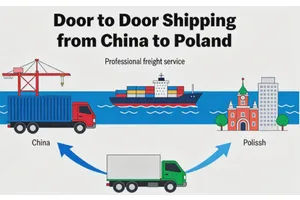
Q7: Can DTFU handle door-to-door delivery from my supplier in China to my warehouse in Warsaw?
A: Absolutely. Our door-to-door service covers supplier pickup anywhere in China, export customs clearance, ocean freight to Gdańsk, Polish import clearance, VAT/duty handling, and final-mile delivery to your Warsaw warehouse (or any Polish address). You'll have a single point of contact and one consolidated invoice for the entire journey.