Are you trying to choose between Air Freight vs Express for shipments from China to the USA? Common pain points include uncertain delivery dates, parcels charged by volumetric weight, documents that slow down customs, and confusion over whether door-to-door convenience is worth the premium. This guide explains the differences in process, transit time, and cost—so you can make a confident, ROI-driven choice.
Quick Decision Guide
| If you need… | Choose | Why it fits |
|---|---|---|
| Delivery in 2–4 days, <45–50 kg | Express | Fastest door-to-door with integrated clearance and end-to-end tracking |
| Best price per kg for 100 kg+ | Air Freight | Lower unit cost for bulk cargo; consolidation keeps rates competitive |
| Door-to-door simplicity for samples | Express | Pickup, brokerage, and final mile included |
| Better control over routing and cost | Air Freight | Flexible carriers/routes; airport-to-airport or door-to-door via forwarder |
| Rural/residential US delivery | Express | Courier networks reach most ZIP codes efficiently |
In the sections below, we break down processes, timelines, charges, and real scenarios—plus a simple framework to choose the right mode for each shipment.
Key Differences Between Air Freight and Express Shipping
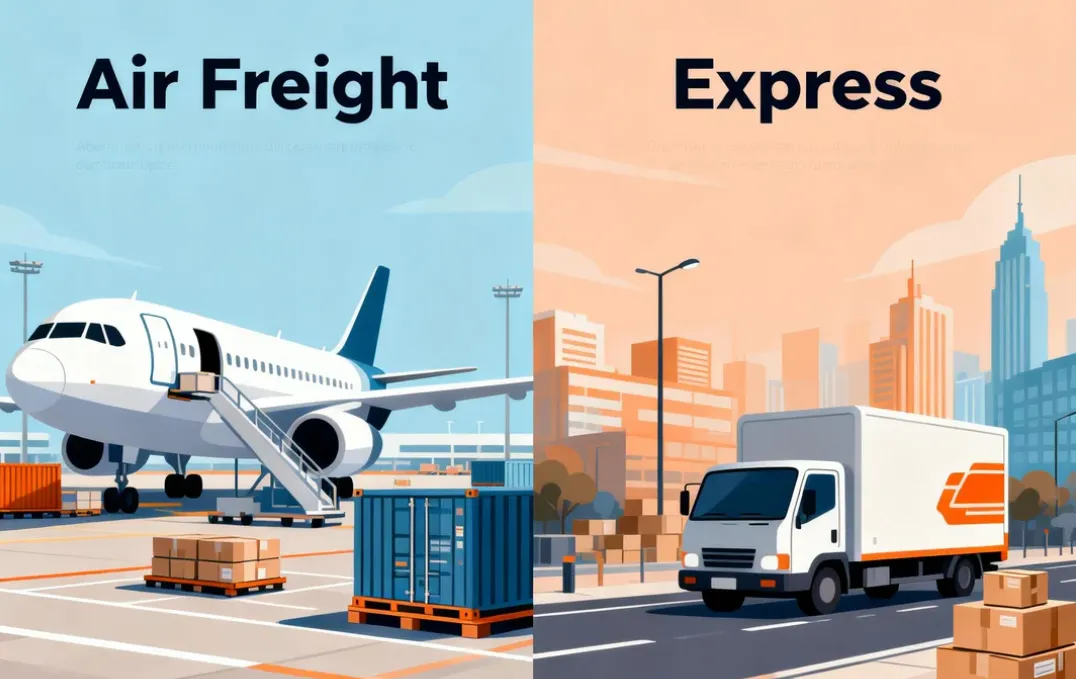
When shipping goods from China to the USA, understanding the distinctions between air freight and express shipping is essential for optimizing both cost and delivery time. While both utilize air transport, they differ significantly in handling, speed, pricing, and suitability for various cargo types.
Shipping Process and Handling Explained
Air Freight involves consolidating shipments from multiple shippers into pallets or containers. These are transported via commercial airlines or dedicated cargo planes. The process generally includes:
- Booking space with a freight forwarder (like DTFU International Logistics)
- Export customs clearance in China
- Cargo consolidation, loading, and air transport to the USA
- Import customs clearance and deconsolidation at destination
- Final delivery, often via truck to the consignee
Air freight is ideal for sizable, heavy, or less time-sensitive cargo.
Express Shipping (e.g., DHL, FedEx, UPS, TNT) is a door-to-door courier service. Typically, the process is:
- Pickup from the shipper’s address in China
- Immediate air transport on dedicated courier flights
- Automated customs clearance using the carrier’s brokerage services
- Last-mile delivery to the consignee’s door in the USA
Express is best for urgent, small, high-value shipments or samples.
Key Differences Table
| Feature | Air Freight | Express Shipping |
|---|---|---|
| Handling | Bulk cargo, pallets, containers | Small parcels, cartons |
| Process | Airport-to-airport, requires trucking | Door-to-door, all-in-one service |
| Customs Clearance | Manual/document-based, may need agent | Usually handled by courier |
| Speed | Fast, but not instant | Fastest, priority boarding |
| Tracking | Flight and warehouse stages | End-to-end real-time tracking |
| Weight/Volume Suitability | 45kg+ (bulk, heavy cargo) | 0.1kg – 70kg (small parcels) |
Transit Time Comparison: Air Freight vs Express
Transit times are a critical consideration for shippers.
- Air Freight: Generally takes 3–7 days (airport to airport), but door-to-door can be 5–10 days, depending on consolidation schedules, customs processing, and delivery arrangements.
- Express Shipping: 2–5 days door-to-door to most major US cities, with services like DHL Express and FedEx International Priority.
Typical Transit Times Table
| Route | Air Freight (Door-to-Door) | Express Shipping (Door-to-Door) |
|---|---|---|
| Shanghai → Los Angeles | 5–8 days | 2–3 days |
| Shenzhen → New York | 5–9 days | 2–4 days |
| Guangzhou → Chicago | 6–10 days | 2–4 days |
| Beijing → Dallas | 6–10 days | 2–5 days |
Note: Times may vary based on peak season, airline schedules, customs processes, and weather disruptions.
Related reading: For a deeper analysis of U.S. import costs, see Freight Cost from China to USA.
Cost Structure: How Are Rates Calculated?
Air Freight:
- Priced mainly by chargeable weight (the greater of actual or volumetric weight).
- Key factors: route, airline, seasonality, fuel surcharges, security fees, and local charges at origin/destination.
- For cargo over 300kg or high volume, air freight is typically more economical per kg versus express.
- Additional costs: pickup/delivery charges, customs brokerage, documentation, and insurance.
Express Shipping:
- All-in-one rates (door-to-door), calculated by actual or volumetric weight.
- Higher per-kg costs, especially for shipments above 21kg.
- Includes pickup, customs clearance, and final delivery; surcharges for remote areas, oversized items, or restricted goods.
Example Rate Table (2026 Indicative Ranges)
| Weight | Air Freight (per kg) | Express Shipping (per kg) |
|---|---|---|
| 10 kg | $7 – $9 | $10 – $16 |
| 50 kg | $5 – $7 | $9 – $13 |
| 100 kg | $4.5 – $6 | $9 – $12 |
| 500 kg | $3.5 – $5.5 | $8 – $11 |
Note: These are indicative rates for reference. For accurate quotes, contact a reliable provider like DTFU International Logistics.
How Fast Is Air Freight and Express from China to USA?
Average Delivery Times for Major US Destinations
Delivery speed depends on multiple factors, but typical estimates for shipments departing from main Chinese airports to top US gateways are as follows:
| Origin Airport | Destination (USA) | Air Freight (Door-to-Door) | Express (Door-to-Door) |
|---|---|---|---|
| PVG (Shanghai) | LAX (Los Angeles) | 5–8 days | 2–3 days |
| SZX (Shenzhen) | JFK (New York) | 5–9 days | 2–4 days |
| CAN (Guangzhou) | ORD (Chicago) | 6–10 days | 2–4 days |
| PEK (Beijing) | DFW (Dallas) | 6–10 days | 2–5 days |
| HKG (Hong Kong) | ATL (Atlanta) | 7–10 days | 2–4 days |
- Express shipping is consistently faster, with more predictable schedules and priority handling.
- Air freight offers competitive speeds for larger shipments but may face delays during peak seasons or due to consolidation wait times.
Further reading: For time-sensitive imports, see the detailed Shipping time from China to USA insights.
Factors Impacting Transit Speed (Customs, Airports, Carriers)
Several critical factors influence how quickly your shipment arrives in the USA:
-
Customs Clearance
- Express carriers often have integrated, expedited clearance with electronic pre-declaration, minimizing delays.
- Air freight may experience longer customs wait times, especially for high-value or complex cargo, or if documents are incomplete.
-
Airport Congestion
- Major hubs like LAX, JFK, and ORD can become congested during peak import periods (e.g., pre-holiday, Q3-Q4).
- Temporary flight capacity reductions can extend handling times.
-
Airline and Carrier Schedules
- Express services operate daily, with multiple flights.
- Air freight consolidations may mean your cargo waits for scheduled departures.
-
Delivery Address
- Shipments going to remote areas may add 1–2 days for final delivery, especially with express shipments.
-
Documentation
- Incomplete or incorrect paperwork can lead to customs holds. Partnering with an experienced freight forwarder like DTFU International Logistics ensures smooth documentation and faster clearance.
-
Weather & Force Majeure
- Typhoons, snowstorms, or unforeseen events (e.g., COVID-19 disruptions, labor strikes) can affect both air freight and express timelines.
-
Security Protocols
- Both China and USA airports have implemented enhanced security measures, especially in times of elevated risk.
Best Practices for Faster Shipping:
- Use complete, accurate documentation.
- Choose reliable, experienced providers with strong US-China routes.
- Consider peak season surcharges and booking early.
Cost Comparison: Which Option Is More Cost-Effective?
Freight Rate Comparison by Weight and Volume
When comparing air freight and express shipping from China to the USA, one of the key decision factors is how freight rates are calculated. Both services use either actual weight (gross weight) or volumetric weight (also known as dimensional weight), but the thresholds and pricing models differ.
Air Freight:
-
Typically more cost-effective for shipments above 100 kg or high-volume cargo.
-
Charges are based on the greater of the gross weight or volumetric weight, calculated as:
- Volumetric weight (kg) = Length (cm) × Width (cm) × Height (cm) / 6000
Express Shipping (e.g., DHL, FedEx, UPS):
- Ideal for parcels under 50 kg or when speed is critical.
- Volumetric divisor is usually 5000. Volumetric weight (kg) = Length (cm) × Width (cm) × Height (cm) / 5000.
- Rates include pick-up, customs clearance, and last-mile delivery.
- Common price breakpoints: 0.5–5 kg (documents/samples), 5–21 kg, 22–44 kg, and 45–70 kg+. Above ~45 kg, air freight often becomes more economical per kg.
Sample Rate Comparison Table (2026 Indicative Ranges)
| Service Type | Weight Range | Rate/kg (USD) | Typical Transit Time | Best For |
|---|---|---|---|---|
| Air Freight | 100-300 kg | $3.5 - $5.5 | 5-8 days | Pallets, bulk cargo |
| Air Freight | 300+ kg | $3.0 - $4.5 | 5-8 days | Large, heavy shipments |
| Express | 0.5-5 kg | $10 - $22 | 2-4 days | Small, urgent parcels |
| Express | 5-21 kg | $10 - $18 | 2-4 days | High-value goods |
| Express | 22+ kg | $7 - $13 | 2-4 days | Medium-size shipments |
Note: Prices shown are indicative for 2026 and may vary depending on origin city (e.g., Shanghai, Shenzhen, Guangzhou), destination in the USA (such as Los Angeles, Chicago, New York), and carrier fuel surcharges.
Recommended resource: For detailed container shipping rates, visit How much to ship a Container from China to USA.
Extra Fees and Surcharges to Watch Out For
Both air freight and express shipping come with potential additional charges:
Air Freight:
- Fuel surcharge (updates monthly/quarterly)
- Security fee (per AWB)
- Terminal handling charge (THC)
- Customs clearance fee (at both origin and destination)
- Warehouse storage charges if the cargo stays longer at the airport
- Delivery charges for door-to-door service
Express Shipping:
- Remote area surcharge (for non-urban US ZIP codes)
- Oversize/Overweight fees
- Duties & taxes (can be billed to shipper or consignee)
- Additional handling fees for irregular parcels
- Insurance (optional but recommended for high-value items)
Pro Tip: Always request a full quotation from your freight forwarder or express provider to avoid unexpected costs.
Real-World Cost Scenarios for Common Shipments
To illustrate the actual cost difference between air freight and express, below are indicative 2026 scenarios from Guangzhou, China to Los Angeles, USA:
| Cargo Type | Dimensions/Weight | Air Freight Cost (USD) | Express Cost (USD) | Transit Time | Notes |
|---|---|---|---|---|---|
| 3 cartons, electronics | 0.5 CBM/60 kg | $280 | $560 | 6 days (air), 3 days (express) | Express nearly 2x more, but much faster |
| 5 pallets, machinery parts | 6 CBM/1200 kg | $4,200 | $12,000+ | 6 days (air), 4 days (express) | Air freight is more economical for large shipments |
| Apparel, small batch | 0.1 CBM/15 kg | $90 | $190 | 6 days (air), 2 days (express) | Express offers both speed and convenience |
For bulk cargo, air freight is significantly more cost-effective, while express shines for urgent, lightweight parcels.
DTFU International Logistics offers transparent pricing, ensuring no hidden fees, and provides full cost breakdowns before shipment.
When to Choose Air Freight or Express Shipping?
Best Use Cases for Air Freight (Large, Heavy Shipments)
Air Freight is optimal when:
- Your shipment is over 100 kg or occupies significant volume (e.g., more than 1 CBM).
- The cargo is not critically urgent (5–8 days transit is acceptable).
- You need better rates for bulk movement, such as machinery, industrial components, fashion stock, or automotive parts.
- You require flexible delivery options (airport-to-airport, door-to-door available via forwarder).
- You are shipping to major US airports (Los Angeles International Airport, Chicago O’Hare, New York JFK) for further distribution.
Best Use Cases for Express (Small, Urgent Shipments)
Express Shipping is ideal when:
- Speed is essential (delivery within 2–4 days).
- Shipments are under 50 kg, or consist of high-value, small-volume goods.
- You’re sending important documents, samples, electronics, or medical supplies.
- Door-to-door delivery and full tracking is necessary.
- You need a hassle-free experience with customs clearance included and minimal paperwork.
- Remote or residential addresses in the USA are the destination.
Related guide: Explore additional options for How much does it Cost to Ship a Pallet from China to USA.
Volume, Weight, and Value Considerations
When deciding between air freight and express, evaluate:
- Volume: If your shipment is over 1 CBM or more than 3 cartons, air freight is generally more cost-effective.
- Weight: Shipments exceeding 100 kg favor air freight due to lower per-kg rates for bulk.
- Value: High-value or time-sensitive goods (like electronics, luxury goods) are better suited to express for enhanced security and speed.
- Fragility: Express offers better handling for fragile items due to dedicated parcel networks.
- Budget vs. Speed: If cost sensitivity outweighs urgency, select air freight. If delivery speed is critical, opt for express.
- Destination: For rural or hard-to-reach locations in the US, express is often the only viable option.
Tip from Ivan Chan: Engage with an experienced freight forwarder like DTFU International Logistics to analyze your cargo profile, delivery deadlines, and cost objectives. Our team provides tailor-made solutions, whether you need standard air freight, fast express shipping, or integrated services like customs clearance, cargo insurance, and door-to-door logistics.
Summary Table: When to Choose Which Mode
| Factor | Air Freight | Express Shipping |
|---|---|---|
| Weight | >100 kg | <50 kg |
| Volume | >1 CBM | <0.5 CBM |
| Transit Speed | 5-8 days | 2-4 days |
| Handling | Pallets, bulk cargo | Parcels, documents |
| Cost-Effectiveness | High for large shipments | High for urgent, small items |
| Customs | Separate clearance needed | Included in service |
| Tracking | Standard | End-to-end, real-time |
| Delivery Type | Airport-to-airport/door | Door-to-door worldwide |
For further assistance or a personalized shipping quote, contact DTFU International Logistics—your trusted partner in global trade, offering comprehensive sea freight, air freight, road freight, Amazon FBA, warehousing, cargo insurance, and customs clearance solutions.
Customs Clearance: What to Expect with Air Freight and Express
Customs Procedures and Required Documents
Customs clearance is a crucial part of international shipping, especially when moving cargo from China to the USA. Both Air Freight and Express Shipping require compliance with U.S. Customs and Border Protection (CBP) regulations. However, the procedures and documentation can differ based on the shipping mode.
Air Freight:
- Customs Declaration: All air freight shipments must be declared to CBP. This involves submitting a Bill of Lading (or Air Waybill (AWB)), Commercial Invoice, Packing List, and any required permits or certificates (such as FDA, FCC, or CITES if applicable).
- Importer Security Filing (ISF): Also called “10+2 filing,” this is mandatory for ocean freight but not for air freight. However, accurate pre-advice and manifest filing are still required.
- Customs Bond: Shipments valued over $2,500 or subject to other regulations must have a customs bond.
- Entry Summary (Form 7501): This document summarizes the shipment’s value, classification, and applicable duties/taxes.
Express Shipping (Courier Services like DHL, FedEx, UPS):
- Integrated Process: Express providers act as both carrier and customs broker, streamlining the process.
- Waybill/Invoice: A commercial invoice and air waybill are required. The provider submits customs data electronically.
- Simplified Clearance: For shipments under $800 (de minimis value), clearance is faster with minimal paperwork.
- Automated Brokerage: Express companies usually handle all customs duties, taxes, and required documentation on behalf of the customer.
Required Documents Table:
| Document | Air Freight | Express Shipping |
|---|---|---|
| Air Waybill/Bill of Lading | Required | Required |
| Commercial Invoice | Required | Required |
| Packing List | Required (often checked) | Sometimes required |
| Import Licenses/Permits | If applicable (by cargo type) | If applicable |
| Customs Bond | Required if value > $2,500 | Handled by express provider |
| Entry Summary (7501) | Required for formal entries | Handled by express provider |
| Power of Attorney | Usually required for formal clearance | Not usually required |
Tip: Always double-check the product HS Code, value declaration, and consignee information to prevent clearance delays.
How to Avoid Delays at US Customs
Delays at US Customs can cause extra costs and disrupt your supply chain. Here’s how to minimize risks for both Air Freight and Express shipments:
- Ensure Accurate Documentation: Incorrect or incomplete paperwork is the leading cause of customs holds. Double-check all information, especially value, product description, and HS code.
- Pre-Alert and Pre-Advice: Notify your freight forwarder or courier early with all shipping documents so they can begin the clearance process before arrival.
- Know the Regulations: Some products (like electronics, food, or pharmaceuticals) require permits from agencies such as the FDA or FCC. Research requirements for your goods.
- Use a Reliable Customs Broker: For air freight, partner with a professional broker. For express shipments, major couriers usually handle brokerage internally.
- Track Your Shipment: Use tracking systems to monitor customs clearance status in real-time. This allows you to respond quickly if an issue arises.
- Respond Promptly to CBP Requests: If CBP requests additional information or inspection, respond as soon as possible to avoid storage or demurrage fees.
- Utilize Experienced Freight Forwarders: At DTFU International Logistics, we provide end-to-end customs clearance support, helping you avoid typical pitfalls and ensuring fast, compliant entry into the United States.
Tips to Optimize Your Shipping from China to USA
How to Reduce Costs Without Sacrificing Speed
Balancing speed and cost efficiency is essential for competitive international shipping. Here are proven strategies:
-
Choose the Right Service for Your Cargo:
- For bulk or heavy goods, Air Freight is generally more cost-effective than Express.
- For parcels under 45 kg or urgent deliveries, Express Shipping is faster but usually at a premium.
-
Consolidate Shipments:
- Combine multiple small shipments into one consolidated air freight load to benefit from bulk rates and reduced per-unit costs.
-
Plan Ahead and Book Early:
- Last-minute bookings often face higher rates. Scheduling in advance allows for better pricing and more options.
-
Leverage Multiple Carriers or Routes:
- Sometimes, routing via less congested airports (e.g., Chicago O’Hare instead of LAX) can lower costs and avoid delays.
-
Negotiate Long-Term Contracts:
- If you ship regularly, negotiate rates with your logistics provider for stable pricing.
-
Use a Professional Freight Forwarder:
- An experienced forwarder can optimize your logistics chain, suggest cost-saving alternatives, and manage customs efficiently.
-
Utilize Cargo Insurance Wisely:
- Insure only the value you can’t afford to lose. Compare insurance rates and coverage details.
Sample Cost & Transit Time Table (2026):
| Origin (China Airport) | Destination (US Airport) | Air Freight (Econ, 100kg) | Express (5kg) | Transit Time (Air Freight) | Transit Time (Express) |
|---|---|---|---|---|---|
| Shanghai (PVG) | Los Angeles (LAX) | $3.5–$5.5/kg | $10–$16/kg | 3-5 days | 2-3 days |
| Shenzhen (SZX) | New York (JFK) | $3.5–$5.5/kg | $10–$16/kg | 4-6 days | 2-3 days |
| Guangzhou (CAN) | Chicago (ORD) | $3.5–$5.5/kg | $10–$16/kg | 4-6 days | 2-4 days |
Note: Actual rates and times fluctuate based on seasonality, cargo type, and carrier capacity. Contact DTFU International Logistics for a tailored quote.
You may also be interested in: Shipping from Shanghai to USA, which covers additional shipping strategies and considerations.
Choosing Reliable Freight Forwarders and Express Providers
Selecting the right logistics partner is a key success factor. Consider the following when choosing a Freight Forwarder or Express Provider:
- Expertise and Track Record: Look for companies with proven experience in China–USA air freight and express shipping.
- Service Portfolio: Your provider should offer a wide range of services—Sea Freight, Air Freight, Road Freight, Amazon FBA, Warehouse, Cargo Insurance, Consolidated Freight, Breakbulk, and especially One-Stop Customs Clearance.
- Transparent Pricing: Avoid hidden charges. Ask for a breakdown of all costs: freight, handling, customs, surcharges, and insurance.
- Customer Support and Responsiveness: Quick communication and proactive problem-solving are essential, especially in time-sensitive shipments.
- Regulatory Compliance: Ensure your provider is up-to-date with US and China customs policies, security filings, and trade regulations.
- Technology and Tracking: Choose providers with advanced tracking and digital management tools.
Making the Best Shipping Choice for Your Needs
To determine whether Air Freight or Express Shipping is best for your China to USA shipment, consider these factors:
-
Speed:
- Express is unbeatable for time-critical parcels under 45 kg.
- Air Freight is efficient for larger shipments; transit time is only slightly longer but at a much lower unit cost.
-
Cost:
- Express is more expensive per kg, especially above 45 kg.
- Air Freight offers better rates for heavier or bulkier cargo.
-
Cargo Type and Value:
- Sensitive, high-value, or urgent goods may justify the expense of Express.
- For general merchandise, electronics, textiles, and machinery, Air Freight often delivers the best balance.
-
Customs and Regulatory Complexity:
- Express providers simplify customs for low-value shipments.
- For complex, high-value, or regulated goods, consult an experienced freight forwarder like DTFU for professional guidance.
-
Service Needs:
- If you require value-added services (warehousing, insurance, FBA prep), a comprehensive forwarder is advantageous.
Summary Table:
| Factor | Air Freight | Express Shipping |
|---|---|---|
| Best for | Bulkier, heavier, less-urgent cargo | Small, urgent, high-value parcels |
| Cost | Lower for >45kg | Higher per kg, but fast for <45kg |
| Speed | 3–7 days | 2–4 days |
| Customs | Standard (can be complex) | Streamlined (for most parcels) |
| Documentation | More comprehensive | Simplified, handled by provider |
| Flexibility | More routing, consolidation options | Limited by provider’s network |
Still unsure? Contact our team at DTFU International Logistics for a personalized consultation and a cost-benefit comparison based on your specific needs. We are dedicated to optimizing your China–USA logistics, every step of the way.
1-Minute Decision Framework
- If your deadline is ≤ 4 days and shipment is < 45–50 kg → choose Express.
- If shipment is ≥ 100 kg or ≥ 1 CBM and deadline ≥ 5 days → choose Air Freight.
- For 50–100 kg → compare both; if delivery must be 2–3 days, Express; otherwise Air Freight.
- For low-density goods → calculate both dim weights; pick the lower all-in cost.
- For remote/residential US addresses → Express for predictable final-mile delivery.
- For regulated or multi-carton commercial cargo → Air Freight with professional brokerage.
Calculator-Ready Rules
- Volumetric weight (air freight): L × W × H (cm) ÷ 6000
- Volumetric weight (express): L × W × H (cm) ÷ 5000
- Common express breakpoints: 0.5–5 kg, 5–21 kg, 22–44 kg, 45–70 kg+
- Practical thresholds: < 45–50 kg (Express); ≥ 100 kg or ≥ 1 CBM (Air Freight)
FAQ: Air Freight vs Express
- Which is faster from China to USA?
Express: 2–4 days door-to-door to major US cities; Air Freight: 5–8 days door-to-door on average. - Which is cheaper?
Below ~45–50 kg, Express can be competitive for urgent parcels; above ~100 kg or 1 CBM, Air Freight is usually cheaper per kg. - How is chargeable weight calculated?
Compare actual vs volumetric weight; carriers charge the greater one. See formulas above. - Maximum size/weight for Express?
Most couriers cap single pieces around 70 kg and have side length limits. Oversize may incur surcharges or be refused. - What items face restrictions?
Batteries, liquids, aerosols, magnets, and certain electronics need special handling; some are prohibited for Express. Check carrier DG rules. - What if I need door-to-door with customs included?
Choose Express or ask DTFU International Logistics for door-to-door Air Freight with brokerage.
Packing & Documentation Checklist
- Confirm HS Code, product description, and declared value.
- Prepare Commercial Invoice and Packing List; add AWB details for air freight.
- Measure and record carton dimensions to compute volumetric weight.
- Use sturdy cartons/pallets; avoid oversized single pieces for Express.
- Share receiver details and any required permits (e.g., FDA, FCC) before pickup.
- Insure high-value cargo; confirm coverage terms.
Key Takeaways
- Express is the fastest door-to-door option for small, urgent shipments.
- Air Freight offers lower unit cost and flexibility for heavier or bulkier cargo.
- Dim weight drives pricing—measure precisely and compute both modes.
- Clearance and paperwork accuracy are the top drivers of on-time delivery.
- For a tailored plan and below-market contract rates, speak with DTFU International Logistics.