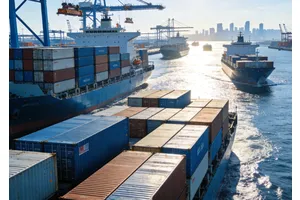
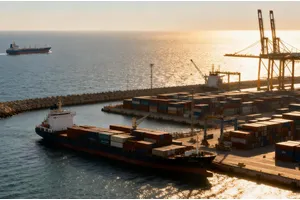
Your $150,000 CNC machining center just rolled off the factory floor in Shenzhen. The packing team takes measurements — and that's when you hear the words every importer dreads: "It won't fit in a standard container." The machine is 2.8 meters wide. A 40-foot GP container has an internal width of just 2.35 meters. You've just entered the world of Out of Gauge cargo shipping from China to the USA — a more expensive, more complex, but entirely manageable logistics challenge that thousands of businesses navigate successfully every year.
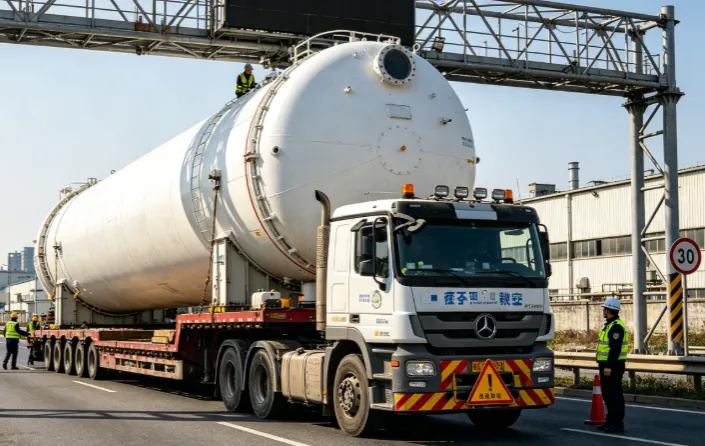
At DTFU Logistics, we've handled hundreds of OOG shipments — from 40-ton injection molding machines bound for Los Angeles to 60-meter wind turbine blades routed through Houston. Beyond oversized cargo, we provide comprehensive shipping from China to USA services and specialized heavy machinery shipping from China for project cargo of every scale. By the time you finish reading, you'll know exactly which shipping equipment you need, what it will cost in 2026, how the end-to-end process works, which China port to choose, and — most importantly — how to avoid the costly mistakes that derail first-time OOG shippers.
What Is Out of Gauge (OOG) Cargo? Definition, Types & When You Need It
Out of Gauge (OOG) cargo is any freight that exceeds the internal dimensions of a standard shipping container — meaning it literally cannot fit inside a regular 20GP, 40GP, or 40HC box. The key thresholds are straightforward:
- Internal width of a standard container: 2.35 meters (7'8.5"). If your cargo is wider than this, it's OOG.
- Door height of a standard 40GP: 2.28 meters (7'6"). For a 40HC (High Cube): 2.58 meters (8'6"). Exceed these, and it's OOG.
- Maximum payload of a standard 40ft container: approximately 26,500–28,000 kg. Cargo heavier than this typically requires specialized equipment.
It's critical to understand that OOG is not a single category — it sits within a broader classification system that determines your shipping options and costs:
| Classification | Definition | Typical Cargo | Shipping Method |
|---|---|---|---|
| In-Gauge (IG) | Fits within standard container internal dimensions | Standard machinery, consumer goods, palletized freight | Standard GP/HC container (FCL/LCL) |
| OOG (Out of Gauge) | Exceeds container dimensions but can be transported on specialized container equipment | Large injection molding machines, transformers, construction equipment, steel structures | Flat Rack, Open Top, or Platform container |
| Breakbulk (BBK) | Cannot fit on or inside any container type; loaded directly onto the vessel | Yachts, train carriages, massive industrial boilers, crane sections | Breakbulk vessel (LOLO — Lift-on/Lift-off) |
| Heavy-Lift | Single piece exceeding approximately 30 metric tons, regardless of dimensions | Power generator stators, industrial reactors, large marine engines | MPP (Multi-Purpose) vessel or heavy-lift charter |
In practice, the most common OOG cargo categories we see from China to the USA include construction machinery (excavators, wheel loaders, bulldozers), manufacturing equipment (CNC machining centers, injection molding machines, industrial presses), energy sector components (transformers, wind turbine blades and tower sections, solar farm steel supports), prefabricated steel structures, and large commercial vehicles.
Key OOG Terminology
Before diving deeper, here are the terms you'll encounter throughout this guide:
- Flat Rack (FR): A container with a solid base and collapsible end walls — no sides or roof. Available in 20ft (20FR) and 40ft (40FR) sizes. The workhorse of OOG shipping.
- Open Top (OT): A container with no solid roof, covered by a removable tarpaulin. Designed for over-height cargo that fits within standard width.
- Platform: A flat base with no end walls at all — essentially a reinforced steel deck for extremely wide or irregularly shaped loads.
- Revenue Ton (RT): The billing unit for breakbulk cargo, calculated as the greater of weight in metric tons or volume in cubic meters (1 RT = 1 MT or 1 CBM).
- Lashing & Securing: The system of chains, straps, and tensioners used to immobilize cargo on a flat rack or open top. The combined breaking strength of all lashings must be at least 1.8× the cargo weight.
- Center of Gravity (CoG): The balance point of your cargo, which must be clearly marked and communicated — improper CoG information is a leading cause of lifting accidents.
Flat Rack vs Open Top vs Breakbulk: Choosing the Right OOG Shipping Equipment
Selecting the wrong equipment is the single most expensive mistake in OOG shipping — it can trigger re-booking fees, port storage charges, and weeks of delay. Below is a comprehensive comparison of all six shipping methods available for oversized cargo from China to the USA, followed by a decision framework you can use to self-diagnose your shipment.
Six Shipping Methods Compared
| Method | Max Payload | Max Width | Best For | West Coast Transit | Cost Level | Damage Risk | 2026 Reference Rate |
|---|---|---|---|---|---|---|---|
| Flat Rack (20FR/40FR) | ~40 tons | ~4 m | Over-width machinery, large vehicles, steel structures | 15–22 days | $$ | Medium | $3,500–$8,000/unit |
| Open Top (20OT/40OT) | ~28 tons | 2.35 m | Over-height cargo within standard width (tall machinery, coils) | 15–22 days | $$ | Medium | $3,000–$6,500/unit |
| Platform | ~40 tons | Unlimited (no walls) | Extremely wide or irregularly shaped cargo | 15–22 days | $$ | Medium-High | $4,000–$9,000/unit |
| RORO (Roll-on/Roll-off) | Vessel-dependent | Ramp-dependent | Self-propelled wheeled/tracked equipment | 18–28 days | $$ | Very Low | $110–$185/CBM |
| Breakbulk / LOLO | 200–800 tons | Unlimited | Non-containerizable massive cargo | Varies | $$$ | Medium-High | $95–$165/RT |
| Heavy-Lift / MPP Vessel | 400+ tons | Unlimited | Single pieces exceeding 150 tons | Varies | $$$$ | Medium | Custom quote |
Method Deep-Dive
Flat Rack Containers are the most commonly used OOG equipment. They handle the broadest range of cargo types at a manageable cost premium over standard FCL. One technical detail frequently overlooked: the end walls on a 20FR stand 2.231 meters high, while on a 40FR they're only 1.943 meters — a 29 cm difference that matters when your cargo is close to the height limit. Always confirm the specific equipment dimensions before booking.
Open Top Containers are ideal when the problem is purely height. The cargo sits within the container's side walls but extends above them, covered by a tarpaulin. This offers better weather protection than a flat rack and is typically 10–20% cheaper. However, the tarpaulin condition should be inspected before loading — a torn tarp can mean water damage upon arrival.
RORO Vessels deserve special attention because they offer the lowest damage risk of any OOG method. Cargo is simply driven or towed onto the ship and secured in a weather-protected deck. If your equipment has its own wheels or tracks and fits within the vessel's ramp dimensions, RORO is almost always the safest choice. The trade-off: fewer sailings and slightly longer transit times.
Breakbulk shipping operates on a completely different pricing model. Instead of a per-container rate, you pay per Revenue Ton (RT) — whichever is greater between your cargo's weight in metric tons and its volume in cubic meters. At 2026 benchmark rates of $95–$165 per RT from China to major US ports, breakbulk becomes cost-effective for very dense, heavy items. For irregularly shaped cargo, you'll also encounter broken stowage charges — you pay for the space your cargo prevents other cargo from occupying.
Heavy-Lift / MPP vessels are the ultimate solution for truly massive single pieces. These specialized ships have onboard cranes capable of lifting 400+ tons. Charter rates run approximately $25,000–$45,000 per day in 2026, making this option viable only for the largest industrial projects.
Quick Decision Framework
If you're unsure which equipment you need, follow this logic:
- Cargo width > 2.35 m? → You need a Flat Rack or Platform container.
- Cargo height > 2.58 m but width ≤ 2.35 m? → Open Top is your answer.
- Self-propelled (wheels or tracks)? → Strongly consider RORO for the lowest damage risk.
- Weight > 40 tons or dimensions exceed flat rack limits? → Move to Breakbulk / LOLO.
- Single piece > 150 tons? → You're in Heavy-Lift / MPP territory.
- None of the above? → Your cargo fits in a standard FCL container — congratulations, this is the cheapest option.
How Much Does OOG Shipping from China to the USA Cost?
Let's answer the question every importer asks first. For comparison, standard container shipping from China to the USA costs a fraction of OOG rates, but once your cargo exceeds standard container dimensions, the economics shift dramatically. The total landed cost for a typical OOG shipment — a 22-ton piece of machinery on a 40ft Flat Rack, shipped FOB from Shenzhen to door in Los Angeles — ranges from approximately $7,600 to $14,200 in 2026, excluding import duties. Here's exactly where that money goes:
Line-by-Line Cost Breakdown (Real Example)
| Cost Component | Estimate (USD) | Notes |
|---|---|---|
| Inland Trucking — Factory to Shenzhen Port | $600–$1,200 | Multi-axle lowboy trailer; oversize transport permit required (apply 15+ days ahead) |
| China Export Customs Clearance | $150–$300 | Customs broker service fee |
| Origin Terminal Handling (THC) | $400–$650 | Special equipment THC is 50–100% higher than standard containers |
| Ocean Freight — 40FR, Shenzhen → LA | $3,500–$4,800 | Base ocean freight for a 40ft Flat Rack |
| OOG Surcharge | $800–$1,500 | "Lost slots" compensation — your protruding cargo prevents adjacent container stacking |
| BAF (Bunker Adjustment Factor) | $200–$500 | Fuel surcharge, adjusted quarterly |
| Lashing & Securing | $400–$1,100 | Mandatory; combined breaking strength ≥ 1.8× cargo weight |
| Cargo Insurance (All Risks, 110% CIF) | $250–$400 | Strongly recommended; OOG cargo faces elevated handling risk |
| Destination THC — Port of LA | $450–$750 | Includes special equipment discharge |
| US Customs Brokerage Fee | $150–$350 | Licensed US customs broker |
| Single Entry Customs Bond | $300–$800 | Minimum ~$150; typically 0.5–1% of entered value |
| Destination Trucking — Port to Warehouse | $800–$2,000 | Oversize load permits required state by state |
| Total Landed Cost (excluding duties) | ~$7,600–$14,200 |
For a broader look at ocean freight pricing across all cargo types, see our sea shipping cost from China to USA breakdown.
Cost by US Destination
| Destination | Total Landed Cost (excl. duties) | Ocean Transit Time |
|---|---|---|
| West Coast (LA/Long Beach, Seattle, Oakland) | $7,600–$14,200 | 12–18 days |
| Gulf Coast (Houston, New Orleans) | $8,000–$15,000 | 30–35 days |
| East Coast (NY/NJ, Savannah, Norfolk) | $10,000–$17,000 | 28–35 days |
| Southeast (Savannah, Charleston, Miami) | $9,000–$16,000 | 28–35 days |
For a complete overview of all freight modes and pricing tiers, see our full shipping cost from China to USA guide.
Understanding OOG Surcharges
The OOG surcharge is the cost component that catches most first-time shippers off guard. Here's why it exists: when your cargo protrudes beyond a flat rack's footprint, the container slot adjacent to it on the vessel becomes unusable — a "lost slot." The carrier charges you for this lost revenue opportunity. The surcharge scales with how far your cargo overhangs:
- Minor overhang (a few centimeters beyond the platform edge): $500–$800
- Moderate overhang (20–50 cm on one or both sides): $800–$1,200
- Significant overhang (50+ cm, or overhang on multiple sides): $1,200–$2,500+
Additional surcharges to budget for include the Peak Season Surcharge (PSS) of 15–25% during August through October, and Demurrage/Detention (DEM/DET) at $150–$400 per day — OOG equipment typically comes with only 3–5 days of free time at destination, compared to 7 days for standard containers.
Four Ways to Reduce OOG Shipping Costs
- Disassemble where possible. If a machine can be broken down into components that fit standard containers, do it. The cost of reassembly at destination is almost always less than OOG surcharges on an intact unit.
- Book 4–6 weeks ahead. Last-minute OOG bookings in peak season can carry premiums of 30% or more — if equipment is available at all.
- Negotiate extended free time. Request 10–14 days of free time at destination instead of the standard 3–5 days. This is usually approved for established shippers and can save thousands in DEM/DET fees.
- Consider alternative US ports. Savannah is typically 10–15% cheaper than NY/NJ for East Coast delivery, and Houston often undercuts LA/LB for Gulf-bound cargo despite the longer transit.
How to Ship OOG Cargo from China to the USA: Step-by-Step Process
Shipping OOG cargo is a 10-step process with no room for shortcuts. Each step builds on the one before it — skip one, and you'll pay for it downstream.
Step 1: Pre-Shipment Assessment
Before anything else, you need factory-verified dimensions — not estimates, not CAD drawings from six months ago. Measure the packed cargo in its final export-ready state. Accuracy must be within ±2%. You'll also need the Center of Gravity (CoG) marked on the cargo exterior — this is non-negotiable for crane operators. Take photos from all four sides and the top.
Expert Tip: Always request a photo of the flat rack's CSC (Container Safety Convention) plate before booking. We've seen cases where the plate had expired by three months, and the terminal refused to load it — causing a two-week delay.
Step 2: Choose Your Incoterm
Your Incoterm determines who pays for what — and who bears the risk at each stage:
| Incoterm | Best For | Who Handles What |
|---|---|---|
| EXW (Ex Works) | Experienced importers with their own China logistics | Buyer handles everything from factory gate onward — highest risk, lowest seller involvement |
| FOB (Free On Board) | Buyers with a trusted freight forwarder | Seller delivers to port and handles export clearance; buyer controls ocean freight and beyond |
| CIF (Cost, Insurance, Freight) | Buyers who want carrier responsibility through ocean transit | Seller arranges ocean freight + insurance to destination port; buyer handles US customs and final delivery |
| DDP (Delivered Duty Paid) | First-time importers; those wanting a single fixed cost | Forwarder handles everything — factory pickup, export, ocean, US customs, duties, and final delivery |
For OOG cargo, DDP shipping from China to the USA is increasingly the preferred choice among US importers. It eliminates the complexity of coordinating Chinese trucking permits, US customs bonds, and oversized last-mile delivery — all of which become more complicated with OOG shipments. If you're weighing different trade terms, our DDP vs FOB comparison breaks down which option delivers the best value for complex shipments.
Step 3: Export Packaging
OOG cargo needs protection that standard packaging doesn't provide. Key requirements: - Anti-corrosion treatment for metal surfaces exposed during ocean transit - ISPM 15-compliant fumigation for all wooden crating, dunnage, and pallets (stamped certification required) - Shockwatch impact indicators and tilt indicators on high-value machinery (these provide objective evidence if damage occurs) - Lifting points clearly marked with rated capacity labels
Step 4: China Inland Oversize Transport
Moving oversized cargo from factory to port within China requires provincial oversize transport permits, which must be applied for at least 15 days in advance. Depending on the cargo dimensions and route, you may need: - A multi-axle lowboy trailer (8–18 axles, depending on weight) - Route survey to verify bridge clearances, weight limits, and tunnel heights - Escort vehicles for cargo exceeding 3 meters in width or 30 meters in length
Step 5: China Export Customs Clearance
Standard documentation applies — Commercial Invoice, Packing List, Certificate of Origin — but OOG shipments also require the Bill of Lading to explicitly note whether the cargo is In-Gauge or Out of Gauge. Used machinery may require additional export licenses and pre-shipment inspection certificates from Chinese authorities.
Step 6: Port Loading & Lashing
OOG cargo is staged in a dedicated area of the terminal (the OOG yard) before loading. A marine surveyor should supervise the loading process — their report is invaluable if an insurance claim arises later. Lashing must meet the 1.8× cargo weight rule: if your machine weighs 22 tons, the combined breaking strength of all chains and straps securing it must be at least 39.6 tons.
Step 7: Ocean Transit
During the 15–35 day voyage, monitor your shipment via GPS/AIS tracking. The Bill of Lading (B/L) serves as the document of title — do not release the original B/L until payment terms are satisfied. For OOG cargo stowed on deck (common with flat racks), confirm that your insurance covers on-deck stowage risks.
Step 8: US Customs Clearance
The ISF (Importer Security Filing, or "10+2") must be submitted at least 24 hours before vessel departure from China. Late filing triggers a $5,000+ penalty from CBP. Your licensed US customs broker will file CBP Form 7501 for the actual entry. We cover the full customs documentation checklist in Section 7.
Step 9: Duty & Tax Payment
Import duties are calculated on the CIF value (cost + insurance + freight) of your cargo. The 2026 tariff landscape includes: - Base duty rate (determined by your HTS code — many machinery categories under Chapter 84 are 0%) - Section 301 tariffs of 7.5%–25% on many Chinese-origin goods - Section 122 tariffs of an additional 10%, effective February 2026 - MPF (Merchandise Processing Fee): 0.3464% of entered value - HMF (Harbor Maintenance Fee): 0.125% of entered value (ocean shipments only)
Step 10: US Final Mile Delivery
Discharging OOG cargo from the vessel requires specialized heavy-lift cranes at the destination port. From there, oversized trucking to the final delivery address requires state-level permits (each state has its own application process), possible pilot/escort vehicles for loads over 3.5 meters wide, and a liftgate truck if your delivery location lacks a loading dock. Always inspect the cargo thoroughly before signing the delivery receipt — once signed, damage claims become exponentially harder.
Best China Ports for OOG & Project Cargo: Shanghai, Shenzhen, Ningbo & More
No compe***** article covers this — yet port selection can mean the difference between a smooth OOG shipment and weeks of delay. China's major ports vary significantly in their OOG handling capabilities, terminal equipment, and carrier networks for specialized cargo.
| Port | OOG / Heavy-Lift Capability | Best For | Key US Destinations |
|---|---|---|---|
| Shanghai (Yangshan) | ★★★★★ — Largest heavy-lift gantry cranes in China; most OOG-experienced terminal operators | Yangtze River Delta manufacturing; highest-value project cargo | LA/LB, NY/NJ, Savannah |
| Shenzhen (Yantian/Shekou) | ★★★★★ — South China's primary OOG hub; extensive flat rack and open top inventory | Pearl River Delta; electronics and machinery exports | LA/LB, Houston, Miami |
| Ningbo-Zhoushan | ★★★★ — Rapidly expanding OOG capacity; typically less congested than Shanghai | Zhejiang and Jiangsu manufacturing; good alternative to Shanghai during peak | LA/LB, Savannah, Norfolk |
| Qingdao | ★★★★ — North China's top port for heavy machinery and construction equipment | Shandong, Hebei heavy industry; bulldozers, excavators, steel structures | LA/LB, Seattle, Houston |
| Tianjin (Xingang) | ★★★ — Gateway for the Beijing-Tianjin-Hebei industrial corridor | Northern China manufacturing; steel, industrial boilers, wind energy components | LA/LB, Houston |
| Guangzhou (Nansha) | ★★★ — Viable South China alternative with lower congestion | Guangzhou, Foshan manufacturing; furniture, ceramics, general machinery | LA/LB, Miami, NY/NJ |
Four Factors for Port Selection
- Proximity to your supplier. Every additional kilometer of oversize inland trucking in China adds cost, permit complexity, and delay risk. Choose the closest capable port.
- Target US gateway. West Coast (LA/LB) is the shortest transit (15–22 days ocean + 5–10 days inland). East Coast (NY/NJ, Savannah) adds 10–15 days but may be closer to your final destination, reducing US trucking costs.
- Cargo extremity. Larger ports (Shanghai, Shenzhen) accept wider and heavier OOG cargo than smaller ports. If your cargo is near the equipment limits, stick with Shanghai or Shenzhen.
- Seasonal congestion. From August through October, Shanghai and Shenzhen experience heavy congestion. During these months, Ningbo or Guangzhou can save 7–10 days by avoiding port queues.
Recommended Port Pairings
- Yangtze River Delta manufacturing → Shanghai or Ningbo → LA/LB (15–22 days, West Coast gateway)
- Pearl River Delta manufacturing → Shenzhen or Guangzhou → Houston (30–35 days, Gulf Coast industrial zone)
- Northern China heavy industry → Qingdao or Tianjin → LA/LB or Seattle (Pacific Northwest gateway)
- East Coast-bound project cargo → Shanghai → Savannah or NY/NJ (28–35 days, direct East Coast)
No matter which port you choose, our sea shipping from China to USA network covers all major gateways with weekly sailings and competitive contract rates.
US Customs Clearance for OOG Cargo: Tariffs, Duties & Required Documents
Customs clearance for OOG cargo is not fundamentally different from standard cargo — but the stakes are higher because any delay at the port generates demurrage charges at OOG rates ($150–$400/day vs. $75–$150/day for standard containers).
Complete Documentation Checklist
| Document | Required? | Purpose |
|---|---|---|
| Commercial Invoice | ✅ Yes | Declares the transaction value, product descriptions, and country of origin |
| Packing List (detailed) | ✅ Yes | Must itemize dimensions and weight per piece — critical for OOG verification |
| Bill of Lading | ✅ Yes | Must clearly state "In-Gauge" or "Out of Gauge" — this notation affects terminal handling |
| ISF 10+2 Filing | ✅ Yes | 10 importer data elements + 2 carrier data elements; must be filed 24+ hours before vessel loading in China |
| CBP Form 7501 | ✅ Yes | The formal customs entry summary |
| Customs Bond | ✅ Yes | Single-entry (0.5–1% of cargo value) or continuous bond ($500–$800/year for frequent importers) |
| Certificate of Origin | ⚠️ Conditional | Required if claiming preferential tariff treatment under a free trade agreement |
| EPA Form 3520-1 | ⚠️ If engines | Required for diesel/gasoline engines — emissions compliance certification |
| Lashing Certificate | ⚠️ Conditional | Some carriers require a third-party lashing inspection certificate for OOG cargo |
| Cargo Photos & Drawings | 🔶 Strongly Advised | Pre-submission to CBP can accelerate OOG cargo clearance |
2026 US Tariff Landscape for Chinese Machinery
The current tariff environment as of mid-2026 is multi-layered. Here's what applies to a typical machinery import:
- Base Duty Rate (HTS Chapter 84): Many machinery categories — including injection molding machines (8477.10), excavators (8429.52), and wheel loaders (8429.51) — carry a 0% base duty rate. CNC machining centers (8457.10) are around 4.2%. Always verify your specific HTS code.
- Section 301 Tariffs: An additional 7.5%–25% applies to most machinery and equipment of Chinese origin. The higher rate typically applies to items on Lists 1–3; List 4A items are at 7.5%.
- Section 122 Tariffs: A new 10% across-the-board tariff on all imports, effective February 2026.
- MPF (Merchandise Processing Fee): 0.3464% of the entered value (minimum ~$32.71, maximum ~$634.62 per entry).
- HMF (Harbor Maintenance Fee): 0.125% of the entered value for ocean freight only.
Real-world calculation: A $100,000 injection molding machine (HTS 8477.10, 0% base duty, Section 301 at 25%, Section 122 at 10%) imported via ocean would face: - Section 301: $25,000 - Section 122: $10,000 - MPF: $346.40 - HMF: $125.00 - Total duties and fees: approximately $35,471
Critical: HTS Code Classification
HTS code misclassification is the #1 cause of US customs delays for OOG machinery. A wrong code can trigger not just delays but also penalty duties and retroactive billing. We strongly recommend pre-classifying your HTS code with a licensed customs broker before the cargo leaves China. This is especially important for machinery that could fall under multiple headings — for example, a machine that performs multiple functions may be classified differently than one with a single purpose.
OOG Cargo Delivery in the USA: Insurance, Permits & Costly Mistakes to Avoid
US Last-Mile Oversized Delivery
Once your OOG cargo clears customs, it still needs to reach its final destination — and this leg contains some of the most overlooked costs in the entire shipping process.
Four non-negotiable elements of US oversized trucking:
- State-by-state permits. Every state through which your truck passes requires its own oversize/overweight permit. Cross-country deliveries may need permits from 6–10 states. Processing time is typically 3–7 business days per state — plan accordingly.
- Pilot/escort vehicles. Loads exceeding 3.5 meters (11'6") in width or 30 meters (98') in length generally require one or two escort vehicles with warning signs and flags. These add $1–$3 per mile.
- Liftgate service. If your delivery address lacks a loading dock or forklift, the truck must have a hydraulic liftgate. Without one, the driver will refuse delivery and you'll be charged a redelivery fee. This is the single most common last-mile failure we see.
- Route survey. For extremely large loads, a physical route survey verifies bridge weight ratings, overhead clearance at every overpass, and turn radius feasibility.
White-glove delivery ($150–$600 per piece) is worth considering for sensitive machinery — it includes indoor placement, debris removal, and basic uncrating.
Cargo Insurance for OOG Shipments
OOG cargo faces significantly higher risk than standard containerized freight. During loading and discharge, your machinery is lifted by crane with no container walls to protect it. Lashing can fail. Weather exposure is greater. A single incident can destroy a six-figure piece of equipment.
| Insurance Type | Coverage Scope | Recommended For |
|---|---|---|
| All Risks (Institute Cargo Clauses A) | Broadest coverage — accidental damage, theft, water damage, loading/unloading incidents | All OOG shipments; the standard we recommend |
| Institute Cargo Clauses B | Named perils — fire, explosion, vessel collision, heavy weather | Lower-value OOG cargo where premium savings matter |
| Institute Cargo Clauses C | Major casualties only — total loss, fire, sinking | Not recommended for OOG; coverage too narrow |
| War & Strikes Risk | War, civil unrest, strikes at ports | Recommended for shipments transiting high-risk areas |
Premiums for OOG cargo typically run 0.3%–0.8% of the CIF value, compared to 0.2%–0.3% for standard containerized cargo. For a $100,000 machine, that's $300–$800 — a fraction of the potential loss. For a deeper dive into coverage options, read our guide on shipping container insurance costs for shipments from China.
Claims best practices: Photograph the cargo from every angle before loading. Ensure the marine surveyor's loading report is included in your documentation. And critically — inspect the cargo before signing the delivery receipt. The moment you sign, the carrier's liability effectively ends.
10 Costly Mistakes to Avoid
After handling hundreds of OOG shipments, here are the mistakes we see repeatedly — and what they cost:
- Providing approximate dimensions. Even 5 cm of error can mean your cargo doesn't fit the booked flat rack. Re-booking fees and port storage can exceed $2,000.
- Skipping the CoG marking. Crane operators need the center of gravity to lift safely. Without it, the terminal may refuse to handle your cargo.
- Choosing based on freight quote alone. A breakbulk quote looks cheaper until you're paying $500/day in port storage because the next sailing isn't for three weeks.
- Underinsuring or skipping insurance entirely. We've seen a $180,000 transformer destroyed when a lashing chain snapped during rough weather. The importer had no insurance.
- Applying for China oversize permits too late. The 15-day minimum is real — miss it, and your cargo sits at the factory for an extra two weeks.
- Not booking specialized equipment in advance. During peak season (Aug–Oct), flat racks and open tops can be fully committed 6–8 weeks out. Book early.
- Misclassifying the HTS code. This triggers customs exams, penalty duties, and delays that cascade into demurrage charges.
- Forgetting the liftgate. The driver arrives at a residential or construction-site address with no way to unload. Redelivery fee: $300–$800.
- Missing the ISF filing deadline. CBP fines start at $5,000. For repeat offenders, they escalate.
- No buffer time during peak season. A shipment that takes 35 days in March can take 55 days in October. If your production line depends on this machinery arriving on time, build in a 2–3 week buffer during Q3/Q4.
Peak Season Survival Guide
| Strategy | Action |
|---|---|
| Book 6–8 weeks ahead (vs. 3–4 in off-peak) | Flat racks and open tops are in highest demand Q3 |
| Use alternative ports | Ningbo instead of Shanghai; Savannah instead of NY/NJ — avoids the worst congestion |
| Budget +20–30% for freight | Peak season premiums are real and non-negotiable |
| Negotiate rate lock | Request a 30-day rate validity clause in your contract |
| Negotiate extended free time | 10–14 days at destination gives you breathing room if customs or trucking is delayed |
FAQs
What exactly counts as Out of Gauge (OOG) cargo?
Any cargo exceeding a standard container's internal width of 2.35 meters or door height of 2.28 meters (GP) / 2.58 meters (HC) is classified as OOG. It requires specialized equipment — flat racks, open tops, platforms, or breakbulk vessels — instead of standard enclosed containers.
How much does OOG cargo shipping from China to the USA cost in 2026?
For a typical OOG shipment on a 40ft Flat Rack from Shenzhen to Los Angeles, expect a total landed cost of approximately $7,600–$14,200 (excluding import duties). East Coast destinations run $10,000–$17,000. Every shipment varies by dimensions, weight, port pair, and season — always get a custom quote.
What's the difference between OOG, breakbulk, and heavy-lift cargo?
OOG cargo exceeds standard container dimensions but can still be transported on specialized container equipment (flat rack, open top). Breakbulk cargo cannot fit on or inside any container and is loaded directly onto the vessel. Heavy-lift refers to single pieces exceeding approximately 30 metric tons, often requiring specialized MPP (Multi-Purpose) vessels.
How long does OOG cargo take from China to the USA?
Ocean transit to the US West Coast takes 15–22 days, plus 5–10 days for inland delivery. To the US East Coast, ocean transit is 28–35 days, plus inland transport. Total door-to-door timeframes range from approximately 25 days (West Coast) to 50+ days (East Coast or inland destinations). For standard container transit benchmarks, refer to our how long to ship from China to USA timeline.
What documents are required for OOG shipping?
The essential documents include a Commercial Invoice, detailed Packing List (with per-piece dimensions and weight), Bill of Lading (with OOG notation), ISF 10+2 filing, CBP Form 7501, and a Customs Bond. Cargo photos and engineering drawings are strongly recommended to pre-clear OOG shipments with customs and carriers.
Can I ship OOG cargo DDP from China to the USA?
Absolutely. DTFU Logistics provides full DDP (Delivered Duty Paid) service for OOG cargo — covering factory pickup, Chinese export clearance, ocean freight, US customs entry, all import duties and tariffs, and oversized final-mile delivery to your door. DDP is increasingly the preferred option for first-time OOG importers who want a single, predictable landed cost.
Which China port is best for OOG cargo?
Shanghai (Yangshan) and Shenzhen (Yantian/Shekou) are China's top OOG ports, with the largest heavy-lift crane capacity and most experienced terminal operators. Qingdao is the best choice for heavy machinery from northern China, and Ningbo is an excellent alternative to Shanghai with lower congestion.