If you are importing from Chinese factories in 2026, door to door shipping from China to Turkey has changed more in the past twelve months than in the previous five. Carriers began restoring Suez sailings in August after two years of Cape of Good Hope diversions — Maersk and Hapag-Lloyd rerouted their Gemini AE19 service, and MSC followed on parts of its Asia–Mediterranean network, including the Tiger loop that calls Mersin. As we detailed in Red Sea shipping returns under tight security, that recovery is partial and can still reverse overnight. At the same time, Turkey eliminated the €30 low-value import exemption on February 1, 2026, and the TAREKS product-safety list keeps expanding. China remains Turkey's largest source of imports, with bilateral trade above $40 billion a year.
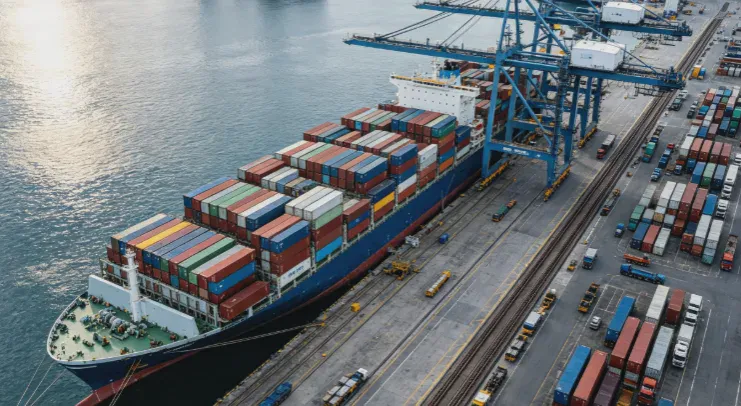
Whether your goods are headed to a warehouse in Istanbul, a shop in Ankara, or a customer in Izmir, this guide covers what door-to-door shipping actually costs on live 2026 bookings, how long it takes, and how to clear Turkish customs without drama.
What "Door to Door" Shipping from China to Turkey Actually Includes
Door-to-door (D2D) shipping means one logistics provider takes responsibility for your cargo from the supplier's factory door in China to your door in Turkey — export clearance, international freight, import clearance, duties and taxes, and final delivery bundled into one service and one price.
In Incoterms 2020 terms, the service is almost always quoted as DDP (Delivered Duty Paid). In practice, your freight forwarder handles every step: factory pickup and trucking to the Chinese port, export clearance, international freight, terminal handling, Turkish import clearance through a licensed Gümrük Müşaviri (customs broker), payment of import duty and KDV (Turkish VAT, 20% standard), and last-mile trucking to your final address.
The alternative, DDU (Delivered Duty Unpaid), stops at the destination port: you or your own broker clears the goods and pays the taxes. For most importers — especially first-timers and SMEs without a Turkish tax ID — DDP wins because it turns an unpredictable process into one fixed price. If you are still deciding between terms, our DDP vs FOB guide walks through when each Incoterm makes sense.
True DDP vs. "quote + extras" DDP. We consistently see providers advertise "DDP" and bury the caveats in fine print — "duties at cost," "taxes subject to actual assessment," "anti-dumping excluded." A genuine DDP quote absorbs that risk: the number quoted is the number paid, even if the lira moves while your container is at sea. Demand an itemized breakdown naming each line in writing — freight, export clearance, Turkish brokerage, duty by HS code, KDV, anti-dumping, terminal handling, last-mile. A forwarder who refuses to itemize plans to add charges later.
How Long Does Door to Door Shipping from China to Turkey Take?
A sea-freight DDP shipment runs through seven stages. In late 2026, total time depends on one big fork: whether your carrier sails the Suez Canal or still diverts around the Cape of Good Hope.
| Stage | What Happens | Time |
|---|---|---|
| 1. Enquiry & booking | Cargo details (HS codes, weight, volume, value), DDP quote, booking confirmed | Day 0 |
| 2. Factory pickup & consolidation | Trucking from your supplier to a warehouse near the departure port | Days 1–3 |
| 3. China export clearance | Export declaration filed; 1–2 working days for standard goods | Days 3–5 |
| 4. Ocean transit | Suez (26–33 days) or Cape of Good Hope (36–42 days) | Days 5–47 |
| 5. Turkish import clearance | Broker files the BEYAN declaration; channel assignment | Days 40–52 |
| 6. Duty & KDV payment | All taxes settled, cargo released from the terminal | Days 45–52 |
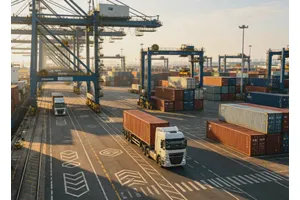
| 7. Last-mile delivery | Trucking to Istanbul, Ankara, Izmir, or your address anywhere | Days 45–55 |
Stage 4 is the biggest variable of 2026. A Suez sailing from Shanghai to Ambarli runs about 26–33 days; a Cape routing runs 36–42 — 10 to 14 days longer for every milestone after departure. When we quote a sea DDP shipment, we name the routing and carrier in writing; a forwarder who answers "about 30 days" for everything is not reading their own schedule.
Real experience from this lane: the routing also changes your insurance. Cape voyages spend longer in open water, and war-risk premiums differ between services — on some the surcharge is bundled into freight, on others it appears as a separate line at origin. Confirm the transit time for your sailing in writing.
Sea Freight, Air or Rail: Choosing the Right Mode from China to Turkey
Three modes serve the China–Turkey corridor, with very different economics in 2026.
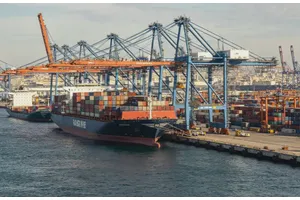
Sea freight (FCL & LCL) carries the overwhelming majority of lane volume and is the clear choice above about 5 CBM. FCL (Full Container Load) gives the lowest cost per unit and fewer handling points; LCL (Less than Container Load) lets you share space and pay only for what you use, suiting first shipments and trial orders. The main Turkish gateways are Ambarli (Istanbul, European side, the largest terminal complex), Mersin, Izmir Aliağa, and Gemlik.
Air freight delivers in 5–9 days door to door via direct services from Shanghai (PVG), Shenzhen (SZX), and Guangzhou (CAN) into Istanbul (IST) and Sabiha Gökçen (SAW). Turkish Cargo's IST hub is among the world's largest. Air is priced on chargeable weight — actual or volumetric (L × W × H cm ÷ 6000), whichever is greater — so packaging discipline matters as much as the per-kg rate.
Rail (Middle Corridor) — the Trans-Caspian International Transport Route through Kazakhstan, the Caspian ferry, Azerbaijan, and Georgia into the BTK railway — delivers in 20–28 days door to door at a cost about 30–40% below air. It suits machinery, auto parts, and mid-weight industrial goods; the Caspian ferry crossing is the reliability bottleneck, so we quote rail with a cushion. For a fuller breakdown of the trade-offs, see our sea vs rail freight comparison.
| Factor | Sea LCL | Sea FCL | Air Freight | Rail (Middle Corridor) |
|---|---|---|---|---|
| Best volume | 1–15 CBM | 15+ CBM | Under 2 CBM / urgent | 10–50 CBM |
| D2D transit (2026) | 35–50 days | 30–48 days | 5–9 days | 20–28 days |
| Cost level | $$ | $ per unit | $$$$ | $$$ |
| Best cargo | General, mixed | Bulk, heavy, volume | High-value, seasonal, spare parts | Machinery, auto parts |
| Main risk | Consolidation delays | Routing shifts | Rate volatility | Caspian ferry schedule |
Door to Door Shipping Cost from China to Turkey: 2026 Real Ranges
The figures below are what we quote on live China–Turkey bookings in Q3 2026. Rates are still elevated versus the pre-2024 baseline because much capacity continues around the Cape, but returning Suez services are pulling spot rates down. Treat these as budget ranges — your HS code, weight, and destination city move the number. For the full cost picture beyond DDP, our guide to shipping cost from China to Turkey breaks down every component of the total.
Sea freight DDP (all-in: freight + clearance + duty + KDV + last-mile)
FCL rates below wrap the full door-to-door service; if you are comparing freight alone, our separate guide to how much to ship a container from China to Turkey gives the FCL-only numbers.
| Route | 20GP FCL | 40HQ FCL | LCL (per CBM) | D2D Transit |
|---|---|---|---|---|
| Shanghai → Istanbul | $2,100–$2,700 | $3,500–$4,400 | $72–$95 | 30–48 days |
| Shenzhen → Istanbul | $2,250–$2,800 | $3,600–$4,500 | $77–$100 | 32–50 days |
| Ningbo → Mersin | $2,070–$2,600 | $3,420–$4,300 | $68–$90 | 32–50 days |
| Qingdao → Izmir | $2,340–$2,900 | $3,690–$4,600 | $81–$105 | 34–52 days |
| Guangzhou → Gemlik | $2,100–$2,700 | $3,500–$4,400 | $76–$100 | 32–50 days |
Air freight DDP
| Route | DDP Air (all-in, per kg) | D2D Transit |
|---|---|---|
| Shanghai PVG → Istanbul IST | $4.80–$6.90 | 5–8 days |
| Shenzhen SZX → Istanbul IST | $4.90–$7.10 | 5–9 days |
| Guangzhou CAN → Istanbul IST | $5.00–$7.30 | 5–9 days |
Rail freight DDP
| Route | 40ft Container | D2D Transit |
|---|---|---|
| Zhengzhou → Istanbul (Middle Corridor) | $5,200–$7,200 | 20–28 days |
| Xi'an → Istanbul (Middle Corridor) | $5,000–$7,000 | 20–28 days |
All DDP estimates assume a 5–10% duty rate and KDV at 20%. Your product's HS code changes the duty component — a textile shipment carries a very different tax load from machinery.
Worked example: a 20ft furniture shipment, line by line
Here is the full landed-cost breakdown for a 20ft container of household furniture (declared CIF value $20,000) shipped DDP from Shenzhen to an Istanbul warehouse in Q3 2026:
| Cost Item | Amount (USD) |
|---|---|
| Cargo value (FOB Shenzhen) | $20,000 |
| Factory-to-port trucking (Shenzhen) | $180 |
| Export clearance & documentation | $120 |
| Ocean freight (Shenzhen → Istanbul, 20GP) | $1,650 |
| Cargo insurance (0.3% of CIF) | $66 |
| Istanbul terminal handling (Ambarli) | $280 |
| Turkish customs brokerage | $200 |
| Import duty (8% on CIF) | $1,734 |
| KDV — 20% on (CIF + duty + fees) | $4,556 |
| Last-mile delivery (Istanbul) | $250 |
| Total Landed Cost | $29,036 |
Ocean freight is only about 5.7% of the landed total — duties, KDV, and destination charges dominate. "How much is the freight?" is the wrong question on this lane; "what is the all-in DDP price?" is the one a forwarder commits to in writing.
Customs Clearance for Door to Door Shipping from China to Turkey: Channels, Duties & TAREKS
Turkey runs one of the most demanding import regimes in the region — demanding, but predictable if you know the system.
The channel system: green, yellow, red, and blue
Every import declaration (the BEYAN) is risk-scored and assigned to a lane:
- Green: automatic clearance — no document check, no physical inspection. Earned through accurate declarations, consistent values, and a clean history.
- Yellow: document review of your invoice, packing list, and certificates. Usually resolved in 1–3 working days.
- Red: physical inspection — container opened, goods sampled, sometimes laboratory-tested. Add 5–7 working days plus daily port storage fees.
- Blue: post-release audit, most often for authorized economic operator (AEO) accounts. Keep every document for at least five years.
The unwritten rule that catches importers: Turkish customs cross-references declared values against its own reference price database. Undervaluation is the fastest way to earn a red channel. Under Article 234 of Customs Law No. 4458, a short-paid value triggers a penalty of roughly three times the underpaid duty — we have seen shipments flagged for invoices 10–15% under the reference price. Invoice real value, and make sure the commercial invoice, packing list, and B/L agree on every digit.
Duties and taxes in 2026
| Tax | Rate | Applied To |
|---|---|---|
| Customs duty (Gümrük Vergisi) | 0–20% by HS code (some goods higher) | CIF value |
| KDV (VAT) | 20% standard (1% / 10% for select goods) | CIF + duty + other taxes |
| Additional customs duty (ACD / İGV) | Often 10–30%+ | A broad list of Chinese-origin consumer goods |
| ÖTV (Special Consumption Tax) | 20–70% | Luxury goods, alcohol, tobacco, vehicles |
| Anti-dumping duty | Case-by-case | Certain Chinese textiles, steel, and more |
The KDV calculation is cumulative: it applies to CIF value plus customs duty plus any other taxes. On a $10,000 CIF shipment at 10% duty: duty = $1,000, KDV = 20% × $11,000 = $2,200, total tax = $3,200 — before anti-dumping or additional duties. Turkey's EU customs union gives EU-origin industrial goods duty-free access; Chinese-origin goods do not benefit, and since 2020 a wide list of consumer products has carried additional duties stacked on the MFN rate. Checking base duty, ACD, and anti-dumping status for your HS code before shipping is not optional.
TAREKS: the pre-arrival gate
TAREKS (Turkey's risk-based trade control system, operated by the Ministry of Trade) screens imports against product-safety requirements before customs can release them. Electronics, machinery, medical devices, PPE, cosmetics, toys, and selected textiles typically require a TAREKS registration and reference number, filed by your importer of record or customs broker; processing takes days to weeks depending on risk class.
Start TAREKS before the vessel departs China. Waiting until the container sits at Ambarli burns daily storage fees while the application grinds through — a common, avoidable delay we fix for clients whose forwarder "handles everything" but forgot this step.
Two things most guides don't tell you about this lane
- Turkey allows "no original B/L" release. Turkish customs law permits the importer to take delivery against a bank guarantee or indemnity even without the original bill of lading. For a Chinese exporter selling FOB or DDP, that means your buyer can obtain the cargo while you still hold the B/L. Protect yourself with a payment structure that does not rely on the B/L as your only leverage — or ship with a forwarder who controls the destination release process, standard on our DDP services.
- The lira moves your costs. The lira has depreciated sharply against the dollar since 2021, and the exchange rate used for duty assessment affects the taxes you pay. A DDP quote with a fixed USD total protects you from currency swings; ask which currency your taxes are locked in.
Turkey Import Regulations from China: Product Compliance at a Glance
| Product Category | Typical Duty | TAREKS | CE/TSE | Notes for This Lane |
|---|---|---|---|---|
| Textiles & apparel | 10–12% + anti-dumping risk | Yes (selected) | Labeling only | Verify AD status before shipping; huge category from China |
| Electronics & 3C | 0–10% + ACD | Yes | CE + TSE | Dual certification required; TAREKS mandatory |
| Machinery & equipment | 0–8% | Yes | CE declaration | Heavy/dimensional; 40HQ often ideal |
| Furniture & home goods | 5–10% | No | No | Volume-heavy; watch container utilization |
| Auto parts | 3–10% | Yes | Homologation if safety-related | Rail D2D is often cost-effective |
| Food & beverages | 10–50%+ | No | Import license | Strictest category; ministry approval, shelf-life limits |
| Chemicals | 0–10% + ACD | Yes | KKDIK registration | Turkey's REACH-equivalent; early registration needed |
One correction worth repeating because it appears in older guides: Turkish anti-dumping measures target specific products — steel (duties around 22–32%) and certain synthetic-fiber textiles (21–44%) — not every category a "Chinese goods" headline implies. Ceramics are not currently subject to Turkish anti-dumping duties, and for glassware the 2025–2026 story is investigations in progress, not final duties. Confirm your exact HS code's status with a broker before booking.
The 2026 E-Commerce Rule Change That Ended Cheap Parcels from China to Turkey
If you sell into Turkey through AliExpress, Temu, Shein, or your own webshop, this is the most important update in the article.
- Until August 2025: parcels under €30 entered with minimal formalities and no duty.
- August 21, 2025 onward: parcels between €30 and €150 became subject to a 30% customs duty on most goods plus 20% KDV, with a minimum €30 tax per parcel.
- February 1, 2026: the €30 low-value exemption was eliminated entirely. Every commercial import — regardless of declared value — now requires full formal clearance: a complete customs declaration (BEYAN), a licensed customs broker, and payment of all applicable duties and KDV.
The consequence is simple: the era of cheap, lightly-taxed small parcels from China into Turkey is over. Sellers protecting margins are consolidating small orders into LCL or FCL shipments under DDP. The same logic applies to Amazon Turkey FBA sellers — consolidated DDP with correct carton labeling and delivery appointments beats a stream of small parcels on both cost and clearance reliability.
Seven Mistakes That Cost Importers Time and Money on This Lane
- Skipping the HS-code pre-check. A 30-minute review by a broker who knows Turkish tariff practice can save weeks in port storage. "Cotton t-shirt" and "polyester t-shirt" are different HS codes with different treatment.
- Invoicing low to "save" duty. The reference price database catches it, the red channel delays it, and the penalty (roughly 3× the underpaid duty) erases any savings several times over.
- Ignoring anti-dumping and additional duty status. Textiles, steel, and a wide consumer-goods list carry duties a generic online quote will not show. Verify before booking; a real DDP quote absorbs them.
- Missing TAREKS or KKDIK registration. Both must be in motion before departure for many product categories.
- Booking late for peak windows. Chinese New Year, Ramadan/Eid, and the Q4 European stocking season all squeeze space. Book 6–8 weeks out for sea, 3–4 weeks for air.
- Trusting a "DDP" quote without an itemized breakdown. If duties and taxes are "at cost," you are carrying the risk, not the forwarder.
- Skipping cargo insurance on the longer routings. Cape voyages mean more days at sea and different risk profiles. All-risk cover at roughly 0.3–0.5% of cargo value is cheap insurance — our guide to shipping container insurance cost for shipments from China shows how this line is priced.
Why DTFU for Door to Door Shipping from China to Turkey
We have shipped this corridor since 2014, and the 2026 picture — Suez services coming back, TAREKS expanding, the low-value rule gone — is exactly where an experienced forwarder earns its fee. DTFU is headquartered in Shenzhen with direct coverage across Shanghai, Ningbo, Qingdao, Tianjin, Guangzhou, and Yiwu, so your cargo leaves from the port closest to your supplier. On the Turkish side we work directly with licensed customs brokers in Istanbul, Mersin, and Izmir — one accountable team from factory to door.
Our DDP quotes are genuinely all-inclusive: export clearance, freight, Turkish import clearance, duties, KDV, anti-dumping where applicable, and last-mile delivery, locked in writing. Direct carrier contracts (MSC, Maersk, CMA CGM, COSCO, and others on the lane) let us tell you which service is running Suez and which is still routing around the Cape — and price accordingly. We also run dedicated door-to-door services to neighboring markets, with landing pages for shipping from China to Iran, shipping from China to Iraq, and shipping from China to Egypt if your network stretches beyond Turkey.
Send your cargo details — product, weight, volume, and destination city — and we will come back with a written, itemized door-to-door quote within 24 hours. No hidden fees, no "duties at cost" fine print, and a routing and transit time we can actually defend.