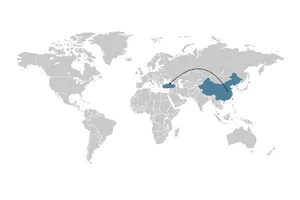
Turkey is China's third-largest trading partner in the Middle East, with bilateral trade exceeding $40 billion annually — and air shipping from China to Turkey is the backbone keeping this supply chain moving at speed. Yet for many importers, navigating air freight options feels like piecing together a puzzle: Which service type fits your cargo? How much should you actually pay per kilogram? Will your shipment get stuck in Turkish customs?

This guide answers every one of those questions — in the order that matters. We start with the service types available, move through routes and airlines, break down transit times and real costs (including the chargeable weight trap most first-timers fall into), walk through the full door-to-door process, demystify Turkish customs, and finish with a practical framework for choosing a reliable freight forwarder. By the end, you'll have a clear, actionable plan for your next air shipment from China to Turkey.
Air Freight Service Types: Express, Standard, Consolidated & Charter
Before you compare prices or transit times, you need to know what you're actually choosing between. Air freight is not one monolithic service — it's a spectrum of four distinct options, each with its own trade-offs between speed, cost, and cargo suitability.
The Four Types at a Glance
| Service Type | Best For | Typical Transit (Door-to-Door) | Cost Level | Minimum Weight |
|---|---|---|---|---|
| Express Courier | Samples, documents, urgent small parcels | 2–5 days | Highest | 0.5 kg |
| Standard Air Freight | Commercial shipments 100kg+ | 5–10 days | Medium | ~45 kg |
| Consolidated Air Freight | Smaller commercial shipments, cost-sensitive cargo | 7–15 days | Lower | ~45 kg |
| Air Charter | Oversized cargo, emergency large-volume shipments | Custom | Negotiated | 30,000 kg+ |
Express Courier (DHL, FedEx, UPS)
If your shipment weighs less than 45 kg and every day counts, express courier services are your go-to. Carriers like DHL, FedEx, and UPS operate integrated door-to-door networks: they pick up from your supplier in China, handle export clearance, fly the goods on their own or commercial aircraft, manage Turkish import clearance, and deliver directly to the recipient's door in 2 to 5 business days.
The trade-off is cost. At $10 to $20 per kilogram, express courier pricing quickly becomes uneconomical for shipments above the 45 kg threshold — we cover this air freight vs. express cost trade-off in more detail, and the same logic applies to the China–Turkey corridor. We've seen importers pay $800 to ship a 40 kg box that could have moved for under $300 via consolidated air freight — a 2.6× premium for saving perhaps 3 to 5 days.
Best for: Product samples, legal documents, replacement parts, small e-commerce orders.
Standard Air Freight (Direct Airline Booking)
Standard air freight is the workhorse of China–Turkey trade. You (or your freight forwarder) book cargo space directly with an airline — most commonly Turkish Airlines Cargo (TK), which dominates this corridor with daily direct flights from multiple Chinese cities. Your goods fly airport-to-airport, typically reaching Istanbul (IST) in 1 to 3 days flight time, with the full door-to-door cycle running 5 to 10 days.
This is where economies of scale kick in: the per-kilogram rate drops significantly as your shipment weight increases beyond 100 kg, 300 kg, and 500 kg thresholds. For a typical commercial shipment of 300 kg, you should expect to pay $4.00 to $6.50 per kilogram for direct standard air freight from major Chinese hubs.
Best for: B2B commercial goods — textiles, auto parts, machinery components, electronics in production batches.
Consolidated Air Freight (Shared ULD)
Consolidated air freight (also called consolidation or groupage) is the sleeper pick that many small-to-medium importers overlook. Instead of booking an entire Unit Load Device (ULD) — an air cargo pallet or container — you share the space and cost with other shippers. Your freight forwarder combines multiple customers' cargo into one ULD, ships it as a single booking, then deconsolidates at the destination airport for individual customs clearance and delivery.
The cost advantage is real: consolidated rates typically run $3.00 to $5.50 per kilogram, roughly 20% to 35% less than standard direct air freight. The trade-off is transit time — consolidation adds 2 to 5 days for cargo collection, ULD buildup, and deconsolidation on the Turkish end. But for non-urgent shipments, that time premium buys meaningful savings.
Best for: E-commerce sellers restocking Turkish warehouses, SMEs shipping 50–200 kg, seasonal inventory that isn't on a razor-thin timeline.
Air Charter
For the vast majority of importers, air charter — renting an entire freighter aircraft — is overkill. But it exists for edge cases: moving a factory's worth of production machinery on a tight deadline, or flying humanitarian supplies at scale. Charter rates are negotiated case by case and depend on aircraft availability, route, and season.
Quick Decision Rule: If you're shipping under 45 kg and every day counts → Express Courier. Between 45 kg and 300 kg and you can tolerate 7–15 days → Consolidated. Over 300 kg or you need it there fast → Standard Air Freight.
Major Air Cargo Routes: From China's Key Airports to Turkey
Once you've identified your service type, the next question is: which airport in China should your cargo depart from? The answer depends on where your supplier is located, which airline offers the best connection, and whether a direct or transit routing makes more sense for your budget and timeline.
Chinese Departure Airports & Their Advantages
| Departure Airport | Code | Best Airline(s) | Frequency | Aircraft | Best For |
|---|---|---|---|---|---|
| Shenzhen Bao'an | SZX | Turkish Airlines (TK) | Daily | A330F | Electronics, e-commerce from Pearl River Delta |
| Shanghai Pudong | PVG | China Eastern (MU), TK, EY, ET, GF | Daily (multiple carriers) | A350 / B777F | Manufacturing goods from Yangtze River Delta |
| Guangzhou Baiyun | CAN | Turkish Airlines (TK), Thai Airways (TG) | Daily | B777F | Southern China manufacturing, machinery |
| Beijing Capital | PEK | Air China (CA) | Daily | A330 / B777 | Northern China industrial goods |
| Zhengzhou Xinzheng | CGO | Turkish Airlines (TK) | 4× weekly | A330F | Central China manufacturing, smartphones |
| Hong Kong | HKG | TK, Emirates (EK) | Daily | B747F / B777F | High-value goods, transshipment from Asia |
Shenzhen (SZX) is the standout for electronics and cross-border e-commerce. With Turkish Airlines operating a daily Airbus A330-200F freighter direct to Istanbul, cargo departing Shenzhen today typically clears Turkish customs within 48 to 72 hours. The Pearl River Delta's dense manufacturing ecosystem — from smartphones in Dongguan to household goods in Foshan — feeds directly into this corridor. For a broader look at shipping from Shenzhen to Turkey across all modes, we have a dedicated route guide.
Shanghai Pudong (PVG) offers the most airline competition on the China–Turkey route. China Eastern (MU) flies daily with A350 belly cargo capacity, while Turkish Airlines, Etihad (EY), Ethiopian Airlines (ET), and Gulf Air (GF) all serve PVG–IST, creating price competition that benefits shippers. For Yangtze River Delta manufacturers — automotive parts, industrial machinery, textiles — Shanghai is the natural gateway.
Turkish Destination Airports
| Airport | Code | Role | Serves |
|---|---|---|---|
| Istanbul Airport | IST | Primary cargo hub | All of Turkey + European transshipment |
| Sabiha Gökçen | SAW | Secondary Istanbul hub | E-commerce parcels, express shipments |
| Ankara Esenboğa | ESB | Capital region | Central Anatolia |
| Izmir Adnan Menderes | ADB | Aegean gateway | Western Turkey industrial zone |
Istanbul Airport (IST) handles the vast majority of air cargo from China. Its cargo terminal is one of the world's largest, with dedicated handling facilities for general cargo, perishables, and dangerous goods. From IST, trucking networks reach every major Turkish city — Ankara (4 hours), Izmir (5 hours), Bursa (2.5 hours), and Konya (7 hours).
Airline Comparison: Who Flies China to Turkey Cargo?
| Airline | Type | Direct Flights | Frequency | Price Tier | Reliability |
|---|---|---|---|---|---|
| Turkish Airlines Cargo (TK) | Dedicated freighter + belly | SZX, CAN, CGO, PVG, HKG → IST | Daily (varies by route) | Mid-range | ★★★★★ |
| China Eastern (MU) | Belly cargo | PVG → IST | Daily | Mid-range | ★★★★ |
| China Southern (CZ) | Belly cargo | CAN, PKX → IST (via transit) | Daily | Mid-range | ★★★★ |
| Air China (CA) | Belly cargo | PEK → IST (via transit) | Daily | Mid-range | ★★★★ |
| Sichuan Airlines (3U) | Belly cargo | TFU → IST | 4× weekly | Lower | ★★★ |
| Emirates SkyCargo (EK) | Belly cargo | HKG, CAN → DXB → IST | Daily | Higher | ★★★★★ |
| Etihad Cargo (EY) | Belly cargo | PVG → AUH → IST | Daily | Mid-range | ★★★★ |
Turkish Airlines Cargo is the dominant player for a reason: as the national carrier of Turkey, TK offers the most direct routes from China to Istanbul, the highest frequency, and the best cargo handling connections at IST. Their dedicated A330F freighters on the SZX–IST and CAN–IST routes provide pure cargo capacity unaffected by passenger seasonality. For most shippers, TK is the default choice — and often the right one.
The Middle Eastern carriers — Emirates, Etihad, and Qatar Airways — offer indirect routings via Dubai, Abu Dhabi, and Doha. Transit times are 1 to 3 days longer than direct flights, but they can be competitive on price during peak seasons when direct capacity tightens. The trade-off is handling risk: every transit adds a connection point where things can go wrong.
Direct vs. Transit: The Practical Trade-Off
| Factor | Direct Flight | Transit Routing |
|---|---|---|
| Airport-to-airport time | 1–3 days | 4–7 days |
| Cost | $4–$7/kg | $3–$5.5/kg |
| Handling risk | Lower (single touchpoint) | Higher (2–3 touchpoints) |
| Capacity availability | Tighter in peak season | More flexible |
| Best for | Time-sensitive, high-value cargo | Cost-sensitive, non-urgent cargo |
Air Freight Transit Times: How Long from China to Turkey?
With routes and airlines established, let's get specific about timing. A common mistake among first-time importers is equating "air freight" with "next-day delivery." The flight itself is fast — but the full door-to-door timeline involves multiple stages before and after the aircraft leaves the ground.
Transit Time Matrix by Service Type × Route
| Service Type × Routing | Airport-to-Airport | Door-to-Door (Typical) |
|---|---|---|
| Express Courier (DHL/FedEx/UPS) | 1–2 days | 2–5 days |
| Standard Air Freight (direct) | 1–3 days | 5–10 days |
| Standard Air Freight (transit) | 4–7 days | 8–14 days |
| Consolidated Air Freight | 3–7 days (after consolidation) | 7–15 days |
Where the Time Actually Goes
A door-to-door shipment via standard air freight from Shenzhen to Istanbul typically breaks down like this:
| Stage | Time | What's Happening |
|---|---|---|
| 1. Supplier pickup → forwarder's warehouse | 1–2 days | Trucking within China, cargo received and checked |
| 2. Export customs declaration | 0.5–1 day | Electronic filing, potential inspection |
| 3. Airline booking & cargo screening | 0.5–1 day | X-ray security, ULD buildup, waiting for scheduled flight |
| 4. Flight (SZX → IST direct) | 10–12 hours | Actual air transit |
| 5. Arrival & cargo breakdown at IST | 0.5–1 day | Unloading, customs warehouse transfer |
| 6. Import customs clearance | 1–2 days | Declaration, potential physical inspection, duty payment |
| 7. Last-mile delivery | 1–2 days | Trucking to final address in Turkey |
| Total | 7–12 days |
Notice that the flight itself — the part most people think of as "shipping time" — accounts for less than 12 hours of a 7-to-12-day process. The ground handling on both ends is where most of the time is spent, which is why choosing a forwarder with efficient warehouse operations and customs brokerage matters as much as choosing the right airline.
Variables That Can Add Days
- Flight frequency matters more than flight speed. A route with weekly flights effectively adds up to 6 days of waiting if you miss the cutoff. Daily flights — like TK's SZX–IST service — mean your cargo flies within 24 hours of being ready.
- Turkish customs inspections are unpredictable. In our experience, roughly 10% to 15% of air freight shipments to Turkey undergo physical inspection, which can add 2 to 5 business days. The single best protection is impeccable documentation (see Section 7).
- Peak season congestion. From mid-September through November, and again in the weeks before Chinese New Year, air cargo capacity tightens across the China–Turkey corridor. Shipments that normally fly same-day may wait 2 to 3 days for space.
Air Freight Cost from China to Turkey: Rates, Chargeable Weight & What You'll Actually Pay
This is the section most readers scroll to first — and it's where compe*****s offer the least useful information. Let's fix that.
2026 Market Rate Overview
Air freight rates are not fixed numbers. They fluctuate weekly based on fuel prices, capacity, and seasonal demand. What follows are realistic market ranges as of mid-2026, not precise quotes. If you are also evaluating ocean freight, our shipping cost from China to Turkey guide covers sea freight rates for containerized cargo, and our container shipping cost breakdown explains FCL and LCL pricing in detail.
| Service Type | Rate Range (USD/kg) | Notes |
|---|---|---|
| Express Courier | $10–$20/kg | All-inclusive door-to-door; most expensive below 30 kg |
| Standard Air Freight (direct) | $4.00–$7.00/kg | Airport-to-airport; excludes origin/destination handling |
| Standard Air Freight (transit) | $3.00–$5.50/kg | Airport-to-airport; wider range depending on routing |
| Consolidated Air Freight | $3.00–$5.50/kg | Includes consolidation/deconsolidation; airport-to-airport |
| DDP Air Freight | $10–$20/kg | All-inclusive door-to-door with duties & taxes paid |
Rate by Weight Tier (Standard Air Freight, Direct)
The per-kilogram rate drops as your shipment gets heavier — this is known as weight-break pricing, and it's why consolidating shipments before tendering them to the airline almost always saves money.
| Weight Tier | Typical Rate (USD/kg) | Total Cost (at mid-range) |
|---|---|---|
| 45–99 kg | $5.50–$7.00 | $303–$693 |
| 100–299 kg | $4.50–$6.00 | $675–$1,794 |
| 300–499 kg | $4.00–$5.50 | $1,600–$2,745 |
| 500–999 kg | $3.50–$5.00 | $2,625–$4,995 |
| 1,000+ kg | $3.00–$4.50 | $4,500–$4,500+ |
The Chargeable Weight Trap (Most Importers Get This Wrong)
Here is the single most important concept in air freight pricing, and not one of our compe*****s explains it properly.
Airlines charge based on chargeable weight — the greater of actual weight and volumetric weight. You don't pay for how heavy your cargo is. You pay for how much space it occupies, unless it's heavier than it is bulky.
The formula:
Volumetric Weight (kg) = Length (cm) × Width (cm) × Height (cm) ÷ 6,000
Real example: A carton measuring 120 cm × 80 cm × 80 cm with an actual weight of 80 kg.
- Volumetric weight = 120 × 80 × 80 ÷ 6,000 = 128 kg
- Actual weight = 80 kg
- Chargeable weight = 128 kg (the greater of the two)
That's a 60% increase over what the scale alone would suggest. If your forwarder quotes $5.00/kg and you assumed 80 kg, you budgeted $400. The actual charge is $640 — because the airline charges for 128 kg.
How to protect yourself: Before booking, ask your supplier for the outer carton dimensions of your shipment. Calculate the volumetric weight yourself. If it exceeds the actual weight by more than 20%, talk to your forwarder about repackaging options — using smaller boxes, compressing soft goods, or eliminating unnecessary void fill can reduce your chargeable weight significantly.
What Makes Up Your Air Freight Bill?
Beyond the base freight rate, your invoice includes several mandatory surcharges:
| Charge Component | What It Covers | Typical Range |
|---|---|---|
| Base Freight Rate | Airline transport cost | Varies (see rate tables above) |
| Fuel Surcharge (FSC) | Pass-through of jet fuel price fluctuations | $0.30–$0.80/kg |
| Security Surcharge (SCC) | Cargo screening and airport security | $0.10–$0.20/kg |
| Terminal Handling (THC) | Airport cargo terminal operations at origin & destination | $50–$80 per shipment |
| Air Waybill Fee | Issuance of the AWB document | $25–$50 |
| Customs Clearance Fee | Brokerage service for export and/or import | $80–$200 per clearance |
| Cargo Insurance | Optional coverage for loss/damage | ~0.3%–0.5% of declared cargo value |
A quoted rate of "$5.00/kg" can easily become $6.50/kg or more once surcharges are added. Always ask your forwarder for an all-in rate — one number that includes base freight, fuel, security, and terminal fees — so you're comparing apples to apples across quotes.
Seasonal Price Swings
Air freight rates between China and Turkey follow a predictable seasonal pattern. In our decade of experience managing this route, the most expensive windows are:
- Q4 holiday surge (October–November): Retail inventory rushing to meet year-end demand pushes rates up 15% to 30%
- Pre-Chinese New Year (January–early February): Factories rush to ship before the 2-week shutdown; space is tight and rates spike
- Ramadan (dates shift annually): Turkish import activity often slows during the holy month, but the weeks leading up to it can see elevated demand
If your shipment isn't time-critical, the March–May and mid-June through August windows typically offer the most favorable rates.
Door-to-Door Air Shipping from China to Turkey
You know the service types, routes, timelines, and costs. Now let's walk through exactly what happens when you book a door-to-door air shipment — from your supplier's loading dock in China to your warehouse in Turkey.
Step 1: Supplier Pickup (Day 1–2)
Your freight forwarder dispatches a truck to your supplier's factory or warehouse anywhere in China. The cargo is collected, verified against the packing list, and transported to the forwarder's consolidation warehouse — typically located near the departure airport. For Shenzhen departures, this often means a facility in the Fuyong or Bao'an district, 20 to 30 minutes from the airport cargo terminal.
Step 2: Export Customs Declaration (Day 2–3)
Before cargo can be tendered to an airline, it must clear Chinese export customs. Your forwarder submits an electronic declaration through the China Customs Single Window system, providing:
- Commercial Invoice (value, HS codes, buyer/seller details)
- Packing List (exact contents, quantities, dimensions, weights)
- Export Contract or purchase order (if requested)
- Certificate of Origin (if required by the destination country or for preferential duty treatment)
Most declarations clear within hours. If flagged for inspection, customs officers will physically examine a sample of the cargo — this can add a day. Accurately declared goods with correct HS codes almost never face issues at this stage.
Step 3: Airline Booking & Cargo Screening (Day 3–4)
Once export customs releases the cargo, your forwarder books space on the selected flight. The cargo undergoes mandatory security screening — X-ray scanning and, for certain cargo types, explosive trace detection — then is built into a Unit Load Device (ULD) , the standardized pallet or container that loads directly into the aircraft.
Step 4: International Air Transit (Day 4–5)
Flight time from major Chinese hubs to Istanbul ranges from approximately 10 hours (SZX–IST direct) to 12 hours (PVG–IST direct), plus any layover time for transit routings. Throughout the flight, the Airway Bill (AWB) number serves as your shipment's unique identifier for tracking.
Master AWB vs. House AWB: The Master AWB (MAWB) is the contract between the airline and your freight forwarder, covering the consolidated shipment. The House AWB (HAWB) is the contract between your forwarder and you, covering your specific cargo. If you're shipping via consolidation, you'll receive an HAWB number — use it to track your goods through your forwarder's online portal.
Step 5: Turkey Import Customs Clearance (Day 5–7)
Upon arrival at Istanbul Airport (IST) or another Turkish gateway, the cargo moves to a bonded customs warehouse. Your forwarder's customs broker in Turkey files the import declaration. This is typically the most variable stage — it can clear in 1 day or take 5+, depending on documentation quality and whether the shipment is selected for physical inspection. Detailed customs requirements are covered in the next section.
Step 6: Last-Mile Delivery (Day 7–10)
After customs release, the cargo is loaded onto a truck for final delivery. From Istanbul, road transit to major Turkish cities takes: Ankara (4 hours), Izmir (5 hours), Bursa (2.5 hours), Gaziantep (10 hours), and Konya (7 hours). Your forwarder should provide a delivery confirmation with a signed proof of delivery (POD).
Turkey Customs Clearance, Import Duties & DDP Air Shipping
Turkish customs is the part of the process that keeps importers up at night — and with good reason. Turkey maintains one of the more rigorous import control regimes in the region. But if you understand the system, it's navigable.
The Three-Layer Tax Structure
Every air shipment entering Turkey faces up to three layers of taxation, calculated on the CIF value (Cost + Insurance + Freight):
| Tax Layer | Rate | Applied To |
|---|---|---|
| Customs Duty | 0%–20% (varies by HS Code) | CIF value |
| VAT (KDV) | Standard 18%; reduced 1% or 8% for certain categories | CIF value + Customs Duty |
| Special Consumption Tax (SCT/ÖTV) | 0%–200% (product-specific) | CIF value + Customs Duty (for applicable goods) |
Worked example: You import $15,000 worth of electronic accessories (HS Code 8517.62, 0% customs duty, 18% KDV):
- CIF value: $15,000
- Customs Duty (0%): $0
- KDV base: $15,000 + $0 = $15,000
- KDV (18%): $2,700
- Total import cost beyond freight: $2,700
Now let's run the same numbers for textile garments (HS Code 6109.10, 12% customs duty, 18% KDV):
- CIF value: $15,000
- Customs Duty (12%): $1,800
- KDV base: $15,000 + $1,800 = $16,800
- KDV (18%): $3,024
- Total import cost beyond freight: $4,824
The HS Code makes a dramatic difference — $2,700 vs. $4,824 on identical CIF values. Always verify your HS Code and rate with your forwarder before shipping.
TAREKS: Turkey's Import Gatekeeper
TAREKS (Risk-Based Trade Control System) is a Turkey-specific requirement that no compe***** article mentions — and it's arguably the most important compliance hurdle for certain product categories.
TAREKS is an electronic system operated by the Turkish Ministry of Trade that screens imports for safety, quality, and environmental compliance before they reach Turkish consumers. Products subject to TAREKS cannot clear customs until they've received a TAREKS approval number.
Products commonly subject to TAREKS:
- Electronics and electrical equipment (safety testing)
- Medical devices and personal protective equipment (PPE)
- Toys and children's products
- Construction materials (including ceramics and tiles — a major import from China)
- Certain chemicals and cosmetics
- Batteries and accumulators
If your product falls into any of these categories, your Turkish customs broker will need to submit a TAREKS application with test reports, certificates of conformity, and product documentation. Processing typically takes 5 to 15 business days and should be initiated before your cargo arrives in Turkey to avoid storage charges at the airport.
CE Marking Under the EU to Turkey Customs Union
Turkey has been in a Customs Union with the European Union since 1996, which means products that require CE marking in the EU also require CE marking for import into Turkey. This applies to electronics, machinery, medical devices, toys, construction products, and many other categories. Your supplier in China should be able to provide CE documentation if the product is manufactured for export to European and Turkish markets. For importers distributing goods across the continent, we also provide dedicated shipping from China to Europe services covering all major EU gateways.
Quick-Reference HS Codes for Common Imports from China
| Product Category | Example HS Code | Customs Duty | KDV |
|---|---|---|---|
| Textile garments (cotton T-shirts) | 6109.10 | 12% | 18% |
| Smartphones | 8517.12 | 0% | 18% |
| Laptop computers | 8471.30 | 0% | 18% |
| LED lighting fixtures | 9405.40 | 3.7% | 18% |
| Furniture (wooden chairs) | 9401.61 | 5% | 18% |
| Auto parts (brake pads) | 8708.30 | 3% | 18% |
| Ceramic tiles | 6907.21 | 5%–8% | 18% |
⚠️ Rates are based on publicly available tariff schedules as of 2026. Always verify with your customs broker before shipping, as rates and classifications are subject to change.
DDP vs. DDU: Which Air Shipping Incoterm Makes Sense for Turkey?
| Factor | DDP (Delivered Duty Paid) | DDU (Delivered Duty Unpaid) |
|---|---|---|
| Who handles customs? | Seller/forwarder | Buyer/consignee |
| Who pays duties & taxes? | Seller/forwarder (baked into your price) | Buyer (you pay directly to customs) |
| Cost predictability | Fixed, all-inclusive quote | Variable — depends on final customs assessment |
| Best for | First-time importers, those without a Turkish customs broker | Experienced importers with an existing customs broker in Turkey |
| Typical cost premium vs. DDU | 15%–30% markup over duties + forwarder service fee | No markup — you pay duties and broker fees directly |
For a broader comparison of Incoterm strategies, see our DDP vs. FOB guide — while the trade-offs differ by trade lane, the core decision framework applies. In our experience, DDP makes the most sense for importers shipping less than 500 kg at a time and those without an established relationship with a Turkish customs broker. The convenience of a single, predictable invoice outweighs the markup. For larger, regular shipments, DDU with a local Turkish broker typically yields lower total costs — but requires you to handle the customs interface yourself.
How to Choose a Reliable Air Freight Forwarder & Reduce Shipping Costs
Every section up to this point has been building toward this decision. If you take away one thing from this guide, let it be this: the forwarder you choose is more important than the airline, the route, or the service type. A great forwarder makes every other variable work in your favor.
Five Criteria for Evaluating an Air Freight Forwarder on the China–Turkey Route
1. IATA certification. An IATA-accredited cargo agent has a direct contractual relationship with airlines — no middlemen, no markup layers. This means access to published TACT rates (The Air Cargo Tariff), priority space allocation during peak seasons, and the ability to issue AWBs directly. Forwarders without IATA accreditation must book through intermediaries, adding cost and reducing transparency.
2. Route-specific expertise. A forwarder that "ships everywhere" often masters nowhere. Ask specifically: How many China–Turkey air shipments do you handle per month? Do you have a dedicated Turkey desk? Can you share a recent case study? The forwarders who consistently book space on TK, MU, and CZ flights to Istanbul have the carrier relationships and operational knowledge that generalists lack. The same principle applies across the region — whether you need shipping from China to Iran or routes deeper into the Middle East, route-specific expertise beats generalist coverage every time.
3. Turkish customs brokerage capability. Does the forwarder have its own customs brokerage team in Turkey, or does it subcontract to a third party? Direct brokerage means accountability — when customs flags your shipment, your forwarder's own staff is at the airport resolving it, not forwarding emails to a subcontracted broker who has 20 other clients ahead of you.
4. Real-time tracking. You should be able to enter your AWB number and see the exact status and location of your cargo, 24/7. If a forwarder's "tracking" consists of emailing you a PDF status update every few days, you're flying blind.
5. Verifiable references. A legitimate forwarder should be able to provide client references or published case studies for the China–Turkey route. Generic testimonials from other trade lanes don't count.
Air-Freight-Specific Cost-Saving Strategies
Know the consolidation tipping point. For shipments under roughly 300 kg, consolidated air freight almost always delivers the lowest per-kilogram cost — sometimes $1.50 to $2.00/kg less than direct booking. Above 300 kg, the consolidation/deconsolidation overhead stops being worth it, and direct standard air freight becomes more economical.
Book 7–10 days ahead whenever possible. Last-minute bookings — especially in Q4 or pre-CNY — can carry a 30% to 50% rate premium. If your production schedule allows for advance planning, tell your forwarder your target ship date 2 weeks out and ask them to lock in space early.
Consolidate multiple supplier shipments in China before air freight. If you source from three suppliers across Dongguan, Yiwu, and Ningbo, don't ship three separate air consignments. Have your forwarder collect from all three suppliers, consolidate into one ULD at their Shenzhen or Shanghai warehouse, and ship as a single booking. You avoid paying the base charge (and minimum weight billing) three times.
Optimize your packaging for volumetric efficiency. Every cubic centimeter of unnecessary void fill or oversized carton dimensions translates directly into higher chargeable weight. If your supplier routinely uses standardized boxes that are 20% larger than the contents require, work with your forwarder to repackage at their warehouse before tendering to the airline. The warehouse repackaging fee is almost always dwarfed by the chargeable weight savings.
Mind the calendar. The three windows where you should expect to pay peak-season air freight premiums on China–Turkey: (1) mid-September through late November (global Q4 retail surge), (2) 2 to 3 weeks before Chinese New Year (factories rushing out shipments), and (3) 1 to 2 weeks before Ramazan Bayramı (Turkish holiday demand spike). Ship outside these windows when your timeline allows, and budget a 20% to 30% buffer when you can't.
Incoterms at a Glance for Air Freight
| Incoterm | Who Arranges Air Freight? | Who Bears Risk During Transit? | Best Use Case |
|---|---|---|---|
| EXW (Ex Works) | Buyer | Buyer (from factory gate) | You have a forwarder relationship and want full control |
| FOB (Free on Board) | Buyer | Seller until loaded onto aircraft; buyer thereafter | Common but designed for sea freight — "on board" is ambiguous for air |
| CIF (Cost, Insurance, Freight) | Seller | Seller until destination airport; buyer thereafter | Seller-managed logistics, you take over at IST |
| DDP (Delivered Duty Paid) | Seller/forwarder | Seller until your door | Hassle-free for inexperienced importers; premium pricing |
For air freight, EXW or CIF are the most practical options. EXW gives you maximum control (via your chosen forwarder), while CIF lets your Chinese supplier manage the outbound logistics if they have an established forwarder relationship. FOB — designed around the ship's rail — doesn't translate cleanly to air freight. Ultimately, the forwarder you select shapes every aspect of your shipping experience — we explore this in depth in our analysis of the strategic role of freight forwarders in modern supply chains.
FAQs
How much does air freight cost from China to Turkey per kg?
Standard air freight from China to Turkey ranges from $4.00 to $7.00 per kilogram for direct shipments above 100 kg, and $3.00 to $5.50/kg for consolidated or transit-routed shipments. Express courier (DHL, FedEx, UPS) runs $10 to $20/kg. These are airport-to-airport rates; door-to-door and DDP services add handling, customs brokerage, and tax components. See Section 5 for a detailed breakdown.
How long does air freight take from China to Turkey?
Door-to-door air freight from China to Turkey typically takes 5 to 15 days, depending on service type: express courier (2–5 days), standard direct air freight (5–10 days), and consolidated air freight (7–15 days). The actual flight is only 10 to 12 hours — ground handling, customs clearance, and last-mile delivery account for the rest. See Section 4 for the full timeline breakdown.
Which airlines fly cargo directly from China to Turkey?
The primary airlines operating direct cargo routes from China to Turkey are Turkish Airlines Cargo (TK) — the dominant carrier with daily freighters from SZX, CAN, CGO, PVG, and HKG — China Eastern (MU) from PVG, and Sichuan Airlines (3U) from TFU. Multiple Middle Eastern carriers (Emirates, Etihad, Qatar Airways) also serve the route via a single transit stop, adding 1 to 3 days but often offering competitive pricing. See Section 3 for a full airline comparison.
What is the cheapest way to ship by air from China to Turkey?
For shipments under 300 kg, consolidated air freight typically offers the lowest per-kilogram cost at $3.00 to $5.50/kg — roughly 20% to 35% less than direct standard air freight. For heavier shipments (300 kg+), direct standard air freight becomes more competitive as the weight-break discount kicks in, and you save on the consolidation/deconsolidation overhead. For shipments under 45 kg, express courier services are often the only practical option despite higher unit prices, because the fixed base charges for standard air freight make small shipments uneconomical.
Can I ship electronics with batteries by air from China to Turkey?
Yes, but lithium batteries are classified as Class 9 Dangerous Goods (DG) under IATA regulations and require specific handling. Lithium-ion batteries (UN3480 for batteries alone, UN3481 for batteries packed with or contained in equipment) must be declared, properly packaged to prevent short circuits, and accompanied by a Dangerous Goods Declaration (DGD) completed by a certified DG specialist. Not all freight forwarders are IATA DG-certified — confirm your forwarder's DG credentials before booking. Lithium metal batteries (UN3090/UN3091) face stricter restrictions on passenger aircraft and may require freighter-only routing.
Do I need an import license to receive air cargo in Turkey?
For most consumer and commercial goods, no import license is required — a standard customs declaration with correct HS Codes is sufficient. However, certain regulated categories do require licenses or permits: medical devices, pharmaceuticals, certain chemicals, firearms and ammunition, food products (health certificates), and telecommunications equipment (type approval from the Information and Communication Technologies Authority of Turkey, BTK). Products subject to TAREKS also require pre-approval (see Section 7).
Which Chinese airport is best for air freight to Turkey?
Shenzhen (SZX) is the top choice for electronics, e-commerce, and general cargo from southern China, with daily direct TK A330F freighter service to IST. Shanghai (PVG) offers the most airline competition and is ideal for Yangtze River Delta manufacturing. Guangzhou (CAN) is a strong alternative for southern China with daily TK B777F service. The "best" airport is the one closest to your supplier — domestic trucking to a distant airport for a marginally better rate rarely pays off.
Get a customized air freight quote from China to Turkey within 24 hours. Contact DTFU Logistics for a free consultation — tell us your cargo type, weight, dimensions, and preferred timeline, and we'll build a tailored logistics plan that fits your budget.