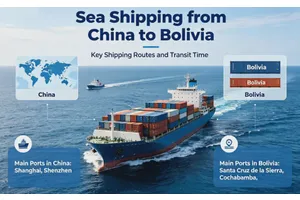
Door to door shipping from China to Bolivia presents a logistics challenge unlike almost any other South American destination. Bolivia is a landlocked country — it has no direct ocean access. Every container from China must first arrive at a port in Chile or Peru, then travel hundreds of kilometers overland across an international border before reaching its final destination. If you are an importer researching how to get goods from Chinese suppliers to La Paz, Santa Cruz, or Cochabamba, you have probably noticed that most online information is frustratingly vague — a single transit time estimate and a "contact us" button, with no real explanation of what you are paying for or what can go wrong.
This guide changes that. Drawing on over a decade of hands-on freight forwarding experience on the China–South America corridor, we have put together a complete breakdown of the three viable sea freight routes with segment-by-segment transit times, a step-by-step walkthrough of Bolivia's ANB and SENAVEX customs clearance, a practical comparison of DDP, DDU, and EXW specifically for Bolivia's landlocked reality, a worked import tax calculation, and a real case study tracing a 22 CBM electronics shipment from Shenzhen to Santa Cruz in 37 days. For a broader overview of all freight options to the region, visit our Shipping From China To Bolivia hub page.
Why Is Shipping to Bolivia Different from Other South American Countries?
Bolivia is one of only two landlocked countries in South America (the other is Paraguay). This single geographic fact fundamentally changes how international shipping works: every ocean freight shipment from China must transit through a neighboring country — either Chile or Peru — before entering Bolivian territory. That extra step adds an entire cross-border land transport segment, a second layer of customs transit documentation, and coordination requirements that simply do not exist when shipping to coastal nations like Brazil or Colombia. For dedicated shipping guides to these transit countries, explore our pages on Shipping From China to Chile and Shipping From China to Peru.
Three terms define how this works:
- Transshipment — Cargo is offloaded at a Chilean or Peruvian port, then transferred to trucks for the land journey into Bolivia. This is fundamentally different from a direct port-to-door delivery in a coastal country.
- In-bond Transit — Goods travel under customs seal from the arrival port to Bolivia's border without paying Chilean or Peruvian import duties. Formal customs clearance happens inside Bolivia, not at the arrival port.
- Last-mile Delivery — Once cargo clears Bolivian customs, it is trucked from the customs warehouse to your final address — which can mean navigating high-altitude mountain roads (La Paz: 3,640m) or unpaved rural routes.
Where your goods are headed matters. In our experience handling shipments across Bolivia for over a decade, we have found that matching the entry route to the destination city is the single most impactful cost-and-time decision an importer can make. La Paz, at 3,640m altitude, is best served via Arica, Chile — the closest Pacific port at just 460 km away. Santa Cruz de la Sierra, Bolivia's economic hub at 400m in the eastern lowlands, is accessible via all three routes. Cochabamba, centrally located at 2,560m, works well with either Route A or B.
What Are the Shipping Routes from China to Bolivia? (Sea & Air Freight)
Route A: Shipping from China to Bolivia via Arica, Chile (Recommended)
Chinese cargo departs from major ports — Shenzhen (Yantian/Shekou), Shanghai, Ningbo, Qingdao, and Guangzhou. The ocean voyage to the Port of Arica in northern Chile takes 28 to 32 days. After discharge and in-bond transit processing (1 day), cargo is loaded onto a sealed truck. The land leg from Arica to the Tambo Quemado border crossing takes about half a day, followed by 2 to 3 days to La Paz or 3 to 4 days to Santa Cruz.
Arica is the closest Pacific port to Bolivia at just 460 km from La Paz. This short land distance minimizes the most variable and delay-prone segment of the journey — cross-border road transport through the Andes. For importers also shipping to Chile directly, our Door to Door shipping From China to Chile guide covers coastal delivery options. Best for: La Paz, Oruro, Cochabamba, and all western Bolivia.
Route B: Shipping from China to Bolivia via Matarani, Peru
The ocean leg from China to Peru's Port of Matarani takes 30 to 35 days. The land leg from Matarani to the Desaguadero border crossing and onward to La Paz is shorter than Route A's — typically 1 to 2 days. This route serves as a valuable alternative when Chilean ports face congestion or strikes, and it is geographically logical for the Lake Titicaca region. If you are shipping directly to Peru, see our Door to Door Shipping from China to Peru guide. Best for: La Paz area and as a backup when Arica is congested.
Route C: Shipping from China to Bolivia via Santos, Brazil (Eastern Route)
This is the longest and least common route. Cargo travels from China to Brazil's Port of Santos (35 to 40 days), then overland via Puerto Suárez and Corumbá into eastern Bolivia. It only makes practical sense for heavy or bulk cargo specifically destined for Santa Cruz, where the overland distance from the Brazilian border is shorter than from the Chilean or Peruvian coasts. For shipments destined within Brazil, read our Door to Door Shipping from China to Brazil guide. Best for: Bulk/heavy cargo to Santa Cruz only.
Air Freight from China to Bolivia: Fastest Door-to-Door Option
For time-sensitive shipments, air freight offers a 5- to 12-day alternative. The two primary cargo airports are Viru Viru International (VVI) in Santa Cruz — Bolivia's main cargo gateway with modern facilities — and El Alto International (LPB) in La Paz, one of the world's highest commercial airports at 4,061m. Air freight from China typically routes through Miami (MIA), São Paulo (GRU), or Lima (LIM) before connecting to VVI or LPB. Best for high-value electronics, seasonal goods, samples, and express shipments under 2 CBM.
Shipping Routes from China to Bolivia: Quick Comparison Table
| Route | Departure Ports | Transit Port | Total Transit | Best Cities | Best For |
|---|---|---|---|---|---|
| A: Arica ⭐ | Shenzhen, Shanghai, Ningbo, Qingdao, Guangzhou | Arica (Chile) | 30–35 days | La Paz, Oruro, Cochabamba | Primary — shortest overall |
| B: Matarani | Shenzhen, Shanghai, Ningbo | Matarani (Peru) | 32–38 days | La Paz, Lake Titicaca | Alternative — less congestion |
| C: Santos | Shenzhen, Shanghai | Santos (Brazil) | 38–45 days | Santa Cruz, eastern Bolivia | Bulk/heavy cargo only |
| Air Freight ✈️ | Shenzhen, Shanghai, Guangzhou | Miami / Lima / São Paulo | 5–12 days | Nationwide | High-value, urgent, samples |
FCL vs LCL Shipping to Bolivia: Which Is Cheaper for Your Cargo?
FCL (Full Container Load) means you book an entire container exclusively for your cargo. Standard container types are the 20GP (~28 CBM), 40GP (~58 CBM), and 40HQ (~68 CBM). The general threshold: if your shipment exceeds 15 CBM, FCL is almost always more economical per unit than LCL. Beyond cost, FCL offers superior security — the container stays sealed throughout transit — and faster total time because it skips the 3- to 7-day consolidation and deconsolidation windows. One Bolivia-specific note: some border crossings on Routes B and C cannot accommodate 40HQ containers on standard truck chassis. Always verify container size compatibility with your forwarder before booking.
LCL (Less than Container Load) is the pay-for-what-you-use option. Your cargo is consolidated with other shipments at a Chinese CFS (Container Freight Station), shipped in a shared container, deconsolidated at the destination CFS, and then individually trucked to Bolivia. LCL is ideal for shipments under 15 CBM, trial orders, and e-commerce batches. You can ship as little as 1 CBM. The trade-off is a 30–50% higher cost per CBM and longer total transit.
Quick decision framework: Cargo ≥ 15 CBM → FCL. Cargo < 15 CBM and not urgent → LCL. Cargo < 15 CBM and urgent → air freight. Fragile or high-value cargo → FCL even if under 15 CBM.
How Does Bolivia Customs Clearance Work? (ANB & SENAVEX Guide)
Bolivia customs clearance for imports from China involves a dual-agency system that catches unprepared importers more often than any other South American destination.
The Two Key Agencies
- ANB (Aduana Nacional de Bolivia) — Bolivia's National Customs Authority, responsible for duty assessment and customs supervision. It operates the SUMA electronic declaration system for all import filings.
- SENAVEX (Servicio Nacional de Verificación de Exportaciones) — Despite its name, SENAVEX also regulates imports. For certain product categories, it requires a pre-inspection certificate obtained in the country of origin before your goods leave China. Missing this certificate means your cargo will be rejected at the Bolivian border.
The 6-Step Clearance Process
- Pre-Shipment Document Preparation. Prepare a commercial invoice in Spanish (ANB rejects Chinese- or English-only invoices), a packing list (Lista de Empaque), a Certificate of Origin (FORM A for GSP or FORM F for China-Chile FTA routing), the Bill of Lading or Airway Bill, and a SENAVEX pre-inspection certificate if your HS code requires one.
- SENAVEX Import Pre-Inspection. If your product category triggers a SENAVEX requirement, the inspection certificate must be obtained in China before departure. This cannot be done retroactively.
- ANB Electronic Declaration (SUMA). Your Bolivian customs broker files the Declaración Única de Importación (DUI) through the SUMA platform. The declared CIF value and HS code classification determine the duty and tax calculation.
- Customs Valuation and Inspection. ANB applies WTO Valuation Agreement methodology to verify declared value. According to the World Trade Organization's Customs Valuation Agreement, customs authorities have the right to challenge declared transaction values when they appear inconsistent with prevailing market prices for identical or similar goods — and ANB actively exercises this right, particularly on shipments from China. Cargo is routed through a green (automatic release), yellow (document review), or red (physical inspection — add 2–5 days) channel system.
- Duty and Tax Payment. Pay the Gravamen Arancelario (GA) — customs duty at 0–40% depending on HS code — plus IVA (VAT at 13%, calculated on CIF + GA) and any ICE (specific consumption tax on alcohol, tobacco, vehicles, and luxury goods).
- Release and Final Delivery. After payment confirmation, arrange inland transport. Major cities (La Paz, Santa Cruz, Cochabamba): 1–2 days. Remote areas: allow 2–5 additional days.
Bolivia Import Document Checklist
- Commercial invoice — must be in Spanish (Factura Comercial)
- Packing list (Lista de Empaque)
- Certificate of Origin (FORM A or FORM F)
- Bill of Lading or Airway Bill
- SENAVEX inspection certificate (if applicable — confirm before shipping)
- Single Import Declaration (DUI)
- Cargo insurance certificate (Póliza de Seguro)
- Bolivian Tax ID (NIT)
Why Customs Clearance Gets Delayed
- Document language mismatch — Spanish translation missing or incorrect (the #1 preventable cause).
- Declared value flagged as undervalued — ANB cross-references against international benchmarks.
- Missing SENAVEX pre-inspection — cannot be obtained after goods arrive.
- HS code misclassification — wrong code triggers a hold, reassessment, and potential penalty.
Restricted Goods
Used clothing and footwear require a special import permit. Certain chemicals, pesticides, and some agricultural products face seasonal restrictions or bans. Weapons, ********s, and hazardous waste are prohibited. Always verify with your forwarder before shipping.
DDP vs DDU Shipping to Bolivia: Which Incoterm Should You Choose?
The Incoterm you choose determines who pays for what — and who bears the risk at each stage. For Bolivia, the stakes are higher because of the multi-country coordination involved.
Quick Reference
- DDP (Delivered Duty Paid) — Forwarder handles everything: China pickup → export customs → ocean/air freight → Chile/Peru transit → Bolivia ANB + SENAVEX clearance → duty and VAT payment → final delivery. You receive the goods.
- DDU (Delivered Duty Unpaid) — Same as DDP, but you pay Bolivia's duties and VAT directly using your own NIT registration.
- CIF (Cost, Insurance and Freight) — Forwarder covers up to the arrival port. You handle everything from there: transit, Bolivia clearance, duties, delivery.
- FOB (Free on Board) — You take over from the Chinese loading port. You arrange ocean freight and everything downstream.
- EXW (Ex Works) — You collect from the Chinese factory and handle absolutely everything.
Responsibility Matrix
| Incoterm | China Pickup | Export Customs | Ocean/Air Freight | Chile/Peru Transit | Bolivia ANB | Duty & VAT | Bolivia Delivery | Best For |
|---|---|---|---|---|---|---|---|---|
| DDP | ✅ Forwarder | ✅ Forwarder | ✅ Forwarder | ✅ Forwarder | ✅ Forwarder | ✅ Forwarder | ✅ Forwarder | Hassle-free; recommended |
| DDU | ✅ Forwarder | ✅ Forwarder | ✅ Forwarder | ✅ Forwarder | ✅ Forwarder | ❌ Importer | ✅ Forwarder | Importers with local broker |
| CIF | ✅ Forwarder | ✅ Forwarder | ✅ Forwarder | ❌ Importer | ❌ Importer | ❌ Importer | ❌ Importer | Experienced importers |
| FOB | ❌ Importer | ❌ Importer | ❌ Importer | ❌ Importer | ❌ Importer | ❌ Importer | ❌ Importer | Large traders |
| EXW | ❌ Importer | ❌ Importer | ❌ Importer | ❌ Importer | ❌ Importer | ❌ Importer | ❌ Importer | Rare cases |
Our Recommendation
DDP is strongly recommended for virtually all Bolivia importers. A Bolivia shipment involves six distinct operational layers across three jurisdictions (China, Chile/Peru, Bolivia). Under DDP, your forwarder owns all six as a single integrated chain. Under any other Incoterm, you become the project manager. For a deeper comparison of trade-off strategies, see our analysis of DDP vs FOB: Which Option Saves Time and Reduces Hassle. DDU is a reasonable compromise if you already have a Bolivian NIT and a local broker relationship. EXW and FOB are not recommended unless you are a large enterprise with dedicated in-house teams in both China and Bolivia.
What Your DDP Quote Covers
| Cost Component | Who Pays | Notes |
|---|---|---|
| China factory to port trucking | Forwarder | Domestic transport to departure port |
| China export customs clearance | Forwarder | Including inspection and document fees |
| Ocean freight (China → Chile/Peru) | Forwarder | FCL or LCL, based on volume |
| Destination port THC and handling | Forwarder | Terminal handling at Arica or Matarani |
| In-bond transit (port → Bolivia border) | Forwarder | Customs-sealed trucking |
| Bolivia customs brokerage | Forwarder | DUI filing and SUMA system management |
| Bolivia import duty (GA, 0–40%) | Forwarder | Advanced on your behalf |
| Bolivia VAT (IVA, 13%) | Forwarder | Calculated on CIF + GA |
| Bolivia ICE (if applicable) | Forwarder | Specific goods only |
| Bolivia inland delivery | Forwarder | Last-mile to your door |
How Much Import Duty and Tax Will I Pay in Bolivia?
Tariff Structure
| Product Category | Typical GA (Duty) | Notes |
|---|---|---|
| Electronics | 0–10% | Many consumer electronics at 0% |
| Machinery and equipment | 0–5% | Industrial machinery often duty-free |
| Industrial goods (general) | 5–15% | Most manufactured products |
| Textiles and apparel | 15–30% | Higher protection for local industry |
| Automobiles and parts | 0–40% | Varies by engine displacement |
| Chemicals | 5–10% | Some require SENAVEX pre-inspection |
The Formula
Total Import Tax = GA + IVA + ICE (if applicable)
- GA = CIF Value × GA Rate (determined by HS code, 0–40%)
- IVA = (CIF Value + GA) × 13%
- ICE = Specific goods only (alcohol, tobacco, vehicles, luxury cosmetics)
Worked Example: Electronics Import
| Parameter | Value |
|---|---|
| Product | Consumer electronics (smartphones) |
| HS Code | 8517.12 |
| CIF Value | $10,000 |
| GA Rate | 0% (electronics — duty-free) |
- GA = $10,000 × 0% = $0.00
- IVA = ($10,000 + $0) × 13% = $1,300.00
- ICE = Not applicable
- Total Import Tax = $1,300.00
Your total landed cost before freight is approximately $11,300. Electronics importers pay only 13% VAT — zero customs duty — making Bolivia surprisingly competitive compared to some neighboring countries.
Tariff Preference Opportunities
Bolivia is a full CAN (Andean Community) member and MERCOSUR associate. Goods meeting CAN rules of origin may qualify for reduced duty rates. Your Certificate of Origin — whether FORM A (GSP) or FORM F (China-Chile FTA) — is not just paperwork. It can directly reduce your duty bill. Discuss the optimal certificate with your forwarder before shipment.
How Long Does Door to Door Shipping from China to Bolivia Take & Cost?
Door-to-Door Sea Freight Timeline (Route A: Shenzhen → La Paz)
| Stage | Duration | Activity |
|---|---|---|
| 1. Factory to port + export customs | 2–4 days | Trucking and Chinese customs declaration |
| 2. Ocean transit: China → Arica, Chile | 28–35 days | Pacific crossing |
| 3. Arica discharge + in-bond transit docs | 1–2 days | Chilean customs transit processing |
| 4. Land transport: Arica → Bolivia border | 1–2 days | Sealed truck to Tambo Quemado |
| 5. Bolivia customs clearance (ANB) | 1–3 days | DUI filing, SENAVEX, duty/tax payment |
| 6. Release → final delivery | 1–2 days | Last-mile to importer's address |
| Total | 34–48 days |
Air freight door-to-door: 5–12 days. For a focused look at sea freight costs and transit specifics, see our Sea Shipping from China to Bolivia breakdown.
5 Delay Factors to Watch
- Port congestion at Arica or Matarani — strikes or peak-season backlogs.
- Andean rainy season (December–March) — landslides and road closures on mountain routes.
- Bolivian public holidays — Carnaval de Oruro, Semana Santa, Fiestas Patrias (Aug 6).
- SENAVEX red-channel spikes — random inspection increases add 2–5 days.
- Incomplete documentation — the #1 cause of avoidable delays.
5 Ways to Reduce Shipping Costs
- Avoid peak season surcharges. Ocean freight rates from China spike 30% to 50% during the pre-Chinese New Year rush (January/February) and the pre-Christmas peak (September through November). We track these fluctuations weekly for our clients and consistently see the best rates during March–May and June–August windows. If your procurement timeline has any flexibility, shifting your shipment by even two weeks can save thousands of dollars on a single container.
- Use Route A via Arica — shortest total distance, lowest combined sea + land cost.
- Consolidate to FCL above 15 CBM — per-unit cost drops materially at container-load volume.
- Prepare all documents before departure — avoid daily demurrage and detention charges at the destination.
- Use a single forwarder for the full DDP chain — eliminates the cost of managing multiple intermediaries across three countries.
How to Package and Insure Goods for Shipping from China to Bolivia?
Bolivia-Specific Packaging
- High-altitude protection. La Paz (3,640m) and El Alto airport (4,061m) mean significantly lower atmospheric pressure. Sealed packaging — plastic-wrapped electronics, liquid containers, aerosols — can bulge or rupture. Use vented caps for liquids and reinforced seals for vacuum-packed goods.
- Multi-modal handling. Your cargo undergoes at least four separate handling events (China loading, port discharge, border truck transfer, customs inspection). Palletize everything. Stretch-wrap with edge protectors. Do not ship loose cartons.
- Moisture protection. The Andean rainy season (December–March) exposes cargo to high humidity on mountain transit routes. Use desiccant packs and moisture-barrier wrapping for sensitive goods.
- Palletization is mandatory. The truck-to-truck transfer at the Chile/Bolivia border is where loose cargo gets damaged. Every carton should be palletized and secured.
Cargo Insurance: Essential
Bolivia shipments involve more risk segments than almost any other South American destination — ocean transit, port handling, cross-border trucking on remote Andean highways, and Bolivian customs inspection. We recommend All Risks coverage (Institute Cargo Clauses A) at 110% of CIF value. For a detailed breakdown of what insurance covers and costs, read our guide on Shipping container insurance cost for shipments from China.
Risk Management Checklist
- Use a forwarder with proven China–Chile–Bolivia corridor experience
- All documents in Spanish before cargo leaves China
- All Risks insurance at 110% CIF value
- 5–7 day buffer during rainy season or peak periods
- Confirm SENAVEX requirements for your HS code before shipping
- Palletize and moisture-protect all cargo
How to Choose a Reliable Freight Forwarder for Bolivia Shipments?
A Bolivia door-to-door shipment involves six distinct operational layers across three countries. Standard forwarders handle the first two well (China export + ocean freight). Few handle layers 3 through 6 — Chile/Peru in-bond transit, Bolivia ANB clearance, SENAVEX compliance, and high-altitude last-mile delivery. A weak link in any single layer cascades into delays, storage fees, and frustration.
A qualified Bolivia forwarder should provide: door pickup from any major Chinese city (Shenzhen, Shanghai, Ningbo, Guangzhou, Qingdao, Yiwu, and others), full China export customs handling, ocean or air freight with direct carrier contracts, direct management of the Chile/Peru in-bond transit, Bolivia ANB clearance with local SUMA system expertise, SENAVEX pre-inspection verification before your cargo leaves China, DDP duty and VAT advance payment, nationwide Bolivia last-mile delivery, real-time tracking, and a single dedicated account manager.
DTFU Logistics brings all of this to every Bolivia shipment. As a FIATA and IATA dual-certified freight forwarder — credentials held by fewer than 5% of freight forwarders operating on the China–South America corridor — we have spent over a decade building direct relationships with ocean carriers, maintaining an in-house Bolivia clearance team with local partners in La Paz, Santa Cruz, and Cochabamba. Direct carrier contracts ensure competitive rates and guaranteed space, even during peak season when spot-market rates spike. Transparent DDP pricing means every cost component is itemized — you see exactly where your money goes, before you commit. For a complete overview of our Americas coverage, visit Shipping from China to Americas.
FAQs
How long does door to door shipping from China to Bolivia take?
Sea freight via Route A (China → Arica, Chile → Bolivia) takes 34–48 days door-to-door. The ocean leg is 28–35 days; land transit, customs clearance, and last-mile delivery add 6–13 days. Air freight takes 5–12 days.
How much does door to door shipping from China to Bolivia cost?
Cost depends on cargo volume, shipping method (FCL/LCL/Air), route, and Incoterm. LCL sea freight is most economical for shipments under 15 CBM. FCL offers lower per-unit cost for larger volumes. Contact a forwarder for a specific quote based on your cargo.
Why does shipping to Bolivia cost more than to Chile or Peru?
Bolivia is landlocked. Every sea freight shipment must transit through a Chilean or Peruvian port, adding a cross-border land segment, in-bond customs transit fees, and additional handling. This adds 3–7 days and incremental cost versus a direct coastal delivery.
What is the cheapest way to ship from China to Bolivia?
LCL sea freight via Route A (via Arica, Chile) is the most economical for shipments under 15 CBM. FCL is cheaper per unit above 15 CBM. Ship off-peak (avoid Jan/Feb and Sep–Nov) for the best rates.
DDP or DDU — which should I choose for Bolivia?
DDP is strongly recommended. Bolivia's landlocked geography, dual customs agencies (ANB + SENAVEX), and multi-country transit requirements make DDP the most practical choice. Under DDP, your forwarder handles all coordination — you simply receive the goods.
What documents do I need to import from China to Bolivia?
(1) Commercial invoice in Spanish, (2) packing list, (3) Certificate of Origin, (4) Bill of Lading or Airway Bill, (5) SENAVEX certificate if applicable, (6) DUI import declaration, (7) cargo insurance certificate, and your Bolivian NIT.
How does Bolivia customs clearance work?
Six steps: prepare Spanish documents before shipment → obtain SENAVEX pre-inspection if required → file DUI through ANB's SUMA system → undergo valuation and green/yellow/red channel inspection → pay GA duty + 13% IVA + ICE if applicable → arrange last-mile delivery.
Can I ship from any Chinese city to Bolivia door to door?
Yes. Forwarders offer door pickup from Shenzhen, Shanghai, Ningbo, Guangzhou, Qingdao, Yiwu, Xiamen, Tianjin, and other major cities. Domestic trucking to the port adds 1–3 days.
Are there restricted items I cannot ship to Bolivia?
Used clothing and footwear require a special permit. Certain chemicals, pesticides, and agricultural products face restrictions. Weapons, ********s, and hazardous waste are prohibited. Always verify with your forwarder.