Struggling with unexpected customs delays, skyrocketing storage fees (Armazenagem), or the complex Siscomex system when importing to South America's largest market? You are not alone. To simplify your supply chain and protect your margins, door to door shipping from China to Brazil is the most effective logistics strategy. In our over 10 years of hands-on experience at DTFU International Logistics Co.,Ltd, we've helped countless businesses navigate this notoriously complex trade lane, turning logistics headaches into predictable, streamlined operations.
In this comprehensive guide, we will break down the exact processes, shipping methods, critical documentation, and local nuances required to ship successfully from China to Brazil.
What is Door to Door Shipping from China to Brazil?
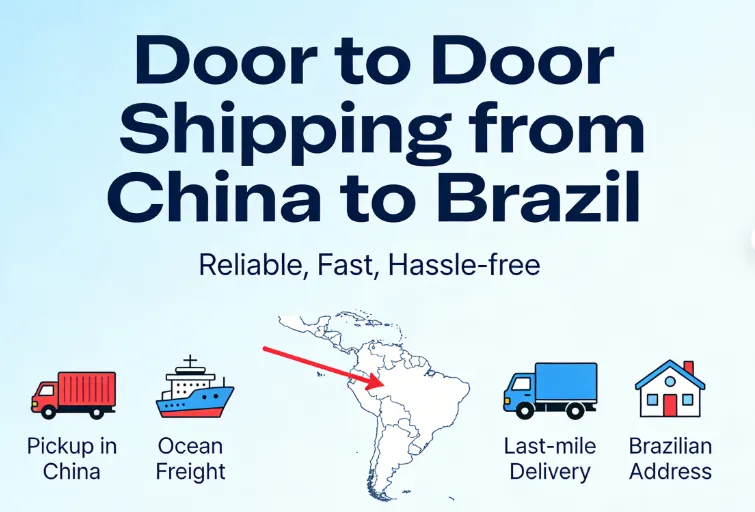
Door to Door Shipping from China to Brazil is an end-to-end international logistics solution where a single freight forwarder manages the entire transportation lifecycle—from your supplier's factory floor in China directly to your warehouse or designated address in Brazil. This includes origin pick-up, export clearance, international freight (sea, air, or express), import clearance coordination, and final inland delivery.
Crucial Note on Brazil Shipping Terms: Why DDP is Not an Option
In our daily operations, the most common and costly mistake we see new importers make is requesting DDP (Delivered Duty Paid) terms for Brazil. Brazil strictly prohibits DDP shipping.
Due to rigid Receita Federal (Brazilian Customs) regulations, the importer of record must be a registered Brazilian entity with a valid CNPJ and RADAR license. The importer must pay all duties and taxes directly to the government via the Siscomex system.
Because of this, a professional Door to Door service to Brazil operates under DAP (Delivered at Place) or DDU (Delivered Duty Unpaid) terms. At DTFU International Logistics Co.,Ltd, we handle 100% of the physical movement of your cargo up to your final address, while seamlessly coordinating with your appointed Despachante Aduaneiro (local customs broker). They facilitate the direct payment of duties on your behalf, ensuring full legal compliance without slowing down the supply chain.
Related Reading: If you're interested in door to door solutions for other major South American markets, see Door to Door shipping From China to Chile.
Door to Door vs. Traditional Port to Port Shipping
Understanding the different service levels is vital for supply chain managers looking to optimize costs and reduce administrative burden:
| Service Type | Scope of Logistics Covered | Best Suited For | Importer Workload |
|---|---|---|---|
| Door to Door | Supplier’s warehouse in China to consignee’s address in Brazil. | E-commerce, SMEs, high-value goods, businesses lacking local logistics teams. | Minimal—freight forwarder manages almost everything. |
| Port to Port | Port of loading in China to port of arrival in Brazil (e.g., Shanghai to Santos). | Large-scale manufacturers with established in-house logistics and trucking contracts. | High—consignee handles all destination customs, taxes, and inland delivery. |
| Door to Port | Supplier’s warehouse in China to destination port in Brazil. | Cost-sensitive cargo where the buyer prefers to manage last-mile delivery locally. | Moderate—consignee handles customs clearance and final delivery. |
For businesses looking to minimize risk, reduce hidden fees, and avoid navigating Brazil's challenging inland trucking routes (such as the steep Serra do Mar highway from Santos to São Paulo), Door to Door is overwhelmingly the most efficient choice.
Key Benefits of Door to Door Shipping for China-Brazil Trade
International shipping involves intricate regulations and multiple handovers. By consolidating these steps with a single expert forwarder, you gain significant operational advantages:
- Single Point of Accountability: You communicate with one dedicated partner—such as DTFU International Logistics Co.,Ltd—preventing the "blame game" between different carriers and agents.
- Streamlined Documentation: We proactively audit your Commercial Invoices and Packing Lists. In our experience, 70% of delays at Brazilian ports stem from incorrect NCM (Nomenclatura Comum do Mercosul) codes. We catch these errors before the ship leaves China.
- Cost Predictability: By bundling origin, freight, and destination services, you benefit from our preferential contract rates that fall well below the market average. This prevents duplicate charges and surprise fees upon arrival.
- Mitigation of Local Risks: We actively monitor local conditions, including potential Receita Federal strikes (greves) and port congestion, adjusting routing dynamically to avoid exorbitant Armazenagem (storage) penalties.
Main Shipping Methods: Sea, Air, and Express Courier
Choosing the right shipping method balances your budget against your required lead time.
Ocean Freight Door to Door: FCL vs LCL
Ocean freight remains the backbone of China-Brazil trade, ideal for heavy, bulky, or non-urgent cargo. When planning your budget, remember to account for the AFRMM (Merchant Marine Renewal Tax), which adds approximately 8% to your base sea freight cost upon arrival in Brazil.
| Feature | FCL (Full Container Load) | LCL (Less than Container Load) |
|---|---|---|
| Container Usage | Exclusive use (20ft, 40ft, 40HQ) | Shared container space with other shippers |
| Cost Efficiency | Lowest cost per unit for bulk shipments | Cost-effective for smaller volumes (priced per CBM) |
| Security | Maximum (sealed at origin, opened at destination) | Moderate (requires consolidation/deconsolidation) |
| Best For | High-volume importers, large machinery | SMEs, sample orders, mid-sized inventory |
Average Transit Times & Costs (2026 Estimate):
| China Port | Brazil Port | FCL Transit (Days) | LCL Transit (Days) | FCL Cost (USD 40HQ)* | LCL Cost (per CBM)* |
|---|---|---|---|---|---|
| Shanghai | Santos | 32–38 | 38–45 | $4,200–$5,800 | $130–$190 |
| Ningbo | Paranaguá | 34–40 | 40–47 | $4,300–$6,000 | $130–$190 |
| Shenzhen | Rio de Janeiro | 35–42 | 42–48 | $4,400–$5,900 | $140–$200 |
*Note: Rates are for reference and fluctuate with seasonality (e.g., Chinese New Year or Brazil's crop harvest season).
Air Freight Door to Door
When time is money, Air Freight bypasses the month-long ocean transit. Flights typically depart from major hubs like PVG (Shanghai) or CAN (Guangzhou) and arrive at GRU (São Paulo) or GIG (Rio de Janeiro).
- Transit Time: 3–7 days (airport-to-airport); roughly 6–12 days door-to-door, factoring in rigorous Brazilian customs clearance.
- Best For: High-value electronics, seasonal fashion, critical replacement parts, or urgent product launches.
Air Freight Cost Reference (2026):
| Route (Airport to Airport) | General Cargo Rate (USD/kg, 100kg+) |
|---|---|
| PVG (Shanghai) – GRU (São Paulo) | $6.8 – $9.5 |
| CAN (Guangzhou) – GIG (Rio) | $7.2 – $10.5 |
Related Topic: For a comparative look at air freight options on other international routes, see Air Freight.
International Express Courier (DHL, FedEx, UPS)
For documents, small samples, or lightweight e-commerce parcels (under 50kg), express couriers offer the fastest door-to-door transit, usually taking 4–8 days.
| Courier | Typical Delivery Time | Price (5kg Document) | Price (10kg Parcel) |
|---|---|---|---|
| DHL | 4–6 days | $160 | $265 |
| FedEx | 5–7 days | $150 | $255 |
| UPS | 5–7 days | $155 | $260 |
The Step-by-Step Process: How We Move Your Cargo
Shipping to Brazil requires flawless execution. Here is how DTFU International Logistics Co.,Ltd manages the Door to Door process:
- Booking & Origin Pick-up: We collect the cargo from your Chinese supplier. We verify packaging integrity to ensure it withstands the long ocean voyage or air transit.
- Export Customs in China: Our team handles all export declarations, ensuring compliance with Chinese customs authorities.
- International Transit & Mercante Registration: For ocean freight, we ensure your Bill of Lading is accurately registered in Brazil's Mercante system before the vessel arrives. This is a strict legal requirement for tax assessment.
- Import Customs in Brazil: Upon arrival, the import declaration is filed via Siscomex. We work in tandem with your Despachante Aduaneiro, providing them with flawless documentation to expedite the payment of II (Import Duty), IPI, ICMS, and PIS/COFINS.
- Deconsolidation & Dispatch: We swiftly move your cargo out of the port terminal to avoid Brazil's notoriously high Armazenagem (demurrage/storage) fees.
- Last-Mile Delivery: Utilizing vetted local trucking partners, we navigate Brazil's complex infrastructure to deliver the goods safely to your final destination.
Essential Documents for Brazilian Customs
Brazil is unforgiving when it comes to paperwork discrepancies. A single typo on the Commercial Invoice can result in heavy fines or cargo seizure.
| Document | Why It Is Critical for Brazil |
|---|---|
| Commercial Invoice | Must include exact NCM codes, detailed product descriptions in Portuguese or English, and accurate freight values. |
| Packing List | Must match the Commercial Invoice perfectly; used for physical customs inspections. |
| Bill of Lading (B/L) | Original B/L is often required; must include the freight cost (as Brazil calculates taxes on CIF value) and the importer's CNPJ. |
| Special Certifications | Products like cosmetics, medical devices, or electronics may require prior approval from ANVISA or INMETRO. |
How to Choose a Reliable Freight Forwarder for Brazil
Not all freight forwarders are equipped to handle the nuances of the Brazilian market. When selecting a partner, look for:
- Deep Local Knowledge: Your forwarder must understand the difference between a CNPJ and RADAR, and know how to calculate compounding taxes (like ICMS varying by state).
- Benefit-Oriented Pricing: Look for forwarders who offer transparent, all-inclusive logistics pricing based on preferential contract rates, rather than low-balling the ocean freight only to hit you with massive destination fees.
- Proactive Problem Solving: A good forwarder doesn't just move boxes; they anticipate strikes, port congestion, and regulatory shifts.
At DTFU International Logistics Co.,Ltd, we pride ourselves on delivering premium, benefit-driven logistics solutions. Our vast network and deep understanding of the China-Brazil corridor mean you get faster transit times, lower overall costs, and absolute peace of mind.
If you are considering other Latin American destinations, you may find the guide on Shipping from China to Colombia valuable.
FAQs
Q1: Can I ship DDP from China to Brazil? A: No. Brazil does not allow DDP shipments. Importers must have a RADAR license and pay taxes directly to the government. We offer seamless DAP/DDU Door to Door services where we handle all logistics, and your customs broker handles the tax payment.
Q2: How long does Door to Door shipping take? A: Ocean freight typically takes 35–50 days, air freight takes 6–12 days, and express couriers take 4–8 days, inclusive of customs clearance and final delivery.
Q3: What is the AFRMM tax? A: The AFRMM (Merchant Marine Renewal Tax) is a Brazilian federal tax applied to sea freight, roughly equal to 8% of the total ocean freight cost. It must be factored into your landed cost calculations.
Q4: How can I avoid high storage fees (Armazenagem) in Brazil? A: The best way to avoid high storage fees is to ensure your Commercial Invoice, Packing List, and NCM codes are 100% accurate before the cargo leaves China. DTFU proactively audits your documents to ensure rapid customs clearance upon arrival.
Q5: Is my cargo insured during transit? A: Cargo insurance is not automatically included but is highly recommended. DTFU can secure comprehensive insurance policies at highly competitive rates to protect your investment from origin to destination.
Ready to streamline your imports from China to Brazil? Contact DTFU International Logistics Co.,Ltd today to leverage our preferential rates and expert Door to Door logistics solutions. Let us handle the complexity so you can focus on growing your business.