Door to door shipping from China to Venezuela is not like shipping to Miami, Rotterdam, or even São Paulo. Currency controls, strict SENIAT customs procedures, and the absence of direct shipping routes turn what should be a routine logistics operation into a complex coordination challenge. If you have ever had cargo sit at Puerto Cabello for weeks because of a missing Spanish translation on a commercial invoice, you already understand why the right freight forwarder matters. In our 10+ years managing freight from Shenzhen to Venezuela, we have learned that the difference between a 42-day delivery and a 90-day customs hold often comes down to one document prepared correctly before the container ever leaves China.
Venezuela remains a vital trade partner for Chinese manufacturers. Bilateral trade surged from roughly $742 million in 2003 to approximately $20 billion by 2012, and today the flow of machinery, electronics, textiles, and consumer goods continues steadily. Whether you are a B2B importer restocking inventory, an e-commerce seller testing a new market, or an SME sourcing industrial equipment, this guide will show you exactly how door-to-door shipping works, what it costs in 2026, how Venezuelan customs operates, and how to choose a freight forwarder who actually knows this route.
What Is Door-to-Door Shipping from China to Venezuela?
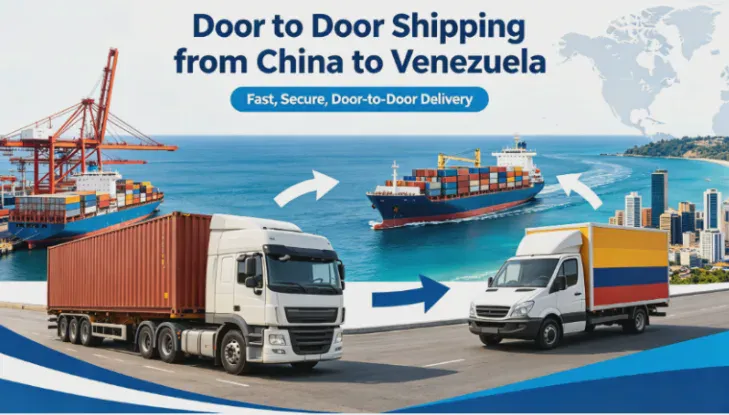
Door-to-door shipping is an end-to-end logistics service where the freight forwarder manages every stage of the journey: pickup from your Chinese supplier, export customs clearance, international transit, import customs clearance, duty and tax payment, and final delivery to your address in Venezuela.
Unlike port-to-port or airport-to-airport services, door-to-door shifts the operational burden entirely to the logistics provider. For most importers shipping to Venezuela, this is not a luxury. It is a necessity.
DDP (Delivered Duty Paid): The Preferred Incoterm for Venezuela
Under DDP (Delivered Duty Paid), the seller or forwarder assumes all costs and risks until the goods reach the buyer's door. This and all trade terms referenced in this guide follow the Incoterms 2020 framework published by the International Chamber of Commerce. This includes:
- Pickup and inland transport in China
- Export customs clearance
- Ocean or air freight to Venezuela
- Import customs clearance and SENIAT compliance
- Payment of all import duties, taxes, and handling fees
- Last-mile delivery to the consignee's warehouse or business address
DDP dominates the China-Venezuela corridor for one simple reason: Venezuelan currency controls and SENIAT bureaucracy make it extremely difficult for foreign buyers to manage import formalities remotely—far more complex than typical DDP shipping from China to USA arrangements. Most Venezuelan importers do not hold USD accounts capable of settling customs duties directly with SENIAT. A DDP arrangement solves this headache by embedding all landed costs into a single, predictable invoice.
DDU (Delivered Duty Unpaid): When It Makes Sense
Under DDU (Delivered Duty Unpaid), the forwarder delivers the cargo to the destination, but the buyer handles import clearance and pays all duties and taxes upon arrival.
This option only works if:
- Your consignee has an established Venezuelan customs broker (agente de aduanas)
- The consignee holds the necessary RIF tax ID and can settle duties in local currency or approved foreign currency
- You have shipped to Venezuela before and understand SENIAT's pre-declaration timelines
For first-time importers or SMEs without a local logistics team, DDU adds unnecessary risk.
DAP (Delivered at Place): The Middle Ground
DAP (Delivered at Place) means the seller delivers the goods to a named destination (such as Puerto Cabello port or Caracas airport), but the buyer handles unloading and import formalities. DAP is rarely used for Venezuela because it still leaves the importer exposed to the same customs and currency complexities.
Incoterm Decision Table for Venezuela
| Incoterm | Who Pays Duties | Who Handles Customs | Best For |
|---|---|---|---|
| DDP | Seller/Forwarder | Forwarder's local agent | Most importers; first-time shippers; SMEs |
| DDU | Buyer | Buyer's broker | Experienced importers with local customs contacts |
| DAP | Buyer | Buyer's broker | Specific port/airport delivery needs only |
Why Door-to-Door Makes Sense for Venezuela Specifically
Venezuela is not a generic South American destination. Three structural challenges make door-to-door service not just convenient, but strategically essential. Unlike the more streamlined corridors for door to door shipping from China to Brazil or door to door shipping from China to Colombia, this route requires specialized local knowledge.
SENIAT Bureaucracy and Pre-Declaration Requirements
Venezuelan customs, administered by SENIAT (Servicio Nacional Integrado de Administración Aduanera y Tributaria), operates under strict pre-declaration rules:
- Sea freight shipments must be pre-declared 2 to 15 days before arrival at the Venezuelan port
- Air and land freight require pre-declaration 1 to 15 days before arrival
- A formal declaration must be filed within 5 working days of cargo arrival
- All documentation must be in Spanish, with original typewritten commercial invoices (photocopies are rejected)
Missing any of these steps triggers automatic cargo holds, storage fees, and potential fines. A door-to-door forwarder with a Venezuelan customs partner manages this timeline proactively.
Currency Controls and Payment Complexity
Venezuela maintains strict currency controls that complicate international trade. Importers often face:
- Difficulty accessing USD or EUR at official exchange rates
- Additional VAT surcharges of 5% to 25% for payments made in foreign currency, cryptocurrency, or non-Venezuelan crypto assets
- Banking restrictions that delay duty payments
Under a DDP shipping arrangement, the forwarder's local agent pays duties and taxes in local currency on behalf of the consignee, eliminating the buyer's exposure to these frictions.
Infrastructure and Last-Mile Limitations
- Port congestion at La Guaira: Equipment shortages and high volume create recurring delays
- Inland transport challenges: Fuel availability fluctuates, road conditions vary, and security considerations differ between Caracas and interior destinations
- No direct shipping routes: Most cargo transships via Panama, Jamaica, or Colombia, adding coordination layers
A freight forwarder with established local trucking networks in Caracas, Puerto Cabello, and Maracaibo can navigate these constraints far more effectively than an importer trying to arrange last-mile delivery from abroad.
Shipping Options: Sea Freight vs Air Freight vs Express Courier
Choosing the right shipping mode depends on your cargo volume, budget, and urgency. Businesses exploring neighboring markets may also find our guides to door to door shipping from China to Peru and door to door shipping from China to Chile useful for comparison. Here is how the three main options compare for door to door logistics China Venezuela.
Sea Freight Door to Door (FCL & LCL)
Sea freight is the cheapest way to ship from China to Venezuela for large or heavy cargo. It is the default choice for machinery, building materials, wholesale consumer goods, and vehicles.
FCL (Full Container Load) means your cargo occupies an entire container. The two standard sizes are:
- 20GP: Approximately 28 CBM capacity; ideal for medium shipments
- 40HQ: Approximately 68 CBM capacity; delivers the best per-CBM value for high-volume cargo
For most importers, the 40HQ is the sweet spot. In 2026, market data shows 40HQ rate increases have been far more moderate than 20GP spikes, making the larger container economically advantageous.
LCL (Less than Container Load) means your cargo shares container space with other shipments. You pay by the cubic meter (CBM). LCL works well for smaller shipments that do not justify a full container, though you should budget for slightly longer transit times due to consolidation and deconsolidation.
Specialized containers are available for non-standard cargo:
- Flat racks: For oversized machinery
- Open-top containers: For cargo that must be loaded from above
- Reefer containers: For temperature-sensitive goods
Typical door-to-door sea transit: 35 to 55 days, including pickup, export clearance, ocean transit, transshipment, import clearance, and delivery.
Air Freight Door to Door
Air freight is the fastest option and ideal for urgent shipments, high-value electronics, perishables, or sample orders.
Because there are no direct flights between China and Venezuela, cargo routes through hubs such as Panama City, Miami, Mexico City, or Madrid. This adds connection time but does not change the fundamental value proposition: air freight delivers in days what sea freight delivers in weeks.
Air freight pricing is tiered by weight:
| Weight Tier | Rate per kg (Airport-to-Airport) | Door-to-Door Add-on |
|---|---|---|
| 45–100 kg | $7.00–$9.00 | +2–4 days |
| 100–300 kg | $6.00–$7.50 | +2–4 days |
| 300–1,000 kg | $5.50–$7.00 | +2–3 days |
| 1,000+ kg | $4.50–$6.50 | +2–3 days |
Typical door-to-door air transit: 7 to 12 days.
Express Courier Door to Door
Express courier services (DHL, FedEx, UPS) handle documents, small parcels, and e-commerce samples with the fastest delivery times.
- Transit time: 3 to 5 days door-to-door
- Cost: $10 to $16 per kg
- Limitations: Strict weight and size caps; limited tracking granularity inside Venezuela; higher per-kg cost makes express uneconomical for commercial volumes
Decision Matrix: Which Mode Should You Choose?
| Factor | Sea FCL | Sea LCL | Air Freight | Express Courier |
|---|---|---|---|---|
| Budget Priority | Lowest cost | Low cost | High cost | Highest cost |
| Urgency | Low (35–55 days) | Low (40–60 days) | High (7–12 days) | Very high (3–5 days) |
| Cargo Volume | Large (20GP/40HQ) | Small to medium | Small to medium | Very small |
| Best For | Machinery, bulk goods | Partial loads | Electronics, samples | Documents, parcels |
| DDP Rate Range | $1.50–$3.50/kg | $120–$200/CBM | $5.00–$12.00/kg | $10–$16/kg |
Step-by-Step: How Door-to-Door Shipping Works
Understanding the full logistics chain helps you know what to expect and where a professional freight forwarder from Shenzhen to Venezuela adds value. Here is the exact process DTFU Logistics manages for every door-to-door shipment.
Step 1: Booking and Supplier Coordination
You provide cargo details: product type, weight, dimensions, HS code, supplier address, and destination in Venezuela. DTFU confirms HS code accuracy (a critical step many forwarders skip) and schedules pickup. If you are sourcing from multiple factories, we coordinate collection from each location under a single booking reference.
Step 2: Pickup and Origin Warehousing
Cargo is collected from the supplier and transported to DTFU's consolidation warehouse. At this stage, optional services include:
- Quality inspection
- Re-packing or palletization
- Labeling and barcode application
- Photographic documentation of cargo condition
Step 3: Export Customs Clearance (China)
DTFU prepares and submits export documentation to Chinese customs:
- Commercial invoice
- Packing list
- Export declaration
- Certificate of origin (when required)
Our licensed customs brokerage team ensures compliance with Chinese export regulations, preventing delays at the port of loading.
Step 4: International Transit
For sea freight, containers are loaded at Shanghai, Shenzhen, Ningbo, or Guangzhou and sail to transshipment hubs such as Colón (Panama), Kingston (Jamaica), or Cartagena (Colombia). From there, feeder vessels carry the cargo to Puerto Cabello or La Guaira.
For air freight, cargo departs from Shanghai Pudong (PVG), Guangzhou Baiyun (CAN), or Shenzhen Bao'an (SZX) and connects through Panama City, Miami, or Madrid before arriving at Simón Bolívar International Airport (CCS) in Caracas.
Step 5: Import Customs Clearance (Venezuela)
This is where experience separates professional forwarders from generalists. DTFU's Venezuelan customs partner:
- Submits the SENIAT pre-declaration within the required window
- Files the formal declaration within 5 working days of arrival
- Manages document review and responds to customs queries
- Coordinates physical inspections if required
Step 6: Duty and Tax Payment
Under DDP shipping from China to Venezuela, DTFU's local agent pays all import duties, the 16% VAT, and customs handling fees on your behalf. You receive a single, consolidated invoice covering the entire shipment. No surprise charges. No currency control headaches.
Under DDU, your consignee arranges payment directly with SENIAT.
Step 7: Last-Mile Delivery
Cargo moves from the port or airport to your warehouse or business address. In Venezuela, last-mile logistics require local knowledge:
- Caracas deliveries: Navigate traffic and security considerations in the capital region
- Interior destinations: Coordinate with reliable carriers who understand regional road conditions and fuel availability
- Puerto Cabello to Valencia: A common inland route for industrial importers
Step 8: Delivery Confirmation
Your shipment arrives. You sign the proof of delivery (POD). Tracking is updated to "delivered." Your account manager follows up to confirm satisfaction and address any questions.
Consolidated Shipping from Multiple Chinese Suppliers
Many Venezuelan importers do not source from a single factory. You might buy electronics in Shenzhen, textiles in Guangzhou, and hardware in Ningbo. Managing three separate shipments to Venezuela is expensive and logistically chaotic.
Consolidated shipping solves this.
DTFU operates a nationwide pickup network covering all major Chinese manufacturing hubs. We collect cargo from each supplier, bring it to our Shenzhen consolidation warehouse, and:
- Inspect and verify quantities
- Re-pack or palletize for container loading
- Merge everything under a single Bill of Lading (B/L)
- Provide one point of contact for the entire shipment
The benefits are substantial:
- Cost savings: Shared container space reduces per-unit freight costs
- Simplified documentation: One commercial invoice, one packing list, one certificate of origin
- Unified customs clearance: A single customs entry in Venezuela instead of multiple
- Reduced coordination overhead: One pickup schedule, one tracking number, one delivery
For SMEs and e-commerce sellers sourcing from multiple Alibaba suppliers or trade fair contacts, consolidation is often the difference between a profitable import and a logistical nightmare.
Transit Times and Costs: 2026 Rates
The following tables reflect current market conditions for China to Venezuela shipping cost 2025 2026. For port-to-port benchmarks, see our detailed guide to sea shipping from China to Venezuela. Rates fluctuate based on carrier capacity, fuel surcharges, peak season demand (September to November), and origin port. Contact DTFU for a locked quote valid 14 days.
Sea Freight Door-to-Door Rates and Transit Times
| Route | Container | Port-to-Port | Door-to-Door | Cost Range (2026) |
|---|---|---|---|---|
| Shanghai to Puerto Cabello | 20GP | 30–35 days | 40–50 days | $2,500–$4,200 |
| Shanghai to Puerto Cabello | 40HQ | 30–35 days | 40–50 days | $3,500–$5,000 |
| Shenzhen to La Guaira | 20GP | 28–35 days | 38–48 days | $2,600–$4,500 |
| Shenzhen to La Guaira | 40HQ | 28–35 days | 38–48 days | $3,600–$5,200 |
| Ningbo to Puerto Cabello | 20GP | 32–38 days | 42–52 days | $2,500–$4,300 |
| Guangzhou to La Guaira | 20GP | 28–35 days | 38–48 days | $2,600–$4,500 |
LCL sea freight: $120 to $200 per CBM, door-to-door.
Air Freight Door-to-Door Rates and Transit Times
| Weight Tier | Rate per kg | Door-to-Door Time |
|---|---|---|
| 45–100 kg | $7.50–$9.50 | 8–12 days |
| 100–300 kg | $6.50–$8.00 | 8–12 days |
| 300–1,000 kg | $5.50–$7.00 | 7–11 days |
| 1,000+ kg | $4.50–$6.50 | 7–10 days |
Express courier: $10 to $16 per kg, 3 to 5 days door-to-door.
DDP All-Inclusive Pricing (Per kg)
| Mode | DDP Rate | Best For |
|---|---|---|
| Sea DDP | $1.50–$3.50/kg | Large-volume, non-urgent shipments |
| Air DDP | $5.00–$12.00/kg | Medium-volume, time-sensitive cargo |
Note on rate validity: Ocean freight markets shift rapidly. The 20GP container market has seen sharper price volatility than 40HQ in 2026. For budget-sensitive shipments, consolidating into a 40HQ or choosing LCL often delivers better value than a small FCL booking.
Disclaimer: The rates and transit times shown above reflect market conditions as of 2026 and are provided for planning purposes only. Final quotes depend on real-time carrier capacity, fuel surcharges, cargo specifications, and customs complexity. Contact DTFU for a binding quotation valid for 14 days.
Key Ports and Routing: Where Your Cargo Moves
Understanding the port landscape helps you choose the most efficient origin and destination combination for your shipment.
Major China Origin Ports
- Shanghai: China's busiest container port with the highest sailing frequency to South America. Best for FCL shipments to Puerto Cabello.
- Shenzhen: Located at the heart of the Pearl River Delta manufacturing belt. Ideal for electronics, consolidated cargo, and multi-supplier pickups. DTFU's main warehouse is here.
- Ningbo-Zhoushan: Strong for machinery, industrial equipment, and automotive parts.
- Guangzhou: A major hub for textiles, footwear, consumer goods, and LCL consolidation.
- Qingdao, Xiamen, Tianjin: Secondary options for region-specific manufacturing clusters in northern and southeastern China.
Major Venezuela Destination Ports
- Puerto Cabello: Venezuela's busiest port, handling over 80% of containerized imports. It offers the best infrastructure, equipment availability, and inland connectivity for industrial cargo. If your destination is Valencia, Maracay, or central Venezuela, Puerto Cabello is the logical choice.
- La Guaira: Located just outside Caracas, La Guaira is the second-largest port and the closest maritime gateway to the capital region. However, it suffers from higher congestion and equipment shortages than Puerto Cabello. Build a buffer into your schedule if using La Guaira.
- Maracaibo: Serves western Venezuela and the Zulia region. Useful for regional distribution but offers fewer sailing connections than the two main ports.
Air Freight Gateways
- Simón Bolívar International Airport (CCS): The primary air cargo hub in Caracas. Nearly all air freight from China arrives here before moving inland.
- Maracaibo (MAR) and Valencia (VLN): Secondary airports for regional air distribution, though most international cargo still clears through CCS.
The Transshipment Reality
There are no direct vessel or flight routes between China and Venezuela, which adds coordination complexity not found on direct lanes such as shipping from China to Colombia. Geopolitical and commercial factors limit direct carrier calls, which means almost every shipment transships through an intermediate hub.
Common ocean transshipment hubs:
- Colón, Panama: The most frequently used hub for China-Venezuela cargo
- Kingston, Jamaica: Common for Caribbean routing
- Cartagena, Colombia: Alternative for certain carrier networks
What transshipment means for you:
- Add 3 to 7 days to published port-to-port transit times
- Your cargo is unloaded from the main vessel and reloaded onto a smaller feeder vessel
- There is a small but real risk of missed connections during transshipment
- Transshipment fees are included in DTFU's door-to-door quotes
Working with a forwarder that holds direct carrier contracts reduces transshipment risk by securing priority space and reliable connection windows.
Venezuelan Customs, Duties, and Taxes: The SENIAT Guide
Navigating Venezuela customs clearance from China is where most shipments succeed or fail. This section breaks down exactly what SENIAT requires and how duties are calculated.
Understanding SENIAT Procedures
SENIAT operates under a pre-declaration system designed to streamline port processing but which creates tight deadlines for importers:
- Pre-declaration: Mandatory submission 2 to 15 days before vessel arrival for sea freight; 1 to 15 days for air or land freight
- Formal declaration: Must be filed within 5 working days of cargo arrival at the port or airport
- Document language: All declarations and supporting documents must be in Spanish
- Original documents: Commercial invoices must be original and typewritten; photocopies are rejected
Missing the pre-declaration window or submitting incomplete paperwork triggers automatic cargo holds, demurrage charges, and potential penalties.
Import Duties and Taxes Breakdown
Venezuela applies taxes based on the CIF method (Cost + Insurance + Freight):
| Tax or Duty | Rate | Applied To |
|---|---|---|
| Customs Duty (Arancel) | 5%–35% | Based on HS code classification |
| VAT (IVA) | 16% | CIF value + import duty |
| Luxury Tax | 10%–15% | High-value vehicles, certain electronics |
| Customs Handling Fee | ~1% | Processing charge |
Duty Calculation Example
Let us walk through a realistic example. You are importing machinery valued at $10,000 CIF with a 10% customs duty rate:
- Import duty: $10,000 × 10% = $1,000
- VAT base: $10,000 + $1,000 = $11,000
- VAT (16%): $11,000 × 16% = $1,760
- Total duties and taxes: $2,760
Under DDP, this $2,760 is prepaid by your forwarder's local agent. Under DDU, your consignee must arrange payment directly with SENIAT within the declaration window.
Product-Specific Duty Rates
| Product Category | Typical Duty Rate | Additional Requirements |
|---|---|---|
| Capital goods | 5% | Standard documentation |
| Raw materials | 10%–15% | Standard documentation |
| Finished consumer goods | 15%–35% | Standard documentation |
| Electronics | 5%–20% | SENCAMER certification |
| Textiles and fashion | ~35% | Standard documentation |
| Vehicles (passenger) | 35%–40% | INTT homologation, quota approval |
| Commercial vehicles | 10%–20% | INTT homologation |
Special 2025–2026 Exemptions
Official Gazette No. 6,918 (June 30, 2025) introduced significant exemptions:
- 90% VAT exemption on certain imports for public and private entities using own resources
- Full duty and VAT waiver for specific ministries and state corporations in energy, water, mining, and cement sectors
- Coverage extends to approximately 1,409 tariff subheadings
Most commercial importers will not qualify for these exemptions, but they are worth reviewing if your shipment falls under eligible categories.
Required Documentation: The Complete Checklist
Accurate documentation is the single most controllable factor in avoiding customs delays. Here is the complete checklist for Venezuela import requirements from China.
Mandatory Documents (All Must Be in Spanish)
Commercial Invoice (original, typewritten — photocopies rejected)
- Must list unit price and total value separately
- Insurance and freight costs must be itemized separately
Packing List
- Detailed weight, dimensions, number of packages, and contents per package
Bill of Lading (B/L) — Sea freight (4 copies required)
Airway Bill (AWB) — Air freight
Certificate of Origin
- Verifies China manufacturing; may qualify for duty reductions
HS Code Declaration
- Accurate classification is critical; incorrect codes trigger inspections and penalties
Import License
- Required for regulated goods including electronics, vehicles, pharmaceuticals, and machinery
Conditional and Special Documents
RIF (Registro de Identificación Fiscal) — Venezuelan importer's tax ID number
SENCAMER Certificate — Required for electronics and telecommunications equipment
INTT Homologation — Required for vehicle imports
Phytosanitary Certificate — For agricultural products, wood, and plants
ISPM 15 Fumigation Certificate — For wooden pallets, crates, and packaging materials
Quality Standard Certificate — For certain industrial and mechanical products
Pro tip from our operations team: We prepare all documentation in Spanish at origin, before the container ever leaves China. This simple step eliminates one of the most common causes of Venezuelan customs delays.
The SENIAT Pre-Declaration Timeline: What the Official Rules Don't Tell You
Officially, SENIAT requires pre-declaration 2 to 15 days before arrival. In our operational experience managing this route since 2014, three timing nuances consistently catch importers off guard:
- Friday arrivals are the riskiest. If your vessel arrives on a Friday, the 5-working-day declaration window effectively shrinks because SENIAT offices operate limited hours on weekends. We always push to file pre-declarations by Tuesday for Friday arrivals.
- Air freight pre-declaration windows are tighter in practice. While the rule states 1 to 15 days, air cargo often arrives faster than expected due to schedule changes. We file air pre-declarations as soon as the AWB is issued—typically 5 to 7 days before departure—to avoid last-minute scrambles.
- The "original typewritten invoice" rule is stricter than it sounds. SENIAT inspectors have rejected invoices printed from Excel templates that use standard fonts. We require our clients' suppliers to use formal letterhead with original signatures—no digital signatures accepted at Puerto Cabello.
Cargo Insurance and Risk Management
Given the extended transit times, multiple handling points, and unique operational environment, cargo insurance for China Venezuela shipping is not optional. It is essential.
Why Insurance Matters on This Route
- Extended exposure: Door-to-door sea transit takes 35 to 55 days, increasing the window for damage, theft, or weather-related loss
- Port handling risks: Customs inspections at Puerto Cabello and La Guaira can be physically intrusive, with cargo opened and repacked by customs officials
- Theft and pilferage: While not unique to Venezuela, high-value cargo at congested ports requires additional vigilance
- Transshipment vulnerability: Every time cargo moves from one vessel to another at a hub, handling risk increases
Coverage Types Explained
| Coverage Type | What It Covers | Recommended For Venezuela? |
|---|---|---|
| All-Risk | Physical loss or damage from virtually all external causes | Yes — broadest protection |
| Warehouse-to-Warehouse | Cargo from supplier pickup through final delivery | Yes — matches door-to-door scope |
| Named Perils | Only specific listed risks (fire, sinking, collision) | No — too narrow for this route |
How DTFU Mitigates Risk
- Secure warehousing in Shenzhen with 24/7 CCTV monitoring and access control
- Vetted local trucking partners in Venezuela equipped with GPS-tracked vehicles
- Real-time container tracking from origin port to destination delivery
- Optional pre-shipment inspection and photographic documentation for high-value cargo
- Insurance placement assistance with reputable underwriters familiar with South American trade
Expert tip: We generally recommend insuring cargo for 110% of the CIF value. This covers the goods themselves plus a buffer for freight and duty recovery, ensuring you are not out of pocket if a total loss occurs.
Filing a Claim
If damage occurs:
- Document the condition immediately upon delivery — do not sign a clean POD if damage is visible
- Photograph cargo before unpacking and after unpacking
- Preserve all original packaging materials
- Submit the claim with the B/L or AWB, commercial invoice, damage report, and photographs within the insurer's required timeframe
Common Challenges and How to Avoid Them
After managing hundreds of shipments on this corridor, we have seen the same preventable problems recur. Here is how DTFU addresses each one upfront.
| Challenge | Why It Happens | How DTFU Prevents It |
|---|---|---|
| Port congestion at La Guaira | Equipment shortages and high volume | Recommend Puerto Cabello when routing allows; build a 5-day buffer for La Guaira bookings |
| Incorrect HS code classification | Lack of familiarity with Venezuelan tariff schedules | Pre-shipment HS code verification by our licensed customs team |
| Documents rejected for language | Commercial invoices submitted in English | All documentation prepared in Spanish at origin before export |
| Missing SENCAMER or INTT permits | Importer unaware of product-specific requirements | Pre-shipment compliance check; guidance on required certifications |
| Currency control delays | Restrictions on USD duty payments | DDP service eliminates the buyer's need to handle local tax settlements |
| Wooden packaging rejected | Missing ISPM 15 fumigation certificate | Origin warehouse inspection; re-packing with compliant materials if needed |
| Undervaluation accusations | Declared value perceived as below market rate | Accurate valuation guidance based on supplier commercial invoices |
| Transshipment delays | Missed connections at Panama or Caribbean hubs | Direct carrier contracts with priority space agreements |
Why Choose DTFU Logistics for China-Venezuela Shipments
Not every freight forwarder who claims "global coverage" actually understands the China-Venezuela corridor. Here is what DTFU brings to this specific route.
Founded in 2014 and headquartered in Shenzhen, we operate at the center of China's manufacturing and export ecosystem. Our office location matters because it puts us within hours of the factories that produce your cargo.
FIATA and IATA dual certification means our operations meet globally recognized professional standards. These are not decorative logos. They represent audited processes, trained personnel, and financial accountability.
Direct carrier contracts ensure competitive rates and secured space even during peak season capacity crunches. When market capacity tightens, our clients do not get rolled.
Venezuela-specific expertise comes from established relationships with local customs brokers and trucking networks in Caracas, Puerto Cabello, and Maracaibo. We do not rely on generic South American agents. We work with partners who know SENIAT's evolving requirements firsthand.
24/7 online tracking gives you real-time visibility from pickup to final delivery. Your dedicated account manager answers the phone when you call.
Multi-supplier consolidation across China with centralized warehousing, quality inspection, and container loading simplifies complex sourcing operations into a single shipment.
Transparent DDP quotes mean you know your total landed cost before the container ever leaves the port. No hidden fees. No surprise storage charges. No currency control headaches.
FAQs
How long does door-to-door shipping take from China to Venezuela?
Sea freight takes 35 to 55 days door-to-door. Air freight takes 7 to 12 days. Express courier takes 3 to 5 days.
What is the cheapest way to ship from China to Venezuela?
For bulk shipments, sea freight FCL 40HQ or LCL offers the lowest per-unit cost. DDP sea rates start around $1.50 per kg for large volumes.
What documents are required for Venezuelan customs clearance?
You need a commercial invoice, packing list, bill of lading or airway bill, certificate of origin, HS code declaration, and import license for regulated goods. All documents must be in Spanish.
Can I ship electronics from China to Venezuela?
Yes, but electronics require SENCAMER certification and accurate HS code classification. DDP service is strongly recommended to manage compliance complexity.
What is DDP shipping, and why is it recommended for Venezuela?
DDP means the seller or forwarder pays all costs including duties and taxes. It is recommended because Venezuelan currency controls and SENIAT customs complexity make it extremely difficult for foreign buyers to manage import formalities remotely.
What are the import duties and taxes for goods from China to Venezuela?
Customs duties range from 5% to 35% depending on the HS code. VAT is 16% applied to CIF value plus import duty. Some goods also incur luxury tax.