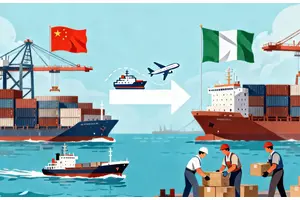
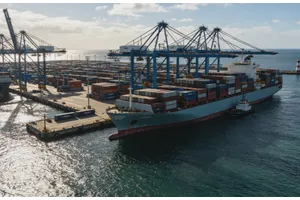
DDP shipping from China to Nigeria is the only Incoterm that makes sense for most first-time importers — and the most abused one on the market. A genuine DDP quote covers eight layers: pickup in China, export clearance, ocean or air freight, arrival handling at the Nigerian port, customs clearance through a licensed agent, the import duty, the 7.5% VAT, and final delivery to your door. On a 20ft container in 2026, those layers add up to an all-in price of roughly $5,500–$8,300, built on a port-to-port ocean rate of $2,970–$3,800 plus a DDP premium of $2,500–$4,500. The premium is not profit padding — it is the price of making Nigeria's Form M, SONCAP, and PAAR machinery someone else's problem.
This guide itemizes what a genuine DDP quote on this lane contains, the pre-shipment compliance sequence that decides whether your cargo clears in days or months, the port choice between Lekki, Tin Can, and Apapa, and the currency reality that catches importers who budget in dollars and pay in naira. The overall service and gateways are mapped on our shipping from China to Nigeria page; this guide goes deep on the DDP layers that page summarizes.
What Is DDP Shipping from China to Nigeria?
| Layer | Who Handles It | Included in a Genuine DDP Quote? |
|---|---|---|
| Supplier pickup & consolidation in China | Forwarder | Yes |
| Export customs declaration (China) | Forwarder | Yes |
| Ocean freight (FCL/LCL) or air freight | Forwarder | Yes |
| Arrival handling at Apapa/Tin Can/Lekki/Onne | Forwarder's port agent | Yes |
| Form M, SONCAP & PAAR coordination | Forwarder's compliance team | Yes |
| Import duty (by HS code) | Forwarder (DDP) | Yes — must be written in |
| VAT (7.5% of CIF + duty) | Forwarder (DDP) | Yes — must be written in |
| Inland delivery (Lagos, Abuja, Kano...) | Forwarder's trucking network | Yes |
The fine print is where fake DDP lives. Watch for the phrases "duties at cost," "taxes subject to actual assessment," or "customs fees at destination" in the quotation — each one quietly moves the unpredictable part of the cost back to you. A genuine DDP quote names the layers, absorbs the duty and VAT into the price, and takes the customs risk itself. On this lane, that distinction is worth thousands of dollars, because the "unpredictable part" is not small — it is the 20% duty bracket plus 7.5% VAT on top of your entire CIF value.
Why DDP Wins on the Nigeria Lane: Form M, SONCAP, and the PAAR Sequence
Nigeria's import system is built around three documents that must exist before your container can be declared, and none of them is something a foreign buyer can casually arrange from abroad:
| Compliance Step | Issued By | Lead Time | Who Files |
|---|---|---|---|
| Form M | CBN portal via authorized dealer bank | 3–7 working days | Nigerian importer (or forwarder's Nigerian entity) |
| SONCAP Product Certificate (PC) | SON-authorized body (SGS, Intertek, Cotecna) | 1–3 weeks | Chinese supplier + forwarder |
| SONCAP Certificate (SC) | SON-authorized body, per shipment | 3–5 working days after PC | Forwarder |
| PAAR (Pre-Arrival Assessment Report) | Nigeria Customs Service (NCS) | After Form M + docs submitted; before vessel arrival | Forwarder's licensed agent |
| NAFDAC registration | NAFDAC | 2–8 weeks | For food, drugs, cosmetics, chemicals |
Form M is the shipment's identity document, opened through the CBN's Trade Monitoring System by an authorized dealer bank. Without an approved Form M number, the cargo does not legally exist for Nigerian customs. SONCAP is the conformity certificate: your supplier obtains a Product Certificate for the goods, and each shipment needs its own SONCAP Certificate of Conformity from an authorized body — electronics, machinery, and most manufactured goods are on the mandatory list. PAAR is the Pre-Arrival Assessment Report issued by customs after the final invoice, packing list, CCVO, and B/L are submitted; it fixes the duty amount and must exist before clearance can start.
The sequence has a hard rule: start it before the cargo leaves China. Form M can be opened the day you book; the SONCAP PC should be running while the goods are being produced; PAAR is filed while the vessel is at sea. A shipment that arrives in Lagos with no Form M will sit at the terminal on demurrage — $40–75+ per day after the 7–14 day free window — while the paperwork catches up. Under DDP, that sequence is the forwarder's job, and the demurrage risk is the forwarder's risk, which is precisely the point.
The document set that supports the sequence is shorter than importers expect but must be exactly right: the commercial invoice and packing list from your supplier, the bill of lading showing the Form M number, the CCVO (Combined Certificate of Value and Origin), the SONCAP certificate, and an insurance certificate. The CCVO is the one most Chinese suppliers have never heard of — it combines the value declaration and the origin claim in the single form Nigerian banks and customs accept, and the Form M number must appear on the B/L for the bank to process the PAAR. The general clearance mechanics behind this are covered in our customs clearance from China guide; on this lane, the timing of the sequence matters as much as the documents themselves.
Operational insight: the rejections we see are almost never the big things. They are HS code mismatches between the Form M and the actual goods, and declared values that trip NCS's valuation database. A $50,000 shipment whose invoice under-declares by 30% gets flagged, re-valued, and penalized — and the "savings" vanish in penalties and demurrage. On DTFU's Nigeria bookings, the HS code and value are audited against market benchmarks before the Form M is even opened. Thirty minutes of pre-check prevents a month of port storage.
DDP Cost from China to Nigeria
| Service | 2026 All-In DDP Range | Transit |
|---|---|---|
| 20ft container, sea DDP (Lagos) | $5,500–$8,300 | 42–50 days door-to-door |
| 40ft / 40HC container, sea DDP (Lagos) | $6,800–$10,500 | 42–50 days |
| LCL sea DDP (per CBM) | $350–$600 | 45–55 days |
| Air DDP (per kg, 100+ kg) | $7.00–$12.00 | 7–12 days |
| Express courier DDP | $12–$18 per kg | 5–8 days |
Two factors move these numbers. First, the cargo value itself: duty and VAT scale with CIF, so a high-value 20ft (electronics) lands near the top of the range while building materials sit at the bottom. Second, the destination: deliveries beyond Lagos add naira-denominated trucking — roughly ₦120,000 within Lagos against ₦2,500,000+ to Kano or Abuja — which the DDP price absorbs. Also note the surcharge environment: carriers added steep Asia–West Africa surcharges in mid-2026 (Maersk at $1,000 per 20ft and $2,000 per 40ft, CMA CGM's peak-season surcharge at $715 per TEU), so older published rate tables are stale the moment they are posted. The ocean-rate baseline for the container sizes is in our 20ft and 40ft shipping from China to Nigeria guide; the DDP layers above are what this guide adds.
What a Genuine DDP Quote Itemizes
| Line Item | Genuine DDP | Fake DDP |
|---|---|---|
| Ocean freight + BAF | Included | Included |
| Origin pickup, export clearance, THC | Included | Often "extra at origin" |
| Destination THC & terminal handling | Included | Sometimes excluded |
| Customs brokerage (licensed agent) | Included | Excluded |
| Import duty (by HS code) | Included, written in | "Duties at cost" |
| VAT 7.5% | Included, written in | "Taxes subject to assessment" |
| Inland trucking to your address | Included | Excluded — "delivery extra" |
| Insurance (optional but advised) | Offered at 0.3–0.5% of CIF | Not mentioned |
The test is simple: ask for the written inclusion list before you book, and ask what happens if customs assesses a higher duty than the quote assumed. A forwarder who says "we absorb the difference" is selling real DDP. A forwarder who says "you pay the difference at the port" is selling a freight rate with a DDP sticker on it — the same cargo, with the risk relocated to your side of the transaction.
Lekki vs Tin Can vs Apapa: Choosing the Right Lagos Gateway for Your DDP Shipment
Lagos has three working gateways, and the choice changes both your timeline and your demurrage exposure:
| Port | Vessel Wait Reality | Choose It When |
|---|---|---|
| Apapa (Lagos Port Complex) | 5–14 days at anchor in peak periods; Oshodi-Apapa Expressway congestion on pickup | You need the highest carrier frequency; your forwarder has barge options to Ikorodu bonded terminals |
| Tin Can Island (TCIP) | Comparable pricing; occasionally faster berth availability | Apapa is congested and your cargo tolerates the same terminal reality |
| Lekki Deep Sea Port | Significantly lower wait times; Nigeria's newest deep-water terminal | You want to avoid Apapa entirely; ONE offers a direct Shekou→Lekki service |
| Onne (Port Harcourt) | 45–55 days transit from China; freight 30–50% higher | Cargo destined for the east (Aba, Onitsha, Port Harcourt area) — bypasses Lagos entirely |
Apapa remains the default because it has the most sailings — but "default" and "fastest" are different words. The congestion math is brutal: a vessel waiting 10 days at anchor before berthing pushes your free storage window to start late, and if the container then clears slowly, demurrage compounds. Lekki is the structural answer — deep-water berths, modern equipment, and waits measured in hours rather than weeks — and its service frequency is growing. For DDP bookings, the port decision belongs to the forwarder, and it should be made per-shipment: your cargo's origin port, your delivery address, and the current congestion picture all feed in.
Operational insight: for cargo bound for warehouses on the mainland side of Lagos, we routinely discharge at Apapa and barge the containers to bonded terminals around Ikorodu, bypassing the Oshodi-Apapa truck gridlock entirely. The barge leg costs a few hundred dollars and routinely saves 3–7 days of road misery. A forwarder without that option will simply quote you the truck route — and you will pay the difference in demurrage and driver frustration.
The Naira Problem: Exchange Rates, FX Windows, and Who Carries the Risk
Duty and VAT are assessed and paid in naira, and the exchange rate is the quiet variable in every Nigeria cost projection. At mid-2026 levels of roughly ₦1,500 = $1, a $3,471 duty bill is ₦5.2 million; if the naira weakens 10% between assessment and payment, the dollar cost of that same bill rises by a matching margin. The I&E window rate moves, the parallel market moves more, and an importer paying naira bills with dollar-budgeted funds eats the difference.
Under a genuine DDP quote, that currency risk belongs to the forwarder: the price is fixed in dollars, and the forwarder converts and pays the naira-denominated duty and VAT from its own treasury operation. Under FOB or CIF, the currency risk is yours — you must fund a naira account, time the conversion, and hope the rate holds while customs processes the assessment. The inland trucking layer has the same currency signature: trucking is quoted in naira (₦120,000–₦2,500,000+ by distance), so the dollar cost of last-mile delivery moves with the exchange rate too. Add it up and the FX layer alone can swing a 20ft shipment's landed cost by 5–10% between budgeting and delivery — which is why "fixed in dollars, all-in" is the single most valuable sentence in a Nigeria DDP quotation.
How Lagos Clearance Actually Works: The Agent Ecosystem and Its Unwritten Rules
Port clearance in Lagos runs on a chain of specialized players, and knowing who does what is the difference between a 3-day release and a 3-week saga:
- Terminal operators (APM Terminals at Apapa, Greenview and others at Tin Can) control discharge, storage, and release. Their storage clocks start at discharge, not at clearance.
- Licensed customs agents are the only ones who can transact with the Nigeria Customs Service's systems — PAAR filing, duty payment, and release processing all run through them. Every DDP shipment needs one; a forwarder's in-house or contracted agent is the backbone of the service.
- The delivery order dance: after customs releases the container, the shipping company must issue a delivery order, the terminal must match it to the unit, and the truck must be booked and gated in. Each handoff has its own queue; a good agent runs several in parallel.
- The road layer: trucks leaving the port face checkpoints on the corridor routes, and the police/LASTMA presence on the Oshodi-Apapa Expressway is a practical factor — properly documented, sealed containers move; undocumented cargo attracts attention and "settlement" costs.
The unwritten rule of the ecosystem: whoever controls the agent controls the timeline. This is why the DDP provider's Lagos office matters more than its Shenzhen office — the Shenzhen side is commodity logistics; the Lagos side is where shipments go to die or to fly. Our door to door shipping from China to Nigeria service runs the whole chain with a dedicated Lagos clearance team for exactly this reason: DTFU's Nigeria desk keeps its own licensed agents and terminal relationships at Apapa, Tin Can, and Lekki, so the delivery-order queue and the storage clock are managed as one process rather than three handoffs.
A Worked DDP Example: 20ft Container, Shenzhen to Lagos
Here is the full ledger of a typical 2026 DDP booking — 20ft, general merchandise, CIF value $17,356, delivered to a Lagos warehouse:
| Line Item | Amount | Currency |
|---|---|---|
| Ocean freight (Shenzhen → Apapa, incl. BAF) | $3,200 | USD |
| Origin pickup, export clearance, THC | $350 | USD |
| Destination THC & terminal handling | $450 | USD |
| Customs brokerage (licensed agent) | $300 | USD |
| Import duty (20% of CIF) | $3,471 | Naira-equivalent |
| VAT (7.5% of CIF + duty) | $1,562 | Naira-equivalent |
| Inland trucking (Lagos delivery) | ~$230 | Naira |
| Marine insurance (0.4% of CIF) | $70 | USD |
| Total DDP | ~$9,633 | All-in |
The ocean line is a third of the all-in number. Duty and VAT are another half. That is the honest shape of this lane — and it is why a port-to-port quote of $3,200 can end up costing an unprepared importer $9,600 by the time the container reaches the warehouse. For the container-size economics and the full landed-cost comparison, our sea shipping cost from China to Nigeria guide has the supporting tables, and the shipping time from China to Nigeria guide breaks down the 42–50 day door-to-door timeline leg by leg.
One more layer belongs in the budget: the Q4 peak and the weeks around Chinese New Year push both ocean rates and port congestion higher, so a DDP quote taken in the quiet season can read 10–15% differently in the peak. If your launch date is fixed, book the DDP slot early and lock the price — the surcharge announcements from carriers this year (the $1,000/20ft and $2,000/40ft Asia–West Africa adjustments, and the $715 per-TEU peak-season surcharge) show how fast the freight layer can move beneath a stale quote.
FAQs
1. How much does DDP shipping from China to Nigeria cost?
A 20ft container all-in runs $5,500–$8,300; a 40ft runs $6,800–$10,500, depending on cargo value (duty and VAT scale with it) and destination. LCL is $350–600 per CBM; air DDP is $7–12 per kg.
2. What is included in DDP shipping to Nigeria?
Everything: pickup in China, export clearance, freight, Nigerian port handling, customs clearance through a licensed agent, import duty, 7.5% VAT, and delivery to your address. If a quote excludes duty or VAT, it is not DDP.
3. What is the VAT rate on imports to Nigeria?
7.5%, calculated on the CIF value plus the import duty. On an $18,000 CIF shipment at 20% duty, VAT adds $1,620.
4. Lekki or Apapa — which port is better for DDP shipments?
Lekki has dramatically lower vessel wait times and modern equipment, with a direct Shekou→Lekki service (ONE). Apapa has more sailings but 5–14 day anchor waits in peak periods. For most DDP cargo, the forwarder should choose per-shipment based on origin port, destination, and congestion.
5. How long does DDP shipping from China to Nigeria take?
Sea DDP runs 42–50 days door-to-door; air DDP takes 7–12 days; express 5–8 days. Port-side delays add when compliance documents are not pre-arranged.
Send your cargo details — commodity, HS code if you have it, weight, volume, and delivery address in Nigeria — and DTFU Logistics will quote the shipment DDP with every layer written in: Form M opened the day you book, SONCAP managed with the authorized body, PAAR filed while the vessel is at sea, and duty and VAT absorbed into a fixed dollar price. We pick the gateway per shipment — Apapa with barge routing, Tin Can, or Lekki direct — and deliver to Lagos, Abuja, Kano, or anywhere else in the country with one invoice and one accountable team.