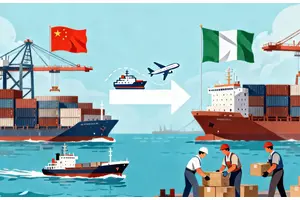
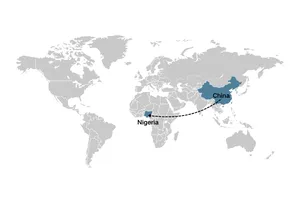
Nigeria imported over $12 billion worth of goods from China in 2025 — and the overwhelming majority of that cargo arrived in shipping containers. If you are planning to import goods via 20ft and 40ft shipping from China to Nigeria, you have probably already discovered that finding clear, honest information about costs, transit times, and Nigeria's notoriously complex import procedures is harder than it should be. At DTFU Logistics, our shipping from China to Nigeria services have helped importers across West Africa — including Ghana and South Africa — navigate this exact journey. Most online resources give you a single price number with no context, then leave you to figure out customs clearance — and your true total cost — on your own.
That is exactly why we built this guide. In the sections ahead, you will find mid-2026 port-by-port container rates from every major Chinese port to Lagos, Apapa, Tin Can, and beyond. You will learn how to decide between a 20ft and 40ft container based on your actual cargo volume, not guesswork. We walk you step by step through Nigeria's import compliance requirements — Form M, SONCAP (both PC and SC certificates), PAAR pre-approval, and duty calculation — with real worked examples. Most importantly, we break down the complete total landed cost of a container shipment so you never get blindsided by charges you did not budget for. Whether you are a seasoned B2B importer, an SME placing your first container order, or an e-commerce seller expanding into the Nigerian market, this is the resource we wish every client had before their first shipment.
20ft vs 40ft Container: Dimensions, Capacity & How to Choose the Right Size
Before you can budget for shipping, you need to answer one foundational question: which container size actually fits your cargo? Choosing wrong means either paying for empty space you did not use, or worse, discovering at the warehouse that half your goods will not fit. Here is everything you need to make the right call.
20ft GP, 40ft GP & 40ft HC Container Specifications
The global standard for container shipping revolves around the TEU (Twenty-foot Equivalent Unit). A single 20ft container equals one TEU, while a 40ft container counts as two TEUs. There are three main container types you will encounter for dry cargo on the China–Nigeria route:
| Specification | 20ft GP (20GP) | 40ft GP (40GP) | 40ft High Cube (40HC) |
|---|---|---|---|
| Internal Dimensions (L×W×H) | 5.90 × 2.35 × 2.39 m | 12.03 × 2.35 × 2.39 m | 12.03 × 2.35 × 2.69 m |
| Internal Volume | ~28 CBM | ~58 CBM | ~68 CBM |
| Max Payload | ~21,000 kg | ~26,500 kg | ~26,500 kg |
| Standard Pallets (Euro) | 10 pallets | 24 pallets | 24 pallets |
| Door Opening (W×H) | 2.34 × 2.28 m | 2.34 × 2.28 m | 2.34 × 2.58 m |
Key takeaway: The 40ft High Cube (40HC) gives you an extra 30 cm of height compared to a standard 40GP — a critical advantage when shipping voluminous goods like furniture, mattresses, or lightweight bulky items. The difference of 10 CBM between a 40GP and 40HC is roughly equivalent to the cargo space of a small van.
Real-World Loading Guide: What Actually Fits in Each Container?
Numbers on a spec sheet are useful, but most importers want to know what those numbers mean in practice. Based on our experience handling hundreds of container shipments from China to Nigeria, here are realistic loading estimates for common cargo categories:
| Cargo Type | 20ft GP Capacity | 40ft GP Capacity | 40ft HC Capacity |
|---|---|---|---|
| Furniture (flat-packed) | 1 small apartment set (living + 2 bedrooms) | 2–3 full apartment sets | 3+ full apartment sets |
| Electronics (cartoned) | ~400–600 mid-size cartons | ~800–1,200 mid-size cartons | ~900–1,400 cartons |
| Building Materials (tiles) | ~20–24 pallets (~22–26 tons) | ~22–24 pallets (~26 tons) | Same as 40GP (weight-limited) |
| Solar Panels | ~300–400 standard panels | ~650–800 standard panels | ~750–900 panels |
| Vehicles (with racking) | 2 compact cars or 3 motorcycles | 4 compact cars or 6 motorcycles | 4 cars (height not the constraint) |
| Textiles/Clothing (baled) | ~18–22 tons (~24–27 CBM) | ~24–26 tons (~55–60 CBM) | ~24–26 tons (~65–70 CBM) |
Important: For dense, heavy cargo like tiles, stone, or machinery, you will hit the weight limit long before you fill the container's volume. A 20ft container can carry up to ~21 tons of cargo — if your goods are heavier than that per CBM, you need to calculate by weight, not volume.
20ft vs 40ft Decision Framework: Which Size Is Right for Your Shipment?
Choosing between a 20ft and 40ft container is fundamentally a cost-per-unit analysis, but you also need to weigh cash flow, inventory planning, and destination logistics. Here is a practical decision framework:
By Cargo Volume (the simplest rule): - Less than 15 CBM → Ship LCL (Less than Container Load, also called consolidated shipping). You only pay for the space you use, typically $85–$200 per CBM on the China–Nigeria route. - 15–25 CBM → This is the gray zone. A 20ft container costs roughly $2,970–$3,800 in ocean freight (mid-2026). At 20 CBM of LCL at $150/CBM, you would pay $3,000 — roughly the same as a full 20ft container. In this range, compare actual LCL quotes against a 20ft FCL rate. - 25–55 CBM → 20ft FCL is your sweet spot. Once your cargo exceeds ~25 CBM, the per-CBM cost of a dedicated 20ft container beats LCL every time, and you get the added benefit of a sealed container that only carries your goods. - 55+ CBM → 40ft FCL (or 40HC if tall items). At these volumes, the 40ft container's per-CBM cost — typically 25–35% lower than a 20ft — makes it the clear winner.
By Cargo Type: - Heavy, dense goods (building materials, machinery, metal products, stone tiles) → Prefer a 20ft container. You will max out the weight capacity of a 20ft (~21 tons) well before filling its volume, so a 40ft container would have significant wasted space. - Light, bulky goods (furniture, textiles, insulation, packaging materials) → Prefer a 40ft HC. The extra height and volume let you maximize cargo while staying well under the weight limit. - Mixed general cargo → A 20ft container offers more flexibility. You can ship two 20ft containers to two different Nigerian destinations, or stagger shipments to manage cash flow.
Cash Flow vs Unit Economics: A 40ft container costs roughly $3,150–$4,000 in ocean freight versus $2,970–$3,800 for a 20ft — only about 10–20% more in freight for double the cargo capacity. However, your total outlay (freight + duties + destination charges) will be higher upfront. If cash flow is tight, two staggered 20ft shipments may be easier to manage than one large 40ft shipment, even though the per-unit cost is higher.
2026 Container Shipping Costs from China to Nigeria: Real 20ft & 40ft Rates
This is the question every importer asks first, and for good reason — ocean freight is typically the largest single line item in your shipping budget. The rates below are drawn from our 10+ years of freight forwarding experience, direct carrier contracts, and live market data from the China–Nigeria trade lane. As a FIATA and IATA dual-certified forwarder, we negotiate these rates daily on behalf of importers just like you — and we believe in quoting transparent, all-in pricing with no hidden fees.
Current 20ft & 40ft Container Rates by Chinese Port (June 2026)
| Origin Port | Port Code | 20ft GP (USD) | 40ft GP (USD) | 40ft HC (USD) | Sea Transit |
|---|---|---|---|---|---|
| Shanghai | CNSHA | $3,100 – $3,630 | $3,300 – $3,850 | $3,450 – $4,000 | 36–38 days |
| Ningbo | CNNGB | $3,050 – $3,550 | $3,250 – $3,750 | $3,400 – $3,900 | 35–37 days |
| Shenzhen | CNSZX | $2,970 – $3,450 | $3,150 – $3,650 | $3,300 – $3,800 | 35–37 days |
| Guangzhou | CNGZ | $3,080 – $3,580 | $3,280 – $3,780 | $3,430 – $3,930 | 36–38 days |
| Qingdao | CNQDG | $3,200 – $3,700 | $3,400 – $3,900 | $3,550 – $4,050 | 38–45 days |
| Tianjin | CNTSN | $3,300 – $3,800 | $3,500 – $4,000 | $3,650 – $4,150 | 40–48 days |
| Xiamen | CNXMN | $3,100 – $3,600 | $3,300 – $3,800 | $3,450 – $3,950 | 37–40 days |
What these rates represent: The figures above are port-to-port ocean freight — the charge to move your container from a Chinese seaport to a Nigerian seaport (typically Lagos Apapa or Tin Can Island). They include the base ocean freight rate and the Bunker Adjustment Factor (BAF). They do not include origin terminal handling charges, documentation fees, destination port charges, customs brokerage, import duties, VAT, or inland delivery in Nigeria. See Section 7 for a complete landed cost breakdown.
For context, the most common destination is Lagos Port Complex (Apapa) or Tin Can Island Port (TCIP). If your cargo is destined for Port Harcourt (Onne), expect rates to run 30–50% higher — a 20ft container from Shanghai to Onne currently ranges from $4,150 to $4,780, while a 40ft can reach $7,650 to $8,860. For a deeper dive into container-specific pricing, see our dedicated guides on the cost of shipping a 20ft container from China to Nigeria and cost of shipping a 40ft container from China to Nigeria. DTFU is a leading provider of sea shipping from China to Nigeria, offering competitive rates from all major Chinese ports.
What Is Included vs What Is NOT in a Container Shipping Quote
One of the most common frustrations we hear from first-time importers is discovering — after the invoice arrives — that the "shipping quote" they received only covered part of the journey. Here is how to read any quote you receive:
| Quote Type | What It Includes | What It Excludes | Best For |
|---|---|---|---|
| Port-to-Port | Ocean freight + BAF | Origin charges, destination charges, duties, inland trucking | Importers with their own logistics team on both ends |
| All-in FCL | Ocean freight + origin THC + documentation + booking + seal fee | Destination charges, customs clearance, duties, inland delivery | Importers with a Nigerian customs broker |
| Door-to-Door (DDP) | Everything: pickup in China + ocean freight + destination handling + customs clearance + duties + inland delivery | Nothing (truly all-inclusive) | Importers who want a single point of responsibility |
Pro tip: When comparing quotes from different freight forwarders, always confirm which of the three categories above their price falls into. A $3,200 port-to-port quote and a $4,500 all-in FCL quote might be equally competitive once you add the missing components to the cheaper one.
Understanding Rate Volatility: Why Container Prices Change
If you checked container rates six months ago and again today, you may have noticed significant movement. The China–Nigeria freight market has been particularly dynamic in 2026. Here is what is driving the changes:
- Carrier surcharges are stacking up. In June 2026, Maersk introduced a $1,000 per 20ft and $2,000 per 40ft surcharge on the Asia–West Africa corridor. CMA CGM introduced a Peak Season Surcharge on the Far East–West Africa lane of $715 per TEU effective March 2026. These surcharges alone can add 20–35% to the base freight rate.
- Q1 2026 saw an ~18% increase in average freight rates compared to Q1 2025, driven by strong Nigerian import demand and front-loaded orders ahead of anticipated carrier rate restructures.
- Geopolitical risk premiums remain elevated due to ongoing Red Sea routing disruptions, which increase voyage distances and tie up vessel capacity globally — even on routes that do not transit the Red Sea directly.
- Seasonal peaks add $300–$600 per container during the pre-Christmas import surge (August–October) as Nigerian businesses stock up for year-end retail demand.
- Nigerian port congestion at Apapa and Tin Can can trigger emergency congestion surcharges when vessel waiting times extend beyond normal levels.
- According to the World Shipping Council, global container freight rates remain sensitive to regional disruptions — and the West Africa corridor is no exception. In our experience, securing space with carriers that maintain consistent West Africa schedules is the most reliable way to protect your budget from surprise surcharges.
FCL vs LCL: When to Use a Full Container vs Shared Container Space
For shipments too small to fill an entire container, LCL (Less than Container Load) — also called consolidated shipping — lets you share container space with other importers' cargo. Here is the quick decision matrix:
| Cargo Volume | Recommended Mode | Typical Cost (Mid-2026) | Transit Time |
|---|---|---|---|
| < 5 CBM | LCL | $120 – $260 / CBM | 35–50 days |
| 5–15 CBM | LCL | $85 – $200 / CBM | 35–50 days |
| 15–25 CBM | Compare LCL to 20ft FCL | LCL: $1,275–$5,000 total vs 20ft: $2,970–$3,800 | 35–50 vs 30–38 days |
| 25–55 CBM | 20ft FCL | $2,970 – $3,800 | 30–38 days |
| 55+ CBM | 40ft FCL or 40ft HC | $3,150 – $4,150 | 30–38 days |
LCL is billed by revenue ton — the greater of your cargo's volume (in CBM) or weight (in metric tons at a 1:1 ratio). For example, 3 CBM of dense machinery weighing 4.5 tons would be charged at 4.5 revenue tons.
Risk note for Nigeria-bound LCL: Because your goods share a container with other importers' cargo, a customs issue with any single shipment in the container can delay the entire container's clearance. For high-value or time-sensitive cargo, FCL offers significantly better risk control.
Shipping Routes & Transit Times from Major Chinese Ports to Nigeria
How long does it actually take for a container to get from China to Nigeria? The answer depends on which ports you use, whether the sailing is direct or transshipped, and how smoothly customs clearance goes on the Nigerian side.
Major Chinese Origin Ports for Nigeria-Bound Shipments
DTFU Logistics operates from all seven major Chinese ports serving the West Africa trade lane. Your supplier's location — not ours — should determine your loading port:
| Port | Best For | Typical Sailing Frequency to Lagos |
|---|---|---|
| Shanghai (CNSHA) | General cargo, machinery, electronics | 3–4 sailings / week |
| Ningbo (CNNGB) | Consumer goods, textiles, furniture | 2–3 sailings / week |
| Shenzhen (CNSZX) | Electronics, gadgets, consumer goods | 3–4 sailings / week |
| Guangzhou (CNGZ) | Building materials, furniture, textiles | 2–3 sailings / week |
| Qingdao (CNQDG) | Industrial products, chemicals, machinery | 1–2 sailings / week |
| Tianjin (CNTSN) | Heavy machinery, steel, industrial goods | 1–2 sailings / week |
| Xiamen (CNXMN) | Stone products, ceramics, general cargo | 1–2 sailings / week |
Nigerian Destination Ports: Which One Should Your Shipment Go To?
| Port | Best For | Notes |
|---|---|---|
| Lagos Port Complex (Apapa) | General cargo, highest carrier service frequency | Expect 5–14 day vessel waiting times during peak periods due to congestion. Plan ahead. |
| Tin Can Island Port (TCIP) | Alternative Lagos entry point | Comparable to Apapa in pricing; some carriers prefer it for faster berth availability. |
| Lekki Deep Sea Port | Shippers seeking to avoid Apapa congestion | Nigeria's newest deep-water port. Fewer carriers serve it currently, but wait times are significantly lower. ONE (Ocean Network Express) offers Shekou → Lekki service. |
| Port Harcourt (Onne) | Eastern Nigeria, oil & gas equipment | Rates 30–50% higher than Lagos-bound shipments. 20ft ~$4,150–$4,780. |
| Calabar & Warri | Regional distribution | Limited carrier service. Best for importers with operations near these ports specifically. |
Typical Transit Times & Sailing Routes
Ocean transit time from Chinese ports to Lagos ranges from 30 to 48 days, depending on your origin port and whether the service is direct or transshipped:
| Route Type | Transit Time | Typical Hubs | Carriers |
|---|---|---|---|
| Direct (rare) | 30–38 days | — | COSCO, Maersk (select sailings) |
| Transshipment via Singapore | 35–42 days | Singapore | CMA CGM, MSC, ONE |
| Transshipment via Port Klang | 35–42 days | Port Klang, Malaysia | Maersk, Hapag-Lloyd |
| Transshipment via Colombo | 38–45 days | Colombo, Sri Lanka | MSC, CMA CGM |
| Northern ports (Qingdao/Tianjin) | 38–48 days | Varies | Multiple carriers |
The full door-to-door timeline — from factory pickup in China to final delivery at your Nigerian warehouse — typically runs 42–50 days when you account for inland trucking at origin (1–3 days), export customs clearance (1–2 days), ocean transit (30–45 days), Nigerian port waiting and customs clearance (5–14 days), and final inland delivery (1–5 days depending on destination). For a complete breakdown by port and shipping method, visit our dedicated shipping time from China to Nigeria page.
Door-to-Door Container Shipping from China to Nigeria: The Step-by-Step Process
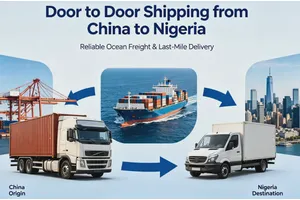
Understanding the end-to-end journey of your container eliminates surprises and helps you plan your inventory and cash flow with precision. For importers seeking a completely hands-off experience, our door-to-door shipping from China to Nigeria service handles every step — from factory pickup to final delivery — under a single contract. Here is exactly what happens from the moment your goods leave the factory until they arrive at your door in Nigeria.
The 8-Step Journey: From Chinese Factory to Nigerian Warehouse
-
Supplier Pickup & Inland Trucking — Your freight forwarder arranges trucking from your supplier's factory or warehouse to the nearest major Chinese seaport. This typically takes 1–3 days and costs $200–$500 depending on distance. If you are purchasing under EXW (Ex Works) terms, this is the first step your forwarder handles.
-
Export Customs Clearance (China) — Chinese export customs requires a declaration package including the commercial invoice, packing list, and customs declaration form. For most general cargo, this is straightforward and clears within 1–2 days. Certain goods (e.g., batteries, chemicals, wooden packaging) may require additional inspection or certification.
-
Port Loading & Vessel Boarding — Your container is delivered to the terminal, passes through security and weight verification, and is loaded onto the assigned vessel. The container is sealed, and the Bill of Lading (B/L) is issued — this is your proof of ownership of the goods in transit.
-
Ocean Freight Transit — Your container spends 30–45 days at sea (see the route and transit table in Section 4). During this period, you can track your container's position via the carrier's tracking platform or your freight forwarder's online portal. DTFU Logistics provides 24/7 real-time container tracking for all shipments.
-
Arrival at Nigerian Port — The vessel arrives at Lagos (Apapa, Tin Can, or Lekki), Port Harcourt, or another Nigerian port. Containers are discharged and moved to the customs-bonded terminal. This is when the clock starts on your free storage period (typically 7–14 days). Every day beyond that incurs demurrage charges.
-
Import Customs Clearance (Nigeria) — This is the most critical step. Nigeria Customs Service (NCS) processes your shipment based on the PAAR (Pre-Arrival Assessment Report), Form M, SONCAP certificate, and supporting documents. If all documents are in order and PAAR was pre-approved, clearance takes 3–7 days. If documents have discrepancies, it can stretch to weeks and accumulate significant demurrage. We cover every document and requirement in detail in Section 6.
-
Port Release & Inland Delivery — Once customs clears your container and duties are paid, the container is released from the terminal. It is loaded onto a truck for inland delivery to your destination. Inland trucking costs vary dramatically by distance — from ₦120,000 for deliveries within Lagos to ₦2,500,000+ for deliveries to Kano or Abuja.
-
Final Delivery — Your container arrives at your warehouse, shop, or designated delivery address. The container is unloaded, and if it is a carrier-owned container, it must be returned to the designated depot within the free detention period to avoid additional per-day charges.
Port-to-Port vs Door-to-Port vs Door-to-Door: Which Service Level Do You Need?
| Service Level | What the Forwarder Handles | What You Handle | Typical Cost Premium (vs Port-to-Port) |
|---|---|---|---|
| Port-to-Port | Ocean freight only | Origin trucking, China export clearance, Nigeria import clearance, duties, inland delivery | Baseline |
| Door-to-Port | Origin pickup + export clearance + ocean freight | Nigeria import clearance, duties, inland delivery | +$500–$900 |
| Door-to-Door (DDP) | Everything — origin to final delivery, including duties and taxes | Nothing except receiving the goods | +$2,500–$4,500 over port-to-port |
For Nigerian importers, DDP (Delivered Duty Paid) is often the most attractive option. Nigeria's import regime is complex, and having a single freight forwarder take responsibility for the entire chain — including clearing customs and paying duties on your behalf — eliminates the risk of demurrage from documentation delays and removes the need to coordinate multiple local service providers.
Incoterms Explained for Nigeria-Bound Shipments
The four most common Incoterms for China–Nigeria trade each shift responsibility differently:
| Incoterm | Who Pays Origin Freight? | Who Pays Ocean Freight? | Who Pays Nigeria Import Duty? | Who Arranges Nigeria Clearance? | Best When... |
|---|---|---|---|---|---|
| EXW (Ex Works) | Buyer (you) | Buyer | Buyer | Buyer | You have a trusted forwarder handling everything |
| FOB (Free on Board) | Supplier | Buyer | Buyer | Buyer | You want control over freight but supplier handles China-side logistics |
| CIF (Cost, Insurance & Freight) | Supplier | Supplier | Buyer | Buyer | You want the supplier to arrange shipping, but you have a Nigerian customs broker |
| DDP (Delivered Duty Paid) | Supplier or Forwarder | Supplier or Forwarder | Forwarder (included) | Forwarder | You want a single party responsible for the entire journey |
Our recommendation for most Nigerian importers: If you have a reliable, experienced freight forwarder offering DDP service on the China–Nigeria route, DDP almost always delivers the lowest total stress and the most predictable total cost. For a detailed breakdown of how these two approaches compare, read our guide on DDP vs FOB: which option saves time and reduces hassle. The forwarder's in-house Nigerian customs team can pre-audit all documents before the vessel sails, submit PAAR in advance, and clear your goods without the demurrage that eats into CIF importers' margins.
Nigeria Import Compliance Made Simple: Form M, SONCAP, PAAR & Customs Clearance
This is the chapter that sets this guide apart. While most shipping cost articles mention Nigerian import requirements in a sentence or two, we are going to walk you through every step — because getting compliance wrong is the single most expensive mistake an importer can make.
The Nigeria Import Documentation Checklist
Every commercial container shipment from China to Nigeria requires the following documents. Missing any one of them can result in your container being held, inspected, fined, or — in the worst case — seized:
| Document | Issued By | Required For |
|---|---|---|
| Form M | Nigerian importer via authorized bank | All commercial imports — your shipment's identity document |
| Commercial Invoice | Chinese supplier | Declares the transaction value, used for duty assessment |
| Packing List | Chinese supplier | Details every item in the container with quantities and weights |
| Bill of Lading (B/L) | Shipping line or freight forwarder | Proof of ownership; must show Form M number |
| SONCAP Certificate (SC) | SON-authorized certification body | Mandatory conformity certificate for regulated products |
| PAAR | Nigeria Customs Service (NCS) | Pre-arrival clearance document — without it, your container cannot be declared |
| Insurance Certificate | Insurance provider | Proof of marine cargo insurance coverage |
| Fumigation Certificate | Fumigation service provider | Required if your cargo includes wood packaging materials |
| Certificate of Origin | CCPIT or local chamber of commerce | Required conditionally — Form M will specify if needed |
Form M — The First Step Every Nigerian Importer Must Take
Form M is the mandatory import application form issued through Nigeria's Central Bank (CBN) electronic portal. Think of it as your shipment's official identity document — without a valid Form M number, your container does not legally exist in Nigeria's import system.
How to obtain Form M: 1. The Nigerian importer (you or your registered business) opens Form M through an authorized dealer bank — major banks like Access Bank, GTBank, Zenith Bank, First Bank, and UBA all process Form M applications. 2. You submit the pro-forma invoice from your Chinese supplier, your incorporation documents, and your Tax Identification Number (TIN). 3. The bank processes the application through the CBN's online system. Processing typically takes 3–7 working days. 4. Once approved, you receive a unique Form M number — this number must appear on your Bill of Lading, commercial invoice, and all subsequent documentation.
Common Form M rejection reasons and how to avoid them: - HS Code mismatch — The HS code on your Form M must exactly match the actual goods being shipped. If in doubt, have your freight forwarder verify HS codes before submission. - Declared value far from market benchmarks — Nigeria Customs uses a valuation database. If your declared invoice value is significantly below typical prices for that product category, your Form M will be flagged and may trigger a physical inspection or valuation uplift. - Exporter qualification issues — If your Chinese supplier lacks export credentials for regulated products, Form M processing may stall.
Critical: Form M must be opened and approved before your cargo departs China. We have seen importers attempt to open Form M after their container has already sailed — this results in the container sitting at Lagos port accumulating $100–$500 per day in demurrage while the paperwork catches up. Do not make this mistake.
SONCAP Certification — What It Is, When You Need It & How to Get It
SONCAP (Standards Organisation of Nigeria Conformity Assessment Programme) is Nigeria's mandatory product compliance program. It applies to the vast majority of manufactured products imported into Nigeria, including electronics, machinery, building materials, furniture, chemicals, toys, automotive parts, and most consumer goods.
SONCAP operates in two stages:
| Stage | Certificate | What It Covers | Validity | How to Get It |
|---|---|---|---|---|
| Stage 1 | PC (Product Certificate) | Certifies that a specific product line meets Nigerian standards | 1–3 years (renewable) | Submit product test reports from an accredited lab to a SON-authorized certification body |
| Stage 2 | SC (SONCAP Certificate) | Certifies a specific shipment batch is compliant | Per shipment only | Apply with your PC + shipping documents for each individual consignment |
Common SONCAP mistake: Many importers obtain a PC and assume they are done. But a PC alone does not clear your goods — you must apply for the SC (SONCAP Certificate) per shipment. The SC references your PC and is linked to a specific Bill of Lading. Applying for the SC only after the container has already arrived at Lagos port is a recipe for demurrage. Complete both stages before your cargo sails.
Products that do NOT require SONCAP: - Food, drugs, and medical devices → Regulated by NAFDAC instead - Fresh agricultural produce - Raw minerals and ores - Crude oil and petroleum products (regulated by DPR/NMDPRA)
Approximate SONCAP costs: PC certification fees vary by product complexity and the accredited body you use — expect anywhere from $150 to $1,000+ per product line. SC fees are typically $100–$300 per shipment.
PAAR & Customs Duty Calculation
PAAR (Pre-Arrival Assessment Report) is the document generated by Nigeria Customs Service after reviewing your Form M, shipping manifest, and supporting documents. Without PAAR, your customs broker cannot file a declaration to clear your container.
Best practice: Your freight forwarder should submit the PAAR application as soon as the Bill of Lading is issued — ideally 5–7 days before the vessel arrives in Lagos. Pre-approved PAAR means your container can move directly into the clearance queue upon arrival rather than sitting idle while paperwork is processed.
How import duty is calculated:
Nigeria calculates import duties on the CIF value (Cost of the goods + Insurance + Freight). The formula:
Import Duty = CIF Value × HS Code Tariff Rate (0%–35%)
VAT = 7.5% × (CIF Value + Import Duty)
Total Tax Burden = Import Duty + VAT (+ any applicable surcharges)
Real worked example: - You import a 20ft container of LED lighting products from Shenzhen to Lagos - CIF value: $18,000 (goods: $14,000 + insurance: $100 + freight: $3,900) - HS Code 9405.40 (LED luminaires) — tariff rate: 20% - Import Duty: $18,000 × 20% = $3,600 - VAT: 7.5% × ($18,000 + $3,600) = $1,620 - Total payable to Nigeria Customs: $5,220
This is why understanding your HS code classification before shipping is so important. A difference of 5% in the tariff rate on a $50,000 CIF shipment equals $2,500 in unexpected duty — and potential penalties if the misclassification is discovered during audit.
How to Avoid Nigeria Customs Clearance Delays
After handling hundreds of China–Nigeria shipments, these are the most common clearance bottlenecks we see — and how a professional freight forwarder prevents them:
- Document inconsistency — The Form M number, B/L consignee name, and invoice details must match exactly. Even a typo in the company name between documents can trigger a hold and manual inspection.
- HS Code misclassification — An incorrect HS code leads to reclassification by Nigeria Customs, back-duty assessment, and potentially a 25% penalty on the underpaid amount.
- Undervaluation — Nigeria Customs operates a sophisticated valuation database. If your declared invoice value is significantly below the benchmark for that product, they will apply an automatic valuation uplift and may impose a fine.
- Missing SONCAP SC — The single most preventable cause of container holds. The SC must be obtained per shipment, before sailing.
- Late PAAR submission — PAAR cannot be applied for until the B/L is issued, but it should be submitted immediately thereafter. Waiting until the vessel arrives adds days of unnecessary storage charges.
What Is the Real Total Cost? Landed Cost Breakdown with Worked Examples
Here is the section no compe***** provides: a complete, line-by-line landed cost breakdown. Understanding your total landed cost — not just the ocean freight — is what separates importers who run profitable operations from those who constantly wonder where their margin went.
The Complete Cost Chain — Every Fee from China to Nigeria
| # | Cost Item | Category | 20ft GP (USD) | 40ft GP (USD) |
|---|---|---|---|---|
| 1 | Factory-to-port inland trucking | China-side | $200 – $500 | $250 – $600 |
| 2 | Export customs declaration | China-side | $80 – $150 | $80 – $150 |
| 3 | Documentation / handling fee | China-side | $50 – $100 | $50 – $100 |
| 4 | Origin Terminal Handling Charge (THC) | China-side | $100 – $180 | $150 – $250 |
| 5 | Ocean freight (base rate) | Ocean freight | $2,970 – $3,630 | $3,150 – $3,850 |
| 6 | BAF (Bunker Adjustment Factor) | Ocean freight | Included in #5 typically | Included in #5 typically |
| 7 | Peak Season Surcharge (PSS) | Ocean freight | $300 – $600 (Q3/Q4 only) | $300 – $600 (Q3/Q4 only) |
| 8 | Security / War Risk Surcharge | Ocean freight | $100 – $200 | $100 – $200 |
| 9 | Destination Terminal Handling | Nigeria-side | $150 – $300 | $200 – $400 |
| 10 | Customs brokerage fee | Nigeria-side | $200 – $500 | $200 – $500 |
| 11 | SONCAP SC certificate | Nigeria-side | $100 – $300 | $100 – $300 |
| 12 | Import Duty | Nigeria-side | CIF × HS tariff (0%–35%) | Same formula |
| 13 | VAT (7.5%) | Nigeria-side | (CIF + Duty) × 7.5% | Same formula |
| 14 | Inland trucking (Lagos local) | Nigeria-side | $130 – $270 (₦200k–₦400k) | $160 – $350 (₦250k–₦550k) |
| 15 | Inland trucking (to Onitsha/East) | Nigeria-side | $600 – $950 (₦900k–₦1.4M) | Same range |
| 16 | Inland trucking (to Abuja/Kano) | Nigeria-side | $1,000 – $1,650 (₦1.5M–₦2.5M) | Same range |
Naira exchange rate assumption: ~₦1,500 = $1 USD (mid-2026 approximate). Inland trucking costs are paid in Naira and can fluctuate with fuel prices and exchange rate movements.
Real Worked Example #1: 20ft Container of Electronics from Shenzhen to Lagos
Scenario: A Lagos-based electronics distributor imports a 20ft container of LED lighting and phone accessories from Shenzhen.
| Cost Item | Calculation | Amount (USD) |
|---|---|---|
| Cargo value (ex-factory) | 400 cartons of electronics | $14,000 |
| China inland trucking | Shenzhen factory → Yantian port (short haul) | $250 |
| Export customs clearance | Standard declaration | $100 |
| Documentation / handling | B/L, export docs | $80 |
| Origin THC | Yantian terminal | $140 |
| Ocean freight (Shenzhen → Apapa) | Mid-2026 rate, mid-range | $3,300 |
| Security surcharge | Asia–West Africa risk premium | $150 |
| Marine cargo insurance | 0.4% of $14,000 | $56 |
| Total CIF value | $14,000 + freight $3,300 + insurance $56 | $17,356 |
| Destination THC + terminal fees | Apapa port | $250 |
| Customs brokerage | Licensed Nigerian broker | $350 |
| SONCAP SC | Electronics category | $200 |
| Import Duty | CIF $17,356 × 20% tariff (electronics) | $3,471 |
| VAT | ($17,356 + $3,471) × 7.5% | $1,562 |
| Inland trucking | Apapa → Ikeja, Lagos | $200 |
| TOTAL LANDED COST | $23,889 |
Key insight: The ocean freight of $3,300 represents only 13.8% of the total landed cost. The combined Nigerian duties and taxes ($5,033) alone exceed the freight cost by over 50%. This is why planning for duties and destination charges is non-negotiable — and why DDP service, where your forwarder quotes you one all-inclusive price, can be significantly less stressful than managing each cost line independently.
Real Worked Example #2: 40ft Container of Building Materials from Guangzhou to Lagos
Scenario: An Abuja-based construction company imports a 40ft GP container of ceramic tiles and sanitary ware from Guangzhou.
| Cost Item | Calculation | Amount (USD) |
|---|---|---|
| Cargo value (ex-factory) | 22 pallets of tiles + bathroom fixtures | $22,000 |
| China inland trucking | Guangzhou → Nansha port | $300 |
| Export customs clearance | Standard + fumigation cert | $150 |
| Documentation | B/L, export docs | $80 |
| Origin THC | Nansha terminal | $200 |
| Ocean freight (Guangzhou → Tin Can) | Mid-2026 rate | $3,550 |
| Security surcharge | Asia–West Africa risk premium | $180 |
| Marine cargo insurance | 0.4% of $22,000 | $88 |
| Total CIF value | $22,000 + freight $3,550 + insurance $88 | $25,638 |
| Destination THC + terminal fees | Tin Can Island | $350 |
| Customs brokerage | Licensed Nigerian broker | $400 |
| SONCAP SC | Building materials category | $250 |
| Import Duty | CIF $25,638 × 20% tariff (ceramic products) | $5,128 |
| VAT | ($25,638 + $5,128) × 7.5% | $2,307 |
| Inland trucking | Tin Can → Abuja | $1,350 |
| TOTAL LANDED COST | $39,073 |
Key insight for 40ft shipments: The per-CBM landed cost of this 40ft container (~58 CBM) works out to approximately $674 per CBM. If the same cargo were split across two 20ft containers, the per-CBM cost would be roughly $780–$850 — the 40ft saves approximately 15–20% on a per-unit basis. For high-volume building material importers, this differential can represent tens of thousands of dollars in annual savings.
Common Container Shipping Challenges & Expert Tips to Avoid Delays and Extra Costs
Even with perfect planning, shipping containers from China to Nigeria involves navigating real-world challenges. Knowing what to expect — and having a mitigation plan — is what keeps your shipment on time and on budget.
Nigerian Port Congestion: What to Expect & How to Mitigate It
The Apapa and Tin Can Island port complex in Lagos is one of the busiest port areas in Africa — and one of the most congested. During peak import periods (August through December), vessels can wait 5–14 days just to secure a berth. Once discharged, containers can sit an additional 3–7 days waiting for customs examination slots.
Mitigation strategies: - Book 4–6 weeks ahead of your intended sailing date, especially for Q3/Q4 shipments. Last-minute bookings command premium rates and may not secure space. - Consider Lekki Deep Sea Port as your discharge port. While fewer carriers serve Lekki, congestion is dramatically lower, and clearance times are typically 2–4 days faster than Apapa. - Use Port Harcourt (Onne) for cargo destined for eastern or southern Nigeria. The higher ocean freight rate (see Section 3) is often offset by lower demurrage exposure and shorter inland trucking distances. - PAAR pre-approval is your best defense. When other importers' containers sit waiting for PAAR processing after arrival, pre-approved shipments can move directly to the clearance queue.
Demurrage & Detention Fees: The Silent Budget Killer
Demurrage is the charge for cargo that remains in the port terminal beyond the free storage period. Detention is the charge for holding the container beyond the free usage period after it has been picked up. Both escalate daily:
| Fee Type | Free Period (Typical) | Daily Rate After Free Period |
|---|---|---|
| Demurrage (port storage) | 7–14 days | $100 – $500 / day per container |
| Detention (container usage) | 7–14 days | $100 – $300 / day per container |
A single weekend of delay — say your customs broker cannot clear on Friday and the port does not operate on weekends — can add $300–$1,500 to your costs. A one-week holdup from a documentation issue can add $2,000–$5,000.
In our experience managing hundreds of Nigeria-bound containers, we have seen demurrage and detention charges wipe out an importer's entire margin on a shipment. One client came to us after accumulating over $4,200 in demurrage on a single 40ft container — their previous forwarder had not submitted PAAR until three days after the vessel arrived, and the resulting paperwork backlog took 11 extra days to clear. After switching to our DDP service with pre-arrival PAAR submission, their next three shipments cleared within 4 days of arrival — total demurrage: $0.
Prevention is the only cure: - Ensure Form M, SONCAP SC, and PAAR are all secured before the vessel sails. - Have your customs broker pre-arrange examination slots and trucking. - Your freight forwarder should provide proactive alerts when free time is approaching its limit. - DTFU Logistics includes document pre-audit and PAAR pre-approval as standard practice for all Nigeria-bound DDP shipments.
Documentation Errors That Cause Shipment Holds
After handling hundreds of Nigeria-bound containers, here are the documentation errors we see most frequently — every one of them avoidable:
- Form M number mismatch — The Form M number on the B/L does not match the number on the invoice or SONCAP SC. Even a single incorrect digit triggers a hold.
- SONCAP SC applied too late or not at all — The SC must reference a valid PC and be tied to the specific B/L. Without an SC, regulated products cannot clear.
- HS Code discrepancy — The HS code on the Form M differs from what customs determines upon inspection. This triggers reclassification, back-duty, and potential fines.
- Packing list quantities do not match the invoice — During a physical examination, if the count does not match, customs may suspect under-declaration and open a full investigation.
Cargo Insurance: Are You Covered?
Marine cargo insurance is one of the most overlooked aspects of container shipping — and one of the most important on the China–Nigeria route. The West Africa corridor carries elevated risks including port theft, container damage during extended waiting periods, and occasional piracy concerns in the Gulf of Guinea.
- All-Risk (Institute Cargo Clauses A) — The broadest coverage. Protects against physical loss or damage from virtually any external cause during transit. Recommended for all high-value shipments.
- Named Perils (Institute Cargo Clauses B/C) — Covers only specifically listed risks (fire, stranding, collision, etc.). Cheaper but leaves significant gaps.
- Premium costs: Typically 0.3%–0.5% of the cargo's insured value. For a $20,000 shipment, that is $60–$100 — a fraction of the cost of one day of demurrage or one damaged pallet. For a comprehensive look at coverage options and costs, read our guide on shipping container insurance costs for shipments from China.
Seasonal Shipping Strategy: When to Ship to Save Money
Timing your shipments strategically can save $300–$600 per container and reduce transit delays:
| Period | Conditions | Recommendation |
|---|---|---|
| Jan–Feb (Chinese New Year) | Factory shutdowns, tight capacity, rate spikes | Book 6 weeks ahead. Ship in December or early March instead of January if possible. |
| Mar–Jun (Q2) | Normal capacity, stable rates | Best shipping window. Rates are typically at annual lows post-CNY, and capacity is plentiful. |
| Jul–Sep (Pre-peak) | Rising demand for Christmas inventory | Book 4 weeks ahead. PSS surcharges begin appearing. Rates start climbing. |
| Oct–Dec (Peak season) | Highest rates, tightest capacity, maximum port congestion | Avoid if possible. If unavoidable, budget $300–$600 PSS surcharge and add 7–14 days to your timeline for port delays. |
A Note on Rates: All pricing in this guide reflects mid-2026 market conditions. The China–Nigeria freight market is dynamic — carrier surcharges, seasonal demand, and port conditions can shift rates by 10–30% within weeks. While we strive to keep these benchmarks current, we recommend requesting a live quote for your specific shipment. According to the Nigeria Customs Service (NCS), accurate HS code classification and complete documentation remain the single largest factor in avoiding unexpected costs — a principle reflected throughout this guide.
Frequently Asked Questions (FAQ)
How Much Does It Cost to Ship a 20ft Container from China to Nigeria in 2026?
Port-to-port ocean freight for a 20ft container ranges from $2,970 to $3,800 depending on your Chinese origin port (mid-2026 rates, Shenzhen being the most competitive). An all-in FCL rate including origin charges runs $3,300–$4,800. A full door-to-door DDP service — covering pickup, ocean freight, Nigerian customs clearance, duties, and final delivery — typically ranges from $5,500 to $7,500 for Lagos-area destinations. See Section 3 for the complete port-by-port rate table and Section 7 for total landed cost breakdowns.
How Much Does It Cost to Ship a 40ft Container from China to Nigeria in 2026?
Port-to-port ocean freight for a 40ft container ranges from $3,150 to $4,150 depending on your origin port. All-in FCL rates are approximately $3,500–$6,200, and door-to-door DDP service runs $7,000–$10,000 for Lagos-area delivery. A 40ft High Cube (40HC) adds roughly $150–$200 to the 40ft GP rate but provides an additional 10 CBM of cargo volume — almost always worth the marginal cost for volume-constrained cargo.
How Long Does Container Shipping from China to Nigeria Take?
Ocean transit from major Chinese ports to Lagos takes 30–48 days depending on your loading port and whether the sailing is direct or transshipped. The fastest routes — Shenzhen or Ningbo to Lagos with direct service — take 35–38 days. Northern ports like Tianjin take 40–48 days. The full door-to-door timeline, including origin trucking, export clearance, ocean transit, Nigerian customs clearance, and final inland delivery, is typically 42–50 days.
Which Chinese Port Is the Cheapest for Shipping to Nigeria?
Shenzhen and Ningbo consistently offer the most competitive rates for container shipping to Nigeria, with 20ft port-to-port rates as low as $2,970–$3,050. These southern/eastern ports have the highest sailing frequency on the West Africa route, creating carrier competition that drives down pricing. Northern ports (Qingdao, Tianjin) have fewer direct sailings and rates run $200–$500 higher. However, the cheapest port for your shipment is almost always the one closest to your supplier — inland trucking savings typically outweigh marginal ocean freight differences.
Is It Better to Use a 20ft or 40ft Container for Shipping to Nigeria?
- Less than 25 CBM → A 20ft container or LCL is more economical.
- 25–55 CBM → A 20ft container is your best option.
- 55+ CBM → A 40ft container delivers 25–35% lower per-CBM costs.
- Heavy goods (tiles, machinery, metals) → A 20ft container is often better — you will max out the weight capacity before filling a 40ft's volume.
- Light/voluminous goods (furniture, textiles) → A 40ft High Cube maximizes value.
For a complete decision framework, see Section 2.
What Documents Are Required to Import a Container from China to Nigeria?
The essential documents are: Form M (obtained via a Nigerian authorized dealer bank before shipment), SONCAP Certificate (Product Certificate PC + Shipment Certificate SC), PAAR (issued by Nigeria Customs Service), Bill of Lading, Commercial Invoice, Packing List, and Insurance Certificate. A Fumigation Certificate is additionally required if your cargo includes wood packaging. See Section 6 for a complete checklist with issuing authorities and timelines.
What Is SONCAP and Do I Need It for My Shipment?
SONCAP (Standards Organisation of Nigeria Conformity Assessment Programme) is Nigeria's mandatory product compliance certification. Almost all manufactured goods — electronics, machinery, building materials, furniture, chemicals, toys, automotive parts, and consumer products — require SONCAP clearance. The process has two stages: the PC (Product Certificate, valid 1–3 years, obtained per product line) and the SC (SONCAP Certificate, obtained per shipment, mandatory for customs clearance). Food, drugs, and medical devices are regulated by NAFDAC instead.
Can I Get Door-to-Door (DDP) Shipping from China to Nigeria?
Yes. DDP (Delivered Duty Paid) service covers the entire journey — factory pickup in China, export clearance, ocean freight, Nigerian import customs clearance, duty and VAT payment, and final delivery to your specified address in Nigeria. DDP is particularly valuable for the Nigeria market because it eliminates the coordination burden and demurrage risk associated with managing Nigerian customs clearance independently. DTFU Logistics specializes in DDP container shipping from all major Chinese ports to destinations across Nigeria, with in-house customs teams on both sides.
How Can I Avoid Port Delays and Extra Charges in Nigeria?
The five most effective measures are: (1) Submit PAAR before vessel arrival — pre-approved PAAR cuts clearance time significantly; (2) Complete SONCAP SC before sailing — never wait until the container arrives; (3) Pre-audit all documents to ensure Form M, B/L, and invoice details are perfectly consistent; (4) Consider Lekki Deep Sea Port to bypass Apapa congestion; (5) Partner with a freight forwarder that has in-house Nigerian customs expertise — they will catch documentation issues before they become demurrage charges. For budget-conscious importers, we also recommend our guide on the cheapest shipping from China to Nigeria for strategies to reduce your total shipping spend.
Partner with DTFU Logistics for Reliable 20ft & 40ft Container Shipping from China to Nigeria
Throughout this guide, we have shown you exactly what it takes to successfully ship a container from China to Nigeria — the costs, the compliance steps, the risks, and the strategies to manage them. Now, here is why over a decade of importers have chosen DTFU Logistics to handle this journey for them.
Why Nigerian Importers Trust DTFU Logistics
Nationwide multi-port coverage. Whether your supplier is in Shanghai, Ningbo, Shenzhen, Guangzhou, Qingdao, Tianjin, or Xiamen, we operate from all seven major Chinese ports. Your supplier's location determines your loading port — not ours.
FIATA & IATA dual certification. We are accredited by both the International Federation of Freight Forwarders Associations (FIATA) and the International Air Transport Association (IATA) — internationally recognized credentials that signal operational competence and financial integrity. For Nigerian importers who have dealt with unreliable operators, this certification matters.
Direct carrier contracts. DTFU Logistics holds direct service contracts with major carriers on the Asia–West Africa trade lane, including Maersk, CMA CGM, COSCO, MSC, and Hapag-Lloyd. These contracts secure competitive rates and — critically — guaranteed space allocations during peak season when spot-market rates spike and capacity tightens.
Dedicated account manager. Every DTFU client is assigned a personal account manager who handles your shipments end to end: pre-auditing Form M and SONCAP documentation before sailing, coordinating PAAR pre-approval, managing customs clearance, and keeping you updated with 24/7 container tracking.
DDP door-to-door made simple. Our DDP service for Nigeria covers everything: factory pickup, China export clearance, ocean freight, Nigerian import clearance, duty and VAT payment, and final delivery to your warehouse, shop, or site — anywhere in Nigeria. One point of contact, one invoice, zero surprises.
Success Story: Lagos Building Materials Importer
A Lagos-based importer of ceramic tiles and sanitary ware had been managing their China–Nigeria shipments through multiple vendors — one forwarder for China-side logistics, a different agent for customs clearance, and a local trucking company for delivery. Each shipment took 55–65 days door-to-door, and roughly one in every three shipments experienced customs holds due to documentation inconsistencies between vendors.
After switching to DTFU's DDP service, they now ship 2–3 × 40ft HC containers per month from Ningbo to Lagos. Our team consolidated the entire chain under one roof: pre-shipment document audit, Form M and SONCAP coordination, PAAR pre-approval, and arranged inland trucking before the vessel even arrived. Their average door-to-door timeline dropped from 55+ days to 44 days. Customs holds — previously a regular occurrence — have been eliminated entirely. The time and demurrage savings alone have more than offset DTFU's service fees, and the importer now has the confidence to increase their monthly order volume.
Get Your Free Container Shipping Quote
Every shipment is different. Your cargo type, volume, origin city, Nigerian destination, and service level (port-to-port, all-in FCL, or DDP door-to-door) all affect your total cost. The best way to get an accurate price is to let our team build a quote specific to your shipment.
Tell us what you are shipping, and we will provide a detailed landed cost breakdown — including all freight charges, duties, and destination fees — within 24 hours, with no obligation.