If you're sourcing goods from China and need them in Portugal fast, air shipping from China to Portugal is the fastest logistics option available — but the pricing structure, transit variables, and customs requirements can feel overwhelming if you've never booked air freight before. A Lisbon-based electronics distributor we worked with last month needed 350 kg of smartphone accessories from Shenzhen delivered in under 10 days ahead of a major promotion. They had no export experience, their shipment included lithium batteries, and Portuguese customs requires CE documentation for electronics. Seven days later, the goods were at their warehouse — with all duties, VAT, and customs clearance handled under a single DDP quote.
This guide breaks down everything you need to know: real per-kilogram costs by weight tier, transit times for every major China–Portugal route, how DDP door-to-door shipping actually works step by step, Portugal's import duty and VAT structure, how to avoid overpaying on chargeable weight, and actionable tips that can cut your air freight bill by 15–30%.
Quick Reference — At a Glance
| Question | Answer |
|---|---|
| How much does air freight cost from China to Portugal? | $3.50–$8.50/kg depending on weight; DDP door-to-door from ~$5.00/kg |
| How long does air shipping take? | 3–8 days airport-to-airport; 5–10 days door-to-door |
| Which airports are used? | Depart: PVG, CAN, SZX, PEK → Arrive: Lisbon (LIS), Porto (OPO) |
| What about customs and taxes? | Portugal VAT 23% + import duty 0–17% depending on product; DDP covers it all |
How Air Shipping from China to Portugal Works
When you book air freight, a freight forwarder acts as your single point of contact for the entire journey. They buy cargo space from airlines at contract rates — not the higher spot rates you'd get booking directly — and manage every step from your supplier's factory floor to your door in Portugal.
There are four service tiers, and which one fits your shipment depends on volume, urgency, and how much you want to handle yourself:
Standard Air Freight (Airport-to-Airport): The forwarder moves your cargo from a Chinese airport to Lisbon (LIS) or Porto (OPO). You arrange pickup from your supplier and last-mile delivery in Portugal yourself. Best for 100 kg+ shipments when you already have logistics partners on both ends. Transit: 3–8 days.
Consolidated Air Freight: Your cargo shares aircraft space with other shipments on the same route. This is the cost-efficiency sweet spot — you get a meaningfully lower per-kilogram rate in exchange for 1–3 extra transit days. Ideal for shipments between 50–500 kg where the savings outweigh the slight delay.
Express Air Freight (DDP Door-to-Door): Everything is handled — factory pickup, China export customs, international air transport, Portugal import clearance, duty and VAT payment, and final delivery. You receive one invoice with one all-in price. This is the "zero headaches" option and the most common choice for first-time importers and SMEs without their own customs broker in Portugal.
Express Courier (DHL / FedEx / UPS): Best for shipments under 45 kg. Delivers in 1–4 days but at a significant per-kilogram premium ($8–$15/kg). Ideal for samples, documents, and small urgent parcels.
Every air shipment revolves around a few key documents and concepts. The Air Waybill (AWB) is your contract of carriage and tracking reference — every air cargo shipment has one. Chargeable weight is the weight you actually pay for (not necessarily your cargo's real weight — more on this critical concept in Section 4). And Incoterms 2020 — specifically EXW, FOB, CIF, and DDP — define who pays for what and where responsibility transfers between seller, buyer, and carrier.
The physical chain is straightforward: your supplier's factory (Shenzhen, Shanghai, Guangzhou, or anywhere in China) → forwarder pickup → China export customs clearance → origin airport cargo terminal → flight (direct or via a European or Middle Eastern hub) → Lisbon or Porto airport → Portugal import customs → last-mile truck delivery to your address.
For importers evaluating all available shipping modes to Portugal — including sea freight, rail, and door-to-door options beyond air — our dedicated shipping from China to Portugal service page provides a complete overview of every route and method.
How Much Does Air Freight Cost from China to Portugal?
The most common question we hear is "how much does air freight cost from China to Portugal?" — and the honest answer is that it depends on weight, route, service level, and season. Below are current market ranges to give you a reliable baseline. For importers distributing across the Iberian Peninsula, our air shipping from China to Spain service offers comparable transit advantages into the neighboring Spanish market, and our comprehensive shipping from China to Spain landing page covers all modes including sea and rail to Madrid, Barcelona, and Valencia.
Air Freight Rates by Weight Bracket
| Weight Bracket | Standard Air (Airport-to-Airport) | Consolidated Air | DDP Door-to-Door (All-In) |
|---|---|---|---|
| 21–45 kg | $7.00–$9.00/kg | $6.50–$8.50/kg | $8.00–$12.00/kg |
| 45–100 kg | $6.00–$8.00/kg | $5.00–$7.00/kg | $6.50–$8.50/kg |
| 100–300 kg | $4.50–$6.50/kg | $3.80–$5.50/kg | $5.00–$7.00/kg |
| 300–500 kg | $3.50–$5.50/kg | $3.10–$4.80/kg | $4.50–$6.00/kg |
| 500–1,000 kg | $3.10–$5.00/kg | $2.80–$4.50/kg | $4.00–$5.50/kg |
| 1,000 kg+ | $3.00–$4.50/kg | $2.50–$4.00/kg | Contact for volume quote |
The pattern is clear: the more you ship, the less you pay per kilogram. Consolidating three 100 kg shipments into one 300 kg shipment can nearly halve your per-kg rate.
What's Inside a Real Air Freight Quote?
Headline per-kg rates can be misleading because surcharges are often quoted separately — or buried in fine print. Here's a transparent, line-by-line breakdown of an actual shipment: 200 kg of consumer electronics, Shenzhen to Lisbon, DDP door-to-door:
| Cost Item | Amount | What It Covers |
|---|---|---|
| Base air freight (200 kg × $5.80/kg) | $1,160 | Cargo space on the aircraft |
| Fuel surcharge (FSC) | $100 | Monthly-adjusted; currently ~$0.50/kg |
| Security surcharge (SSC) | $30 | Mandatory airport screening |
| Export documentation & handling | $60 | China customs filing, AWB issuance |
| Import clearance & last-mile delivery (Lisbon) | $140 | Broker fee + truck to your door |
| Total All-In DDP Cost | $1,490 | No additional charges |
What Moves the Price?
Peak season (Q4, October–December): Rates jump 15–25% as every importer rushes holiday inventory. Book 3–4 weeks ahead or pay a premium.
Chinese New Year (late January/February): Factories close for 2–3 weeks. In the two weeks before shutdown, cargo space tightens dramatically and rates spike.
Fuel price fluctuations: The fuel surcharge resets monthly based on jet fuel indices. When oil rises, your per-kg rate follows within 30 days.
Route availability: Direct flights from China to Portugal are limited. The Hangzhou–Lisbon route (Capital Airlines, 2–4× weekly) offers the fastest transit, but indirect routing via Frankfurt, Dubai, or Istanbul — while adding 1–3 days — often comes with a lower base rate.
All rates in this guide are indicative market ranges as of mid-2026. Air freight pricing changes weekly. For a live quote on your specific shipment, contact a forwarder with your exact cargo details.
How Long Does Air Shipping Take? Transit Times by Route
"How long does air shipping from China to Portugal take?" is the second question every importer asks — and the answer depends on your departure city, whether you fly direct or connect through a hub, and whether you choose door-to-door service.
Route-by-Route Transit Times
| Departure (China) | Arrival (Portugal) | Standard Air | Express / Direct | Typical Routing |
|---|---|---|---|---|
| Shanghai Pudong (PVG) | Lisbon (LIS) | 4–7 days | 3–5 days | Via FRA, CDG, or MAD; direct flights available seasonally |
| Guangzhou Baiyun (CAN) | Lisbon (LIS) | 5–8 days | 4–6 days | Via DOH, DXB, or IST |
| Shenzhen Bao'an (SZX) | Lisbon (LIS) / Porto (OPO) | 5–8 days | 4–7 days | Via European hubs (AMS, FRA, CDG) |
| Beijing Capital (PEK) | Lisbon (LIS) | 5–8 days | 4–6 days | Via FRA or AMS |
| Hong Kong (HKG) | Lisbon (LIS) | 3–6 days | 2–4 days | Direct or via Middle Eastern hubs |
Direct vs. connecting flights: Direct flights like Hangzhou (HGH) to Lisbon (LIS) on Capital Airlines take roughly 15 hours in the air but offer limited cargo capacity. Connecting flights through hubs like Frankfurt, Paris CDG, Amsterdam Schiphol, Madrid, Dubai, Doha, or Istanbul add 1–3 days to the total timeline but typically cost 20–35% less — and offer far more frequent departures. Major airlines serving this lane include Turkish Airlines, Lufthansa, China Southern, Air China, Qatar Airways, Emirates, and Etihad.
Door-to-Door DDP Timeline: Day by Day
| Day | What Happens |
|---|---|
| Day 1 | Forwarder picks up from your supplier; cargo arrives at origin warehouse for inspection and labeling |
| Day 2 | Export customs clearance in China; cargo delivered to airline; AWB issued |
| Day 3–5 | Aircraft departure and transit — direct or via hub connection; tracking available via AWB number |
| Day 5–7 | Arrival at Lisbon (LIS) or Porto (OPO); import customs clearance initiated |
| Day 6–8 | Duties and VAT assessed and paid by forwarder (under DDP); cargo released from customs |
| Day 7–10 | Last-mile truck delivery to your business, warehouse, or Amazon FBA address in Portugal |
What Can Delay Your Shipment
- Random customs inspection — affects roughly 5–10% of air shipments; adds 1–3 days. Clean, accurate documentation is your best defense.
- Incorrect HS code classification — Portuguese customs will hold the shipment until the code is corrected, which can take 2–5 business days.
- Missing CE documentation — electronics, toys, and machinery will not clear without a valid CE Declaration of Conformity.
- Peak season airport congestion — Lisbon and major European hubs experience backlogs in November and December; add a 1–2 day buffer to your planning.
Why Your "Light" Cargo Costs More: Understanding Chargeable Weight
This is the single concept that catches first-time air shippers off guard — and it can turn what looked like a reasonable quote into a surprisingly expensive bill. Airlines do not charge based on how heavy your cargo is. They charge based on how much space it occupies on the aircraft. The official term is chargeable weight, and it is the greater of your cargo's actual gross weight and its volumetric weight.
How to Calculate Volumetric Weight
The IATA-standard formula used globally:
Volumetric Weight (kg) = Length × Width × Height (cm) ÷ 6,000
The divisor 6,000 represents the cubic centimeter equivalent of one kilogram of cargo density (1 m³ = 167 kg). Some carriers use 5,000 for particularly dense trade lanes, but 6,000 is the universal standard you'll encounter on the China–Europe route.
Three Examples That Explain the Concept
| Scenario | Box Dimensions | Volumetric Weight | Actual Weight | You Pay For… | What This Means |
|---|---|---|---|---|---|
| Dense cargo: metal hardware | 100 × 80 × 60 cm | 80 kg | 120 kg | 120 kg (actual) | Efficient use of space — good value |
| Bulky cargo: winter jackets | 120 × 100 × 90 cm | 180 kg | 60 kg | 180 kg (volumetric) | 3× the actual weight — expensive surprise |
| Balanced cargo: smartphones | 80 × 60 × 50 cm | 40 kg | 42 kg | 42 kg (actual) | Nearly equal — no penalty either way |
What This Means for Your Product
| If You Ship… | Expect to Pay Based On… | Why |
|---|---|---|
| Metal parts, machinery, tools, books, tiles | Actual weight (close to it) | Dense goods fill aircraft space efficiently |
| Clothing, furniture components, empty packaging, pillows | Volumetric weight (often 2–3× actual) | Light but bulky — space is the constraint |
| Electronics, footwear, toys, plastic goods | Usually balanced | Moderate density; neither factor dominates |
How to Lower Your Chargeable Weight Without Changing Your Product
- Right-size your boxes: A carton that's 20% larger than necessary adds roughly 20% to your freight bill. Every centimeter counts.
- Vacuum-seal textiles: Clothing and fabric goods compress dramatically — a technique we've used to cut chargeable weight by up to 40% for apparel importers.
- Flat-pack where possible: Disassemble furniture, remove unnecessary retail packaging, and stack components tightly.
- Ask your forwarder to review your packaging: An experienced forwarder can spot optimization opportunities before you ship. We recently helped a Portuguese clothing importer reduce their chargeable weight from 210 kg to 125 kg per shipment simply by switching to vacuum-sealed packaging and right-sized cartons — a 40% freight cost reduction on the exact same goods.
The Complete Door-to-Door Process from China to Portugal
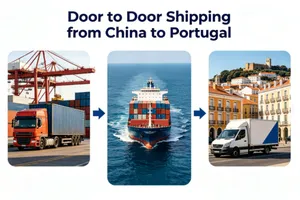
DDP (Delivered Duty Paid) is the most popular shipping term among Portugal-bound importers — and for good reason. Under Incoterms 2020, DDP means your freight forwarder bears all costs, risks, and responsibilities from the factory floor in China to your door in Portugal. If you're weighing DDP against other Incoterms, our DDP vs FOB comparison breaks down which trade term saves more time and reduces hassle for importers. You receive one all-in quote and one point of contact.
DDP vs. Doing It Yourself: Who Handles What?
| Responsibility | EXW (You Manage Almost Everything) | FOB (Split Responsibility) | DDP (Forwarder Manages Everything) |
|---|---|---|---|
| Factory pickup in China | You arrange | Seller arranges | ✅ Forwarder arranges |
| Export customs (China) | You arrange | Seller arranges | ✅ Forwarder arranges |
| International air freight | You book and pay | You book and pay | ✅ Forwarder books and pays |
| Import customs (Portugal) | Your broker | Your broker | ✅ Forwarder arranges |
| Duties and VAT payment | You pay directly | You pay directly | ✅ Forwarder pays (included in quote) |
| Last-mile delivery | You arrange | You arrange | ✅ Forwarder delivers |
| Number of parties to coordinate | 3–4 | 2–3 | 1 |
| Predictable total cost? | ❌ Surprises likely | ⚠️ Partially | ✅ All-in quote upfront |
The DDP Process: Step by Step
- Get a Quote: Send your forwarder these five details — product description, HS code (if known), total weight and carton dimensions, pickup address in China, and delivery address in Portugal. You receive an all-in price, typically within 24 hours.
- Supplier Pickup: The forwarder collects goods from your factory or supplier. Major forwarders have teams across China's manufacturing hubs — Shenzhen, Guangzhou, Yiwu, Shanghai, Ningbo — so proximity is rarely an issue.
- Warehouse Check and Consolidation: Goods are inspected, labeled, and consolidated with other shipments where cost-effective. Packaging is reviewed for air transport compliance.
- Export Customs (China): The forwarder files the export declaration through China Customs' E-port system using your commercial invoice and packing list. For most consumer goods, this clears within one business day.
- Airline Booking and Handover: Cargo space is secured under the forwarder's contract rate. The shipment undergoes security screening, the Air Waybill (AWB) is issued, and cargo is loaded onto the aircraft.
- International Transit: The flight departs. You can track your shipment in real time using the AWB number — most forwarders provide an online tracking portal.
- Import Customs (Portugal): Upon landing at Lisbon or Porto, the forwarder's local customs broker files the import declaration with the Portuguese Customs Authority — Autoridade Tributária e Aduaneira (AT). Duties and VAT are assessed.
- Tax Payment: Under DDP, the forwarder pays all duties and VAT on your behalf. This amount is already included in your quote — there is no separate bill.
- Last-Mile Delivery: Once customs releases the cargo, it is trucked to your address in Portugal — whether that's a commercial warehouse, a retail store, or an Amazon FBA fulfillment center.
For a deeper dive into door-to-door logistics covering sea and rail alternatives alongside air, see our complete door to door shipping from China to Portugal guide.
Portugal Customs Clearance and Import Duties
Portugal applies the Union Customs Code (UCC) as an EU member state. The Portuguese Customs Authority — Autoridade Tributária e Aduaneira (AT) — enforces all import regulations. The good news is that the process is standardized across the EU; the practical reality is that documentation errors are the number one cause of delays. Because Portugal is part of the EU customs territory, importers distributing goods across the continent should also review our shipping from China to Europe overview for region-wide logistics considerations.
Required Documents for Air Freight Import
| Document | Required? | Purpose |
|---|---|---|
| Air Waybill (AWB) | ✅ Always | Contract of carriage and tracking reference |
| Commercial Invoice | ✅ Always | Product description, HS codes, declared value, seller/buyer details, Incoterm |
| Packing List | ✅ Always | Itemized contents, weights, and dimensions per carton |
| EORI Number | ✅ Always | Economic Operators Registration and Identification — mandatory for any business importing into the EU. Apply via the AT portal (3–5 business days) |
| Certificate of Origin | ⚠️ Situational | May qualify your goods for reduced or zero-duty rates under EU trade preference agreements |
| CE Declaration of Conformity | ⚠️ Product-dependent | Required for electronics, toys, machinery, medical devices, and personal protective equipment |
| MSDS (Safety Data Sheet) | ⚠️ Product-dependent | Required for chemicals, batteries, liquids, and cosmetics |
| Import License | ⚠️ Rare | Applies to restricted goods such as certain food products and pharmaceuticals |
Portugal Import Duties by Product Category
| Product Category | Typical Duty Rate | Notes |
|---|---|---|
| Consumer electronics (phones, accessories, components) | 0–3% | Most electronics are duty-free under the WTO Information Technology Agreement |
| Clothing and textiles | 8–12% | Rate varies by fabric composition and origin |
| Footwear | 8–17% | Leather footwear typically at the higher end of the range |
| Furniture (wood, metal, plastic) | 0–6% | Wood furniture may also require a phytosanitary certificate |
| Machinery and industrial parts | 0–4% | Many machinery categories are fully duty-free |
| Toys and games | 0–4.7% | CE certification mandatory regardless of duty rate |
| Solar panels | 0% | Currently zero-rated |
How Portugal VAT (IVA) Is Calculated
Portugal applies IVA (Imposto sobre o Valor Acrescentado) at three rates:
- Standard rate: 23% — applies to most imported consumer and industrial goods
- Intermediate rate: 13% — certain food products and agricultural inputs
- Reduced rate: 6% — essential foodstuffs, books, medicines, and some medical equipment
The formula is straightforward:
IVA = (CIF Value + Import Duty) × VAT Rate
Real example — importing $15,000 worth of clothing from China:
| Component | Amount |
|---|---|
| CIF value (cost, insurance, freight) | $15,000 |
| Import duty (10%) | +$1,500 |
| Taxable base | $16,500 |
| VAT at 23% | +$3,795 |
| Total import charges above product cost | $5,295 |
Common Customs Errors and How to Avoid Them
| Mistake | Consequence | Prevention |
|---|---|---|
| Incorrect HS code on commercial invoice | Shipment held; possible re-classification penalty | Verify against the EU TARIC database before shipping |
| No EORI number | Cannot clear customs — period | Apply at the AT portal before your first import; it takes 3–5 business days and is free |
| Missing CE documentation | Electronics, toys, and machinery rejected at the border | Confirm CE requirements during the quoting phase, not after the cargo is in the air |
| Undervalued goods on the invoice | Portuguese customs actively cross-checks declared values; fines plus back taxes apply | Always declare the actual transaction value |
| Undeclared lithium batteries | Serious IATA DGR violation; fines can exceed $50,000 and the shipment will be seized | Disclose all battery-containing cargo to your forwarder during the quoting stage |
Prohibited and Restricted Items for Air Import
Prohibited (cannot ship by air to Portugal under any circumstances): weapons and ammunition, flammable liquids and compressed gases, counterfeit or IP-infringing goods, endangered species products (CITES), and illegal drugs.
Restricted (can ship with special handling and documentation): lithium batteries — standalone (UN3480) and packed with equipment (UN3481) — must comply with IATA Dangerous Goods Regulations Section II, which requires UN38.3 test certification, an MSDS, and specific packaging and labeling. Liquids exceeding 100ml per unit, aerosols, cosmetics containing alcohol, strong magnets, and perishable foods also fall under the restricted category and require advance disclosure to your forwarder.
Air Freight vs. Sea Freight from China to Portugal
Choosing between air and sea comes down to four factors: urgency, cargo value, shipment size, and how far ahead you can plan. For a detailed breakdown of ocean freight pricing on this specific route, refer to our sea shipping cost from China to Portugal analysis — and for containerized shipping options, our cost of shipping container from China to Portugal guide covers FCL and LCL rates in depth.
Head-to-Head Comparison
| Factor | Air Freight | Sea Freight (LCL) | Rail Freight |
|---|---|---|---|
| Transit time | 3–8 days | 30–45 days | 18–25 days |
| Cost per kg | $3.50–$8.50 | $0.50–$1.50 | $2.00–$4.00 |
| Minimum practical shipment | ~45 kg | ~1 CBM | ~1 CBM |
| Schedule reliability | High (daily departures) | Medium (weekly sailings) | Medium (weekly departures) |
| Carbon footprint | ~500g CO₂ per ton-km | ~15g CO₂ per ton-km | ~30g CO₂ per ton-km |
| Best for | Urgent, high-value, perishable, seasonal goods | Bulk, heavy, non-urgent, cost-sensitive cargo | Mid-weight industrial shipments |
Five Questions to Decide
- Is your cost of a stockout higher than the air freight premium? If running out of inventory costs you $5,000 in lost sales and canceled orders, a $1,200 air freight bill is not an expense — it's an insurance policy. Professional importers calculate this number before comparing shipping modes.
- Is your cargo worth more than roughly $50 per kilogram? High-value goods like electronics, precision instruments, and luxury items tie up less capital in transit and cost less to insure when they spend days — not weeks — in the logistics pipeline.
- Do you have a hard deadline? Product launch events, trade shows, holiday promotions, or seasonal sales windows all favor air freight. Missing the date costs significantly more than the freight premium.
- Is your shipment under 200 kg? At this weight range, sea freight minimum charges, documentation fees, and brokerage costs can narrow the air-sea price gap to the point where air freight is genuinely competitive on a total landed cost basis.
- Can you plan 6–8 weeks ahead? If yes, sea freight's cost advantage is undeniable. If your supply chain doesn't give you that much lead time, air freight buys you the flexibility to react quickly.
The Strategy Experienced Importers Use
Ship the first batch by air, and the rest by sea. Send 100–200 kg by air freight to stock shelves immediately or test a new product in the market. Meanwhile, your bulk order of 500 kg or more travels by sea at a fraction of the per-unit freight cost. This hybrid approach is how the most successful Portugal-based importers balance cash flow with product availability. For a broader comparison of inland freight alternatives, our sea vs rail freight analysis examines which overland option is faster and more reliable from China.
How to Reduce Air Freight Costs from China: 7 Expert Tips
1. Consolidate — Don't Ship in Small Batches
Shipping 300 kg at $4.20/kg costs $1,260. Shipping three separate 100 kg shipments at $6.00/kg each costs $1,800 — a $540 difference for the exact same total weight. If your supplier cannot hold inventory for consolidation, ask your forwarder. Many offer free short-term warehousing in China specifically for this purpose.
2. Avoid Peak Season When You Can
Q4 (October–December) air freight rates jump 15–25% above the annual average. The two weeks before Chinese New Year are even tighter as factories rush out shipments before closing. The best months for competitive rates are March through May and July through September.
3. Choose Consolidated over Direct Flights
Consolidated air freight — where your cargo shares space with other shipments on the same route — typically costs 20–35% less than booking dedicated direct flight space. The 1–3 extra transit days are almost always worth the savings unless your deadline is truly immovable.
4. Optimize Your Packaging
As covered in the chargeable weight section, reducing your carton dimensions can cut your freight bill significantly. A forwarder who reviews your packaging before quoting is saving you money — not being difficult. Vacuum-sealing textiles, right-sizing boxes, flat-packing furniture, and eliminating unnecessary filler material are all zero-cost changes that produce real savings.
5. Work with an IATA-Certified Forwarder with Direct Airline Contracts
Forwarders who buy cargo space on the spot market pass inflated rates on to you. Forwarders with IATA certification and direct contracts with major carriers access contract rates that are consistently 10–20% below spot market pricing. Ask any forwarder you're evaluating: "Do you hold direct contracts with airlines on the China–Europe lane?"
6. Classify Your HS Codes Correctly Before Shipping
A customs hold caused by a misclassified HS code does not just delay your shipment. It racks up airport storage fees — often $50–$100 per day — while the issue is resolved. A professional forwarder validates your HS codes against the EU TARIC database before your cargo leaves China. Prevention costs nothing. Correction costs time and money.
7. Use DDP — It's Often Cheaper Than the DIY Approach
Many importers assume that booking freight, hiring a customs broker, and arranging delivery separately will save money. Here is what usually happens:
| Approach | Typical Cost (200 kg, Shenzhen → Lisbon) | What You Get |
|---|---|---|
| DIY: spot-rate freight + separate broker + separate delivery | ~$1,700–$1,950 | Three vendors to coordinate, three invoices to reconcile |
| DDP through an integrated forwarder | ~$1,400–$1,600 | One point of contact, one all-in invoice, zero surprises |
The integrated forwarder buys freight at contract rates, clears customs at volume, and consolidates deliveries. Those efficiencies translate into a lower total landed cost for you — plus significantly less coordination work. For importers expanding across Western Europe, we offer similar DDP air freight solutions to neighboring markets — see our DDP shipping from China to Spain guide for Iberian coverage and our air shipping from China to UK page for the British market.
FAQs
How much does it cost to ship by air from China to Portugal?
A typical air freight shipment costs $3.50–$8.50 per kilogram, depending on weight tier and service level. A 100 kg consolidated shipment runs roughly $5.00–$7.00/kg. A 500 kg shipment drops to $3.50–$5.00/kg. DDP door-to-door service — which includes pickup, both customs clearances, duties, VAT, and final delivery — starts at approximately $5.00/kg. For an exact quote, you will need to provide your forwarder with your product details, total weight, dimensions, and pickup and delivery addresses.
How long does air freight from China to Portugal take?
Airport-to-airport air freight takes 3–8 days depending on the departure city and whether the flight is direct or connects through a hub. Shanghai to Lisbon is the fastest China–Portugal route at 3–5 days. Door-to-door DDP typically takes 5–10 days including pickup, export and import customs clearance, and last-mile delivery. Express courier services for small parcels deliver in 1–4 days at a higher per-kilogram cost.
Why was my air freight quote much higher than the per-kg rates I saw online?
This usually comes down to three factors. First, chargeable weight — you are likely being charged on volumetric weight (the space your cargo occupies), not its actual weight. A bulky 60 kg shipment can bill at 180 kg if the cartons are oversized. Second, surcharges like the fuel surcharge, security surcharge, and terminal handling fees are often listed separately or buried in fine print online. Always ask for the all-in rate. Third, shipments under 45 kg pay a steep per-kilogram premium because of minimum charges — air freight pricing is designed for volume.
What documents do I need to import goods from China to Portugal?
At minimum: an Air Waybill (AWB), a Commercial Invoice with accurate HS codes, a Packing List, and a valid EORI number. Depending on your product type, you may also need a CE Declaration of Conformity, an MSDS, a Certificate of Origin, and/or an import license. The full checklist with explanations for each document is in the customs clearance section above.
How much import tax will I pay to bring goods from China into Portugal?
Two taxes apply: import duty and VAT. Import duty ranges from 0% to 17% depending on your product's HS code — electronics are typically 0–3%, clothing 8–12%, and footwear 8–17%. VAT (IVA) is charged at 23% on the total of the CIF value plus import duty. For a $10,000 shipment of clothing with 10% duty, expect approximately $1,000 in duty plus $2,530 in VAT — roughly $3,530 in total import charges above the product cost.
What is the difference between DDP and DDU — and which one should I choose?
Under DDP, your forwarder handles everything: China export clearance, air freight, Portugal import customs, duty and VAT payment, and final delivery. You pay one all-in price. Under DDU, the forwarder delivers to Portugal, but you are responsible for import customs clearance, paying duties and VAT, and arranging last-mile delivery. Choose DDP if you want predictability and a single point of contact. Choose DDU only if you already have a trusted customs broker in Portugal and are comfortable managing the import tax process.
Can I ship products with lithium batteries by air from China to Portugal?
Yes — with strict compliance requirements. Lithium batteries are classified as Dangerous Goods under IATA DGR. Standalone batteries fall under UN3480; batteries packed with equipment fall under UN3481. You must provide a UN38.3 test report, an MSDS, and ensure IATA-compliant packaging and labeling. A Dangerous Goods declaration must accompany the shipment. Never ship undeclared batteries — penalties start in the tens of thousands of dollars, and undeclared dangerous goods shipments are seized. Always inform your forwarder upfront if any part of your shipment contains batteries.
Is air freight from China to Portugal worth the extra cost over sea freight?
It depends on your specific situation. Air freight is worth the premium when your stockout cost is high, your cargo value exceeds roughly $50/kg, you are facing a hard deadline (launch event, promotion, seasonal window), or your shipment is under approximately 200 kg — at which point sea freight minimum charges begin to close the cost gap. For large, non-urgent bulk shipments where you can plan 6–8 weeks ahead, sea freight remains significantly more economical.