The gap between the rate you are quoted for 20ft and 40ft shipping from China to Egypt and the amount you actually pay is where most importers lose their margin. A container that books at $3,200 in Shanghai can land in Alexandria with a $12,000 invoice attached once terminal handling, bunker adjustments, Egyptian import duty, and 14% VAT are stacked on top — and that is before anyone mentions the ACID number that has to exist before your cargo is even allowed on board.
This guide covers the container math the rate sheets leave out: the 2026 FCL (Full Container Load) ranges we book from Shenzhen, Nansha, Shanghai, Ningbo, and Qingdao into Alexandria, Port Said, Damietta, and Sokhna; the per-cubic-meter rule that decides 20ft versus 40ft; realistic transit times on a Suez corridor that is still recovering from two years of disruption; Egypt's ACID / Nafeza clearance obligations; and the door-to-door DDP structure that removes Egypt's customs learning curve for first-time importers.
Cost of Shipping a 20ft Container from China to Egypt: 2026 FCL Rate Benchmarks
The 20ft container (20GP) measures roughly 5.90 m × 2.35 m × 2.39 m internally, holding 28–33 CBM with a maximum payload around 24–28 metric tons. That weight-to-volume ratio is the whole point of the box: it is the container you choose when your cargo is heavy for its size — ceramic tile, steel sections, hardware, pumps, machinery, marble, and bagged chemicals.
Base ocean freight on this lane in 2026 sits between $2,400 and $3,400 per 20GP port-to-port, depending on origin port, Egyptian destination port, and booking window:
| Origin Port (China) | Alexandria | Port Said | Damietta | Sokhna |
|---|---|---|---|---|
| Shenzhen / Nansha | $2,500 – $3,100 | $2,450 – $3,050 | $2,550 – $3,150 | $2,400 – $3,000 |
| Guangzhou | $2,550 – $3,150 | $2,500 – $3,100 | $2,600 – $3,200 | $2,450 – $3,050 |
| Shanghai | $2,600 – $3,250 | $2,550 – $3,200 | $2,650 – $3,300 | $2,500 – $3,150 |
| Ningbo | $2,550 – $3,200 | $2,500 – $3,150 | $2,600 – $3,250 | $2,450 – $3,100 |
| Qingdao | $2,700 – $3,350 | $2,650 – $3,300 | $2,750 – $3,400 | $2,600 – $3,250 |
Southern Chinese ports price the lane lowest because export volume out of the Pearl River Delta keeps slot costs tight and sailings frequent. A Foshan tile supplier shipping out of Nansha will usually beat a Tianjin origin by $100–$300 per box before inland trucking is even considered.
What a 20ft quote must itemize. A base rate is not a price. Ask any forwarder to break a 20ft quote into these three blocks before you compare numbers:
| Cost Block | Typical Line Items | 2026 Range |
|---|---|---|
| Origin charges | Trucking, export declaration, THC, DOC fee, seal fee | $250 – $550 |
| Ocean freight | Base rate plus BAF, PSS (Q3), ISPS, war risk | $2,400 – $3,400 |
| Destination charges | Egyptian THC, delivery order, storage, customs broker | $300 – $700 |
The most common source of invoice shock is a forwarder quoting only the middle block. Two quotes can differ by 40% on paper and land within $100 of each other once everything lands on the bill. If you want one reference figure before you start collecting quotes, start with How Much Does It Cost to Ship a Container from China to Egypt.
40ft Container Shipping Rates from China to Alexandria and Other Egyptian Ports
A 40ft container (40GP) doubles your volume for far less than double the money: 58–60 CBM against roughly 30,480 kg of payload — a weight ceiling barely higher than a 20ft's. That asymmetry is the single most important fact on this lane.
| Origin Port (China) | 40GP to Alexandria | 40HQ to Alexandria |
|---|---|---|
| Shenzhen / Nansha | $3,450 – $4,200 | $3,650 – $4,450 |
| Shanghai | $3,600 – $4,350 | $3,800 – $4,600 |
| Ningbo | $3,550 – $4,300 | $3,750 – $4,550 |
| Qingdao | $3,700 – $4,450 | $3,900 – $4,650 |
The 40ft High Cube (40HQ) adds about 10 usable CBM of height for a $150–$300 premium — the cheapest capacity upgrade available to any importer, and effectively free on a per-CBM basis.
Choosing your Egyptian destination port changes both the base rate and the destination-side bill:
| Egyptian Port | Serves | Notes for 40ft Importers |
|---|---|---|
| Alexandria | Egypt's main import gateway; Nile Delta and northern industry | Highest frequency of direct China calls; THC and congestion slightly higher than Damietta |
| El Dekheila | Alexandria's bulk and project terminal | Often used for heavy 20ft cargo and machinery |
| Port Said | Suez Canal entrance; eastern Delta | Strong for cargo routed toward Ismailia and the canal zone |
| Damietta | Nile Delta, furniture and textile manufacturing | Competitive terminal handling costs; smaller direct-call network |
| Sokhna | Greater Cairo and the Suez industrial corridor | Shortest inland run to Cairo (about 140 km); the natural choice for Cairo-bound cargo |
Seasonality matters more than most importers expect. Chinese export peak (August through October) and the pre-Chinese New Year rush (December into January) can push base rates up 20–40%, while the second half of 2026 has seen new capacity on the Suez corridor press rates down by 10–20%. If your cargo is not urgent, booking in February through May is the cheapest window of the year.
The 40HQ Question for Bulky Cargo
If your product is light for its size — furniture, mattresses, plastic housewares, apparel, packaging, toys — a 40GP is a mistake. The cargo will cube out at 58 CBM while weighing 7 tons, and you will have paid for height you did not buy. The 40HQ exists precisely for this cargo profile, and on a $4,200 Alexandria rate the high cube usually costs about 6% more for 17% more volume. If you are weighing a container purchase or lease rather than a single booking, see High cube shipping container cost from China.
20ft vs 40ft Container Cost per CBM China to Egypt: The Break-Even Rules
Comparing headline rates is how importers pick the wrong box. Compare cost per cubic meter instead:
Cost per CBM = Total all-in container cost ÷ Actual loaded CBM
Three rules settle nearly every China–Egypt decision:
Rule 1 — The volume threshold. Below roughly 12–15 CBM, LCL (Less than Container Load) is usually cheaper. Between 15 and 30 CBM, the answer depends on density. Above about 30 CBM, a 40ft almost always wins on unit cost.
Rule 2 — The weight threshold. Above roughly 400 kg per CBM, price the 20ft first. Cargo that hits 22–24 tons fills a 20ft by weight while leaving the box half empty; a 40ft would move the same tonnage for $1,200–$1,500 more.
Rule 3 — The rate differential. When a 40ft costs less than 1.6× a 20ft, the bigger box is dramatically more efficient per CBM — often 35–45% cheaper per cubic meter. That single ratio is the foundation of our full 20ft & 40ft Container Cost from China to Egypt comparison.
Two Worked Examples
Example A — Furniture, 48 CBM at 6.5 tons (light cargo). A Cairo retailer importing sofas and flat-pack furniture from Foshan:
| Option | Freight + Destination | Cost per CBM | Verdict |
|---|---|---|---|
| 1 × 40HQ | ~$4,600 | ~$96 | Best |
| 2 × 20GP | ~$6,400 | ~$133 | 39% more expensive |
| LCL at ~$120/CBM + stripping | ~$6,700 | ~$140 | Slower and dearer |
Example B — Ceramic tile, 16 CBM at 22 tons (dense cargo). The same decision reverses completely:
| Option | Freight + Destination | Feasible? |
|---|---|---|
| 1 × 20GP | ~$3,300 | Yes — weight-limited, not volume-limited |
| 1 × 40GP | ~$4,700 | Legal to load, but pays $1,400 for space you cannot use |
| LCL | Not offered | Most carriers cap LCL at 1,000 kg/CBM |
Our industry insight: The question we ask every importer before quoting is not "how many CBM?" but "how many CBM and how many kilograms?" A shipment of 20 CBM at 2 tons and a shipment of 20 CBM at 22 tons look identical on a packing list and require opposite containers. On China–Egypt, tile, marble, and bagged minerals routinely trigger this trap, and the rebooking fee after a weight-capped container is rejected at the terminal costs more than the original freight saving.
When LCL Beats a 20ft Container
LCL pricing on this lane runs $100–$200 per CBM, and the cheap headline usually excludes the destination half of the journey — container freight station handling, stripping, and storage at the Egyptian end.
| Shipment Volume | LCL Total (~$130/CBM + fees) | 20GP FCL Total (~$3,300 all-in) | Verdict |
|---|---|---|---|
| 5 CBM | ~$650 | ~$3,300 | LCL wins |
| 10 CBM | ~$1,300 | ~$3,300 | LCL wins |
| 14 CBM | ~$1,820 | ~$3,300 | Near break-even |
| 18 CBM | ~$2,340 | ~$3,300 | FCL edges ahead |
| 25 CBM | ~$3,250 | ~$3,300 | Effectively tied — take the FCL for speed and security |
Beyond cost, FCL also removes the cargo-mixing risk that comes with shared containers: your goods are sealed at origin and opened at destination, which matters for branded retail packaging and anything requiring a clean chain of custody.
FCL Transit Time from Shenzhen, Shanghai and Ningbo to Egypt
Port-to-port transit on China–Egypt is 24 to 35 days, and the spread has little to do with distance — the full breakdown by origin and destination port sits in our guide to Shipping time from China to Egypt:
| Origin Port | Alexandria | Port Said | Sokhna |
|---|---|---|---|
| Shenzhen / Nansha | 24 – 30 days | 25 – 31 days | 23 – 29 days |
| Shanghai | 26 – 33 days | 27 – 34 days | 25 – 32 days |
| Ningbo | 25 – 31 days | 26 – 32 days | 24 – 30 days |
| Qingdao | 28 – 35 days | 29 – 36 days | 27 – 34 days |
Most China–Egypt cargo moves through the Suez Canal, which is what makes this lane unusually fast for its distance — Alexandria is closer in sailing days to Shanghai than to Los Angeles. Since 2024 the picture has been complicated: several carriers rerouted around the Cape of Good Hope, adding 10–15 days and emergency surcharges of $500–$1,500 per container at the height of the disruption. Through 2026, most mainline services have returned to Suez routing while continuing to apply a war risk premium of $100–$300 per box, a charge that is legitimate but frequently omitted from first quotes. For how the corridor reopened and what it means for booking windows, see Red Sea Shipping Returns Under Tight Security.
Direct sailing versus transshipment. Direct calls — offered by carriers including COSCO, MSC, CMA CGM, and CULines — cost $100–$300 more than services routing through Port Klang or Colombo, and save 4–8 days. For cargo tied to a delivery deadline, the premium almost always pays for itself.
Add the non-sailing time. A 28-day ocean transit becomes a 40-day door-to-door move once you account for booking and container pickup, export declaration, port loading, Egyptian customs clearance, and inland trucking:
| Stage | Typical Duration |
|---|---|
| Booking, pickup, and export declaration | 4 – 7 days |
| Port handling and vessel loading | 2 – 5 days |
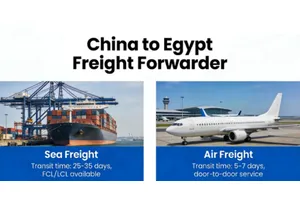
| Ocean transit (direct, via Suez) | 24 – 33 days |
| Egyptian clearance (ACID pre-filed, documents clean) | 3 – 7 days |
| Inland delivery | 1 – 3 days |
| Total door-to-door | 34 – 55 days |
Real-life scenario: A Shenzhen hardware exporter we handle ships door locks and fittings to an Alexandria distributor. Because the ACID number and CargoX document set are prepared and validated before the container is loaded, clearance at Alexandria typically takes three working days. When the same client's supplier once shipped with a missing certificate of origin, the container sat for nine days and the storage bill exceeded the ocean freight difference between the two forwarders they were comparing.
The Cheapest Way to Ship a 20ft Container from China to Egypt (Without Cutting Corners)
Cheaper shipping on this lane comes from structure, not from squeezing a forwarder's margin:
- Ship from the port closest to your supplier. Ningbo, Shanghai, Nansha, and Shenzhen all serve Egypt; choosing the wrong origin adds $150–$400 in inland trucking per container.
- Consolidate multi-supplier orders. Three suppliers shipping 6 CBM each become one 18 CBM FCL instead of three LCL consignments with three sets of destination fees.
- Book in the off-season. February through May is consistently the cheapest window; August through October is the most expensive.
- Book early, not cheaply. Space booked 3–4 weeks ahead costs less than space booked in the week of sailing, particularly on Egypt services where capacity is concentrated among a handful of carriers.
- Control the freight under FOB or EXW. If you buy on FOB terms, you choose the forwarder and see the freight cost. Under CIF, your supplier's forwarder sets a rate you cannot audit.
- Step up to a 40HQ instead of a second 20ft. The single largest freight saving available to importers moving 20–28 CBM.
What not to cut. Three places where saving money backfires on this lane: cargo insurance (0.1–0.5% of cargo value, against a loss that could erase a year of margin on a $30,000 container), the destination-side clearance partner (a cheap broker who misdeclares HS codes generates penalties and storage that dwarf any fee difference), and documentation accuracy (one avoidable inspection costs more than the freight saving between two competing quotes). On the first of those, our note on Shipping container insurance cost for shipments from China explains how the premium is calculated and what it actually covers.
DTFU Logistics contracts directly with carriers on the China–Egypt corridor rather than buying through brokers, which means contract space and rates are locked before peak season — during the August–October squeeze, that difference shows up as booked space rather than a rolled container. If the lowest defensible price is your deciding factor, compare candidates against our checklist for the Cheapest shipping agent from China to Egypt.
Egypt Customs Clearance Documents for a 20ft Container: The ACID & Nafeza Checklist
Egypt's import process has one feature that catches nearly every first-time exporter: ACID (Advance Cargo Information Declaration). Under Egypt's customs framework, the importer of record must file cargo details in advance through the Nafeza national single window, obtain an ACID number, and share it with the exporter before the goods are loaded. The number must appear on the Bill of Lading and the vessel manifest. Cargo that sails without a valid ACID number is not cleared on arrival — it is refused, and the cost of that mistake runs into thousands of dollars plus weeks of delay.
Documents are exchanged through CargoX, the platform Egyptian Customs uses for document transfer. Your document set should be complete and consistent across every file:
- Bill of Lading (B/L) — showing the ACID number, matching the commercial invoice exactly
- Commercial Invoice — stated on a CIF basis with freight and insurance shown separately
- Packing List — accurate weights and dimensions; discrepancies trigger re-inspection
- Certificate of Origin — required for tariff eligibility
- ACID Number — issued via Nafeza to the Egyptian importer, mandatory on all sea and air shipments
- GOEIC registration or inspection certificate — for regulated product categories such as textiles, food contact goods, and electrical items
- HS Code justification — technical datasheets and product photos for goods that could fall under more than one heading
Duties and 14% VAT: Where Your Money Actually Goes
Egyptian import duty is levied on the CIF value (goods + freight + insurance), and VAT at 14% is then charged on the CIF value plus the duty — a compounding structure most rate calculators never show:
| Cost Component | Amount | Notes |
|---|---|---|
| Goods value (FOB) | $15,000 | Electronics and components |
| Ocean freight | $3,200 | 20GP, Shanghai–Alexandria |
| Cargo insurance | $75 | ~0.5% of cargo value |
| CIF value | $18,275 | Duty and VAT base |
| Import duty @ 20% | $3,655 | Rate set by HS code |
| VAT @ 14% on (CIF + duty) | $3,070 | Charged on $21,930 |
| Customs broker and clearance | $200 | Egyptian licensed broker |
| Inland delivery, Alexandria → Cairo | $300 | One 20ft chassis |
| Total landed cost | ~$25,500 | ~70% above goods value |
The lesson is uncomfortable but unavoidable: government charges, not ocean freight, are the largest single cost of importing into Egypt. Duty plus VAT alone added $6,725 — more than double the freight. A $200 saving on the freight rate changes almost nothing; a correct HS classification and a valid certificate of origin can change the verdict entirely. For the freight half of that equation, see Shipping Cost from China to Egypt.
Our industry insight: The two questions that decide whether an Egypt shipment clears smoothly are asked weeks before the vessel arrives: "Who holds the ACID number, and does it match the B/L?" and "Is the HS code defensible with a datasheet?" We insist on both being locked down before loading, because Egyptian Customs classification queries are routine for combined-function goods — electronics with integrated components, machinery with electrical parts — and a query answered after arrival costs $40–$100 per day in storage.
Demurrage and Detention: The Clock That Starts at Berth
Once your container is discharged, two separate clocks start. Demurrage applies while the loaded container sits inside the terminal beyond the free period; detention applies once you have taken delivery but keep the carrier's equipment beyond the free days. Free time at Egyptian ports is typically 5–7 days for demurrage and 7–14 days for detention, after which charges escalate daily and can reach $50–$150 per container per day. Pre-filing the ACID, having the broker engaged before arrival, and scheduling inland trucking in advance are the three things that keep both clocks from ever starting.
Door-to-Door 40ft Container Shipping from China to Egypt (DDP)
If Egypt's customs process, ACID filing, and forex-related payment requirements feel like a second job, the cleanest answer is door-to-door shipping under DDP (Delivered Duty Paid) — one contract, one price, one accountable party from your supplier's factory gate to your warehouse in Egypt. For a full walkthrough of that model, see Door to Door Shipping from China to Egypt.
| Incoterm (2020) | Ocean Freight | Insurance | Egyptian Duty & VAT | Clearance | Inland Delivery | Risk Transfers |
|---|---|---|---|---|---|---|
| EXW | Buyer | Buyer | Buyer | Buyer | Buyer | At the Chinese factory |
| FOB | Buyer | Buyer | Buyer | Buyer | Buyer | On board, China |
| CIF | Seller | Seller* | Buyer | Buyer | Buyer | On board, China |
| DAP | Seller | Seller | Buyer | Buyer | Seller | At your door, duty unpaid |
| DDU | Seller | Seller | Buyer | Buyer | Seller | At your door, duty unpaid |
| DDP | Seller | Seller | Seller | Seller | Seller | At your door, duty paid |
*CIF insurance provides minimum cover only. A forwarder-arranged DDP shipment normally carries broader cargo insurance.
Under a door-to-door DDP arrangement, the full chain runs as seven linked steps: factory pickup in China → export declaration → container loading and ocean freight → Egyptian destination handling → ACID-linked customs clearance and duty/VAT payment → inland trucking → delivery and signed receipt. You see one price and one point of contact; the forwarder carries the customs risk. Scope, exclusions, and the way the duty and VAT component is evidenced are covered in DDP shipping from China to Egypt.
How DDP pricing is structured on this lane. A credible DDP quote separates what is fixed from what must be reimbursed at cost:
| DDP Component | Basis |
|---|---|
| Freight and origin charges | Fixed at booking |
| Destination port charges | Fixed at booking |
| Customs duty and VAT | Reimbursed at actual, evidenced by customs receipt |
| Clearance service and inland delivery | Fixed at booking |
Any provider that quotes a single lump sum without showing the duty and VAT basis is either overcharging on the tax component or under-quoting it to win the booking and returning with a supplement later. Transparent forwarders show you the receipt.
Shipping a 40ft Container from China to Cairo and Inland Egypt
Cairo is about 140 km from Sokhna and 220 km from Alexandria, and that distance difference shows up directly in your landed cost:
| Inland Leg | Typical 40ft Cost | Transit Time |
|---|---|---|
| Sokhna → Cairo / 10th of Ramadan City | $180 – $320 | 1 day |
| Alexandria → Cairo / 6th of October City | $250 – $420 | 1 – 2 days |
| Alexandria → Alexandria Free Zone | $120 – $220 | Same day |
| Sokhna → Suez Industrial Zone | $100 – $180 | Same day |
Two practical constraints matter for 40ft inland moves in Egypt: road weight limits are enforced more strictly on the highway network than inside the terminal, so a 40ft loaded to its full 30-ton payload may need splitting or a permitted route; and delivery appointments at congested Cairo industrial zones frequently require night or early-morning slots. A forwarder who arranges the inland leg at the same time as the ocean booking, rather than after discharge, avoids both problems.
How to Choose a Freight Forwarder for China–Egypt FCL Shipping
China–Egypt is not a lane where the cheapest quote is the cheapest shipment. Use this checklist before you sign:
- Chinese origin presence. A forwarder based at the Chinese ports picks up cargo, files export declarations, and controls bookings — a broker reselling space controls none of it.
- Direct carrier contracts. Contract rates and guaranteed space with mainline carriers are what keep you moving in August and September.
- Egypt-specific customs expertise. ACID filing, Nafeza registration checks, CargoX document handling, and GOEIC requirements are specialized skills — not general customs work.
- Credentials. FIATA and IATA certification in a forwarder means the operation is audited against international forwarding standards.
- All-in quoting discipline. Insist that origin charges, ocean freight, and destination charges appear separately and completely.
- Track record on the lane. Ask for recent container movements on this exact corridor, with cargo types and ports.
- Cargo insurance capability. Coverage should be offered as standard, not as an afterthought.
- Tracking and accountability. A platform that shows vessel departure, discharge, clearance, and delivery status removes the information vacuum that generates expensive panic decisions.
Real-life scenario: We handle a mixed portfolio on this corridor — Nansha to Sokhna LCL towel shipments for a household-goods distributor, Shenzhen to Alexandria air freight for machinery gears, Shenzhen to Cairo air freight for PCB boards when a delivery deadline overrides freight cost, and finished door hardware moving as FCL. The pattern across all of them is identical: shipments that go wrong are the ones where documentation or the ACID number was treated as paperwork instead of a prerequisite, and the cost of fixing it after arrival is five to ten times the cost of getting it right before loading.
Watch for these three warnings. A quote that excludes destination port charges is not a quote, it is a hook. A provider who cannot explain ACID filing in specific terms has not filed many of them. And a price that sits 30% below the entire market is either missing the tax component or planning to add it at the destination — where you have no leverage.
If you are shipping to Egypt regularly, the practical default is to work with a Freight forwarder from China to Egypt who handles the container, the documentation, and clearance as one accountable move. That is what we do at DTFU Logistics — a Shenzhen-based forwarder operating since 2014, FIATA and IATA certified, moving cargo from China to 120+ countries with direct carrier contracts, dedicated account managers, all-in transparent quotes, and 24/7 shipment tracking on the China–Egypt lane.
FAQs
How much does it cost to ship a 20ft container from China to Egypt in 2026?
Base ocean freight runs about $2,400–$3,400 port-to-port, with southern Chinese ports the cheapest and Qingdao the most expensive. Add $250–$550 in origin charges and $300–$700 in Egyptian destination charges, and a realistic all-in figure lands between $3,200 and $4,600.
How much does it cost to ship a 40ft container from China to Egypt in 2026?
A 40GP typically books at $3,450–$4,650 for pure ocean freight, with a 40HQ adding $150–$300. Because a 40ft carries roughly double the volume of a 20ft for 40–50% more money, the per-CBM cost is dramatically lower.
Is a 40ft always cheaper than two 20ft containers?
For light cargo, almost always — a 48 CBM furniture shipment costs about 39% less per CBM in one 40HQ than in two 20ft boxes. For heavy cargo above 400 kg/CBM, two 20ft containers may be unavoidable because the 40ft's payload ceiling is barely higher than the 20ft's.
How long does it take to ship a container from China to Egypt?
Plan on 24–33 days of ocean transit via Suez on a direct service, or 34–55 days door-to-door including booking, clearance, and inland delivery. Cape of Good Hope routings add 10–15 days. For the sea leg in detail, see Sea Shipping from China to Egypt.
What total import duty and VAT will I pay on a 40ft container in Egypt?
Duty depends on the HS code and is charged on the CIF value; VAT is then 14% on the CIF value plus duty. On a $15,000 shipment, duty and VAT together commonly add 35–45% of CIF — often the largest line on the invoice.
Can I ship a 20ft container to Egypt with door-to-door DDP service?
Yes. Under DDP, the forwarder handles factory pickup, export declaration, ocean freight, ACID-linked clearance, duty and VAT payment, and inland delivery for one quoted price. It is the standard choice for importers without an Egyptian customs team.
Bottom Line
The 20ft versus 40ft decision on China–Egypt is settled by density, not by preference: above roughly 400 kg per CBM the 20ft is your box, below about 250 kg per CBM a 40HQ will cut your cost per cubic meter by a third or more, and under 12–15 CBM you should check LCL's destination charges before committing. Budget 34–55 days door-to-door, insist on a quote that separates origin, ocean, and destination charges, and treat the ACID number and document set as prerequisites rather than paperwork. And remember that on this lane, duty and 14% VAT will outweigh your freight — protecting margin means getting classification right, not shaving $100 off a rate.
If you would rather not manage the container math, carrier contracts, ACID filing, and Egyptian clearance separately, talk to DTFU Logistics. Send us your cargo volume, weight, product type, and destination city, and we will return a transparent 20ft or 40ft quote for shipping from China to Egypt — port-to-port or door-to-door under DDP — with one accountable team from factory pickup to final delivery.