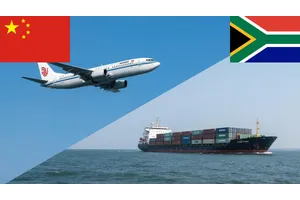
If your suppliers are based in Shanghai, Zhejiang, Jiangsu, or Anhui, shipping from Shanghai to South Africa is the shortest, most frequent, and often most cost-effective route you can take — provided you understand how this lane actually works. Shanghai is the world's busiest container port, and it offers the most direct sailings to South Africa of any Chinese origin. But a great freight rate means little if you are blindsided by SARS duties, Durban congestion delays, or destination charges that were never in your quote.
This guide gives you the complete 2026 picture: why Shanghai is the natural gateway for China–South Africa trade, every shipping method with real cost ranges, transit times to Durban, Cape Town, and Gqeberha, exactly what SARS charges when your cargo lands, how DDP vs FOB vs CIF changes your risk and cost, and how to choose a freight forwarder who actually knows this lane. The rates below come from shipments we handle every week out of our Shanghai hub — DTFU has run the China–South Africa lane since 2014, and these are the numbers on our actual bookings, not a published tariff card.
Why Shanghai Is the Gateway for China–South Africa Shipping
The World's Busiest Container Port
Shanghai's port complex — Yangshan Deep Water Port and Waigaoqiao — moves more than 45 million TEUs a year, the highest of any port on earth. That scale translates directly into advantages for South Africa-bound cargo:
- Most frequent direct sailings to South Africa of any Chinese port — multiple departures weekly to Durban
- The largest carrier density — MSC, Maersk, CMA CGM, COSCO, ONE, and Hapag-Lloyd all maintain dedicated Asia–South Africa loops calling Shanghai
- Scale-driven rates — the sheer volume of boxes moving through Yangshan keeps freight levels competitive year-round
The Yangtze River Delta Supplier Advantage
Shanghai's hinterland is China's densest manufacturing region. If your suppliers sit in the Yangtze River Delta, shipping from Shanghai removes thousands of dollars and days of domestic trucking compared to hauling cargo to Shenzhen or Qingdao:
| Supplier Region | Typical Products | Best Load Port |
|---|---|---|
| Shanghai itself | Machinery, auto parts, chemicals, consumer goods | Yangshan / Waigaoqiao |
| Zhejiang (Yiwu, Hangzhou, Wenzhou) | Small commodities, textiles, hardware, household goods | Shanghai or Ningbo |
| Jiangsu (Suzhou, Wuxi, Nanjing) | Electronics, textiles, furniture, industrial goods | Shanghai |
| Anhui (Hefei, Wuhu) | Home appliances, auto parts, building materials | Shanghai |
For Yiwu suppliers, shipping through Shanghai is often preferable to Ningbo because of the direct sailing frequency to South Africa and competitive LCL consolidation services.
Shanghai vs Ningbo vs Shenzhen for South Africa
| Origin | Direct Sailings to Durban | Ocean Transit | Freight Level | Best For |
|---|---|---|---|---|
| Shanghai | Most frequent | 18–24 days | Competitive | YRD suppliers, LCL consolidation |
| Ningbo | High | 19–25 days | Competitive | Zhejiang suppliers, near-direct options |
| Shenzhen (Yantian/Shekou) | Moderate | 22–28 days | Slightly higher | Pearl River Delta suppliers |
| Guangzhou (Nansha) | Moderate | 21–27 days | Competitive | PRD suppliers |
The rule of thumb: match the load port to your supplier's location. The domestic trucking cost and time to haul cargo from Jiangsu to Shenzhen usually outweighs any ocean transit advantage — Shanghai is the natural gateway for the entire Yangtze River Delta.
Shipping Methods from Shanghai to South Africa: Sea, Air & Express Compared
Sea Freight FCL (Full Container Load)
FCL means you book an entire container — the right choice once your shipment exceeds roughly 15 cubic meters. Container options:
| Container | Capacity | Best For |
|---|---|---|
| 20ft GP | ~28 CBM | Mid-size shipments (15–28 CBM) |
| 40ft GP | ~58 CBM | Large shipments, best unit economics |
| 40ft HC | ~68 CBM | Volumetric cargo, tall/light goods |
The 40ft costs only 50–60% more than the 20ft while carrying roughly double the volume — if your cargo is anywhere near 20 CBM, upsizing almost always wins. For a deeper look at the 40ft HC economics, see our guide on high cube shipping container cost from China.
Sea Freight LCL (Less than Container Load)
LCL lets you share container space and pay only for the volume you use — ideal for shipments under 15 CBM, trial orders, and small businesses testing the South African market. Your cargo consolidates at a Shanghai CFS, then deconsolidates at the destination Container Freight Station in Durban. LCL adds 5–8 days to the timeline versus FCL.
Air Freight from Shanghai (PVG)
When time is critical, air freight from Pudong International Airport (PVG) is the premium option — 5–10 days door-to-door. Ideal for high-value goods, electronics, urgent spare parts, and seasonal products. Shanghai has excellent cargo capacity to Johannesburg (JNB) and Cape Town (CPT), often via hubs like Dubai, Doha, or Hong Kong.
Express Courier (DHL, FedEx, UPS)
For small parcels under 50 kg, documents, and samples, express courier delivers in 3–6 days — the fastest but most expensive per-kg option.
Quick Comparison Table
| Method | Volume | Door-to-Door | Cost Level |
|---|---|---|---|
| Sea FCL | 15+ CBM | 28–40 days | $ |
| Sea LCL | 1–15 CBM | 33–45 days | $$ |
| Air Freight | 100–1,000 kg | 5–10 days | $$$ |
| Express Courier | <50 kg | 3–6 days | $$$$ |
2026 Shipping Costs from Shanghai to South Africa: Full Price Breakdown
Sea Freight Rates (2026 Reference)
These are freight-only rates from Shanghai to South African ports as of mid-2026 — indicative ranges, since ocean freight moves weekly:
| Service | Volume | Freight-Only Price Range |
|---|---|---|
| Sea LCL | 1–15 CBM | $100–$220 per CBM |
| Sea FCL 20ft GP | ~28 CBM | $1,300–$2,200 total |
| Sea FCL 40ft GP | ~58 CBM | $2,000–$3,300 total |
| Sea FCL 40ft HC | ~68 CBM | $2,200–$3,500 total |
⚠️ These numbers are freight only — moving the box from Shanghai to a South African port, nothing more. The total landed cost is typically three to four times the freight number once SARS duty, VAT, clearing fees, and inland haulage are added. For our continuously updated reference, see the shipping cost from China to South Africa page.
What the Total Landed Cost Actually Looks Like
Here is a worked example for a typical 20ft container of consumer goods (cargo value $15,000, landed at Durban):
| Cost Element | Calculation | Amount |
|---|---|---|
| Ocean freight (20ft GP, mid-2026) | Market rate | $1,300–$2,200 |
| Import duty (SACU tariff, 20% for this example) | $15,000 × 20% | $3,000 |
| VAT (15%) | ($15,000 + $3,000) × 15% | $2,700 |
| SARS clearing agent & port fees | Fixed | $300–$500 |
| Total, delivered to Durban port gate | — | $7,300–$8,400 |
| Inland delivery to Johannesburg (optional) | Trucking | +$600–$1,200 |
The freight-only quote was $1,300–$2,200; the landed cost is $7,300–$8,400. Anyone who quotes you "shipping from Shanghai to South Africa" without walking you through duty and VAT is quoting an incomplete number.
Air Freight Rates (2026 Reference)
| Weight Tier | Rate (per kg) | Typical Use |
|---|---|---|
| 45–100 kg | $6.00–$8.50 | Samples, urgent parts |
| 100–300 kg | $5.00–$7.50 | E-commerce restocks |
| 300–1,000 kg | $4.50–$6.50 | Commercial shipments |
| 1,000+ kg | $4.00–$6.00 | Best per-kg rate |
Express courier runs $8.00–$14.00/kg. Air freight charges on chargeable weight — the higher of gross or volumetric weight (L×W×H cm ÷ 6,000).
What Is Included in a DDP Quote vs What Is Extra
A genuine DDP (Delivered Duty Paid) quote from Shanghai should itemize:
- Ocean freight (base rate + BAF)
- China export customs clearance and documentation
- Origin terminal handling at Yangshan/Waigaoqiao
- Destination terminal handling at Durban, Cape Town, or Gqeberha
- SARS import duty (SACU tariff, by HS code)
- VAT (15% on customs value + duty)
- Clearing agent fees and port charges
- Last-mile delivery to your door in South Africa
What DDP does NOT cover: demurrage (container sitting past free time — typically 3–7 days, then escalating daily), detention, storage from customs holds, and re-inspection fees. If your quote does not mention them, ask — a one-line "all-inclusive" quote with no itemization is the biggest red flag on this lane.
Cost Drivers & How to Save Money
- Seasonality: rates spike in Q4 (October–December), the 4–6 weeks before Chinese New Year, and around China's Golden Week. Booking in Q2 (April–June) consistently saves 15–25%.
- Booking lead time: book 4–6 weeks ahead of sailing for the best rates and guaranteed space.
- Supplier consolidation: combine multiple Yangtze River Delta suppliers into one container at a Shanghai consolidation warehouse (free 30-day storage window).
- Container utilization: fill the box before you book — empty space is paid-for space.
Transit Times: How Long Does Shipping Take from Shanghai to South Africa?
Ocean Transit from Shanghai by Destination Port
| Destination Port | Ocean Transit from Shanghai | Notes |
|---|---|---|
| Durban | 18–24 days | Most frequent direct sailings on the lane |
| Cape Town | 20–28 days | +2–4 days beyond Durban |
| Gqeberha (Port Elizabeth) / Ngqura | 19–27 days | +1–3 days beyond Durban |
Most services route through the Suez Canal — the natural artery for Asia–South Africa trade. Since the Red Sea disruptions, some carriers have re-routed services around the Cape of Good Hope, adding 7–10 days on affected legs — always ask whether your quote is for a direct Suez routing or a rerouted service. For expanded schedule detail, see our shipping time from China to South Africa guide.
Door-to-Door Timeline by Method
| Method | Door-to-Door | Notes |
|---|---|---|
| Sea FCL | 28–40 days | Port-to-port + pickup, clearance, delivery |
| Sea LCL | 33–45 days | +5–8 days for consolidation/deconsolidation |
| Air Freight | 5–10 days | Via Dubai, Doha, or Hong Kong hubs |
| Express Courier | 3–6 days | Small parcels and documents |
What Slows Things Down
Durban congestion is the classic culprit — Durban handles roughly 60% of South Africa's container traffic, and vessel bunching cascades into berth delays and demurrage. SARS clearance adds 2–6 days for a well-prepared filing, weeks for a sloppy one. The December holiday period (mid-December to early January) slows both the port and the customs house — plan arrivals for January or February instead.
Shanghai to South Africa Shipping Process: A Step-by-Step Guide
Stage 1 — Factory Pickup & Consolidation (Days 1–3)
Your forwarder arranges trucking from your supplier(s) to their Shanghai consolidation warehouse. Multi-supplier orders from Zhejiang, Jiangsu, and Anhui all arrive at one location, get counted, inspected, and labeled. A 30-day free warehousing window lets a late supplier catch up without stalling the shipment. If your cargo includes wooden pallets or crates, ensure ISPM 15 fumigation and stamping happens here — Durban and Cape Town customs enforce this strictly.
Stage 2 — China Export Customs Clearance (Days 2–5)
Your forwarder files the export declaration at Shanghai customs (Yangshan or Waigaoqiao) with the commercial invoice, packing list, and customs declaration form. Chinese export clearance is routine for most general cargo; the usual holdup is an HS code mismatch between supplier and customs expectations. Cross-check classification before filing.
Stage 3 — Ocean Transit (Days 5–30+)
The container loads at Yangshan Deep Water Port and heads out via the Suez route to Durban, Cape Town, or Gqeberha. Main carriers on this lane: MSC, Maersk, CMA CGM, COSCO, ONE, Hapag-Lloyd, and PIL. A quality forwarder gives you real-time tracking with milestone updates at vessel departure, Suez transit, arrival, and customs milestones — if they cannot, treat it as a red flag.
Stage 4 — South Africa Import Clearance (Adds 2–6 Days)
Your forwarder (under DDP) or your clearing agent files the SAD500 declaration with SARS — our customs clearance team handles this end to end. The shipment clears against your importer customs code. Well-prepared filings clear in 2–3 days; document inconsistencies trigger inspections that stretch to a week or more.
Stage 5 — Duty & VAT Payment
Duty and VAT must be paid before SARS releases the goods. Regular importers often hold a deferment account to pay monthly rather than per shipment; under DDP this is handled for you as part of the all-in price.
Stage 6 — Last-Mile Delivery (1–4 Days)
From Durban, containers truck to Johannesburg/Gauteng (the City Deep inland depot is the main hub for the inland market — 1–2 days), Cape Town is served locally, and Gqeberha/Ngqura cargo stays coastal.
South Africa Customs: SARS Duties, VAT & Required Documents
SARS Import Duty (SACU Tariff)
South Africa applies the SACU (Southern African Customs Union) tariff schedule. Duty is ad valorem — a percentage of the customs value — ranging from 0% to over 40% depending on the HS code. Most consumer goods fall in the 10–25% band; machinery and industrial inputs are often lower; vehicles, alcohol, and textiles sit at the top end.
Two things catch importers out:
- ITAC import permits are required for controlled goods — second-hand goods, used vehicles, certain textiles and steel products — and applications take 2–6 weeks, so they must start before the container sails.
- NRCS compliance applies to regulated product categories (electronics, appliances, automotive components) that must meet South African compulsory specifications.
Check both before you book, not after the cargo lands.
VAT on Imports
VAT is 15%, applied to the customs value plus the import duty. Using the earlier example: $15,000 cargo at 20% duty gives a $3,000 duty, an $18,000 VAT base, and $2,700 of VAT. Duty plus VAT together typically add 35–40% of the cargo value on top of freight. If your business is VAT-registered in South Africa, you can claim the input VAT back; if not, it is a real cost.
Essential Documents Checklist
| Document | Required? | Notes |
|---|---|---|
| Commercial Invoice | Yes | Must describe goods in detail; value consistency is critical |
| Packing List | Yes | Must match the invoice exactly |
| Bill of Lading (B/L) or AWB | Yes | Telex release accepted for sea freight |
| Certificate of Origin | Yes | Verify any preferential rate eligibility |
| SAD500 customs declaration | Yes | Filed by importer or clearing agent with SARS |
| SARS importer customs code | Yes | You (or your DDP provider) must be registered |
| ITAC import permit | Conditional | Second-hand goods, used vehicles, certain textiles/steel |
| NRCS compliance | Conditional | Electronics, appliances, regulated products |
| ISPM 15 fumigation certificate | Conditional | Mandatory if any wood packaging is used |
Common Pitfalls
HS code misclassification is the most expensive mistake on this lane — it changes your duty rate, triggers re-inspection, and can attract penalties plus interest. Under-declaration is the second: SARS maintains reference pricing databases, and the penalty regime is serious. Missing ISPM 15 stamps on wood packaging get the whole container quarantined and fumigated at destination ($200–$500 and 3–5 days, at your expense). Inconsistent documents — invoice and packing list mismatches — trigger physical inspections that add days and fees.
DDP vs FOB vs CIF: Choosing the Best Incoterm for Your South Africa Shipment
Incoterms at a Glance
| Incoterm | Freight | Insurance | SA Duty/VAT | Clearing Agent | Last-Mile | Risk Transfers |
|---|---|---|---|---|---|---|
| EXW | Buyer | Buyer | Buyer | Buyer | Buyer | At factory gate, China |
| FOB | Buyer | Buyer | Buyer | Buyer | Buyer | Once loaded on vessel, China |
| CIF | Seller | Seller | Buyer | Buyer | Buyer | Once loaded on vessel, China |
| DAP | Seller | Seller* | Buyer | Seller | Seller | At your door, South Africa |
| DDP | Seller | Seller* | Seller | Seller | Seller | At your door, South Africa |
*CIF insurance is minimum cover only; DAP/DDP typically include broader coverage arranged by the forwarder. For a detailed side-by-side of the two most popular terms, see DDP vs FOB: Which Option Saves Time and Reduces Hassle.
When DDP Wins
If you are new to the South African market, do not yet have a SARS customs code, and do not want to build a relationship with a clearing agent — DDP is the answer. One quote, one provider, one accountable party. For e-commerce sellers and SMEs shipping a handful of containers a year, DDP removes the entire SARS learning curve and protects your cash flow from surprise tax bills. For the full picture of what end-to-end service involves, see our guide on door to door shipping from China to South Africa.
When FOB or CIF Makes More Sense
If you are already a registered importer with your own clearing agent in Durban, or your business is VAT-registered and you want to manage the input VAT claim yourself, FOB or CIF gives you control over destination-side costs. Large-volume importers (10+ containers a year) often negotiate better local haulage and clearing rates than a standard DDP markup includes. The rule of thumb: the more containers you ship, the more control you want; the fewer you ship, the more you want the all-in price.
How to Choose a Reliable Freight Forwarder for Shanghai to South Africa Shipping
What to Look For
- Lane-specific experience — ask directly: how many containers have you moved from Shanghai to Durban this year?
- Direct carrier contracts — forwarders with FIATA/IATA certification and direct agreements with MSC, Maersk, CMA CGM, and COSCO lock in rates and space that brokers cannot match in peak season
- Shanghai consolidation capability — a physical hub at or near Yangshan/Waigaoqiao with free warehousing for supplier consolidation
- Transparent itemized DDP quoting — one number with no breakdown means duty and VAT are missing
- Real-time tracking — milestone-level visibility from booking to delivery is table stakes on a 30-day ocean lane
Red Flags
- "All-inclusive" quote that refuses to itemize
- Cannot name the clearing agent they work with in Durban
- Quote is 30%+ below compe*****s — duty and VAT are almost certainly excluded
- No physical presence or agent network in South Africa
- No real-time tracking during ocean transit
For budget-focused importers, our guide on the cheapest shipping agent from China to South Africa walks through cost-optimization strategies in detail.
Frequently Asked Questions
How much does it cost to ship a 40ft container from Shanghai to South Africa?
Freight-only: $2,000–$3,500 (mid-2026 reference, 40ft GP/HC from Shanghai to Durban). Total landed cost including SARS duty, VAT, and clearance is typically $11,000–$16,000 for a consumer-goods container with cargo value of $25,000–$35,000 — the exact number depends on your HS code duty rate.
How much does a 20ft container cost from Shanghai to South Africa?
Freight-only: $1,300–$2,200. Total landed cost for a typical $15,000 consumer-goods shipment: $7,300–$8,400, including duty, VAT, and clearing — before inland delivery.
How long does sea freight take from Shanghai to South Africa?
Ocean transit from Shanghai to Durban is 18–24 days — among the fastest on the lane thanks to direct sailings. Door-to-door for FCL: 28–40 days. LCL adds 5–8 days for consolidation and deconsolidation. For a deeper look, see how long does shipping from China to South Africa take.
Which South African port should I ship to — Durban, Cape Town, or Gqeberha?
Durban for the Gauteng/Johannesburg inland market — it handles ~60% of South Africa's container traffic. Cape Town for Western Cape demand. Gqeberha (Port Elizabeth)/Ngqura for the Eastern Cape automotive and manufacturing corridor. Most China services call Durban first.
Is LCL or FCL cheaper for my shipment volume?
LCL wins below roughly 15 CBM; FCL takes over above it — a full 20ft container costs far less than the equivalent LCL volume once you are paying for the whole box anyway.
What import duty will I pay on goods from China?
SACU tariff duty is ad valorem on the customs value: 0–40%+ by HS code, with most consumer goods at 10–25%. Check your product's classification before booking — it drives the single biggest variable in your landed cost.
What is the VAT rate on imports into South Africa?
15%, applied to the customs value plus the import duty. Duty and VAT together typically add 35–40% of the cargo value on top of freight.
Do I need a SARS registration or clearing agent to import?
Your shipment must clear SARS under a registered importer customs code — either your own or your DDP provider's. Under a DDP arrangement, the forwarder manages the entire clearance for you.
Can I ship from Yiwu or Suzhou via Shanghai?
Yes — and it is usually the smartest choice. Goods from Yiwu, Suzhou, Wuxi, Hangzhou, and other Yangtze River Delta hubs are trucked to Shanghai's consolidation warehouses in 1–2 days, then load onto the frequent direct South Africa sailings. This is far more efficient than hauling the same cargo to southern Chinese ports.
Is DDP shipping available from Shanghai to South Africa?
Yes — and it is the most popular choice for first-time and SME importers. A DDP service covers factory pickup, China export clearance, ocean freight, SARS clearance, duty, VAT, and last-mile delivery in one predictable price.