China is Algeria's largest trading partner, with bilateral trade exceeding $9 billion annually — and Guangzhou sits at the heart of this corridor as southern China's premier export gateway. If you're an Algerian importer trying to figure out shipping from Guangzhou to Algeria, you've probably run into a frustrating problem: cost estimates that range from $1,000 to over $6,000 for the exact same 20ft container, with nobody explaining why.
In this guide, we cut through the confusion. You'll get realistic 2026 shipping costs with line-by-line breakdowns of what you're actually paying for, accurate transit times by port and method, a step-by-step door-to-door process walkthrough, and actionable Algerian customs compliance advice — all from a freight forwarder that handles China–Algeria shipments every month.
When Should You Ship from Guangzhou? A Practical Decision Guide
Not every shipment bound for Algeria should leave from Guangzhou — and forcing it when your supplier is 2,000 kilometers away makes no sense. Here's how to decide whether Guangzhou is the right departure point for your cargo.
Scenario 1: Your Supplier Is in Guangdong or South China
If your factory is in Guangzhou, Foshan, Dongguan, Shenzhen, Zhongshan, or anywhere in the Pearl River Delta, shipping from Guangzhou — specifically Nansha Port or the older Huangpu Port — is the obvious choice. Inland trucking from a Guangdong factory to Nansha typically takes 2–4 hours and costs $150–$350. Dragging that same container 1,400 km north to Shanghai or Ningbo would add 2–3 days and $300–$600 in unnecessary domestic freight.
Scenario 2: You're Sourcing from Canton Fair or Guangzhou Wholesale Markets
Guangzhou hosts the Canton Fair — the world's largest trade expo with over 25,000 exhibitors — and the city's sprawling wholesale districts for textiles, electronics, hardware, bags, and furniture. If you're buying here, the most logical workflow is simple: consolidate your purchases at a Guangzhou warehouse, palletize and label them, then truck directly to Nansha for export. Your goods never leave the city until they sail.
Scenario 3: You Want the Southern Port Advantage on Mediterranean Routes
Guangzhou and Shenzhen sit roughly 2,500 nautical miles closer to the Suez Canal than Tianjin or Qingdao in northern China. For Algeria-bound cargo, that geography translates into real savings: 5–7 days faster transit and 10–15% lower base freight compared to northern ports. Carriers like CMA CGM, MSC, and COSCO all operate regular Mediterranean sailings out of Nansha, typically 3–4 departures per week.
Scenario 4: When NOT to Ship from Guangzhou
If your supplier is in Zhejiang province, the smarter departure port is Ningbo or Shanghai — we offer dedicated Shipping from Shanghai to Algeria services with weekly sailings. If they're in Shandong, use Qingdao. If they're in the Beijing-Tianjin-Hebei region, ship from Tianjin. Forcing a Guangzhou departure when your goods are closer to another port wastes both time and money. A good freight forwarder operates at all major Chinese ports and lets your supply chain — not their office location — determine the optimal departure point.
Quick Decision Framework
| Your Supplier Location | Recommended Port | Why |
|---|---|---|
| Guangdong Province | Guangzhou (Nansha) / Shenzhen | Closest port, minimal trucking cost |
| Fujian Province | Xiamen | Direct access, no cross-province hauling |
| Zhejiang / Jiangsu / Shanghai | Shanghai / Ningbo | World's busiest container ports |
| Shandong / Hebei / Beijing / Tianjin | Qingdao / Tianjin | Northern China logistics hubs |
| China–Algeria Trade at a Glance | |
|---|---|
| Bilateral trade volume (2024) | $9B+ |
| Major Chinese exports to Algeria | Machinery, electronics, construction materials, textiles, auto parts, furniture |
| Belt & Road Initiative | Algeria is a key BRI partner; infrastructure projects drive sustained import demand |
| Peak import seasons | Ramadan stocking (March–April), back-to-school (July–August), pre-CNY (December–January) |
For a complete overview of shipping options from all Chinese ports to Algeria — including Shenzhen, Shanghai, Ningbo, Qingdao, and Tianjin — visit our Shipping From China To Algeria service page.
Shipping Methods from Guangzhou to Algeria: Sea, Air & Door-to-Door
Choosing the right shipping method is the single biggest cost-and-speed decision you'll make. Here's how each option works for the Guangzhou–Algeria corridor.
Sea Freight: FCL vs. LCL
FCL (Full Container Load) means you rent an entire container for your cargo alone. You'll choose from three standard sizes:
| Container Type | Internal Capacity | Best For |
|---|---|---|
| 20ft (20GP) | ~28 CBM / ~28,000 kg | Heavy, dense cargo; machinery; smaller full loads |
| 40ft (40GP) | ~56 CBM / ~28,800 kg | Bulk consumer goods; mixed commercial cargo |
| 40ft High Cube (40HQ) | ~68 CBM / ~28,800 kg | Bulky but lightweight goods; furniture; maximum volume |
LCL (Less than Container Load) lets you share container space with other shippers. You only pay for the volume you use, calculated per CBM (Cubic Meter) .
Here's the decision rule most experienced importers follow: if your shipment exceeds 15 CBM, FCL almost always delivers a lower cost per unit. Below 15 CBM, LCL typically makes more sense — but be aware that LCL involves more handling steps (consolidation at a Guangzhou CFS, deconsolidation at the Algerian port), which adds 7–15 days to total transit.
| FCL (20ft) | LCL | |
|---|---|---|
| Best for | >15 CBM | <15 CBM |
| Cost structure | Fixed per container | Per CBM |
| Cargo security | High (exclusive use) | Moderate (shared container) |
| Transit speed | Faster (direct port-to-port) | Slower (consolidation + deconsolidation) |
| Handling risk | Low | Higher (more touch points) |
| Per-unit cost | Lower for full loads | Higher per CBM |
For current vessel schedules, carrier options, and the latest ocean freight trends on this route, see our full Sea Shipping from China to Algeria guide.
Air Freight from Guangzhou
Air freight works when speed outweighs cost. From Guangzhou Baiyun International Airport (CAN) , cargo typically transits through Istanbul (Turkish Airlines), Doha (Qatar Airways), or Dubai (Emirates) before landing at Houari Boumediene Airport (ALG) in Algiers. There are no direct flights on this route — everything connects through a Middle Eastern or European hub.
Cost is calculated per kilogram, and you'll always pay for the greater of actual weight or dimensional weight (length × width × height in cm ÷ 6,000). This matters: a shipment of pillows may weigh 80 kg but occupy 3 CBM, giving it a chargeable weight far higher than its actual weight.
Air freight makes sense for: - Time-sensitive orders (retail replenishment, seasonal goods) - High-value electronics where inventory carrying cost is high - Small samples and prototypes - Perishable goods requiring temperature control
For detailed air cargo rates, airline comparisons, and transit hub options, read our complete Air shipping from China to Algeria guide.
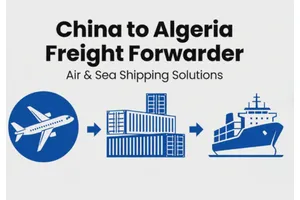
Door-to-Door Shipping (DDP / DDU)
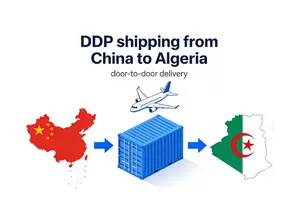
Door-to-door shipping covers the entire chain: factory pickup in Guangdong to Guangzhou warehouse consolidation to China export customs to international ocean/air transit to Algeria import customs to duties and taxes to trucking to your final warehouse or store.
| Incoterm | What's Included | Best For |
|---|---|---|
| EXW (Ex Works) | Goods at factory gate only | Experienced importers with their own logistics team |
| FOB (Free on Board) | Up to vessel loading at Chinese port | Importers who have a freight forwarder + Algerian customs broker |
| CIF (Cost, Insurance, Freight) | FOB + ocean freight + insurance | Importers comfortable handling Algerian clearance themselves |
| DDU (Delivered Duty Unpaid) | Door-to-door without Algerian duties | Experienced importers with an Algerian tax account |
| DDP (Delivered Duty Paid) | Everything — including Algerian import duties | First-time importers; businesses wanting a single all-in price |
Not sure which Incoterm fits your situation? Our DDP vs FOB: Which Option Saves Time and Reduces Hassle comparison breaks down the cost and risk tradeoffs for Algeria-bound shipments.
DDP is particularly valuable for first-time importers to Algeria. Algerian customs procedures are more complex than many markets — French-language documentation, product-specific certifications (IANOR), and a multi-layered tax calculation can overwhelm a newcomer. With DDP shipping from China to Algeria, your forwarder handles all of it, and you receive one predictable, all-in quote.
For a step-by-step breakdown of the full journey — from Guangdong factory to Algerian doorstep with typical timelines at each stage — see our Door to Door Shipping from China to Algeria guide.
Guangzhou to Algeria Shipping Costs (2026 Edition)
Here's the pricing reality that most guides won't give you. For a regularly updated overview of rates from all Chinese departure ports, bookmark our Shipping Cost from China to Algeria page. Shipping costs aren't a single number — they're a stack of line items. Understanding each one is how you spot hidden fees and negotiate effectively.
FCL Container Rates: Guangzhou to Algeria
| Container Type | Guangzhou to Algiers | Guangzhou to Oran | Notes |
|---|---|---|---|
| 20GP | $2,350 – $3,200 | $2,500 – $3,400 | Southern port advantage keeps rates lower vs. Tianjin ($2,800–$4,500) |
| 40GP | $3,950 – $4,850 | $4,200 – $5,100 | 40ft delivers ~15–20% lower cost-per-CBM vs. 20ft when near full |
| 40HQ | $4,100 – $5,000 | $4,350 – $5,250 | Best value for bulky goods — 21% more volume for a small premium |
Container pricing shifts monthly with fuel costs and seasonal demand — check How much to ship a Container from China to Algeria for the latest FCL and LCL rates from every major Chinese port.
Rates as of Q3 2026. These are base freight estimates — see below for additional charges.
What's Actually in That Price?
When one website quotes $1,000 and another quotes $6,390 for the same 20ft container, they're not measuring the same thing. Here's a realistic all-in breakdown for a 20ft container of machinery from Guangzhou Nansha to Algiers:
| Cost Component | Estimated Range (USD) | What It Covers |
|---|---|---|
| Base Ocean Freight | $2,000 – $2,800 | Vessel slot from Nansha to Algiers |
| Bunker Adjustment Factor (BAF) | $350 – $500 | Fuel cost surcharge, fluctuates quarterly |
| Terminal Handling Charges (THC) | $110 – $210 | Port loading fees at Nansha |
| Suez Canal Transit Fee | $150 – $300 | Mandatory passage fee (prorated per container) |
| Documentation Fee | $70 – $90 | Bill of Lading issuance, customs declaration prep |
| Trucking (Guangdong to Nansha) | $150 – $350 | Factory-to-port inland transport |
| Cargo Insurance | $50 – $150 | 0.3%–0.5% of cargo value, strongly recommended |
| Peak Season Surcharge (PSS) | $0 – $400 | May–July and October–December only |
| Estimated All-In Range | $2,880 – $4,600 | Realistic door-to-port total |
The $1,000 quotes you sometimes see? That's likely base freight only for a low-demand period, stripped of BAF, THC, documentation, and trucking — effectively a vessel slot with nothing else included. The $6,000+ quotes may bundle DDP customs brokerage, Algerian import duties, and inland Algeria delivery. Knowing the difference is how you compare quotes honestly.
Guangzhou vs. Other Chinese Ports: Cost Comparison
| Origin Port to Algiers | 20GP | 40GP / 40HQ | Transit (Days) |
|---|---|---|---|
| Guangzhou (Nansha) | $2,350 – $3,200 | $3,950 – $5,000 | 25 – 35 |
| Shenzhen (Yantian) | $2,250 – $3,300 | $3,550 – $4,800 | 25 – 35 |
| Shanghai | $2,150 – $3,300 | $3,550 – $4,700 | 30 – 38 |
| Ningbo | $2,200 – $3,150 | $3,700 – $4,750 | 31 – 39 |
| Qingdao | $2,400 – $3,000 | $3,850 – $4,950 | 33 – 41 |
| Tianjin | $2,800 – $4,500 | $4,500 – $6,000 | 35 – 42 |
Southern ports (Guangzhou, Shenzhen) consistently offer the best combination of price and speed for Algeria-bound cargo.
LCL Rates: Per CBM
For shipments under ~15 CBM, you'll pay per cubic meter:
| Guangzhou to | Rate per CBM (USD) | Minimum |
|---|---|---|
| Algiers | $140 – $430 | Typically 1 CBM |
| Oran | $160 – $450 | Typically 1 CBM |
The wide range reflects cargo type (general vs. fragile vs. hazardous), seasonal demand, and forwarder consolidation frequency. Spot-check with 2–3 forwarders for your specific cargo.
Air Freight Rates: Per KG
| Weight Tier | Guangzhou CAN to Algiers ALG (USD/kg) | Transit |
|---|---|---|
| 45 – 100 kg | $6.50 – $8.50 | 3 – 7 days |
| 100 – 300 kg | $5.80 – $7.50 | 3 – 7 days |
| 300 – 500 kg | $5.00 – $6.80 | 3 – 7 days |
| 500 – 1,000 kg | $4.00 – $5.50 | 3 – 7 days |
| 1,000+ kg | $3.00 – $5.00 | 3 – 7 days |
Five Ways to Cut Your Guangzhou to Algeria Shipping Costs
- Book 6–8 weeks ahead. Last-minute bookings during peak season (May–July, October–December) easily add $400–$600 in surcharges.
- Consolidate LCL into FCL when you hit ~15 CBM. Once you cross that threshold, a 20ft container typically costs less per CBM than LCL.
- Use 40HQ for bulky cargo. You get ~21% more volume than a standard 40ft for a marginal premium — the best cost-per-CBM on the route.
- Time your shipments around peak periods. Ramadan stocking (March–April), the global July–October peak, and pre-Chinese New Year (January) all spike rates.
- Optimize your packaging. Wasted space inside a container is wasted money. Professional palletizing and compact packaging can reduce CBM by 10–15%.
Transit Times & Shipping Routes from Guangzhou to Algeria
The Sea Route: Nansha to Algiers
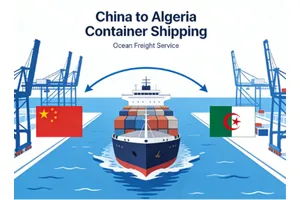
A container leaving Nansha Port follows this path: South China Sea to Strait of Malacca to Indian Ocean to Suez Canal to Mediterranean Sea to Port of Algiers. The total distance is approximately 6,500–7,000 nautical miles, covered in 25–40 days depending on routing.
| Route | FCL Transit | LCL Transit |
|---|---|---|
| Guangzhou to Algiers | 25 – 35 days (direct) / 30 – 40 days (transshipment) | 35 – 48 days |
| Guangzhou to Oran | 26 – 38 days | 37 – 45 days |
| Guangzhou to Annaba | 27 – 40 days | 39 – 50 days |
| Guangzhou to Bejaia | 30 – 38 days | ~40 – 45 days |
LCL takes longer because of consolidation at origin (7–10 days at a Guangzhou CFS) and deconsolidation at the destination port (5–7 days before your cargo is available for pickup).
Air Freight Transit: CAN to ALG
Airport-to-airport: 3–7 days depending on transit hub and connection timing. Door-to-door, including pickup, customs at both ends, and final delivery: 6–12 days.
| Transit Hub (Airline) | Typical Total Transit | Notes |
|---|---|---|
| Istanbul (Turkish Airlines) | 3–5 days | Often the fastest connection |
| Doha (Qatar Airways) | 4–6 days | Reliable Middle East hub |
| Dubai (Emirates) | 4–7 days | Good cargo capacity |
What Causes Delays — and How to Plan Around Them
| Delay Factor | Typical Impact | How to Mitigate |
|---|---|---|
| Algiers port congestion | +4–6 days (Q4 and post-Eid) | Ship to Oran or Bejaia as alternatives during peak |
| Incomplete customs documents | +7–14 days | Pre-clearance document review before vessel departure |
| Suez Canal incidents | +3–10 days | Rare but planning for a 5-day buffer in delivery promises is prudent |
| Ramadan / peak season | +5–10 days on vessel space | Book 8 weeks ahead during March–April and July–October |
| Weather (South China Sea monsoon) | +2–4 days | May–October; most carriers build this into schedules |
Step-by-Step: The Guangzhou to Algeria Door-to-Door Process
Here's what actually happens, stage by stage, when you ship a container from Guangzhou to Algeria. Understanding each step eliminates surprises.
Stage 1: Supplier Pickup in Guangdong
Your forwarder dispatches a truck to your supplier's factory or warehouse anywhere in the Pearl River Delta — Guangzhou, Foshan, Dongguan, Shenzhen, Zhongshan, Huizhou. The driver verifies cargo quantity against the packing list and collects the Commercial Invoice. Typical trucking to a Guangzhou consolidation warehouse: 2–4 hours.
Stage 2: Guangzhou Warehouse Consolidation & Export Prep
If you're buying from multiple Guangdong suppliers, all goods converge at a Guangzhou warehouse. Here, they're palletized, stretch-wrapped, labeled, and measured for exact CBM. Most forwarders offer 7–14 days of free storage — enough time for all your suppliers to deliver before consolidation. This is also the moment to do a quality spot-check before the goods leave China.
Stage 3: China Export Customs Clearance
Your forwarder submits the export declaration to Guangzhou Customs electronically. Required documents: - Commercial Invoice (with HS codes) - Packing List - Certificate of Origin (obtained from CCPIT — needed for Algerian tariff determination) - Export license (if applicable for regulated goods)
Guangzhou customs clearance is generally efficient — 1–3 working days for standard cargo. Problems are rare at this stage if documentation matches the physical cargo.
Stage 4: Container Loading & Port Delivery
The container — either loaded at the warehouse and trucked to Nansha sealed, or loaded at the port's CFS (Container Freight Station) — arrives at the terminal. Key details recorded at this stage: container number, seal number, and VGM (Verified Gross Mass) , which is mandatory for all containers under SOLAS regulations. Missing the VGM deadline means your container misses the vessel.
Stage 5: International Ocean Transit
The vessel departs Nansha. Your forwarder issues the Bill of Lading (B/L) — either as an original (needed if you're selling to a third party), telex release (faster, commonly used), or sea waybill. During the 25–35 day voyage, track your container via the carrier's online system or your forwarder's tracking platform.
Stage 6: Algeria Import Customs Clearance
This is where shipments most commonly go wrong. When the vessel arrives at Algiers, your forwarder or customs broker submits the import documentation to Algerian Customs (Direction Générale des Douanes) . Officials verify CIF value, HS codes, and product compliance. Duties and taxes are assessed and must be paid before cargo release.
The five most common Algerian customs rejection reasons — and how to prevent each:
| Problem | Why It Happens | Prevention |
|---|---|---|
| CIF value mismatch | Declared value doesn't match market reference | Use accurate invoice values; don't under-declare |
| HS code misclassification | Wrong tariff heading to wrong duty rate | Verify 6-digit HS codes with your forwarder before shipment |
| Missing French translations | Algerian law requires French on commercial docs | Translate all invoices and packing lists before export |
| Invoice vs. packing list discrepancy | Quantities, weights, or descriptions don't match | Cross-check all documents before submission |
| Missing product certificates | Regulated goods lack IANOR/health/quality certs | Identify certification needs before procurement |
Stage 7: Final Delivery in Algeria
Once cleared, your container is trucked to your warehouse or store in Algiers, Oran, Constantine, Annaba, or anywhere in Algeria. The empty container must be returned to the port or depot within the free detention period (typically 7–14 days) — exceeding this triggers daily detention charges of $50–$150.
Algerian Customs Clearance & Import Regulations
Required Documents Checklist
| Document | Purpose | Issuer |
|---|---|---|
| Commercial Invoice | Declares goods value, description, HS codes | Exporter (China) |
| Packing List | Details dimensions, weight, quantity per package | Exporter (China) |
| Bill of Lading (B/L) or Air Waybill (AWB) | Proof of shipment and contract of carriage | Shipping line / airline |
| Certificate of Origin (CO) | Verifies Chinese origin for tariff determination | CCPIT (China) |
| Import License | Authorization to import commercial goods | Algerian Ministry of Commerce |
| Insurance Certificate | Proof of cargo insurance coverage | Insurance company |
| Proforma Invoice | Preliminary invoice for customs valuation reference | Exporter (China) |
| Single Administrative Document (SAD) | Standard Algerian customs entry declaration | Customs broker |
| Product-Specific Certificates | IANOR, health, phytosanitary, MSDS, etc. | Relevant authorities |
Critical compliance note: All commercial documents submitted to Algerian Customs must include French translations. Documents submitted in English or Chinese only will be rejected.
Import Duties & Taxes: A Worked Example
Algerian import taxes are calculated on CIF value (Cost + Insurance + Freight) in a multi-step stack:
| Tax Component | Rate | Applied To |
|---|---|---|
| Customs Duty | 5%–30% (varies by HS code) | CIF value |
| Customs Service Fee | 2% | CIF value |
| Solidarity Tax | 1% | CIF value |
| VAT | 19% (standard) / 9% (essentials) | CIF + Duty + Fees |
Real example — importing $15,000 CIF of machinery (HS Chapter 84, customs duty 15%):
| Line Item | Calculation | Amount (USD) |
|---|---|---|
| CIF Value | — | $15,000 |
| Customs Duty (15%) | $15,000 × 15% | $2,250 |
| Customs Service Fee (2%) | $15,000 × 2% | $300 |
| Solidarity Tax (1%) | $15,000 × 1% | $150 |
| Subtotal for VAT | $15,000 + $2,250 + $300 + $150 | $17,700 |
| VAT (19%) | $17,700 × 19% | $3,363 |
| Total Import Cost | $2,250 + $300 + $150 + $3,363 | $6,063 |
Your total landed cost for this shipment is $15,000 (CIF) + $6,063 (taxes) = $21,063 before inland Algeria delivery.
Product-Specific Duty Rates
| Product Category | HS Chapters | Typical Customs Duty |
|---|---|---|
| Electronics & electrical equipment | 84–85 | 15% – 30% |
| Machinery & mechanical appliances | 84 | 10% – 18% |
| Textiles & garments | 61–63 | 12% – 20% |
| Furniture | 94 | 15% – 25% |
| Construction materials | 68–73 | 10% – 20% |
| Raw materials | Various | 5% – 10% |
IANOR Certification
IANOR (Institut Algérien de Normalisation) is Algeria's national standards body. Products subject to mandatory IANOR certification include electrical appliances, certain construction materials, food contact materials, and some consumer goods. Certification must be obtained before the goods arrive — it cannot be handled retroactively at the port. Your forwarder should identify IANOR requirements for your specific HS codes during the pre-shipment planning phase.
New 2025–2026 Requirements
Effective July 2025, Algerian Customs mandates: - A valid NIF (Tax Identification Number) or NIN (National Identification Number) for all import declarations - 6-digit HS code on all commercial invoices (previously 4-digit was accepted)
Shipments missing either requirement will be held at the port, accruing storage fees daily.
Guangzhou Ports & Algeria Destination Ports
Loading from Guangzhou
| Port | Best For | Notes |
|---|---|---|
| Nansha Port | FCL container shipments | Guangzhou's main deep-water port; Phase 4 terminal handles the largest vessels; 3–4 weekly Mediterranean sailings |
| Huangpu Port | Smaller vessels, breakbulk cargo | Older port closer to Guangzhou city center; lower throughput but convenient for factories in eastern districts |
| Shenzhen (Yantian / Shekou) | Alternative to Nansha | ~2 hours from Guangzhou; frequently used interchangeably with Nansha for the same trade corridor |
Arriving in Algeria
| Destination Port | Region Served | Primary Cargo Types |
|---|---|---|
| Algiers (Alger) | National capital, central Algeria | Consumer goods, electronics, general cargo (~30% of national trade) |
| Oran (Wahran) | Western Algeria | Industrial goods, construction materials, machinery |
| Annaba | Eastern Algeria | Bulk cargo, steel, textiles, industrial supplies |
| Bejaia (Bgayet) | North-central | Food imports, reefer cargo, packaged goods (10–15% lower rates than Algiers) |
| Skikda | Northeast | Petrochemicals, heavy equipment, project cargo |
Choosing your destination port: Pick the port closest to your final delivery address. Shipping to Algiers when your warehouse is in western Algeria adds 4–6 hours of unnecessary trucking and $200–$400 in extra inland freight. Let your end destination drive the port choice.
How to Choose a Freight Forwarder for Guangzhou→Algeria Shipments
Choosing the right Freight forwarder from China to Algeria is critical — not all forwarders know Algeria, and picking the wrong one is the most expensive mistake you can make on this route.
What to Look For
- Algeria-specific experience. Ask point-blank: "How many containers did you ship to Algeria last month?" A forwarder that primarily handles Europe or the US may not know that Algerian Customs requires French-language documents or that IANOR certification applies to your product.
- Guangzhou local presence. They should have staff on the ground to handle factory pickups in Foshan/Dongguan, warehouse consolidation, and Nansha port procedures — especially during the chaotic Canton Fair season.
- Multi-port capability. If your supplier moves from Guangdong to Zhejiang next year, you shouldn't need to find a new forwarder. They should handle Shanghai, Ningbo, Qingdao, Tianjin, and Xiamen equally well.
- Direct carrier contracts. Forwarders with direct CMA CGM, MSC, and COSCO contracts offer better rates and — crucially — guaranteed space when the market tightens during peak season.
- DDP capability. Can they handle the full door-to-door chain including Algerian import duty payment? If not, you'll need to coordinate with a separate Algerian customs broker.
Red Flags
- Quotes that seem too good to be true (the hidden destination charges will appear later).
- No experience with Algerian customs specifically — generic "we ship worldwide" is a warning sign.
- Cannot provide recent Algeria shipment references.
- Vague about Incoterms responsibilities — if they can't clearly explain DDP vs. DDU, walk away.
Why Importers Choose DTFU Logistics
DTFU Logistics has been handling China–Africa freight for over a decade. We run operations at every major Chinese port — Guangzhou, Shenzhen, Shanghai, Ningbo, Qingdao, Tianjin, and Xiamen — so your supply chain determines the departure point, not our office location.
On the Guangzhou–Algeria corridor specifically:
- Local team in Guangdong handles factory pickups, warehouse consolidation, and Nansha/Huangpu port procedures
- Direct contracts with CMA CGM, MSC, and COSCO ensure competitive rates and guaranteed space during Ramadan and peak season
- Algerian customs expertise — we review all documents for French translation compliance, HS code accuracy, and IANOR requirements before your container leaves China, catching issues that would otherwise trigger port delays
- Transparent, all-in pricing — no hidden destination charges; you see the full quote before you book
- Dedicated account manager — one person who knows your entire Guangzhou–Algeria supply chain
- 24/7 online cargo tracking so you know exactly where your goods are at every stage
We hold FIATA and IATA dual certification — internationally recognized credentials held by a minority of freight forwarders in China.
Beyond Algeria, DTFU covers the entire North Africa region — including dedicated Shipping From China To Tunisia and Shipping From China To Morocco services for importers expanding across the Maghreb.
FAQs
How much does it cost to ship a 20ft container from Guangzhou to Algeria?
A 20ft container from Guangzhou Nansha to Algiers costs $2,350–$3,200 in base ocean freight (2026 rates). The all-in door-to-port total — including BAF, THC, Suez Canal fee, documentation, and Guangdong trucking — typically ranges from $2,880 to $4,600. Always ask whether a quote includes local charges or is base freight only.
How long does sea freight take from Guangzhou to Algeria?
FCL direct sailings: 25–35 days port-to-port. Transshipment routes: 30–40 days. LCL: 35–48 days (includes consolidation and deconsolidation time). Door-to-door: add 5–10 days for customs clearance and inland delivery at both ends.
What is the cheapest way to ship from Guangzhou to Algeria?
Sea freight FCL is the most cost-effective option for shipments over approximately 15 CBM. LCL sea freight works for smaller volumes but has higher per-CBM cost. Air freight only makes economic sense for urgent, high-value, or very small shipments.
What documents are required for Algerian customs clearance?
Nine core documents: Commercial Invoice (with French translations), Packing List, Bill of Lading or Air Waybill, Certificate of Origin, Import License, Insurance Certificate, Proforma Invoice, Single Administrative Document (SAD), and product-specific certificates (IANOR, health, phytosanitary, etc., as applicable).
What are the import duties and taxes for shipping to Algeria?
Customs duties: 5%–30% (varies by HS code). VAT: 19% standard, 9% for essential goods. Additional levies: Customs Service Fee (2% of CIF) and Solidarity Tax (1% of CIF). All taxes are calculated on CIF value + customs duty. A $15,000 CIF machinery shipment at 15% duty rate would incur approximately $6,063 in total import taxes.
Can I get door-to-door DDP service from Guangzhou to Algeria?
Yes. DDP (Delivered Duty Paid) covers the entire chain — factory pickup in Guangdong to China export customs to international shipping to Algeria import customs to all duties and taxes to final delivery to your warehouse or store. It's the simplest option for first-time importers and businesses that want a single predictable cost.
Which Algerian port should my shipment go to?
Algiers is the primary entry point and works for most cargo. Oran serves western Algeria and is better for industrial goods and construction materials. Annaba serves the east. Bejaia offers rates 10–15% lower than Algiers for bulk and packaged goods. Choose based on your final delivery city to minimize inland trucking cost and time.
Is Guangzhou better than Shanghai for shipping to Algeria?
For suppliers located in Guangdong or South China, yes — Guangzhou offers 5–7 days faster transit and 10–15% lower cost than Shanghai or northern ports. But if your supplier is in Zhejiang or Jiangsu, Shanghai or Ningbo will be cheaper and faster. The right port depends entirely on your supply chain geography.