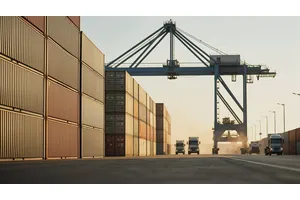
Your container left Xi'an on Thursday and your retail reset is in three weeks — do you know which of the two gauge changes will eat the days, and what the box really costs once Polish duty and VAT land on it? Below is the 2026 mechanics of this lane: the platforms, the work at Brest and Małaszewicze, the transit spread by origin city, a full rate table and a landed-cost example you can check line by line.
How Rail Freight from China to Poland Reaches the EU Through Malaszewicze
A China–Poland train leaves the Chinese network at one of two crossings: Alashankou (handover to Dostyk, Kazakh side) or Khorgos (to Altynkol). Alashankou is the busier, moving 8,165 China–Europe trains in 2025, up 6.3% year on year, with a single-day peak of 30.
From there the boxes ride the 1,520 mm network across Kazakhstan, Russia and Belarus. UTLC ERA, which operates most of that leg, runs published blocks from Xi'an, Chongqing, Chengdu and Changsha into Małaszewicze, and from Yiwu into Łódź.
Then comes the part that decides your delivery date. China runs 1,435 mm standard gauge, the CIS network runs 1,520 mm broad gauge, and the EU is back on 1,435 mm. Every westbound container is handled twice: once at the Chinese–Kazakh border, and once at Małaszewicze, nine kilometres west of Terespol on the Polish side of the Belarus border. Between 84% and 90% of westbound China–Europe trains enter the EU there, depending on whether you use the Eurasian Rail Alliance Index (84%) or Politico's figure (90%).
That single fact explains why Poland gets the shortest rail lead times in the EU. A container bound for Duisburg or Milan passes Małaszewicze and runs another two to four days; a container bound for Warsaw is already inside the customs territory when the crane sets it down — which is why Polish importers treat this as their primary lane rather than an alternative to sea freight from China.
China Departure Stations for Rail Freight to Poland
Seven platforms do almost all the volume, and they are not interchangeable: each has its own departure rhythm, cargo mix and pricing, because the inland rail leg inside China is charged separately from the international tariff.
| Departure station | Platform city | Transit to Małaszewicze | What the platform is built around |
|---|---|---|---|
| Chengdu Chengxiang | Chengdu | 12–15 days | Electronics, auto parts, machinery; shortest western routing |
| Chongqing Tuanjiecun | Chongqing | 12–15 days | Machinery, motorcycles, chemicals; heavy industrial base |
| Xi'an Xinzhu | Xi'an | 13–16 days | Largest platform by departures; general cargo, solar modules, e-commerce |
| Zhengzhou Putian | Zhengzhou | 14–18 days | Consumer goods, apparel, furniture for Central European distribution |
| Yiwu West | Yiwu | 15–20 days | Small commodities, seasonal and holiday goods, mixed cartons |
| Suzhou West | Suzhou | 15–20 days | Textiles, precision parts, electronics from the Yangtze Delta |
| Wuhan Wujiashan | Wuhan | 14–17 days | Auto parts and electronics; smaller platform, fewer blocks |
Chengdu and Chongqing are faster for a structural reason: they sit closer to Alashankou, so the domestic leg is two to three days shorter. Yiwu and Suzhou pay for their position — the run to the border eats three to five days before the international leg starts.
If your supplier is in Shenzhen, Guangzhou or Ningbo, the cargo does not need its own train: it is trucked or railed to the nearest platform and consolidated there. That feeder leg costs $400–$900 per 40HQ and takes three to six days — the most under-quoted line item on this corridor.
The Brest–Malaszewicze Gauge Change: What Happens to Your Container
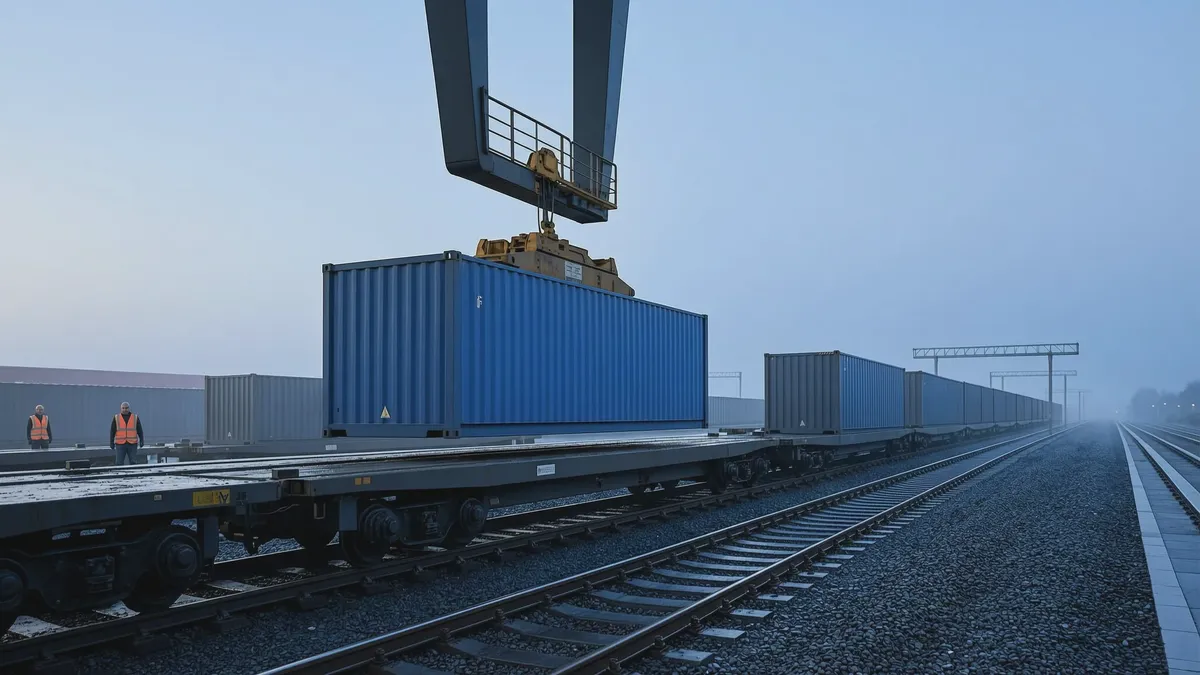
The broad-gauge train pulls into the Małaszewicze complex and stops. What follows is not a wheel swap. Container trains are transshipped: a gantry crane or reach stacker lifts each box off the 1,520 mm flat wagon and sets it on a 1,435 mm platform, pinned and braked before a European haulier takes it on. Bogie exchange exists for some wagon types, but assume a lift.
Platform geometry limits what fits. A standard 80-foot European platform carries one 40-foot box or two 20-foot boxes. A 45-foot pallet-wide container needs a longer platform, which is scarcer and usually surcharged. Book 45ft to save cube only after platform availability is confirmed.
Dwell time is queue time, not handling time. The crane cycle is minutes; the two to four days in transit estimates come from trains arriving faster than the terminal can process them. PKP PLK's bottleneck programme identified 783 restrictions on its network, including station tracks shorter than 750 metres, which forces long block trains to be split before handling.
The terminal is not one company. PKP PLK owns the infrastructure; several private terminals inside the complex do the handling. INBAP opened a container terminal here that was handling close to 200 containers a day within about six months, most from China, and its siding takes 400 broad-gauge and 200 standard-gauge wagons. Container Terminal Mala, part of CLIP Group, signed a PLN 95.14 million contract in June 2026 to connect its terminal to standard-gauge track 1000 and broad-gauge line 450, targeting 197,486 TEU of extra annual capacity by the end of 2028.
Poland moved nearly 790,000 TEU by intermodal rail in the first quarter of 2026, a record 19.2% of its rail freight performance.
Your container is then in the EU but not in free circulation: until the declaration is lodged it sits in a bonded area, and the storage clock runs.
Rail Freight from China to Poland Cost in 2026: FCL, LCL and Modal Comparison
Rail is quoted per container, station to station, with Brest transshipment and Małaszewicze terminal handling normally inside the rate. Sea and air are sold on their own units, and the table below labels each one.
| Mode | Unit | 2026 range | What the figure normally covers |
|---|---|---|---|
| Rail FCL | 40HQ | $4,000–$6,400 | Rail tariff, Brest transshipment, Małaszewicze terminal handling |
| Rail FCL | 20ft | $2,850–$4,500 | Same scope; roughly 70% of the 40HQ rate |
| Rail LCL | per kg | $1.50–$3.00 | Consolidated wagon space, deconsolidation at a bonded CFS |
| Sea FCL | 20ft | $1,800–$2,500 | Port to port Gdansk/Gdynia, terminal charges excluded |
| Sea FCL | 40ft / 40HQ | $2,800–$3,800 (peak to $4,800) | Port to port; Q4 peaks push the top of the band |
| Sea LCL | per CBM | $48–$120 | Consolidation, port handling, destination CFS |
| Air | per kg | $4.50–$9.00 (DDP $7–$15) | Airport to airport by weight tier; DDP includes duty and VAT |
Then the rail rate stops being the whole story. A 40HQ booked Xi'an–Małaszewicze at $5,200 arrives at your Polish warehouse with six more lines on it.
| Cost line | Typical 2026 range | Notes |
|---|---|---|
| Rail freight, station to station | $4,000–$6,400 | Includes Brest transshipment and terminal handling |
| Origin trucking and export declaration | $600–$1,200 | Feeder to the platform plus Chinese export filing |
| Border and gauge-change surcharges | $250–$500 | Charged separately by some operators, inside the rate by others |
| Małaszewicze storage beyond free time | $150–$350 | Free time is typically 3–5 days after discharge |
| Polish import declaration and brokerage | $150–$300 | One declaration, one EORI |
| Duty | 0–12% of customs value | By HS code under TARIC |
| Import VAT | 23% of (customs value + duty) | Recoverable if you are VAT-registered |
| Onward delivery to Warsaw or Łódź | $250–$450 | Road, same or next day after release |
Four things move the number more than the market does. Weight caps a 40HQ on a rail platform at roughly 21–24 tonnes gross depending on platform and crossing; overweight cargo is repriced, not carried. Cargo class matters — dangerous goods and temperature-controlled boxes are quoted individually. Direction matters: eastbound capacity is cheaper per box because the trade is imbalanced. Season does the rest.
Rates here are the ones DTFU is quoting on live bookings this quarter; for the ocean-side picture and its peak behaviour, the shipping cost from China to Poland breakdown covers the container and LCL lines in the same detail.
Rail Freight Transit Time from China to Poland by Departure City
Published transit figures cluster between 12 and 22 days, which is useless for planning. Operator records are tighter: one forwarder's register of 214 Chengdu–Małaszewicze trains averages 18.7 days station to station, fastest run 12 days, most recent ten at 16.8 days. The 14–18 day band is the good end of the distribution, not the middle.
Plan on 14–18 days station to station for a clean run and 18–30 days for door-to-door shipping from China, once factory pickup, export clearance, the Polish import declaration and final delivery are added. Most quotes go wrong exactly here: the rail leg runs in calendar days while the two clearance steps at each end are counted in working days.
Three schedule mechanics matter at booking. Blocks leave on fixed weekly slots per platform, republished monthly. LCL consolidations run weekly with a cargo cut-off five to seven days before departure. And platforms distinguish public trains, which sell space to any shipper including LCL, from custom trains, chartered by one large shipper and skipping consolidation — two to three days faster, and not available unless you fill most of the train.
In Q4, book three to four weeks ahead — space sells out before the rate does. The shipping time from China to Poland page carries the month-by-month view.
Polish Customs Clearance for Rail Freight: EORI, ICS2 and 23% VAT
Clearance starts before the train arrives, and it starts with a number most first-time importers do not have.
EORI is the EU-wide trader identifier. Without it the Polish customs system will not accept a declaration, and every party on the document — importer, buyer, representative — is identified by EORI alone. Registration is free but takes a few working days, so it belongs in week one of the purchase order.
ICS2 is the EU's advance cargo security system. Since 1 September 2025 it has been fully operational for rail and road, so an entry summary declaration (ENS) must be lodged before the train reaches the EU border. Your forwarder or the rail operator usually files it; if nobody has asked for a goods description and HS code before departure, that is a warning sign.
The declaration goes into AIS/IMPORT PLUS, the Polish customs platform that replaced the old AIS import system nationwide on 31 October 2024. It is one electronic declaration keyed to EORI, and it is where the two tax lines are calculated: duty at 0–12% of customs value by HS code, and import VAT at 23% of customs value plus duty.
The two VAT routes differ in cash, which matters more than the rate. Default: pay the import VAT within 10 days of the customs notification, then reclaim it as input VAT. Simplified (art. 33b of the Polish VAT Act, since 1 July 2020): account for the import VAT in your VAT return and pay nothing at clearance. On the 40HQ below that keeps roughly $13,000 off your cash out for a month.
The simplified route is not automatic: it needs an application to the head of the customs-tax office, conditions including no overdue public debt, and periodic renewal. A deferment arrangement under art. 33a exists as an alternative. Set it up before your first container.
Clearing at Małaszewicze puts goods into free circulation immediately and lets you deliver anywhere in the EU; clearing inland under T1 is slower at the border but lets you consolidate several containers into one declaration. The commonest causes of a stopped rail container are dull ones: an HS code that does not match the invoice description, an invoice value below the customs office's reference price, missing CE documentation and declaration of conformity on electronics, and consumer goods without Polish-language instructions or an energy label. On the export side, DTFU files the Chinese declaration through its own China customs clearance service, which is where most HS mismatches actually start.
Landed Cost Example: A 40HQ of LED Lighting Cleared at Malaszewicze
Here is the chain on one page: a 40HQ of LED panel luminaires (HS 9405, duty 4.7%) at $48,000 FOB Shenzhen, 55 CBM, 9,000 kg, into a Warsaw warehouse.
| Line | Amount | How it is calculated |
|---|---|---|
| Goods, FOB Shenzhen | $48,000.00 | Supplier invoice |
| Origin trucking and export declaration | $900.00 | Shenzhen to Xi'an platform, plus export filing |
| Rail freight, Xi'an to Małaszewicze | $5,200.00 | 40HQ, mid-band of the 2026 range |
| Border and gauge-change handling | $450.00 | Brest transshipment and terminal work |
| Cargo insurance | $180.00 | 0.33% of CIF, all-risks |
| Customs value (CIF) | $54,730.00 | Goods + origin costs + rail freight + handling + insurance |
| Import duty at 4.7% | $2,572.31 | 4.7% × $54,730.00 |
| Import VAT at 23% | $13,179.53 | 23% × ($54,730.00 + $2,572.31) |
| Import declaration and brokerage | $220.00 | One declaration, Małaszewicze |
| Delivery to Warsaw | $380.00 | Road, post-release |
| Total landed | $71,081.84 | Sum of all lines above |
The VAT is recoverable if you are registered and deducting, so the real economic cost is $57,902.31. On the art. 33b route the $13,179.53 never leaves your account at clearance — it appears as output and input VAT in the same return and nets to zero.
Note what the arithmetic says: the rail rate is 7.3% of landed cost, duty plus VAT is 22%. Importers who negotiate freight for a week and accept the HS code their supplier suggested are optimising the smaller number.
Rail Freight vs Sea and Air from China to Poland: When Rail Actually Wins
"Faster than sea, cheaper than air" has been true since 2016 and does not help you choose. The useful comparison is cost per kilo and cost per day saved.
A 40HQ at $5,200 carrying 17 tonnes works out at about $0.31/kg. The same box by sea at $3,300 is $0.19/kg, and air freight from China at $6.00/kg is roughly twenty times the rail rate. Rail's premium over sea is therefore about $1,900 per 40HQ, and it buys 16 days.
Convert that into money: at a 25% annual carrying cost, 16 days is worth about 1.1% of the cargo value. To justify a $1,900 premium on carrying cost alone, the box needs to hold about $173,000 of goods — more than most 40HQs of consumer goods carry, which is why rail is often not cheaper but insurance against a stockout, and should be bought as insurance.
Rail wins clearly in three situations: seasonal goods where two weeks late misses the selling window; high value per cubic metre, where carrying cost is steep; and unreliable sea schedules, where the safety stock covering a 40-day ocean transit costs more than the rail premium. A customer penalty above $1,900 per container makes the case for you.
Sea still wins on anything heavy, low-value or non-urgent: furniture, ceramics, raw materials, building products, and any order placed three months ahead. Air wins on launches, samples and spare parts where a line-down cost dwarfs the freight. And the Red Sea rerouting has added 10–14 days to Asia–Europe ocean transits since 2024, which has improved rail's relative position without rail rates moving much. The sea vs rail freight comparison covers the reliability side of that argument.
Restricted Cargo on the China–Poland Rail Route: Batteries, DG and CBAM
Rail accepts a narrower cargo base than sea, and the restrictions are operational: platforms refuse what they cannot carry across 10,000 kilometres with two gauge changes.
Lithium batteries are the sharpest line. Standalone cells and packs (UN3480) are refused by most platforms outright. Batteries packed with or contained in equipment (UN3481) are accepted by some platforms with an MSDS, a UN38.3 test summary and a packaging certificate, and refused by others. E-bikes and portable power stations are the classic borderline case: get acceptance in writing before the cargo leaves the factory, not at the platform gate. If your product line is battery-heavy, the Shipping Electronics & Batteries from China rules cover the documentation in full.
Dangerous goods move under two rulebooks on one journey: SMGS in the 1,520 mm space and RID from Brest onwards. A declaration that satisfies one does not automatically satisfy the other, and the paperwork has to be ready before loading — there is no acceptable place to fix it en route.
Counterfeits and unlicensed branded goods are the fastest way to lose a container: EU customs works from rights-holder databases, and a seizure means storage, destruction and a case file — not a delay.
Cold chain is limited by physics: most container platforms carry no power, so a reefer needs its own gen-set, and there are few places to refuel one between Alashankou and Małaszewicze. Chilled and frozen cargo belongs on a vessel.
Two 2026 regimes now sit on top. CBAM entered its definitive phase on 1 January 2026: importers of iron and steel, aluminium, cement, fertilisers, hydrogen and electricity above 50 tonnes a year need a CBAM account and must surrender certificates against embedded emissions. Steel and aluminium are exactly what moves by rail, so this is a cost line, not a footnote. Separately, EU countervailing duties on Chinese battery electric vehicles under Regulation (EU) 2024/2754 apply at up to 35.3% on top of the 10% standard duty.
Seasonal Delays on Rail Freight from China to Poland
Rail has fewer failure modes than ocean freight but sharper ones: a single border event backs up the whole corridor.
| Window | What happens | What to do |
|---|---|---|
| Chinese New Year (late Jan–Feb) | Factories close 2–4 weeks; platforms cut blocks | Ship by mid-January or accept February rates |
| Golden Week (1–7 Oct) | Three to five days lost at origin | Book before mid-September |
| Q4 peak (Sep–Dec) | Space sells out 3–4 weeks ahead; rates firm | Contract space in August |
| Winter (Dec–Feb) | −25°C in Kazakhstan; brake and coupling checks add 1–3 days | Add buffer on January departures |
| Border closures | Poland shut all crossings with Belarus on 11 September 2025 ahead of the Zapad exercises and reopened on 25 September | Keep 7–10 days of float; ask about the Middle Corridor fallback |
| Volume swings | Eurasian rail container traffic fell 23.3% in 2025 to 572,300 TEU | Capacity is looser than 2024, but not on every platform |
The September 2025 closure is the case study worth knowing. Two weeks of a closed border did not just delay the trains already rolling; it stacked them at Brest, filled the Małaszewicze terminals on reopening, and pushed booking windows out by another two to three weeks. The fallback — the Middle Corridor through Kazakhstan, the Caspian, Azerbaijan and Georgia — works, but adds a week to ten days. It is a contingency, not a substitute.
FAQs
How long does rail freight from China to Poland take? 14–18 days station to station to Małaszewicze, 18–30 days door to door. Operator records for Chengdu average 18.7 days across 214 trains, so plan on the upper half.
How much does a 40HQ cost by rail from China to Poland in 2026? $4,000–$6,400 station to station including the Brest transshipment. Budget $5,200 as a working mid-point for a Xi'an booking.
Is rail cheaper than sea from China to Poland? No. Sea runs $1,800–$2,500 for a 20ft and $2,800–$3,800 for a 40ft; rail on a 40HQ costs about $1,900 more and saves roughly 16 days.
What is rail LCL priced at, and how is it calculated? $1.50–$3.00/kg, with volume converted at roughly 1 CBM to 167 kg, so light bulky cargo is effectively priced on cube.
Why do containers stop at Malaszewicze? The EU runs 1,435 mm standard gauge and the CIS network runs 1,520 mm. Małaszewicze is where boxes are lifted from broad-gauge to standard-gauge wagons and enter EU customs territory.
Do I need an EORI number to import into Poland? Yes. Polish customs identifies every party on the declaration by EORI alone, and no declaration is accepted without one.
Can I defer the 23% Polish import VAT? Yes, under art. 33b of the VAT Act — declare it in your VAT return instead of paying at clearance, subject to an application and periodic renewal. Otherwise VAT is due within 10 days of the customs notification.
Can I ship lithium batteries by rail to Poland? UN3480 standalone cells are refused by most platforms. UN3481 batteries in equipment are accepted by some, with MSDS, UN38.3 and a packing certificate — confirm before loading.
Which Chinese city is fastest for rail to Poland? Chengdu and Chongqing at 12–15 days, because they are closest to Alashankou. Yiwu and Suzhou run 15–20 days.
Is rail affected by the Poland–Belarus border situation? Yes. Poland closed all crossings on 11 September 2025 and reopened on 25 September, pushing booking windows out by two to three weeks.
A rail booking lives or dies on two dates: the platform cut-off and the customs release at Małaszewicze. If you want the 2026 rate card applied to your cargo, send the HS code, weight and Polish delivery address to contact DTFU Logistics and DTFU will price the rail leg, the clearance and the delivery as one number — we book directly on the Xi'an, Chengdu and Yiwu platforms and run our own Polish clearance, so the figure you get back is the figure you pay. The same team moves Shipping From China to Europe destinations beyond Poland on the same block trains.