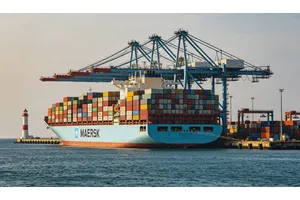
On the Poland–Belarus border, straddle cranes lift forty-foot containers from broad-gauge wagons onto European standard-gauge railcars. Over 90% of China–Europe rail freight passes through this one Polish yard — and it's one of three gateways that decide your shipping cost from China to Poland. The other two: the deep-water port of Gdańsk, where megamax ships from Shanghai and Ningbo berth directly, and Warsaw Chopin Airport, where cargo planes land within hours of leaving Shenzhen.
That three-way choice makes Poland unique among European markets: a Baltic deep-water port, the continent's busiest rail transshipment terminal, and a major air hub all compete on its own soil. Which gateway you pick decides whether your freight bill reads $1,800 for a container or $9.00 per kilo by air — and whether inventory arrives in 5 days or 45.
| Gateway | Cost basis | Typical 2026 range | Transit | Best for |
|---|---|---|---|---|
| Sea — Gdańsk / Gdynia / Szczecin | Per container or per CBM | 20ft $1,800–$2,500 · 40ft $2,800–$4,800 | 32–40 days | Bulk cargo, anything that fits a container |
| Rail — Malaszewicze gateway | Per container or per kg | FCL $4,000–$6,400 · LCL $1.50–$3.00/kg | 14–18 days | Mid-value, time-sensitive-but-not-urgent cargo |
| Air — Warsaw Chopin (WAW) / Katowice (KTW) | Per chargeable kg | $4.50–$9.00/kg (DDP up to $15/kg) | 3–7 days | Urgent, high-value, lightweight cargo |
I've handled China–Poland freight since 2014 — first as a booking clerk watching wagons stack up at Małaszewicze every winter, now with the FIATA and IATA dual-certified team at DTFU Logistics. This guide covers container rates, per-kg air tiers, the rail price premium, the 23% VAT and duty math, the surcharges missing from the first page of a quote, and the seasonal windows that can swing your cost by 20%. By the end you'll know what your cargo should cost — and what to ask before you book.
What Determines the Cost of Shipping from China to Poland?
Before comparing rates, understand the five levers that move every quote on this lane. Two of them are about your cargo, two are about your choices, and one is about timing — and each can change the price more than the difference between forwarders.
| Cost driver | How it moves your price | What to check |
|---|---|---|
| Weight vs. volume | Air freight bills the greater of gross or volumetric weight; sea and rail bill by CBM | Chargeable weight (air), CBM (sea/rail) |
| Origin city & port | Southern China (Shenzhen/Guangzhou) vs. Yangtze delta (Shanghai/Ningbo) shift inland trucking and sailing frequency | Trucking distance to port, sailing schedule |
| Season & demand | Q4 peak and Chinese New Year add 10–25% to every mode | Booking date vs. peak windows |
| Surcharges & handling | BAF, THC, PSS, customs broker and storage fees can add 15–30% on top of the headline rate | Full breakdown, not just "all-in" |
| Duties & VAT | Polish VAT at 23% plus duty by HS code applies to CIF value — often the single biggest line item | Correct HS classification, DDP vs. DAP terms |
Air freight bills per kilogram of chargeable weight — the greater of actual and volumetric weight (length × width × height in cm ÷ 6,000). Sea and rail bill per cubic meter (CBM) with weight ceilings per container. That's why a bulky, lightweight shipment can be cheaper by sea than by air even when the per-kg air rate looks low.
The other reason quotes are hard to compare: no two forwarders quote the same scope. One "40ft to Gdańsk" price may include terminal handling and customs clearance; another may stop at the port gate. We'll get to that in the hidden-charges section — first, the headline numbers for each gateway.
Sea Freight Cost from China to Poland: FCL & LCL via Gdańsk
Sea freight is the price anchor for this lane. For full container loads (FCL), the Port of Gdańsk — specifically the Deepwater Container Terminal (DCT) — is the only Baltic port that receives direct calls from the world's largest container ships, so cargo from Shanghai or Ningbo can skip the transshipment stop in Hamburg or Rotterdam entirely. Gdynia and Szczecin serve as secondary discharge ports, mainly for LCL deconsolidation and northern-Poland distribution.
Container (FCL) rates
| Container | Port-to-port (off-peak) | Q4 peak season | Door-to-door add-on |
|---|---|---|---|
| 20ft (20GP) | $1,800–$2,500 | Up to $3,200 | +$600–$900 |
| 40ft / 40HQ | $2,800–$3,800 | Up to $4,800 | +$800–$1,200 |
Port-to-port rates from major Chinese ports (Shanghai, Ningbo, Shenzhen, Qingdao, Guangzhou) to Gdańsk include ocean freight only. Add the door-to-door column for factory pickup, export and import clearance, and trucking to your door in Poland — typically $2,600–$3,600 for a 20ft and $3,800–$5,800 for a 40ft, depending on season and destination. Rates have held these bands through 2026 because most Asia–Europe services still reroute around the Cape of Good Hope after the Red Sea disruption, keeping capacity tight at a higher base level than pre-2024.
LCL rates and the FCL break-even
For shipments under about 12–15 CBM, less-than-container-load (LCL) is the economical choice: $48–$120 per CBM to Warsaw or Gdańsk, consolidated in Shenzhen, Shanghai or Yiwu and deconsolidated at destination. The catch is time — LCL adds 5–10 days — and per-CBM handling. Above roughly 15 CBM, a 20ft container wins: you pay for the space you use, not a share of someone else's freight.
| Your shipment | Recommendation | Why |
|---|---|---|
| Under ~8 CBM | LCL | Cheapest per CBM; slower but fine for first orders |
| 8–15 CBM | Compare LCL vs. 20ft | LCL handling fees start to eat the savings |
| Over ~15 CBM | FCL 20ft | Flat container price beats per-CBM LCL |
| Over ~28 CBM or heavy cargo | FCL 40ft/40HQ | 20ft hits weight or volume ceiling |
Origin ports: how your Chinese departure city changes the bill
| Origin port | Typical transit to Gdańsk | Rate note |
|---|---|---|
| Shanghai | 28–34 days | Highest sailing frequency — most competitive spot rates |
| Ningbo-Zhoushan | 30–35 days | Similar to Shanghai; strong 40HQ equipment availability |
| Shenzhen (Yantian/Shekou) | 30–35 days | South China electronics base; add inland trucking for inland suppliers |
| Qingdao | 31–35 days | Good for North China manufacturers (Shandong, Hebei) |
| Guangzhou (Nansha) | 32–37 days | Longer sea leg; competitive for Pearl River Delta cargo |
| Tianjin (Xingang) | 33–38 days | Farthest north; usually the slowest to Gdańsk |
For most importers the choice is geographic: ship from the port nearest your factory. If your supplier is in Guangdong, consolidating to Shenzhen and booking 40HQ out of Yantian is the standard play. Full ocean rates and seasonal swings on this lane are covered in our sea shipping cost from China to Poland guide, and container-level detail — including what changes when you upgrade from 20ft to 40HQ — in our cost of shipping a container from China to Poland breakdown. For an overview of every mode on this corridor, our shipping from China to Poland service page covers the full menu.
Rail Freight Cost from China to Poland: The Malaszewicze Route
Rail is the mode Poland is built for. The China–Europe Railway Express funnels through Małaszewicze (often spelled Malaszewicze), the EU's largest rail transshipment hub, where containers transfer from 1,520 mm broad-gauge wagons to 1,435 mm standard-gauge cars. That gauge change is the physical heart of the corridor — and the reason rail freight has a cost structure no other mode replicates.
Rail FCL runs $4,000–$6,400 per container — a clear premium over sea FCL, offset by transit of 14–18 days station-to-station versus 32–40 by sea. LCL rail is quoted at $1.50–$3.00 per kg (or $80–$160 per CBM), consolidating at Chengdu, Chongqing, Xi'an, Zhengzhou or Yiwu before the long haul west.
The price premium buys you two things. First, speed: a Chengdu-to-Malaszewicze train covers the route in 12–15 days, roughly three weeks faster than the vessel. Second, predictability: rail schedules run like clockwork compared to Cape-route ocean schedules — which matters when your customer is restocking on a deadline. The trade-offs are real: rail capacity tightens in Q4, and the border crossing itself can bottleneck.
From the field: We once had a client's two 40ft containers of home appliances sit at Małaszewicze for six extra days in January while the yard cleared a backlog of holiday-season trains. The gauge change normally takes 2–4 days; in deep winter, with frozen points and inspection holds, we budget an extra 3–5 days as standard. Lesson: rail quotes the station-to-station time, but the border crossing is where schedules flex — always pad your rail ETA in December–February.
When does rail beat both alternatives? When your cargo is worth $8–$30 per kg — electronics, auto parts, machinery components, seasonal retail — and your customers can tolerate 2–3 weeks but not 5–6.
Air Freight Cost per kg from China to Poland
Air freight answers a simple question: how much is your time worth? Warsaw Chopin Airport (WAW) is the primary gateway, with Katowice (KTW) a solid secondary hub for southern Poland. Rates move by weight tier, because airlines price space as much as weight.
| Weight tier (airport-to-airport) | Rate (USD/kg) | DDP all-in rate | Typical transit |
|---|---|---|---|
| 45–100 kg | $7.50–$9.00 | $10.00–$15.00 | 5–7 days |
| 101–500 kg | $6.00–$7.50 | $8.00–$12.00 | 4–6 days |
| 501–1,000 kg | $5.00–$6.50 | $7.00–$10.00 | 3–5 days |
| 1,000+ kg | $4.50–$5.80 | $7.00–$10.00 | 3–5 days |
Note the DDP column: for $10–15 per kg the forwarder handles pickup, export customs, the flight, Polish import clearance, 23% VAT and final delivery — often cheaper than airport-to-airport once you add your own broker, VAT payment and trucking (we quantify this in the hidden-charges section).
The volumetric trap: airlines charge by chargeable weight. A carton of plastic housewares weighing 80 kg but measuring 120 × 80 × 100 cm bills at 160 kg (120 × 80 × 100 ÷ 6,000) — double the scale weight. Compact packaging is the single fastest way to cut your per-kg cost; every centimeter shaved off dimensions reduces the bill. Express couriers (DHL, FedEx, UPS) cover the 1–5 day door-to-door niche for samples and parcels under 100 kg, but at $15–$35 per kg they're a tool for emergencies, not inventory. Our dedicated air shipping from China to Poland guide breaks down every tier, airline and customs step in detail.
Sea vs Rail vs Air: The Cheapest Way to Ship from China to Poland
Here's the decision framework we actually use with clients. There is no single cheapest way to ship from China to Poland — there is a cheapest way for your cargo profile.
| Your situation | Gateway | Indicative all-in cost | Door-to-door time |
|---|---|---|---|
| Bulk stock, low value per kg, flexible timing | Sea FCL (Gdańsk) | $2,600–$5,800 per container | 35–50 days |
| First orders, samples, < 8 CBM | Sea LCL | $48–$120/CBM + handling | 40–55 days |
| Mid-value goods, seasonal retail, restocking | Rail (Malaszewicze) | $1.50–$3.00/kg or FCL $4,000–$6,400 | 18–30 days |
| Urgent restock, high-value, lightweight | Air (WAW) | $7.50–$9.00/kg a2a | 5–12 days |
| Samples, documents, parcels | Express courier | $15–$35/kg | 2–5 days |
The math that convinces most importers is the cost-of-delay calculation. If a stockout on Allegro or Amazon costs you $500 per day, upgrading from sea (35 days) to rail (20 days) saves 15 days — $7,500 in avoided losses — for a freight premium of maybe $2,000–$3,000. The "cheapest" option is the one whose total cost, including the cost of waiting, is lowest. For a complete time-side view of every mode and port pair, see our shipping time from China to Poland guide.
From the field: A Warsaw-based homeware seller on Allegro started with sea LCL, then switched his top 30 SKUs to rail after stockouts cost him his best-seller badge. His freight bill rose about 35%, but sell-through jumped because inventory arrived in 3-week cycles instead of 7-week ones — and he stopped paying $8–12/kg express air for monthly emergency top-ups. That's the pattern we see most: sea for base stock, rail for SKUs that sell, air for true emergencies.
For sellers distributing beyond Poland into the wider EU, clearing in Poland unlocks free circulation across all 27 member states — our shipping from China to Europe coverage runs the same gateways with last-mile delivery continent-wide.
Total Landed Cost: Polish Customs Duty, 23% VAT & ICS2
The freight rate is only half the story. Every commercial import into Poland pays customs duty (by HS code) plus 23% VAT on the duty-inclusive value — the VAT line is usually bigger than the freight itself. As an EU member, Poland applies the common customs tariff, so the duty rate is identical whether you clear in Gdańsk, Małaszewicze or Warsaw.
The EU's ICS2 (Import Control System 2) now requires an electronic Entry Summary Declaration (ENS) before arrival for all modes — sea, rail and air; a late ENS means border holds. Polish customs runs on the AIDA declaration system, and every importer needs an EORI number before the first shipment. Regulated products (electronics, toys, machinery, PPE) additionally require CE marking with a Declaration of Conformity.
| Product category | Typical EU duty | Notes |
|---|---|---|
| Electronics, most machinery | 0–3% | HS 84–85 range; CE marking required |
| Furniture, plastics, home goods | 3–6% | Check TARIC for exact HS code |
| Textiles, footwear, apparel | 8–12% | Highest common category; quotas historically applied |
| Ceramics, glassware | 5–10% | Anti-dumping cases exist for some Chinese ceramics |
The VAT calculation, with real numbers: say your cargo has a CIF value (cost + insurance + freight) of $10,000 and carries 5% duty. Duty = $500. VAT base = $10,000 + $500 = $10,500. VAT at 23% = $2,415. Total import taxes: $2,915 — on top of whatever you paid the carrier. The HS code you declare decides both the duty rate and, indirectly, whether customs inspects your shipment, so classification errors are the most expensive mistake in this entire process.
From the field: A client shipping LED strip lights declared them under a general electronics code at 0% duty — the correct code for the specific product carried 6.5%, plus an anti-dumping measure on that subcategory that we caught in pre-shipment review. Reclassified before departure, the shipment cleared Gdańsk in two days instead of facing a duty reassessment and storage fees that would have run well past $2,000. Lesson: let the forwarder's compliance team check your HS codes against TARIC before the cargo leaves the factory, not after it arrives.
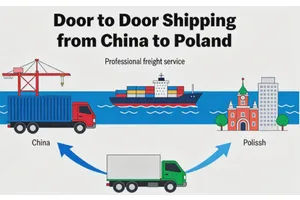
Under DDP (Delivered Duty Paid), the forwarder prepays duty and VAT in one all-in rate — the standard for e-commerce sellers and importers without a Polish entity. Under DAP, you pay duty and VAT yourself, which only makes sense if you hold an EORI and can reclaim VAT. The full door-to-door mechanics, including Amazon FBA palletization and Allegro requirements, are covered in our door to door shipping from China to Poland guide. The Shanghai–Barcelona EV charger shipment in our case library — two containers, CE documents fixed at the factory, cleared in days — shows exactly how we run EU-bound FCL compliance, and Poland runs the same process.
Hidden Charges That Inflate Your China–Poland Quote
Every forwarder's headline rate hides a second page. Here's what actually appears on the final invoice, and roughly what each line costs on this lane.
| Charge | What it is | Typical size |
|---|---|---|
| BAF / fuel surcharge | Carrier fuel adjustment, indexed monthly | $150–$400 per 40ft; $0.50–$1.50/kg air |
| THC (terminal handling) | Port/airport handling at origin and destination | $250–$500 per container total |
| PSS (peak season surcharge) | Q4 / pre-CNY demand charge | $300–$800 per 40ft |
| Customs broker fees | Export + import declarations (China and Poland) | $150–$500 per shipment |
| Storage & demurrage | Container sits at terminal past free time (usually 3–7 days) | $50–$150 per day |
| Cargo insurance | ~0.3–0.5% of declared value | $30–$250 typical |
The classic trap: an airport-to-airport air quote of $6.50/kg looks cheap until you add broker fees, import duty, the 23% VAT and trucking from WAW. On a real 300 kg shipment we price this lane at roughly $6,364 total airport-to-airport versus $3,000–$3,600 all-in DDP — the "expensive" option is cheaper because it stops the surprise bill. Six ways we cut costs for clients on this lane: consolidate to reach higher weight tiers; right-size the container (a 20ft instead of 40ft when under 28 CBM); compress packaging to cut CBM and chargeable weight; book off-peak (air and rail run 15–25% cheaper outside Q4); share FCL space instead of paying LCL handling; and keep volume with one forwarder for contract rates and priority space.
2026 Freight Rate Outlook: When to Book Your China–Poland Shipment
Freight rates on this lane swing with the calendar more than with the economy. Here's the season map we plan against:
| Period | Sea impact | Rail impact | Air impact |
|---|---|---|---|
| Q4 peak (Sep–Dec) | +$500–$1,000 per container, +5–10 days | Space sells out 2–3 weeks ahead | +15–25% rates, +1–3 days |
| Chinese New Year (Jan–Feb) | Factories close; +7–14 days before/after | Border backlog; +3–5 days at Małaszewicze | +1–2 days, rates firm |
| Golden Week (early Oct) | +3–7 days | +3–5 days | +2–3 days |
| Baltic winter (Dec–Mar) | Minimal (icebreaker support) | +2–3 days at border | No impact |
| Red Sea / Cape reroute (ongoing 2026) | +10–14 days vs. pre-2024 | No impact | No impact |
Booking windows matter as much as rates: sea needs 3–4 weeks' lead for equipment (40HQ out of Shanghai and Ningbo gets scarce in Q4), air 2–3 weeks in peak, rail 1–2 weeks. Poland's e-commerce engine — Allegro plus Amazon FBA centers at WRO1 and POZ1 — keeps demand firm year-round, so the premium isn't going away. Plan so your Q4 inventory sails in August and CNY stock clears the yard by mid-January.
FAQs
How much does it cost to ship a 20ft or 40ft container from China to Poland?
A 20ft container runs $1,800–$2,500 port-to-port (up to $3,200 in Q4), and a 40ft/40HQ runs $2,800–$3,800 (up to $4,800 in Q4). Door-to-door DDP adds roughly $600–$1,200 for clearance and trucking in Poland.
How much is air freight per kg from China to Poland?
Airport-to-airport rates are $4.50–$9.00 per kg depending on weight tier: the more you ship, the lower the per-kg rate. All-in DDP air (including 23% VAT and delivery) runs $7.00–$15.00 per kg.
Is rail freight from China to Poland worth the premium over sea?
Rail FCL costs $4,000–$6,400 versus $2,800–$3,800 by sea, but delivers in 14–18 days instead of 32–40. For mid-value cargo where stockouts cost real money, the premium pays for itself.
What's the cheapest way to ship from China to Poland?
For bulk: sea FCL via Gdańsk. For shipments under ~15 CBM: sea LCL at $48–$120/CBM. The cheapest total option for time-sensitive inventory is often rail — compute your cost-of-delay before choosing.