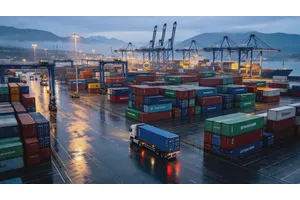
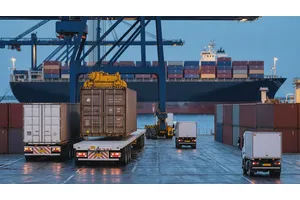
Is your China-South Africa quote suddenly $1,400 higher on a 20ft box while the sailing schedule looks unchanged? Three carriers repriced this lane inside eleven days, Durban is still running a 15-day queue, and the two charges behind the increase hit different invoice lines at different times. Here is the exact surcharge stack, what it does to a landed cost, and which port to book into before the December cut-offs.
What Changed on the China-South Africa Lane in November 2026
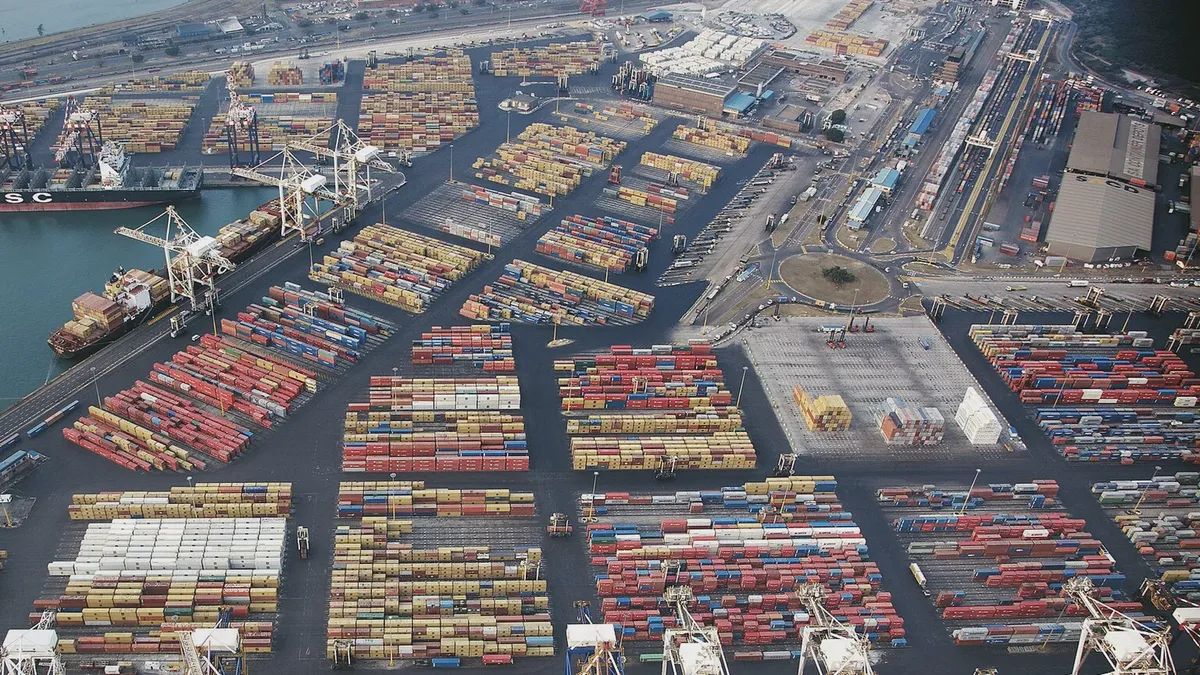
The freight rate did not move much. The surcharge layer did. Maersk's dry-container peak season surcharge from Far East Asia to South Africa and Mauritius moves to $1,000 per 20ft and $2,000 per 40ft from 9 November (10 November for Vietnam origin), four times the $250/$500 level it set on 15 October. On top of that, Maersk's Durban Congestion Fee Destination rises from 1 November to $400 per 20ft and $800 per 40ft for China-origin cargo ($450/$900 from the rest of Far East Asia, the Indian subcontinent and the Middle East; 8 November for Korea and Taiwan).
The other alliances priced the same problem differently:
| Carrier | Charge | Amount, 20ft / 40ft | Effective | Date that fixes the level |
|---|---|---|---|---|
| Maersk | Peak season surcharge, Far East Asia to South Africa and Mauritius | $1,000 / $2,000 | 9 Nov 2026 (Vietnam 10 Nov) | Scheduled departure of the first water leg at booking confirmation |
| Maersk | Durban Congestion Fee Destination | $400 / $800 (China origin) | 1 Nov 2026 (Korea, Taiwan 8 Nov) | Same price calculation date rule |
| Hapag-Lloyd | Peak season surcharge, Asia and Oceania to Durban and Cape Town | $500 / $1,000 | 3 Nov 2026 | Cargo loaded on board |
| CMA CGM | PSS, Far East to Durban | $750 / $1,500 | Since 22 Oct 2026 | Loading date |
| CMA CGM | PSS, China to South Africa | $300 / $600 | 1 Nov 2026 | Loading date, short-term contracts |
Two things about that table matter more than the headline amounts. First, the charges are per container, not per tonne, so a half-filled 20ft pays the same $1,400 as a full one — that single fact changes how you should consolidate before Chinese New Year. Second, the effective dates are not the sailing dates. Maersk prices off the scheduled departure of the first water leg at the moment you confirm the booking; Hapag-Lloyd prices off the date the box is loaded on board; CMA CGM prices off its loading date. A booking confirmed on 6 November for a 7 November first leg keeps the old $250/$500 level. The same booking confirmed for a 12 November leg pays $1,000/$2,000. Same cargo, same carrier, $750 more on a 20ft.
CMA CGM's two Durban notices overlap and the carrier has not published how they interact, so ask which level applies to your booking rather than adding them together. That is the kind of question a forwarder should be answering before you pay a deposit, not after the invoice arrives.
Why Durban Port Congestion Is Still 15 Days Deep
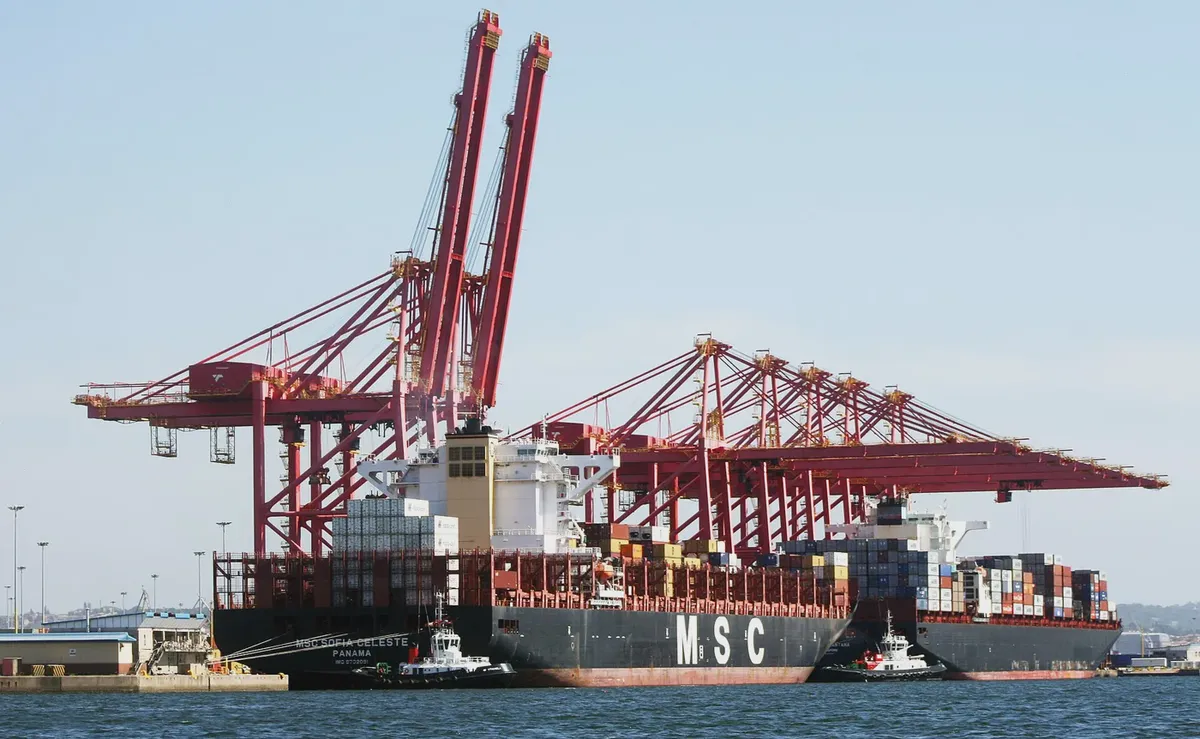
Durban has not recovered from the August switch of Durban Gateway Terminal — the former Pier 2 — to ICTSI operation and the Navis N4 terminal system. Volumes at DGT fell roughly 30% between 14 August and 10 September against the previous four-month average, and the backlog has outlived the initial disruption.
The numbers as of the first week of November:
- The port-wide planning indicator stood at 15 days in the BUSA Cargo Movement Update of 3 November, up a day on the previous week. Cape Town was at 5 days, Coega at 4 and Port Elizabeth at 1.
- Container vessels averaged 7.46 days at anchorage in the seven days to early November, with average arrival delays of 6.02 days and departure delays of 5.59 days (Kuehne+Nagel vessel data).
- Seventeen container vessels were waiting for Durban on 2 November — six inside the designated anchorages and eleven further offshore — representing roughly 85,000 TEU afloat. The 9,326 TEU APL Charleston had been waiting since 21 October.
- DGT handled 34,976 TEU in the week to 1 November, up 12%, yet anchorage time at the terminal remained above 11 days, with about 35,000 container moves still outstanding and stack occupancy at 65%.
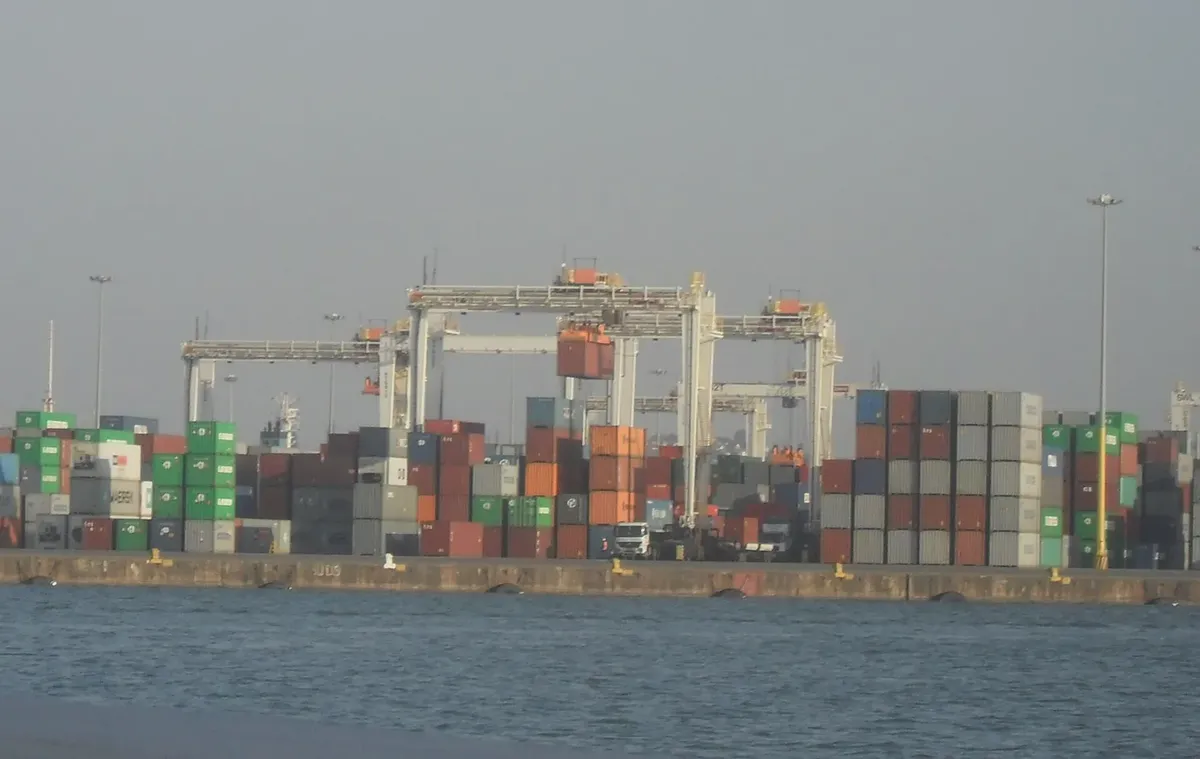
The recovery date is the part importers keep misreading. Transport Minister Barbara Creecy told the industry in late October that DGT may return to its former operating performance between December 2026 and February 2027. The South African Association of Freight Forwarders puts the standing queue at about 19.5 days of added supply chain time on a static workload, and notes that clearing it within 30 days would need roughly 5,000 moves a day against a 3,400-move target. Kuehne+Nagel's own read is blunter: no meaningful improvement before the end of Q1 2027.
The Cape is a different story. In the week to 1 November, Cape Town Container Terminal handled 18,886 TEU (up 76%, 126% of target) with average anchorage of one hour and 42 hours at berth; Ngqura handled 18,257 TEU with anchorage down from 53 to 21 hours. National throughput rose 20% to 100,423 TEU. Cape capacity is working. What is not working is the road and rail capacity to move that cargo inland, which is now the constraint on routing Gauteng-bound boxes through the Cape.
What a Container from China to South Africa Costs in November 2026
Two numbers matter this month, and quotes that show only one of them are the reason invoice disputes are rising. The first is freight-only, port to port, with standard bunker adjustments inside it. The second adds the November surcharge step that applies to your booking.
| Equipment | Freight only, port to port | November surcharges (Maersk, China origin) | All-in ocean, Nov 2026 |
|---|---|---|---|
| 20ft GP | $1,300 – $2,200 | + $1,400 | $2,700 – $3,600 |
| 40ft GP | $2,000 – $3,300 | + $2,800 | $4,800 – $6,100 |
| 40ft HQ | $2,200 – $3,500 | + $2,800 | $5,000 – $6,300 |
| LCL, per CBM | $150 – $220 | Pro-rated, roughly + $30 – $50 | $180 – $270 |
| Air, per kg (300 kg+) | $4.60 – $6.80 | None applicable | $4.60 – $6.80 |
The base freight line is the same band this lane has carried all year; what moved is the middle column. Air freight is tiered: expect $6.20–$8.40 per kg at 45–99 kg, $5.40–$7.40 at 100–299 kg and $4.60–$6.80 above 300 kg, from Shanghai, Shenzhen or Guangzhou to Johannesburg or Cape Town with 3–6 days of flying time.
These are the lower half of what is bookable, not a ceiling. Urgent bookings and premium-carrier sailings in the first week of November were quoted well above the top of these bands, and the spread between two quotes a week apart on the same sailing window is wide enough to reach 20%. The reason to anchor on a band is that it lets you sanity-check a quote instead of accepting it. The ranges above are the ones DTFU has been quoting out of Shenzhen, Ningbo and Shanghai this month, with the surcharge shown as its own line rather than folded into a single number, because that is the only way to see which part of a quote moved between two sailings.
On top of freight, budget origin charges of $250–$450 per container (export declaration, THC, documentation, haulage to port if your supplier is inland), destination charges of $350–$600 (DTHC around $200 on a 20ft, delivery order fee, wharfage), and road haulage. For the full breakdown by port pair, see how much to ship a container from China to South Africa; for gateway, service and documentation options on the trade, the shipping from China to South Africa lane page; and for carrier and sailing choices, our sea freight from China service page.
What the Surcharges Add to a Landed Cost
A 20ft of furniture, FOB $10,000, shipped from Shenzhen to a Johannesburg warehouse, priced at the middle of the November band:
| Cost line | Furniture, 20% duty | Electronics, 0% duty |
|---|---|---|
| FOB goods | $10,000 | $10,000 |
| Ocean freight | $1,750 | $1,750 |
| Peak season surcharge | $1,000 | $1,000 |
| Durban congestion fee | $400 | $400 |
| Marine insurance (0.4%) | $53 | $53 |
| CIF value | $13,203 | $13,203 |
| Customs duty | $2,641 | $0 |
| Added tax value (CIF + 10% + duty) | $17,164 | $14,523 |
| Import VAT at 15% | $2,575 | $2,179 |
| Destination THC, delivery order, broker | $440 | $440 |
| Durban to Johannesburg trucking | $500 | $500 |
| Total landed | $19,359 | $16,322 |
| Cost above FOB | $9,359 (94%) | $6,322 (63%) |
The VAT line is where most first-time importers get their cash flow wrong. South Africa does not charge 15% on the invoice. SARS levies VAT on the added tax value: the customs value plus 10% of that value plus any non-rebated duty, per section 13(2)(a) of the VAT Act. On the furniture example that is 15% of $17,164, not 15% of $13,203 — a difference of $595 in cash at the port gate. If you are a registered VAT vendor importing for taxable supplies, that VAT comes back as input tax once the goods are released, but you still fund it first, and the 10% uplift is never refunded because it is a notional amount standing in for freight and insurance, not a payment to SARS.
Note also what the two new charges do to a margin: $1,400 of the $19,359 landed cost is surcharge. It is 7% of the total and 14% of the goods value, and it arrived with eleven days' notice.
How Long Shipping from China to South Africa Takes Now
Port-to-port transit has not changed; the queue has. Sailing time from Shanghai or Ningbo to Durban is 18–26 days depending on the service, 22–28 days from Yantian or Shekou, and 25–30 days from northern ports that transship. Then add the current reality at the berth: 7–15 days at anchorage at Durban, 2–4 days of terminal handling, and 2–5 days of SARS clearance if your documents are in order.
| Leg | Durban routing | Cape Town routing |
|---|---|---|
| Sailing, China to port | 18–28 days | 22–30 days |
| Waiting at anchorage | 7–15 days | Under 1 day at present |
| Terminal and clearance | 3–7 days | 3–6 days |
| Door-to-door to Johannesburg | 38–55 days | 33–45 days |
That is the honest answer to "how long does shipping from China to South Africa take" in November 2026: the ocean leg is a three-week problem, and the port is a two-week problem. Historically the same booking cleared in 26–35 days door to door. For the seasonal and carrier-side drivers behind those ranges, see shipping time from China to South Africa.
Durban vs Cape Town vs Ngqura: The Port Trade-Off, Costed
Everyone knows Cape Town's terminal is running better than Durban's this month. The decision is not that simple, because the ocean saving is small and the road leg is not.
| Port | Port indicator, 3 Nov | Ocean freight vs Durban | Road to Johannesburg | Where it wins |
|---|---|---|---|---|
| Durban | 15 days | Base | 570–600 km, $350–$650 per 20ft | Gauteng, KwaZulu-Natal, most general cargo |
| Cape Town | 5 days | $100 – $400 lower | 1,400 km, $950 – $1,500 per 20ft | Western Cape; Gauteng only when the queue costs more than the extra road |
| Ngqura (Coega) | 4 days | $150 – $300 higher | 1,050 km, $750 – $1,150 per 20ft | Eastern Cape; time-critical Gauteng with buffer |
| Port Elizabeth | 1 day | $200 – $350 higher | 1,100 km, $800 – $1,200 per 20ft | Small urgent lots, automotive parts |
Run the arithmetic rather than the reputation. A 20ft diverted from Durban to Cape Town saves somewhere between $100 and $400 on the ocean leg but adds roughly $600–$850 on the road leg to Gauteng. What it buys is 10–14 days of schedule certainty — and that is worth real money if the box would otherwise sit at anchor while terminal storage runs at about ZAR 2,533 a day on a 20ft after three free days, with carrier detention starting after the free period.
So the split is predictable. If your cargo is going to Gauteng or further north and you have eight weeks of slack, stay on Durban and price the queue into your landed cost. If you are shipping into the Western Cape, book Cape Town and stop paying for a Durban problem you do not have. If the cargo is tied to a production line or a January promotion, the Cape routing usually wins even after the road leg — and for that kind of shipment, door-to-door shipping from China to South Africa with a fixed delivery date is the way to price it.
One more local constraint: do not assume the Maputo corridor or a road bridge over Beitbridge solves the problem. Cross-border truck times at Beitbridge reached 53 hours in the week to 25 October, and the alternative ports carry their own intermodal backlog.
When Exactly the Surcharge Hits Your Invoice
This is the part that decides whether you pay $250 or $1,000 on a 20ft, and it is entirely administrative.
- Maersk, non-spot bookings: the level is fixed by the price calculation date, defined as the scheduled departure of the first water leg at the time of booking confirmation. A later actual departure does not move it. A roll onto a different vessel might, if it produces a fresh confirmation — ask.
- Hapag-Lloyd: the level depends on the date the cargo is loaded on board. A delayed gate-in that pushes stuffing by two days can move you into the new window.
- CMA CGM: loading date again, with separate Far East-to-Durban and China-to-South Africa notices running at the same time.
Under FOB, freight and surcharges sit with the buyer, which is you. Under CIF, the supplier nominally pays freight to the port, but carriers increasingly re-bill surcharges introduced after shipment — so check the wording. Under DDP, your forwarder absorbs the surcharge inside the all-in price, which means a DDP quote issued before 9 November may be re-quoted or honoured only for a stated validity window. If you are holding a DDP rate for Q1 shipments, the single most valuable question you can ask this week is what happens to that rate if the November surcharges are extended into January.
How to Book November-January Without Losing a Week at Anchor
- Put the price calculation date in writing. Ask for the named vessel, the first water-leg date and the surcharge level in the quote, not just the total.
- Fill the box. Because the surcharges are per container, two half-loaded 20fts now cost $2,800 in surcharges where one 40ft costs $2,800 in total. Consolidating POs into a single 40HQ is the cheapest tactical move available this quarter.
- Ask for extended free time. Maersk has temporarily raised import detention free time at all Durban terminals from four to five days, valid until 31 December 2026, with the standard four days resuming on 1 January. Confirm it on your booking, not on the advisory.
- Pre-lodge the clearance file. SARS importer code, commercial invoice, packing list, bill of lading, ITAC permits for restricted goods and an NRCS letter of authority where the product needs one. A container that arrives with an incomplete file joins the queue twice: once at anchor and once in the terminal. DTFU lodges the Durban entry before the vessel is allocated a berth on most of our South Africa bookings, which is what keeps a five-day detention window workable when the ship is running a week late.
- Nominate trucking before discharge. With Durban stack occupancy at 65% and truck-slot allocation tight, a truck booked after release is a storage bill.
- Plan the Chinese New Year cut-off now. Chinese New Year falls on 6 February 2027, factories slow from mid-January and full shutdowns cluster from about 30 January. With 38–55 days door to door through Durban, cargo that must be on shelf in March has to sail by early January — which means booking in the first half of December, during the current surcharge regime.
LCL, Air or FCL: Where the Break-Even Sits Now
The old rule of thumb — switch from LCL to a 20ft at 13–15 CBM — no longer holds this quarter, precisely because the new charges are per container. With LCL all-in at $180–$270 per CBM and a 20ft at $2,700–$3,600 plus roughly $1,000 of destination and haulage costs, the crossover has moved to about 18–20 CBM. Below that, LCL is still cheaper even after the pro-rated surcharge; above it, the 20ft wins and keeps winning as you fill it.
Air is a different decision. A cubic metre of dense cargo weighs about 167 kg chargeable, which costs roughly $770–$1,140 by air at $4.60–$6.80 per kg, against $180–$270 by LCL. That is a four-to-sixfold premium, so air only makes sense below about 150 kg, or when the delay itself costs more than $5–$6 per kg — a launch date, a production line stop, or a promotion you cannot move. For anything in that bracket, air shipping from China to South Africa lands in 4–7 days door to door and bypasses the Durban queue entirely.
Whichever mode you choose, insure the cargo properly — a marine policy at 0.3–0.6% of insured value is cheap next to a container sitting exposed at anchor for two weeks. Our guide to shipping container insurance cost explains what a policy does and does not cover.
FAQ
How long does shipping from China to Durban take in November 2026? Sailing is 18–26 days from Shanghai or Ningbo, plus 7–15 days at anchorage and 3–7 days for terminal handling and clearance. Door to door to Johannesburg runs 38–55 days, against 26–35 days in a normal year.
How much is a 20ft container from China to South Africa right now? Freight only, port to port, is $1,300–$2,200. With Maersk's November peak season surcharge and Durban congestion fee, the ocean leg is $2,700–$3,600 before origin and destination charges.
What is Maersk's PSS to South Africa from 9 November? $1,000 per 20ft and $2,000 per 40ft, up from $250 and $500 set on 15 October, for China, Hong Kong, Taiwan, Southeast Asia and Vietnam origin (Vietnam from 10 November). The level is set by the scheduled first water-leg departure at booking confirmation.
Is the Durban congestion fee separate from the PSS? Yes. Maersk's Congestion Fee Destination for Durban is $400 per 20ft and $800 per 40ft for China-origin cargo from 1 November, charged alongside the PSS. Hapag-Lloyd has published a $500 per TEU PSS but no separately published Durban congestion fee at the time of writing.
Which date decides the surcharge I pay? Maersk uses the price calculation date — the scheduled departure of the first water leg when you confirm the booking. Hapag-Lloyd uses the date the cargo is loaded on board. CMA CGM uses its loading date. Two days of difference can move a 20ft by $750.
Is Cape Town cheaper than Durban right now? The ocean freight is $100–$400 lower, but the road leg to Johannesburg is 1,400 km against 570–600 km, costing $950–$1,500 against $350–$650 for a 20ft. Cape Town wins on time and certainty, not on total cost, unless your cargo is staying in the Western Cape.
How long is the queue at Durban? The port-wide planning indicator was 15 days on 3 November. Vessels averaged 7.46 days at anchorage, with 17 container ships waiting on 2 November and about 85,000 TEU afloat.
When will Durban port be back to normal? The Transport Minister expects Durban Gateway Terminal to return to its former performance between December 2026 and February 2027. Kuehne+Nagel does not expect meaningful improvement before the end of Q1 2027.
Who pays the surcharges under FOB, CIF and DDP? Under FOB the buyer pays freight and surcharges; under CIF the supplier pays freight to the port but later surcharges are usually re-billed; under DDP the forwarder absorbs them inside the all-in rate, so confirm the quote's validity date and what happens if the surcharge is extended.
Do I pay VAT on the freight and the surcharges? VAT is 15% of the added tax value: customs value plus 10% of that value plus duty. The customs value includes freight and insurance to the port, so yes, the surcharge is effectively inside the base you pay 15% on.
What free time do I get at Durban? Terminal storage free time is typically three days for import containers, after which storage accrues at about ZAR 2,533 per day on a 20ft. Maersk has extended import detention free time at all Durban terminals from four to five days until 31 December 2026.
Should I ship LCL or a 20ft this quarter? The break-even has moved to about 18–20 CBM because the November surcharges are charged per container. Under 18 CBM, LCL is usually cheaper; above 20 CBM, a 20ft or 40HQ wins even with the congestion fee.
Can I avoid the new surcharge by booking early? Only if your first water leg is scheduled to depart before the carrier's effective date and the booking is confirmed before then. Maersk froze the level at booking, so a confirmed booking with a 7 November first leg still pays $250/$500 even if the vessel sails late.
The lane is priced for a queue that will not clear this year, and the difference between a workable quarter and an expensive one is how you book, not which carrier you like. If you want your November or December cargo routed with the queue priced in — Durban versus the Cape, FCL versus consolidated LCL, and a quote that shows the surcharge line instead of hiding it — contact us with your cargo details and ready date, and DTFU will model both gateways against your delivery window before you commit. For a wider view of how the rest of the continent is pricing this quarter, see shipping from China to Africa, and for the export-side documentation that keeps a Durban clearance inside its free time, our China customs clearance service.