Are you considering DDP shipping from China to France but unsure how it works or whether it's the right choice for your business? With so many logistics options and complex terms like FOB, CIF, and EXW, making an informed decision is challenging. In this comprehensive guide, we’ll unravel the essentials of DDP (Delivered Duty Paid) shipping, compare methods, break down costs, and help you navigate the customs process. Discover how to optimize your cross-border supply chain and select the best DDP freight forwarder for seamless China-France logistics.
What is DDP Shipping? An Overview for Importers from China to France
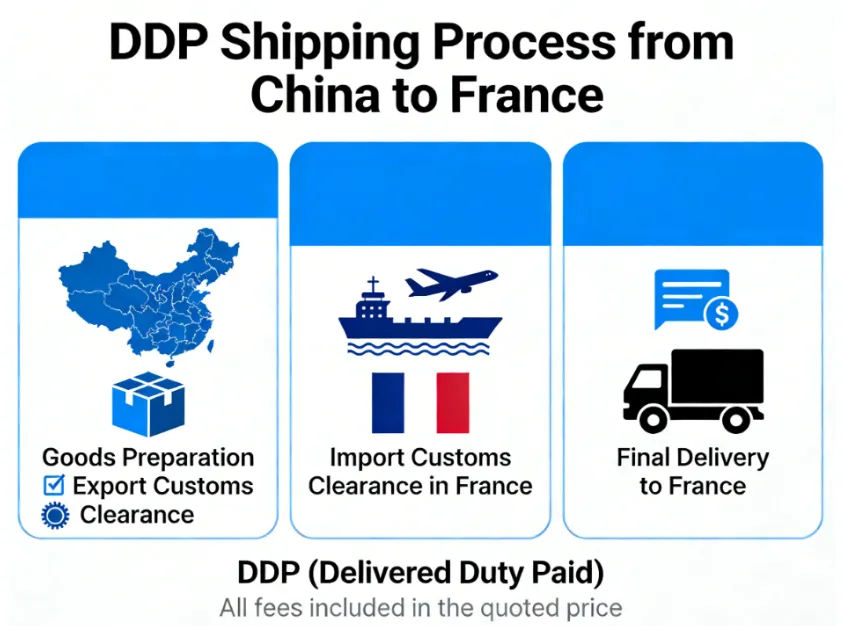
DDP (Delivered Duty Paid) is an international shipping term defined by the Incoterms rules, issued by the International Chamber of Commerce (ICC). Under DDP, the seller is responsible for delivering the goods to the buyer's designated destination—here, anywhere in France—with all transportation costs, customs duties, and taxes prepaid.
Key Features of DDP Shipping:
- Seller’s Responsibility: The seller manages the entire shipping process, including export clearance in China, transportation, import clearance in France, payment of customs duties, VAT, and final delivery.
- Buyer’s Convenience: The buyer only needs to receive the goods. All logistics, documentation, and regulatory hurdles are handled by the seller or their appointed freight forwarder.
- All-inclusive Pricing: The quoted price includes freight, customs clearance, duties, taxes, and delivery to the buyer’s door.
- Risk Transfer: Risk transfers to the buyer only when the goods are delivered to the agreed place in France.
Why choose DDP shipping from China to France?
For new importers or businesses seeking hassle-free logistics, DDP is an ideal solution. It removes complexity from the import process and ensures compliance with French regulations.
If you're interested in DDP solutions for other European countries, check out our DDP shipping from China to Spain guide for a broader perspective on the process.
DDP in the Real World: Who Is the Importer of Record in France?
This is where many generic DDP articles stay vague. In practice, the party that lodges the import declaration in France (directly or through a customs representative) becomes the de facto importer of record for compliance purposes.
Based on our experience, the most common disputes around “DDP” are not about ocean or air freight—they come from misalignment on who carries compliance and tax responsibilities at destination, and what consignee details appear on the import paperwork.
Before you confirm a DDP deal, make sure these are clearly agreed in writing:
- Who will act as importer of record for France entry
- What consignee details will appear on the Commercial Invoice and customs entry
- Whether your product category requires pre-shipment compliance documents (for example, certain CE-related categories)
How DDP Shipping Differs from Other Incoterms (FOB, CIF, EXW)
When importing from China to France, it’s crucial to understand how DDP compares to other commonly used Incoterms:
| Incoterm | Delivery Point | Seller's Responsibility | Buyer's Responsibility | Customs Duties & Taxes |
|---|---|---|---|---|
| EXW | Seller’s premises (China) | Prepares goods for pick-up | All transport, export/import clearance, duties, delivery | Paid by buyer (France) |
| FOB | Port of loading (China) | Delivery to port and export clearance | Main transport, import clearance, duties, delivery | Paid by buyer (France) |
| CIF | Port of destination (France) | Main transport, insurance, up to French port | Import clearance, duties, final delivery | Paid by buyer (France) |
| DDP | Final destination (France) | All steps: export, freight, import clearance, delivery | Receives goods at agreed place | Paid by seller (China), included in fee |
Key Differences:
- DDP transfers maximum responsibility to the seller, while EXW and FOB place most obligations on the buyer.
- Only in DDP does the seller pay all customs duties and taxes in France.
- CIF covers freight and insurance only up to the destination port, not customs clearance or final delivery.
Advantages of Choosing DDP for China-France Logistics
DDP shipping from China to France offers several benefits for importers, including:
- Simplified Import Process:
Importers do not need to handle complex customs procedures in France. All compliance and paperwork are managed by the seller or their freight forwarder. - Cost Transparency:
DDP quotations are all-in-one, covering freight, duties, and delivery. This helps businesses budget more accurately and avoid unexpected expenses. - Reduced Risk of Delays:
Based on our experience, experienced freight forwarders like DTFU International Logistics Co.,Ltd ensure all documents and procedures meet both Chinese and French regulations, minimizing the risk of customs delays. - Better Resource Allocation:
Importers can focus on core business activities instead of logistics and compliance. - Enhanced Control & Tracking:
Professional logistics partners offer end-to-end tracking, insurance, and dedicated customer support throughout the shipping process.
In summary:
Choosing DDP for your China-to-France shipments ensures a smoother, more predictable, and often more cost-effective import experience.
For more details on the latest changes in France–China trade policies, you may find our analysis on France Floats 30% Tariff on Chinese Imports: What It Means for China–EU Trade and Global Logistics useful.
Step-by-Step DDP Shipping Process from China to France
Seller and Buyer Responsibilities in DDP Shipments
Seller’s Responsibilities:
- Packing and labeling the cargo according to international and French standards.
- Handling export customs clearance in China.
- Booking and paying for main transportation (sea, air, rail, or express).
- Arranging for cargo insurance if required.
- Completing import customs clearance and paying duties/VAT in France.
- Final local delivery to the buyer’s address in France.
Buyer’s Responsibilities:
- Provide accurate delivery details and necessary supporting documents.
- Receive the goods at the agreed location in France.
- Inspect the goods upon arrival and report discrepancies immediately.
Detailed Workflow: From Supplier to Delivery in France
Below is a typical DDP shipping workflow from China to France:
Step 1: Order & Shipment Preparation
- Buyer and seller agree on terms and confirm DDP shipping.
- Goods are produced, packed, and prepared for export.
Step 2: Export Customs Clearance (China)
- Seller or designated freight forwarder, such as DTFU International Logistics Co.,Ltd, arranges export documentation and passes customs in China.
Step 3: International Freight
- Cargo is shipped via the chosen method (e.g., sea freight, air freight, or rail).
- Transit times vary based on mode and destination (see table below).
| Shipping Method | Typical Transit Time (China to France) | Best for |
|---|---|---|
| Sea Freight (FCL) | 24-33 days | Bulk, heavy, non-urgent cargo |
| Sea Freight (LCL) | 28-38 days | Smaller shipments, cost-sensitive |
| Air Freight | 3-6 days | Urgent, high-value, lightweight |
| Rail Freight | 17-23 days | Mid-sized, moderately urgent cargo |
| Express Courier | 2-5 days | Samples, urgent small parcels |
Step 4: Import Customs Clearance (France)
- Seller (or their agent) completes all customs declarations.
- Duties, VAT, and other taxes are paid in advance.
Step 5: Final Delivery
- Goods are delivered to the buyer’s specified address in France.
- Buyer receives and inspects the cargo.
DDP Pre-Shipment Checklist (China → France)
Based on our operations team’s day-to-day execution, these checks prevent most avoidable holds and rework:
| Check Item | What to Verify | Why It Matters in France |
|---|---|---|
| HS code & product name | Same HS code and consistent product naming across invoice/packing list | Classification drives duty/VAT and inspection risk |
| Declared unit value | Reasonable unit value with consistent currency | Outliers can trigger valuation checks |
| Marking & labeling | Carton labels and key marks where required | Reduces relabeling and warehouse delays |
| Battery / DG screening | Battery type and required safety documents if applicable | Affects routing and carrier acceptance |
| CE / compliance documents | Required declarations/certificates for regulated categories | Prevents non-compliance holds and returns |
| Address data quality | Full French postcode, contact, and delivery constraints | Last-mile failures are often data-quality issues |
Required Documentation and Compliance for DDP Shipping
To ensure smooth DDP shipping from China to France, the following documents are generally required:
- Commercial Invoice
Details the transaction, value, and product description. - Packing List
Specifies the packing details, weights, and dimensions. - Bill of Lading (B/L) or Airway Bill (AWB)
Confirms shipment and transportation details. - Export/Import Customs Declaration
Mandatory for clearing cargo at both origin and destination. - Certificate of Origin
Required for certain regulated or preferential tariff goods. - Import Licenses or Permits
For specific controlled products (e.g., electronics, food, medical devices). - Insurance Certificate (if applicable)
Confirms coverage for goods in transit.
Compliance Tip:
Based on our experience, the fastest way to prevent clearance issues is to standardize your Commercial Invoice and Packing List fields before cargo departs China (HS code, unit value, Incoterm, consignee details, and consistent product descriptions). DTFU International Logistics Co.,Ltd has deep expertise in both Chinese and French customs procedures, helping clients avoid costly errors and delays.
DDP Shipping Methods: Air Freight, Sea Freight, Rail, and Express
When considering DDP shipping from China to France, selecting the right transportation method is crucial. The main options include Air Freight, Sea Freight, Rail Freight, and Express Courier. Each mode offers different transit times, cost structures, and suitability depending on the type and urgency of your cargo.
Comparing Transit Times, Costs, and Suitability for Different Cargo
Below is a comprehensive comparison table to help you evaluate the major DDP shipping methods for the China-France route:
| Shipping Method | Typical Transit Time | Cost Range (per kg/CBM) | Recommended Cargo Types | Main Ports/Routes | Pros | Cons |
|---|---|---|---|---|---|---|
| Sea Freight | 24-38 days | $45-$130/CBM (FCL/LCL) | Bulk goods, large shipments, non-urgent cargo | Shanghai, Shenzhen to Le Havre, Marseille | Most cost-effective for large volumes, high capacity (e.g., 20FT: 28CBM, 40HQ: 68CBM), stable schedules | Slow transit, FCL/LCL cut-off times, port congestion risk |
| Air Freight | 3-6 days | $3.5-$8/kg | High-value, urgent, sensitive cargo, electronics | Shanghai PVG, Guangzhou CAN to Paris CDG | Fastest transit, reliable, less handling | Higher cost, weight/size limits |
| Rail Freight | 17-23 days | $85-$170/CBM | Medium-sized, time-sensitive, not as urgent as air; electronics, auto parts | Chengdu, Xi’an to Lyon, Paris | Faster than sea, eco-friendly, stable schedules | Limited routes, customs documentation required |
| Express Courier | 2-5 days | $7-$18/kg (all-in) | Parcels, samples, e-commerce shipments (< 100kg per parcel) | DHL, FedEx, UPS door-to-door | Door-to-door, customs included, quick | Expensive for large/voluminous cargo |
Key Observations:
- Sea Freight remains the most economical for large shipments, especially for non-urgent goods.
- Air Freight and Express are best for time-sensitive or high-value shipments.
- Rail Freight is a solid compromise, balancing speed and cost, particularly amid sea and air disruptions.
- Express is ideal for small parcels, like e-commerce orders, with the convenience of full DDP services.
If you're exploring shipping to other European destinations, our Sea shipping from China to France guide provides additional insights and options.
France Delivery Reality: Entry Point vs Final Address
Two shipments can have the same “China → France transit time” and still arrive days apart at the consignee door. Based on our experience, the last-mile leg and appointment scheduling matter most for:
- B2B deliveries with restricted receiving hours
- Downtown Paris deliveries with access constraints
- Rural postcodes where linehaul frequency is lower
Here is a practical routing lens for planning:
| Destination Area (France) | Common Entry | Typical Last-Mile Pattern | When It’s a Good Fit |
|---|---|---|---|
| Paris / Île-de-France | Paris CDG (air) / Le Havre (sea) | Linehaul + appointment delivery | Dense delivery network and fast availability |
| Lyon / Central-East | Rail hubs (when available) / sea to Le Havre | Linehaul to Lyon + regional delivery | Good balance for palletized cargo |
| Marseille / South | Marseille-Fos (sea) | Shorter domestic leg in the south | Efficient for Southern France delivery |
| Lille / North | Sea to Le Havre / air to CDG | Northbound trunking + delivery | Strong coverage for Northern France |
Selecting the Best Shipping Solution for Your Business Needs
Choosing the optimal method depends on several factors:
-
Cargo Volume & Weight:
- Use Sea Freight for FCL (Full Container Load) or LCL (Less than Container Load) when shipping large or heavy shipments.
- Rail Freight is suitable for pallets and medium-sized cargo.
- Air Freight and Express suit lightweight, high-value, or urgent items.
-
Delivery Timeline:
- If delivery speed is critical (e.g., product launches, perishable goods), Air Freight or Express Courier are preferred.
- For more flexible timelines, Sea or Rail can help reduce costs.
-
Budget:
- Consider the total DDP cost, not just freight. Sea is cheapest per unit, but air/express may offer savings on warehousing or inventory holding costs due to faster delivery.
-
Cargo Type & Sensitivity:
- Fragile, sensitive, or regulated items might require air or express due to better handling.
-
Destination Flexibility:
- Some destinations in France (like inland cities) are better served by rail or air to minimize domestic transport time.
Expert Tip:
Based on our experience, a quick pre-check of chargeable weight/volume and the final French delivery postcode often changes the “best” option more than people expect. Consult with a reputable freight forwarder like DTFU International Logistics Co.,Ltd to conduct a cost-benefit analysis tailored to your specific goods, shipment frequency, and customer's location in France.
DDP Shipping Costs from China to France: Fees and Pricing Structure
Understanding the cost structure is vital for budgeting and ensuring profitable international trade. DDP shipping bundles all expenses, making landed cost calculation simpler, but it’s important to break down the individual components.
Based on our professional team’s quote analysis for the China–France lane in 2026 Q1, “all-in” DDP pricing remains highly dependent on cargo density, HS code, and delivery postcode in France—so the most reliable way to budget is to compare like-for-like quotes with clear inclusions.
How Chargeable Weight Works
For air and express, you don’t always pay by gross weight. Carriers typically charge the higher of actual weight vs volumetric weight. In our experience, this is the #1 reason new importers feel “DDP is expensive” when the real issue is low packaging density.
| Mode | Common Charging Basis | What It Means for You |
|---|---|---|
| Air Freight | Chargeable weight (max of actual vs volumetric) | Bulky cartons can cost more than heavy cartons |
| Express Courier | Chargeable weight + postcode-based surcharges | Postcode and carton size can change the bill quickly |
| Sea Freight (LCL) | CBM + minimum charges | Very small CBM can still be billed at a minimum |
Main Cost Components: Freight, Customs Duties, Taxes, and Other Charges
DDP (Delivered Duty Paid) Shipping includes all major costs until the goods are delivered to the buyer’s door. Typical components:
-
Freight Charges:
- Cost for transporting goods via sea, air, rail, or express.
-
Customs Duties:
- Tariffs imposed by French Customs based on Harmonized System (HS) codes and declared values.
-
VAT and Local Taxes:
- France VAT is typically 20% for most goods; reduced rates may apply for specific categories.
-
Origin and Destination Charges:
- Handling, loading/unloading, port fees, and terminal charges in China and France.
-
Documentation Fees:
- Costs for commercial invoices, bills of lading, packing lists, certificates, and any required permits.
-
Insurance (optional but recommended):
- Protects cargo against loss or damage in transit.
-
Last-Mile Delivery:
- Trucking or courier charges from the port/airport to the final address in France.
-
Additional Services:
- Warehousing, consolidation, special handling (e.g., OOG – Out of Gauge Freight).
Here is a sample breakdown for a typical FCL sea freight DDP shipment (updated for 2026 Q1):
| Cost Component | Estimated Cost (40HQ container, Shanghai to Le Havre) |
|---|---|
| Freight Charges | $3,800 – $6,200 |
| Customs Duties | Depends on HS code (average 4-8%) |
| VAT (20%) | On CIF value + duties |
| Origin Charges (China) | $350 – $600 |
| Destination Charges | $450 – $800 |
| Insurance | $90 – $180 |
| Last-Mile Delivery | $350 – $900 (to different cities) |
| Documentation | $40 – $90 |
| Total (approx.) | $5,200 – $8,800+ |
Note: Actual rates depend on cargo type, shipping method, and market fluctuations.
What a Real DDP Quote Should Include
To avoid “cheap headline, expensive landing”, compare quotes using the same inclusions. Based on our experience auditing compe***** quotes, missing items are usually destination-side.
| Quote Line Item | Must Be Stated Clearly | Typical Pitfall |
|---|---|---|
| Freight (main leg) | Mode, route, and service level | “Air” quoted but routed as slower economy service |
| Export clearance (China) | Included or not | Shipper asked to provide export docs later |
| Import clearance (France) | Declarant responsibilities | Ambiguous importer-of-record arrangement |
| Duty & VAT | Basis of calculation | “DDP” offered but duty/VAT not truly included |
| Destination handling | Terminal/handling scope | Added after arrival as “local charges” |
| Last-mile delivery | Address type and appointment | Remote area or appointment fees appear late |
For a detailed breakdown of shipping costs for specific container sizes and routes, refer to our comprehensive 20ft & 40ft Container Cost from China to France article.
How to Calculate and Optimize Your DDP Shipping Budget
Steps to Calculate DDP Shipping Costs:
- Identify Your Shipping Method: Choose between sea, air, rail, or express based on volume, urgency, and budget.
- Request a Detailed DDP Quote: Ensure all charges (freight, duties, taxes, last-mile delivery) are included—avoid vague offers.
- Classify Goods Correctly: Use the accurate HS code to determine customs duties and VAT rates.
- Calculate Total Landed Cost: Add up all charges from origin to final destination.
- Factor In Seasonal/Market Surcharges: Shipping rates fluctuate; consider peak seasons, currency rates, and fuel surcharges.
- Choose the Right Container Size: For sea, select the optimal container—20FT (28CBM), 40FT (56CBM), 40HQ (68CBM), or 45HQ (78CBM)—to maximize space utilization.
Optimization Tips:
- Consolidate Shipments: Combine LCL shipments to reach FCL for lower per-unit cost.
- Negotiate Volume Discounts: Frequent shippers can secure better rates with forwarders.
- Optimize Packaging: Increase cubic utilization to reduce unused container space.
- Leverage Freight Forwarder Expertise: A knowledgeable partner like DTFU International Logistics Co.,Ltd can recommend the most cost-effective routes, manage customs complexity, and prevent costly errors.
Cost-Saving Tips and Avoiding Hidden Charges in DDP Logistics
- Transparent Quotes: Always demand itemized DDP quotes to identify all cost components and avoid surprise fees.
- Understand Surcharges: Be wary of additional charges like demurrage, storage, or customs inspections that may not be included upfront.
- Avoid Over-Declaration or Under-Declaration: Both can trigger fines or delays at French Customs.
- Plan for Peak Seasons: Book shipments in advance during high-demand periods (pre-Christmas, Chinese New Year) to lock in rates and space.
- Choose Reputable Forwarders: Work with established companies such as DTFU International Logistics Co.,Ltd, known for professional, transparent, and one-stop logistics solutions covering Sea Freight, Air Freight, Amazon FBA, Warehouse, Cargo Insurance, Customs Clearance, and more.
- Monitor Regulatory Updates: Stay aware of policy changes, such as the EU’s Import Control System 2 (ICS2), which impacts customs data requirements for shipments into France.
- Invest in Insurance: It is more cost-effective to be protected than risk losing the entire shipment due to unforeseen events.
Customs Clearance and Taxation for DDP Shipments to France
How DDP Simplifies Customs Clearance for Importers
DDP shipping (Delivered Duty Paid) is an ideal solution for importers who want a smooth, hassle-free logistics experience from China to France. Under DDP terms, the seller or their appointed freight forwarder assumes responsibility for all shipping procedures, customs clearance, import duties, and taxes in the destination country. This means the importer receives the goods at their French address without managing customs paperwork or paying additional fees upon arrival.
Key ways DDP simplifies customs for importers:
- Single Point of Contact: The seller or the freight forwarding company handles all shipping and import formalities, acting as the primary contact with French Customs.
- All-Inclusive Pricing: The total price quoted includes freight, customs brokerage, duties, and taxes, eliminating hidden costs.
- Reduced Risk of Delays: Professional DDP providers like DTFU International Logistics Co.,Ltd are experienced in documentation and compliance, minimizing the risk of customs holds or penalties.
- Time-Saving: Importers save significant administrative time and resources, allowing them to focus on core business activities.
VAT, Duties, and French Tax Regulations Explained
When shipping from China to France under DDP terms, it is important to understand the components of import tax and duty calculation:
| Item | Description | Typical Rate (as of 2026 Q1) |
|---|---|---|
| Import Duty | Based on the product’s HS code and declared value. | 0-17% (varies by product) |
| VAT (Value Added Tax) | Applied to the total of goods value + duties + shipping costs. | Standard 20% |
| Other Taxes | Includes eco-contributions or excise taxes for specific product categories. | Varies |
| Customs Fees | Brokerage/processing fees collected by customs or appointed agents. | €15-€50+ per shipment |
Key Points about French Taxation:
- VAT Registration: For commercial shipments, the import VAT must be paid at clearance. Recovering this VAT is possible for French-registered businesses.
- HS Code Classification: Accurate classification is critical; misdeclaration can cause fines or shipment holds.
- Product Compliance: Items such as electronics, cosmetics, or food may require additional certificates or conformity assessments.
- Recent Policy Updates: France and the EU have reinforced import controls on counterfeits and certain high-risk goods; ensure up-to-date compliance.
Compliance Hotspots We See Most Often (Practical Risk Control)
Based on our experience, these scenarios account for a large share of France-bound delays:
- Inconsistent product descriptions between invoice and packing list (generic names that don’t match actual function)
- Missing compliance evidence for regulated categories
- Weak consignee/address data causing delivery failure and storage charges
To control risk, our team typically confirms key data points before pickup and re-checks the full document set before departure.
For those interested in detailed port-to-port transit and local delivery, our Shipping from Shanghai to France article provides port specifics, timelines, and real-world case studies.
Common Customs Challenges and How to Overcome Them
Despite DDP’s advantages, some challenges persist in customs clearance from China to France. Below are common issues and solutions:
| Challenge | Description | Solution/Best Practice |
|---|---|---|
| Incorrect Documentation | Errors in commercial invoice, packing list, or HS codes. | Use experienced freight forwarders like DTFU for professional documentation. |
| Under/Over Valuation | Misstating the value of goods to minimize duties or taxes. | Always declare accurate values; customs audits are strict in France. |
| Non-compliant Products | Lack of CE marking, safety certificates, or restricted items. | Pre-check product requirements, work with compliance-savvy partners. |
| Delays During Peak Season | Ports (e.g., Le Havre, Marseille) get congested during high season. | Plan shipments early, track real-time port conditions, and communicate closely. |
| Sudden Regulatory Changes | New EU or French import rules without notice. | Subscribe to regulatory updates and work with up-to-date logistics providers. |
Leveraging a reliable partner like DTFU International Logistics Co.,Ltd can help you avoid these pitfalls and ensure your DDP shipments to France arrive smoothly and on schedule.
Choosing a Reliable DDP Freight Forwarder from China to France
Key Criteria for Selecting the Best DDP Shipping Partner
Selecting the right DDP freight forwarder is critical for a seamless supply chain. Here are the main criteria to consider:
- Experience & Track Record: Look for providers with proven expertise in China-France DDP shipping and established local networks.
- Comprehensive Service Portfolio: Providers like DTFU International Logistics Co.,Ltd offer sea freight, air freight, rail freight, express, Amazon FBA, warehousing, and door-to-door services.
- Transparent Pricing: Clear, all-inclusive quotes prevent unexpected costs.
- Compliance Knowledge: Up-to-date expertise in French customs, EU regulations, and product compliance.
- Customer Support: Multilingual support, shipment tracking, and proactive communication.
- Insurance Options: Ability to provide cargo insurance and risk management solutions.
| Provider’s Capability | Why it Matters |
|---|---|
| Local Presence in France | Helps with last-mile delivery and quick problem resolution. |
| Customs Brokerage Expertise | Reduces clearance delays and compliance risks. |
| Flexible Shipping Solutions | Adapts to your cargo type, deadlines, and budget. |
How to Spot “DDP in Name Only”
In our experience, a provider’s DDP offer is often incomplete if they can’t answer these clearly:
- What is included at destination (handling, clearance, duties/VAT, and final-mile delivery)?
- What happens if customs requests additional information or an inspection?
- Who carries the risk of storage or demurrage if paperwork is wrong?
Red Flags: How to Avoid Scams and Unreliable Providers
Unfortunately, the freight forwarding industry can attract unreliable intermediaries. Watch for these warning signs:
- Unusually Low Prices: In our experience, if a quote looks "too good to be true," it may exclude critical costs (duties, VAT, local delivery).
- Lack of Credentials: Verify business licenses, international logistics certifications, and client testimonials.
- No Physical Address or Local Presence: Reliable forwarders like DTFU International Logistics Co.,Ltd have both China and France contact points.
- Poor Communication: Delayed responses or vague answers to compliance questions.
- Refusal to Share Documentation: Legitimate providers share all documents, including B/L (Bill of Lading), invoices, and customs forms.
- Negative Online Reviews: Research independent forums and platforms for user experiences.
Partnering with a reputable provider such as DTFU International Logistics Co.,Ltd ensures cost-effective, secure, and compliant DDP shipping from China to France.
FAQs
Q1: What is the main benefit of choosing DDP shipping from China to France?
A1: DDP shipping relieves importers of customs clearance, duties, and tax payments, providing a "door-to-door" solution. You receive the goods at your French address with all local fees and paperwork handled by the seller or their agent.
Q2: Which French ports are most commonly used for China-France DDP shipments?
A2: Le Havre and Marseille are the busiest entry points for sea freight, while Paris Charles de Gaulle airport is preferred for air shipments.
Q3: How long does DDP shipping from China to France usually take?
A3: Typical transit times (based on our operations team’s lane averages in 2026 Q1):
| Shipping Method | Estimated Transit Time |
|---|---|
| Sea Freight | 24-38 days |
| Rail Freight | 17-23 days |
| Air Freight | 3-6 days |
| Express | 2-5 days |
Q4: What types of goods can be shipped via DDP?
A4: Most commercial goods, including electronics, textiles, machinery, and e-commerce parcels, can be shipped. However, items subject to French or EU restrictions (e.g., batteries, chemicals, pharmaceuticals) require special handling.
Q5: Can I track my DDP shipment from China to France?
A5: Yes, reliable freight forwarders like DTFU International Logistics Co.,Ltd provide real-time tracking and regular updates throughout the shipping process.
Q6: Who pays for customs duties and VAT in DDP shipments?
A6: The seller or their appointed freight forwarder covers all import duties, VAT, and clearance fees. The buyer receives the goods with no extra charges on delivery.
Q7: How can I minimize shipping costs for DDP shipments from China to France?
A7: Based on our experience, the biggest cost levers are correct HS classification, realistic packaging optimization (chargeable weight/volume), and consolidation planning. Work with experienced providers like DTFU, consolidate shipments where possible, and ensure all paperwork is accurate to avoid fines or delays.
Q8: Should I use DDP or DAP for shipping to France?
A8: DDP is best when you want maximum simplicity and predictable landed cost at the consignee door. DAP (Delivered at Place) can be better if you prefer to handle import VAT/duties yourself (for example, when you have your own customs setup). Based on our experience, the right choice depends on your tax position, internal compliance capability, and how often you ship.
Q9: What information do you need to quote DDP accurately?
A9: For an accurate quote, our team typically needs product description, HS code (or photos/specs to help confirm), carton count, weight/CBM, pickup city in China, delivery postcode in France, and whether any special handling applies (battery, fragile, branded goods, etc.).
For more region-specific inquiries or to compare timeframes, you might also be interested in our overview of Shipping time from China to France and similar logistics solutions.
If you have further questions about DDP shipping from China to France, feel free to contact DTFU International Logistics Co.,Ltd for a free consultation and customized logistics solutions.